Article Contents:
- Trim system: philosophy of a comprehensive approach
- Ceiling cornices: the crown of vertical composition
- Functions of ceiling cornice
- Types of ceiling cornice profiles
- Sizes and proportions
- Wall moldings: horizontal and vertical structure
- Horizontal moldings
- Vertical moldings and frames
- Wall molding profiles
- Baseboards: the foundation of composition
- Architectural role of baseboards
- Sizes and proportions of baseboards
- Baseboard profiles
- Additional elements of the trim system
- Corner elements and outlets
- Consoles and Brackets
- Casing and trimmings
- Materials: unity of wood species
- Oak: Nobility and Eternity
- Beech: Uniformity and Strength
- Ash: Contrasting Beauty
- Spruce: economical base
- Color strategies for comprehensive finishing
- Monochromatic scheme
- Natural Wood
- Contrasting scheme
- Tonal gradation
- Installation of comprehensive system
- Sequence of work
- Element joints
- Finishing
- Style Solutions
- Classicism
- Baroque
- Neoclassicism
- Modern style
- Create comprehensive finishing with STAVROS

High-end interior is not a sum of scattered elements, but a thought-out system where each detail is connected by invisible threads of stylistic and functional unity.Cornices for walls and ceilingsdo not exist independently — they work in conjunction with wall moldings, baseboards, door casings, ceiling outlets, creating a cohesive architectural composition.Moldings and cornicestransform an ordinary room into a space with character, history, individuality, where horizontal and vertical lines create rhythm, and the play of light on profiled surfaces adds depth and volume.
Finishing trim systemThis is a comprehensive approach in which all linear decorative elements are selected not randomly, but according to a single logic: profile consistency, proportional sizing, material unity, color harmony. WhenCeiling cornicecorresponds in shape tobaseboard, whenwall moldingswhen motifs of cornices are repeated, when all elements are made from the same type of wood and have identical finish, the feeling of completeness and professionalism emerges — the hallmark of true design versus amateurism.


Trim System: Philosophy of the Comprehensive Approach
The traditional approach to renovation is fragmented — walls are first leveled and painted, then the ceiling is installed, followed by baseboards, and cornices are purchased last-minute, often from whatever is available. The result is predictable — mismatched materials, inconsistent profiles, visual chaos. A pine baseboard clashes with oak casings. A plastic ceiling cornice clashes with wooden wall finishes. Wide wall moldings overpower delicate baseboards.
A professional comprehensive approach is the opposite. It begins with designing an integratedtrim systemwhere all elements are defined at once — from ceiling cornices to baseboards. The primary material is selected — for example, oak. The profile character is determined — classical multi-element or modern minimalist. Proportional relationships are established — height of baseboard to cornice projection, width of wall molding relative to both. A unified finish is chosen — natural oil, staining, or coloring to a specific shade.
Only after this design phase does procurement and installation begin. All elements are purchased from a single manufacturer, from the same batch of wood, with identical processing. This guarantees perfect color, texture, and surface quality match.Wooden cornices and moldingsTrim elements from STAVROS are manufactured precisely according to this principle — as a system of interconnected elements, not a random assortment of boards.




Ceiling Cornices: The Crown of Vertical Composition
Ceiling corniceis not merely a decorative strip under the ceiling, but a crucial architectural element that completes the vertical composition of the wall, creates a transition to the ceiling, and visually defines the room’s height. In classical architecture, the cornice is the crowning part of an order, its crown — the most visible and expressive detail.
Our factory also produces:


Functions of a ceiling valance
Visual function — the cornice creates a horizontal line that visually separates the wall and ceiling, making their boundary soft and decorative rather than sharp. It also affects the perception of room height — a heavy cornice visually lowers the ceiling, while a slender, elegant one raises it. Architectural function —wooden cornice for the ceilingcompletes the vertical division system of the wall, marking the final point in the composition. Psychological function — the cornice creates a sense of protection and spatial completeness, like a roof over one’s head, even on a room scale.
Practical function — behind the cornice, one can hide LED strip lighting for ceiling contour illumination, conceal the junction between wall and suspended ceiling, mask irregularities at the top of the wall. Acoustic function — the profiled surface of the cornice disperses sound waves, reducing reverberation in the room.
Get Consultation
Types of Ceiling Cornice Profiles
Classic multi-element profile includes 5-7 elements — tori (toruses), cavetto, gussets (sims), scotia, plinths. These elements are arranged sequentially, creating a complex interplay of convexities and concavities, light and shadow. Suchsolid wood corniceis characteristic of classicism, baroque, and empire — styles valuing architectural detailing.
Simplified classical profile contains 3-4 elements, preserving classical logic but making it less excessive. This is a compromise between classical tradition and modern restraint, suitable for neoclassical interiors. Modern minimalist profile — simple geometric shape, rectangle with rounded edges or trapezoid. Minimal details, maximum line clarity. Suitable for contemporary, Scandinavian, minimalist styles.
Dimensions and Proportions
Cornice projection — distance from the wall to its edge — determines the visual mass of the element. Standard projection 50-70 mm suits most rooms with ceilings 2.7-3 meters high. Increased projection 80-120 mm — for high ceilings from 3.5 meters and spacious rooms. Reduced projection 30-50 mm — for small rooms and minimalist styles.
Cornice height (vertical dimension) is usually less than projection and measures 40-80 mm. The cornice must be a horizontally oriented element — its projection exceeds its height. This creates a sense of stability, reliability, and proper crowning of the structure.
Wall Moldings: Horizontal and Vertical Structure
wall moldingscreate architectural division of the wall’s plane, transforming it from a dull vertical surface into a composition with structure, rhythm, and hierarchy.
Horizontal Moldings
Handrail (dado) — horizontal molding at 90-120 cm height, marking the upper boundary of the panel zone. Historically, it served as a hand support while walking along the wall, hence its name. Today, it serves a decorative function, dividing the wall into a lower panel section and an upper free section.Wooden handrailOften has a rounded top for convenient hand support.
A frieze molding is a horizontal strip located 20-30 cm from the ceiling, marking the frieze zone. It can be a simple rectangular profile or more complex. It creates additional horizontal division in the upper part of the wall, especially relevant in high rooms. Intermediate horizontals — additional moldings that create a more complex division of the wall into tiers. Used in grand interiors with very high ceilings.
Vertical moldings and frames
Vertical pilasters — narrow vertical moldings imitating flat columns. They divide walls into sections and create a vertical rhythm. Particularly effective in spacious rooms with proper proportions. Framed moldings —Wooden paneling, forming rectangular or square frames on the wall — a classic buaizer technique. Inside the frames, contrasting paint, wallpaper, or fabric can be used, creating the effect of a picture gallery.
Wall molding profiles
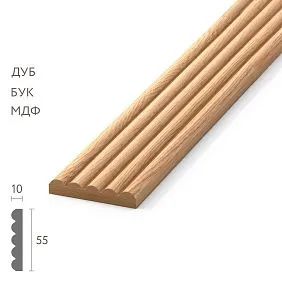
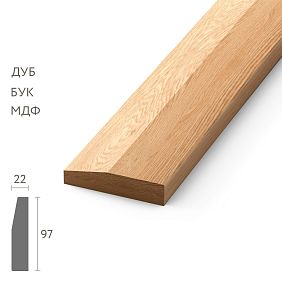
Wall moldings usually have a symmetrical profile, designed for viewing from different angles. Width 30-80 mm, thickness 10-25 mm. The profile can be simple — a rectangle with a bevel — or complex — with multiple relief levels. It is important to coordinate the wall molding profile with the ceiling cornice profile — they should speak the same language of form.
Baseboard: the foundation of composition
wooden baseboard— it is not just a technical detail hiding the junction between floor and wall, but a full architectural element creating the base of vertical composition.
Architectural role of baseboard
In classical architecture, the baseboard corresponds to the building's plinth — a massive foundation on which the entire structure stands. The plinth is always stronger and more massive than the main walls, bearing the load. This logic is transferred into interior design —high wooden baseboard— creates a sense of solidity, reliability, and proper support for walls.
The baseboard also creates a transition between the horizontal floor and the vertical wall. Its profile — usually with an upper bevel — visually softens the sharp angle, making the transition smooth and pleasing to the eye. The protective function of the baseboard is practical — it protects the lower part of the wall from damage by furniture, vacuum cleaners, mops, and other objects.
Dimensions and proportions of baseboards
The height of the baseboard is determined by the ceiling height and overall finish scale. For ceilings 2.5-2.7 meters, the optimal height is 70-90 mm. For ceilings 3-3.2 meters — 100-120 mm. For high ceilings over 3.5 meters, you can usewide skirting boards120-150 mm and even higher.
Classic proportional rule — the height of the baseboard should be approximately half the overhang of the ceiling cornice. If the cornice overhangs 100 mm, the baseboard should be about 50-60 mm. Or the height of the baseboard equals the cornice overhang — visually, this creates balance between the top and bottom of the wall, between the crown and the base.
Baseboard profiles
Simple rectangular baseboard with slight rounding at the top edge — minimalist solution for modern interiors. Classic baseboard with complex profile made of 3-5 elements — for traditional styles. Baseboard with cable channel — practical modern solution allowing wires to be hidden.with a classic profile creates a sense of solidity, reliability.— can be combined with plastic cable channel insert, uniting the aesthetics of natural wood with functionality.
Additional elements of the molding system
Comprehensive finishing includes other elements complementing the main triad of cornice-molding-baseboard.
Corner Elements and Rosettes
decorative rose outlets— round or polygonal carved elements installed at molding frame corners, at cornice junctions, on the ceiling center for chandeliers. Rosettes break the monotony of straight lines, create accents, add ornamentation. A ceiling rosette under a chandelier visually enlarges the fixture, making it a more significant interior element.
Corner elements of cornices — pre-made internal and external corner inserts, eliminating the need for precise 45-degree trimming. Especially relevant for complex profiles where precise fitting is difficult.Wooden Corner Elements— ensure perfect cornice junctions at room corners.
Consoles and brackets
Decorative brackets— installed under the cornice, creating an illusion that the massive cornice rests on these supports. This is a classic architectural technique inherited from stone masonry. Brackets can be simple — rectangular protrusions — or complex — with carving, volutes, ornamentation. They are placed with a specific rhythm — every 80-120 cm around the room perimeter.
Consoles are also used as functional elements — small decorative items, vases, figurines can be placed on them.Wooden console— becomes both decoration and a small shelf.
Casing and trim
Door casings are an essential part of the trim system. Their profile must match the profiles of cornices and moldings. The width of the casing is usually 1.5–2 times wider than the wall molding. The wood species and color are identical to all other elements.Window frames operate on the same logic. In classical interiors, windows often receive more complex framing than doors — with a window sill, side pilasters, and an upper pediment. This emphasizes the window’s importance as a source of light.
Window frames operate according to the same logic. In classical interiors, windows are often given more elaborate framing than doors — with a windowsill, side pilasters, and an upper pediment. This emphasizes the importance of the window as a source of light.
Materials: Unity of wood species
For creating a harmonioustrim system finishIt is critical to use one wood species for all elements.
Oak: nobility and eternity
Oak cornices, moldings, baseboards create an interior of exceptional durability and beauty. Oak has a pronounced texture that creates visual interest even on simple profiles. The color range, from light honey to dark brown, allows selecting a shade to match any concept. Oak is incredibly strong, resistant to moisture and mechanical impacts.
Beech: Uniformity and Strength
Beech elements have a fine-grained, uniform structure, ideal for painted interiors.Beech moldingsAfter quality painting, they provide a perfectly smooth surface. Beech also bends well after steaming, allowing the creation of curved elements — arched casings, bay cornices.
Ash: Contrasting Beauty
Ash trim items have a bright, contrasting texture, especially effective in natural finishes. The light ash tone creates a Scandinavian aesthetic. Strength is comparable to oak at a more affordable price.
Spruce: economical base
Spruce elements are the most affordable, suitable for painted interiors with limited budgets. It is important to choose high-quality wood without knots, grade "Extra" or "A". Under quality paint, a spruce trim system looks respectable.
Color strategies for comprehensive finishing
Color unifies all elements of the trim system into a single whole.
Monochromatic scheme
All elements —Crown Molding, Moldings, Baseboards, Casings— are painted in one color, most often white. This creates a clear architectural graphic against colored or textured walls. A white trim system works with any style and wall color.
Natural wood
Preserving the natural color of the wood species under transparent oil or lacquer creates a warm, organic atmosphere. All elements made from the same wood species with identical tinting or without it. It is important to use wood from the same batch to ensure perfect color matching.
Contrasting scheme
A trim system of one color contrasts with walls of another. For example, dark elements made of wenge on light walls create a clear graphic. Or white elements on walls of saturated colors — blue, green, burgundy — create a classic elegant effect.
Tone gradation
Complex scheme with a smooth transition of tone from dark at the bottom to light at the top or vice versa. Baseboard is dark, wall moldings are medium, ceiling cornice is light. This creates a sense of depth and layering.
Installation of a comprehensive system
Installationtrim system finishRequires sequence and precision.
Work sequence
First, all elements are marked on walls and ceilings. Horizontal lines are marked for cornices and moldings, vertical lines for pilasters and frames. Everything is drawn with a pencil, checked with a level and tape measure. Then installCeiling cornicearound the perimeter of the room. The cornice is attached with adhesive and additionally secured with self-tapping screws to the wall and ceiling.
After the cornice, installwall moldingsFirst horizontal, then vertical, forming frames. Then mountedbaseboard. On the final stage, additional elements — outlets, brackets, casing — are installed.
Element Joints
A critical moment — joining elements at corners. Internal and external angles require precise 45-degree trimming. A miter saw with a rotating platform is used for accurate cuts. The cuts must be perfect — even a one-degree deviation creates a noticeable gap. After trimming, elements are fitted and, if necessary, refined with a file.
Joints are sealed with adhesive. After installation, all joints and mounting points are filled with acrylic wood putty. After drying, they are sanded with fine-grit sandpaper for a perfect smoothness.
Final finishing
The entire installed system is primed. Then painted or oiled in multiple layers with intermediate sanding. It is important to use the same material for all elements — one paint, one oil — to ensure identical tone and sheen.
Style Solutions
Cornices for walls and ceilingsAdaptable to any style.
Classicism
Multi-profile cornices, complex moldings, high baseboards. All made from noble woods — oak, walnut. Traditional colors — white, cream, natural wood. Strict symmetry, clear proportions.
Baroque
Rich carving, gilding, curved forms.Wooden MouldingsWith carved ornaments, brackets with volutes, outlets with floral motifs.
Neoclassicism
Simplified classical profiles, restrained decoration.Moldings and cornicesof minimalist forms, but retaining classical logic of division.
Modern style
Minimalist profiles, clear geometry. Flat planks instead of complex cornices. Contrasting color solutions.
Create a comprehensive finish with STAVROS
Finishing trim systemSTAVROS — a complete set of coordinated elements made from the same wood species with identical processing quality.
More than 5900 itemsof solid wood — Ceiling Molding, wall moldings, floor skirting boards, Casings, Outlets, Brackets, carved appliqués.
Our consultants will help you design a comprehensive system with correct proportions. We will calculate the amount of materials. We will provide samples. We will recommend installers.
For over twenty years, STAVROS has realized hundreds of projects for comprehensive finishing. Visit our showroom in Moscow or St. Petersburg. See ready-made compositions, evaluate the quality.
Your home deserves a systematic approach, wherecornices, moldings and baseboardswork as a unified ensemble. Contact STAVROS today and create a professional-level interior.