Article Contents:
- Vignette as the art of accent
- Anatomy of a vignette: form and content
- Materiality of the vignette: wood as a carrier of meaning
- Trim as context for the vignette
- Stylistic Collections: From Classic to Avant-Garde
- Classicism: symmetry of the eternal
- Empire: solemn geometry of power
- Art Nouveau: fluidity of plant forms
- Art Deco: Geometric Luxury
- Gothic: drama of verticals
- Grapevine: playfulness of natural abundance
- Russian style: folk wisdom in ornament
- Summer Garden: French sophistication
- Practical application: where and how to use vignettes
- Furniture fronts: from mass-produced to exclusive
- Walls: creating architectural composition
- Doors and openings: creating portals
- Ceilings: the fifth wall demands attention
- Selection and composition: the art of balance
- Stylistic unity
- Scaling
- Placement density
- Color coordination
- Maintenance and Durability
- Protective coating
- Cleaning
- Mechanical damage
- Frequently Asked Questions
- Conclusion: The art of details by STAVROS

Interior. We say this word easily, but behind it lies a whole universe of meanings, decisions, details. What makes a space come alive? Not square footage, not appliances, not even the color of the walls. Details. Those very little things that turn a collection of objects into a story, a mood, an atmosphere.collections of decor for interior vignettes— is the language spoken by the space. Vignettes — carved, elegant, filled with ornament — become accents that catch the eye, make you pause, examine, feel.
When you enter a room, the first impression is formed in seconds. What do you see? Smooth walls, standard furniture, typical solutions? Or does your gaze catch on an elegant carved overlay on a cabinet door, on an ornament on a cornice, on a vignette on the wall framing a mirror? These details don't shout, they whisper — but it is this whisper that creates the character of the interior, makes it unique, one-of-a-kind.
Trim — moldings, cornices, baseboards, casings — is the architectural grammar of space. And decorative vignettes are the poetry. Together they create a composition where strict geometry of lines combines with the fluidity of plant ornaments, where symmetry is balanced by asymmetrical details, where classical forms come to life thanks to the handiwork of craftsmen.


Vignette as the art of accent
What is a vignette in the context of interior decor? It is a compact decorative element — a carved overlay, an ornamental composition, a fragment of a pattern. Vignettes came from typography, where they adorned the beginning and end of text, creating visual frames. In interiors, they perform the same function: they frame, accentuate, complete the composition.




Anatomy of a vignette: form and content
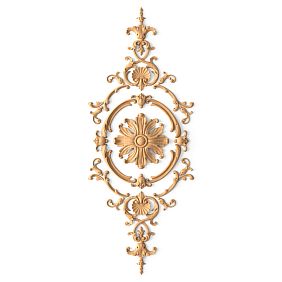
A classical vignette is symmetrical. The central element — a flower, rosette, medallion — is framed by leaves, scrolls, volutes. Symmetry creates a sense of stability, order, harmony. Such vignettes are characteristic of classical and neoclassical styles, where balance and proportion are the foundation of aesthetics.
Asymmetrical vignettes are a find for Art Nouveau, Art Nouveau, eclecticism. Here there is no rigid axis of symmetry, the composition develops freely, following the natural logic of plant forms. A winding vine, a curved stem, a scattering of leaves — all this creates dynamism, movement, liveliness.
The size of the vignette matters. Miniature elements (5-10 cm) are used as focal accents — in the corners of door panels, at molding joints, in the center of small panels. Medium-sized ones (15-25 cm) become independent decorative elements — the centerpiece of a wall composition, furniture front decoration, an accent above a doorway. Large ones (30-50 cm and more) are sculptural panels that dominate and set the tone for the entire interior.
Our factory also produces:


The materiality of the vignette: wood as a carrier of meaning
A vignette made ofwooden trim— is not just decor, it is the materialization of craftsmanship. Wood carving requires an understanding of the material, a sense of form, patience, and precision. Every leaf, every curl is carved by hand or milled from a model created by the carver. The wood lives under the tool — it resists, it guides the master's hand, it dictates its own rules.
The wood grain becomes part of the decor. On smooth beech, the carving looks crisp, graphic, every line reads like an engraving. On oak with its pronounced pores, the carving gains texture, volume, and additional depth. On ash, the light wood emphasizes the delicacy of the work, making the ornament airy, almost weightless.
The color of the wood also contributes to the image. Natural light tones are for Scandinavian and modern interiors, where naturalness is important. Dark stained shades are for classic styles, where nobility and depth are required. Painted vignettes — white, gray, pastel — are for neoclassical and Provencal styles, where delicacy and softness are important.
Get Consultation
Molding as context for the vignette
A vignette does not exist in a vacuum. It interacts with surrounding elements — moldings, cornices, baseboards, casings.Wood Trimcreates a frame, a context in which the vignette unfolds.
Imagine: a wall divided by moldings into rectangular panels. In the center of each panel — a carved vignette. The molding creates the border, the vignette — the content. Together they form classic boiserie — a paneling system characteristic of palace interiors of the 17th-18th centuries. But this system also works in a modern context, if the proportions are chosen correctly and the ornamentation is simplified.
Or another option: a horizontal molding divides the wall into two parts. The upper part is painted a light shade, the lower part — a darker one. At the joint, right on the molding, small vignettes are placed at intervals of 60-80 cm. They turn a utilitarian element into a decorative detail, add rhythm, and create an ornamental frieze.
The cornice under the ceiling can also be complemented with vignettes. They are placed in the corners where two walls meet, masking the joint while simultaneously accentuating it. Or in the center of a long wall, creating a visual focal point on the vertical plane. A carved cornice with integrated vignettes turns the transition from wall to ceiling into an architectural element worthy of attention.
Style Collections: from Classic to Avant-Garde
Shop of very rare interior decoroffers collections, each carrying its own philosophy, its own style, its own language of forms. Choosing a collection is choosing the mood, the era, the cultural code of your space.
Classic: the symmetry of the eternal
The classic collection is an ode to harmony. The vignettes here are strictly symmetrical, the ornament is ordered, the forms are recognizable. Acanthus leaves, palmettes, rosettes, meanders — all borrowed from antiquity, reinterpreted by the Renaissance, and perfected by classicism.
The central motif of a classic vignette is the rosette. Round or oval, it consists of petals radiating from the center. Around it — a frame of leaves, often acanthus — a stylized plant that the ancient Greeks considered a symbol of vital force. The symmetry is absolute — the right and left halves of the vignette mirror each other.
Classic vignettes pair excellently with profiled molding. Moldings with complex profiles — coves, chamfers, beads — create a relief frame, in the center of which the vignette looks like a jewel in a setting. Cornices with consoles, baseboards with plinths, casings with portals — all are elements of a unified system where each element complements the others.
The color palette of classicism is restrained. Natural wood with a transparent finish, white enamel, gilding on protruding elements. Contrasts are soft — light wood on a slightly darker background, white decor on a cream wall. This creates sophistication without ostentatious luxury.
Empire: the solemn geometry of power
Empire is the style of emperors. It emerged under Napoleon as the embodiment of imperial grandeur. Vignettes in the Empire style are more geometric, stricter, more monumental than in classicism. Here appear symbols of power: laurel wreaths, eagles, military trophies, lyres, torches.
A characteristic feature of Empire vignettes is the use of antique motifs in a solemn, almost military interpretation. The palmette becomes more angular, acanthus leaves — more graphic. Rosettes are often replaced by stars or solar signs. Geometric elements are added — meanders, cross lines, diamond-shaped grids.
Empire vignettes are large, dominant. They are not modest, they announce themselves. They are placed in central, focal points — above the main entrance, above the fireplace, in the center of the ceiling. Empire molding is massive — wide cornices with large relief, thick moldings with a pronounced profile, pilasters with fluting and luxurious capitals.
The color of Empire is saturated. Dark mahogany, black lacquer, gilding. Contrasts are strong — gold on green, white on burgundy. This is not a style for the timid — it requires space, high ceilings, confidence in the choice.
Art Nouveau: the fluidity of plant forms
Art Nouveau, or Art Nouveau, is a reaction to the geometric strictness of classicism. At the end of the 19th century, artists grew tired of straight lines and turned to nature. Art Nouveau vignettes are waves, curves, flowing lines that follow the natural growth of plants.
Characteristic motifs: irises, lilies, bindweeds, poppy pods, stems twisting as if alive. Symmetry here is not absolute — it is only implied, but the actual composition is free, dynamic. A vignette can start in one corner and develop diagonally, occupying the entire space.
The line in Art Nouveau is the main expressive tool. It is not an outline defining a form, it is the form itself, living its own life. The line thickens and thins, meanders, loops, creates lace from voids and fills. Carving in Art Nouveau is more complex than in classicism — it is multi-level, with strong depth variations, with fine details requiring virtuoso skill.
Art Nouveau molding is specific. Moldings are often asymmetrical, with a wavy edge. Cornices are decorated with plant motifs integrated into the profile. Casings can have an arched top with carved plant fill.buy round moldingfor Art Nouveau staircases means choosing handrails with smooth curves, possibly with carved inserts repeating the plant theme of the vignettes.
The color of Art Nouveau is natural, but often unusual. Greenish wood tones achieved by staining. Purple, lilac accents. Bronze, patinated copper for metal inserts. This is a style for people with unconventional taste, who value artistry and individuality.
Art Deco: geometric luxury
Art Deco of the 1920s-30s is a modernization of classicism through the lens of industrial aesthetics. Vignettes here are geometricized but have not lost their decorative quality. Zigzags, chevrons, stepped forms, trapezoids—all create a dynamic, energetic ornament.
Characteristic motifs of Art Deco: stylized sun rays (sunburst), fountains, skyscrapers, dynamic lines symbolizing speed and progress. Floral elements are present but geometricized—leaves turn into triangles, flowers into polygons, stems into straight or stepped lines.
Art Deco vignettes often incorporate contrasting materials. Wood is combined with metal—brass, chrome. Inlay, marquetry (a technique using different wood veneers) create multicolored compositions. This is an expensive style requiring quality materials and impeccable execution.
Art Deco trim features clear profiles, often stepped, reminiscent of skyscraper architecture. Moldings with right angles, cornices with geometric ornamentation, baseboards with metal inserts.Wooden balusters made to order in the Art Deco style have a faceted form, possibly with metal rings or inlay.
Art Deco color is contrasting and saturated. Black with gold, white with chrome, dark wood with light inlay. This is a style for striking, confident interiors that are not afraid to attract attention.
Gothic: the drama of verticals
The Gothic collection is for lovers of mystique, history, dramatic interiors. Gothic vignettes are recognizable: pointed arches, trefoils, quatrefoils, roses (cathedral rose windows), gables (pointed pinnacles).
Gothic ornamentation is complex, detailed, multi-layered. Carving is deep, with strong relief contrasts creating dramatic shadows. Motifs are floral but stylized—oak, grapevine, ivy, intertwined in intricate compositions where it is difficult to separate one element from another.
Gothic vignettes are often vertical, elongated upward, following the overall logic of the style where everything strives towards the sky. They work excellently on tall, narrow panels, on door panels, on vertical furniture elements.
Gothic trim includes architraves with pointed finishes, moldings with Gothic profiles (cavetto + sharp projection), cornices with dentils (crockets—a Gothic decorative element).flat wooden balusters to buy for a Gothic interior means choosing carved panels with Gothic ornamentation, which are installed instead of traditional balusters.
Gothic color is dark, saturated. Ebony, dark oak, mahogany. Sometimes—bright colored accents reminiscent of stained glass: red, blue, green. This is a style for spacious rooms with high ceilings, where it can fully unfold.
Grape: the playfulness of natural abundance
The 'Grape' collection is a celebration of abundance. Grape clusters, leaves, vine tendrils—an ancient decorative motif symbolizing fertility, joy, earthly pleasures. Such vignettes are ideal for dining rooms, kitchens, wine cellars, restaurants.
Grape carving is realistic. Each berry is worked separately, creating a voluminous cluster. Leaves with veins, tendrils curling into spirals—all this requires the jeweler-like precision of the carver. Such vignettes are often large, occupying a significant area, because the grapevine is a sprawling, generous plant.
Trim that pairs with grape vignettes can be classic—simple profiled moldings and cornices that do not compete with the rich ornamentation of the vignettes. Or thematic—moldings with grape motifs integrated into the profile, creating a cohesive composition.
Color is natural. Light wood, possibly with slight tinting in greenish or golden hues. Sometimes grape clusters are tinted purple or green for greater realism, and leaves in muted green. This creates a picturesque effect, especially striking in country, Provence, or Mediterranean-style interiors.
Russian style: folk wisdom in ornamentation
The Russian collection is our cultural heritage. Vignettes here are filled with motifs from folk art: floral scrolls, Sirin birds, geometric solar signs, carving in the 'ship' technique (blind relief carving).
A characteristic feature of Russian ornamentation is rhythm, the repetition of elements creating a border pattern. Vignettes can be corner—for framing panels, or central—large compositions with complex subjects.
Russian carving is often flatter, more graphic than Western European. This is related to technological features—contour and low-relief carving predominate, where form is created not so much by volume as by clear contour and internal detailing.
Russian style trim includes carved architraves, cornices with valances (carved overhangs), friezes with folk ornamentation. Color is bright, open—red, blue, gold, green. Or natural wood with painting in the Khokhloma, Gzhel, or Mezen painting techniques. This is a style for people proud of their national roots, valuing a connection with tradition.
Summer Garden: French refinement
The 'Summer Garden' collection is inspired by French Baroque and Rococo, particularly the famous Summer Garden in St. Petersburg, created under the influence of Versailles. Vignettes here are airy, elegant, filled with movement.
Characteristic motifs: rocaille (shells and Rococo scrolls), floral garlands, cupids, birds, ribbons. The asymmetry of Rococo is softened here, compositions are more balanced but retain lightness and playfulness.
Carving is high, with thin elements that seem almost lace-like. Leaves with openwork detailing, flowers with individual petals, each curving in its own way. This is virtuoso work requiring many hours of manual labor.
The 'Summer Garden' trim is refined. Moldings are narrow, with a delicate profile. Cornices are low but with rich, fine ornamentation. Baseboards are elegant, possibly with gilding. Everything is aimed at creating an atmosphere of aristocratic refinement, lightness, almost airiness.
Color is pastel—white, cream, pale pink, blue, mint. Gilding is present but does not dominate, merely highlighting protruding details. This is a style for romantic, refined interiors, bedrooms, boudoirs, living rooms in classic French taste.
Practical application: where and how to use vignettes
Theory is beautiful, but practice is where ideas meet reality. Where are carved vignettes appropriate in a modern interior? How to integrate them so they don't look like an anachronism or a museum exhibit?
Furniture facades: from mass-produced to exclusive
The most obvious application of vignettes is furniture decoration. A standard cabinet, chest of drawers, or sideboard with smooth facades turns into an exclusive piece simply by adding carved overlays.
Cabinet doors are adorned with central vignettes or corner elements. A central vignette becomes the focal point of the door, especially effective on tall, narrow wardrobe doors. Corner vignettes (four per door) create a framed composition, visually structuring the plane.
Chest of drawers drawers are another fertile ground. A small vignette in the center of a drawer front, around the handle, transforms a utilitarian element into a decorative one. If a chest has three or four drawers, using identical vignettes creates rhythm, while using vignettes of different sizes (increasing from top to bottom) creates a pyramidal composition.
Tabletops and lids are horizontal surfaces that can also be adorned. Carved vignettes, inlaid into the corners of a writing desk's tabletop, turn it into an artifact. The lid of a chest, wooden box, or casket with a carved vignette becomes a piece of applied art.
Walls: creating an architectural composition
A wall is a canvas. An empty wall is a missed opportunity. Carved vignettes allow you to transform a flat surface into a three-dimensional architectural composition.
Panel systems (boiserie) are a classic technique. A wall is divided by moldings into rectangular panels. In the center of each is a carved vignette. This creates rhythm, structures the space, and adds depth. Panels can be the same size or different—larger in the center of the wall, smaller at the edges.
Friezes are horizontal decorative strips under the ceiling or at panel level. Vignettes are placed at equal intervals, creating an ornamental border. This is a less costly option than a full panel system, but no less effective.
Accent zones—above the fireplace, behind the headboard, around the TV, in the center of the wall opposite the entrance. Here, a large, expressive vignette is placed, possibly combined with a molding frame. This creates a focal point that sets the mood for the entire room.
Framing functional elements—mirrors, paintings, clocks, panels. Vignettes placed at the corners of a frame or above and below a mirror turn a utilitarian object into a decorative centerpiece. This is especially effective in hallways, where a mirror is a mandatory element.
Doors and openings: creating portals
A door is a transition between spaces. A decorated door is a portal, a ceremonial entrance that gives significance to the transition.
Paneled doors are ideal for applying vignettes. Each panel gets its own vignette—in the center or at the corners. This turns a standard door into an individual, exclusive one.
Door architraves can be complemented with vignettes in the upper corners—where the vertical part of the architrave meets the horizontal. This masks the joint, turning it into a decorative element.
Above the door opening, on the pediment (if the architrave has a triangular or arched finish), a central vignette is placed. This is a classic technique, originating from ancient architecture, where temple pediments were adorned with sculptural compositions.
The door panels themselves, if they are smooth, can be adorned with overlay vignettes. This is a less traditional solution, but it works in eclectic interiors where different styles and eras are mixed.
Ceilings: the fifth wall requires attention
The ceiling is often forgotten when planning decor. And in vain—it's a significant part of the visual field, especially in rooms with high ceilings.
Ceiling rosettes are a traditional place for vignettes. The center of the ceiling, the point where the chandelier is attached, is adorned with a round or oval carved rosette. This is not only decor but also a functional element—it masks the electrical fittings and creates a finished composition.
Corner vignettes on the ceiling are placed where walls and ceiling cornices meet. They mask joints, add volume, and create a sense of architectural refinement.
Coffered ceilings are a system of beams and moldings that divide the ceiling into squares or rectangles (coffers). In the center of each coffer, a small vignette can be placed. This is a luxurious solution, requiring high ceilings (at least 3 meters), but it makes an impression.
Selection and composition: the art of balance
How to choose vignettes for a specific interior? How to compose them with moldings to create a harmonious composition, not a chaotic clutter of decor?
Stylistic unity
First rule: vignettes must match the overall style of the interior. Gothic vignettes in Scandinavian minimalism are a stylistic dissonance. Modernist ones in a classic interior are a misunderstanding. Choose a collection that resonates with the architectural features and furniture of the room.
If the style is not clearly defined, if it's eclectic, use neutral classic vignettes. Symmetrical floral compositions, rosettes, palmettes—they are universal enough to work in different contexts.
Scaling
The size of vignettes should correspond to the scale of the room and the elements being decorated. A large vignette in a small room is overwhelming. A small one in a large hall gets lost.
For standard living spaces (ceiling height 2.5-2.7 m), medium-sized vignettes—15-25 cm—are optimal. For high ceilings (3 m and above), large ones—30-50 cm—can be used. For small elements (cabinet doors, drawers)—miniature ones—5-15 cm.
Placement density
More doesn't mean better. An excess of decor turns an interior into a carving museum, where the eye has nothing to latch onto because everything is equally decorative. Pauses, empty spaces are needed to allow the decor to 'breathe'.
Optimally: accent zones are richly decorated, background ones are restrained. For example, the central wall of the living room gets a panel system with vignettes, the other three walls get only a cornice and baseboard without additional decor. This creates hierarchy and highlights the main elements.
Color coordination
Vignettes should be color-coordinated with the moldings and furniture. Options:
Monochromatic solution - all wood is the same shade or everything is painted one color. Creates integrity, calmness, suitable for minimalist interiors.
Contrast solution - vignettes are darker or lighter than the background. Creates graphic quality, emphasizes form, works in modern and neoclassical interiors.
Accent solution - vignettes are highlighted with color (e.g., gilded, painted in a contrasting shade). Creates drama, attracts attention, characteristic of luxurious styles - Baroque, Rococo, Empire.
Care and longevity
Carved wooden vignettes are durable decor, but they require proper handling rules.
Protective Coating
Wood must be protected. Varnish, oil, wax - the choice depends on style and operating conditions. For rooms with normal humidity, oil or wax is sufficient. For kitchens, bathrooms where humidity and risk of soiling are higher - varnish that creates an impermeable film.
The coating needs renewal. Oil and wax - every one to two years. Varnish lasts longer - 5-7 years, then requires renewal. This is simple: the surface is lightly sanded with fine sandpaper, dust is removed, a fresh coat of finish is applied.
Cleaning
Carved elements with their complex relief collect dust. Regular cleaning is mandatory. A soft brush or makeup brush works perfectly, reaching into all recesses. A vacuum with a soft attachment is another option.
Wet cleaning - carefully. A well-wrung soft cloth, no aggressive cleaning agents. Wood dislikes excess moisture - it can swell, the finish can become cloudy.
Mechanical damage
Carving is fragile. Thin elements - leaves, petals - can break off upon impact. Be careful when moving furniture, cleaning. If damage occurs, the broken piece can be glued with wood glue - with careful work, the joint will be unnoticeable.
Frequently asked questions
Are carved vignettes suitable for modern interiors?
Yes, but you need to choose the right ones. Classic lush vignettes are inappropriate in minimalism. However, geometric (Art Deco), abstract, or extremely laconic floral motifs work excellently. The key is in scale and restraint.
How much do carved vignettes cost?
The range is wide: from 500 rubles for a simple small overlay to 50,000 for a large exclusive hand-carved panel. The average price for a quality medium-sized vignette (15-20 cm) made of oak or beech is 2000-5000 rubles.
Can you order a vignette based on an individual sketch?
Yes, many workshops, includingInterior decor salon, offer custom production. You bring a sketch or description, the master creates a model, agrees it with you, then carves it. The cost of custom work is higher than serial production, but the result is absolutely unique.
How are carved vignettes attached?
Depends on weight and installation location. Light ones - with wood glue or liquid nails. Heavy ones - additionally with screws, which are countersunk and concealed with filler. On furniture fronts - often with glue to avoid damaging the panel with screws.
Should vignettes be painted or left as natural wood?
Decide based on style. Natural wood is universal, emphasizes the material, suitable for classic, country, Scandinavian style. Painted - for interiors requiring a specific color: white for neoclassical and Provence, black for loft and Art Deco, colored for eclectic.
Are vignettes only made of wood or are there other materials?
They are made of plaster, polyurethane, polystyrene. They are cheaper, lighter, moisture-resistant. But wood is about status, tactile appeal, durability, restorability. The choice depends on budget and priorities.
Which wood species is best for carved vignettes?
Oak - maximum strength and durability, expressive grain. Beech - uniform structure, ideal for painting. Linden - soft, easy to carve, allows creating finest details, but less durable. For exclusive work - exotic species with unique color and grain.
Can vignettes be used outdoors, for facade decor?
Yes, but with caveats. Wood on a facade requires protection from moisture and UV radiation. Species resistant to the external environment are needed (larch, oak), special coatings (yacht varnish, exterior oils), regular maintenance. An alternative is polyurethane vignettes, they are moisture-resistant and don't fade.
How often do carved elements need maintenance?
Dust cleaning — once a month. Oil coating renewal — every 1-2 years. Varnish renewal — every 5-7 years. Inspection for damage — annually. With proper care, carved vignettes last for decades without losing their appearance.
In which rooms are carved vignettes appropriate?
In practically all of them. Living room — a classic place for rich decor. Bedroom — to create coziness and romance. Study — for solidity and status. Dining room — especially grape motifs. Hallway — to create a first impression. Even bathroom and kitchen — if the wood is protected with a moisture-resistant coating.
Conclusion: The Art of Details by STAVROS
An interior without details is like text without punctuation. Technically understandable, but faceless, monotonous, quickly tiresome. Details are what turn a space into a place with character, history, soul.collections of decor for interior vignettes— is a library of visual meanings from which you compose your unique spatial text.
A vignette is not just an ornament. It is a point of concentration of craftsmanship, attention, time. The carver creating it invests not only skill but also a piece of themselves. Every curl, every leaf — the result of many chisel movements, many decisions: how deep to cut, at what angle, where to leave a sharp edge, where to round the transition. It is meditative, almost sacred work, which in our age of industrial production is becoming increasingly rare and valuable.
When you choose a carved vignette for your interior, you are not just choosing decor. You are choosing a connection to a craftsmanship tradition that spans millennia. You are choosing uniqueness in a world of replication. You are choosing a material that will live and age with the home, acquiring a patina of time, becoming part of the family history.
The company STAVROS has been working in the field of architectural decor and carved wood products for over two decades. The history began in 2002 when two artist-carvers, Andrey Ragozin and Evgeny Tsapko, founded a workshop. The first major project — the reconstruction of the interiors of the Konstantinovsky Palace in Strelna — set the level of requirements for themselves: only museum quality, only absolute accuracy in recreating historical samples.
Over the years, STAVROS has participated in the restoration and creation of interiors for the Hermitage, Alexander Palace, Trinity-Izmailovsky Cathedral, Sheremetev Mansion — objects of world cultural heritage. This experience became the foundation: having learned to work with palace interiors, the company easily adapts this mastery for residential spaces, creating products worthy of the best examples.
Today, the STAVROS catalog includes thousands of decorative elements. Style collections — from classic to avant-garde. Vignettes of all sizes — from miniature five-centimeter to monumental meter-long panels. Wood species — oak, beech, ash, linden, walnut, exotic species. Finishing options — natural wood with oil or wax, painted, patinated, gilded.
STAVROS production combines traditional craft techniques and modern technologies. CNC machines ensure the accuracy of the base form, but the final processing is always manual. Carvers refine details, sanders bring the surface to perfect smoothness or, conversely, create texture, wood artists apply patina to emphasize the relief.
Custom orders are an important part of STAVROS's work. If the catalog does not have the needed vignette, the masters will create it according to your sketch or photograph. If a specific size not represented in the standard line is needed — they will make it. If a rare wood species or non-standard finishing is required — they will execute it. Flexibility, while maintaining quality, is the working principle.
Consultation support is not a formality, but real help. STAVROS designers will help select vignettes for a specific interior, calculate the quantity, suggest layout options with trim. Technologists will explain installation features, recommend coatings and care methods. This is a comprehensive approach where the client receives not just a product, but a solution to their task.
STAVROS delivery geography — all of Russia and CIS. Offices and showrooms in Moscow and St. Petersburg allow seeing the products in person, touching them, assessing the quality of processing. For regions, a well-established logistics system works — cooperation with reliable transport companies, professional packaging, cargo insurance. Your order will arrive intact, regardless of distance.
STAVROS pricing policy is honest. Prices reflect real costs for quality materials and qualified labor. They do not inflate markups here, but also do not skimp on materials or masters' salaries. The result is an optimal price-quality ratio, where you pay for real value, not for a brand or marketing.
STAVROS warranty is a confirmation of confidence in their products. If a quality issue arises — they will replace or refund. If consultation on installation or care is needed months after purchase — they will answer and help. Long-term relationships, not a one-time transaction — the company's philosophy.
When you choose decor from STAVROS collections, you choose craftsmanship with history, quality tested by museums, beauty created by hands. You make your interior not just beautiful, but meaningful, filled with significance, worthy of admiration and passing on to future generations.
Wood remembers. Carving tells. STAVROS embodies. Create an interior that will speak about you.