












































































Article Contents:
- 1. History and Genealogy of Styles
- 1.1. Ancient Roots and Orders
- 1.2. Renaissance
- 1.3. Baroque
- 1.4. Rococo
- 1.5. Neoclassicism
- 1.6. Empire
- 1.7. Victorian Era
- 1.8. Neoclassicism and XX–XXI Centuries
- 2. Construction and Materials
- 2.1. Wood species
- 2.2. Panel / Solid Wood / Veneer
- 2.3. Joints
- 2.4. Hardware
- 2.5. Finishing
- 3. Decoration and Profiles
- 3.1. Carving
- 3.2. Cornices, Moldings, Columns, Candelabras
- 3.3. Inlays and Marquetry
- 3.4. Fabrics
- 4. Classification by Rooms and Types
- 4.1. Living Room
- 4.2. Dining Room
- 4.3. Bedroom
- 4.4. Study / Library
- 4.5. Small Furniture
- 5. Styles in Detail: Recognition and Examples
- Baroque: Theatricality and Grandeur
- Rococo: Elegance and Coquetry
- Neoclassicism: Harmony and Nobility
- Empire Style: Imperial Grandeur
- 6. How to distinguish authentic classicism from stylization
- Material expertise
- Assessment of Manufacturing Quality
- Documentary confirmation
- 7. Selection and purchase: step-by-step algorithm
- 7.1. Interior brief
- 7.2. Furniture selection
- 7.3. Budgeting
- 7.4. Custom order vs ready-made solutions
- 7.5. Delivery and assembly
- 8. Care, maintenance, restoration
- Climate requirements
- Regular Maintenance
- Repairing damage
- Professional Restoration
- 9. Aesthetics and integration into modern interiors
- Neoclassicism in the 21st century
- Lighting in classical interiors
- Interior case studies
- 10. Ecology and sustainability
- Material certification
- Principles of sustainable development
- 11. Prices and market
- Price segmentation
- Pricing factors
- 12. Common mistakes and myths
- Common Misconceptions
- Stylistic errors
- 13. Mini-glossary of terms
- 14. FAQ
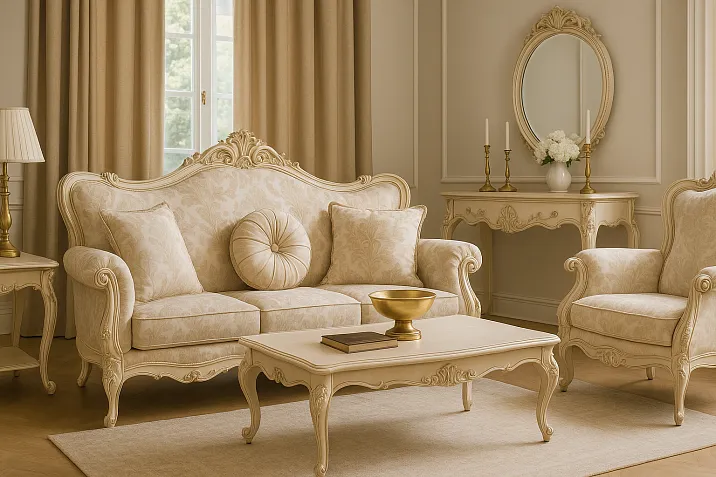
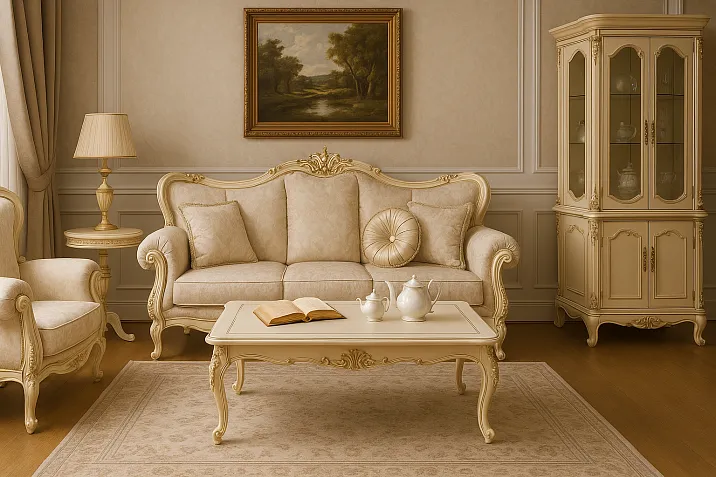
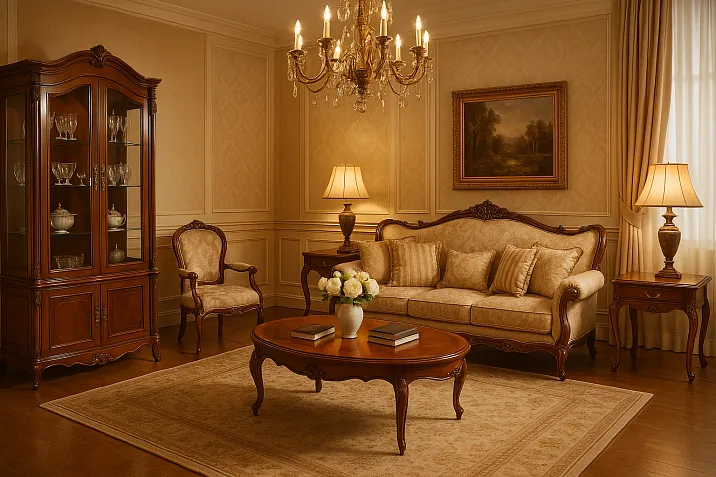

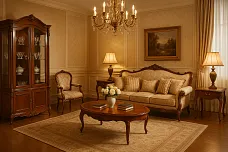
Classical furniture represents the embodiment of multi-century traditions of furniture art, where each element is created according to the canons of symmetry, flawless proportions, and classical motifs of ancient heritage. The philosophy of creation is based on fundamental principles — the use of exclusively premium natural materials, traditional joinery techniques, and the creation of handcrafted decoration of the highest level of craftsmanship.
Furniture in the classical style differs from mass-produced goods by a unique aesthetic concept, where not only the external beauty of items is important, but also a deep understanding of the historical stylistic features of each era. From the theatricality of Baroque with its lavish forms to the strict monumental elegance of Empire — each stylistic direction requires specialized knowledge in the field of classical proportioning, traditional decorative elements, and professional materials science.
Classical styles of furniture serve not only as functional everyday items, but also become genuine family heirlooms, carefully passed down through generations as a material embodiment of cultural traditions and impeccable taste. Quality Classic Furniture represents a long-term investment in the beauty, functionality, and prestige of the home space.
This comprehensive guide thoroughly examines the full genealogy of classical stylistic directions from antiquity to the present day, detailed features of constructive and technological solutions, professional rules for selecting furniture for various functional spaces, time-tested technologies for proper care and qualified restoration, as well as current trends in successfully integrating traditional classical forms into modern interior solutions of the 21st century.


1. History and genealogy of styles




1.1. Ancient roots and orders
Fundamental architectural-aesthetic principles of classical furniture They draw their historical origins from the majestic architectural traditions of ancient Greece and powerful Rome. The classical orders system developed by ancient masters laid down immutable foundations of mathematical proportioning and harmonious decorative design, which invariably define the aesthetic canons of modern high-end elite furniture production.
The Doric order, with its characteristic strict geometry and monumental strength, established fundamental principles of architectural monumentality and constructive logic. The Ionic order, with its elegant spiral volutes, introduced into classical art elements of refined elegance of form and decorative sophistication. The Corinthian order, with its luxurious vegetal capitals carved from acanthus leaves, defined the highest level of decorative artistic ornamentation.
Characteristic fluting — strictly vertical grooves on the surface of ancient columns — became the historical prototype of modern decorative treatment. furniture legs classical tables and chairs. Traditional acanthus leaves, with their complex plastic form, became the primary universal motif of refined carved decoration. The strict mathematical harmony of classical proportions, based on the principle of the golden section, determined for centuries the indisputable rules for creating perfect furniture forms.
Our factory also produces:


1.2. Renaissance
The great Renaissance era of the 15th-16th centuries radically changed the approach to furniture art, introducing into traditional craftsmanship a fundamentally new scientific approach to geometric proportioning and mathematical harmony of forms. Outstanding master carpenters of that time carefully studied classical architectural treatises by Vitruvius, meticulously applied complex mathematical principles in creating elite furniture, where every decorative and constructive element was precisely calibrated according to strict canons of classical beauty.
Characteristic features of Renaissance furniture were perfectly clear geometric forms, strictly symmetrical artistic compositions, extensive use of complex inlays made from contrasting colored and textured precious woods. Traditional marquetry technique reached a special technical and artistic perfection during this period — outstanding master carpenters created astonishingly complex geometric and floral ornamental compositions.
Get Consultation
1.3. Baroque
The 17th century marked a true artistic revolution in the development of furniture aesthetics and decorative-applied arts. The grandiose Baroque style introduced into furniture and interior items unprecedented opulence of rich decorative ornamentation, dynamic curved forms of unprecedented complexity, and extremely lavish use of precious gilding and silvering.
Characteristic elements of Baroque style were elegant cabriole legs adorned with virtuoso carved cartouches and mascarons, massive tabletops with luxurious inlays of rare woods and semi-precious stones, extensive use of artistically treated bronze hardware of the highest quality, creating an unparalleled atmosphere of royal luxury and courtly grandeur.
1.4. Rococo
The mid-18th century brought to European decorative arts a fundamental transition to a significantly more intimate, chamber-like, and refined artistic style. The elegant Rococo style noticeably softened the characteristic Baroque opulence and theatricality, introducing into beautiful furniture graceful S-shaped lines, refined rocaille ornamentation, and delicate pastel color palettes of noble shades.
Characteristic distinctive elements of Rococo were virtuoso executed asymmetrical artistic compositions with elegant marine decorative motifs, extensive use of iridescent mother-of-pearl and noble ivory in complex inlays, application of refined chinoiserie technique — stylization after traditional Chinese applied arts.
1.5. Classicism
The concluding period of the 18th century marked the triumphant return to enduring ancient ideals of architectural and artistic beauty. The noble Classicism style brought into elite furniture characteristic strictness of clear lines, impeccable symmetry of harmonious compositions, and aristocratic restraint of refined decorative ornamentation.
Mathematically precise classical proportions acquired particular principle importance in Classicism — every architectural and decorative element must strictly conform to the strictest ratios derived from ancient canons of beauty. Characteristic traditional ornaments of Classicism were elegant laurel leaf garlands, decorative ribbons and bows, refined rosettes, elegant palmettes, and strict ancient meander.
1.6. Empire
The early 19th century brought to European applied arts the majestic Empire style, characterized by its monumental architectural forms and solemn imperial symbolism. premium class furniture of this notable historical period distinguished itself by imposing massive forms, extensive use of military and ancient state insignia — majestic eagles, triumphal wreaths, solemn fasces, enigmatic sphinxes, and symbols of martial valor.
Applied materials reached an unprecedented level of luxury and nobility — select red woods of rare species, artistically crafted bronze of the highest quality, precious gilding and noble silvering, luxurious marble of various shades and textures. Characteristic distinctive features of Empire were emphatically straight monumental lines, impressively heavy classical proportions, extraordinarily rich decorative ornamentation of exceptional artistic value.
1.7. Victorian Era
The 19th century brought to European furniture art a distinctive eclecticism — free mixing of various historical stylistic directions and decorative traditions. Victorian Luxury Furniture Distinguished by exceptional architectural complexity, abundance of virtuoso carved decoration, and extensive use of luxurious velvet upholstery in rich, deep colors.
Technological progress brought revolutionary new wood-processing technologies, enabling master carpenters to create significantly more complex and refined artistic compositions. Characteristic features of the Victorian style included whimsically curved lines, extraordinarily rich three-dimensional carving, use of exotic wood species imported from distant colonies of the British Empire.
1.8. Neoclassicism and the 20th–21st centuries
The 20th century brought radical simplification of traditional classical forms and their successful adaptation to the dynamically changing modern lifestyle of industrial society. The neoclassical style carefully preserved the foundational principles of classical proportioning and harmony, but decisively rejected the excessive decorative ornamentation of past eras.
Modern Classic Collection Clearly demonstrates an exceptionally successful combination of enduring traditional architectural forms with the current needs and requirements of modern life. Characteristic distinguishing features of modern neoclassicism include sharply defined clean lines, impeccable quality of premium materials, practical functionality, and organic integration of advanced technologies while steadfastly preserving the classical aesthetic foundation.
2. Construction and Materials
2.1. Wood Species
A professional selection of wood species fundamentally determines not only the external aesthetic qualities of the finished product, but also its operational durability, stability of geometric parameters during prolonged use. High-quality classical furniture is made exclusively from carefully selected premium wood species with optimal physical and mechanical properties.
Oak remains universally recognized as the benchmark for structural strength and exceptional longevity. The characteristic density of quality oak wood is 650–800 kg/m³, ensuring unparalleled dimensional stability and outstanding resistance to various mechanical impacts. Oak wood features a distinctly pronounced decorative grain with a beautiful ring pattern, especially vividly displayed when professionally radial-sawn. Natural tannins, abundantly present in oak wood, provide reliable natural protection against destructive insect pests and pathogenic fungi.
Beech is highly valued by master carpenters for its exceptionally uniform internal structure and superior workability at all stages of the manufacturing process. The optimal density of beech wood, 650–750 kg/m³, makes it an ideal material for producing complex turned elements and delicate carved ornamentation. Beech wood readily accepts various types of staining and artistic patination, enabling craftsmen to create diverse decorative effects and simulate more expensive wood species.
2.2. Panel / Solid / Veneer
|
Material Type |
Durability |
Cost |
Restorability |
Aesthetic Qualities |
|
Solid Wood |
100+ years |
High |
Full |
Maximum |
|
Glued Panel |
50–70 years |
Average |
Limited |
High |
|
Veneer on MDF |
20–30 years |
Low |
Minimal |
Average |
|
Laminated Board |
5-10 years |
Minimal |
None |
Low |
Solid wood provides absolutely maximum durability and a unique opportunity for multiple professional restorations if necessary. Each solid wood item is absolutely unique due to the incomparable natural wood grain pattern, possesses a characteristic natural scent, and has special tactile properties of premium quality natural material.
Glued panel made from carefully selected lamellas successfully combines the structural strength of solid wood with noticeably greater dimensional stability. Progressive gluing technology makes this material significantly less prone to undesirable cracking and warping under natural changes in ambient humidity.
2.3. Joints
Traditional joinery, proven by centuries of practical use, remains the fundamental basis for creating quality durable furniture. The classic "birdsmouth" joint provides absolutely maximum mechanical strength for drawers of various configurations, perfectly enduring tens of thousands of intensive daily cycles over many decades of continuous use.
Various types of dowel joints — open, blind, with special insert dowels — guarantee exceptional longevity of all frame structures. The highest precision fit of all connected elements is a clear indicator of the manufacturer's professional skill and directly affects the overall service life of the finished product.
2.4. Hardware
Exceptionally high-quality European hardware is absolutely an indispensable part of true luxury furniturePrecision hinges made of high-quality brass or corrosion-resistant stainless steel ensure smooth and silent door operation for many years of intensive daily use.
Modern full-extension guides with integrated soft-close and dampers significantly enhance daily furniture comfort. High-quality decorative elements made of artistic bronze — handles, appliqués, rose petals — serve as important stylistic accents and emphasize belonging to a specific historical style.
2.5. Finishing
Professional finishing decisively determines not only the final appearance of the finished product, but also its durability under daily use. Traditional shellac polish creates a characteristic deep mirror-like gloss, maximally highlighting the natural decorative texture of the wood. Applying multi-layered polish is a complex technological process requiring exceptionally high professional skill and significant time investment.
Oil-and-wax finishes create a noble matte surface with special tactile appeal and warmth of natural material. These eco-friendly finishes are relatively easy to restore when needed and over time acquire especially attractive noble patina of natural aging.
|
Finish Type |
Gloss |
Durability |
Restorability |
Cost |
|
Shellac Polish |
High |
50+ years |
Complex |
High |
|
Polyurethane Lacquer |
Medium |
20–30 years |
Average |
Average |
|
Oil-Wax |
Matte |
10-15 years |
Simple |
Low |
|
Nitro Lacquer |
High |
5-10 years |
Complex |
Low |
3. Decor and Profiles
3.1. Carving
Exquisitely executed carved decoration rightfully considered the soul and quintessence of true high-art classical furniture. Each element of traditional ornament carries deep symbolic and cultural significance, is created according to strict historical canons, and requires years of professional craftsmanship.
Traditional acanthus leaves in classical symbolism represent life force, renewal, and the triumph of life over death. Elegant rosettes symbolize the sun, divine light, and cosmic harmony. Graceful volutes embody ideas of movement, development, and the infinity of time.
Modern high-precision CNC technologies allow reproducing the most complex traditional ornaments with previously unattainable mathematical accuracy and detail, yet the final hand-finishing by an experienced master carver invariably imparts each piece with unique individuality. Characteristic micro-irregularities inherent only to handwork create a living play of light and shadow, fundamentally unachievable through mechanical processing.
3.2. Cornices, Borders, Columns, Candlesticks
Various profiled elements play an exceptionally important role in forming the overall architectural character of elite furniture and creating a cohesive stylistic image. Different classical profiles — elegant husk, strict cove, soft roll, graceful scroll — create a complex interplay of light and shadow, visually lightening or emphasizing the overall structure in accordance with the artistic concept.
Columns and pilasters used in elite cabinetry must strictly conform to rigorous classical proportions of historical orders. The column diameter, base and capital height, exact number of flutes — all these critically important parameters are strictly regulated by ancient architectural canons.
Carved Inlays of various sizes and configurations allow to radically transform the appearance of relatively simple furniture, turning it into a true work of applied art.
3.3. Inlays and Marquetry
Ancient inlay techniques using contrasting materials allow creating unique decorative panels of exceptional artistic value. Marquetry — the highest art of veneer assembly — enables masters to create astonishingly complex multi-colored compositions from contrasting in color and texture precious wood species.
Traditional inlay materials include iridescent mother-of-pearl, noble ivory, artistic metal, semi-precious colored stones. Each material requires application of specific professional processing technologies and secure attachment to the wooden base.
3.4. Fabrics
High-quality upholstery materials for elite classical soft furniture must strictly conform to the highest international standards of quality, durability, and aesthetic appeal.
|
Material |
Abrasion Resistance (Martindale) |
Characteristics |
Application |
|
Velvet |
25,000 cycles |
Luxurious Texture |
Parade Furniture |
|
Gobelin |
50,000 cycles |
Rich Texture |
Classic Interiors |
|
Natural Leather |
100,000+ cycles |
Durability |
Office Furniture |
|
Silk |
15,000 cycles |
Exclusivity |
Boudoir Furniture |
4. Classification by Rooms and Types
4.1. Living Room
Classic Living Room Furniture Forms the main representative zone of the house and creates the first impression of the owners' taste and status. Monumental walls and shelves serve not only for practical storage of tableware and collectibles, but also for an effective display of family heirlooms and art collections.
Luxurious buffets with masterfully carved facades and noble marble tops emphasize the high status of the interior and create an atmosphere of aristocratic refinement. Display cases with special glass shelves and professional lighting create an impressive museum-like presentation of valuable items.
Sofas with carved wooden frames of premium quality are traditionally upholstered in noble fabrics — luxurious silk, soft velvet, practical high-grade natural leather. The frame should visibly demonstrate the masterful craftsmanship of the carver and the flawless quality of select wood.
Living Room Planning Checklist:
- Room Area and Ceiling Height
- Number of Seating Places (Sofa + Chairs)
- Storage Volume (Tableware, Books, Collections)
- Zoning (TV Zone, Fireplace Group)
- Passages Between Furniture (Minimum 70 cm)
4.2. Dining Room
Sliding dining tables in classic style are invariably the compositional and functional center of the dining area. High-quality transformation mechanisms must be securely concealed within the table's structure, without disrupting the overall aesthetics and stylistic unity. Solid tabletops made of select wood or noble natural stone visibly emphasize the solidity and respectability of the setting.
Buffet credenzas perform an important function of organized storage for festive tableware and various serving accessories. The upper part with elegant glass doors effectively displays the finest examples of the family's porcelain and crystal collection, while the lower part securely hides everyday utilitarian items.
4.3. Bedroom
Luxurious beds with high carved headboards invariably become the dominant compositional center of the entire bedroom area. The artistic headboard can be masterfully crafted from select wood with refined carved decoration or elegantly upholstered in expensive fabric with traditional button tufting. The bed's dimensions should harmoniously correspond to the overall proportions of the room.
Comodes for storing linens and clothing are traditionally adorned with carved facades and luxurious marble tops of various shades. The number of drawers is determined by real organizational needs for storing personal items. Vanity tables with triptych mirrors create a cozy corner of beauty within the bedroom interior.
4.4. Office/Library
Solid desks and writing tables made of select wood with traditional leather tops create a professional working atmosphere and emphasize the seriousness of the owner's intentions. Numerous drawers and compartments of various configurations ensure convenience for daily work with documents and office supplies.
Bookshelves with protective glass doors reliably protect valuable collections from dust and create a cozy intellectual atmosphere in the home office. Adjustable shelves allow placing books and documents of various standard formats with maximum convenience.
4.5. Small Furniture
Elegant consoles of various sizes and stylistic affiliations serve important decorative purposes and allow effectively zoning the space. Elegant benches and ottomans complement the main soft furniture group organically. Special stands for vases and sculptures emphasize the collection-oriented character of the interior and create additional compositional accents.
5. Styles in Detail: Recognition and Examples
Baroque: theatricality and grandeur
Baroque furniture is characterized by dynamic curved forms of exceptional complexity and artistic expressiveness. Elegant cabriole legs with masterfully carved mascarons, graceful volute elements, luxurious cartouches with heraldic symbolism create an unparalleled atmosphere of royal opulence and courtly grandeur.
The color palette of baroque leans toward rich, deep tones — noble burgundy, emerald green, luxurious gold. Upholstery fabrics — luxurious velvet, shimmering silk, artistic tapestry — must fully correspond to the overall opulence and lavishness of the style.
Typical styling errors:
- Overloading with small decorative elements
- Failure to observe scale
- Use of cheap gold-plated imitations
- Mixing with minimalist styles
Rococo: elegance and coquetry
Rococo significantly softens the characteristic baroque opulence, introducing playfulness, elegance, and a distinctive French refinement of the 18th century. Characteristic S-shaped lines, delicate rocaille ornamentation, and pastel color palettes create an unparalleled atmosphere of aristocratic French boudoirs of the Louis XV era.
Modern application of rococo in 21st-century interiors requires special caution and professional sense of proportion — excessive ornamentation may appear tasteless and inappropriate. It is recommended to use individual stylistic elements as refined accents.
Classicism: harmony and nobility
Classical furniture returns to enduring ancient principles of architectural and artistic beauty. Flawless strict symmetry, mathematically precise proportions, aristocratic restraint in decoration create an atmosphere of genuine elegance and nobility.
In modern interiors, classicism appears most relevant and organic, easily combining with minimalist design directions. It is truly a universal style for those who highly value elegance without excess.
Empire: imperial grandeur
Empire embodies grandiose ideas of statehood and demonstration of power of a great empire. Characteristic massive forms, solemn military symbolism, use of precious materials create an atmosphere of official solemnity and state grandeur.
Modern application of empire requires spacious rooms with high ceilings and appropriate scale. In small spaces, it is recommended to use only individual elements of the style.
|
Style |
Period |
Key characteristics |
Color palette |
Modern application |
|
Baroque |
17th-18th centuries |
Curved forms, gilding |
Burgundy, gold |
Grand halls |
|
Rococo |
18th century |
S-lines, asymmetry |
Pastel tones |
Boudoirs, bedrooms |
|
Classicism |
18th-19th centuries |
Symmetry, classical motifs |
White, cream |
Universal |
|
Neoclassical |
19th century |
Monumentality, eagles |
Red, gold |
Offices, libraries |
6. How to distinguish authentic classic furniture from stylization
Material Expertise
Authentic classic furniture can be reliably distinguished from cheap imitations by a number of objective criteria and features. Solid wood is unmistakably identified by its characteristic end grain surfaces — natural annual rings and wood grain texture are clearly visible. Veneered items exhibit suspiciously repetitive patterns and unnatural symmetry of fibers.
The weight of the item is a key indicator of material quality. Furniture made of solid wood is significantly heavier than similar items made of MDF or particleboard. The sound produced when tapping also differs markedly — solid wood gives a characteristic dull, resonant sound, while composite materials produce a hollow, ringing sound.
Assessment of manufacturing quality
The quality of joinery is easily checked by visual inspection and tactile sensation. Gaps between elements must be absolutely minimal, and surfaces must fit perfectly. Visible mechanical fasteners in noticeable areas are strictly prohibited for genuine premium-class furniture.
HowTo: How to check furniture quality when purchasing
- Inspect the ends — solid wood shows natural texture
- Check the weight — quality furniture is significantly heavier
- Tap the surface — solid wood gives a dull sound
- Assess the smell — natural wood has a pleasant aroma
- Check the joints — gaps must be minimal
- Test the mechanisms — drawers and doors must operate smoothly
- Examine the hardware — quality brass does not tarnish
Documentary confirmations
Certificates of wood species quality, official documents on material origin, detailed manufacturer warranties — all of these must be included with truly quality furniture. A serious manufacturer, completely confident in the quality of its products, never conceals the manufacturing technologies used or the sources of materials.
|
Criterion |
Original |
Imitation |
|
Material |
Solid Wood |
MDF/Particleboard with laminate |
|
Weight |
Heavy |
Light |
|
Sound |
Dull |
Bright |
|
Smell |
Wooden |
Chemical |
|
Connections |
Carpentry |
Screws |
|
Carving |
Hand-finished |
Only machine-made |
|
Hardware |
Brass/Copper |
Silumin |
|
Price |
High |
Suspiciously low |
7. Selection and Purchase: Step-by-step Algorithm
7.1. Interior Brief
Professional analysis of the room includes careful assessment of ceiling height, total room area, quality and direction of natural lighting throughout the day. All these critically important factors significantly influence the optimal choice of furniture style and its dimensions.
Color palette must fully correspond to the overall interior concept and personal preferences of the owners. Light furniture effectively visually expands small spaces, while dark furniture creates a cozy, intimate atmosphere. Contrasting combinations require a professional design approach.
7.2. Choosing a Set
Clearly formulated functional requirements determine the optimal type and necessary quantity of furniture. Basic modules are later supplemented with stylish accessories and decorative elements. Usage scenarios influence the choice of specific transformation mechanisms and upholstery materials.
Modular systems provide a unique opportunity to create individual compositions that precisely match the needs of a specific family. The provision for expanding the collection is critically important for long-term planning of interior development.
7.3. Budgeting
The cost of classic furniture varies within an exceptionally wide range depending on the quality of materials used, complexity of decorative furnishings, level of exclusivity and prestige of the manufacturer. Oak costs 3-5 times more than pine, hand carving increases the final price by 2-3 times.
Phased purchasing allows rational spreading of significant investments over time without compromising stylistic unity. Reasonable savings are possible by choosing simpler decorative elements or alternative wood species of similar quality.
7.4. Custom Order vs Ready-made Solutions
Ready-made furniture from a showroom allows quickly furnishing a space, but may not meet individual requirements in terms of size or decor. Custom order ensures full compliance with all requirements, but requires significantly more time and financial resources.
Production time for exclusive luxury furniture may range from several months to a full year depending on the complexity of the construction and decor. Quality control for custom orders includes approval of detailed sketches, selection of specific materials, intermediate inspections at all stages of production.
7.5. Delivery and Assembly
Professional packaging must guarantee full preservation of furniture during transportation over any distance. Detailed micro-steps of acceptance include careful checking of delivery completeness, integrity of decorative finish, flawless operation of all mechanisms.
A defect report must be prepared upon detection of any damage or defects. Clear warranty obligations must be explicitly stated in the supply contract, specifying exact service terms and conditions.
Care, Maintenance, Restoration
Climate Requirements
Optimal air humidity should be maintained within the range of 45-55% at a stable temperature of 18-22°C throughout the year. Sudden fluctuations in these parameters inevitably lead to undesirable wood cracking and deformation of structural elements.
Direct sunlight causes irreversible fading of decorative finishes and critical drying of wood. Protective curtains or blinds are recommended. The distance from heating appliances should be at least 50 cm to prevent localized overheating.
Regular maintenance
Daily care includes gently removing dust with a microfiber cloth. Abrasive materials are strictly prohibited — they may irreversibly scratch the delicate finish.
Weekly wet cleaning is performed with a slightly damp cloth, followed by thorough drying. Monthly application of special natural wax-based polishes nourishes the wood and restores the protective coating.
Repairing damage
HowTo: How to remove a white ring from a glass on polish
- Mix wood ash with a few drops of vegetable oil
- Apply the paste to the white spot
- Leave for 2-3 hours for effect
- Remove residue with a damp cloth
- Polish the surface to a shine
- If necessary, repeat the procedure
Minor scratches are removed with a specially selected wax matching the wood tone. Dents on soft wood are corrected using steam through a damp cloth with a hot iron.
Professional restoration
Serious damage requires mandatory intervention by qualified antique furniture restoration specialists. Cracks are filled with special putty matched to the wood tone, followed by careful sanding and application of protective coating.
Restoration of carved decoration is an exclusively complex technological process requiring professional skills of a wood carver. Lost elements are recreated from preserved fragments while maintaining historical accuracy and authenticity.
|
Type of care |
Frequency |
Used materials |
Potential risks |
|
Dust removal |
Daily |
Microfiber |
Scratches from dirt |
|
Wet cleaning |
Weekly |
Slightly damp cloth |
Wood swelling |
|
Polishing |
Monthly |
Wax, polishes |
Accumulation of composition |
|
Deep cleaning |
Once a year |
Professional products |
Coating damage |
9. Aesthetics and integration into modern interiors
Neoclassicism in the 21st century
Modern reinterpretation of classical architectural forms skillfully adapts multi-century traditions to the current needs of dynamic modern life. Simplification of decorative elements, rational use of innovative materials, organic integration of modern technologies allow preserving timeless classical aesthetics while maintaining contemporary functionality.
Neoclassicism harmoniously combines with minimalist design directions. Clear lines, restrained decoration, neutral color palette create an elegant atmosphere without excessive ornamentation and flamboyance.
Lighting in classical interiors
Properly designed lighting dramatically affects the perception of beauty of classical furniture and the overall atmosphere of the room. General lighting from luxurious chandeliers with crystal pendants, accent lighting from elegant table lamps with fabric shades, decorative backlighting of display cases and paintings create a multi-level lighting architecture.
Dimmers allow creating various lighting scenarios for different times of day and various events — from bright working lighting to intimate evening light.
Interior case studies
Apartment 60 m²: Bright neoclassicism with minimal decoration, functional transformable furniture, mirrors for visual space expansion.
House 180 m²: Full classical style with zoning by styles — Baroque in the living room, Classicism in the office, Rococo in the bedroom.
Office 20 m²: Strict Empire style, dark oak furniture, leather upholstery, minimal decoration, emphasis on functionality.
10. Ecology and sustainability
Material certification
Responsible furniture production implies using wood exclusively from managed forests, certified by international FSC (Forest Stewardship Council) standards. This reliably guarantees forest resource regeneration and effective protection of natural ecosystems.
Ecologically safe lacquer-paint materials with minimal volatile organic compound (VOC) content ensure complete safety for human and pet health. Water-based lacquers are becoming increasingly popular in premium furniture production.
Sustainability principles
The longevity of classical furniture is a critically important ecological factor of modernity. Items that honestly serve for many decades without loss of functionality or aesthetic qualities dramatically reduce overall environmental burden and contribute to rational conservation of natural resources.
The possibility of professional restoration significantly extends the lifespan of quality furniture. The secondary market for antique and vintage furniture actively contributes to preserving planetary resources.
11. Prices and market
Price segmentation
Price ranges by different stylistic directions and quality levels:
|
Segment |
Cost per item |
Military symbolism, ancient motifs |
Decor |
Production |
|
Economy |
20-50 thousand rubles |
MDF with PVC film |
Carving |
Mass production |
|
Medium |
50-150 thousand rubles |
Veneered MDF |
Simple carving |
Serial production |
|
Premium |
150-500 thousand rubles |
Solid Wood |
Hand-carved |
Low-series production |
|
Luxury |
From 500 thousand rubles |
Rare woods |
Exclusive |
Custom |
Pricing factors
Main cost-increasing factors include the use of hand-carved details (cost increase by 2-3 times), use of veneer from rare wood species, use of cast decorative hardware, significant structural complexity, exclusive design, and manufacturer prestige.
Reasonable cost savings are possible by choosing alternative wood species of similar quality, simplifying decorative elements without losing stylistic identity, and using quality but non-exclusive hardware.
12. Common mistakes and myths
Common misconceptions
Myth of classic darkness: The widespread misconception that classic furniture is always dark and visually heavy is easily refuted by numerous examples of light, elegant interiors. White classic furniture and light wood species create an airy atmosphere.
Scaling error: Incorrect scaling of profiles and decorative elements makes furniture disproportionate and disharmonious. The size of carving must correspond to the dimensions of the item.
Stylistic errors
Over-decorating disrupts the classical harmony of composition and creates a sense of tastelessness. Mixing incompatible styles without understanding their historical characteristics leads to eclectic disorder.
Savings on material quality completely destroy the overall impression of the interior and devalue investments in classic furniture.
13. Mini-glossary of terms
Cartouche — decorative element in the form of a scroll, shield, or plaque for placing coats of arms, monograms, or inscriptions.
Rocaille — main ornamental motif of the Rococo style in the form of a stylized seashell.
Volute — architectural element in the form of a spiral scroll, characteristic of Ionic and Corinthian orders.
Marquetry — decorative technique of furniture embellishment using a set of multi-colored veneers from valuable wood species.
Filigree — decorative wooden insert in a frame, the main element of door and facade decoration.
Portal — architectural framing of an opening, actively used in furniture decoration.
Grooves — vertical channels on the surface of columns and pilasters.
Politur — traditional transparent finish for furniture based on natural shellac.
Patina — noble aged patina on the surface of metal or wood.
Inlay — decorative technique of embedding pieces of other materials into the surface.
14. FAQ
What does the term 'classic furniture' mean?
Classic furniture refers to items crafted in historical artistic styles (Baroque, Rococo, Empire, Classicism) using traditional natural materials, adhering to classical proportions, and employing authentic decorative elements based on principles of ancient art and architecture.
What are the main styles in classic furniture?
Main historical styles include ancient (Greek-Roman), Baroque with its opulence, elegant Rococo, strict Classicism, monumental Empire, eclectic Victorian style, and modern Neoclassicism. Each style has distinctive features in decoration, proportions, and materials used.
How is furniture correctly classified by type?
Furniture is classified by functional purpose (storage units, seating and relaxation furniture), by rooms (living room, bedroom, office, dining room), by historical styles, materials used (solid wood, veneer, composites), and quality level (economy, standard, premium, luxury).
What is the name for antique historical furniture?
Furniture older than 100 years is officially called antique and possesses not only practical but also significant historical, artistic, and collectible value. Furniture aged 50–100 years is called vintage.
What is the fundamental difference between Neoclassicism and traditional Classicism?
Neoclassicism represents a modern interpretation of classical forms with simplified decorative elements, adapted to current needs, using modern materials and technologies while preserving the core principles of proportioning and compositional harmony of classical styles.
How to properly care for classic furniture made of solid wood?
It is necessary to maintain stable air humidity at 45–55% and temperature at 18–22°C, avoid direct sunlight and proximity to heating appliances, regularly remove dust with a soft cloth, perform wet cleaning weekly, and use specialized wax-based polishes monthly.
How to reliably identify wood species (oak, beech, walnut)?
Oak has a distinct coarse-grained texture with clear annual rings and a characteristic woody aroma. Beech features a fine, uniform structure with a light rose-colored tone. Walnut has a distinctive wavy texture and color range from light brown to dark chocolate.
What is best to choose for different rooms?
For the living room, formal furniture with rich decoration and imposing forms is optimal. For the bedroom, cozy furniture with soft lines and calm color palette is suitable. For the office, strict functional furniture with quality hardware and minimal decoration, not distracting from work, is recommended.
Which wood species are considered most valuable for classic furniture?
The most valuable are oak (for strength and durability), walnut (for beautiful texture), mahogany (for stability and luxurious appearance), as well as exotic species — padauk, ebony, Karelian birch. The choice depends on style, budget, and personal preferences.
How long can quality classic furniture last?
With proper care and use of quality materials, classic furniture made of solid wood can last 50–100 years or more. Many antique pieces from the 18th–19th centuries remain functional after professional restoration, confirming the exceptional durability of traditional technologies.
Can classic furniture be successfully combined with modern interiors?
Yes, in the style of Neoclassicism or modern Classicism, such a combination is not only possible but extremely popular. It is important to maintain a balance of styles, choose items with simplified decoration, use neutral color palettes, and properly zone the space.
How to properly care for carved decorative elements?
Carving requires especially delicate handling: dust is removed with a soft brush or special brush, polishing uses wax-based compounds, deep stains are carefully cleaned with cotton swabs. Abrasive materials and aggressive chemicals must not be used.
Classic furniture remains an enduring value in the modern interior design world, successfully combining centuries-old craftsmanship traditions with innovative production technologies to create items of the highest quality and timeless aesthetic appeal. Proper selection, professional care, and timely restoration guarantee the preservation of beauty and functionality for many decades, making quality classic furniture a wise long-term investment in comfort, prestige, and family traditions.


