Article Contents:
- Apartment 50 m²
- House- Cottage
- Townhouse
- Cafe
- Boutique
- Conclusion: From Theory to Practice
- Frequently Asked Questions

Theory is good, but practice convinces. One thing is reading about the possibilities of wooden paneling in Russian style, another is seeing how these elements work in real interiors, solve specific problems, and create an atmosphere. In this article — five cases: from a compact apartment to commercial space, whereWooden boards in interior, Baseboards, Crown Moldingand carved elements became the basis of the design.
Each case is a real project with specific initial data (area, budget, requirements), solutions (which elements were used, how they were installed), and results (photos, cost estimate, owner’s review). These are not idealized catalog images, but live interiors where people work, relax, and live.
We will show thatdecor in Russian styleis possible in any space — from a small city apartment to a country house, from private housing to public spaces. The key is understanding the principles of the style, proper selection of elements, and quality execution.
Apartment 50 m²
Initial data. Two-room apartment in a panel building constructed in the 1980s, Moscow, residential district. Area 50 m², ceiling height 2.65 m, standard layout (hallway, room 18 m², room 12 m², kitchen 8 m², combined bathroom). Owner — journalist, 35 years old, lives alone, works a lot at home, atmosphere of focus and coziness is important.
Decoration and paneling budget — 450,000 rubles. Requirements: preserve Russian style, but avoid museum-like aesthetics; maximize use of natural materials; create a workspace in the large room; visually increase ceiling height.
Solutions. The large room (18 m²) became a living room-office. One wall (behind the desk) is covered with vertical pine boards 40×50 mm with 30 cm spacing (board + gap). Boards run from baseboard to ceiling (height 2.65 m), painted with matte white enamel. Between boards and walls — 40 mm air gap with acoustic foam (improves acoustics for video calls, podcast recordings).
The other three walls of the living room are painted light gray (RAL 7047), creating a backdrop for the white boards. Baseboard around the perimeter — MDF 140 mm height, paintable, painted the same light gray, blending with walls (visually expands space). Ceiling cornice — MDF 80 mm, white, contrasts with light gray ceiling (ceiling painted slightly darker than walls, visually making it appear higher — reverse perception psychology).
Small room (12 m²) — bedroom. Walls beige (RAL 1015), one wall (headboard) decorated with three vertical panels: frames made of 50 mm wide molding (birch, painted white), inside panels — wallpaper with small floral pattern (stylized after traditional Russian fabrics). Baseboard — same as in living room (MDF 140 mm, beige).
Narrow hallway (1.2 m), long (6 m). To visually expand, walls painted white, baseboard white 100 mm, cornice white 60 mm. On one wall — three horizontal moldings (at 80, 140, 200 cm heights), dividing the wall into bands, creating rhythm. Moldings thin (30 mm), birch, painted white.
Kitchen 8 m² — bright, functional. Cabinet facades — MDF paintable, white. Splashback — ceramic tiles 10×10 cm, white. Baseboard — moisture-resistant MDF 120 mm, white. On the free wall (dining area) — three vertical pine boards 40×50 mm, natural color under oil, creating an accent of natural wood in the white space.
Materials and cost estimate. Pine boards 40×50 mm — 85 m.l. × 180 rub = 15,300 rub. Birch moldings of various profiles — 140 m.l. × 250 rub = 35,000 rub. MDF baseboard 120-140 mm — 45 m.l. × 350 rub = 15,750 rub. MDF cornice 60-80 mm — 45 m.l. × 300 rub = 13,500 rub. Primer, enamel, oil — 12,000 rub. Fasteners — 4,000 rub. Labor (installation, painting) — 85,000 rub. Total paneling: 180,550 rub.
Remaining finishing (wall, ceiling painting, flooring, doors, plumbing, electrical) — 270,000 rub. Total budget: 450,550 rub (within planned amount).
Result. The apartment visually became higher and more spacious. White vertical boards in the living room 'raise' the gaze, creating an illusion of greater height. The board wall works as an acoustic element — the owner notes that the sound in the room became softer, more comfortable for long work sessions.
Russian style is expressed subtly: through vertical lines of boards (reference to wooden architecture), panel compositions in the bedroom, natural wood. No excess, kitsch, museum-like aesthetics. The interior is modern, yet soulful, warm, and characterful. Owner: 'I wanted the apartment to be not just a functional box, but a place where it’s pleasant to be, reflecting my connection to Russian culture. It turned out exactly what was needed.'




House- Cottage
Initial data. Single-story wooden house made of 150×150 mm beams, near Moscow, 12-acre plot. Built in 2020, area 85 m² (living-kitchen 35 m², two bedrooms 15 m² each, bathroom, boiler room, veranda). Owners — family couple with two children (8 and 12 years old), used as a cottage (May to October) and weekends in winter.
Budget for interior finishing — 600,000 rubles. Requirements: preserve exposed wooden walls (beams visible, not covered), but add decorative elements; create coziness, traditional atmosphere; use natural materials; everything must be practical (children, dog, intensive use).
Solutions. The beams were left exposed, sanded (grit 120-180), and coated with oil and hard wax (Osmo, color 3062 — natural with slight golden tint) in three layers. The beams retained their texture but gained protection against moisture, dirt, and wear.
Living room-kitchen — an open-plan space. Ceiling — wooden beams (100×150 mm), protruding 100 mm from the ceiling plane, creating rhythm. Beams in natural color, coated with the same oil. Between beams — ceiling made of pine planks, painted white (visually raises the ceiling, creates contrast with dark beams).
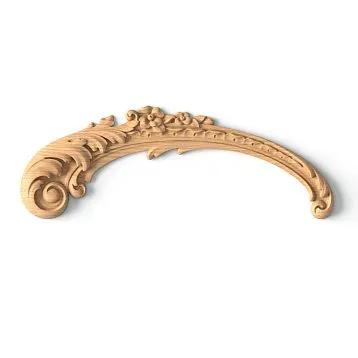
Zoning of the living room and kitchen — a carved wooden arch installed at the boundary of zones. Arch made of larch, carving — traditional plant ornament (twining stems, leaves, stylized flowers).Carved wooden window casingsHandcrafted by a master, then coated with oil. The arch does not block the space, but clearly divides it into zones.
Baseboards throughout the house — larch solid wood, height 150 mm, simple rectangular profile with rounded top edge. Coated with the same oil as walls. Larch chosen for moisture resistance (humidity fluctuations occur at the dacha) and durability.
Bedrooms — more intimate and cozy. Walls — same beams, but one wall in each bedroom (headboard area) is additionally finished with horizontal cedar strips (section 30×40 mm, spacing 10 cm). Cedar chosen for its aroma (essential oils soothe and promote sleep) and beautiful pinkish hue, contrasting with yellowish pine walls.
Veranda — an open space where the family spends most of their time during summer. Floor — larch terrace board. Railing — vertical larch strips 50×80 mm with 12 cm spacing (child safety), round handrail diameter 50 mm. All coated with exterior oil (Osmo UV-Schutz-Öl, color 429 — cedar) in 3 layers, UV and moisture protection.
Materials and estimate. Cedar strips 30×40 mm for bedrooms — 60 m.p. × 350 rub = 21000 rub. Larch strips 50×80 mm for verandas — 120 m.p. × 450 rub = 54000 rub. Larch baseboard 150 mm — 65 m.p. × 950 rub = 61750 rub. Carved arch (custom work) — 85000 rub. Ceiling beams (decorative, additional to structural) — 45 m.p. × 800 rub = 36000 rub. Osmo oil (for interior and exterior) — 55000 rub. Fasteners — 8000 rub. Work (sanding, oiling, installation) — 120000 rub. Total linear meters and wood finishing: 440750 rub.
Other (windows, doors, plumbing, heating, electricity) — 160000 rub. Total budget: 600750 rub (minor overrun, but acceptable).
Result. The house turned out warm, cozy, with a distinct Russian character, but without excess. Wooden walls create the base, the carved arch — a bright accent, not overwhelming the space. Cedar strips in bedrooms fill rooms with a pleasant aroma, promoting relaxation.
Children are thrilled with the house — for them it’s “a real house, like in fairy tales.” The dog feels free (wooden floors and baseboards withstand its claws). The family spends more time at the dacha, the house has become their favorite place. Owner: “We wanted not just a dacha for barbecues, but a place where the soul rests, where you feel connected to the earth and tradition. Wood, carving, simple forms — this is what we needed.”
Our factory also produces:




Townhouse
Initial data. Three-story townhouse in a cottage settlement, Saint Petersburg (suburb). Area 180 m² (1st floor — living room, kitchen, bathroom; 2nd floor — three bedrooms, two bathrooms; 3rd floor — workshop/office, closet). Built in 2022, standard developer project, basic finish (walls plastered for painting, floors concrete screed, ceilings stretch ceilings).
Owners — creative couple (architect and artist), 40 and 38 years old, no children. Decoration budget — 1200000 rubles. Requirements: radically change the standard interior, add individuality; use Russian style as a base, but in a modern interpretation; create a gallery atmosphere (lots of space for paintings, art objects); the staircase should become the main interior element.
Stretch ceilings removed, ceilings plastered and painted white. Around each room perimeter — ceiling cornice made of solid ash, complex profile (with ogee), width 100 mm. Ash chosen for its light color and expressive striped texture. Cornices coated with white oil (wood texture visible, but color lightened).
Staircase to second floor — central element. Steps — solid oak, thickness 50 mm, coated with natural color oil. Railing — vertical oak strips 40×60 mm with 10 cm spacing, rectangular handrail 80×50 mm with rounded edges. Treads painted deep blue (RAL 5010), creating contrast with natural steps and strips.
Staircase to third floor — lighter, more airy. Steps — same oak, railing — horizontal stainless steel strips (diameter 12 mm), creating a modern accent in the wooden surroundings.
Living room (40 m², ceiling height 3.2 m) — three walls white smooth (background for paintings), one wall (end wall behind sofa) — full-height lath panel. Vertical strips, ash, section 50×80 mm, spacing 20 cm. Strips painted in gradient: dark gray (RAL 7016) at bottom, lightening to medium gray (RAL 7044) in center, light gray (RAL 7035) at top. Gradient creates visual dynamism, upward direction.
Kitchen — minimalist, but with wooden accents. Cabinet — MDF facades, white matte. Countertop — solid oak, thickness 60 mm, coated with countertop oil. Backsplash — concrete-effect ceramic tile, gray. Baseboard — oak, height 140 mm, natural color.
Bedrooms — each with its own character, but unified by common elements (oak baseboards 140 mm, ash cornices 100 mm). Main bedroom — wall behind the bed finished with a lath composition: five vertical laths, frames made of molding (oak, 60 mm), inside — natural linen upholstery. Linen creates texture, absorbs sound, pleasant to the touch.
Office on third floor — fully lath-covered. All four walls from floor to ceiling clad with vertical strips (pine, 40×50 mm, spacing 25 cm), painted light beige (RAL 1015). Between strips and walls — acoustic wool panels (gray, thickness 20 mm), improving room acoustics (office used for video recording, good acoustics essential). Ceiling — also lath-covered (strips 20×40 mm, horizontal, spacing 40 cm), creating a coffered effect.
Materials and estimate. Strips of different sections (oak, ash, pine) — 850 m.p. × average price 350 rub = 297500 rub. Molding and cornices (oak, ash) — 320 m.p. × 450 rub = 144000 rub. Oak baseboards 140 mm — 120 m.p. × 1100 rub = 132000 rub. Staircase (steps, railing, handrail) — 280000 rub. Oil, enamel, primer — 65000 rub. Fabrics (linen for laths) — 28000 rub. Acoustic wool — 35000 rub. Fasteners — 15000 rub. Work (installation, painting, upholstery) — 320000 rub. Total linear meters and decor: 1316500 rub.
Other (floors, doors, plumbing, electricity, furniture) — 480000 rub. Total budget exceeded by 596500 rub, but owners decided to invest more, as the result exceeded expectations.
Result. The townhouse transformed from a generic, faceless space into a unique house with a strong character. The staircase became a sculpture, connecting floors not only physically but aesthetically. Lath panels create texture, depth, and play of light. The gradient paint on the laths in the living room — a find, many guests ask how it was done.
Office with fully lath-covered walls — favorite spot of the owners. Acoustics there are ideal (recordings are clean), atmosphere is intimate and focused. Artist: “When I work there, I feel enclosed, protected from the outside world. The wood around creates such calmness, such concentration — I am most productive there.”
Get Consultation
Cafe
Initial data. Cafe for 40 seating places, first floor of a residential building, city center (Kazan). Area 120 m² (main hall 80 m², kitchen 25 m², restrooms and utility 15 m²). Space rented, lease term 5 years with possibility of extension. Cafe concept — traditional Russian cuisine (pelmeni, borscht, pies, kvass) in modern presentation.
Decoration budget — 800000 rubles. Requirements: create an atmosphere of a Russian home, but not kitschy (no balalaikas or samovars); use natural materials; space must be cozy, inviting for long meals; acoustics important (cafe should not be echoey); everything practical, easy to clean (commercial use).
Hall divided into three zones: main hall (8 tables for 4 people), window zone (4 tables for 2 people), semi-enclosed “red corner” (2 tables for 6 people for groups). Zoning — wooden lath partitions 2.2 m high, not reaching the ceiling (maintains sense of one space, but creates privacy).
Partitions — vertical pine strips 50×80 mm with 15 cm spacing, painted natural color under oil. Between strips, walls visible, painted warm beige (RAL 1014). Strips mounted on a lath with 40 mm air gap, behind strips — acoustic wool panels (gray, thickness 20 mm), improving hall acoustics.
The walls of the hall — combined finish. The lower part (up to 120 cm height) — horizontal pine boarding panels, painted in light gray (RAL 7035). The upper part (from 120 cm to the ceiling) — plaster, painted in warm beige. The junction between the lower and upper parts — horizontal molding (pine, 50 mm, natural color).
The ceiling — wooden beams (imitation, actually 100×100 mm beams attached to the concrete ceiling), creating 2×2 m coffers. Beams painted in dark brown (stain + varnish). Between beams — white ceiling (gypsum board, painted). The contrast of dark and light creates volume, reduces the visual height of the ceiling (3.5 m), making the space cozier.
Baseboards — pine, height 150 mm, painted in light gray (matching the lower panels). Wide baseboards protect walls from chair legs and waiter trolleys.
"Red Corner" — semi-enclosed zone for companies. Three walls — solid lath panels (50×80 mm laths, 8 cm spacing, natural color), creating privacy. The fourth side opens to the hall. On one wall — carved wooden panel (300×200 cm) with traditional Russian motif: stylized Tree of Life with birds and flowers. Panel made of linden (soft, easy to carve), oiled, illuminated from below by LED strip.
Furniture — solid oak tables (50 mm thick tops), wooden chairs with upholstered linen seats. All natural, durable, matching the concept.
Materials and estimate. Pine laths of different cross-sections — 680 m.p. × 200 rub = 136000 rub. Boarding for lower panels — 55 m² × 450 rub = 24750 rub. Ceiling beams (imitation) — 85 m.p. × 350 rub = 29750 rub. Molding — 95 m.p. × 280 rub = 26600 rub. Pine baseboards 150 mm — 75 m.p. × 420 rub = 31500 rub. Carved panel (custom work) — 120000 rub. Wool acoustic panels — 45000 rub. Oil, stain, varnish, enamel — 38000 rub. Fasteners — 12000 rub. Labor (installation, painting, carving) — 180000 rub. Total finishing: 643600 rub.
Furniture (tables, chairs, bar counter) — 280000 rub. Lighting, textiles, tableware — 160000 rub. Kitchen equipment, ventilation — outside the finishing budget. Total budget for finishing and furniture: 1083600 rub (overrun, but owners covered from reserve fund).
Result. The cafe opened in May 2024, quickly gained popularity. Visitors note the atmosphere: "like home," "cozy," "Russian, but not kitschy." Acoustics are comfortable — even at full capacity (40 people) in the hall, it's not noisy, conversation is possible without raising voices. Lath partitions and wool panels work excellently.
The carved panel in the "Red Corner" became a signature feature — it’s photographed, posted on social media, and people discover the cafe through it. Average check 1200 rub, table turnover 3-4 times per day (lunch, afternoon tea, dinner). Return on investment in finishing — approximately 18 months, acceptable for the hospitality industry.
Owner: "We wanted the cafe to be more than just another roadside eatery — a place people want to visit, where they enjoy spending time. Wood, natural materials, thoughtful acoustics, details — all of this creates an atmosphere people are willing to pay for. The finishing not only paid for itself financially, but also reputationally — people talk about us, recommend us."
Boutique
Initial data. Boutique of original clothing and accessories, shopping center, Yekaterinburg. Area 55 m² (shopping hall 40 m², fitting rooms 10 m², utility room 5 m²). Leased space, lease term 3 years. Boutique concept — original clothing with ethnic motifs, natural fabrics (linen, cotton, wool), handmade, eco-friendly.
Finishing budget — 550000 rubles. Requirements: interior must match the concept (natural materials, Russian aesthetics); create a gallery atmosphere where clothing is art; maximize vertical surfaces for hanging (minimum 3 hangers per 1 m² of wall); fitting rooms must be comfortable and spacious; lighting is critical (products must look appealing).
Walls of the shopping hall — combined system. Base — gypsum board, painted in light beige (RAL 1015). On walls — vertical birch laths 40×60 mm cross-section, 60 cm spacing. Laths run from floor to ceiling (height 2.8 m), painted with white oil (birch texture visible, but color lightened).
Between laths (60 cm gaps) — horizontal planks (birch, 30×40 mm) at heights 140, 160, 180 cm, to which clothing rods are hung. This creates a modular system: laths — vertical structure, planks — horizontal supports, rods — functional elements. The system is easy to modify (reposition planks to different heights, add/remove rods) depending on the collection.
Ceiling — white, smooth. Around perimeter — birch ceiling cornice (80 mm wide, white, matching laths). On ceiling — track lighting system with adjustable spotlights directed at merchandise (illumination on clothing rods — 800-1000 lux, bright but not harsh).
Baseboard — birch, height 120 mm, white. Floor — light wood-effect ceramic tile (practical for commercial space), but visually resembles parquet.
Fitting rooms (2 cabins, each 2×2 m) — more intimate, cozy. Walls painted in warm terracotta (RAL 3012). One wall in each fitting room — full-height mirror. The other wall — lath panel (birch, 30×40 mm laths, 10 cm spacing, natural color under oil), with hooks for clothing and a shelf for bags. Lighting — warm, soft (LED panels 3000K, diffused light).
Utility room — functional, no decoration. Metal shelves, walls painted neutral gray.
Entrance area — accent. Above entrance (inside boutique) — carved wooden sign: boutique name, cut from linden (30 mm thick), oiled, illuminated by spotlights. Font stylized after Old Slavonic, but readable. Sign — art object, setting the tone.
Materials and estimate. Birch laths of different cross-sections — 280 m.p. × 240 rub = 67200 rub. Planks for supports — 95 m.p. × 180 rub = 17100 rub. Birch cornices 80 mm — 38 m.p. × 320 rub = 12160 rub. Birch baseboards 120 mm — 38 m.p. × 520 rub = 19760 rub. Carved sign (custom) — 45000 rub. Mirrors for fitting rooms — 28000 rub. Track lighting system + lights — 85000 rub. Clothing rods (stainless steel) — 32000 rub. Oil, enamel, primer — 22000 rub. Fasteners — 6000 rub. Labor (installation, painting, carving, lighting) — 95000 rub. Total finishing: 429220 rub.
Furniture (cashier counter, stools, shelves) — 85000 rub. Textiles, decor — 35000 rub. Total budget: 549220 rub (exactly within planned budget).
Result. The boutique opened in September 2024. The interior attracts attention — many come "just to look," then become customers. The vertical lath system works excellently: clothing is hung so that each item is visible, not lost in the mass. Customers note that choosing is easy, no need to dig through clutter.
Fitting rooms received many positive reviews — they are spacious, bright, with a pleasant atmosphere. Terracotta wall color creates warmth, lath panel — texture. Many customers photograph in fitting rooms and post on social media (free boutique advertising).
Modular hanging system allows quickly changing the display: new collection — reposition planks, rehang rods. This saves time and provides flexibility. Owner: "I didn’t expect how much the interior affects sales. People come not just for clothing, but for experience, for atmosphere. Our boutique is not a store, but a space where Russian aesthetics, natural materials, beauty of items create a cohesive image. Customers buy more often, average check is higher, they return more often."
Conclusion: from theory to practice
Five different projects, five different spaces, but one common thread — using wooden trim as the basis of Russian style. Apartment, dacha, townhouse, cafe, boutique — everywhere laths, moldings, baseboards, carved elements work not only for aesthetics, but also for function: improve acoustics, create zoning, organize space, solve practical problems.
Main conclusion from these cases: Russian style is possible in any space and any budget. From 180000 rubles for trim in a compact apartment to 1300000 rubles in a spacious townhouse — the range is wide, but the principles are the same: natural materials, correct proportions, quality execution, functional suitability.
Second conclusion: Russian style is not a museum-style aesthetic, but a living, contemporary design language. All five projects were created in 2023-2024, all actively used, all received positive feedback from owners and visitors. It’s a working style, current, in demand.
Company STAVROS produces elements used in these projects and hundreds of others across Russia. Laths of all cross-sections from different wood species. Moldings, baseboards, cornices in standard and custom profiles. Carved elements — from small inlays to large panels. All from kiln-dried solid wood, precise dimensions, ready for installation.
We work with interior designers, architects, construction companies, business owners, and private clients. We assist at every stage: consultation on material selection, quantity calculation, manufacturing (standard and custom), installation recommendations, and delivery of finishing coverings.
If you plan a project in Russian style — residential or commercial, large or compact, budget or premium — contact us. We have experience, materials, technologies, and a desire to help you create a space that is not just beautiful, but also meaningful, filled with tradition-related significance.
23 years on the market, thousands of completed projects, from apartments to restaurants, from dachas to museums. We know how to make Russian style modern, how to avoid kitsch, how to combine beauty and practicality. When you contact STAVROS, you get not just a materials supplier, but a partner who understands your task and helps solve it.
Frequently asked questions
How much does it cost on average to design an interior in Russian style with trim?
It depends on the area and level. Apartment 50 m² — from 180,000 to 450,000 rubles for trim and finishing. House 85 m² — from 440,000 to 700,000 rubles. Townhouse 180 m² — from 800,000 to 1,500,000 rubles. Commercial space (café, boutique) 50-120 m² — from 400,000 to 900,000 rubles. The estimate includes materials, work, and finishing coverings. Savings are possible by using MDF instead of solid wood, simpler profiles, fewer carved elements.
What is the project implementation timeline from measurement to completion?
Compact apartment 50 m² — 3-4 weeks (1 week for design and ordering materials, 2-3 weeks for installation and finishing). House 85-180 m² — 6-10 weeks (2 weeks for design, 1-2 weeks for manufacturing non-standard elements, 3-6 weeks for installation). Commercial space — 4-8 weeks depending on complexity. Hand-carved elements extend the timeline by 2-4 weeks.
Can Russian style be implemented in a rented space?
Yes, as shown by café and boutique cases. Focus on elements that can be dismantled upon departure: lath partitions on battens (do not damage walls), surface-mounted moldings and baseboards (attached with glue + finishing nails, walls are spackled upon removal), furniture and decor. Avoid built-in elements (niches, built-in cabinets), major structural changes (wall demolition). Minimum rental term is 3-5 years to ensure investment return.
Is a professional designer needed, or can one design it themselves?
For simple projects (apartment, one-two rooms with lath panels and standard moldings) — you can do it yourself, using ready-made solutions and modular systems. For complex projects (townhouse with staircase, commercial space, custom carved elements) — it’s better to hire an interior designer experienced in Russian style. A designer will help avoid errors in proportions, colors, material selection, saving time and nerves.
What are the most common mistakes when implementing Russian style?
Over-decorating (too much carving, ornamentation — results in a museum, not a living space). Incorrect proportions (elements too thin or thick relative to room size). Mixing styles (Russian style + high-tech or loft — conflicting). Saving money in the wrong places (cheap materials in visible areas, expensive ones in hidden areas). Ignoring functionality (beautiful but impractical solutions).
How to avoid kitsch and museum-like aesthetics in Russian style?
Moderation in the number of elements (better less, but higher quality). Modern color palette (not only red and gold, but also gray, beige, white, muted tones). Combination of traditional forms and modern materials (lath panels + LED lighting). Focus on textures and proportions, not ornamentation. Avoid obvious symbols (bells, matryoshkas, samovars) in favor of abstract references to tradition.
Is Russian style suitable for small apartments?
Yes, as shown by the 50 m² apartment case. Key elements: vertical elements (visually raise ceilings), light color palette (visually expand space), restrained decor (avoid overloading). Lath panels on one or two walls, not all. Tall baseboards and cornices (create architectural depth even in small spaces). Filigree compositions on accent walls.
What materials are most practical for commercial spaces?
Solid hardwood (oak, ash, larch) for visible elements exposed to wear. MDF for decorative elements (cornices, moldings). Moisture-resistant finishes (polyurethane lacquer for floors and baseboards, oil for vertical surfaces). Reinforced fasteners (more attachment points than in residential spaces). Avoid fragile elements (thin rails, fine carving), light porous surfaces (quickly dirty).
How long does wooden trim last in commercial spaces?
With proper material and finish selection — 15-25 years. Solid oak/ash with polyurethane lacquer — 20-25 years without replacement, with periodic finish renewal (every 5-7 years). Painted MDF — 10-15 years, then requires repainting or replacement. Carved elements (if not subjected to mechanical stress) — 25-30 years. To extend lifespan: regular cleaning, timely finish renewal, quick repair of damage.
Can Russian style be combined with other styles in one space?
Carefully and selectively. Good combinations: with Scandinavian (shared love for wood, natural materials, functionality), eco-style (naturalness, eco-friendliness), minimalism (restrained forms). Poor combinations: with high-tech (conflict between warm/cold, natural/synthetic), baroque (different ornament systems), loft (industrial vs traditional). If combining — zone: one room Russian style, another another style, but do not mix within one space.