Article Contents:
- Architecture of a Modern Online Catalog: Navigation Logic
- Three-Level Category Hierarchy
- Horizontal Filters: Narrowing Selection by Parameters
- Product Card Anatomy: Reading Between the Lines
- Visual Block: Multi-Angle Photography
- Identification Block: SKU and Name
- Specifications Block: Technical Parameters
- Price Block: Cost Transparency
- Description Block: Context and Application
- Reviews and Rating Block
- Actions Block: Add to Cart and Compare
- Item Comparison Mechanism: Objective Choice
- Comparison Table: Parameters in Columns
- Cart and Checkout: The Path from Selection to Delivery
- Cart Contents: Review and Edit
- Applying a Promo Code or Discount
- Delivery Calculation
- Filling in Contact Details
- Selecting Payment Method
- Order Confirmation
- Order tracking
- PDF Catalog: Offline Alternative
- What is a PDF Molding Catalog
- PDF Catalog Structure
- How to Use the PDF Catalog
- PDF Catalog Relevance
- Frequently Asked Questions About Using the Catalog
- How do I find out how much molding I need for my apartment?
- Can I order molding by exact meterage, not just in full sections?
- Are the prices in the catalog shown with or without VAT?
- Why does the price on the website differ from the price in the PDF catalog?
- Can I return molding if it doesn't fit?
- How to check the quality of the molding upon receipt?
- Conclusion: The catalog as a tool for informed choice
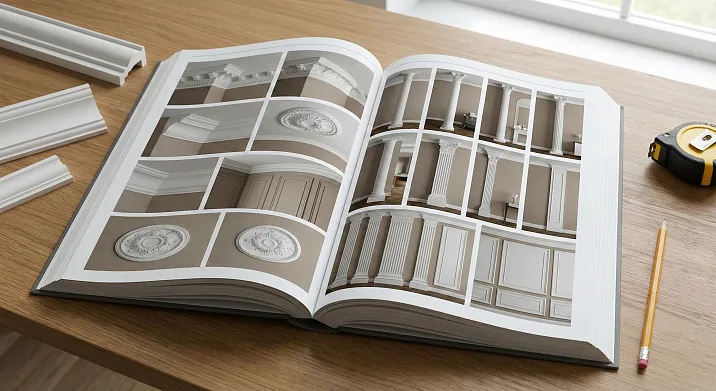
Imagine: you are starting a renovation of a 140 m² apartment, with a budget of 300-450 thousand rubles for molding, a classical style with elements of neoclassicism, 3.2-meter ceilings, needing cornices, moldings for boiserie, floor skirting boards, three ceiling rosettes, door overlays, two columns for zoning the living room. The task is to find all of this from one manufacturer, see real photos of the elements, technical specifications (dimensions down to the millimeter, weight, polyurethane density), current prices, calculate the total cost, place an order — without leaving home, without visiting ten hardware stores, without flipping through paper catalogs from a decade ago with outdated assortments.
Polyurethane molding catalog prices— a query entered into search engines 15-20 thousand times monthly (according to Yandex.Wordstat). People are looking for a convenient selection tool: a structured online catalog with filters (by size, style, price, collection), detailed product cards (photos from all angles, drawings, specifications), current prices (updated weekly, not outdated price lists from a year ago), the ability to compare items (cornice A vs. cornice B — how they differ, which to choose), a cart and online ordering (without calling managers, filling out paper forms, waiting for invoices via email).
A modern molding catalog is not a list of SKUs with prices (a boring 200-line Excel file where cornice C-245 costs 850 rub./meter, but it's unclear what it looks like, how wide it is, if it suits your interior). It is an interactive platform: visualization (360° photos, ability to zoom, examine relief details), filtering (specified "cornices 120-150 mm wide, classical style, price up to 1000 rub./meter" — the system returned 8 suitable items out of 300 in the category), comparison (added three cornices for comparison, you see a table: dimensions, price, polyurethane density, style, stock availability), calculation (entered a room perimeter of 48 meters, the system calculated the number of cornices considering standard 2-meter section lengths, the total cost), ordering (added to cart, filled in delivery address, paid online or chose payment upon receipt).
This article is an instruction manual for using a modern online molding catalog. We will break down the catalog structure (how categories, subcategories, collections are organized), filter functionality (how to find what you need among thousands of items in 30 seconds), the anatomy of a product card (what information is critical for selection, how to read technical specifications), the element comparison mechanism (methodology for comparing analogues), the ordering process (from adding to cart to receiving the shipment), working with PDF catalogs (when they are convenient, how to download, how to use offline). The goal is to turn the selection of molding from chaotic browsing of websites into a structured process that saves time, nerves, and money.

Architecture of a modern online catalog: navigation logic




Three-level category hierarchy
Professionalonline molding catalogis built on the principle "from general to specific" — three levels of detail, allowing quick narrowing of the search from 2000 items to 10-20 relevant ones.
Level 1 — Macro-categories (by element function):
Ceiling elements — cornices (straight and corner), rosettes (round, oval, square), coffers, domes. Everything mounted on the ceiling or at the ceiling-wall junction.
Wall elements — moldings (straight, flexible, corner), panels, friezes, pilasters, half-columns, overlays. Decoration installed on vertical surfaces.
Floor elements — skirting boards (straight, flexible, corner), borders, thresholds. Framing of the wall-floor junction.
Door and window elements — architraves, portals, pediments, keystones, consoles. Framing of openings.
Columns and supports — full columns, half-columns, pilasters (with bases, shafts, capitals — as sets or separately). Vertical architectural accents.
Decorative elements — consoles, brackets, corner elements, cartouches, medallions, 3D panels. Accents complementing the main elements.
Level 2 — Subcategories (by element type):
Within the macro-category "Ceiling elements" subcategories: smooth cornices (minimalism, no ornament), cornices with dentils (classicism), cornices with modillions (Renaissance), ornamental cornices (Baroque, Rococo), corner cornices (for wall junctions), smooth concentric rosettes, rosettes with floral ornament, rosettes with geometric ornament, square coffers, rectangular coffers.
Level 3 — Collections and series (by style and design):
Within the subcategory "Cornices with dentils" collections: Classic (strict proportions, small dentils, width 80-120 mm), Imperial (large dentils, width 150-200 mm, solemnity), Modern (stylized dentils, geometric, width 100-150 mm).
This hierarchy allows top-down navigation: entered the catalog → selected macro-category "Ceiling elements" → subcategory "Cornices with dentils" → collection "Classic" → see 15-25 specific items (SKUs), each with a photo, dimensions, price.
Our factory also produces:


Horizontal filters: narrowing the selection by parameters
Within any category (even the final, third level) there can be dozens of items. Filters are a tool for instantly eliminating irrelevant options.
Filter by size:
For cornices: width (50-80 mm, 80-120 mm, 120-180 mm, 180-250 mm, over 250 mm), profile height (20-50 mm, 50-100 mm, 100+ mm). Checkboxes — marked the needed ranges, the system kept only items falling within them.
For rosettes: diameter (up to 400 mm, 400-600 mm, 600-900 mm, 900-1200 mm, over 1200 mm).
For baseboards: height (40-60 mm, 60-100 mm, 100-150 mm, 150+ mm).
Filter by Style:
Checkboxes: Classicism, Baroque, Rococo, Empire, Modern, Art Deco, Minimalism, Scandinavian, Loft. Selected "Classicism" — see elements with characteristic features (acanthus, dentils, egg-and-dart, strict proportions). Selected "Minimalism" — see smooth, concise profiles without ornament.
Filter by Price:
Slider or input fields: minimum and maximum price per unit (linear meter for cornices/moldings/baseboards, per piece for rosettes/overlays/columns). Set "up to 800 rub./meter" — system filtered out everything more expensive.
Filter by Availability:
Checkbox "In stock" — shows items that ship on the day of order or the next day (no 7-14 day production wait). Critical for tight renovation deadlines.
Filter by collection:
If the manufacturer organizes items into designer collections (a set of elements developed in a unified style, compatible with each other), you can filter by collection name. For example, the "Versailles" collection — Baroque elements with lavish scrolls, garlands, high detail. Selected a collection — see all elements from it (cornices, moldings, rosettes, columns), guaranteed to be compatible.
Sorting results:
After applying filters, results can be sorted: by price (low to high or vice versa), by popularity (bestsellers first — what's bought most often, meaning proven in practice), by novelty (new arrivals first — current trends for 2026), by width/height/diameter (smaller to larger).
Example of using filters:
Went to the "Ceiling cornices" category (300 items). Applied filters: width 120-180 mm (filtered out narrow and excessively wide), style Classicism (filtered out Baroque, Minimalism), price up to 1000 rub./meter (filtered out premium segment), in stock (filtered out made-to-order items). Result: 12 items perfectly matching the request. Search time — 30 seconds.
Get Consultation
Anatomy of a product card: reading between the lines
Selected a cornice, clicked — product card opened. What should be there to make an informed purchase decision?
Visual block: multi-angle photography
Main photo: cornice on a white background, front view (profile, relief, proportions visible). High resolution (clickable, opens in full size 2000×2000 pixels — can zoom, examine ornament details, edge sharpness, primer quality).
Additional photos: side view (profile depth, projection from wall visible), end view (element thickness, polyurethane structure on cut visible), angled view (volumetric effect, play of light and shadow on relief), interior photo (cornice installed in a real room — scale, compatibility with ceiling, walls, furniture clear).
Drawing (technical illustration): side view with dimensions in millimeters — width, height, depth of each profile element. Critical for professional installers and designers (need to know exactly how much height the cornice takes from the ceiling, how it matches other elements in size).
360° rotation (optional, premium catalogs): interactive module — rotate the cornice with mouse, see it from all sides.
Identification block: SKU and name
SKU: unique product code (e.g., C-245-PU). C — category (cornice), 245 — catalog number, PU — material (polyurethane). SKU is used when ordering (manager just needs the SKU, they'll immediately understand what you want without lengthy descriptions).
Name: brief description (Ceiling cornice with dentils, classic style, width 150 mm). Name should be informative (not just "Cornice 245", but indicating key characteristics).
Characteristics block: technical parameters
Dimensions:
Width (or height for vertical elements) — main dimension determining visual scale. For cornices: 150 mm (distance from edge adjacent to ceiling to edge projecting into room). For baseboards: height 100 mm (distance from floor to top edge of baseboard on wall).
Profile height (relief depth) — how much the element projects from the base plane. For cornice with dentils: profile height 80 mm (from wall to most protruding point of cornice).
Section length — standard length of one element (usually 2000 mm or 2400 mm for cornices, moldings, baseboards). Important for quantity calculation (room perimeter 50 meters ÷ 2 meter section = 25 sections needed to order).
Weight: kilograms per linear meter (for cornices/moldings/baseboards) or kilograms per piece (for rosettes, overlays). Cornice width 150 mm weighs 1.8 kg/meter — critical information for installation (affects adhesive choice, need for additional fasteners).
Polyurethane density: kg/m³ (320, 350, 400 — higher means stronger, more durable, better quality). Premium segment: 380-400 kg/m³, mid-range: 320-350 kg/m³, budget: 250-300 kg/m³.
Material: polyurethane (full explanation — high-density polyurethane foam, non-flammable, with UV stabilizers, moisture-resistant).
Color: white primed (standard, for painting), ivory, beige (optional with some manufacturers).
Style: classicism, baroque, modern (indicated so buyer immediately understands stylistic affiliation).
Collection: collection name, if element belongs to a designer series (e.g., "Athena" collection — classical elements with acanthus).
SKUs of compatible elements: manufacturer recommendations (cornice C-245 pairs with molding M-118, baseboard P-67, rosette R-34 — elements from the same collection or stylistically compatible).
Price block: cost transparency
Unit price: rubles per linear meter (for cornices/moldings/baseboards) or rubles per piece (for rosettes, overlays, columns). For example, cornice C-245: 850 rub./meter.
Price per section: automatic calculation (2-meter section × 850 rub./meter = 1700 rub.). Convenient for understanding how much one unit of product costs when ordering.
Volume discounts: tiered (for orders of 10-50 meters — 5% discount, 50-100 meters — 10% discount, over 100 meters — 15% discount). Encourages large orders, beneficial for projects (300 m² house, multiple apartments simultaneously).
Stock availability: indicator (green — in stock, shipping tomorrow; yellow — made-to-order, production 7-10 days; red — out of stock, check lead times).
Delivery time: specific dates (if ordered today, delivery February 20, 2026 — clear whether you can meet renovation deadlines).
Description block: context and application
Text description (3-5 paragraphs): who the element suits (apartment owners with ceilings 2.8-3.5 meters, classical or neoclassical style), where it's used (ceiling framing in living rooms, bedrooms, studies), what it pairs with (moldings for boiserie, floor baseboards 100-120 mm high), installation method (adheres with polyurethane glue, corner joints at 45°, no additional fasteners needed), painting method (acrylic paint, two coats, brush and roller).
Advantages of this item: what distinguishes it from analogs (high polyurethane density 380 kg/m³, sharp dentil definition — crisp edges, groove depth 8 mm, triple-layer white primer, dimensional accuracy ±1 mm).
Reviews and rating block
Average rating: stars (4.8 out of 5 based on 127 reviews).
Customer reviews: real opinions (Ivan, Moscow: "Ordered 60 meters for an apartment, excellent quality, clear relief, installed ourselves, adhered easily, looks premium after painting"). Reviews provide practical context — you learn nuances not in the official description (how easy it is to cut, how well the glue holds, appearance after painting).
Action block: adding to cart and comparison
Quantity calculator: input field (enter length in meters, the system will calculate the number of sections and total cost). Example: entered 48 meters (room perimeter), system output: "You need 24 sections of 2 meters each, total cost 40,800 rub. (48 meters × 850 rub./meter), cargo weight 86 kg".
"Add to cart" button: click — item added to cart, you can continue selecting other elements or proceed to checkout.
"Add to compare" button: click — item added to comparison list (you can add 2-4 more analogs, then open comparison table, choose the best).
"Order sample" button: if manufacturer provides samples (40 cm cornice fragment for quality assessment), click — place sample order, arrives in 3-5 days.
Item comparison mechanism: objective selection
Selected three cornices of similar width and style, but from different manufacturers or different collections of one manufacturer. How to choose the best? "Compare" tool generates a table.
Comparison table: parameters in columns
Table columns — items (cornice A, cornice B, cornice C). Rows — comparison parameters.
Visual comparison: photos of all three cornices side by side (differences in relief, proportions are visible).
Dimensions: width (A: 148 mm, B: 152 mm, C: 150 mm), profile height (A: 75 mm, B: 82 mm, C: 80 mm). Differences are visible.
Weight: kg/meter (A: 1.6 kg, B: 1.9 kg, C: 1.8 kg). Cornice B is heavier — either polyurethane density is higher (good), or profile is more massive.
Polyurethane density: A: 320 kg/m³, B: 380 kg/m³, C: 350 kg/m³. B — leader in material quality.
Price per meter: A: 750 rub., B: 950 rub., C: 850 rub. B is 27% more expensive than A, 12% more than C.
Stock availability: A — in stock, B — made-to-order 10 days, C — in stock. If urgency is important, A or C.
Rating: A — 4.5/5 (89 reviews), B — 4.9/5 (156 reviews), C — 4.7/5 (112 reviews). B — leader in customer satisfaction.
Final score (if system offers automatic calculation): quality/price ratio score. A: 0.070 (density somewhat low, price low — budget option). B: 0.063 (maximum density, high price — premium). C: 0.067 (golden mean — quality is decent, price is moderate).
Solution: if budget allows, choose B (maximum quality, high ratings, durability). If budget is limited, C is optimal. A — if saving is critical, but willing to compromise on density.
Cart and checkout: the path from selection to delivery
Selected 48 meters of cornices, 80 meters of moldings, 50 meters of baseboards, three sockets, ten door overlays. Everything is in the cart. What's next?
Cart contents: verification and editing
Opened the cart — you see the list of items:
Cornice C-245, 24 sections × 2 meters = 48 meters, price 850 rub./meter, total 40800 rub.
Molding M-118, 40 sections × 2 meters = 80 meters, price 420 rub./meter, total 33600 rub.
Baseboard P-67, 25 sections × 2 meters = 50 meters, price 650 rub./meter, total 32500 rub.
Socket R-34, 3 pieces × 6500 rub./piece, total 19500 rub.
Overlay N-12, 10 pieces × 850 rub./piece, total 8500 rub.
Total items: 134900 rub.
You can edit the quantity (increase or decrease), delete an item, add more products (return to catalog).
Applying a promo code or discount
Field "Promo code" — if you have a promo code (e.g., received for subscribing to the newsletter, participating in a promotion), enter it — the system recalculates the amount with the discount. Promo code WINTER2026 — 5% discount, total 128155 rub.
Automatic volume discount (if the system provides it): order over 100 thousand rubles — 7% discount, total 125523 rub.
Delivery calculation
Enter the delivery city (Moscow, Saint Petersburg, Yekaterinburg, Novosibirsk — list or input field). The system calculates the cost and delivery time.
Example:
Moscow: courier delivery to door 2500 rub., timeframe 1-2 days (if the product is in stock at the Moscow warehouse).
Yekaterinburg: delivery by transport company to terminal 8500 rub., timeframe 5-7 days. Delivery to door +3000 rub., timeframe +1 day.
Pickup from manufacturer's warehouse: free, you can pick up tomorrow (if you are located in the manufacturer's city).
Total order cost: items 125523 rub. + delivery 8500 rub. = 134023 rub.
Filling in contact details
Form: Full name (Ivanov Ivan Ivanovich), phone (+7 912 345-67-89), email ([email protected]), delivery address (city, street, house, apartment, postal code). Comment (if you need to specify details — "call an hour before delivery", "leave with the concierge").
Selecting payment method
Online card payment (bank card Visa/MasterCard/Mir, funds are debited immediately, order is confirmed instantly).
Payment upon receipt (cash or card to courier/at transport company terminal). Convenient if you don't want to pay in advance, want to see the product first.
Bank transfer for legal entities (an invoice is issued to the company's bank account, you pay via bank, after payment is received the order is shipped).
Installment plan (if the store works with partner banks — 3-12 months interest-free, online approval in 5 minutes).
Order confirmation
Click the "Place Order" button. The system generates an order, assigns a number (No. 12345), and sends a confirmation email to you (order number, items, total amount, address, delivery timeframe). The store manager contacts you by phone within 1-3 hours (clarifies details, confirms availability of all items, coordinates the shipping date).
Order tracking
In your personal account on the website or by order number, you see the status: placed → paid → being assembled at warehouse → shipped → in transit → arrived in your city → being delivered by courier → received. Updates are sent via SMS or email.
PDF catalog: offline alternative
Not everyone has constant internet access at the site (construction site, country house without Wi-Fi). Or it's more convenient to flip through the catalog on a tablet while showing options to a client (designers, foremen). For such cases — a PDF catalog.
What is a PDF catalog of moldings
A PDF file (usually 50-150 pages, size 15-50 MB) containing a structured list of all items with photos, article numbers, dimensions, and prices. Downloaded from the manufacturer's website for free (usually after registration or subscribing to the newsletter — the manufacturer gets your email for marketing, you get the catalog).
Structure of the PDF catalog
Cover: manufacturer's logo, catalog name (Polyurethane Moldings 2026), contacts (phone, email, website).
Table of contents (2-3 pages): list of categories with page numbers (Ceiling Cornices — p. 5, Wall Moldings — p. 28, Baseboards — p. 45, Rosettes — p. 60, etc.). Clickable links (in PDF you can click on a category to go to the desired page).
Category pages: each category starts with a heading (Ceiling Cornices), followed by a grid of items (usually 4-6 items per page). Each item: photo (front view), article number, name, dimensions (width × height × section length), weight (kg/m), price (RUB/meter or RUB/piece). Compact, visual, convenient for comparing adjacent items.
Article number index (last pages): alphabetical list of all article numbers with page numbers (quickly find a specific item if you know the article number).
How to use the PDF catalog
During a client meeting: a designer shows options to the client on a tablet (you flip through the PDF, the client sees photos, you comment). The client selects liked items, you write down the article numbers, then place an order via the website or by phone.
On site without internet: a foreman checks against the catalog (which cornice was ordered — article C-245, width 150 mm, verifies the delivered goods for compliance).
For cost estimate: a construction company downloads the PDF catalog with prices, uses it to prepare an estimate for the client (cornice C-245 — 850 RUB/meter, 48 meters = 40,800 RUB, molding M-118 — 420 RUB/meter, 80 meters = 33,600 RUB, total materials 134,900 RUB).
Relevance of the PDF catalog
Problem: prices change (every quarter, half-year, year — depends on the manufacturer, economic situation, currency exchange rates, raw material costs). A downloaded PDF catalog may contain outdated prices after six months.
Solution: the cover or first page of the PDF catalog indicates the validity date (Price list valid from February 1, 2026 to May 31, 2026). The manufacturer updates the PDF catalog every 3-6 months, publishing a new version on the website. Before ordering, check the date of your catalog; if older than 6 months — download a fresh one or clarify prices on the website/by phone.
Frequently asked questions about working with the catalog
How do I know how much molding I need for an apartment?
In the product card (for cornices, moldings, baseboards) there is a calculator: enter the length in meters, the system calculates the number of sections. To calculate length: perimeter of the room (sum of lengths of all walls). For example, a room 5×6 meters, perimeter 22 meters. If gluing cornices along the perimeter, you need 22 meters of cornices (the system will calculate 11 sections of 2 meters, accounting for +5-10% margin for corner trimming).
For rosettes: one rosette per room (in the center of the ceiling, where the chandelier is), or several rosettes if the ceiling is large (hall 40 m² — three rosettes compositionally possible).
For moldings (boiserie, wall frames): depends on the design project. If making frames sized 1×1.5 meters (perimeter of one frame 5 meters), three frames per wall — 15 meters of moldings for one wall.
If it's difficult to calculate yourself — contact a manager (phone/email/chat on the website), describe the project (room area, ceiling height, what you plan to decorate), the manager will calculate the quantity for free.
Can I order molding not in whole sections, but by exact meterage?
Most manufacturers sell by sections (cornice length 2 meters — minimum order unit). If you need 48.5 meters, order 25 sections (50 meters), 1.5 meters remain as spare (useful during installation — if you make a cutting mistake, damage a section, you have a spare).
Some manufacturers cut to order (you specify the exact meterage and cut sizes, production cuts before shipping), but this is custom order (lead time +3-7 days), not always available.
Are prices in the catalog with or without VAT?
For individuals (purchase for own apartment, house) prices are indicated with VAT (final price you pay). For legal entities (companies, sole proprietors) prices may be indicated without VAT (in the product card there will be a note "+VAT 20%", the final price when placing the order will increase by 20%).
Check in the catalog description or with a manager.
Why does the price on the website differ from the price in the PDF catalog?
The PDF catalog is updated less frequently (every 3-6 months), while prices on the website are more current (updated weekly or monthly). If you see a discrepancy, refer to the price on the website (it is the valid one).
Can I return molding if it doesn't fit?
It depends on the reason. If the product is of good quality (without defects) but doesn't suit you in size or style (you made a mistake in selection) — a return is possible within 14 days of receipt, provided the packaging is unopened and the product is unused (Consumer Protection Law). You return it to the store (or send it via a transport company at your own expense) and receive a refund for the product (shipping costs are not reimbursed).
If the product is defective (cracks, chips, dimensions do not match those stated) — return or exchange within the warranty period (usually 12-24 months), with the cost of return shipping paid by the seller.
How to check the quality of molding upon receipt?
Inspection upon receipt (before payment, if payment is upon receipt; or immediately after delivery, if payment was made online):
Is the packaging intact (boxes not dented, not opened)?
Does the number of sections match the order (recount them)?
Appearance of elements (no cracks, chips, voids)?
Do the dimensions match (measure the width of several sections with a tape measure — should match the stated dimensions ±2 mm)?
If you find a discrepancy — create a report (photos, description), contact the seller, and arrange a return or exchange.
Conclusion: The catalog as a tool for informed choice
Price list for molding in the format of a modern interactive catalog — not a dry list of numbers, but a full-fledged information system that transforms the selection of decor from agonizing guesswork into a structured process. Filters eliminate irrelevant options in seconds (from 300 cornices, they leave 12 suitable ones), product cards reveal every item down to the smallest details (dimensions to the millimeter, weight, polyurethane density, photos from all angles, drawings, applications, reviews), comparing items provides an objective picture (not emotions of 'like/dislike', but a table of parameters, quality/price scores), the cart and checkout save time (no need to call, dictate article numbers, wait for invoices — everything online in 5 minutes).
Catalog with photos and prices solves three tasks simultaneously: it inspires (you see hundreds of options, understand the possibilities of decor, ideas for the interior are born), informs (you get the technical data necessary for selection and quantity calculation), and sells (transparent prices, convenient checkout, fast delivery — purchase barriers are minimal).
The PDF catalog complements the online version for offline situations (client meetings, work on sites without internet, estimate preparation), but requires attention to currency (check the date, update every six months).
The company STAVROS offerspolyurethane molding catalog, uniting 2000+ items across all categories: ceiling cornices (80 profiles, width from 50 to 300 mm, styles from minimalism to baroque, prices 320-1800 rub./meter), wall moldings (120 profiles, width 30-150 mm, smooth and ornamental, flexible and rigid, prices 180-1200 rub./meter), floor skirting boards (60 profiles, height 40-180 mm, prices 280-1400 rub./meter), ceiling rosettes (90 models, diameters 200-1500 mm, prices 1200-28000 rub./piece), decorative overlays (200+ models, sizes from 40×40 mm to 600×1200 mm, prices 150-8000 rub./piece), columns and pilasters (full sets, heights 1800-3200 mm, prices 8000-45000 rub./set).
The structure of the STAVROS catalog is logical: macro-categories on the main page (icons with names, one click — go to the category), subcategories within (smooth cornices, with dentils, ornamental, corner), collections (Classic, Baroque, Modern, Empire — designer series of matching elements). Filters work quickly (size, style, price, availability, collection — checkboxes and sliders, results update instantly), sorting is flexible (by price, popularity, novelty, size).
STAVROS product cards are maximally informative: 5-8 photos of each item (front view, side view, end view, angled view, in interior, close-up of relief), technical drawing with dimensions, full characteristics (material, density 320-400 kg/m³, weight, dimensions accurate to the millimeter, section length, style, collection), description of application (3-4 paragraphs: for whom, where, how to install, what to combine with), recommendations for matching elements (article numbers of moldings, skirting boards, rosettes from the same collection), customer reviews (real opinions with ratings), quantity calculator (enter the footage, the system calculates sections and cost).
STAVROS prices are transparent: indicated per linear meter (for cornices, moldings, skirting boards) and per piece (for rosettes, overlays, columns), include VAT for individuals, and are updated weekly (currency is guaranteed). Volume discounts are graduated (10-50 meters -5%, 50-100 meters -10%, more than 100 meters -15%), promo codes are valid (subscribing to the newsletter gives a 5% promo code, participation in promotions — up to 10-15%).
The functionality of the STAVROS cart is convenient: you see all items listed, can edit quantities, delete, return to the catalog for additions, apply promo codes, see the total amount including discounts, calculate delivery to your city (automatic calculation — enter the city, the system provides cost and timeframe), choose a payment method (online card, upon receipt, non-cash for legal entities, installment plan 3-12 months), and place an order in 2-3 minutes.
The STAVROS PDF catalog is available for download (120 pages, size 28 MB, contains all 2000+ items with photos, article numbers, dimensions, prices), is updated quarterly (current version — February 2026, valid until May 2026), and is free (downloadable after registration on the website or subscribing to the newsletter).
STAVROS service after selection in the catalog: assistance from managers in quantity calculation (free consultation by phone, email, chat — describe your project, get a calculation in 10-30 minutes), samples for evaluation (order trial elements, receive them in 3-5 days, physically assess quality before the main order), delivery (warehouses in Moscow and St. Petersburg, shipment the day after payment, delivery across Russia 2-10 days depending on the region, protective packaging — bubble wrap + corrugated cardboard, transport damage is excluded), 24-month warranty (if you find a manufacturing defect — replacement or refund without questions).
Choose STAVROS — choose a catalog that transforms the chaos of thousands of options into a structured choice, providing complete information for decision-making, saving time, and eliminating errors. Your interior deserves decor chosen consciously — the STAVROS catalog is the tool for this choice.