Article Contents:
- Philosophy of personalization: from mass to unique
- Tired of sameness
- Hardware as a signature
- Economics of renewal
- Handmade wooden handles: from craft to art
- Handcrafted and Unique
- Forms: from minimalism to sculpture
- Wood species and textures
- Finishing and treatments
- Combined Solutions
- Carved balusters: vertical sculpture
- From simple to complex
- Style Solutions
- Wood Species for Carving
- Finishing carved balusters
- Decorative inlays: details as accents
- Cornices and Molding
- Corner Elements
- Garlands and friezes
- Cartouches and shields
- Brackets and Consoles
- Customization practice: from idea to implementation
- Analysis of existing furniture
- Hardware selection
- Installation
- Conclusion: A wooden house is life filled with meaning
- Style solutions for customization
- Modern furniture with wooden accents
- Classic furniture: enhancing character
- Vintage and eclectic
- Where to buy and how to choose
- Specialized Manufacturers
- Quality Criteria
- Frequently Asked Questions
- Conclusion: details create the whole

Mass production stripped furniture of soul — thousands of identical chests, millions of identical wardrobes, endless rows of standard tables filled apartments around the world. But in 2026, the pendulum swung in the opposite direction: people are tired of uniformity, they need uniqueness, individuality, history. And the most accessible way to turn mass-produced furniture into original pieces — change the hardware. Replacing standard handles with handmadeFurniture Handlesfrom solid wood, installing carvedbalustersinstead of simple, adding uniquedecorative elements— all this instantly transforms an ordinary item into a piece reflecting the owner’s personality.
Customization through hardware is not only aesthetics, but also practicality. Instead of buying new expensive furniture, you refresh existing pieces, investing in details. This is eco-friendly (extends the life of items), economical (the cost of hardware is incomparable to the cost of new furniture), creative (you can realize your own ideas). This is democratization of design, where professional results are accessible to anyone willing to invest attention in details.




Philosophy of Personalization: From Mass to Unique




Tired of sameness
Over the last decades, the furniture industry has moved toward standardization. IKEA and its followers created a global language of standard furniture: everywhere the same modules, everywhere identical solutions. This was convenient, accessible, functional—but soulless. Apartments started looking alike, like twins; furniture became an impersonal backdrop.
By the mid-2020s, a critical mass of dissatisfaction had accumulated. People want their homes to tell their stories, reflect their tastes, express their individuality. But buying custom-made furniture is accessible to few—it’s expensive, time-consuming, requires working with designers and craftsmen. Customization through hardware solves this problem: you buy basic furniture (new or existing), then personalize it by replacing parts.
Our factory also produces:


Hardware as a signature
Furniture Handles— it’s the first thing you reach for when opening a cabinet or pulling out a drawer. It’s a point of tactile contact, repeated dozens of times a day. Replacing standard metal handles with custom wooden ones is a simple operation that delivers a powerful effect. Suddenly, a mass-produced chest gains character, individuality, becomes yours.
Custom handles don’t have to be expensive exclusive items. They can be handcrafted by local artisans, wooden handles preserving natural grain, vintage handles from flea markets, even DIY (if you have woodworking or metalworking skills). The key is that they reflect your taste, tell a story, are chosen thoughtfully—not randomly picked.
Get Consultation
Economics of renewal
Replacing furniture is a costly pleasure. A quality solid wood chest costs from 50,000 to 200,000 rubles. A set of customwooden handlesfor the same chest—3,000 to 10,000 rubles. The difference is enormous. Yet, the visual effect of replacing handles is comparable to buying new furniture: the item looks refreshed, fresh, modern.
This is especially relevant for quality furniture purchased 10–20 years ago. The frame, fronts, and countertop are in excellent condition—but the design is outdated. Don’t rush to discard or sell it. Replace the hardware; perhaps repaint the fronts—and you’ll get practically new furniture for a fraction of the original purchase price.
Custom wooden handles: from craft to art
Wooden furniture handlesare experiencing a renaissance. After decades of dominance by cold metal and plastic, the warmth of living material is returning. But this isn’t a simple return—modern wooden handles are more complex, interesting, diverse than ever before.
Handcrafted and unique
Custom handles are made individually or in small batches by artisans. Each handle is the result of manual labor: turning on a lathe, hand-carving, sanding, selecting grain, applying finish. Even if an artisan makes ten identical handles, each will differ in details—the arrangement of growth rings, slight variations in shape, tonal nuances.
This is the opposite of factory stamping. A factory handle from hundreds of thousands of identical units is soulless, faceless. A custom handle from a dozen similar ones is individual, alive, with character. You’re not buying just a functional element, but a piece of a specific person’s work, their skill, their time, their attention to material.
Shapes: from minimalism to sculpture
ModernFurniture Handlesmade of wood vary in shape. Minimalist cylindrical knobs—ideal for modern furniture where clean lines matter. Organic asymmetrical handles, mimicking natural branch curves—perfect for eco-style and biophilic design. Geometric polyhedrons—for Art Deco and mid-century modern interiors.
handle-buttonscan be round, square, octagonal, teardrop-shaped. Their size ranges from miniature 25 mm to large 60 mm—the choice depends on furniture scale and desired effect. A large knob becomes an accent, drawing the eye. A small one dissolves, remaining a delicate detail.
handle-eyeshandles 96 to 320 mm long create horizontal lines, emphasizing furniture geometry. Short knobs (96–128 mm) suit small drawers and doors. Long ones (200–320 mm)—for wide fronts, creating a striking visual accent.
Inset handles— a modern solution where the handle is embedded into the front, creating a smooth surface. It’s minimalist, practical (nothing to catch on), contemporary. Wooden inset handles combine clean form with material warmth.
Wood species and textures
For custom handles, select species with expressive grain and sufficient hardness. Oak—classic, dense wood with large-pored texture, color ranging from light honey to dark brown. Oak handles last decades, acquiring a noble patina of use.
Walnut—dark, noble wood with fine grain and rich tones. Walnut handles look expensive, sophisticated, suitable forclassic furnitureand modern interiors emphasizing luxury.
Ash—light-colored wood with clear, expressive grain. Comparable in strength to oak, but visually lighter, more modern. Ash handles are ideal formodern furnitureScandinavian and minimalist interiors.
Maple—light, fine-grained wood, hard (density up to 750 kg/m³), with a soft cream tone. Maple handles are smooth, pleasant to the touch, suitable for light interiors.
Exotic species—mahogany, rosewood, zebrawood, wenge—are used for exclusive handles. Their unusual colors and textures turn each handle into a miniature work of art.
Finishing and treatments
can be processed differently, creating various visual and tactile effects.Wooden handlescan be processed differently, creating various visual and tactile effects.
Brushing — removal of soft fibers with a stiff brush, emphasizing the relief of growth rings. A brushed handle is tactilely rich, massages the palm upon gripping, and appears textured and three-dimensional.
Burning (yakisugi) — a Japanese technique where wood is burned with a soldering lamp to a surface char, then brushed. This results in a deep black or dark brown color with emphasized texture. Burned wood is resistant to moisture and pests.
Oil finish preserves the naturalness of wood, penetrates the structure, protects, but does not create a surface film. The wood remains warm, breathable, and alive. Oil can be colorless (highlighting the natural tone) or tinted (changing the color while preserving texture visibility).
Wax finish creates a silky surface, soft matte sheen, and additional protection. Wax is applied over oil or on bare wood, then polished by hand.
Lacquer finish is used less often — it creates gloss and durable protection, but removes the wood’s tactile warmth. If lacquer is used, it must be matte, ultra-thin, and water-based.
Combined Solutions
Modern trend — combination of wood with other materials. Wooden handle with brass tips. Walnut bracket with copper rings. Oak button with mother-of-pearl inlay. These combinations create visual richness, tactile variety, and a jewelry-like effect.
Carved balusters: vertical sculpture
Carved Balusters: Vertical Sculpture
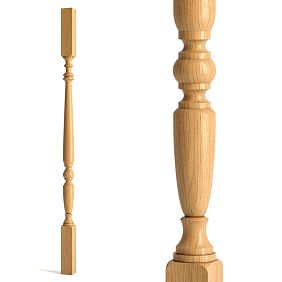
balusters— vertical supports of stair railings — traditionally served as a showcase for the carver’s skill. A carved baluster is a miniature sculpture where each element has meaning, proportion, and visual rhythm.
From simple to complex
Simplest baluster — smooth cylinder or square block. Functionally minimalist, suitable for modern staircases. But if you want to add character, individuality, or connection to tradition — carved balusters are indispensable.
First level of complexity — turned baluster with simple profile: several expansions and contractions creating rhythm and visual dynamics. This is classic, never going out of fashion, suitable for most interiors.
Second level — turned baluster with carved elements: grooves, channels, relief bands. Carving emphasizes individual sections, creates play of light and shadow, adds detail.
Third level — fully carved baluster, where every centimeter is handcrafted: botanical ornaments, geometric patterns, interlacing, shaped elements. This is the pinnacle of carving skill, a one-of-a-kind piece for exclusive interiors.
Style Solutions
Forclassic furnitureand interiors characterized by balusters with botanical motifs: acanthus leaves, grapevines, rosettes, garlands. This is heritage of Greek-Roman tradition, reinterpreted in Renaissance, Baroque, and Neoclassical eras.
Forof modern stylesprefer geometric carved patterns: diamonds, squares, vertical grooves, spiral cuts. This creates visual complexity without historical stylization.
For ethnic interiors (Russian style, Scandinavian, Asian) use motifs characteristic of each culture: Slavic solar symbols, Scandinavian runes and interlacing, Asian dragons and clouds.
Wood Species for Carving
Not every wood is suitable for carving. The species must be soft enough to carve easily, yet dense enough to hold fine details without chipping.
Linden — classic material for carving. Soft, uniform, without pronounced texture (allowing carving to be the main decoration). Linden balusters are stained or tinted after carving, as linden’s natural color is pale.
Ash — slightly harder than linden, carves well, has a pleasant pinkish-brown tone that darkens over time. Ash balusters can be left natural or tinted.
Oak — hard wood, more difficult to carve, requires more effort and a sharper tool. But carved oak balusters are incredibly durable, resistant to mechanical damage, and have expressive texture that complements carving.
Beech — hard, uniform wood, carves well with properly sharpened tools. Beech balusters are strong, hold fine details, and have a delicate pinkish tone.
Finishing carved balusters
Carving is beautiful on its own, but final finish determines the final look. Natural finish (oil, wax) preserves the color and texture of wood, highlights carving through play of light. This is the choice for interiors valuing naturalness.
Tinting changes the color of wood while preserving visibility of texture and carving. Dark tones (walnut, wenge) create solidity and elegance. Grey tones — modernity, restraint. Colored (green, blue) — creativity, playfulness.
Painting — using opaque paint to hide wood texture, leaving visible only the relief of carving. White paint — classic for palace interiors. Black — modern graphic style. Gold or silvering — luxury of Baroque and Rococo.
Patination — technique of artificial aging, where darker paint or wax is rubbed into carved recesses, creating an effect of centuries-old dust accumulation. This gives balusters an antique look, depth, and historic character.
Decorative appliqués: details as accents
decorative elements— small carved details that are glued onto furniture facades, doors, walls, creating visual richness without the need to cut the entire surface.
Rosettes and medallions
Round or oval decorative appliqués with floral or geometric ornaments. Size from 50 to 300 mm in diameter. Rosettes are glued to the center of cabinet doors, corners of chests, above doorways, creating focal points.
Carved rosettes can be simple (one layer of petals, concentric circles) or complex (multi-layer compositions of acanthus leaves, flowers, scrolls). The choice depends on the interior style: for minimalism — simple, for classic — complex.
Corner elements
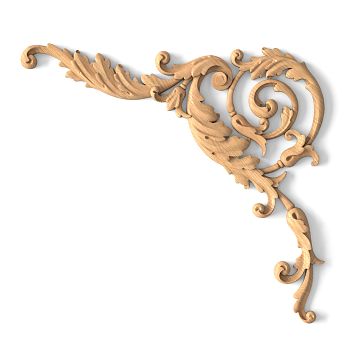
Decorative corner appliqués — a traditional element of classical furniture. They protect corners from damage (function) and decorate them (aesthetics). Corner elements can be symmetrical (identical for all corners) or asymmetrical (different for upper and lower corners).
Carving on corner elements often includes plant motifs flowing downward: leaves, branches, vines. This creates a sense of growth, organic nature, and connection to nature.
Garlands and friezes
Horizontal decorative appliqués imitating hanging garlands of flowers, fruits, ribbons. This is a classical motif, originating from antiquity through the Renaissance and Baroque. Garlands are glued to the upper frieze of cabinets, chests, buffets, creating visual completeness and grandeur.
Garland lengths vary from 200 to 1000 mm, height 50–150 mm. They can be symmetrical (central composition with elements spreading outward) or asymmetrical (free composition).
Cartouches and shields
Decorative appliqués in the shape of medieval shields or baroque cartouches — elements borrowed from heraldry and monumental architecture. Cartouches often contain inscriptions, dates, initials — a way to personalize furniture, turning it into a family heirloom.
On modern furniture, cartouches are used as ironic references to historical styles or as genuinely personal elements (initials, significant dates). The carving can be deep relief or light contour.
Brackets and Consoles
Functional-decorative appliqués imitating load-bearing elements. A carved wooden bracket under a shelf creates visual support (though the actual load is borne by hidden fasteners). Console brackets under a chest’s countertop add architectural and monumental qualities.
Carving on brackets often includes volutes (spiral scrolls), acanthus leaves, geometric steps. These are elements of classical architectural orders, adapted to the furniture scale.
Customization practice: from idea to implementation
Analysis of existing furniture
Before starting customization, assess what you have. Quality furniture made of solid wood or MDF with a decent construction is an excellent base. Cheap furniture made of particleboard with laminate finish is questionable, as its lifespan is limited, and investments in hardware may not pay off.
Inspect the facades: are there cracks, chips, deformations? If yes — repair is needed before customization. Check the fasteners: loose hinges, weak drawer guides should be replaced simultaneously with handles.
Determine the style of the furniture and interior. Modern minimalist furniture requires corresponding hardware — simple forms, restrained materials. Classic — carved or turned elements. Eclectic — can take anything, but moderation is needed.
Selection of hardware
Buy furniture handles— can be found in specialized stores, with craftsmen, on handmade platforms, vintage markets. Pay attention to:
Center-to-center distance — critical for pull handles. Standard sizes: 96, 128, 160, 192, 256, 320 mm. Measure the distance between existing holes on the facade. If the new handle has a different center-to-center distance, you’ll need to drill new holes and fill the old ones.
Material and weight — heavy, bulky handles require strong fastening. Ensure the facades can support the weight. Light wooden handles are universal.
Style and proportions — the handle must match the scale of the furniture. A large handle on a small drawer looks ridiculous, a small one on a large door disappears. The handle’s style should resonate with the furniture’s style or create an intentional contrast.
Color and finish — coordinate with facade colors. On dark furniture, light handles are striking (contrast), on light furniture — either the same light color (monochrome) or dark/colored (accent).
Installation
Replacementfurniture handles— a simple operation accessible to everyone. Tools: screwdriver or drill, ruler, pencil, (optional) drill if new holes are needed.
Removing old handles: unscrew the screws from the back of the facade, remove the handles. If screws are seized — use penetrating lubricant (WD-40).
Marking new holes (if center-to-center distance changed): accurately measure and mark the centers of holes. Use a level to ensure handles are strictly horizontal. A 1 mm error will be noticeable.
Drilling: if new holes are needed, drill from the front of the facade using a drill bit 1–2 mm larger than the screw diameter. Drill at medium speed, without heavy pressure, to avoid chipping.
Filling old holes: with wood putty matching the facade color. After drying, sand and repaint if necessary.
Installing new handles: Insert the screw through the hole in the facade, screw the handle from the front side. Tighten evenly, do not over-tighten (may crack wooden handles or deform the facade).
Integration of decorative elements
Decorative InsertsMounted with glue — carpentry PVA, epoxy, or special wood glue. The facade surface must be clean and degreased. Apply glue to the back of the applique, press it onto the facade, and fix it with weight or clamps for 15–30 minutes.
For heavy appliques, thin finishing nails (nails without heads) are additionally used, which are driven into the recess, spackled, and painted.
Placing appliques requires artistic sense. Symmetry, balance, proportions — key principles. The rosette must be exactly centered on the door panel. Corner elements on all four corners. Garland strictly horizontally at the same height.
Style-based customization solutions
Modern furniture with wooden accents
This is a story about multitasking. The sofa transforms into a full-sized bed with an orthopedic mattress. The coffee table unfolds into a dining table for eight. The shelving unit simultaneously serves as a partition, zoning the space, a display case for collections, and a storage area. The chair is equipped with built-in wireless charging, USB ports, and adjustable reading lights.— clean lines, minimal decoration, functionality. Customization here is delicate: replacing plastic or basic metal handles withsimple wooden formsCylindrical brackets from light ash or oak on white or gray facades. Round buttons from walnut on dark facades.
Adding wooden handles makesmodern furniturewarmer, more tactile, and connects with nature. This technique is popular in Scandinavian and Japanese interiors, where minimalist forms combine with natural materials.
Decorative appliques in modern style are rarely used — only if they are geometric elements supporting the overall interior graphics. Carved floral ornaments will clash.
Classic furniture: enhancing character
Classic Furnitureoften comes with basic hardware — simple buttons or brackets. Replacing withcarved or turned handlesimmediately elevates the status of the item. Brass handles with wooden appliques, carved wooden brackets with inlays, rosette-shaped buttons.
Addingdecorative inserts— garlands, rosettes, corner elements — transforms a simple chest into a baroque masterpiece. The key is not to overdo it. If every surface is covered with carving, it creates overload and visual noise.
Balance: several key accents (central rosette, garland on frieze, corner elements) against calm surfaces. This creates rhythm, hierarchy, visual breathing.
Vintage and eclectic
Vintage furniture found at flea markets or inherited from grandmother often has worn or missing handles. Customization here is a way to extend the life of the item, give it a new character, and integrate it into a modern interior.
Two paths are possible: historically accurate restoration — searching for handles matching the era and style of the furniture, or creative transformation — installing modern handles on old furniture, creating an eclectic effect, a dialogue between eras.
Soviet chest from the 70s with minimalist Japanese wooden buttons. Victorian buffet with geometric brass handles in the Art Deco style. This creates uniqueness, narrative, personal history of the item.
Where to buy and how to choose
Specialized Manufacturers
Company STAVROS offers a wide rangewooden handles from solid wood— from simple cylindricalbrackets— to carved exclusive models.handles without coating— from oak, ash, walnut — for those who want to stain or paint them themselves.Handles with Finish— ready for installation.
Also in the assortmentcarved balusters— varying in complexity — from simple turned to fully hand-carved.Decorative InsertsOutlets, garlands, corner elements, appliqués — for customizing furniture and interiors.
All items made from selected solid wood, undergo quality kiln-drying, and are processed using modern equipment. Custom orders based on your sketches or photos are possible.
Quality criteria
When choosing hardware, pay attention to:
Wood quality: uniform color, absence of large knots and cracks (unless it’s a designer choice), proper drying (humidity 8–12%).
Processing accuracy: smooth surface, clear engraving, symmetrical shapes. Poorly processed handles will scratch your hand, and low-quality engraving with chips will quickly deteriorate.
Fastening elements: screws must be of sufficient length (usually 25–35 mm for standard fronts), made of stainless steel or brass (won’t rust).
Finish coating: even, without streaks, spots, or uneven coverage. Oil and wax must be fully absorbed and polished. Lacquer should be smooth, without bubbles or "orange peel" effect.
Frequently asked questions
Is it difficult to replace furniture handles yourself?
No, it’s one of the simplest operations. You only need a screwdriver and a few minutes per handle. If the center-to-center distance matches the existing one — even easier. If not — you’ll need a drill and skill in drilling straight holes.
How to choose the right handle size for furniture?
General rule: the handle should occupy 1/3 — 1/2 of the front’s width. For narrow doors (300 mm) — short knobs (96–128 mm) or buttons. For wide doors (600+ mm) — long knobs (160–256 mm). Drawer handles on a chest are usually shorter than cabinet door handles.
Can wooden handles be installed on kitchen furniture?
Yes, but quality protective treatment is essential — oil-wax or lacquer resistant to moisture and grease. Wood near the sink and stove requires extra attention: wipe handles regularly and renew the coating once a year.
Is customizing furniture with hardware expensive?
It depends on scale. A set of qualitywooden handleshandles for a chest (6–8 pieces) costs 3000–8000 rubles. This is incomparable to the price of a new chest (50,000–150,000 rubles). Even with decorative appliqués (1000–3000 per piece), customization is 10–20 times cheaper than buying new furniture.
How to care for wooden handles?
Wipe with a soft, damp cloth without aggressive chemicals. Once a year, treat with wood oil (if the finish is oil-based) or polish (if lacquered). Frequent use naturally polishes wood by hand, giving it a noble sheen.
Can different handles be combined in one interior?
Yes, but cautiously. Different rooms — different handles (e.g., bedroom vs. living room) — is acceptable. Within one room, on different furniture — also possible, but it’s best to maintain a consistent style, material, or color. Different handles on one piece of furniture — only as an intentional design choice.
Where to find a craftsman for custom hardware?
Search on social media (Instagram, VK) using hashtags #woodenhandles, #carvedhardware, #customfurniture. On handmade platforms (Yarmarka Mastertov, Etsy). At local artisan fairs. Or contact STAVROS, which offers custom orders.
Does customization increase furniture’s resale value?
It depends on the quality of customization. Professionally executed with quality hardware — yes, the furniture becomes unique and thus more valuable. Amateurish with cheap hardware — may lower the price. If you plan to sell — keep original handles so the buyer can choose.
How to incorporate vintage handles into a modern interior?
Through balance. Vintage handles on one piece of furniture (e.g., chest or buffet) become an accent against a modern backdrop. The rest of the furniture — minimalist and neutral. This creates eclectic style, dialogue between eras, and personal history within the space.
Is customization more eco-friendly than buying new furniture?
Definitely yes. Extending the life of existing furniture reduces consumption of new resources, minimizes waste, saves energy used in production and transportation. Especially if the hardware is made from local materials and produced locally. This is the philosophy of circular economy — use what you have for as long and as effectively as possible.
Conclusion: details create the whole
Customizing furniture through hardware is not just cost-saving and a creative process. It’s a way to create a space that tells your story, reflects your taste, and expresses your individuality. Everyhandcrafted wooden handle, eachcarved baluster, eachdecorative insert— it is a choice, a decision, an act of creativity.
In the era of mass production, customization brings us back control over our environment. You are not simply buying a ready-made standard solution — you are creating something unique. Your chest of drawers is not like a million others. Your staircase tells the story of the carver who crafted the balusters. Your furniture lives, changes, accumulates the patina of use, becomes a family heirloom.
The company STAVROS supports this philosophy, offering a wide selection offurniture handles, balusters, decorative elements made of solid wood. From simple functional to carved custom — everyone will find hardware matching their vision. The option for individual orders allows you to realize any idea: from an exact replica of a historical handle to a modern sculptural form.
Start small: replace handles on one piece of furniture. See how a familiar chest of drawers transforms, how new details change its character. Feel the tactile pleasure of touching warm wood instead of cold metal. Feel pride when guests ask: 'Where did you find such beautiful furniture?' — and you reply: 'It's my work, I customized it.'
Create interiors where every detail matters. WhereModern Furniturebecomes unique through custom hardware. WhereClassic Furnituregains new life through carved elements. Where the home stops being a set of standard items and becomes a space reflecting you — your values, your taste, your story. Customization through hardware is accessible luxury of individuality in a world of mass production.