












































































Article Contents:
- Main Differences Between Duroplastic and Polyurethane and Polystyrene
- Polystyrene: Affordable Fragility
- Polyurethane: Elastic Premium Quality
- Duroplastic: The Golden Middle with a Lean Toward Quality
- Comparative Properties Table
- Cornices and Skirting Boards: Creating a Unified Decor Line
- Ceiling Cornices: Finishing the Upper Surface
- Floor Skirting Boards: Protection and Aesthetics
- Wall Moldings: Vertical Division
- Unity of Style and Profile
- Application in Residential and Commercial Interiors
- Residential Interiors: From Budget to Premium
- Commercial Spaces: Reliability Under Load
- Public Buildings: Scale and Durability
- Restoration of historical interiors
- Installation and Maintenance of Duroplastic Items
- Surface Preparation
- Choosing adhesive and fasteners
- Cutting and joining
- Installation process
- Painting
- Maintenance During Operation
- Cost and Advantages of a Durable Material
- Pricing Positioning
- Calculation of Total Ownership Cost
- Hidden Advantages of Quality
- Investment in Real Estate
- Ecological Aspects
- Conclusion: Durability as a Philosophy of Choice
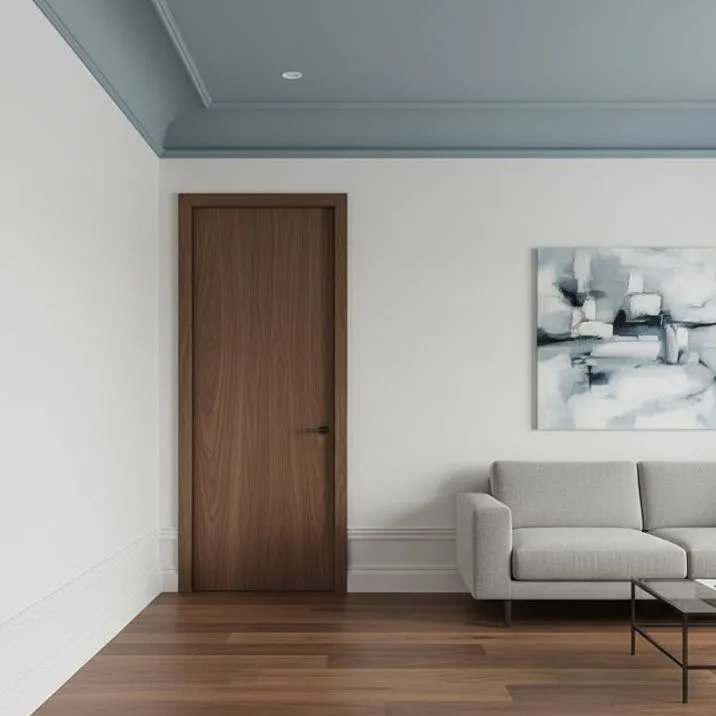
Repair is complete. Walls are leveled, ceiling is stretched, floor is laid. But something is off. The room looks unfinished, empty, lacking character. There’s no final note that transforms a set of finished surfaces into a harmonious interior. And here, cornices and skirting boards enter the scene — elements that many consider secondary, while professionals know are critically important.
The problem is material selection. Cheap polystyrene looks exactly that — cheap. Gypsum is heavy, fragile, difficult to install. Wood is fussy and expensive. Polystyrene is lightweight both literally and figuratively. And here comes duroplastic — a material that combines strength, aesthetics, durability, and reasonable price.
Duroplastic Cornice и Duroplastic Skirting Boards They have conquered the market not through marketing, but through real advantages. Decades without losing appearance, absolute water resistance, impact resistance, perfect geometry — these are not advertising promises, but proven realities. Let’s examine in detail what duroplastic is, how it differs from other materials, and why professionals choose it specifically.


Main differences of duroplastic from polyurethane and polystyrene
Decorative trim items are made from various materials. Three main ones are polystyrene, polyurethane, and duroplastic. They look similar but have radically different physical properties.




Polystyrene: accessible fragility
Polystyrene is obtained by foaming a polymer followed by extrusion. The result is a porous structure, 95-98% air. Density of 30-45 kg/m³ makes the material lightweight — a two-meter profile weighs 200-300 grams.
Lightness is the main advantage and the primary drawback simultaneously. Installation is simple, does not require strong fasteners, just glue. But mechanical strength is minimal. A random impact leaves a dent, a sharp object scratches the surface, and falling from height results in cracking.
Temperature resistance is limited to 80°C. When heated, the material softens, deforms, and loses its shape. Organic solvents — acetone, gasoline, white spirit — destroy it instantly. This is critical when choosing adhesives and paints — only water-based compositions.
Price — the main argument in favor of polystyrene. A meter of ceiling cornice costs 150-400 rubles. For a standard room with 18-20 meters of perimeter, you will need 2700-8000 rubles. Even affordable with the most modest budget.
Our factory also produces:


Polyurethane: elastic premium
Polyurethane is synthesized by reacting a polyol and an isocyanate. The technology is more complex, and the raw materials are more expensive. The material foams during the reaction, filling the mold. The density of the finished product is 200-350 kg/m³ — 5-10 times higher than polystyrene.
Elasticity — the key property of polyurethane. The material bends without breaking and returns to its original shape after the load is removed. Special flexible profiles can be bent for decorating arches, columns, and curved surfaces.
High chemical resistance. Polyurethane withstands contact with most solvents, allowing the use of any paints and adhesives. Thermal resistance up to 110-130°C allows installation near heat sources.
The cost of polyurethane is 4-6 times higher than polystyrene. A meter of cornice costs 800-1500 rubles. For a room, you will need 14400-30000 rubles. The price reflects the complexity of production and superior operational properties.
Get Consultation
Duroplastic: the golden middle with a tilt toward quality
Duroplastic is high-density polystyrene that has undergone additional processing under pressure and temperature. The technology is patented by the Belgian company Orac Decor, although today many factories produce analogs.
The compaction process collapses air bubbles in the polystyrene structure, fuses cell walls, and creates a monolithic mass. Density increases to 350-420 kg/m³ — like polyurethane.
Ceiling baseboard duroplastic weighs 8-10 times more than polystyrene of the same size.
Strength is comparable to polyurethane, but there is no elasticity. Duroplastic is rigid and does not bend. This limits its use to straight sections, but ensures perfect geometry without sagging on long profiles.
Surface is dense, smooth, practically non-porous. After painting, it resembles quality plastic. Does not absorb moisture, does not retain dust, and is easily cleaned with any cleaning agents.
The price of duroplastic is between polystyrene and polyurethane. A meter of cornice costs 600-1200 rubles, which is 2-4 times more than polystyrene, but 1.5-2 times cheaper than polyurethane. For a room, you will need 10800-24000 rubles.
Comparative table of properties
Density: polystyrene 30-45 kg/m³, duroplastic 350-420 kg/m³, polyurethane 200-350 kg/m³. Duroplastic is the densest, therefore the strongest.
Mechanical strength: polystyrene low, duroplastic high, polyurethane high. Polystyrene breaks under impact, duroplastic and polyurethane withstand it.
Flexibility: polystyrene absent, duroplastic absent, polyurethane high. For curved surfaces, only polyurethane.
Thermal resistance: polystyrene up to 80°C, duroplastic up to 90-110°C, polyurethane up to 110-130°C. All are suitable for residential spaces.
Moisture resistance: all three materials are absolutely moisture-resistant, water absorption less than 2%. Can be used in humid areas.
Service life: polystyrene 5-15 years depending on installation location, duroplastic 25-30 years, polyurethane 25-30 years. Long-lasting materials pay for themselves through the absence of replacement needs.
Cornices and baseboards: creating a unified decorative line
Decorative trim items do not exist in isolation. Ceiling cornices, baseboards, wall moldings — all these are parts of a unified system forming the visual framework of the interior.
Ceiling cornices: finishing the upper plane
Duroplastic Cornice Installed at the junction of wall and ceiling. Functionally, it conceals the technological gap, uneven junctions, cables, and utilities. Aesthetically — it completes the interior, creating a transition between vertical and horizontal planes.
Profiles vary in width from narrow 30-50 mm to wide 150-200 mm. Narrow ones suit low ceilings 2.5-2.7 m, where a wide cornice would visually lower the ceiling even more. Wide profiles create an impression in high spaces 3 m and above, matching the scale of the space.
Surface relief varies from smooth minimalist to ornately decorated. Smooth profiles suit modern interiors, emphasizing clean lines. Relief profiles with classical ornaments are for historical styles, neoclassicism, art deco.
Duropolymer cornice for stretch ceiling — special category. These cornices are installed before stretching the fabric, serving as a base for attaching the stretch ceiling trim. Requirements for rigidity and geometric precision are maximum — duropolymer handles this perfectly.
Baseboards: protection and aesthetics
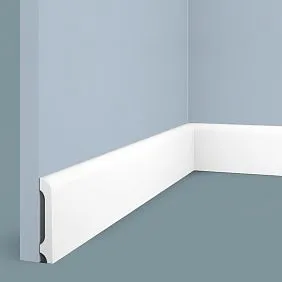
Duroplastic Skirting Boards Protect the lower part of walls from mechanical damage, conceal the gap between wall and floor, cover cables and utilities. Height varies from classic 70-80 mm to European 100-150 mm.
High baseboards — a trend of recent years. Profiles 100-150 mm visually elongate the room, create a sense of respectability, protect walls at greater heights. Duropolymer ensures the rigidity needed for such dimensions — polystyrene would sag under its own weight.
Cross-section shape can be classic triangular, rectangular, or complex profiled. Classic shapes suit traditional interiors, rectangular sections — for minimalism, complex profiles — for rich decorative solutions.
Baseboard colors are usually white for painting, but colored variants are possible. White is universal, can be painted to match wall color or contrast. Colored options are ready for installation without additional finishing.
Wall moldings: vertical division
Moldings are installed on walls to create decorative panels, frame wallpaper, and zone spaces. Width is usually 30-80 mm, profile can be flat or three-dimensional.
Applications are diverse: separating different wallpaper types, creating classic panels with framing, frames for pictures and mirrors, horizontal division of high walls. Duropolymer moldings maintain sharp geometry and do not sag over long spans.
Placing moldings at different heights creates rhythm. Classic scheme: baseboard at floor level, molding at 60-80 cm (panel boundary), molding at 160-180 cm (upper third boundary), cornice under ceiling. Results in a four-level division system.
Style and profile unity
To create a harmonious interior, cornices, baseboards, and moldings must be from the same collection. Manufacturers develop profile series with a unified stylistic solution — common relief character, proportions, ornament details.
Duropolymer baseboard for ceiling and floor baseboard from the same series create a visual framing of the room. Top and bottom correspond, forming a complete composition. Adding wall moldings enhances the effect.
Color unity is critical. All elements are painted with one color — usually white or to match wall color. Color variations will destroy harmony. Use paint from the same batch for all profiles.
Proportional correspondence is also important. Large profiles look bulky in small rooms, small ones disappear in large spaces. Choose sizes proportionally to room dimensions and ceiling height.
Application in residential and commercial interiors
Duropolymer is universal and suitable for any type of space. However, application specifics vary depending on the space's purpose.
Residential interiors: from budget to premium
In apartments and houses duropolymer cornice solves aesthetic and durability tasks. Ceiling cornices complete the interior, floor baseboards protect walls, wall moldings create decorative accents.
For bedrooms, profiles with delicate relief are suitable, creating a calm atmosphere. Ceiling cornice height 70-100 mm, floor baseboard height 80-100 mm. Color is usually white or pastel tones, harmonizing with the overall palette.
Living rooms suit more expressive profiles. Wide cornices 100-150 mm, high baseboards 100-120 mm, wall moldings possible for creating panels. Relief can be richer, accentuating the room's representativeness.
Kitchens and bathrooms require moisture-resistant materials. Duropolymer is ideal — does not fear water, steam, does not swell, does not lose strength. Easily cleaned with any means, does not retain dirt in pores.
Children's rooms value duropolymer's impact resistance. Active play leads to accidental wall impacts — duropolymer baseboards withstand without chips or dents. Material's ecological safety is certified.
Commercial spaces: reliability under load
Offices, stores, hotels, restaurants — wherever foot traffic is high, duropolymer is indispensable. Material's wear resistance guarantees maintaining appearance for years under intensive use.
In office corridors, baseboards are constantly bumped by shoes, carts, and cleaning equipment. In half a year, polystyrene would be covered in dents and chips. Duroplastic retains its original appearance, requiring only periodic wet cleaning.
Stores, with their constant flow of customers, equipment rearrangement, and product deliveries, create extreme conditions for finishes.
Duroplastic Skirting Boards They withstand these loads without requiring replacement for decades.
Hotels value low maintenance requirements. Duroplastic can be cleaned with any disinfectant without damage. This is critical for maintaining sanitary standards with high guest turnover.
Restaurants and cafes combine high foot traffic with increased humidity and temperature fluctuations. Duroplastic remains stable under these conditions, does not deform, and does not lose its appearance.
Public buildings: scale and durability
Museums, theaters, concert halls, and administrative buildings require decor that matches the scale of the architecture. Wide cornices of 150-200 mm, high baseboards of 120-150 mm, and rich reliefs—all of this is implemented in duropolymer.
Durability is especially important in public buildings. Repairs are difficult due to operating schedules and expensive due to scale. A material serving 25-30 years without replacement pays for itself multiple times.
Fire safety regulations are stricter than in residential spaces. Duroplastic has a flammability class of G2-G3, which is permissible for most building types. Certificates confirming compliance with standards are mandatory.
Restoration of historical interiors
During restoration, it is often necessary to restore lost plaster decoration. Manufacturing plaster copies is expensive and time-consuming. Duroplastic allows recreating historical profiles faster and cheaper.
Modern duroplastic molding technologies allow copying complex historical ornaments with high precision. After painting to match old stucco, it is impossible to distinguish from the original.
The weight of duroplastic profiles is 5-7 times less than their gypsum counterparts. This reduces load on aging structures of old buildings, where every kilogram is critical.
Installation and maintenance of duroplastic items
Correct installation is a guarantee of longevity. Duroplastic installation technology has specific features distinguishing it from polystyrene work.
Surface preparation
The base must be flat, clean, dry, and strong. Remove peeling coatings, wash away dust, and ensure humidity no more than 10%. Level irregularities over 5 mm with putty — duroplastic is rigid and will not replicate wall waves.
Priming improves adhesive bond to the base. Use an acrylic penetrating primer. Priming porous bases — plaster, gypsum board, aerated concrete — is especially important.
Marking determines the result. For ceiling cornices, draw a horizontal line around the room at the required height. Use a laser level for precision — even a millimeter incline will be noticeable.
Choosing adhesive and fasteners
Duroplastic profiles are suitable for strong adhesives — liquid nails, polyurethane construction adhesives, epoxy compounds. Acrylic sealants can also be used, but they are less strong. Organic solvents in adhesives are not harmful to duroplastic, unlike polystyrene.
Adhesive alone for heavy duroplastic profiles is insufficient. Additional mechanical fastening is mandatory. Self-tapping screws or finishing nails are installed at 40-50 cm intervals. For baseboards, mounting on clips or special mounting strips is possible.
Self-tapping screw heads are countersunk 2-3 mm below the profile surface. Holes are filled with acrylic putty, then sanded with fine sandpaper after drying. After painting, mounting points are invisible.
Cutting and joining
Duroplastic is dense and cannot be cut with a paper knife. A circular saw with a fine-toothed disc for aluminum or laminate is required. It provides a perfectly flat cut at a precise angle. Metal hacksaw is also suitable, but requires more effort.
Angles are cut at 45 degrees for internal and external joints. Cutting precision is critical — a 1 mm gap on the ceiling will be very noticeable. Use a miter box or a circular saw with precise angle adjustment.
Joints on straight sections are made with a 90-degree straight cut. Profiles are pressed tightly together, and micro-gaps are filled with acrylic sealant. After painting, the joint is invisible.
Apply paint in thin layers. One thick layer will cause streaks and unevenness. Three thin layers will create a smooth, durable finish. Allow drying time between layers — usually 2-4 hours.
Installation process
Start with the longest section, from the inside corner. The first profile sets the direction of the entire line — treat it with maximum attention. Check for levelness with a level.
Next profiles must be tightly joined to the previous ones. Constantly monitor levelness — errors accumulate, and by the end of the perimeter, a noticeable misalignment may form. Adjust position while the adhesive is still wet.
Corners are the most critical moment. Gaps in corners are the first to catch the eye. Fit profiles with maximum precision, fill micro-gaps with sealant, and form a smooth transition with a wet finger.
After installing all profiles, allow the adhesive to fully dry — usually 24 hours. Then fill mounting points with putty, sand, and remove dust. Now you can paint.
Painting
Duroplastic can be painted with any paints — water-based, alkyd, or oil-based. But water-dispersed paints are more convenient — odorless, dry quickly, easy to apply, and tools can be washed with water.
Priming is not mandatory — the dense surface of duroplastic ensures good paint adhesion. But if you want an ideal result, prime with acrylic primer — color will be more uniform, and paint consumption will be less.
For decorative effects, use special paints. Patina creates an aged effect. Metallic paints imitate gold, silver, bronze. Pearlized paints add a noble sheen. Duroplastic accepts any finish.
For decorative effects, use special paints. Patina creates an antique effect. Metallic paints imitate gold, silver, bronze. Pearl finishes add a noble sheen. Duro polymer accepts any coatings.
Maintenance during operation
Duroplastic is low-maintenance. Regular dry cleaning with a soft cloth or brush preserves its appearance. Every few months, wipe with a damp cloth — that’s sufficient.
Stains are removed with any household cleaning agents. Abrasive cleaners and stiff brushes can be used — it’s hard to scratch the dense surface. Aggressive chemicals with chlorine, acids, or alkalis won’t harm the material.
Damage is repaired locally. Fill scratches with acrylic putty, sand, and repaint. Dents are repaired similarly. Deep damage is easier to fix by replacing the damaged section.
Cost and advantages of a durable material
Price is an important, but not the only factor when choosing a material. Let’s consider the economics of duroplastic in the short and long term.
Price positioning
Duroplastic is 2-4 times more expensive than polystyrene, but 1.5-2 times cheaper than polyurethane.
Duroplastic Cornice A 100 mm wide profile costs 600-1200 rubles per meter, compared to 200-400 rubles for polystyrene and 1000-2000 rubles for polyurethane.
For a standard room with a 18-20 meter perimeter, you will need:
● Polystyrene: 3600-8000 rubles
● Duroplastic: 10800-24000 rubles
● Polyurethane: 18000-40000 rubles
It seems polystyrene is three times cheaper. But this is the purchase price, without considering service life and performance characteristics.
Total ownership cost calculation
A polystyrene cornice on the ceiling lasts 15-20 years, on the floor — 5-7 years. Duroplastic lasts 25-30 years on any surface. Let’s calculate the cost over 25 years of use.
A polystyrene ceiling cornice will not require replacement over 25 years — one installation, 3600-8000 rubles. Duroplastic also requires one installation, 10800-24000 rubles. The difference is 7200-16000 rubles over 25 years, or 290-640 rubles per year. For quality and peace of mind.
A polystyrene baseboard on the floor will require replacement every 5-7 years. Over 25 years — 4 replacements. Each replacement involves material cost plus labor. 3600 rubles × 4 = 14400 rubles for material alone. Plus, pay four times for dismantling and installation.
Duroplastic on the floor is installed once, 10800-24000 rubles. After 25 years, it remains in the same condition as on the day of installation. Savings are obvious — lower total costs, no hassle with periodic repairs.
Hidden advantages of quality
Duroplastic does not deform over time. Polystyrene may sag over long spans, joints may separate, geometry may be compromised. Repair will be needed — filling gaps with sealant, repainting. With duroplastic, such problems do not occur.
Resistance to yellowing preserves whiteness for decades. Polystyrene may yellow under UV exposure near large windows. Repainting or replacement will be necessary. Duroplastic remains snow-white.
Impact resistance eliminates accidental damage. A polystyrene baseboard can easily crack when furniture is moved, when vacuumed, or when hit by a child’s toy. Each damage requires minor repair or replacement. Duroplastic withstands all this without any trace.
Investment in real estate
Quality finishing enhances the attractiveness of a property when sold or rented. Potential buyers and tenants evaluate the interior condition. Neat profiles, smooth geometry, absence of chips and dents create an impression of meticulous care.
Durpolymers retain their appearance for years without any effort from the owner. This increases property value, reduces selling time, allows setting a higher price or rental rate.
Durpolymers' strength is critical when rented out. Tenants are not always careful. Durpolymers withstand careless handling, require no repair when tenants change. Savings on maintaining the property in presentable condition.
Ecological aspects
Durability means less waste. A polystyrene skirting board, replaced every 5-7 years, creates waste four times over 25 years. Durpolymer — once, at final replacement after 30 years. Environmental footprint is three times smaller.
Durpolymers' production is energy-intensive, but it needs to be done less often due to durability. Per year of use, the carbon footprint of durpolymer is comparable to polystyrene, but waste is significantly less.
Conclusion: durability as a philosophy of choice
Choosing materials for finishing is choosing between saving money today and peace of mind tomorrow.
Duroplastic Skirting Boards и duropolymer cornice More expensive than polystyrene when purchased, but cheaper in long-term use.
Strength, durability, moisture resistance, impact resistance — these are not just technical characteristics. This is a guarantee that in 10-15-20 years, the interior will look as good as on the day of completion. No dents, scratches, sagging, or misaligned joints.
Durpolymers' aesthetics are at the premium materials level. Ideal geometry, clear relief, smooth surface after painting. Profiles look expensive, highlight interior quality, create a sense of completion.
Durpolymers' versatility makes them suitable for any space. Residential apartments, country houses, offices, shops, hotels, public buildings — they work flawlessly everywhere, meeting usage requirements.
STAVROS offers a full range of durpolymer trim products.
Crown Molding и Baseboards From leading manufacturers, numerous profiles to suit any taste, professional consultations.
Experienced specialists will help you select profiles matching your interior. Material quantity calculation, installation recommendations, adhesive and accessory selection — full support at every stage.
Quality guarantee, certified products, competitive prices, delivery across Russia — STAVROS makes premium materials accessible.
Ceiling baseboard duroplastic Or floor — choose quality that serves for decades.
Invest in durability. Create an interior that won't require redoing in a few years. Choose materials proven by time and use. Durpolymer is not just a decorative element — it's a philosophy of quality embodied in material.


