Article Contents:
- Evolution of furniture valances in modern design
- From functionality to art
- Technological Revolution in Production
- Classification of furniture valances
- By purpose and place of application
- By Materials of Manufacture
- By stylistic features
- Technical specifications and quality standards
- Dimensional parameters
- Requirements for Surface Quality
- Moisture Resistance and Stability
- Production process of furniture valances
- Raw material and material preparation
- Milling of profiles
- Quality control and packaging
- Methods of mounting and installation
- Traditional fastening methods
- Modern Fastening Systems
- Features of installation under various conditions
- Finishing and decorating valances
- Painting technologies
- Film Coatings
- Veneering and texturing
- Stylistic directions in modern design
- Classic style
- Modern minimalism
- Scandinavian Style
- Loft and Industrial Style
- Application in various types of furniture
- Kitchen cabinets
- Furniture for the Living Room
- Bedroom furniture
- Office Furniture
- Economic aspects of selection
- Price-to-Quality Ratio
- Regional market characteristics
- Procurement Activity Optimization
- Maintenance and operation
- Rules of daily care
- Preventive measures
- Repair and Restoration
- Industry development trends
- Ecological requirements
- Technological Innovations
- Personalization and customization
- Supplier selection and quality criteria
- Key evaluation criteria
- Document Flow and Certification
- Logistics and delivery conditions
- Popular questions and answers (FAQ)
- Which material is better to choose for kitchen valances?
- How to calculate the required amount of curtain rod?
- Can a cornice be installed by oneself?
- How to care for valances with different finishes?
- What is the service life of furniture valances?
- What is the difference between a crown and a valance?
- Can the cornice be painted a different color?
- Do crowns affect furniture cost?
- What sizes of valances are most popular?
- How to check the quality of a valance when purchasing?
- Conclusion
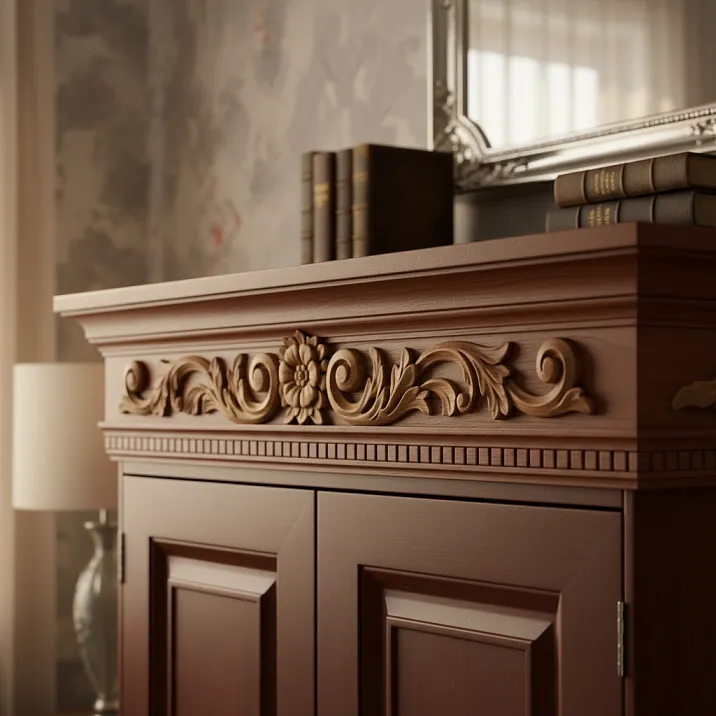
In the world of modern furniture design, details are crucial. When it comes to finishing touches that transform ordinary furniture into a work of art, furniture valances occupy a special place. The decisionBuy wooden cornicesbecomes a key moment in creating a harmonious and functional interior. These elements do not merely decorate—they create a sense of completion, highlight the style, and demonstrate attention to quality.
The modern market of furniture accessories offers a wide range of solutions for every style and budget. However, choosing a quality valance requires understanding not only aesthetic but also functional aspects. The right decision affects not only the appearance of the furniture but also its durability and practicality of use.


Evolution of furniture valances in modern design




From functionality to art
The history of furniture valances spans centuries of development. Initially, these elements served exclusively practical purposes—protection from dust and moisture. Today, they have become full-fledged design tools. Modern furniture manufacturers understand: a properly selected valance can radically change the perception of the entire piece.
In the era of classicism, valances were characterized by monumentality and complexity of profiles. Baroque brought theatricality and opulence to their design. Modernism simplified forms, emphasizing smooth lines. Today, we observe a synthesis of all these approaches—the possibilityBuy wooden cornicesin any style, from strictly minimalist to luxuriously classic.
Our factory also produces:


Technological revolution in production
Modern production technologies have opened new horizons in creating furniture valances. High-precision CNC routers allow creating profiles of any complexity with perfect repeatability. This means that even the most complex designer concepts can be realized with high quality and reasonable cost.
Innovative materials have expanded designers' possibilities. High-density MDF allows creating thin but strong profiles. Special coatings ensure water resistance and longevity. Modern coloring technologies allow achieving any color and texture.
Get Consultation
Classification of furniture valances
By purpose and place of application
Modern classification of furniture valances is based on their functional purpose. Kitchen valances constitute the largest category—they must withstand increased humidity, temperature fluctuations, and exposure to kitchen vapors. The decisionBuy wooden cornicesKitchen requires special attention to the quality of materials and finishes.
Cabinet hardware profiles vary in size and shape. Minimalist designs suit wardrobe systems, while more decorative options are suitable for living rooms. Bathroom hardware requires maximum moisture resistance and chemical resistance.
By manufacturing material
MDF hardware occupies leading positions due to optimal price-quality ratio. The material is easy to process, takes any shape, holds paint and film coatings well. Modern MDF has a density up to 850 kg/m³, ensuring high strength of finished products.
Wooden hardware remains the standard of quality and prestige. Natural oak, beech, and ash wood creates a unique atmosphere of warmth and coziness. However, such items require more careful maintenance and have a high cost.
Plastic hardware attracts with accessibility and practicality. Modern polymer materials allow them to imitate various textures, including natural wood. Main advantages — moisture resistance and ease of maintenance.
By stylistic features
Classic hardware features complex multi-level profiles, often with carved elements. They emphasize the solidity and traditionalism of the interior. The height of such hardware is usually 60-120 mm, creating the necessary visual weight.
Modern hardware is characterized by minimalist forms and functionality. Simple geometric profiles, height 30-60 mm, emphasis on material quality and manufacturing precision. Such solutions are ideal for minimalist interiors.
Hardware in the Provence style has characteristic wear and light tones. The effect of artificial aging creates a sense of long history. Profiles are usually simple, without excessive ornamentation.
Technical Specifications and Quality Standards
Dimensional Parameters
Standardization of cabinet hardware sizes allows compatibility with various furniture types. Profile height varies from 25 to 150 mm depending on purpose. For kitchen cabinets, 40-80 mm height is optimal; for living room furniture, 60-120 mm.
The length of standard blanks is 2440 mm or 3050 mm, corresponding to sheet material dimensions. This minimizes waste during production and reduces the cost of finished products.
Hardware thickness is usually 16-25 mm for MDF products and can reach 30-40 mm for solid wood. This parameter affects the structural strength and visual weight of the element.
Requirements for surface quality
The surface quality of cabinet hardware is determined by roughness class. For items intended for painting, Ra 1.6-3.2 μm class is relevant, ensuring a perfectly smooth surface after finishing. Achieving such quality requires multi-stage sanding with gradually decreasing abrasive grit.
Geometric accuracy of the profile should not deviate more than ±0.2 mm from nominal dimensions. This is especially important for jointing elements and ensuring tight fit to the base.
Moisture resistance and stability
Modern cabinet hardware must maintain geometric stability when air humidity changes from 40% to 70%. For kitchen applications, this range extends to 30-80%. Quality MDF has a water absorption coefficient not exceeding 15% when fully submerged in water for 24 hours.
Temperature stability is especially important for kitchen hardware, which may be exposed to hot steam from stoves. Quality items must withstand temperatures up to 80°C without deformation or color change.
Production process of furniture cornices
Raw material and material preparation
Production of quality cabinet hardware begins with careful selection of materials. For MDF hardware, E1 grade panels with minimal formaldehyde content are used. Material moisture content should not exceed 6-8%, ensuring geometric stability of finished products.
Raw material quality control includes checking density, structural uniformity, and absence of internal defects. Modern non-destructive testing methods allow identifying hidden defects before processing begins.
Milling profiles
Complex profiles are created on high-precision CNC milling machines. Use of special tools with hardmetal cutting edges ensures clean processing and long tool life. Spindle rotation speed reaches 18,000 rpm, enabling perfectly smooth surfaces.
Multi-pass processing begins with rough milling to shape the profile, followed by finishing passes with gradually reduced material removal. Final processing is done with special milling cutters featuring polished cutting edges.
Quality control and packaging
Each batch of finished hardware undergoes multi-stage quality control. Geometric dimensions are checked using coordinate measuring machines, surface quality is assessed visually and instrumentally. Special attention is given to profile conformity to the standard sample.
Products are packaged in special protective materials preventing mechanical damage during transport. Each packaging unit is marked with profile type, dimensions, manufacturing date, and batch number.
Methods of mounting and installation
Traditional fastening methods
The classic method of mounting cabinet hardware involves using carpentry glue in combination with mechanical fasteners. Modern polyurethane adhesives provide joint strength exceeding that of MDF itself. Setting time is 10-15 minutes, full curing occurs after 24 hours.
Mechanical fastening includes dowels, self-tapping screws, and pegs. For concealed mounting, special clips and profiles are used. When selecting fasteners, base thickness and hardware weight must be considered.
Modern fastening systems
Innovative solutions include magnetic mounting systems, allowing quick disassembly of hardware for maintenance or replacement. Such systems are especially convenient when installing built-in lighting or other technical elements.
Clip systems provide secure fixation without glue. This allows multiple disassembly and reinstallation of hardware without damaging the surface. Particularly relevant for temporary or modular housing.
Features of installation under various conditions
Mounting hardware in humid areas requires moisture-resistant adhesives and sealants. All joints must be carefully sealed to prevent moisture ingress. Silicone sealants with antifungal additives are recommended.
In rooms with high temperatures (near stoves, radiators), material thermal expansion must be considered. Compensatory gaps and elastic sealants prevent deformation during temperature fluctuations.
Finishing and decorating moldings
Coloring furniture valances requires a professional approach and quality materials. Surface preparation includes priming with special compositions that enhance paint adhesion to MDF. Primers based on synthetic resins create an ideal base for the final coating.
Modern furniture enamels have high coverage, resistance to abrasion and chemical exposure. Polyurethane enamels create a durable coating with various gloss levels — from deep matte to mirror shine. Modern formulations dry in 2-4 hours at 20°C.
The application technology includes several layers with intermediate sanding. The first layer is a primer-enameled coating for surface leveling, followed by 2-3 finish layers. Each layer is applied by spraying in special painting chambers with controlled microclimate.
Covering valances with decorative films is an economical alternative to painting. Modern PVC films imitate various materials: wood, stone, metal. Film thickness is 0.3-0.5 mm, ensuring good formability when applying to complex profiles.
Film coatings
The gluing process is performed on special membrane presses at a temperature of 120-140°C. Vacuum forming ensures tight adhesion of the film to all protrusions and recesses of the profile. Film edges are sealed with special tools to prevent peeling.
Veneering and texturing
Veneer and Texturing
Natural veneer gives valances the noble look of real wood at significantly lower cost. Veneer thickness is 0.6-0.8 mm, allowing even complex profiles to be covered. Adhesives based on urea-formaldehyde resins ensure strong bonding of veneer to the base.
Surface texturing creates additional visual effects. Brushing imitates the structure of aged wood, patination creates an effect of noble antiquity. These techniques are especially popular for interiors in Provence and country styles.
Style directions in modern design
Classic style
Classic furniture valances are characterized by complex multi-level profiles with clear geometric proportions. The height of such items is usually 80-120 mm, creating the necessary visual weight. The solutionBuy wooden cornicesin the classical style requires understanding of architectural principles and proportions.
The color palette of classic valances leans toward noble tones: white, cream, gold, dark brown. Glossy finishes emphasize the grandeur of the style, while matte finishes create a more subdued atmosphere.
Decorative elements include carved rosettes, coves, acanthus leaves. These details can be either integrated into the main profile or applied as overlays. The quality of decorative execution is a key factor in the success of the entire composition.
Modern minimalism
Minimalist valances are distinguished by extreme simplicity of form. Simple rectangular or slightly rounded profiles, 30-50 mm high, create a subtle shadow that emphasizes transitions between planes. The main emphasis is placed on material quality and manufacturing precision.
Color solutions lean toward monochromatic palettes — white, black, gray. Especially popular are contrasting combinations: white valances on dark furniture or black on light. Matte finishes create a sense of calm and elegance.
Integration of modern technologies is a distinctive feature of minimalist valances. Built-in LED lighting, hidden fasteners, cable channels make these items not only beautiful but also functional.
Scandinavian style
Scandinavian valances embody principles of Nordic aesthetics — functionality, eco-friendliness, simplicity. Light wood tones or white finishes create a sense of purity and freshness. Profiles are usually simple, without excessive decoration.
Natural materials are the main principle of the style. Even if MDF is used, the finish must accurately imitate natural wood. Popular effects include bleached oak, light ash, birch.
The ecological component includes using water-based coatings, minimizing chemical additives, and the possibility of recycling products. These factors are becoming increasingly important for modern consumers.
Loft and industrial style
Loft-style valances imitate industrial structures. Metallic finishes, rust effects, rough textures create an atmosphere of an industrial space. Profiles are usually simple but visually massive.
The color palette includes gray, black, brown, and copper tones. Finishes imitating metal with patina or corrosion marks are especially popular. These effects are created using special decorative paints and aging techniques.
Functionality is a key principle of industrial style. Cornices may include elements for mounting additional accessories, built-in lighting, and technical channels.
Application in various types of furniture
Kitchen cabinets
Kitchen cornices perform multiple functions simultaneously. They conceal ceiling imperfections, create a smooth transition from cabinets to the ceiling, may contain lighting and ventilation systems. The solutionBuy wooden cornicesfor the kitchen requires consideration of specific operating conditions.
Water resistance is the primary requirement for kitchen cornices. Constant exposure to steam, temperature fluctuations, and possible grease splashes require the use of special materials and coatings. Modern technologies allow creating coatings that are easily cleaned with regular cleaning agents.
The dimensions of kitchen cornices vary depending on the cabinet style. For modern kitchens, compact profiles 40-60 mm high are relevant, while for classic styles, more substantial 80-120 mm profiles are used. The length must exactly match the dimensions of the upper cabinets.
Integrating technical elements makes kitchen cornices multifunctional. Built-in lighting improves illumination of work areas, ventilation channels ensure air circulation, mounting systems allow placement of additional accessories.
Living room furniture
In the living room, cornices often become the main decorative accent. Here, more expressive profiles, contrasting colors, and decorative elements are appropriate. Dimensions may be significantly larger than kitchen cornices — up to 150 mm in height to create a monumental effect.
Bookcase cornices create a sense of solidity and respectability. Traditionally, dark wood tones or classic white are used. Carved elements emphasize the high status of the owner.
Modern living rooms require more restrained solutions. Minimalist profiles, neutral colors, emphasis on material quality. Integration of lighting systems is possible to create various lighting scenarios.
Modular furniture imposes special requirements on cornices. They must ensure visual unity of the composition under various module arrangement options. Standardization of profiles and coatings is a key factor for success.
Bedroom furniture
In the bedroom, cornices should create an atmosphere of calm and comfort. Soft lines, muted tones, absence of contrasting elements promote relaxation. Dimensions are usually moderate — 50-80 mm in height.
Materials must be environmentally friendly, with no harmful emissions. This is especially important for children's bedrooms. Water-based coatings, natural materials, certified products — mandatory requirements.
Functional features of bedroom cornices may include hidden compartments for small items, aroma systems, built-in clocks or alarms. These elements should be as inconspicuous as possible and not disrupt the overall harmony.
Office furniture
Office cornices must match the corporate style and create a professional atmosphere. Subdued colors, simple forms, emphasis on functionality — key design principles. Dimensions are usually minimal to save space.
Practicality is the key requirement for office cornices. They must be easy to clean, resistant to mechanical impacts, and have a long service life. Standardization of profiles simplifies maintenance and replacement of components.
Integration of technical systems is especially relevant for offices. Cable channels, monitor mounting brackets, lighting systems enhance the functionality of workstations.
Economic aspects of selection
Price-to-quality ratio
The cost of furniture cornices depends on many factors: material, profile complexity, type of coating, order volume. MDF cornices with film coating — the most economical solution; natural veneer and solid wood are significantly more expensive.
Analysis of total ownership cost should consider not only the initial price but also maintenance expenses, possible repairs, and service life. Quality items may serve 15-20 years without losing appearance, while cheap analogs require replacement every 3-5 years.
The impact of cornices on the total furniture cost is 5-15% depending on the product type. However, their role in forming the overall impression is significantly greater. Quality cornices can dramatically improve the perception of even simple furniture.
Regional market specifics
The cost of cornices in different regions may vary by 1.5-2 times. This is due to logistics costs, competition levels, and consumer purchasing power. Major industrial centers usually offer a wider assortment and competitive prices.
Local manufacturers often offer more flexible cooperation terms: manufacturing non-standard profiles, small batches, short delivery times. This is especially important for small furniture manufacturers and custom orders.
Imported cornices are usually more expensive than domestic ones but may offer unique design solutions and innovative materials. The choice depends on the positioning of the final product and target audience requirements.
Procurement activity optimization
Planning cornice purchases should consider the seasonal demand for furniture. Peak periods are spring and autumn, when consumers actively update interiors. Advance orders allow obtaining more favorable conditions.
Standardizing profiles in product lines reduces warehouse stock and simplifies logistics. Using basic profiles with various finish options — an effective strategy for medium-sized manufacturers.
Partnerships with suppliers ensure stable deliveries and predictable pricing. Long-term contracts allow fixing favorable conditions and planning business development.
Care and Maintenance
Daily care rules
Furniture cornices do not require complex care, but regular maintenance extends their service life. Daily dry cleaning with a soft cloth removes dust and prevents its accumulation in profile relief. Wet cleaning should be done with well-wrung fabric without excessive moisture.
For cornices with painted surfaces, it is recommended to use special furniture care products. Aggressive cleaning agents containing abrasives or strong solvents may damage the coating. Especially careful handling is required for glossy surfaces.
Kitchen cornices require more careful care due to exposure to grease and soot. Regular cleaning with special degreasing agents prevents the formation of stubborn stains. After wet cleaning, the surface must be thoroughly dried.
Preventive measures
Preventing damage is significantly cheaper than repairing it. Protecting cornices from direct sunlight prevents fading and coating cracking. Using protective films during repair work preserves the original appearance of items.
Controlling air humidity is especially important for wooden and MDF cornices. The optimal range of 45-65% prevents cracking and deformation. In dry rooms, air humidifiers are recommended.
Mechanical damage often occurs due to careless handling of furniture. Training users on operating rules, using protective elements at potential impact points significantly reduces the risk of damage.
Repair and restoration
Minor scratches and chips on painted surfaces can be fixed independently. Wax pencils of appropriate color mask small defects. For serious damage, local repainting with professional materials is required.
Delamination of film coatings usually requires complete re-coating of the element. Attempts at local repair rarely yield satisfactory results. Modern films have a service life of 10-15 years with proper use.
Deformations of MDF cornices due to moisture exposure are often irreversible. Prevention in the form of timely sealing of joints and humidity control is significantly more effective than attempts to restore damaged items.
Industry development trends
Ecological Requirements
Modern consumers increasingly pay attention to the ecological properties of materials and production processes. Certification according to FSC standards for wooden products, use of formaldehyde-free materials, water-based coatings are becoming mandatory market requirements.
Waste disposal and recycling programs increase the ecological rating of enterprises. Use of renewable energy sources, minimizing transportation costs through local production — trends of the near future.
Development of biodegradable materials for furniture production opens new opportunities. Composites based on natural fibers, bioplastics may soon compete with traditional materials.
Technological Innovations
Digitalization of production fundamentally changes the industry. Automatic design systems allow creating complex profiles with minimal time expenditure. 3D printing of prototypes accelerates the development of new products.
Integration of IoT technologies into production equipment ensures continuous quality monitoring and predictive maintenance. Artificial intelligence optimizes material cutting and production planning.
New materials and coatings expand designers' possibilities. Self-cleaning nanocoatings, antibacterial composites, materials with variable properties open new horizons.
Personalization and Customization
The modern market is moving toward individualization. Consumers want unique items reflecting their personality and lifestyle.Buy wooden cornicesCustom-made orders are becoming an increasingly popular solution.
Flexible production systems allow manufacturing small batches of non-standard items with minimal additional costs. Modular construction allows creating unique compositions from standard elements.
Online configurators allow customers to independently create the design of future items and see the result in real-time. Virtual and augmented reality make the selection process more visual and convenient.
Supplier selection and quality criteria
Key evaluation criteria
When selecting cornice suppliers, it is important to evaluate not only price but also a complex of factors. Product quality is determined by geometric accuracy, surface quality, and stability of characteristics. Presence of ISO 9001 quality management system — an important indicator of supplier reliability.
Production capacities must match planned order volumes. Modern equipment, qualified personnel, and streamlined logistics ensure stable deliveries. The ability to scale production is important for growing companies.
Technical support includes consultations on profile selection, assistance in developing non-standard solutions, staff training. Service quality is often more important than the lowest price, especially for complex projects.
Documentation and certification
The complete documentation package must include certificates of conformity, sanitary-epidemiological conclusions, quality passports. Documentation is especially important for children's and medical facilities, where ecological requirements are maximal.
Supplier warranty obligations must be clearly defined and documented. The standard warranty period for furniture cornices is 12-24 months depending on material and operating conditions.
Compliance with international standards expands export opportunities and increases competitiveness. CE certification for the European market, various national standards for other regions.
Logistics and delivery conditions
Logistics organization significantly affects the total cost and delivery times of orders. The supplier's own transport ensures greater flexibility and control over delivery quality. Partnership with logistics companies may be more economical for large volumes.
Packaging must ensure product integrity during transportation. Special protective materials, proper stacking, labeling — all this affects the quality of delivered products. Returnable packaging reduces ecological footprint and logistics costs.
Payment terms must correspond to the buyer's financial capabilities. Payment deferral, installment plans, factoring — various tools for optimizing cash flow. Discounts for volume and advance payment may significantly reduce total procurement costs.
Popular questions and answers (FAQ)
What material is better to choose for kitchen cornices?
For kitchen cabinets, the optimal choice is MDF with moisture-resistant coating or natural wood with appropriate treatment. MDF ensures geometric stability under humidity changes, and modern coatings are easily cleaned of grease and soot. It is important to ensure the material has a food safety certificate of class E1 or E0.
How to calculate the required amount of crown molding?
The amount of crown molding is calculated based on the perimeter of upper cabinets, including joint elements. To the obtained length, add 5-10% for trimming and possible defects. For complex configurations, it is recommended to create a detailed plan with dimensions of all sections. The quantity of corner elements is calculated separately.
Can you install crown molding yourself?
Installation of simple crown moldings with a straight profile is accessible to home craftsmen with basic carpentry skills. Standard tools are required: drill, screwdriver, level, circular saw. For complex profiles and critical work, it is better to involve professionals, especially when integrating lighting or other technical elements.
How to care for crown moldings with different coatings?
Painted crown moldings require gentle care with soft, non-abrasive cleaning agents. Film coatings are more resistant to chemical effects but are sensitive to scratches. Veneered surfaces require periodic treatment with special wood finishes. Glossy coatings require polishing to maintain shine.
What is the lifespan of furniture crown moldings?
The lifespan of quality furniture crown moldings is 15-20 years with proper use. MDF products with quality coatings can last as long as the furniture itself. Lifespan depends on usage conditions, material quality, and maintenance. In harsh conditions (high humidity, temperature fluctuations), lifespan may be reduced to 10-12 years.
What is the difference between crown molding and picture frame molding?
Crown molding is a horizontal decorative element installed at the top of furniture. Picture frame molding is a broader concept, including various decorative profiles for framing and finishing. In furniture manufacturing, these terms are often used as synonyms, but technically, picture frame molding can be used for vertical decoration.
Can you repaint crown moldings in another color?
Repainting crown moldings is possible but requires a professional approach. Old coating must be removed, surface sanded, primer and new paint applied. The quality of the result depends on the type of original coating and profile complexity. Film coatings are harder to remove than paint. It is recommended to entrust this work to professionals.
Do crown moldings affect the cost of furniture?
Quality crown moldings can constitute 5-15% of furniture cost, but their impact on perception is significantly greater. Properly selected crown moldings enhance the visual value and market value of the item. When reselling, furniture with quality decorative elements retains value better than items without decoration.
What are the most popular crown molding sizes?
For kitchen furniture, the most popular crown molding heights are 60-80 mm; for living rooms, 80-120 mm. Thickness is usually 16-20 mm for MDF products. Standard stock length of 2440 mm corresponds to sheet material dimensions. When selecting size, it is important to maintain proportions relative to furniture height.
How to check crown molding quality when purchasing?
When purchasing, check the geometric accuracy of the profile, surface quality, absence of chips and cracks. MDF moisture content should not exceed 8-10%, which can be checked with a moisture meter. Coating should be uniform, without streaks or inclusions. It is also important to verify that dimensions match the product's technical passport.
Conclusion
The modern furniture market imposes increasingly higher requirements on the quality and design of decorative elements. Choosing the right crown molding becomes strategically important for furniture manufacturers and interior designers.Buy wooden cornicesQuality crown moldings not only complete the look of furniture but also demonstrate attention to detail, the professionalism of the craftsman, and care for the end consumer.
Technological progress opens new opportunities in producing furniture crown moldings. High-precision equipment, innovative materials, and modern coatings allow creating products that combine beauty, functionality, and durability. However, it is important to remember that technology is merely a tool, while knowledge, experience, and the pursuit of perfection play the main role.
Ecological aspects are becoming increasingly significant in material and technology selection. Responsible manufacturers pay special attention to product safety, minimizing environmental impact, and using renewable resources. This is not only an ethical position but also a competitive advantage in the modern market.
Individualization and customization are trends that will define the industry's development in the coming years. Consumers want unique solutions that reflect their personality and lifestyle. Flexible production systems, modern design and manufacturing technologies make individual approaches accessible and economically justified.
Choosing a reliable crown molding supplier is the key to success for any furniture project. Product quality, stable supply, technical support, and competitive pricing are all factors to consider when making a decision. Long-term partnerships with proven suppliers create a foundation for sustainable business growth.
Company STAVROS, with years of experience in producing high-quality crown moldings, understands all nuances of the modern furniture crown molding market. The combination of traditional woodworking technologies with innovative equipment, use of eco-friendly materials, and continuous improvement of production processes allow creating products that meet the highest quality standards and satisfy the needs of the most demanding customers.