












































































Article Contents:
- Anatomy of contrast: why classic and minimalism are compatible
- Choosing a carved frame: which elements are important
- Character of carving: baroque vs restrained classic
- Proportions: massiveness vs airiness
- Wood species and color
- Choosing a tabletop: materials for modern contrast
- Glass: transparent lightness
- Stone: natural power
- Wood with minimalist processing
- Concrete: industrial aesthetic
- Color combinations: how to find balance
- Dark frame + light tabletop
- Light frame + dark tabletop
- Medium tone frame + neutral tabletop
- Color accents
- Proportions and Dimensions: The Mathematics of Beauty
- Tabletop overhang
- Tabletop thickness vs frame massiveness
- Table height
- Frame finishing: enhancing contrast
- Natural wood under oil
- Staining in dark tones
- Bleaching
- Painting in solid color
- Patination
- Gilding or silvering
- Examples of specific combinations
- Option 1: Baroque frame + white marble
- Option 2: Neoclassical frame + clear glass
- Option 3: Classic frame + live edge tabletop
- Option 4: Carved frame + tinted glass
- Option 5: White frame + black marble
- Interior context: where to place a contrast table
- Dining Room
- Kitchen
- Living Room
- Office
- Assembling a contrast table: practical nuances
- Mounting a glass tabletop
- Mounting a stone tabletop
- Mounting a wooden tabletop
- Protecting the frame from the tabletop
- Caring for a contrast table
- Frequently asked questions about contrast tables
- Does such a table look like eclectic clutter?
- Is such a table suitable for a classic interior?
- And for a minimalist interior?
- What type of wood to choose for the frame?
- Is it necessary to order a tabletop or can you buy a ready-made one?
- How much does it cost to create such a table?
- Can you make such a table yourself without experience?
- Conclusion: when opposites create

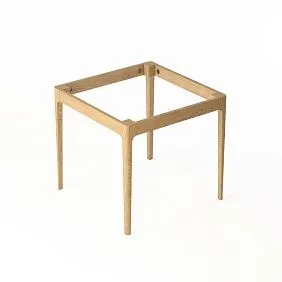
Interior fashion moves in cycles, but now we are witnessing something unique: eras have ceased to oppose each other. Classicism no longer wars with modernity, Baroque peacefully coexists with minimalism, and carved elements from the 18th century organically combine with industrial concrete. One of the most striking examples of this synthesis is tables whereCarved table framewith luxurious turned legs and shaped aprons supports a laconic modern tabletop made of glass, stone, or minimally processed wood. This contrast creates tension that literally electrifies the space.
Why does this work? Because opposites enhance each other. The intricate carving of the frame looks even richer against the backdrop of the strict simplicity of the tabletop. And the smooth minimalist surface appears even more refined next to the Baroque luxury of the under-table. This is a play of contrasts that requires a precise sense of proportion but yields a fantastic result: furniture ceases to be just a functional item and turns into an art object, a statement piece, around which the entire interior is built.
In this article, we will analyze how to create such a balance without sliding into museum-like heaviness or cold asceticism. How to choose a carved frame, what tabletop to pair with it, what materials and finishes to use so that classicism and minimalism speak the same language.

Anatomy of Contrast: Why Classic and Minimalism Are Compatible
At first glance,classic tableandModern Furnitureare antagonists. Classicism speaks of details, ornaments, layering, tradition. Minimalism speaks of emptiness, purity of lines, absence of excess, relevance. But they have something in common: both styles require quality. Classic furniture is valuable for its craftsmanship, the nobility of the material. Minimalist furniture is valuable for its precision of proportions, perfection of surfaces. It is this quality that becomes the bridge between eras.
When you combine a carved oak frame with balusters created by a master turner with a tabletop made of Carrara marble or tempered glass, you unite two types of perfection. The frame demonstrates the perfection of craftsmanship, handmade beauty, time invested in creating details. The tabletop demonstrates the perfection of the material, its natural beauty (in the case of stone) or purity of form (in the case of glass).
Contrast works on a psychological level. Our eyes tire of monotony. An interior strictly maintained in one style may be perfect from a design theory standpoint but is visually tiring. A table with a mix of styles is not threatened by this—it constantly holds attention, offering the eye to switch between the complexity of the frame and the simplicity of the tabletop.




Choosing a carved frame: which elements are important
Not every classic frame is suitable for creating a contrast table. The character of the carving, proportions, and type of wood are important here.
Our factory also produces:


Character of carving: Baroque vs restrained classicism
Baroque carving is swirls, plant ornaments (acanthus, grapevines), complex reliefs, many details. Such a frame looks luxurious, theatrical, dominant. It works well paired with a contrasting tabletop, but it is important that the surrounding space is sufficiently simple. Baroque frame + minimalist tabletop + restrained interior = balance. But if there is a lot of decor around, it will result in overload.
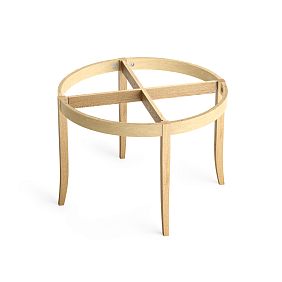
Restrained classicism is turned legs without excessive carving, shaped aprons with smooth curves, decorative elements are present but in moderation. Such a frame is easier to integrate into a modern interior. It adds elegance without drawing attention to itself.
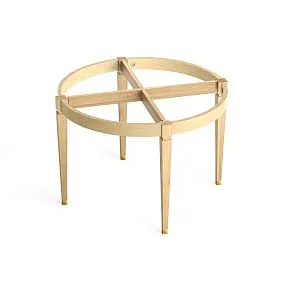
Neoclassicism is a balance between luxury and conciseness. The legs have classical proportions, but the carving is minimal or geometric. The lines are clear, the symmetry is precise, and there is no excessive decorativeness. A neoclassical frame is the perfect foundation for mixing with a modern tabletop.
For a first experience, I recommend choosing frames with moderate carving. Heavily decorated elements are more difficult to balance—they require more experience in working with contrasts.
Get Consultation
Proportions: massiveness vs. airiness
Table framesThey differ in massiveness. Some have thick legs with a diameter of 100-120 mm, wide aprons, and a powerful base. Others have more elegant legs of 70-80 mm, thin aprons, and a visually light construction.
For a contrast table with a modern tabletop, frames of medium massiveness or elegant ones work better. A too heavy frame combined with a thin glass tabletop will look disproportionate—the top seems to float while the bottom weighs it down. Conversely, a too thin frame under a massive marble tabletop will create a sense of fragility and unreliability.
General rule: the visual weight of the frame and tabletop should roughly correspond to each other. If the tabletop is visually light (glass, thin wood), the frame can be of medium massiveness. If the tabletop is heavy (thick stone, massive wood slab), the frame must be powerful enough to visually 'hold' it.
Wood species and color
Oak is a classic for carved frames. Durable, with expressive texture and a noble color. An oak frame can be left in its natural color (light or tinted), painted, or patinated.
Beech is more uniform and light. A beech frame is good for painting when a specific color is needed without a pronounced wood grain.
Ash is a middle option: beautiful texture, but less contrasty than oak. A light warm shade.
The color of the frame is critically important for balance. A dark frame (ebonized oak, wenge, black) creates a dramatic contrast with a light tabletop (white marble, clear glass, light wood). A light frame (natural oak, bleached wood, white paint) is softer, more delicate, suitable for Scandinavian and Provence interiors.
Mid-tones (walnut, cherry, honey oak) are universal, work with most tabletops, and create a harmonious but less dramatic look.
Choosing a tabletop: materials for modern contrast
The tabletop is the second half of the equation. Its material, color, and finish determine how expressive the contrast will be.
Glass: transparent lightness
A glass tabletop on a carved frame is one of the most spectacular options. Glass creates visual weightlessness, allowing one to admire the frame's carving through the transparent plane. The frame becomes not just a support, but a full-fledged decorative element, visible from all angles.
Types of glass:
Clear — maximum lightness, the frame is fully visible. Suitable for elegant, not overly detailed frames.
Tinted (gray, bronze, graphite) — creates a stricter, more modern look. The frame is visible but slightly muted, which is appropriate for heavily decorated carved elements.
Frosted — glass with a matte finish (sandblasted, satin) does not allow seeing the frame but retains visual lightness. A compromise between transparency and opacity.
Glass thickness: for a dining table — minimum 10 mm, preferably 12-15 mm. For a coffee table — 8-10 mm. Tempering for safety and edge finishing (polishing or beveling) is mandatory.
Pros of glass: visual lightness, does not clutter space, highlights the frame, easy to clean.
Cons: shows fingerprints and streaks (requires frequent wiping), cold to the touch, can seem uncozy.
Stone: natural power
A stone tabletop is a choice for lovers of natural materials and substantial, solid things. Stone adds monumentality to the table, but its cold modern aesthetic contrasts beautifully with the warm classicism of carved wood.
Marble — the most noble and spectacular stone. White Carrara marble with gray veins is a classic that works perfectly with a dark carved frame. Black marble (Nero Marquina) with white veins is dramatic, modern, and good with a contrasting light frame. Colored marbles (green, pink, beige) add individuality but require careful combination.
Granite — stronger than marble, less porous, easier to maintain. Wide color palette: from almost black to light gray, with various specks. Granite is visually 'colder,' suitable for strict modern interiors.
Quartz agglomerate — an artificial stone based on quartz. Stronger and more practical than natural stone, does not absorb stains, available in a huge palette of colors and textures (including imitations of marble and granite). For a contrast table — an excellent choice, especially if a specific shade is needed.
Onyx — a semi-precious stone with unique translucent properties. An onyx tabletop with bottom lighting is a luxurious, almost ethereal element. But very expensive and finicky to maintain. For those ready to experiment.
Stone tabletop thickness: 20-30 mm. Edge finishing: straight cut, bevel, radius. A frieze (adding a strip of stone to the edge) can be added to make the tabletop look thicker and more massive.
Stone advantages: natural beauty, unique pattern, durability, sense of solidity.
Disadvantages: heavy (requires a sturdy frame), cold to the touch, porous stones (marble) require protective treatment and careful maintenance.
Minimally processed wood
Wooden tabletops— wood with wood, where's the contrast? But if the frame is carved, decorated, with patina, and the tabletop is a concise, smooth plane of wide boards without visible seams, with minimal edge processing, the contrast arises not in the material, but in the degree of processing and philosophy.
Solid wood with natural edges (live edge) — a tabletop where one or both edges retain the natural shape of the trunk, with or without bark. This is a reference to nature, to organicity. Paired with a symmetrical classic frame, it creates an interesting contrast: handmade symmetry below and natural asymmetry above.
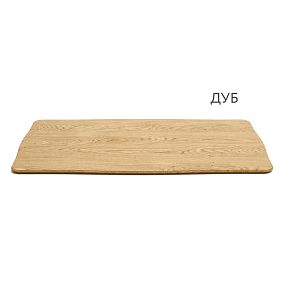
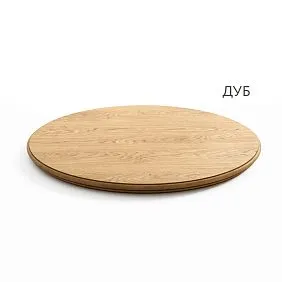
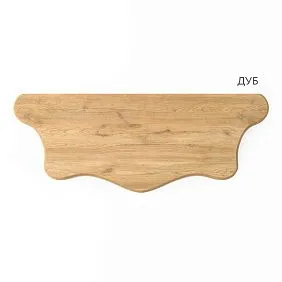
Wide-format boards — a tabletop made of one or two-three wide boards (40-60 cm each) looks modern, minimalist. Minimal seams, maximum wood texture. Combined with a carved frame, this is a contrast of simplicity and complexity in one material.
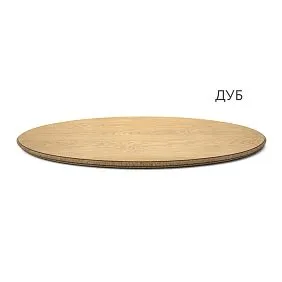
Thin tabletop — if classic tabletops are 35-50 mm thick, modern ones can be thinner — 20-30 mm. This creates visual lightness, especially if the edge is processed without a frieze, simply with a radius or chamfer.
Contrasting wood species — if the frame is made of dark oak, the tabletop can be made of light ash or birch. Or vice versa: light frame + dark tabletop made of walnut or wenge. Contrast of colors within one natural material.
Finishing for a minimalist wooden tabletop: oil (emphasizes texture, preserves the tactile feel of wood) or matte varnish (more durable protection, but the natural look is preserved). Avoid glossy varnish — it cheapens the appearance, depriving the wood of nobility.
Concrete: industrial aesthetic
Concrete tabletop — a bold choice for those who love industrial style. Concrete is associated with lofts, minimalism, urbanity. Paired with a carved solid wood frame, it creates maximum contrast: natural vs. man-made, soft vs. hard, traditional vs. modern.
Concrete can be tinted in different colors (from light gray to almost black, pigments of rust or copper color can be added), polished to smoothness or left textured. The surface is coated with a protective compound (wax, sealant), otherwise concrete will dust and absorb stains.
Concrete tabletop is heavy (comparable to stone), requires a sturdy frame. But the visual effect is worth it — this is a table that will definitely be remembered.
Color combinations: how to find balance
Color is a powerful tool for creating contrast or harmony. Let's analyze the main combinations.
Dark frame + light tabletop
Classic contrast. Dark (black, stained oak, wenge) carved frame + white marble, glass, or light wood tabletop. This combination is maximally expressive, graphic, works in both classic and modern interiors.
Important: if the frame is very dark, almost black, the tabletop should be truly light (white marble, clear glass, bleached wood), otherwise the contrast will be lost.
Light frame + dark tabletop
Reverse option. Light (white, cream, bleached oak) frame + black marble, tinted glass, dark wood. This is a softer, more delicate contrast, suitable for interiors in light tones where a dark frame would be too heavy.
Medium-toned frame + neutral tabletop
If you're not ready for dramatic contrasts, choose a medium-toned frame (natural oak, walnut) and a neutral tabletop (light gray stone, clear or tinted glass, wood of a similar shade). This is a harmonious, calm look where contrast is created not by color, but by the degree of processing and texture.
Color accents
For the bold: colored frame (blue, green, terracotta) + neutral tabletop. Or vice versa: neutral frame + tabletop with colored stone (green marble, pink onyx). Color adds individuality but requires support in the interior — textiles, decor of the same shade.
Proportions and sizes: the mathematics of beauty
A contrasting table requires precise proportions. Imbalance in the sizes of the frame and tabletop will ruin the whole idea.
Tabletop overhang
Overhang is the distance the tabletop extends beyond the frame. For classic tables, the overhang is usually 5-10 cm. For contrast tables with a modern tabletop, the overhang can be increased to 15-20 cm, especially if the tabletop is visually light (glass, thin wood). A larger overhang emphasizes the tabletop floating above the frame.
But don't overdo it: an overhang of more than 25-30 cm can create a sense of instability, especially if the tabletop is heavy (stone, concrete).
Tabletop thickness vs. frame massiveness
A thin tabletop (10-20 mm glass, 20-25 mm wood) looks better with a delicate or medium frame. A thick tabletop (30-40 mm stone, 40-50 mm wood) requires a more massive frame, otherwise it will look flimsy.
There's a trick: visually increase the tabletop thickness with a frieze (an additional strip along the edge). A 20 mm stone tabletop with a 100 mm frieze will look like a 100 mm one but weigh significantly less.
Table Height
The standard height for a dining table is 75 cm. For a coffee table, it's 40-50 cm. However, with a contrasting table, you can play with the height: slightly higher than usual (77-78 cm) creates a more solemn, formal appearance. Slightly lower (72-73 cm) gives a more relaxed, democratic feel.
Frame Finish: Enhancing the Contrast
The finish of the carved frame is the final touch that can either enhance or ruin the intended contrast.
Natural wood under oil
Clear oil emphasizes the wood's texture and color, preserving its natural beauty. This is the choice for those who value naturalness. Paired with a glass or stone tabletop, it creates a balance: warm, living wood below, cold, modern material above.
Staining in Dark Tones
Stain (colors like fumed oak, wenge, ebony) makes the frame dark, almost black, and dramatic. This enhances the contrast with a light tabletop. After staining, a protective coating—varnish or oil—is essential.
Whitewashing
Whitewashed wood offers a soft, Scandinavian aesthetic. The frame is treated with a special oil or glaze that gives the wood a light, almost white hue while preserving the grain. Perfect for pairing with a dark tabletop or clear glass.
Painting in a Solid Color
Paint completely hides the wood grain, providing a uniform color. White, black, graphite, dark blue—the choice depends on the interior. A painted frame is more graphic and modern. Carving becomes less noticeable when painted (especially in dark tones), but the silhouette and shape are emphasized.
Patina
Artificial Aging Technique: The frame is painted in a base color (white, beige, gray), then a dark patina (brown, black, bronze) is applied into the recesses of the carving. This creates a vintage, antique effect. Combined with a modern tabletop, it results in an interesting interplay: antiquity and novelty in a single piece.
Gilding or Silvering
For luxurious interiors: carved elements of the frame are covered with gold leaf, silver leaf, or gold/silver paint. Paired with a marble or glass tabletop, this creates a palatial, yet not museum-like appearance, as the tabletop adds modernity.
Examples of Specific Combinations
The theory is clear, let's move on to specifics. Let's examine several successful combinations.
Option 1: Baroque Frame + White Marble
Frame: massive carved oak frame with baluster legs, shaped aprons with floral carving, and stretchers. Finish: fumed oak stain (almost black), coated with matte varnish.
Tabletop: Carrara marble 25 mm, white with gray veining. Polished edge, straight or with a slight bevel.
Effect: dramatic contrast of black and white, luxurious carving and the cold smoothness of stone. Such a table is a dining room centerpiece and requires a restrained setting (light walls, minimal decor).
Interior Style: neoclassical, contemporary classic, art deco.
Option 2: Neoclassical Frame + Clear Glass
Frame: elegant carved beech frame with medium-thickness turned legs, shaped aprons, minimal carving. Finish: whitewashing (light, almost white hue with preserved grain).
Tabletop: clear tempered glass 12 mm, polished edges.
Effect: airiness, lightness, Scandinavian elegance. The frame is visible through the glass, becoming a sculptural element. The table does not visually clutter the space.
Interior Style: Scandinavian, minimalism, contemporary classic.
Option 3: Classic Frame + Live Edge Tabletop
Frame: traditional carved oak frame with symmetrical turned legs, straight aprons with slight shaping. Finish: natural oak with oil (warm honey shade).
Tabletop: solid walnut with a natural edge (one edge retains the natural shape of the trunk), thickness 40 mm, oil finish.
Effect: contrast of symmetry and asymmetry, man-made and natural. Both elements are wood, but the frame speaks of tradition and order, the tabletop—of nature and freedom.
Interior style: eco-style, modern country, loft with wood.
Option 4: Carved frame + tinted glass
Frame: carved ash frame with moderate decorativeness, legs with simple balusters, aprons with smooth curves. Finish - painted in graphite color (dark gray, almost black).
Tabletop: tinted glass (gray or bronze) 12 mm, processed edges.
Effect: strict, modern, urban. Tinted glass tones down the frame carving, making it less dominant but preserving intrigue. Color scheme - monochrome, elegant.
Interior style: minimalism, high-tech, modern loft.
Option 5: White frame + black marble
Frame: carved beech frame with moderate carving, classic proportions. Finish - painted white (matte paint), light patination with gray patina in recesses.
Tabletop: black Nero Marquina marble with white veins, 30 mm, polished surface.
Effect: elegant, contrasting, visually light (despite the stone tabletop). White frame doesn't feel heavy, black tabletop adds graphic quality. Patina creates a vintage touch.
Interior style: Provence, shabby chic, modern classic.
Interior context: where to place a contrasting table
A table mixing classic and minimalism is a strong accent. Its placement and surroundings are critical for the overall interior balance.
Dining Room
Dining table - a natural place for such an item. If the table is contrasting, the rest of the dining room furniture should be restrained. Neutral chairs (can be classic wooden or modern upholstered), a simple sideboard or chest of drawers, minimal wall decor.
Lighting: a chandelier above the table can support the frame style (classical, if the frame is carved) or the tabletop style (minimalist pendant lamp, if the tabletop is modern). Or neutral, to not compete with the table.
Kitchen
If the kitchen is large and has space for a dining area, a contrasting table can become its center. It's important that the kitchen set doesn't overload the space. Laconic fronts, minimal upper cabinets, clean lines - and the table will shine.
Living Room
A coffee table with contrasting design - a living room decoration. It can be placed between the sofa and armchairs, by the fireplace, by the window. A table on a carved frame with glass or stone tabletop adds elegance to the living room, becomes a focal point.
Office
A writing desk on a carved frame with a laconic tabletop - a choice for a study where an atmosphere of concentration and style is important. Such a table speaks of status, taste, attention to detail.
Assembling a contrasting table: practical nuances
If you decide to create a contrasting table yourself, using a ready-made frame and a custom tabletop, here are the key points.
Attaching a glass tabletop
Glass is attached to the frame with special transparent or metal suction cups (bumpers), which are glued to the tabletop from below and to the frame aprons from above. This allows the tabletop to rest on the frame without rigid attachment. Suction cups dampen vibrations and prevent slipping.
Alternative: metal overlays with soft backing at the points where glass contacts wood. Overlays are attached to the aprons, glass simply rests on them.
Important: there must be a soft pad (silicone, felt) between the glass and wood, otherwise under load the glass may crack from point pressure.
Attaching a stone tabletop
Stone is heavy, but it cannot be rigidly attached to the frame - with changes in temperature and humidity, the frame wood may slightly expand/contract, creating stress. Use elastic attachment: special adhesive-sealant (polyurethane, silicone) is applied in dots or strips on the aprons, the tabletop is placed on top. The adhesive remains elastic, allowing micro-movements.
For large and heavy tabletops, additional metal brackets or Z-plates are used, screwed to the aprons and tabletop. But screws are not tightened completely, leaving slight freedom.
Attaching a wooden tabletop
A solid wood tabletop must be able to 'breathe' - expand and contract across the grain with changes in humidity. Use Z-shaped plates or wooden blocks with oblong (not round) holes. Screws in oblong holes can move slightly, not interfering with the tabletop expansion.
Along the grain, wood hardly changes, so end aprons can be attached rigidly. Side ones - only with sliding attachments.
Protecting the frame from the tabletop
If the tabletop is heavy (stone, thick wood, concrete), glue soft pads (felt, rubber) to the upper ends of the aprons and legs. This will prevent the tabletop from pressing into the wood of the frame and will distribute the load.
Care for a contrast table
Different materials require different care.
Carved wooden frame: wipe with a dry or slightly damp cloth. Renew the oil finish once a year (if the frame is oiled). Avoid getting water into the carvings — it can stagnate in the recesses. A painted frame can be wiped with a damp cloth and mild detergent.
Glass tabletop: clean with glass cleaner or a microfiber cloth with water. Glass shows all marks, fingerprints, streaks — requires frequent cleaning. Use coasters for hot items to avoid leaving marks.
Stone tabletop: marble is porous and requires a protective sealant once a year. Avoid acidic liquids (wine, lemon juice, vinegar) — they can stain. Granite and quartz composite are less finicky, but still wipe up spills immediately. For cleaning, use mild products, not abrasives.
Wooden tabletop: if oiled — renew the finish every 1-2 years. If lacquered — wipe with a damp cloth, avoid prolonged contact with water. Use coasters for hot items and cutting boards.
Frequently asked questions about contrast tables
Does such a table look like eclectic clutter?
With the right balance — no. The key is the quality of the elements, precise proportions, and refined finish. A cheap carved frame with a Chinese glass tabletop will indeed look sloppy. A high-quality solid wood frame with a professionally processed tabletop — that's a harmony of contrasts.
Is such a table suitable for a classic interior?
Yes, if the interior is not strictly museum-like classicism, but rather neoclassical or modern classic. A contrast table will add freshness and relevance without destroying the overall style. The main thing is that the rest of the furniture and decor maintain a balance of classic and contemporary.
What about for a minimalist interior?
Also yes. A carved frame will add warmth and individuality to minimalism, preventing it from sliding into cold austerity. But the frame should not be overloaded with decoration — choose moderately carved, neoclassical options.
What type of wood to choose for the frame?
Oak — versatile, durable, noble. Beech — good for painting. Ash — beautiful in its natural state, but less hard than oak. For a contrast table, I recommend oak — it will withstand any tabletop and last for decades.
Is it necessary to order a tabletop or can you buy a ready-made one?
Ready-made tabletops are available for sale (glass, stone, wooden furniture panels), but their sizes are standard. If a ready-made tabletop fits the size of your frame — great. If not — order a custom size. It's not much more expensive, but it ensures a perfect fit.
How much does it cost to create such a table?
Carved oak frame — 15-25 thousand rubles depending on size and carving complexity. Tabletop: 12mm glass, 100×180 cm — about 10-15 thousand; 25mm marble — 30-50 thousand; 30mm oak wood — 15-20 thousand. Total: from 25 to 75 thousand rubles. A ready-made designer table of comparable level — from 100 to 300 thousand.
Can you make such a table yourself without experience?
If you use a ready-made frame and an ordered tabletop, you only need basic skills — attaching the tabletop to the frame, treating the frame with oil or paint. This is accessible to beginners. Creating a carved frame from scratch requires professional skills and equipment — better to buy a ready-made one.
Conclusion: when opposites create
perfection
The combination of a carved classic frame with a modern minimalist tabletop is not a compromise, but a conscious artistic choice. It's a statement that style doesn't have to be monolithic, that beauty is born at the intersection of eras and aesthetics, that tradition and innovation can not only coexist but also enhance each other.
Such a table is more than just furniture. It's a focal point, a conversation starter, a testament to your taste and courage. It shows that you value the craftsmanship of the woodcarver who created the frame, and at the same time understand the beauty of pure modern forms. That you are not afraid of experiments but know the measure.
The company STAVROS offers a wide selection of carved frames made of solid oak and beech — from Baroque, richly decorated, to restrained neoclassical. Each frame is made on professional equipment, from properly dried wood, with precise carving execution and impeccable surface treatment. STAVROS also manufactures tabletops from solid wood in any sizes and shapes, allowing you to create the perfect combination for your contrast table.
By turning to STAVROS, you get not just furniture components, but a foundation for creating a unique piece that will become the heart of your interior. Professional consultations, precise dimensions, quality control, delivery — STAVROS accompanies your project from idea to implementation.
Don't be afraid of contrasts. In them lies life, energy, character. Mix eras, combine materials, create furniture that tells stories. With ready-made elements from STAVROS, the path from concept to realization becomes simple and exciting. Your home deserves furniture that is not just functional, but inspiring every day!


