Article Contents:
- Three pillars of decorative design: molding, baseboard, carved decor
- Molding: architectural nobility
- Baseboard: functional elegance
- Carved decor: handmade uniqueness
- Choosing decor: style dictates the solution
- Classicism: the triumph of the order system
- Baroque and Rococo: boundless opulence
- Modern styles: minimalism and restraint
- Eclecticism and fusion: the rules of freedom
- Rules for harmonious combination: three laws of decor
- Law of style unity
- Law of proportions and scale
- Law of color and material coordination
- Style selection checklists: specifics for action
- Classical interior: palatial elegance
- Modern minimalist interior: purity of lines
- Loft: industrial brutality with accents
- Provence: French pastoral charm
- The art of creating coziness: the psychology of decorative elements
- Decor as a creator of scale
- Decor as a bearer of time
- Decor as rhythm and structure
- Decor as a status marker
- Frequently asked questions about choosing decorative elements
- Can molding be used in an apartment with low ceilings (2.5 meters)
- Which baseboard to choose if the floor is dark and the walls are light
- Is it necessary to paint polyurethane molding or can it be left white
- Does carved wooden decor combine with modern minimalism
- What is more expensive: wooden baseboard or MDF
- Can you install molding and baseboard yourself or is it necessary to hire professionals
- Where to find quality decorative elements at a reasonable price
- Conclusion: decor is not embellishment, but the architecture of emotions
- STAVROS: complete collection of decorative elements for any style

You are faced with a choice. The renovation is in full swing, the walls are leveled, the ceilings are stretched, the floors are laid. The space is functional, but lifeless. It lacks what turns a box into a home, abstraction into style, emptiness into coziness. It lacks decorative elements.
Butwhich decorative elementchoose? Molding — and risk overloading the interior with opulence? Baseboard — and limit yourself to functional minimum? Carved decor — and delve into palatial theatricality? How to combine elements so they work together, not compete? What suits a classic interior, what suits a modern one, what suits an eclectic one?
Choosing decorative elements is a subtle art. One mistake (style mismatch, wrong proportions, overload) turns an interior into kitsch, museum-like stiffness, or a chaotic jumble of ideas. The right solution creates harmony, where each element is in its place, complements others, works for the overall atmosphere.
Basics of decorative elements— is a system of rules developed over centuries of architectural practice. Understanding these rules frees you from agonizing hesitation between options, gives clear selection criteria, allows creating interiors that don't become outdated, don't irritate, don't require redoing after a year.
In this article, we will build a navigation map of the world of decorative elements. We'll analyze three main categories: molding (ceiling and wall elements made of polyurethane, plaster), baseboards (wooden, MDF, polyurethane — transition between wall and floor), carved decor (overlays, panels, furniture decor made of solid wood). We'll find out how each element works in different styles — from classic to contemporary. We'll formulate combination rules so elements form an ensemble, not cacophony. We'll create checklists for popular styles — what to choose, what to combine, what to pay attention to.
Ready to turn bare walls into a masterpiece? Opening the map.


Three pillars of decorative design: molding, baseboard, carved decor
All the variety of decorative elements boils down to three main categories, each performing its own function in the interior.




Molding: architectural nobility
Polyurethane moldings— heir to plaster decorations of palaces and mansions. Cornices, moldings, rosettes, pilasters, consoles — elements creating architectural expressiveness.
Functions of molding:
-
Architectural division of space: Cornice separates ceiling from walls (visually increases height), wall moldings create panels (break up plane, create rhythm, structure).
-
Masking defects: Cornice hides uneven wall-ceiling joint, molding covers gap between wallpapers, rosette masks hole in ceiling from old chandelier.
-
Style identification: Type of ornament (classical meander, baroque swirls, minimalist straight lines) immediately communicates interior style.
-
Visual luxury: Molding is associated with expensive historical interiors (palaces, theaters, mansions), its presence automatically raises perceived status of the room.
Materials: Modern molding is predominantly polyurethane (light, moisture-resistant, durable, easy to install). Less often plaster (heavy, fragile, expensive, requires professional installation, used in restoration, elite projects). Very rarely — carved wood (exclusive, handmade, astronomical price).
Where used: Ceilings (perimeter cornices, rosettes around chandeliers, coffers — recesses with framing), walls (moldings for panels, friezes — horizontal strips with ornament, pilasters — vertical elements imitating columns), door and window openings (casings, portals).
Our factory also produces:


Baseboard: functional elegance
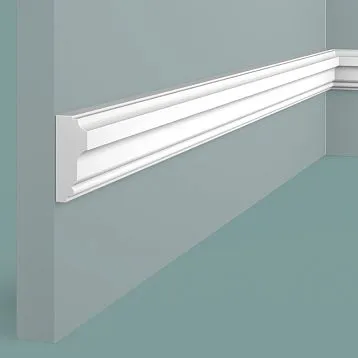
Wooden baseboardor from other materials — transition between wall and floor. Seemingly a purely utilitarian element (covers gap, protects wall from damage during cleaning). But shape, height, material, color of baseboard radically affect perception of interior.
Functions of baseboard:
-
Masking technological gap: When laying floor (laminate, parquet, board) a 10-15 mm gap is left between floor and wall (compensation for thermal expansion). Baseboard covers this gap aesthetically.
-
Wall protection: Bottom of wall suffers from vacuum cleaner hits, mop, feet. Baseboard takes hits, preserving wall finish.
-
Visual completion: Without baseboard interior looks unfinished (wall hangs in air, floor is cut off). Baseboard creates framing, completeness.
-
Stylistic accent: High skirting board (12-20 cm) = classic, tradition, solidity. Low skirting board (4-7 cm) = modernity, minimalism, lightness. Skirting board matching the wall color = visual increase in room height. Contrasting skirting board = clear geometry, graphic quality.
Materials: Solid wood (oak, ash, walnut — expensive, prestigious, eco-friendly, durable). Veneered or painted MDF (medium price, good aesthetics, variety of profiles). Polyurethane (cheap, lightweight, moisture-resistant, but looks plastic, not suitable for all styles). PVC (cheapest, for budget projects, aesthetics questionable).
Profiles: Simple rectangular (minimalism), classic shaped (rounds, beads, shelves — classic, neoclassic), high skirting board with ornament (palace interiors, Empire, Baroque).
Get Consultation
Carved decor: handcrafted uniqueness
Carved elements made of solid wood — wall overlays, furniture fronts, panels, frames. This is a piece product, bearing the imprint of handwork (even if the carving is done by CNC, the finishing is manual).
Functions of carved decor:
-
Accentuation: Carved overlay on a smooth wall — a focal point attracting the eye, setting the tone for the space.
-
Individualization: Mass-produced furniture becomes unique after adding carved elements (overlays on fronts, carved legs instead of standard ones).
-
Tactile richness: Wood is warm, alive, the relief of the carving creates a play of light and shadow, changing throughout the day.
-
Connection with tradition: Wood carving is the oldest craft, its presence brings a sense of cultural continuity, connection with masters of the past.
Application: Walls (carved panels, overlays on smooth panels, framing fireplaces, mirrors), furniture (carved fronts of cabinets, chests of drawers, carved headboards of beds, legs of tables and chairs), doors (carved panels, overlays), ceilings (coffers with carved rosettes — exclusive).
Carving styles: Classical (acanthus leaves, rosettes, meander — Greece, Rome), Baroque (lush cartouches, garlands, putti), Art Nouveau (smooth plant lines, stylization), ethnic (Russian, Scandinavian, Asian — specific ornaments).
Choosing decor: style dictates the solution
The main mistake when choosing decorative elements is ignoring the interior style. Baroque stucco in a loft, minimalist skirting board in a classic study, ethnic carved panels in high-tech — all these are dissonances, jarring to the eye, destroying integrity.
Interior style is a system of rules determining the choice of forms, materials, colors, proportions.which decorative elementis appropriate in a specific style, dictated by its philosophy, historical context, aesthetic principles.
Classic: triumph of the order system
Classical styles (classicism of the 18th-19th centuries, neoclassicism of the 20th-21st centuries) are based on the ancient order system — a strict hierarchy of architectural elements, proportions, symmetry.
Stucco in classic: Mandatory. Ceiling cornices 10-15 cm wide with classical ornaments (egg-and-dart, meander, acanthus). Ceiling rosette with a diameter of 60-100 cm (radial symmetry, moderate detailing). Wall moldings (creating panels — rectangular frames, symmetrically placed). Pilasters in room corners (vertical division, imitation of columns with capitals). Stucco color: white (classic) or contrasting to the walls (white stucco on green walls — a typical classic combination).
Skirting board in classic: High (12-18 cm), wooden or MDF, veneered with valuable wood (oak, walnut). Profile shaped (rounds, beads, transitions — not a straight block). Color: matching the floor (traditional approach) or white (neoclassic variant, visually lightens the interior). Installation: perfectly fitted corners (45-degree joints are flawless), attachment to the wall (not to the floor — historically correct).
Carved decor in classic: Wooden carved overlays in the centers of wall panels (rosettes, medallions with classical ornaments). Carved frames for mirrors and paintings (gilded or patinated).Classic Furniturewith carved elements (cabriole legs, carved chair backs, fronts with pilasters and capitals). Fireplace with a carved wooden portal (if there is a fireplace — it is the centerpiece of the living room).
Combination rule: All elements must belong to the same era (do not mix early classicism with late neoclassicism — they have different proportions). Symmetry is mandatory (paired elements, mirroring). Color palette restrained (white, beige, gray, pastel wall tones + dark wood furniture and skirting boards + gilding of carved decor).
Baroque and Rococo: opulence without limits
Baroque of the 17th century and Rococo of the 18th century — theatrical, demonstratively luxurious styles where there is never too much decor.
Stucco: Abundant, large, multi-layered. Cornices 15-25 cm wide with multi-layered ornaments (garlands, cartouches, rocaille). Ceiling rosettes with a diameter of 100-150 cm with voluminous scrolls, cupids, flowers. Corbels under cornices (decorative projections in the form of volutes). Stucco often gilded or patinated (not just white — that's boring for Baroque).
Skirting board: Very high (15-22 cm), often not flat but with volumetric decor (carved overlays, gilding). Material: solid wood, richly finished. Color: dark (walnut, mahogany) with gilded details or white with gold.
Carved decor: Everywhere. Walls: carved panels, door surrounds. Furniture: fully carved (legs, backs, fronts, armrests). Mirrors and paintings: in lush carved frames with scrolls, masks, putti. Finish: gilding (real or imitation), patination.
Combination rule: More is better (within reason — overload is possible, but it's a risk). Asymmetry is acceptable (Rococo loves playful irregularity). Colors saturated (burgundy, emerald, blue, gold). All elements expensive, demonstrative (Baroque is the style of the rich, not hiding wealth).
Modern styles: minimalism and restraint
Modern styles (minimalism, Scandinavian, contemporary, loft) reject ornamentation for its own sake. Elements are present, but their function is to emphasize architecture, not to decorate.
Molding in modern interiors: Minimal or absent. If used, it is simple in form, without ornaments. Cornice 4-6 cm, straight profile (simple projection, no scrolls). Moldings are thin (2-3 cm), rectangular in section, creating strict panel geometry. Rosettes are not used (chandelier is attached to a flat ceiling). Molding color = wall/ceiling color (monochrome, molding is perceived only through relief, not through color).
Baseboard: Low (4-7 cm), simple shape (rectangle or with minimal top rounding). Material: painted MDF, less often wood. Color: white (Scandinavian style, minimalism) or matching the wall color (visual merging, wall 'flows' onto the floor, height appears increased). Alternative: hidden baseboard (aluminum profile, recessed into the wall — floor does not touch the wall, there is a 5-10 mm gap through which light passes — floating floor effect).
Carved decor: Not used (carving = historicism, incompatible with modernity). Exception: a single carved item as a contrasting accent (antique carved armchair in a minimalist living room — eclecticism, works if the rest of the interior is restrained).
Combination rule: Less is more. Every element is functional (not just decor, but also useful — baseboard covers a gap, cornice hides an uneven joint). Colors are neutral (white, gray, beige, black). Materials are modern (metal, glass, plastic alongside wood and stone).
Eclecticism and fusion: rules of freedom
Eclecticism is a mixture of styles, eras, elements. But it is not chaos, but a thoughtful combination where heterogeneous elements are united by a common idea (color, form, scale).
Molding: Can be classical in form, but painted in an unexpected color (black cornice, gold rosette on a dark blue ceiling). Or modern in form, but arranged according to classical rules (symmetrical panels made of simple moldings).
Baseboard: High wooden (reference to classicism) combined with a concrete floor (loft) — contrast of eras. Or a white modern baseboard next to antique carved furniture — a play on opposites.
Carved decor: Used in doses (1-3 elements per room), as an accent. The rest of the decor is modern or neutral.
Combination rule: Controlled chaos. When mixing elements, maintain balance: if the furniture is classic carved, then the walls and ceilings are minimalist. If the walls are overloaded with molding, the furniture is simple. Common denominator: color palette or material (all wood of the same species, even if styles differ).
Rules for harmonious combination: three laws of decor
Understandingof decorative elementsboils down to three fundamental laws that work in all styles.
Law of style unity
All decorative elements in one room should belong to one style (or consciously contrast, but then it's eclecticism — a separate style).
Mistake: Polyurethane molding in Baroque style (ornate, with scrolls) + simple modern MDF baseboard + Scandinavian furniture (light wood, simple forms). Elements from three different eras, not connected by anything. Result: visual chaos, lack of integrity.
Correct: If the molding is Baroque, then the baseboard is also high, wooden, with decor (or at least a shaped profile), and the furniture is classic or Baroque. Everything works towards one idea: luxury, historicism, opulence.
Law of proportions and scale
The size of decorative elements must correspond to the scale of the room. Large molding in a small room feels oppressive, creates claustrophobia. Small molding in a huge hall gets lost, looks skimpy.
Proportion of cornice height to ceiling height: 1:20 — 1:15. Ceiling 3 meters — cornice 15-20 cm. Ceiling 2.5 meters — cornice 12-16 cm. Ceiling 4 meters — cornice 20-25 cm.
Proportion of molding width to panel size: Molding should be 1:20 — 1:25 of the smaller side of the panel. Panel 100×150 cm — molding 4-5 cm. Panel 60×120 cm — molding 3-4 cm.
Baseboard height: Traditionally 1:20 — 1:15 of the room height. Ceiling 3 meters — baseboard 15-20 cm (high classic). Ceiling 2.5 meters — baseboard 12-16 cm. Modern interiors break the rule (baseboard 5-7 cm at any height), but this is a conscious decision creating an effect of lightness.
Law of color and material coordination
Decorative elements must be connected by color and/or material.
Color schemes:
-
Monochrome: All elements are the same color (white molding, white baseboard, white moldings on white walls). They are perceived through relief, not through color. Effect: calm, airiness, modernity.
-
Contrast: Elements contrast with the background (white molding on colored walls, dark baseboard on light flooring). Effect: clarity, graphic quality, classicism.
-
Triad: Three colors in the interior (walls, floor, decor), connected by a harmonious combination (analogous or complementary colors). Molding, baseboard, carved decor are painted in one of these three colors.
Material coordination: If the baseboard is oak wood, then the carved decor is also made of oak (unity of texture, wood color). If the molding is white polyurethane, then the baseboard can also be white polyurethane (unity of material). Mixing materials is acceptable but requires taste: wooden baseboard + polyurethane molding works if both are painted the same color (white).
Style selection checklists: actionable specifics
Theory mastered, moving to practice. Below are ready-made decor selection schemes for popular styles.
Classical interior: palatial elegance
Ceiling:
-
Polyurethane cornice, width 12-18 cm, classical ornament (egg-and-dart, meander, acanthus), color white or contrasting with walls
-
Ceiling rosette diameter 70-100 cm, radial symmetry, installed around the chandelier
-
If ceiling is high (3.5+ meters) — coffers (square recesses framed by moldings)
Walls:
-
Moldings for creating panels (rectangular frames), molding width 4-6 cm, shaped profile
-
Panels positioned symmetrically, height 120-180 cm from floor
-
Inside panels: wallpaper with classical pattern (damask, stripe) or painting in a color different from moldings
-
Carved wooden appliqués in panel centers (diameter 15-25 cm, classical ornament)
Floor:
-
Wooden baseboardOak or walnut, height 14-18 cm, shaped profile (coves, beads)
-
Baseboard color: matching the floor tone (dark if the floor is dark) or white (neoclassical option).
-
Corners perfectly fitted, joints filled, painting/varnishing uniform
Furniture and accessories:
-
Classic FurnitureWith carved elements (legs, backs, fronts)
-
Mirrors and paintings in carved frames (gilded or patinated)
-
Heavy textiles (velvet, jacquard), curtains with valances
Color palette: White + beige/grey/pastel (walls) + dark wood (floor, furniture, baseboard) + gold (accents of carved decor, frames).
Modern minimalist interior: purity of lines
Ceiling:
-
Simple polyurethane cornice, width 4-6 cm, no ornament (straight profile or single cove)
-
Cornice color = ceiling color (white on white, visible through shadow)
-
No rosette, chandelier mounted directly to surface
Walls:
-
Moldings rarely used; if needed — thin (2-3 cm), rectangular cross-section, creating strict geometry
-
Alternative to moldings: wooden slats (horizontal or vertical strips with gaps), creating rhythm and texture
-
Walls painted (solid color, no patterns) or concrete/brick (loft)
Floor:
-
Painted MDF baseboard or concealed aluminum profile
-
Height 5-7 cm (visible) or 1-2 cm (concealed with lighting)
-
Color: white or matching wall color (visual blending)
Furniture and accessories:
-
Furniture with simple forms, no carving (straight lines, minimal decor)
-
Materials: light wood (oak, ash), metal, glass
-
Light textiles (linen, cotton), simple curtains (Roman, roller) or none
Color palette: White + gray + natural light wood + accent (one color: black, blue, green — in moderation).
Loft: industrial brutality with accents
Ceiling:
-
Moldings are not used (contradicts industrial aesthetics)
-
Ceiling: exposed beams (wooden or metal), concrete, wires and pipes as decor
Walls:
-
Brickwork (natural or imitation), concrete, rough paint
-
No moldings, decor is created by material texture
-
Exception: old carved elements (found at flea markets, thrift stores), incorporated as a contrasting vintage accent (one carved frame on a brick wall)
Floor:
-
Minimal baseboard (5-7 cm) metal or MDF under metal
-
Color: dark (black, graphite) or no baseboard at all (floor goes under the wall)
Furniture and accessories:
-
Industrial furniture (metal + rough wood), vintage (old factory tables, chairs)
-
Carved decor: if used — antique (contrast of an old carved chest and a concrete wall)
Color palette: Gray (concrete) + brick red + black metal + dark wood + rust accents.
Provence: French pastoral
Ceiling:
-
Polyurethane cornice, width 8-12 cm, simple profile or with light floral ornament
-
Color: white patinated (time effect) or light beige
-
Small rosette (40-60 cm) or absent
Walls:
-
Panel moldings (as in classic, but simpler, smaller), width 3-5 cm
-
Panels painted in pastel colors (lavender, mint, peach) or wallpapered with small floral print
-
Carved wooden shelves, overlays (simple carving, patinated)
Floor:
-
Wooden baseboard, height 10-14 cm, simple profile
-
Color: white patinated (peeling paint effect) or light wood
Furniture and accessories:
-
Painted furniture (white, beige, blue), with carved elements (not lush — modest carving)
-
Finishing: patina, brushing (aging effect)
-
Textiles: linen, chintz, lace
Color palette: White + pastels (lavender, mint, beige, blue) + light wood + accents of Provençal herbs (purple, green).
The art of creating coziness: the psychology of decorative elements
Why does one space feel cozy while another feels cold, even if the areas are the same, the furniture is comfortable, and the lighting is sufficient? The difference lies in the presence or absence of decorative elements that create visual and emotional richness.
Decor as a creator of scale
A bare wall is perceived as flat, two-dimensional. Moldings that create panels break up the plane, creating depth and layering. The eye catches onto the relief, studies the transitions of light and shadow, and the space becomes three-dimensional.
A ceiling without a cornice merges with the wall—the room seems lower, oppressive. A cornice separates the ceiling, creating a visual boundary—the height increases (paradox: an element was added, taking up 10 cm of height, but the perceived height grew).
Decoration as a bearer of time
New walls, new furniture, new flooring—everything screams 'straight from the store.' There's no history, no soul. Patinated molding, brushed baseboards, carved antique decor introduce a sense of time, lived-in quality, connection to the past. The space ceases to be impersonal—it gains character, history (even if artificial).
Decoration as rhythm and structure
A row of identical panels on a wall creates rhythm—repetition calms, orders the space. Chaos (random color splashes, disorderly objects) is tiring. Structure (moldings, baseboards, carved elements arranged according to symmetry rules) gives the eye an anchor point, reduces anxiety.
Decoration as a status marker
Like it or not, molding, tall wooden baseboards, carved furniture are perceived as signs of affluence. Historically, they were expensive (handcrafted labor, noble materials), accessible to the wealthy. Today, polyurethane molding is cheap, but the cultural code remains—its presence automatically raises the perceived status of the interior.
If it's important to you that guests appreciate your taste and capabilities (let's not be hypocritical—this matters to many), decorative elements are a tool for demonstration.
Frequently asked questions about choosing decorative elements
Can molding be used in an apartment with low ceilings (2.5 meters)
Yes, but with limitations. Cornice no wider than 8-12 cm, without lush ornaments (simple profile). Ceiling rosettes are best avoided (visually lower the ceiling). Wall moldings are acceptable (don't affect height). The main thing: don't overload—the lower the ceiling, the more modest the decor.
Which baseboard to choose if the floor is dark and the walls are light
Two options: baseboard matching the floor color (dark—traditional approach, baseboard perceived as part of the floor) or baseboard matching the wall color (light—modern approach, wall visually continues downward, room height increases). Both options are correct; the choice depends on style (classic—dark, contemporary—light).
Is it necessary to paint polyurethane molding or can it be left white
It can be left white (it comes primed), but painting is advisable. Paint (acrylic interior paint) protects polyurethane from dust, yellowing, creates a finish (matte or semi-matte) that improves appearance. If the walls are white, molding may not need painting, but re-prime it (primer evens out absorbency).
Does carved wooden decor combine with modern minimalism
Yes, if used sparingly and contrastingly. One antique carved item (mirror frame, panel, chest of drawers) in a minimalist interior creates a focal point, an eclectic accent. Several carved items—overload, destroys minimalism. Rule: 90% of the interior is minimalist, 10%—contrasting historical element.
What's more expensive: wooden baseboard or MDF
Solid wood is 2-4 times more expensive. Oak baseboard 15 cm high costs 2500-3500 rubles per linear meter. Veneered MDF of the same height—800-1500 rubles. Painted MDF—600-1200 rubles. But wood is more durable, prestigious, eco-friendly. Choice depends on budget and priorities.
Can molding and baseboard be installed yourself or is hiring professionals mandatory
You can do it yourself if you're handy and patient. Polyurethane molding cuts easily, glues (special acrylic adhesive), joints are filled with putty. Baseboard (wood, MDF) attaches with adhesive or screws, corners cut with a miter box. Difficulty: precision of corner cuts (45 degrees), neatness of joint filling. If it's your first time—you'll spend more time, mistakes are possible, but the result is achievable. Hiring professionals saves time, guarantees quality, but doubles the budget (labor costs as much as materials).
Where to find quality decorative elements at reasonable prices
From reputable manufacturers with a reputation, portfolio, guarantees. Avoid random sellers at markets (quality is questionable, no one to file claims with). Look for companies specializing in decor (not universal construction warehouses where decor is a side product). Read reviews, request material certificates, see samples in person (not just website photos).
Conclusion: decor is not embellishment, but the architecture of emotions
which decorative elementChoosing is not a technical question, but a philosophical one. It's a choice of how you want to feel in a space. Molding, baseboards, carved decor are not embellishment for beauty's sake (though beauty matters). They are tools for creating atmosphere, mood, connection to culture and history.
Understandingof decorative elementsIt frees you from chaotic rushing between stores, from trying to copy others' interiors, from disappointment with the result. You know the rules—and can consciously follow or break them, creating a space that reflects you.
Choose elements based on style (classic requires one thing, contemporary another, eclectic a third). Maintain proportions (element size should match room scale). Link elements by color and material (unity creates harmony). And remember: better less but higher quality, than more but random.
Start small. One cornice around the ceiling perimeter. One quality tall baseboard instead of a cheap low one. One carved overlay on an accent wall. Assess how the space has changed. If you like it—continue, adding elements gradually, avoiding overload.
Your home is not a set, a museum, or a magazine picture. It's a living space, changing with you. Decorative elements are not frozen forever solutions, but a flexible system that can be supplemented, changed, personalized. Today classic—in five years you might want contemporary—you'll replace molding with minimalist slats. That's normal. The main thing is that at every moment the space corresponds to who you are now.
STAVROS: Complete collection of decorative elements for any style
When it comes to choosing decor, the question arises: where to find quality elements covering all styles, materials, and price categories? Where to get consultation without pushy sales tactics? Where is the guarantee that what you buy matches what was promised? The answer from market professionals is unanimous: STAVROS.
Polyurethane moldings— 2000+ items for every taste: The collection covers all historical styles (Classicism, Baroque, Rococo, Empire, Art Nouveau, Art Deco) and contemporary trends (Minimalism, Contemporary). Ceiling cornices (width from 4 to 30 cm, profiles from strictly geometric to lavishly ornamented). Wall moldings (for creating panels, framing doors, zoning). Ceiling rosettes (diameters from 30 to 150 cm, shapes from simple circular to complex multi-rayed). Pilasters and half-columns (height 200-300 cm, capitals of all orders). Consoles, brackets, corner elements, pediments.
Quality: high-density polyurethane (surface layer 400-450 kg/m³), casting in silicone molds (clarity of the finest ornamental details), factory primer (ready for painting). Perfect geometry (deviation ±1 mm per 2 meters of length). All elements undergo three-stage quality control before shipment.
Wooden skirting boards— Solid wood — prestige and durability: Production from oak, ash, beech (top grade, knot-free, moisture content 8-10%). Profiles: classic figured (height 12-20 cm, complex multi-level profile with coves, beads), contemporary simple (height 6-10 cm, rectangle or minimal rounding), tall palace-style (height 20-25 cm, with carved overlays).
Finishing: natural (oil, wax — emphasizes wood grain), lacquered (glossy or matte — protection and aesthetics), painted (enamel white or custom-colored — for neoclassical interiors), patinated (aged effect — for Provence, vintage).
Packaging: skirting boards are packed in shrink film (protection from scratches, moisture during transport). Kit: skirting boards come with corner elements (internal, external), connectors, end caps (all from the same material, with the same finish — seams are invisible).
Carved solid wood elements — handcrafted accents: Carved overlays (sizes from 50×50 mm to 600×800 mm, floral, geometric, stylized ornaments). Corner elements (for framing panels, doors, mirrors). Round and oval rosettes (diameters 10-40 cm, relief depth 5-15 mm). Carved panels (narrative, landscape, ornamental — small series and one-off pieces by custom order).
Technology: combination of CNC milling (precision, repeatability) and manual finishing by a carver (liveliness, detailing, removal of machine marks). Each element is hand-sanded (gradation P120-P240), checked for relief quality (clarity of all lines, absence of chips).
Classic Furniture— Furniture with carved elements — completing the ensemble: If you've chosen classic decor (molding, tall skirting boards), it's logical to complement the interior with furniture of the same style. STAVROS offers collections: Baroque (opulent carved fronts, gilding, luxury), Classicism (strict forms, moderate carving, nobility), Neoclassical (contemporary interpretation of classics — clean lines with classical accents).
Range: armchairs and sofas (carved frames, upholstery jacquard/velvet/leather), dining and coffee tables (carved legs, tabletops from solid wood or marble), cabinets and dressers (carved fronts, bronze hardware), beds (monumental carved headboards, canopy structures). All furniture is manufactured in-house, materials — solid oak, beech, walnut (not chipboard, not veneer on cheap substrate).
Design and selection services: Not surewhich decorative elementwhat will suit your interior? STAVROS designers provide a free consultation (online or offline). You send photos of the space, style description, wishes — receive recommendations: which cornices, which skirting board, which carved elements, how to arrange them, what color to paint. If visualization is needed — we'll create a 3D model (paid service, but the cost is symbolic — 5-10 thousand, included in the order cost upon purchase).
Turnkey installation: Bought decor — don't know how to install it? STAVROS installation teams (experience from 10 years, specialization — classic and contemporary decor) will perform the installation.Polyurethane moldings, Wooden baseboardmolding, carved overlays — everything will be installed professionally, with a 2-year guarantee (elements won't peel off, won't deform, seams will remain invisible).
Delivery across Russia: Moscow and region — own transport, careful loading, delivery to the floor. Regions — partner transport companies, packaging in crates (protection from damage), cargo insurance. Timelines: Moscow 1-2 days, regions 3-10 days (depends on distance).
Loyalty program: Registered on the website — get a 3% discount on your first order. Orders totaling 50 thousand — permanent 5% discount. For 100 thousand — 7%. For 200 thousand — 10% + personal manager, priority production of custom orders.
Create interiors whereBasics of decorative elementswhere every cornice, every skirting board, every carved overlay is in its place, working towards the overall idea. Trust your choice to STAVROS — a company for which decor is not a commodity, but a calling, not a sale, but assistance in creating your dream space. Your home deserves the best. And STAVROS will provide that best.