












































































Article Contents:
- Tools for cutting: from simple to professional
- Jointer: classic for beginners
- Saw: choosing the blade matters
- Circular saw: precision to the degree
- Jigsaw: for curved cuts
- Templates for non-standard angles
- Internal angles: main task
- Geometry of internal angle
- Cutting sequence in jointer
- Cutting technique for clean edge
- Fitting and adjustment
- External angles: protrusions and bay windows
- Geometry of external angle
- Cutting in jointer for external angle
- Features of external angles
- Compensation for unevenness on external angles
- Compensating for wall curvature: working with reality
- Diagnosing wall curvature
- Wall leveling: radical method
- Baseboard fitting to wall
- Filling gaps with sealant
- Flexible baseboard for severely curved walls
- Touch-up and joint filling: perfecting to perfection
- Joint filling
- Joint touch-up
- Filling holes from fasteners
- Final sanding of angles
- Baseboard mounting: securing without damage
- Choose mounting method
- Installation step: Mounting
- Pilot hole drilling
- Error checklist: Learning from others' mistakes
- Error 1: Cutting without fitting
- Error 2: Cutting with a dull saw
- Error 3: Rushing during cutting
- Error 4: Ignoring wall curvature
- Error 5: Mounting before angle fitting
- Error 6: Driving nails without drilling
- Error 7: Thick spackle layer
- Error 8: Sanding across grain
- Error 9: Using wrong spackle color
- Error 10: Installing wet baseboard
- FAQ: Frequently Asked Questions
- Conclusion

We’ve finished laying the parquet, sanded it, and sealed it with varnish. The floor shines, every plank is in place. The final touch remains — installing wooden baseboard. Seems simple? Nail it along the wall — done. But when it comes to corners, problems arise. Cut a strip at 45 degrees, place it — a 1 cm gap to the floor. Cut again — now the gap is on the other side. Third attempt, fourth, material goes to scraps, nerves at the limit.
Quality cutting of wooden baseboard at complex angles is a skill that distinguishes a professional from an amateur. In theory, it’s simple: two cuts at 45 degrees, join them — you get a straight angle. In practice, walls rarely are exactly 90 degrees, baseboard has a complex profile, and wood may split with improper cutting. One inaccurate angle — and the entire job looks sloppy, cheap, amateurish.
In this article, we’ll cover the entire technology of cutting wooden baseboards from A to Z. We’ll learn which tools to use for different tasks, how to make templates for non-standard angles, how to compensate for wall curvature, how to achieve a perfect joint using spackle and touch-up paint. Most importantly — we’ll learn how to avoid typical mistakes that 90% of beginner craftsmen make. Because proper cutting is not luck — it’s understanding geometry, knowledge of material, and mastery of tools.


Cutting tool: from basic to professional




Miter box: classic for beginners
A miter box is a P-shaped device made of plastic, wood, or metal with slots for specific angles. A classic miter box has slots for 90, 45, and 22.5 degrees. The baseboard is placed in the miter box groove, the saw blade is inserted into the slot of the desired angle, and the cut is made.
Advantages of a miter box: low cost (plastic models cost 150–300 rubles), ease of use (no setup required), compactness (easy to store). This is the optimal tool for one-time jobs — repaired the apartment, stored the miter box in the storage until the next repair in ten years.
Disadvantages of a miter box: limited set of angles (only standard ones), low precision (slots wear out over time, especially in cheap plastic models), inability to work with wide baseboards (they don’t fit into the groove). For baseboards wider than 12 centimeters, a standard miter box is unsuitable.
How to choose a miter box: for wooden baseboards, a metal or wooden miter box with reinforced metal inserts in the slots is better. Plastic models quickly wear out on hard wood. Pay attention to the groove width — it should be 2–3 centimeters wider than your baseboard’s width.
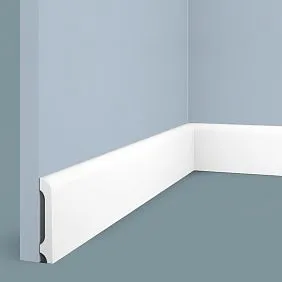
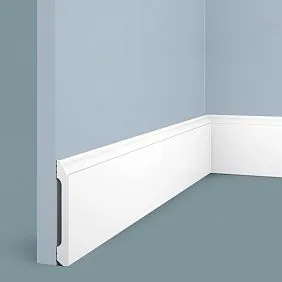
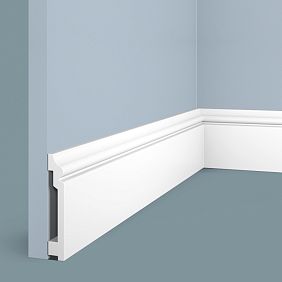
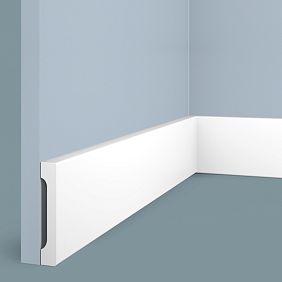
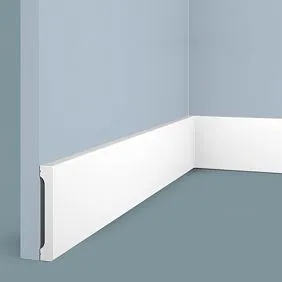
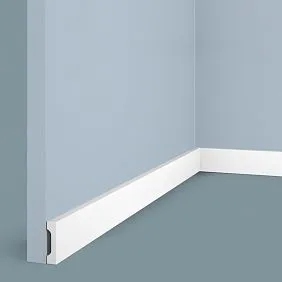
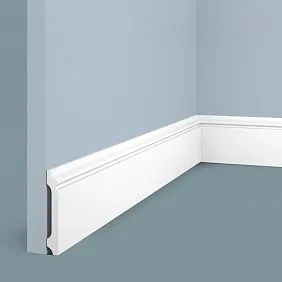
Our factory also produces:
Saw blade selection matters
Different types of saws are used for cutting wood. The choice depends on the hardness of the wood and the required cut quality.
A saw with large teeth (pitch 4–5 mm) cuts quickly but leaves a rough mark. Suitable for softwoods (pine, linden) when an ideal cut is not required (the edge will be hidden). Not suitable for hardwoods (oak, beech, ash) — may split fibers.
A metal saw with small teeth (pitch 1–1.5 mm) cuts slowly but gives a clean cut. Ideal for hardwoods and finishing cuts where precision matters. The downside — slow, especially for wide baseboards. But the risk of splitting is minimal.
A Japanese saw (cuts toward itself, not away) gives an extremely clean cut, almost no sanding required. Popular among professional carpenters. More expensive than standard (from 1500 rubles), requires skill.
Secret to a clean cut: blade sharpness. A dull saw tears fibers, leaving chips. Before an important cut, test the blade on a scrap piece — if the saw cuts easily, the cut is clean, the blade is good. If you have to force it, the cut is ragged — replace the blade.
Get Consultation
Miter Saw: Precision to the Degree
Miter Saw (miter cutter) - an electric tool with a circular blade mounted on a rotating base. Allows setting any cutting angle with precision to 0.5 degrees, ensuring a perfectly smooth cut without chipping.
Device: The circular saw is mounted on an arm that lowers from top to bottom to make the cut. The base rotates left and right, allowing setting an angle from 0 to 45-50 degrees in each direction. Standard angles (15, 22.5, 30, 45 degrees) are marked on the scale, with intermediate divisions.
Advantages of a miter saw: speed (cut takes 2-3 seconds), precision (angle set to the degree), clean cut (fine-toothed blade leaves no chips), ability to work with any baseboard sizes. Professional models have a laser guide showing the cut line — you can see exactly where the blade will pass.
Disadvantages: price (from 5000 rubles for a household model, from 15000 for professional), size (requires space for installation), noise (operates loudly, requires ear protection). Not cost-effective for one-time jobs, but if you're doing renovation throughout an apartment or house, the tool pays for itself in time and quality.
How to use a miter saw: the baseboard is placed on the saw table, pressed against the fence (rear rail). Set the desired angle on the scale and lock it. Lower the blade smoothly, without jerking. Do not push the wood toward the blade — the saw cuts on its own weight. After cutting, raise the blade and remove the baseboard.
Jigsaw: for curved cuts
An electric jigsaw with a wood blade can be used for cutting baseboards, but it is not the best choice for angles. A jigsaw is good for curved cuts (cutting around pipes, around columns), but for straight cuts at precise angles, it is inferior to a hand saw and a miter saw.
Jigsaw problem: the blade vibrates during operation and deviates from vertical. Even with a guide rail, achieving a perfectly straight cut is difficult. It is still acceptable for softwoods, but for hardwoods (oak), the jigsaw leaves chips on the back side of the cut.
When to use a jigsaw: for cutting complex shapes, for trimming baseboards to fit uneven walls (cutting the back of the baseboard to match the wall profile). For corner joints — only as a last resort, when no other tools are available.
Templates for non-standard angles
Not all angles in rooms are exactly 90 degrees. Old houses, homes with complex architecture, bay windows, sloped walls — all of these create angles of 85, 95, 110, 135 degrees. A standard miter gauge with 45-degree slots won't work here.
Solution: creating a custom template for each non-standard angle. The technology is simple but effective.
Step 1: Take a sheet of dense paper or thin cardboard. Place it against the wall angle, folding the sheet precisely along the angle line. You will get a copy of the room’s actual angle.
Step 2: Fold the sheet in half again along the crease line. The second fold line will indicate the angle at which each of the two baseboard pieces should be cut.
Step 3: Unfold the sheet and place it against the baseboard so that the second fold line is perpendicular to the baseboard’s edge. Trace with a pencil — this is the cut line.
Step 4: Cut along the line with a hand saw, ensuring the saw remains vertical. Cut the second piece mirror-image — the angle is the same, but the direction is opposite.
This method allows you to precisely cut baseboards at any angle without measuring with a protractor. Especially convenient for angles that are difficult to reach with measuring tools.
Internal Angles: Main Task
Internal Angle Geometry
An internal angle is the angle formed by two walls converging inward into the room. This is a standard situation in any room — four walls form four internal angles.
When cutting baseboards for an internal angle, each of the two pieces is cut at 45 degrees so that when joined, they form a 90-degree right angle. Important: the cut is made on the front side of the baseboard (the side facing the room), not the back.
Rule for internal angles: when looking at the baseboard from the front side, the left piece is cut so that the top edge is longer than the bottom. The right piece is cut the opposite way — the bottom edge is longer than the top. When joined, the two pieces form a V-shape, with the point directed inward toward the angle.
Cutting Sequence in the Miter Gauge
Place the baseboard in the miter gauge as it will sit against the wall: the bottom part (which contacts the floor) lies on the bottom of the miter gauge, and the back part (which contacts the wall) is pressed against the rear wall of the miter gauge. The front side of the baseboard faces you.
For the left piece: the saw blade is inserted into the slot running from the left rear corner of the miter gauge to the right front corner. Cut, resulting in a cut where the top part of the baseboard is longer than the bottom.
For the right piece: the baseboard is flipped over (now the future right piece lies in the miter gauge), and the saw blade is inserted into the opposite slot — from the right rear corner to the left front corner. Cut, resulting in a mirror-image cut.
Important note: do not confuse left and right pieces. Before cutting, mentally visualize how the baseboard will sit in the corner. If unsure, mark the baseboard with a pencil to indicate which side of the angle it will face.
Technique for a Clean Cut
The quality of the joint is 90% dependent on the cleanliness of the cut. If the end is uneven or chipped, the joint will have gaps — no amount of spackle will fix it.
How to get a clean cut:
Sharp blade — check sharpness before each angle. Replace a dull blade immediately.
Smooth motion — do not jerk the saw, do not press too hard. The blade should move under its own weight plus a slight guiding force. Jerking causes chipping.
Material support — the baseboard must be tightly pressed against the sides of the miter gauge, without vibrating. If it vibrates, hold it by hand (but not in the cutting zone).
Speed — slow down and cut gently during the last 2-3 centimeters of the cut. When the saw exits the wood, there is a high risk of chipping on the back side. A slow exit minimizes this.
Sanding after cut — after cutting, run a fine sanding paper (grit 180-220) along the edge to remove small burrs. Hold the sandpaper flat to avoid rounding the corner.
Fitting and adjustment
After cutting both boards, mandatory fitting on-site. Place the boards against the corner, aligning them without fastening. Inspect the joint from multiple angles — from above, below, and at eye level.
Ideal joint: the gap between boards is no more than 0.5 millimeters across the entire height of the baseboard. Such a micro-gap easily fills with putty and becomes invisible after painting.
Acceptable joint: gap up to 1 millimeter. Requires careful puttying, but will look decent after finishing.
Poor joint: gap exceeding 1-2 millimeters, especially if uneven (0.5 mm at top, 3 mm at bottom). Such a joint requires redoing — you must resaw one end, adjusting the angle.
How to adjust: if the gap is larger at the top, slightly reduce the angle of the top edge of one board. Clamp the baseboard in the miter gauge, slightly tilt the saw (by 1-2 degrees), and make a thin corrective cut. If the gap is larger at the bottom, adjust the bottom edge.
Patience — the key to a perfect angle. Professionals make 3-4 fittings with micro-adjustments, achieving a flawless joint.
External angles: protrusions and bay windows
Geometry of external angles
External angle — an angle protruding into the room (column, wall protrusion, bay window, corridor corner). Less common than internal angles, but requires special attention — external angles are always visible, and any defect is noticeable.
For external angles, the geometry is opposite to internal angles: the cut is made so that the inner (back) side of the baseboard is shorter, while the front side is longer. When joined, the two boards form a V-shape, with the point directed outward, into the room.
Rule for external angles: when viewing the baseboard from the front, the left board is cut so that the bottom edge is longer than the top (opposite to internal angles). The right board — the top edge is longer than the bottom.
Cutting in the miter gauge for external angles
The baseboard is placed in the miter gauge the same way as for internal angles: bottom part on the base, rear part pressed against the side wall. But the direction of the cut is reversed.
For the left board of the external angle: the saw blade is inserted into the slot running from the right rear corner of the miter gauge to the left front corner. This is the opposite slot compared to internal angles.
For the right board: slot from the left rear to the right front.
Many beginners get confused about which slot corresponds to which angle. Simple way to remember: mentally imagine how the baseboard will fit into the corner. For internal angles, the cut edge points toward the wall. For external angles — away from the wall, into the room.
Features of external angles
External angles are mechanically vulnerable — they are stepped on, hit by furniture during rearrangement, or brushed by vacuum cleaners during cleaning. Therefore, requirements for joint strength are higher.
Joint reinforcement: in addition to glue on the ends, use a thin finishing nail driven diagonally through the joint. The nail is driven from one board’s end into the end of the other board at a 30-40 degree angle. The nail head is pressed flush, and the hole is filled with putty. This hidden reinforcement holds the joint even under mechanical stress.
Alternative — pre-madecorner elementswooden corner caps. These are corner overlays that are slipped over the external angle, covering the joint. Convenient, does not require precise cutting, but adds visual bulk — not everyone likes this aesthetically.
Compensating for unevenness at external angles
External angles are often not perfectly straight — walls may slightly deviate from vertical, the angle may not be exactly 90 degrees, but 88 or 92. At a rigid joint, this will create a gap.
Compensation method: after cutting two strips at 45 degrees, try them in place without fastening. If there is a gap, determine its location (top, bottom, middle). File or sand the end of one strip at the gap location, reducing the angle locally by 1–2 degrees. Re-check — the gap should decrease.
This is a matter of feeling the material. Remove material gradually, frequently checking the fit. It’s better to try five times and file once correctly than to cut too much and end up with a gap on the other side.
Compensating for wall curvature: working with reality
Diagnosing curvature
Perfectly flat walls do not exist. Even in new constructions, there are deviations of 2–5 millimeters per meter of length. In older houses, there may be waves of 1–2 centimeters. Baseboard is a rigid strip — it does not bend. If the wall is concave, a gap forms between the baseboard and the wall. If convex, the baseboard hits the protrusion and does not fit elsewhere.
How to check for curvature: place a long straightedge or flat board (2–3 meters) against the wall. Look at the gap between the straightedge and the wall. Gaps mean the wall is concave. If the straightedge does not fully adhere — the wall is convex.
Measure the maximum gap with a ruler. If less than 3 millimeters — it’s not critical; the baseboard will compensate. If 5–10 millimeters — corrective measures are needed. If more than 10 millimeters — serious problem requiring wall leveling or special installation techniques.
Wall leveling: radical method
If the wall is very curved, the correct solution is to level it before installing the baseboard. Apply plaster or putty in 15–20 cm wide strips from floor level around the entire room perimeter. This is labor-intensive, but yields an ideal result.
Technology: at the bottom of the wall, at baseboard height (10–15 cm from floor), install guide strips — metal or wooden boards, set level and in one plane. Apply plaster between guide strips, level with a straightedge. After drying, remove guides (if metal), fill grooves. Result: a perfectly flat strip to which the baseboard will fit ideally.
When this method is justified: during major renovations, when walls are fully plastered. Or when installing expensive wooden baseboards from premium species (oak, beech), where perfection is essential.
Baseboard fitting to the wall
If you do not level the wall, the baseboard must be fitted to its contour. For small irregularities (up to 5 mm), this is done by lightly filing the back of the baseboard.
Technology: place the baseboard against the wall, mark with pencil where it is offset from the wall. Remove the baseboard, place it face down. Using a chisel, file, or coarse sandpaper, remove 2–4 mm from the back of the baseboard at marked spots. Re-check — the fit should improve.
This method requires care — if you remove too much, the baseboard will start to rock. Remove material gradually, frequently checking the fit.
Filling gaps with sealant
For gaps between baseboard and wall 3–7 mm wide, use acrylic sealant. Choose sealant color to match baseboard (for natural wood — beige or brown; for painted — match paint color).
Technology: baseboard is fastened to the floor (not to the wall). Gap between baseboard and wall is filled with sealant from a caulking gun. Excess is wiped with a damp cloth. Seam is smoothed with finger or special putty knife, creating a smooth transition from baseboard to wall.
After drying (24 hours), sealant can be painted to match wall color, if wall is white or beige and wall is colored. Sealant covers technical gap, while remaining elastic — if wood slightly expands or shrinks due to humidity changes, sealant will compress or stretch without cracking.
Flexible baseboard for severely curved walls
If wall has wave more than 10 mm or curved shape (column, bay window), rigid wooden baseboard cannot be installed without gaps. Two solutions:
Solution 1: modular baseboard from short segments. Instead of one 2.5-meter strip, use five 50-cm strips. Short segments more easily follow wall curves. Joints between segments are made at 90 degrees (not 45), filled with putty.
Solution 2: flexible baseboard from veneer or composite materials. These look like wooden (natural veneer on flexible base), but bend to 50 cm radius. Suitable for bay windows, columns. More expensive than standard wood, but essential for complex shapes.
Touch-up and puttying seams: finishing to perfection
Joint puttying
Even perfectly mitered corners have a micro-gap of 0.3–0.5 mm — this is normal. Such a gap is filled with wood putty, after which it becomes invisible.
Choosing putty: for wooden baseboards, use acrylic wood putty. Match color to baseboard. Manufacturers produce putty in various wood tones — oak, pine, walnut, wenge. If baseboard will be painted, putty color is irrelevant — white is acceptable.
Puttying technology:
Step 1: baseboard is secured, joint is cleaned of dust and sawdust. Check that no wood fibers are loose in the gap — remove them.
Step 2: Using a narrow putty knife (or your finger in a rubber glove), press the putty into the gap, pushing it inward. Fill the gap slightly overfilled — the putty will shrink as it dries.
Step 3: Remove excess putty with the knife, running it along the joint. The knife should follow the grain of the wood, not cross it — this minimizes the risk of leaving scratches.
Step 4: Let the putty dry according to the instructions (usually 2–6 hours).
Step 5: Sand the filled area with fine sandpaper (grit 180–220), leveling it with the baseboard’s surface. Sand gently to avoid removing too much putty or exposing the gap again.
Joint Staining
If the baseboard is finished with oil or varnish that highlights the wood grain, the filled joint may show a color difference (putty always slightly differs from wood). Staining is required.
For oil-finished baseboards: use a water-based stain in the desired shade. Apply with a fine brush to the filled area, let it soak in for 5–10 minutes, then wipe off excess with a cloth. The stain will color the putty to match the wood. After drying (1 hour), apply a thin layer of the same oil used to finish the entire baseboard.
For lacquered baseboards: use lacquer tinting paste. Add the paste of the desired color to a small amount of lacquer, mix well. Apply with a fine brush to the joint, feathering it out. After drying (4–6 hours), lightly sand with fine sandpaper, then apply another thin layer of clear lacquer.
For painted baseboards: repaint with the same paint used to finish the baseboard. Use a fine brush to stroke the joint, trying not to go beyond its edges. Usually, one thin coat is sufficient.
Filling Screw Holes
If the baseboard was fastened with finish nails or screws, small holes (2–3 mm in diameter) remain. These also need to be filled.
The technique is the same: putty is pressed into the hole with excess, excess is removed, after drying it is sanded, and if necessary, stained. If done carefully, the fastening spot will be almost invisible.
Professional Tip: Use furniture wax pencils. These are hard wax sticks in various colors (for different wood species). Choose a pencil matching the baseboard’s tone, heat the tip with a lighter (literally 2–3 seconds), press the softened wax into the nail hole. Remove excess with a plastic putty knife. The wax will harden within a minute, filling the hole. This is faster than putty and often less noticeable — wax has a slight sheen, like natural wood.
Final Corner Sanding
After filling and staining, sand all corners with very fine sandpaper (grit 240–320, or even 400). Goal — remove the tiniest imperfections and make the surface smooth to the touch.
Sand gently, without pressure. You can wrap the sandpaper around a small wooden block — this makes it easier to control the flatness. Pay special attention to joint corners — tiny putty ridges often remain there.
After sanding, remove dust with a soft brush or vacuum. Wipe with a slightly damp cloth (if the baseboard is finished with lacquer or oil — use a dry cloth). The corner is now ready — perfectly flat, smooth, with no visible joints.
Baseboard Installation: Secure Without Damage
Installation Method Selection
How to install wooden skirting boardsRight? There are several methods, each with its own pros and cons.
Finish Nails: Thin nails with small heads (1.2–1.5 mm diameter) driven into the baseboard at an angle into the floor or wall. The head is pressed in 2–3 mm, the hole is filled with putty. Pros: simplicity, reliability, no special tools needed. Cons: risk of splitting the baseboard during driving (especially near edges), labor-intensive (each nail must be driven, pressed, and filled).
Screws: Screws with concealed heads, screwed into pre-drilled holes. The hole is drilled slightly smaller than the screw diameter, the screw is driven in so that the head is recessed 2–3 mm, then the hole is filled with putty. Pros: no risk of splitting (if drilled correctly), strong hold, can be removed if needed. Cons: takes longer than nails (each hole must be drilled).
Liquid Nails: A mounting polymer adhesive applied to the back of the baseboard. The baseboard is pressed against the wall, and the adhesive sets in 20–30 minutes. Pros: no holes or putty needed, the baseboard’s surface remains untouched. Cons: only suitable for perfectly flat walls (on curved walls, the adhesive won’t form a strong bond), difficult to remove (the baseboard is permanently glued).
Combined: Adhesive plus nails or screws. The adhesive ensures full-length contact, while the fasteners hold the baseboard until the adhesive sets and provide long-term security. The most reliable method, recommended for expensive baseboards made from premium wood.
Installation Step for Fasteners
For wooden baseboards, the standard installation spacing for nails or screws is 40–50 cm. A 2.5-meter baseboard requires 5–6 fastening points. Near corners, spacing reduces to 20–30 cm — the baseboard must not move away from the wall by even a millimeter.
Where the wall has protrusions or recesses, fasteners are placed more frequently — every 25–30 cm. This presses the baseboard against the wall, compensating for unevenness.
Pre-drilling
To avoid splitting the wood when driving nails or screws, pre-drilling is essential. The drill bit is chosen slightly smaller than the nail or screw diameter.
For a 1.5 mm finish nail, use a 1.2 mm drill bit. For a 3.5 mm screw, use a 2.5–3 mm drill bit.
Drilling is done at an angle of 60-70 degrees to the plinth plane, direction - towards the floor or wall (depending on where the fastener will go). Drilling depth - 2/3 of the nail or screw length.
Important: drill carefully, controlling the drill bit direction. If the drill bit veers off, it may emerge on the front surface of the plinth - this is a defect.
Error checklist: learning from others' mistakes
Error 1: Cutting without checking
Typical beginner mistake: cut two planks at 45 degrees along the wall, immediately nailed them to the wall. When reaching the corner - a 5 mm gap. Cause: did not check the joint before fastening, did not verify the actual wall angle.
Correct: after cutting, always try both planks in the corner without fastening. If there is a gap - adjust it. Only after perfect fitting, fasten the plinth.
Error 2: Cutting with a dull saw
A dull saw tears fibers, leaving a ragged edge and splinters. A joint of such ends will never be tight.
Correct: use a sharp saw. If the saw is dull - replace the blade or sharpen it (for saws with large teeth). For critical cuts - use a new blade.
Error 3: Rushing during cutting
Rapid, jerky sawing motion results in an uneven cut and deviation from the intended angle. Especially critical for a circular saw - if you pull the lever, the blade will tear out a piece of wood.
Correct: cut smoothly, without rushing. The saw should move under its own weight plus slight guiding force. A circular saw descends slowly and controllably.
Error 4: Ignoring wall curvature
You cut the plinth at 45 degrees along the wall, assuming a 90-degree wall angle. But the actual angle is 88 or 92 degrees. The joint ends up with a gap, no matter how hard you try.
Correct: before cutting, check the actual wall angle with a protractor. If it differs from 90 degrees - adjust the cut angles. Or use the paper template method.
Error 5: Fastening before angle fitting
Nailed the first plinth plank. Cut the second, placed it at the corner - there's a gap. Now either accept the gap, or remove the already nailed plank, which is risky (could damage the wood).
Correct: leave the last 30-40 centimeters of each plank unfastened at corners. Try the angle, adjust it. Only after perfect fitting, fasten both planks at the corner.
Error 6: Driving nails without drilling
Nailed a nail into hard wood (oak, beech) without pre-drilling - the plinth cracked along the grain. Or the nail veered off and emerged on the front surface.
Correct: always drill holes before driving nails, especially in hard woods and at the edges of the plinth (where the risk of splitting is highest).
Error 7: Thick spackle layer
Applied thick spackle to the corner gap. After drying, the spackle shrank, cracked, and fell off. Or remained convex, standing out against the wood.
Correct: spackle is applied in thin layers, pressed into the gap. If the gap is deep - use several thin layers with intermediate drying, not one thick layer.
Error 8: Sanding across the grain
Sanded the corner with sandpaper, dragging it across the wood grain. Left scratches visible after varnishing.
Correct: sand along the grain or in circular motions. Cross-grain motions are only for rough treatment with coarse grit; final sanding is only along the grain.
Error 9: Using the wrong spackle color
Spackled an oak plinth with white spackle. After oiling, the joints show white lines.
Correct: choose spackle color to match the wood. For dark woods - dark spackle (walnut, wenge), for light woods - light spackle (pine, oak). Or use paintable spackle (if the plinth will be painted).
Error 10: Installing a wet skirting board
Bought a skirting board, stored in a cold warehouse, brought to a warm apartment, installed immediately. After a week, the skirting board shrank, detached from the wall, joints separated.
Correct: allow the skirting board to acclimate. After delivery, place it in the room where installation will occur for 2-3 days. Wood adapts to temperature and humidity, attains its final dimensions. Only after this cut and install.
FAQ: Frequently Asked Questions
Question: Can you cut a wooden skirting board without a miter saw?
Answer: Yes, it is possible, but more difficult. Draw a cutting line at the required angle on the skirting board using a set square and protractor, then cut along the line, monitoring the saw's verticality. This method requires skill and experience. For beginners, a miter saw or a circular saw is more reliable.
Question: Which wood species is easiest to cut?
Answer: Softwoods - pine, spruce, linden. They cut easily, almost no splinters. Hardwoods - oak, beech, ash - are harder to cut, require sharp tools and care. However, joints of hardwoods are stronger and more durable.
Question: Is it necessary to fill joints, or can they be left as is?
Answer: For natural-colored skirting boards (oiled), a micro-gap of 0.3-0.5 mm can be left - it is barely noticeable. For painted skirting boards, filling is mandatory - any gap will appear as a dark line against the paint.
Question: How long does it take to cut and install skirting boards in one room?
Answer: For an experienced craftsman, a 20-square-meter room (perimeter around 18 meters) takes 4-6 hours of work, including cutting angles, mounting, and filling. For a beginner, it may take a full day or even two, especially if much time is spent on fitting angles.
Question: Is it better to nail skirting boards to the floor or to the wall?
Answer: It depends on the construction. If the floor is wooden (plank, parquet) - you can nail to the floor. If the floor is floating (laminate, parquet board on underlayment) - only to the wall, otherwise you restrict floor expansion, leading to deformation. In most cases, it is safer to nail to the wall.
Question: Can polyurethane corner pieces be used for wooden skirting boards?
Answer: Technically possible, but visually it often looks unnatural - polyurethane differs from wood in texture. Better to use woodencorner elementsor cut corners yourself.
Question: What if the wall angle is not 90 degrees, but, for example, 110 degrees?
Answer: Use the paper template method or measure the actual angle with a protractor. Divide it in half (110 : 2 = 55 degrees). Cut each board at 55 degrees. If you don't have an angle-adjustable tool, make a template.
Question: Is it necessary to cover skirting board ends with varnish or oil before joining?
Answer: Recommended. The end is exposed wood fibers that actively absorb moisture. An unprotected end may darken or swell. Cover the ends with a thin layer of oil or varnish before installation. After joining and filling, cover again.
Conclusion
Quality cutting of wooden skirting boards at complex angles is a skill that comes with experience. The first angle may take an hour of fitting and adjustment. The tenth takes ten minutes. The hundredth takes five, and the joint is perfect from the first attempt. This is a matter of practice, understanding geometry, and feeling the material.
The main thing is not to rush. Measure seven times, cut once - this applies primarily to cutting skirting boards. Try, check, adjust. Use the right tool, sharp and properly adjusted. Work with respect for the material - wood forgives small mistakes, but roughness is punished with cracks and splinters.
Company STAVROS offers a wide range of solid wood skirting boards in oak, beech, ash, pine, and larch. All sizes from 40 to 200 mm in height, variety of profiles - from simple rectangular to intricate carved. Also in the catalog are ready-madecorner elementsfor external and internal corners - they simplify installation, requiring no delicate cutting.
STAVROS consultants will help you select skirting boards to match your floor and interior, calculate the required quantity considering angles and waste, recommend mounting and finishing methods. Because skirting boards are not just a board at the floor. They are the finishing touch of the interior, a frame that defines the space. And this frame must be flawless - no gaps in corners, no visible joints, no installation errors. Only then does the interior look complete, professional, and luxurious. And the path to such a result begins with proper cutting of the first angle.


