Article Contents:
- Psychology of novelty perception in the furniture industry
- Barriers to adopting new decisions
- Diffusion of innovations theory in the furniture business
- Strategic planning for launching novelties
- Market opportunity analysis
- Positioning and differentiation
- Creating a compelling story for a novelty
- The art of storytelling in furniture sales
- Creating emotional connection
- Promotion channels for new furniture
- Digital marketing and social networks
- Traditional promotion channels
- Presentation and demonstration of novelties
- Organization of exhibition spaces
- Training staff to present novelties
- Pricing strategy for novelties
- Premium pricing strategies
- Flexible pricing models
- Handling objections when selling novelties
- Typical objections to novelties
- Techniques for overcoming resistance
- Creating buzz and word-of-mouth
- Viral marketing strategies
- Working with influencers and opinion leaders
- Measuring promotion effectiveness
- Key Success Metrics
- Analytics and monitoring tools
- Regional promotion specifics
- Adapting to local markets
- New Product Distribution Management
- Long-term Strategy for New Product Development
- Product Lifecycle and Planning
- Innovation Planning and Product Line Refresh
- Integration of Online and Offline Promotion
- Omni-channel Sales Approach
- Augmented Reality Technologies
- Case Studies of Successful Launches
- Analysis of Industry Best Practices
- Mistakes and Lessons from Failed Launches
- Building an Ecosystem to Support New Products
- Partner Network and Distribution
- Post-sales Support
- Frequently Asked Questions
- Conclusion: The Art of Turning Innovations into Commercial Success
Launching new furniture onto the market is a moment of truth for any manufacturer or retailer. Months of development, investments in design, production capacity, marketing budgets — all converge at one point: can you effectively communicate the value of your new product to customers? The question of whethereffectively and profitably becomes critically important for business survival and prosperity. Novelty can be both a powerful competitive advantage and a serious obstacle — it all depends on how well the presentation and promotion strategy is built.becomes critically important in a saturated market, where consumers are spoiled for choice and become increasingly demanding in terms of quality and uniqueness of offerings.
New furniture is not just another item in a catalog. It embodies current design trends, responds to the changing needs of modern consumers, and is the result of technological innovations in manufacturing. Each new product carries the potential to become a bestseller or, conversely, to become a warehouse burden, freezing the company’s working capital.


Psychology of Perceiving New Products in the Furniture Industry




Barriers to Adopting New Decisions
Furniture is a durable good, and consumers approach its selection with particular caution. Novelty may be perceived not as an advantage, but as an additional risk. 'What if this style goes out of fashion in a year?', 'How reliable are these new materials?', 'Isn't it better to choose time-tested classics?' — such doubts are natural for furniture buyers.
Innovative resistance is especially pronounced among conservative audience segments. Older buyers prefer familiar forms and materials, young families with limited budgets fear paying extra for 'fashionable items'. Even affluent clients may hesitate if novelty seems too radical to them.
Overcoming psychological barriers requires a systematic approach. Social validation — reviews from early adopters, designer recommendations, celebrities featuring the product in their interiors — gradually reduces perceived risks. The story behind the product’s creation, the designers’ inspiration, and demonstrations of the manufacturing process create an emotional connection with the product.
Our factory also produces:


Diffusion of Innovations Theory in the Furniture Business
Everett Rogers’ classic theory works perfectly in the furniture industry. Innovators — 2.5% of the market — are ready to buy revolutionary new products simply for the sake of novelty. Early Adopters — 13.5% — value the practical benefits of innovations and are willing to pay a premium for them. Early Majority — 34% — purchase new products after their value has been proven.
Understanding these segments helps plan marketing campaigns correctly. For innovators, exclusivity and the opportunity to be first are important. For early adopters, functional advantages and quality of execution are critical. The early majority needs social validation and quality guarantees.
Each segment requires its own communication channels and arguments. Innovators are attracted to specialized design publications and trade shows. Early adopters actively study professional reviews and comparisons. The early majority relies on social media reviews and friend recommendations.
Get Consultation
Strategic Planning for New Product Launches
Market Opportunity Analysis
A successful launch of new furniture begins long before it appears in showrooms. A deep market analysis allows identifying unmet needs, gaps in competitors’ offerings, and emerging consumer preference trends.
Researching interior design trends provides understanding of directions that will be relevant in the coming years. Sustainability, functionality, transformability, integration with smart technologies — these are the vectors of development for the modern furniture industry.Unique interior itemsare becoming increasingly popular among consumers seeking individuality.
Demographic changes affect demand for various furniture categories. Aging population increases demand for ergonomic furniture, urbanization stimulates demand for compact, multifunctional solutions, and rising incomes of young professionals create a market for premium novelties.
Positioning and Differentiation
Clear positioning is the foundation of successful promotion of new products. The novelty must occupy a unique position in consumers' minds, addressing a specific need better than existing alternatives.
Functional positioning highlights practical advantages: "a sofa that saves 30% of space", "a table that adapts to any user's height", "a cabinet with an innovative space organization system". This approach is effective for rational audience segments.
Emotional positioning appeals to feelings and status: "furniture for creators of the future", "interiors that inspire", "design that changes life". Emotional arguments are especially important for premium novelties.
Combining functional and emotional advantages creates the most compelling positioning. Understanding thatWhat new-generation furniture is made of — a question customers must receive comprehensive answers to. Eco-friendliness, durability, ease of care — specific advantages speak louder than abstract 'innovation'.high-end quality allows highlighting both qualitative and status aspects of the novelty.
Creating a compelling story for the novelty
The art of storytelling in furniture sales
Every novelty needs a compelling story that explains its emergence and highlights its unique value. The story of its creation can become a powerful promotional tool, especially if it includes interesting details about the designers' inspiration, technical innovations, and production challenges.
The designer's personal story often resonates with buyers. A narrative about how the designer sought a solution to their own problem — lack of space in an urban apartment, inconvenience of standard furniture, desire to combine beauty and functionality — makes the product more human and relatable.
The technological story highlights the innovation of the solution. Descriptions of new materials, production processes, and testing create a sense of a scientific approach to furniture creation.What quality furniture is made ofModern manufacturers — such information adds weight to the novelty's presentation.
Creating an emotional connection
Successful novelties create an emotional connection with consumers even before purchase. This connection is formed through visual imagery, associations with the desired lifestyle, and promises of positive changes in the buyer's daily life.
The lifestyle approach shows new furniture not as a standalone item, but as part of a desired lifestyle. Photo shoots in beautiful interiors, videos of happy families using the new furniture, stories of home space transformations — all contribute to creating emotional appeal.
The novelty's social significance can become an additional factor of attractiveness. Eco-friendly materials, support for local manufacturers, contribution to the development of the design community — such aspects are especially valued by modern consumers.
Channels for promoting new furniture
Digital marketing and social networks
Modern promotion of new furniture is unthinkable without active use of digital channels. Social networks allow creating buzz around the novelty even before its official launch, attracting influencers' attention, and obtaining early feedback from the target audience.
Instagram is ideal for visually presenting furniture novelties. High-quality photos in interiors, stories showing the creation process, IGTV with designer stories — all contribute to forming an attractive product image. Hashtags help novelties find their audience among millions of posts.
YouTube opens opportunities for more detailed presentation of novelties. Product reviews, demonstrations of functionality, comparisons with competitors, interviews with creators — content that helps potential buyers make informed decisions.
Pinterest works as an inspiration source for people planning to update their interiors. Boards with ideas for using new furniture, combinations with other interior items, mood boards — tools for long-term influence on purchasing decisions.
Traditional promotion channels
Despite digitization, traditional channels remain effective in the furniture business. Exhibitions and trade fairs allow demonstrating novelties to the professional community — designers, architects, retailers — who can become active promoters of innovations.
Specialized print publications about interior design have high reader trust. Publication in an authoritative journal adds status to the novelty and attracts attention from affluent audiences ready to pay a premium for quality and design.
Partnership with interior designers creates a channel for promoting new products in real projects. Designers using the new furniture in their projects become natural brand ambassadors, demonstrating its applicability in various stylistic solutions.
Presentation and Demonstration of New Products
Exhibition Space Organization
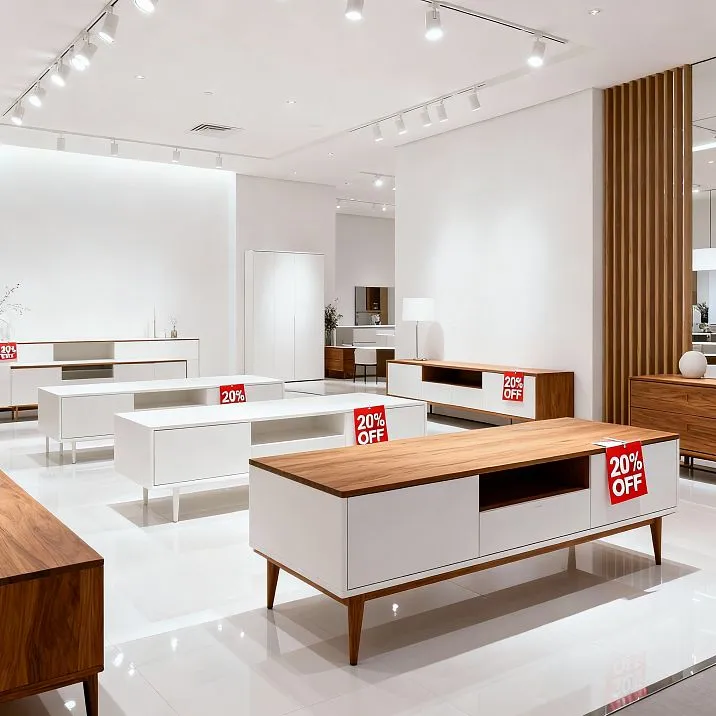
Physical presentation of new furniture requires a special approach to space organization. New items must stand out among existing inventory, attract visitors' attention, and create a desire to try and test the product.
Zoning of exhibition space helps create the right hierarchy of attention. The entrance zone is ideal for placing the most eye-catching novelties — they are the first to catch visitors' attention. Central zones are suitable for demonstrating the functionality and versatility of new solutions.
Interactive elements increase visitor engagement. QR codes with access to video reviews, tablets with configurators, the ability to test transformations and mechanisms — modern buyers value the opportunity to independently study product features.
Lighting plays a critical role in the perception of novelties. Directed lighting highlights design details, creates accents on unique elements. The ability to adjust lighting intensity and color temperature demonstrates how new furniture looks under various conditions.
Staff Training for Presenting New Products
effectively and profitably becomes critically important for business survival and prosperity. Novelty can be both a powerful competitive advantage and a serious obstacle — it all depends on how well the presentation and promotion strategy is built.Effective? The key factor is professional training of sales consultants. Staff must not only know the features of the novelty but also be able to present its advantages, respond to objections, and find appropriate arguments for different types of customers.
Technical training includes studying the construction features of the novelty, properties of materials, mechanisms of transformation, rules of maintenance and operation. The consultant must be prepared to answer any technical question from the customer.
Commercial training focuses on argumentation of advantages, handling objections, closing techniques. Special attention is paid to positioning the novelty relative to existing analogs, justifying the price, and presenting unique value.
Practical trainings include role-playing with different types of customers, refining presentation scripts, simulating complex situations. Regular practice helps staff feel confident when working with novelties.
Pricing Strategy for Novelties
Premium Pricing Strategies
New products often allow setting premium prices, especially if they offer unique advantages or address an unmet market need. The skimming strategy involves initially high prices to maximize profit from early adopters.
Price discrimination allows extracting maximum consumer value. VIP clients receive exclusive access to novelties at full price, while the mass segment waits for price reductions after a certain period. This approach maximizes total revenue.
Psychological pricing takes into account the specifics of how customers perceive price. A price of 99,900 rubles appears significantly lower than 100,000, even with minimal difference. Anchoring — first showcasing the most expensive variant — makes the basic version more attractive.
Flexible Pricing Models
Modern consumers value flexibility in paying for expensive items. Interest-free installment plans make novelties accessible to a broader range of buyers. Leasing programs for corporate clients reduce entry barriers for office furniture.
Trade-in programs stimulate furniture updates. The ability to trade in old furniture toward the purchase of new items reduces the final cost and solves the disposal problem for the buyer.where to buy decorFor updating existing furniture — an alternative question that may arise for budget-conscious buyers.
Seasonal promotions and pre-orders create additional purchase incentives. A discount for pre-ordering novelties motivates the most interested customers, creates pre-demand, and helps plan production.
Handling Objections When Selling Novelties
Typical Objections to Novelties
"Too expensive" — a classic objection, especially relevant for novelties with premium positioning. Behind this objection often lies a lack of understanding of the product's unique value or comparison with simpler analogs.
"I need to think" may indicate uncertainty about novelty, fear of making the wrong choice, or the need for family consultation. Novelties often cause more doubts than proven solutions.
"What if it quickly goes out of style" — a natural concern when purchasing expensive furniture. Consumers fear that the new style will be a short-term trend rather than a long-term design direction.
Techniques for Overcoming Resistance
An educational approach helps overcome misunderstanding of the novelty's value. Detailed explanation of advantages, demonstration of unique features, comparison with alternatives — tools that transform resistance into understanding.
Social validation reduces perceived risks. Reviews from early buyers, designer recommendations, examples of use in well-known projects — evidence that the novelty has already gained recognition from experts and consumers.
Warranties and promises minimize purchase risks. Extended warranty, exchange possibility, trade-in program — tools that give the buyer confidence in the correctness of their decision.
Creating buzz and word-of-mouth
Viral marketing strategies
Creating buzz around a new product is an art that can multiply promotional effectiveness. Viral content spreads naturally, reaching audiences inaccessible to traditional advertising.
Uniqueness and surprise attract attention in the information noise. Furniture with revolutionary design, unexpected features, provocative positioning naturally becomes a topic of discussion on social networks.
Emotional content increases the likelihood of its spread. People share what evokes strong emotions — admiration, surprise, desire. New products with a "wow" effect have greater chances of going viral.
Audience participation in content creation increases engagement. Contests for the best interior with new furniture, calls to share photos, user-generated content — ways to turn customers into active brand promoters.
Working with influencers and opinion leaders
Interior designers are key opinion leaders in the furniture industry. Their recommendations carry high credibility among consumers. Collaboration with well-known designers can become a catalyst for the success of a new product.
Bloggers and Instagrammers create authentic content about new products. Their audience perceives recommendations as genuine advice from friends, not as advertising. Micro-influencers with niche audiences are often more effective than mega-stars.
Professional media and industry experts add credibility to new products. Publication in specialized publications, winning design contests, expert endorsements — factors that influence how the professional community perceives the product.
Measuring promotion effectiveness
Key success metrics
Sales volume is an obvious but not the only indicator of a new product's success. Speed of reaching target volumes, share of sales in the category, comparison with plan — metrics that show the commercial effectiveness of the launch.
Brand and product awareness measures the effectiveness of marketing activities. Spontaneous and prompted awareness, brand associations, understanding of positioning — indicators of communication strategy performance.
Qualitative metrics include customer reviews, expert ratings, media mentions. Net Promoter Score shows customers' willingness to recommend the new product to others — a critical indicator for long-term success.
Analytics and monitoring tools
Web analytics shows interest in the new product in the digital space. Traffic to product pages, viewing time, conversion to inquiries — data that helps optimize online promotion.
Social analytics tracks discussions about the new product on social networks. Volume of mentions, sentiment of reviews, content virality — indicators of the effectiveness of social media marketing activities.
CRM systems accumulate data on customer interactions. Lead sources, effectiveness of various promotional channels, customer profiles for new products — information for adjusting strategy.
Regional promotion specifics
Adapting to local markets
Regional differences in preferences, purchasing power, and cultural specifics require adapting promotional strategies for new products. What works in Moscow may not suit regions with different mindsets and income levels.
Climate conditions affect the perception of certain materials and design solutions.Wood materials for furniturebehave differently in various climatic zones, which influences consumer preferences.
Local media and influencers have greater trust among regional audiences. Partnership with local designers, participation in regional exhibitions, advertising in local publications — tools for effective regional promotion.
Managing new product distribution
Phased geographic launch allows testing market reaction and adjusting strategy. Starting with key cities enables studying demand, optimizing pricing, and fine-tuning logistics before scaling up.
Training regional staff is critical for new product success. Remote training, video materials, regular communication with regional partners — ways to ensure consistent presentation standards across the entire distribution network.
Adapting marketing materials to regional specifics increases promotion effectiveness. Localizing advertising campaigns, accounting for regional holidays and events, using local case studies — tools to enhance communication relevance.
Long-term strategy for product development
Product life cycle and planning
Each new product goes through predictable stages of its life cycle: introduction, growth, maturity, decline. Understanding these stages helps plan marketing activities and promotion investments.
The introduction stage requires maximum promotion investment with minimal sales volume. The goal is to create initial awareness, find early adopters, gather first feedback and usage cases.
The growth stage is characterized by increasing sales and decreasing promotion cost per unit. Focus shifts from creating awareness to encouraging trial purchases and building brand preference.
The maturity stage requires active measures to maintain competitiveness. Product modifications, line expansion, seeking new application segments — strategies for extending the life cycle of successful new products.
Innovation planning and product line refreshment
Continuous innovation is key to long-term success in the furniture industry. While some new products reach peak sales, others must be prepared for launch, creating a constant stream of product updates.
R&D investments in research and development ensure technological leadership. Studying new materials, manufacturing technologies, consumer trends — the foundation for creating breakthrough innovations of the future.
Partnerships with designers and technology companies accelerate innovation processes. Joint projects with renowned designers, integration with IT solutions, use of startup technologies — ways to stay at the forefront of the industry.
Integration of online and offline promotion
Omni-channel sales approach
Modern consumers do not separate online and offline worlds — they expect a seamless experience interacting with the brand. New products must be equally appealing across all communication channels.
Unified creative and positioning support product recognition across all touchpoints. Brand colors, slogans, key messages must be identical in advertising, on the website, in showrooms, and on social media.
Cross-channel analytics shows the customer journey of a modern buyer. The customer may see the new product on Instagram, study its features on the website, visit a showroom for testing, and place an order via a mobile app.
Retargeting and CRM integration allow personalizing communications based on customer behavior. Visitors to the new product page receive personalized offers, event participants — special purchase conditions.
Augmented Reality Technologies
AR applications revolutionize the presentation of furniture novelties. The ability to "place" a virtual model of new furniture in one’s own interior removes the main barriers to online sales of bulky items.
3D configurators allow customers to customize novelties to their needs. Choosing sizes, colors, materials, and additional options creates a sense of involvement in creating a unique product.
Virtual showrooms expand the possibilities for showcasing novelties. 360-degree tours, interactive presentations, virtual consultations — technologies that bring the online experience closer to offline interaction.
Cases of successful launches
Analysis of industry best practices
Successful new product launches in the furniture industry share common characteristics: clear understanding of the target audience, unique positioning, high-quality execution, comprehensive promotion.
IKEA masterfully launches novelties, creating entire stories around them. Each new collection has a name, concept, and emotional weight. Limited collections in collaboration with renowned designers create buzz among brand fans.
Premium brands focus on exclusivity and craftsmanship. Stories about handmade work, unique materials, and decades of master experience create an aura of uniqueness around novelties.
Mistakes and lessons from unsuccessful launches
Underestimating the importance of positioning is a common mistake during new product launches. A product without a clear concept and unique advantages gets lost among competitors and fails to find its audience.
Incorrect pricing can ruin even a great new product. Too high a price deters potential buyers, too low a price creates doubts about quality.
Insufficient staff training leads to ineffective presentation of novelties. Sales staff who do not understand product advantages cannot convincingly present them to customers.
Building a support ecosystem for novelties
Partner network and distribution
Successful launch of a new product requires support from the entire partner network. Dealers must understand positioning, know sales arguments, and be motivated to promote new products.
Partner motivation programs include special purchasing conditions, marketing support, and regional exclusivity.where to buy moldingsand decorative elements for new furniture — a question often raised by partners seeking to offer comprehensive solutions.
Training the partner network is critically important for success. Seminars, webinars, and educational materials help partners effectively present new products to their clients.
After-sales support
Quality after-sales support affects the long-term success of a new product. Satisfied customers become brand ambassadors, recommend the product to friends, and leave positive reviews.
Warranty service for new products must be flawless. Any issues with innovative products receive heightened attention and can seriously damage reputation.
Collecting feedback from early buyers helps improve the product and adjust the marketing strategy. Customer satisfaction surveys, focus groups, and service complaint analysis are sources of valuable information.
Frequently asked questions
How much time is required for a successful launch of new furniture on the market?
The full launch cycle for a new product in the furniture industry typically takes 6 to 18 months, depending on product complexity and campaign scale. The preparation phase includes design development, testing, and production readiness. The marketing campaign begins 2-3 months before launch. Initial results are visible 3-6 months after active sales begin.
What budget is needed to promote new furniture?
The promotion budget depends on project ambitions and scale. A local launch may require only 500,000–1,000,000 rubles. A federal campaign requires 3–5 million rubles. Premium innovations aiming for market revolution may require budgets of 10–20 million rubles and more.
How to evaluate the potential of new furniture before launch?
Pre-launch testing includes focus group research, online surveys, search query analysis, and concept testing on social media. Pilot sales in a limited region or via the internet help assess real demand. A/B testing different positioning approaches reveals the most effective strategies.
What errors are most commonly made during new product launches?
Main errors include insufficient market research, incorrect positioning, overly optimistic return-on-investment timelines, cutting corners on material quality and execution, underestimating the importance of staff training, and ignoring feedback from early buyers.
How to handle negative reviews about new furniture?
Negative reviews about new products require a particularly delicate approach. Quick response, public apologies, and offering solutions are standard procedures. It is important to use criticism to improve the product and prevent similar issues in the future. Positive reviews from satisfied customers help balance the overall picture.
Should multiple new products be launched simultaneously?
Launching multiple new products simultaneously dilutes attention and resources. It is better to focus on one key product, provide it with maximum support, achieve success, and then launch the next. Exception — a new collection, where all items complement each other.
How to determine the optimal price for new furniture?
Pricing new products is based on analyzing value to the consumer, studying competitor prices, and calculating cost with desired margin. Testing various price points through online research or limited offers helps find the optimal balance between profitability and sales volume.
What role do interior designers play in promoting new products?
Interior designers are key opinion leaders in the furniture industry. Their recommendations carry high client trust. Using the new product in real projects, publishing in portfolios, and recommending via social media are powerful promotional tools. Investing in relationships with the design community pays off many times over.
Conclusion: the art of turning innovations into commercial success
Selling new furniture is much more than simply informing the market about the arrival of another product. It is the art of creating a story that resonates with consumers, a strategy for building an emotional connection between innovation and human needs, and the science of precise positioning in a competitive environment.
effectively and profitably becomes critically important for business survival and prosperity. Novelty can be both a powerful competitive advantage and a serious obstacle — it all depends on how well the presentation and promotion strategy is built.Can it succeed in modern conditions? The answer lies in a comprehensive approach that combines deep understanding of consumer psychology, mastery of modern marketing tools, and relentless attention to every aspect of customer experience.
Successful innovations do not appear by chance. Behind each lies thorough market research, a well-thought-out positioning strategy, high-quality execution of all development and launch stages. Today’s furniture consumer is spoiled for choice and does not forgive mistakes — only truly valuable innovations find their way to the hearts and wallets of buyers.
Technology changes the ways furniture is presented and sold, but fundamental principles remain unchanged. Product quality, understanding client needs, honesty in communication, professionalism in service — the foundation of any successful launch, regardless of the channels and tools used.
The furniture industry continues to evolve, offering consumers increasingly sophisticated solutions for creating comfortable spaces.Unique Interiorsbecoming the norm rather than the exception, creating a constant demand for innovative products.
Eco-trends, personalization, integration with smart technologies — directions that will define the development of the furniture industry in the coming years. Companies that can offer truly innovative solutions in these areas and effectively promote them will gain significant competitive advantages.
For many years, the company STAVROS has been a reliable partner for furniture manufacturers and retailers, helping to bring the most daring design ideas to life. A rich assortment of decorative elements, hardware, and finishing materials allows for creating furniture that not only performs its function but also becomes a decoration of the interior.where to buy furniture decorof the highest quality? STAVROS offers solutions for the most discerning manufacturers striving to create products that become sought-after novelties on the market. STAVROS professionals understand that the success of each novelty depends on many details, and are ready to share their experience with anyone striving for perfection in the furniture business.