












































































Article Contents:
- Diagnosis of condition: the art of reading wooden biographies
- Determining historical value and authenticity
- Planning the restoration process
- Creating working documentation
- Disassembly and cleaning: gentle release from layers of time
- Special cleaning methods
- Structural restoration: restoring the strength of the construction
- Modern technologies for structural repair
- Restoring Decorative Elements
- Technologies for recreating lost decoration
- Final finishing and protective coatings
- Traditional and modern finishing methods
- Quality control and final assembly
- Documenting restoration results
- Preventive maintenance and long-term preservation
- Planning preventive work
Each piece of antique furniture holds the history of generations, and the restorer's task is not merely to restore its functionality, but also to preserve the soul of the object. How to restore furniture So that it regains a second life without losing its original charm? Furniture restoration is a delicate art of balancing between preserving authenticity and the necessity of modern technical solutions. In a world where mass production erases individuality, restoring unique items becomes an act of cultural resistance and creative self-expression.
Restoring wooden furniture requires not only technical skills but also a deep understanding of historical manufacturing features, knowledge of properties of different wood species, and mastery of traditional and modern processing methods. Every scratch, every darkening tells its own story, and the craftsman's task is to decide what to preserve as a witness of time and what to restore to extend the life of the object.
Modern approaches to restoration combine respect for historical traditions with the use of innovative materials and technologies. This allows achieving results that were inaccessible to craftsmen of the past, while preserving the authentic character of the items.


Diagnosis of condition: the art of reading wooden biographies
Professional restoration begins with a detailed analysis of the furniture's condition — a process comparable to archaeological excavations. Every defect, every color change, every deformation carries information about the object's life, its usage conditions, and previous repair attempts.
Structural assessment identifies the extent of damage to load-bearing structural elements. Weakening of 'dovetail' joints, cracking of large components, frame deformation — all these issues require immediate attention. Instrumental diagnostics using moisture meters, resistance meters, and endoscopes allow detecting hidden defects inaccessible to visual inspection.
Analysis of finishes determines the type and quantity of lacquer, paint, and stain layers applied over years of use. Chemical tests, ultraviolet radiation, microscopic examinations help identify materials and select optimal methods for their removal or preservation. Understanding historical finishing technologies is critically important for making correct decisions.
Biological damage — traces of insect infestation or fungal decay — requires special attention. Active infection sites must be localized and eliminated before beginning major restoration work. Modern methods of disinsectization and fungicidal treatment provide effective protection without harming the wood.
Documenting the condition creates a detailed map of upcoming work. Photographic documentation of general views and details, compiling defect inventories, measuring deformations — all this forms a technical specification for restoration and allows controlling the quality of completed work.




Determining historical value and authenticity
Attribution of furniture — establishing its age, style, and possible author — influences the choice of restoration methods. Museum exhibits require maximum preservation of original elements, even if this limits functionality. Furniture for everyday use allows more radical interventions.
Stylistic analysis is based on knowledge of the evolution of furniture art. Constructive features, decorative elements, proportions, types of joints — all this helps accurately date the item and determine its cultural affiliation. Knowledge of regional traditions of furniture craftsmanship allows identifying characteristic features of schools and workshops.
Technological markers — traces of tools, surface treatment methods, types of fasteners — provide additional information about the time and place of manufacture. Handcrafting until the mid-19th century leaves distinctive traces that differentiate it from machine-made work. The evolution of fasteners also serves as a reliable dating indicator.
Provenance — the history of ownership of an object — may provide valuable information about its fate and authenticity. Documentary evidence, family traditions, expert opinions help reconstruct the furniture's biography and enable reasoned decisions regarding the nature of restoration.
Our factory also produces:


Restoration Process Planning
The restoration strategy is determined based on a comprehensive analysis of the furniture's condition, its historical value, and its intended use after restoration. Conservation — minimal intervention for stabilization — restoration — returning to the original appearance — and reconstruction — recreating lost elements — are distinguished.
Work prioritization begins with eliminating factors threatening the object's preservation. Pest control, structural reinforcement, and stabilization of cracking elements are performed first. Then follow operations to restore functionality, and finally, aesthetic operations.
Material and technology selection is based on the principle of compatibility with the original. Modern synthetic materials are used only when traditional methods do not provide the required strength or durability. Reversibility — the ability to remove added elements without damage to the original — is an important criterion for selecting solutions.
Temporary scheduling accounts for technological breaks required for glue drying, wood stabilization, and coating curing. Disrupting these timeframes may lead to serious defects, correction of which will require additional effort and expense.
Budgeting for a restoration project includes not only material and labor costs, but also expenses for research, specialist consultations, and purchasing specialized tools. High-quality restoration requires significant investment, but the results justify the costs.
Get Consultation
Creating Working Documentation
The restoration technical specification details all planned operations, indicates materials and technologies, and defines quality criteria. This document serves as a guide for implementers and a basis for quality control.
Step-by-step drawings and diagrams visualize the sequence of operations, especially important during disassembly and assembly of complex structures. Detailed marking of elements prevents errors during reassembly. Photographing each disassembly stage creates a visual assembly guide.
Material specifications indicate exact names, manufacturers, and technical characteristics of all applied compositions. This ensures reproducibility of results and allows procedures to be repeated or modified if necessary.
Quality control checkpoints are established for each stage of work. Intermediate inspections, measurements, and tests allow timely detection and correction of deviations from specified parameters.
Disassembly and Cleaning: Gentle Release from Layers of Time
Disassembling furniture requires maximum care and understanding of the structural features of a specific period. Old joints often rely on animal-based adhesives, which may soften with steam or heat. Modern synthetic adhesives require special solvents or mechanical destruction of joints.
Documenting the disassembly process includes photographing each removed element in its original position, marking parts, and measuring gaps and fits. This information is critically important for accurate reassembly after restoration is complete. Losing even one part or misaligning it may fundamentally alter the character of the object.
Removing fasteners is performed with original hardware preserved wherever possible. Antique nails, screws, hinges were often handmade and have unique shapes. Their preservation supports the authenticity of the object. Damaged fasteners may be restored or fabricated to match.
Removing old finishes is one of the most responsible stages of restoration. Mechanical methods — scraping, sanding — may damage the wood surface. Chemical strippers are effective but require careful application and thorough neutralization. Thermal methods — heat guns, infrared emitters — allow softening finishes for safe removal.
Cleaning wood from contaminants is performed step-by-step, from gentle to more aggressive methods. Dry cleaning with brushes and vacuum cleaners removes surface contaminants. Wet cleaning with special solutions dissolves embedded stains. Bleaching is used only in extreme cases when other methods are ineffective.
Special Cleaning Methods
Ultrasonic cleaning is effective for removing contaminants from hard-to-reach areas — carved elements, internal cavities, complex profiles. The method is safe for wood but requires special equipment and application skills.
Laser cleaning — a modern technology allowing selective removal of contaminants and finishes without affecting the base material. The method is especially effective for cleaning gold leaf, removing graffiti, and restoring carved details. High equipment cost limits its application.
Cryogenic cleaning uses dry ice to remove finishes and contaminants. The method is environmentally friendly, leaves no chemical residues, and is effective for complex surfaces. Requires special equipment and safety measures.
Biological cleaning employs special microorganisms to break down organic contaminants. The method is slow but absolutely safe for wood and the environment. Used for removing grease stains, animal activity traces, and organic dyes.
Structural Restoration: Returning Structural Integrity
Repairing joints — the foundation of structural restoration of furniture. Weakened peg joints can be reinforced with additional elements — wedges, overlays, clamps. In cases of significant damage to pegs and sockets, complete replacement with custom fitting is applied.
Gluing cracks requires understanding of wood grain direction and load characteristics. Longitudinal cracks along the grain are relatively easy to glue. Transverse cracks are more problematic due to different wood expansion coefficients in different directions. Modern flexible adhesives allow creating joints that compensate for material movement.
Replacing lost fragments is performed using wood of the same species, as closely matching in texture and color as possible. The orientation of new elements' grain must exactly match the original. The "inset" insertion technique ensures repair invisibility and maximum joint strength.
Structural reinforcement may require installing additional elements — clamps, braces, overlays. These elements must be concealed from view but provide necessary structural rigidity. Using modern composite materials allows creating reinforcements with minimal weight and maximum strength.
Restoring movable elements — drawers, doors, hinged tops — requires precise fitting of guides, hinges, and locks. Wear of these elements leads to geometric and functional distortion of the object. To restore furniture It is impossible to fully restore without restoring all mechanisms.
Modern structural repair technologies
Injection reinforcement allows restoring the strength of wood damaged by rot or insect damage. Special epoxy-based compounds penetrate deeply into the wood structure, polymerize, and form an reinforcing framework. The method preserves the surface appearance while significantly improving mechanical properties.
Carbon fiber reinforcement is used to strengthen heavily loaded structural elements. Thin carbon fiber tapes, adhered to the surface or embedded in grooves, significantly increase strength without noticeable changes in appearance. The method is especially effective for long beams subjected to bending.
Vacuum impregnation ensures deep penetration of reinforcing compounds into damaged wood. Under vacuum, air is removed from pores, and under pressure, the impregnating compound is introduced. The method allows restoring even severely damaged wood.
Microwave drying accelerates the stabilization process of restored wood. Even heating throughout the volume prevents cracking and deformation. Computer-controlled process ensures optimal settings for different wood species.
Restoring Decorative Elements
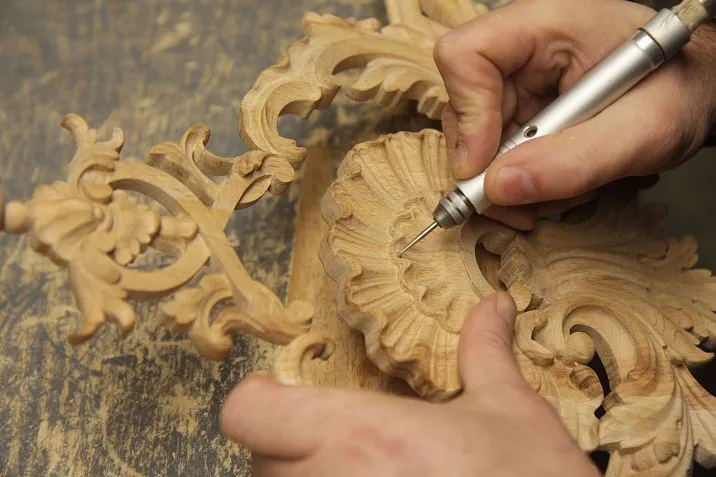
Carved details are the most complex part of restoration work, requiring not only technical skills but also artistic sensitivity. Lost carving fragments are restored based on preserved analogs or historical samples. Modern 3D scanning and printing technologies allow precise reproduction of complex shapes.
Inlay and inlay require knowledge of traditional techniques and materials. Different wood species, bone, mother-of-pearl, metals must be selected according to the original design intent. Restoration of lost elements is performed with jewel-like precision.
Gilding and silvering are restored using traditional technologies — adhesive gold leaf and amalgam for silvering. Modern materials are used only when enhanced resistance to operational stresses is required.
Painting and decorative finishes are recreated with maximum fidelity to the original. Analysis of pigments, binders, and application techniques allows reproduction not only of appearance but also of manufacturing technology. Modern paints are used only when traditional materials cannot be applied.
Hardware — handles, locks, hinges, appliqués — often has high artistic value. Restoration of metal elements includes corrosion removal, restoration of lost details, and recreation of protective and decorative coatings. Patination allows new elements to appear as if aged appropriately.
Technologies for recreating lost decoration
Silicone molding allows precise copying of preserved decorative elements to recreate lost fragments. Flexible molds capture the finest relief details. Castings from special composite materials, after processing, are indistinguishable from carved details.
CNC machining ensures high precision in reproducing complex profiles and three-dimensional forms. Programming the machine based on a 3D model allows manufacturing identical series of parts. The method is especially effective for restoring balusters, posts, and appliqués.
Manual copying remains indispensable for unique elements that cannot be mechanically reproduced. The master carver recreates lost details based on preserved fragments and stylistic analogs. Such work requires deep knowledge of art history and virtuoso mastery of tools.
Combined technologies combine mechanical production of basic forms with manual finishing of details. This approach allows combining the precision of machine production with the individuality of handwork.
Finishing and protective coatings
Surface preparation for final finish determines the quality of the final result. Sanding is performed sequentially with abrasives from coarse to fine grit. Final grit is selected depending on the finish type — for open-pore finishes, P220 is sufficient, while glossy varnishes require P320-P400.
Selection of finish type is based on historical appropriateness and functional requirements. Shellac finishes are traditional for furniture from the 18th-19th centuries but require special care. Modern polyurethane varnishes provide high durability but may alter the surface character.
Wood tinting equalizes color differences between old and new wood, restoring the original hue faded over time. Water-based stains penetrate deeply into the wood structure, while alcohol-based stains create a more intense surface color.
Imitating patina and signs of aging is a delicate operation requiring artistic sensitivity. New elements must naturally blend into the overall ensemble without standing out due to fresh finish. Techniques of artificial aging include brushing, patination, and selective tinting.
Protective coatings must ensure long-term preservation of restored furniture. Multi-layer systems with different functions per layer — primer, leveling, decorative, protective — create optimal conditions for use.
Traditional and modern finishing methods
French shellac polishing remains the standard of quality for antique furniture. Multiple applications of ultra-thin layers with intermediate polishing create a coating of exceptional depth and luster. The technique requires years of experience, but the result surpasses any modern finish.
Oil finishes highlight the natural beauty of wood, creating a warm, lively surface. Linseed oil, tung oil, and modern oil compositions penetrate into the wood structure, providing protection from within. Finishes are easy to renew and repair.
Wax finishes create a soft, natural luster with pleasant tactile qualities. Carnauba wax, beeswax, synthetic compounds are applied with a pad or brush followed by polishing. Wax finishes require regular maintenance but provide an authentic appearance.
Modern finishes are used when traditional materials do not provide required performance characteristics. Water-based varnishes are eco-friendly and safe, polyurethane finishes provide maximum durability, UV-cured finishes offer the highest surface quality.
Quality control and final assembly
Step-by-step quality control ensures the result meets set objectives. Each operation must be inspected and approved before proceeding to the next stage. Defects detected early are easier to correct than after all work is completed.
Dimensional control includes checking geometric parameters — straightness, flatness, perpendicularity, dimensions. Deviations from nominal values may cause assembly problems and compromise the functionality of the item.
Visual inspection assesses surface quality, coating uniformity, and absence of defects. Examination under various lighting angles reveals unevenness, scratches, and spots that may not be noticeable under normal lighting.
Functional testing checks the operation of all movable elements — drawers, doors, transformation mechanisms. Smooth operation, absence of sticking, and correct fitting — all of these affect the ease of use of restored furniture.
Assembly is performed in reverse order of disassembly, taking into account all changes made during restoration. Careful fitting of components, correct positioning, and control of connection tightness ensure the longevity of the restored structure.
Documentation of restoration results
Photographic documentation of results creates a visual history of the project and serves as a basis for subsequent care of the item. Photos taken before, during, and after restoration demonstrate the scope of work performed and the quality of the result.
The restoration passport contains complete information on performed work, applied materials, technologies, and dates of operations. This document is necessary for planning preventive maintenance and possible future interventions.
Recommendations for use and care help the owner preserve restoration results for many years. Climate conditions, usage patterns, care products — all of these affect the preservation of restored furniture.
Warranty obligations define the restorer's responsibility for the quality of work performed. Warranty periods depend on the nature of the work, operating conditions, and materials used.
Preventive maintenance and long-term preservation
Climate control is the foundation of long-term preservation of wooden furniture. Stable temperature of 18-22°C and relative humidity of 45-55% provide optimal conditions for wood. Sudden fluctuations in these parameters may cause deformation, cracking, and peeling of coatings.
Regular inspection allows timely detection of initial damage stages. Monthly inspections for the appearance of cracks, changes in geometry, and coating damage enable preventive measures. Early detection of problems significantly simplifies and reduces their cost of repair.
Preventive treatment protects furniture from biological damage. Regular treatment with insecticides and fungicides prevents infestation by pests. Special attention should be paid to hidden cavities, where infection foci may develop.
Proper placement of furniture affects its preservation. Avoiding direct sunlight, heating appliances, and sources of humidity extends the lifespan of coatings and prevents deformation. Using stands, cloths, and covers protects against mechanical damage.
Care of coatings maintains their protective and aesthetic properties. Different types of coatings require specific care products. Wax coatings require periodic wax renewal, while lacquered coatings require polishing with special compounds.
Planning preventive work
Calendar-based maintenance planning takes into account seasonal climate changes and usage intensity. Spring and autumn inspections allow assessment of the impact of winter heating season and summer heat. Preparation for the heating season includes humidifying air and protecting against drying out.
Technical maintenance of mechanisms ensures their longevity and smooth operation. Lubrication of hinges, guides, and locks should be performed using recommended materials. Adjustment of clearances compensates for natural wear and geometric changes.
Renewal of protective coatings is planned depending on their type and usage intensity. Wax coatings may require renewal several times a year, while lacquered coatings — every few years. Timely renewal prevents damage from penetrating into the material depth.
Monitoring of condition includes maintaining an observation log, photographic documentation of changes, and measuring deformations. Accumulation of data allows predicting process development and planning necessary interventions.
The art of furniture restoration requires deep knowledge, patience, and respect for history. Each project is unique and imposes its own requirements on approaches and methods. To restore furniture Quality means not only restoring its functionality, but also preserving the soul of the item, its historical value, and passing on a piece of cultural heritage to future generations.
Modern technologies open new possibilities for restorers, but do not replace traditional skills and artistic intuition. Combining the best achievements of the past and present allows achieving results previously unavailable.
Furniture restoration is an investment in preserving cultural heritage, a way to extend the life of unique items, and an opportunity to experience the craftsmanship of past generations. Every item saved from oblivion enriches our world, making it more diverse and interesting.
For many years, the company STAVROS has supported restorers and lovers of antique furniture, providing high-quality materials for restoring wooden items. A wide range of traditional and modern compounds, professional advice from specialists, and technical support at every stage of the project make STAVROS a reliable partner in preserving cultural heritage and reviving forgotten masterpieces of furniture art.


