












































































Article Contents:
- What is ceiling molding called: what is usually meant
- What is ceiling molding
- What are the main elements of ceiling molding called
- Ceiling rosette
- Ceiling Cornice
- Ceiling molding
- Frieze
- Cassette Ceilings
- Decorative corner and ornamental elements
- What is the pattern on the ceiling around the chandelier called
- What is the difference between a rosette, molding, and cornice?
- What is the ceiling decoration called depending on its location?
- In the center of the ceiling
- Along the perimeter of the ceiling
- In the corners
- Inside decorative frames
- Types of ceiling plasterwork by style
- Classical plasterwork
- Neoclassical plasterwork
- Modern ceiling decoration
- Minimalist decorative elements
- What materials are ceiling moldings made from?
- Polyurethane
- Gypsum
- Wood
- Composite materials
- How to determine which molding element is right for you
- If you need decor for a chandelier
- If you need to decorate the wall-ceiling joint
- If you want to add frames and geometry
- If you need an expressive classic ceiling
- Common mistakes in ceiling molding names
- Frequently Asked Questions
- What is the molding around a chandelier called?
- What is the molding along the edge of the ceiling called?
- What is the difference between a cornice and a molding?
- Are all decorative elements on the ceiling called stucco?
- What is the square stucco on the ceiling called?
- Is stucco only suitable for classic interiors?
- Conclusion
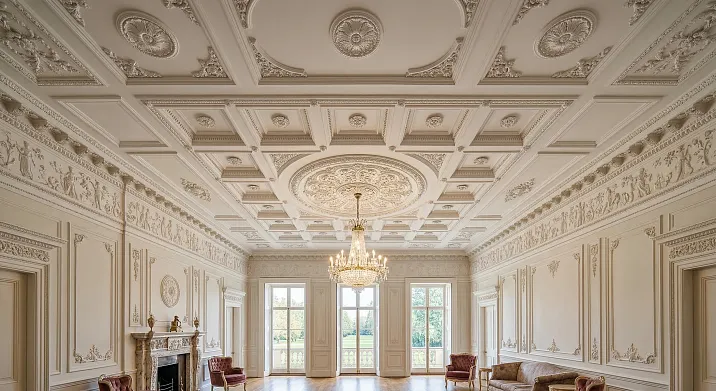


What is the stucco on the ceiling called: what is usually meant
The question 'what is the stucco on the ceiling called' is one of the most frequent when searching for ceiling decor. And it is absolutely logical: most people see a beautiful relief ceiling, want something similar, but do not know exactly what a particular element is called. In conversation, all of this is simply called 'stucco'—and that is not a mistake, but it is not precise either.
In fact, stucco on the ceiling is a collective concept that combines several different decorative elements with their own names, functions, and application logic. A rosette is not a cornice. A molding is not a frieze. A coffer is not a rosette. Understanding these differences is not difficult, and after that, choosing decor becomes much easier.




What is ceiling stucco
Ceiling stucco is the general name for relief decorative elements that are mounted on the ceiling or in the area where the ceiling meets the wall. Historically, stucco was made from gypsum by hand. Today, most products are made from polyurethane—a lightweight, precise in relief, and practical material.
Stucco serves several purposes simultaneously: it decorates the ceiling, structures the space, conceals technical components (joints, wiring, mounting hardware), and emphasizes the interior style. It is not just decor for the sake of decor—it is an architectural tool that influences the perception of the entire space.
Our factory also produces:
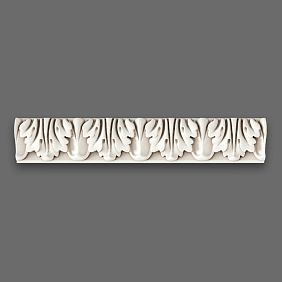


What are the main elements of ceiling molding called?
Let's break down each term—briefly, precisely, with an example of where and why it's used.
Get Consultation
Ceiling rosette
A rosette is a round (less often polygonal or oval) decorative element mounted in the center of the ceiling. Most commonly—around a chandelier: the rosette conceals the mounting hook, frames the light fixture area, and turns it into an architectural accent.
The ceiling rosette is precisely the answer to one of the most common questions: 'what is the pattern on the ceiling around the chandelier called.' The diameter of rosettes varies from 15 to 80 cm and above. The ornament's form can be classical (acanthus leaf, scrolls), geometric (radial pattern), or modern (clean silhouette without relief ornament).
Ceiling cornice
Cornice—a decorative profile element mounted along the perimeter of a room at the junction line of the wall and ceiling. Its main function is to conceal this transition, give the corner clarity and completeness. The cornice also hides minor defects, shrinkage cracks, and unevenness.
Cornices can be smooth (with a simple profile) and ornamental (with a relief repeat). Width—from 4 to 20 cm and more. It is preciselydecorative cornicesmost often the first to appear in an interior when adding molding decor—they provide maximum effect with minimal cost.
Ceiling molding
Molding is a decorative strip with a profile cross-section. Unlike a cornice, molding is used not only along the perimeter but also on the ceiling plane itself: to create rectangular frames, divide the ceiling into symmetrical sections, imitate coffered ceilings.
Ceiling moldings come in narrow (2–3 cm) and wide (up to 8–10 cm) varieties, smooth and ornamental. Moldings are used to create geometric patterns: one large frame around the perimeter, several nested rectangles, symmetrical sections. This is an architectural tool that transforms a flat ceiling into a structured object.
Frieze
A frieze is a decorative horizontal band with a repeating pattern. In an architectural context, the frieze is located between the cornice and the main part of the wall or ceiling. In interiors, a frieze is used as an ornamental belt that adds rhythm and horizontal articulation.
In modern interiors, friezes are less common than cornices or moldings—they are characteristic primarily of classical and Baroque designs with a rich ornamental ceiling program.
Coffers
Coffers are rectangular (less often square or polygonal) recessed ceiling sections framed by moldings or decorative borders. A coffered ceiling creates a sense of architectural depth and structural weight—it is one of the most representative types of ceiling decor.
Historically, coffers were carved directly into load-bearing structures—beams and slabs. Today, the coffered effect is achieved using moldings glued onto a flat ceiling: the visual result is practically identical, and the installation complexity is incomparably lower.
Decorative corner and ornamental elements
This is an auxiliary group of elements: corner inserts, medallions, decorative overlays, ornamental bands. Corner inserts cover the joints of cornices at room corners. Medallions are used as independent decorative accents—on the ceiling or walls. Ornamental bands add rhythm between the main elements of the system.
All these are partsstucco decorationthat do not work independently, but in conjunction with cornices, moldings, and rosettes.
What is the pattern on the ceiling around the chandelier called?
Most often, it is a ceiling rosette—a round decorative disc mounted in the center of the ceiling in the area where the light fixture is suspended. Less commonly used terms are 'decorative rosette,' 'ceiling medallion,' or 'central stucco element'—but all describe the same item.
The rosette is indeed the answer to the query 'what are the decorations on the ceiling around the chandelier called'—and it is usually the starting point for ceiling decoration when someone wants to add decor in a targeted way, without major changes.
How does a rosette differ from molding and cornice?
This is a fundamentally important question because confusion here is very common.
| Element | Location | Function | Shape |
|---|---|---|---|
| Rosette | Center of the ceiling | Framing the chandelier, accent | Round, polygonal |
| Cornice | Perimeter (wall and ceiling joint) | Joint closure, space frame | Long profile |
| Molding | Ceiling plane or perimeter | Frames, geometry, zoning | Long rail |
| Frieze | Horizontal stripe | Ornamental belt | Repeating stripe |
| Coffered | Entire ceiling plane | Architectural depth | Rectangle |
Main difference: a rosette is a local element at a specific point. Cornice and molding are linear elements that create extended decorative lines. A coffer is a volumetric system that structures the entire surface.
What is the ceiling decoration called depending on its location
In the center of the ceiling
Ceiling rosette. Sometimes — a large ornamental medallion. It is always a local accent element that fixes the visual center of the space.
Along the perimeter of the ceiling
Ceiling cornice. It runs along all four walls at the junction line with the ceiling. The cornice is the most 'extended' element of stucco decoration in any room.
In the corners
Corner inserts are special decorative elements that cover the joints of cornices on internal and external corners. Without corner inserts, the cornice in the corner has to be cut at a 45° angle, which requires precision. Ready-made corner elements simplify installation.
Inside decorative frames
Moldings formed into rectangular contours. Inside the frame is a flat ceiling surface. Outside is the molding profile. This creates the effect of a coffered ceiling or architectural section without an actual recess.
Types of ceiling stucco by style
Classical stucco
Rich floral or geometric ornamentation: acanthus leaf, grapevine, egg-and-dart molding (ionics), meander, laurel wreath. Deep relief, complex plasticity. Used in Baroque, Empire, and Classicism interiors.
Neoclassical stucco
The same classical motifs, but in a more restrained and geometrically precise form. Less florality, more architectural rigor. Neoclassicism is today the most popular style of application.ceiling decoration.
Modern ceiling decor
Minimal ornamentation or its complete absence. Clear profile cornices, geometric moldings, concise rosettes. The emphasis is on form and silhouette, not historical detail. This is exactly the kind of decor called an 'architectural accent'—without reference to a specific historical era.
Minimalist decorative elements
Ultra-thin profiles, flat slats without relief, clean geometric shapes. This is molding that is almost unnoticeable—but without which the interior looks unfinished. The right detail, placed precisely.
What materials are ceiling moldings made from?
Polyurethane
Today, the main material for ceiling decorative molding. Lightweight, precise in relief, moisture-resistant, durable, can be installed independently with adhesive.Polyurethane moldingsVisually indistinguishable from gypsum after painting. The optimal choice for apartments, houses, and commercial interiors.
Plaster
Historically the main material for molding. Natural, with the highest relief, but heavy and fragile. Requires professional installation. Used in restoration projects, luxury interiors, where historical authenticity is important.
Wood
Wooden moldings and cornices are used in chalet, rustic, and Scandinavian classic interiors. Heavier than polyurethane, require attachment to load-bearing structures. Create a warm, organic texture—something neither gypsum nor polyurethane provides.
Composite materials
Mixed compositions based on gypsum with polymer additives, expanded polystyrene, pressed paper pulp. Used primarily in the budget segment. The relief is generally less defined than that of polyurethane or gypsum.
How to understand which molding element you need
If you need decor for a chandelier
Ceiling rosette. Selected based on the chandelier's diameter (the rosette should be equal to or 20–30% larger than the light fixture) and interior style (floral for classic, geometric for modern).
If you need to decorate the wall-ceiling joint
Ceiling cornice. Installed along the entire perimeter. Width depends on ceiling height: up to 2.6 m — 4–7 cm cornice, from 2.7 m — 7–12 cm, above 3 m — larger profiles are possible.
If you want to add frames and geometry
Moldings. They are glued onto the ceiling surface, forming rectangular outlines. This is the fastest way to create a 'designer ceiling' from a simple flat surface.
If you need an expressive classic ceiling
System of perimeter cornice + molding frames + central rosette. These are the three elements that together create a full-fledged ceiling architecture. This is exactly how ceilings were decorated in classic interiors — and exactly how it works today with modern materials.
Common mistakes in ceiling molding names
A cornice is called molding. These are different elements. A cornice is along the perimeter at the junction of the wall and ceiling. Molding is on the ceiling plane for frames and geometry. They may look similar (both are long profile strips), but the location and function are different.
Any rosette is called a 'pattern' or 'stucco'. Rosette is the precise term. 'Pattern on the ceiling' is a colloquial description without specifics. When searching and ordering, it is important to use the correct term: 'ceiling rosette', not 'round decoration on the ceiling'.
A frieze is confused with a cornice. A cornice is a three-dimensional profile element at the junction of the wall and ceiling. A frieze is an ornamental strip that is part of a cornice system or is placed separately. It can be part of a cornice, or it can be an independent element.
A coffer is called 'square stucco'. A coffer is a system of rectangular frames on the ceiling that creates visual recesses. Square stucco is not a term, although it is clear what is meant.
All ceiling decoration is called a 'rosette'. A rosette is only the central round element under the chandelier. Cornices, moldings, coffers are independent types of stucco with other names.
Frequently asked questions
What is the stucco around a chandelier called?
Ceiling rosette. This is a decorative round element that is mounted in the center of the ceiling around the light fixture mount.
What is the stucco along the edge of the ceiling called?
Ceiling cornice. It is mounted along the perimeter of the room at the junction of the wall and ceiling.
What is the difference between a cornice and molding?
Cornice — around the perimeter, covers the joint between the wall and ceiling. Molding — on the ceiling plane, creates frames and geometry. Both may look similar externally, but their placement and function are different.
Are all decorative elements on the ceiling called stucco?
In everyday life — yes, all of this is called stucco. Technically, stucco is the material (plaster or polyurethane relief decor), while specific products have their own names: rosette, cornice, molding, frieze, coffer.
What is the square stucco on the ceiling called?
Most likely, it refers to a coffer — a rectangular or square ceiling section highlighted by moldings. A coffered ceiling is a system of such sections covering the entire ceiling surface.
Is stucco only suitable for classical interiors?
No. ModernPolyurethane Itemsare produced in a wide range of forms — from rich classical ornamentation to laconic geometric profiles for contemporary interiors. Stucco is applicable in classic, neoclassical, modern, art deco, and even minimalist styles — with the correct choice of form.
Conclusion
So, what is the stucco on the ceiling called? The precise answer depends on which specific element is being referred to. Rosette — central round decor under the chandelier. Cornice — profile around the perimeter at the joint of the wall and ceiling. Molding — strip for frames and geometry on the ceiling plane. Frieze — ornamental strip. Coffer — system of rectangular frames. Decorative inserts and medallions — additional accents.
Understanding these terms transforms a vague request like 'I want a beautiful ceiling' into a precise task: 'need a 45 cm diameter rosette for a classic living room' or 'I want molding frames on a stretch ceiling in a contemporary interior.'
The full range of ceiling molding decor — cornices, moldings, rosettes, and decorative elements made of polyurethane — is presented in the STAVROS company catalog. Here you can select a specific element by size, shape, and style — and immediately understand what exactly is called by one term or another.
STAVROS — architectural decor for those who want not just to decorate the ceiling, but to create architectural order in it.


