Article Contents:
- Tools and Materials for Installing Slat Panels
- Measuring and Marking Tools
- Cutting Tools
- Installation Tools
- Consumables
- Wall Preparation: Cleaning, Priming, Leveling
- Surface Condition Assessment
- Surface cleaning
- Base Leveling
- Priming
- Surface Level Marking
- Determining the Starting Point
- Working with a Laser Level
- Marking Frame Mounting Points
- Installing Wall Slat Panels with Adhesive
- Which Adhesive to Choose
- How to Apply Adhesive
- Pressing and Temporary Fixation
- Mounting on a Frame: When a Profile is Needed
- When a Frame is Unavoidable
- Frame material
- Frame Leveling
- Attaching Panels to the Frame
- Securing with Finish Nails Around the Perimeter
- Types of Nails and Tools
- Where to Place Nails
- Panel Joining: How to Achieve a Seamless Result
- Step Matching Rule
- Horizontal and Vertical Joint Control
- Corner Joint in the Room
- Features of Installing Flexible Panels on Curved Surfaces
- Preparing a Curved Base
- Adhesive for Flexible Installation
- Installation Sequence on a Column
- Cutting for arched installation
- Installation of slatted panels on the ceiling: specifics and recommendations
- Frame for ceiling installation
- Attaching panels to the ceiling frame
- Gaps and junctions on the ceiling
- Installation of slatted panels on the ceiling with built-in lighting
- Typical installation errors and how to avoid them
- Mistake 1: Installation Without Acclimatization
- Error 2: Ignoring the levelness of the base
- Error 3: Starting layout from an unchecked corner
- Error 4: Insufficient adhesive on the ends
- Error 5: Installation on a damp base
- Error 6: Skipping priming
- Error 7: Incorrect direction of paint application when touching up joints
- Error 8: Ignoring expansion gaps
- Finishing Work After Installation
- Frequently Asked Questions

Good material and poor installation is literally money thrown at the wall. Solid oak slatted panels or high-quality MDF, crookedly installed on an unprepared base, lose all their aesthetics within the first weeks: the slats warp, joints separate, and the surface ceases to be flat. Conversely, even a budget panel, installed skillfully and in compliance with technology, will serve for years and look flawless.
Installing slatted panels is not rocket science. It is a precise sequence of actions, each of which has meaning and purpose. If you understand the logic of the process, rather than just mechanically repeating steps, the result will be professional. It is this logic that we will break down: in detail, with numbers, real examples, and honest warnings about typical mistakes.
The article is written for those who want to doinstallation of slatted panelsthemselves — and do it right the first time.


Tools and materials for installing slatted panels
Let's start with the inventory. A professional differs from an amateur not so much in experience as in having the right tools. Working without the necessary tools is a compromise in quality even before you touch the panel.




Measuring and marking tools
-
Laser level — absolutely essential. Not a builder's bubble level, but specifically a laser one: it projects horizontal and vertical lines simultaneously across the entire wall plane. The cost starts from 1,500 rubles for a basic model. Without a laser level, achieving perfect verticals in the slatted pattern is practically impossible.
-
Tape measure — at least 5 meters, with a tape lock
-
Pencil or thin marker — for applying markings on the wall
-
600 mm square — for checking right angles when cutting panels
-
Plumb bob — as a backup tool in the absence of a laser
Our factory also produces:
Cutting Tools
-
Miter saw (or circular saw with a guide) — for precise cutting of panels to length. Saw with a fine-toothed blade for clean cuts on wood and MDF. Blade tooth count — 60–80 teeth
-
Jigsaw — for curved cuts and trimming in hard-to-reach places
-
Sharp utility knife — for cutting flexible panels on a fabric base along the fabric layer between the battens
Get Consultation
Installation tools
-
Screwdriver or drill — for mounting on the frame
-
Caulking gun for construction adhesive (tube type, for standard 310 ml cartridge)
-
Notched trowel — for even adhesive application on large surfaces
-
Rubber mallet — for pressing and aligning panels without damaging the surface
-
Finish stapler or pneumatic nail gun — for securing with finish nails around the perimeter
-
Corner clamps and clamps — temporary fixation until adhesive sets
Consumables
-
Construction adhesive (selection depends on substrate — more details in the next section)
-
Primer for substrate
-
Anchor nails (when mounting on frame)
-
Metal or wooden profile for frame
-
Finish nails 25–35 mm headless
-
Colored sealant (matching panel color) for sealing joints and connections
-
Painter's tape
Wall preparation: cleaning, priming, leveling
Substrate preparation is 50% of installation success. The most common cause of problems after installing slat panels is neglecting this very stage. A good panel won't lay properly on a poorly prepared wall. Period.
Surface condition assessment
First action — visual and tactile inspection of the wall. Tap the surface with your knuckles: a hollow sound instead of a solid one indicates voids under the plaster. Peeling areas must be removed down to solid substrate. Grease stains, oil-based paint residues, moisture marks — all require treatment before applying primer.
Check wall moisture with an electronic moisture meter. Acceptable value — no more than 8% for most substrates. Fresh plaster must cure for at least 28 days under normal temperature-humidity conditions. Installation on damp substrate guarantees panel deformation and adhesive failure within months.
Surface cleaning
Remove all excess from the wall: old wallpaper (completely, including adhesive residue), peeling paint, mold stains, contaminants. Poorly adhering plaster sections — chip away and restore with repair mortar. Oil and grease stains — degrease with acetone or specialized degreaser.
Mold and mildew — special situation. Affected areas are treated with antiseptic compound with at least 24 hours curing time. After drying — another layer of antiseptic. Installing panels over active fungal growth is strictly prohibited: mold will spread under panels, multiplying the problem.
Substrate leveling
Permissible wall irregularities depend on installation method:
-
Adhesive installation — no more than 3 mm over two-meter slat
-
Frame installation — substrate flatness is non-critical, frame handles leveling function
For adhesive installation, irregularities over 3 mm are corrected with finishing putty. Apply putty in layers no more than 5 mm at a time, dry each layer before next. After drying — sanding with P120–P150.
For walls with curvature exceeding 10 mm over 2 m, the only correct solution is framing. Attempting to compensate significant irregularities with adhesive leads to uneven adhesive thickness, drastically reducing mounting reliability.
Priming
Priming — mandatory step before adhesive installation. It solves multiple tasks simultaneously: strengthens substrate surface layer, equalizes surface absorption capacity, and ensures reliable adhesive adhesion.
Primer selection depends on substrate:
-
Concrete, cement plaster — acrylic deep penetration primer
-
Gypsum plaster, drywall — acrylic primer for gypsum substrates
-
Loose and porous surfaces — strengthening primer (increased binder concentration)
-
Old paint that was not removed serves as a primer-adhesive (concrete contact).
The primer is applied with a roller or wide brush in an even layer. Drying time before installation — according to the manufacturer's instructions, typically 2–4 hours at +20°C. On loose surfaces — two coats of primer with intermediate drying.
Marking the surface according to level
Correct marking is the future result, transferred onto the wall with a pencil even before the adhesive is picked up. Skipping or being lazy at this stage guarantees getting skewed slats, which will be visible every time a person with a good eye enters the room.
Determining the starting point
The first question: where to start? If the slats are vertical — the starting line is vertical; if horizontal — horizontal. It seems obvious. But the main mistake here is starting from the corner of the wall. Corners in most apartments are not vertical. If you 'stand in the corner,' all subsequent markings will proceed with accumulating error.
The correct approach: apply the first vertical line not from the corner, but at a distance of one module's width from the corner. This line is your first true vertical. All subsequent markings are performed parallel to it with a step equal to the module width. The corner gap that forms between the first module and the corner is covered with a trimmed compensation fragment.
Working with a laser level
Set up the laser level on a tripod or windowsill so that the vertical beam is visible along the entire height of the wall. Along this beam, draw a pencil line on the wall — this is the vertical baseline.
The laser horizontal is needed for control during installation of the ceiling and floor rows of panels. Draw horizontal lines at a height of 10–15 cm from the floor and 10–15 cm from the ceiling. These lines will serve as control guides when installing the first and last panels.
Marking the frame attachment points
If installing on a frame — draw vertical lines on the wall indicating the positions of the stud profiles with a spacing of 400–600 mm. It is to these lines that the profile will be attached; this is where the anchor nails will be. Make cross marks — these are the drilling positions.
Installing slatted wall panels with adhesive
Adhesive installation is the fastest and most aesthetically clean method for DIY installation of slatted panels. No frames, no visible fasteners, minimal operations. But it requires a flat and solid base — this is a mandatory condition.
Which adhesive to choose
Choosing the adhesive is a fundamental decision on which the durability of the entire structure depends. Let's consider the main options.
Construction adhesive type 'Liquid Nails' — the most accessible and simple option. Suitable for light and medium panels (MDF up to 8 kg/m²). Applied from a tube via a gun in dots or a zigzag pattern. Open time — 5–10 minutes. Final setting — 24 hours. Important: not all formulations under this brand name are the same — choose an adhesive with an advertised bond strength of at least 10 kg/cm².
Polyurethane construction adhesive — higher bond strength (15–25 kg/cm²), excellent adhesion to wood, MDF, concrete, drywall. Recommended for heavy solid wood panels and for surfaces with moderate unevenness — polyurethane adhesive fills gaps up to 5 mm. Open time — 15–20 minutes, which allows for precise panel alignment.
Acrylic adhesive-sealant — for lightweight decorative panels and flexible structures. Not recommended as the primary fastening for heavy and large modules.
Contact adhesive on a neoprene base — applied to both surfaces, provides an 'instant grab' bond when pressed. Ideal for flexible panels on curved surfaces. Requires precise positioning: repositioning after setting is impossible.
How to apply the adhesive
For dot application — spacing between dots 15–20 cm, dot diameter 20–25 mm. For zigzag application — zigzag amplitude 60–80 mm, spacing 30–40 mm. In any case, the adhesive is applied to the back side of the panel's supporting base, not to the wall — this provides more controlled distribution.
Important nuance: apply adhesive along the panel perimeter in a continuous strip 20–30 mm from the edge. This prevents 'lifting' of the panel edges during drying — the most common defect with insufficient perimeter adhesive seam.
After applying the adhesive, observe the 'open time' — the time specified by the manufacturer before pressing. This period is necessary for partial evaporation of the solvent (for solvent-based adhesives) or activation of the adhesive. Premature pressing reduces bond strength.
Pressing and temporary fixation
Press the panel against the wall according to the markings, starting from the bottom corner. Distribute pressure evenly over the entire surface — with a fist or rubber mallet, moving from the center to the edges. An audible 'smacking' sound when removing your palm is a sign of good adhesive contact with both surfaces.
For temporary fixation until the adhesive sets, use:
-
Painter's tape with loops to the wall (stuck over the panel and to the wall nearby)
-
Wooden wedges and spacers from the floor and ceiling
-
Mounting brackets with screws into the base (removed later)
Pressure holding time — according to the adhesive instructions, typically at least 30–60 minutes until stable setting.
Frame mounting: when a profile is needed
Frame mounting — a professional standard for all cases where adhesive method is insufficient or impossible. Understanding when a frame is needed means making the right decision already at the planning stage.
When a frame is unavoidable
Frame mounting is mandatory in the following situations:
-
Wall unevenness exceeds 5–7 mm over 2 m — the frame compensates for geometric defects of the base
-
Wall made of aerated concrete, foam concrete, crumbling brick — no reliable base for adhesive
-
Cables, pipes, or insulation are planned to be laid behind the panels
-
Heavy solid oak panels (over 12 kg/m²) — adhesive alone will not provide reliable fastening
-
Rooms with unstable temperature conditions (verandas, unheated rooms in winter)
-
Ceiling mounting — a frame is always mandatory
Frame material
Metal profile CD 60×27 mm on hangers — universal standard. The profile is attached to the wall via direct hangers with 6×40 mm dowel nails at 500–600 mm spacing along the hanger height. Frame stud spacing — 400 or 600 mm (to match standard panel module widths of 400 or 600 mm — joints fall on studs).
Wooden lathing from 40×25 mm batten — an alternative to metal provided the room is dry and humidity is stable. Wooden frame is easier to work with, holds screws better, and provides a more reliable base for finish nails in fastener mounting.
Frame leveling
This is the key operation of frame mounting. All profile studs must lie in the same plane. To achieve this:
-
Install the outer studs using a laser level
-
Stretch horizontal control cords between them at several heights
-
Level all intermediate studs against these cords
Frame plane deviation should not exceed 1–2 mm over 2 m. This is achievable with careful level work and patience in adjusting hangers.
Attaching panels to the frame
Panels are attached to the frame with 3.5×25 mm self-tapping screws (for MDF base) through the panel's load-bearing base into the profile. Screws are placed in the gaps between slats — this keeps fasteners invisible from the front side.
For completely hidden fastening, clips are used — spring or U-shaped metal clamps that fit into the groove on the end of the load-bearing base. The clip is fixed to the frame with a screw, the next panel is installed onto the clip of the adjacent one. The front surface remains absolutely clean. This is the professional standard for mounting slatted wall panels in commercial projects.
Perimeter fastening with finish nails
Finish nails — additional mechanical fixation used in both adhesive mounting and frame mounting. They secure the panel against edge "lifting" due to drying and base deformations.
Nail types and tools
Headless finish nails with diameter 1.2–1.6 mm, length 25–35 mm are driven with a pneumatic nail gun or mechanical stapler. Pneumatics are preferable: they ensure precise driving depth without splitting MDF or wood.
If pneumatics are unavailable — finish nails can be hammered using a nail set. A nail set (metal rod of smaller diameter) allows sinking the nail head 1–2 mm below the surface without damaging the slat.
Where to place nails
Along the perimeter of the panel's load-bearing base — 10–15 mm from the edge, spacing 150–200 mm. Along the central axis of the panel — an additional row if panel width exceeds 300 mm. At joint areas — one nail on each side of the joint, 50–70 mm from the edge, is mandatory.
Nails are driven strictly perpendicular to the surface in MDF or solid wood. An angled nail splits the fibers and reduces holding capacity. The driving depth is 1–2 mm below the surface. Nail holes are filled with colored putty or a wax pencil matching the material tone.
Panel joining: how to achieve a seamless result
The joint between panels is an area where an amateur is immediately visible, while a professional is invisible. Good joining is not luck, but technology.
The rule of step alignment
The main principle: the joint between two adjacent panels should visually align with the gap between the slats. This means that the outermost slats of adjacent panels should be spaced at a distance equal to the standard gap in the panel. Manufacturers of quality panels incorporate this principle into the design from the start: the distance from the edge of the supporting base to the axis of the outermost slat is equal to half the standard step.
If the gap step in the panel is 10 mm, then the distance from the edge of the base to the axis of the outermost slat is 5 mm. When joining two panels base-to-base, the distance between the outermost slats will be 5+5=10 mm — that is, equal to the standard gap. The joint is visually indistinguishable from the internal gap.
Horizontal and vertical joint control
When installing each subsequent panel, check:
-
Alignment of the slat axis horizontally (for vertical slats) or vertically (for horizontal slats) — laser level
-
Precise end-to-end fit to the previous panel without gaps or overlaps
-
Perpendicularity of the joint to the wall plane
A slight angular misalignment at the first joint leads to cumulative error: by the fifth or sixth module, the slats noticeably "drift." Check the parallelism of the slats with a laser after every two or three installed panels.
Joint in a room corner
Corner abutment is the most complex node when installing slatted wall panels. There are three professional solutions.
Metal corner profile — L-shaped aluminum trim that covers the panel ends in the corner. Attached with screws or adhesive. Available in aluminum, white, gold, and black colors. The most practical solution for corners with high wear.
Decorative wooden corner molding — rounded or rectangular wooden profile that covers the corner. When installing solid oak slatted panels, it is natural to select a molding from the same material and with the same tonal treatment. This technique creates a solid, finished corner without any synthetic elements.
Mitered end joint — the slats of both panels are cut at a 45° angle and joined in the plane of the corner. The most complex option to execute, requiring absolute cutting precision. However, the result is a perfectly clean corner without any additional elements.
To complete the entire vertical plane of the slatted wall, a wooden baseboard is installed at the base, which covers the lower abutment of the panels to the floor and creates a neat horizontal line. When installing oak or painted MDF slatted panels in classic interiors, a Skirting made of solid wood in the same species and tone is especially appropriate — this creates an impeccable vertical chain from floor to ceiling.
Features of installing flexible panels on curved surfaces
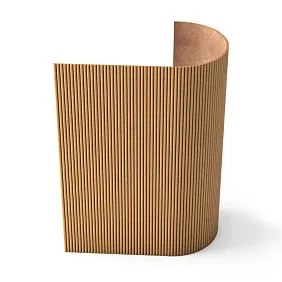
Installationflexible slatted panels on columns, arches, and rounded surfaces — this is a separate discipline requiring a different approach to preparation, layout, and adhesive.
Preparation of a curved substrate
Curved surfaces (columns, arches, rounded walls) are prepared the same as flat ones: cleaning, priming, moisture control. Additionally, check the uniformity of the surface curvature: sharp local variations (bumps and dents) will not be compensated by the flexible panel and will cause visible defects on the finished surface.
For columns, measure the perimeter at several points along the height — the perimeter should be the same (deviation no more than 3–5 mm). Tapering of the column will require trimming the panels in height with geometric compensation.
Adhesive for flexible installation
For installing flexible panels on curved surfaces, contact adhesive based on neoprene or polyurethane is optimal. It is applied to both surfaces, ensuring immediate bonding over the entire contact area when pressed — this is critical for flexible material that tends to return to a flat state.
Application — a thin, even layer with a notched trowel with a tooth size of 2 mm. The open time of contact adhesive is 5–8 minutes. After this time, the surfaces are pressed and immediately bond — repositioning is impossible. This is why a "dry fit" run must be performed before applying the adhesive: place the panel without adhesive and ensure correct positioning.
Installation sequence on a column
-
Apply a vertical starting line on the column — the starting point and joint location (also the ending point)
-
Apply adhesive to the base (column) and the back side of the first module
-
Maintain open time
-
Start from the vertical line, press the top corner of the panel, then gradually wrap around the column, evenly pressing the panel along its entire height
-
Roll the surface with a rubber roller from the center to the edges to remove air inclusions
-
Apply the next module, precisely aligning it with the previous one according to the batten spacing
Cutting for arched installation
When installing on an arched opening, the flexible panel is cut across the battens into strips of the required width. Each strip is bent according to the arch radius and glued sequentially. The joints between the strips fall into the gaps between the battens and become invisible.
Installation of batten panels on the ceiling: specifics and recommendations
The ceiling is the most demanding surface for installation. Gravity works against you: the adhesive must hold the weight of the panel in an inverted position until it fully sets. Frame installation for the ceiling is not a recommendation but a mandatory requirement.
Frame for ceiling installation
The frame for ceiling batten panels is assembled from CD 60×27 mm profiles on direct or vibration hangers. Hanger spacing is 500–600 mm, cross-profile spacing is 400 mm (a multiple of the panel width). The load-bearing profile is positioned perpendicular to the direction of the battens — so each panel rests on several crossbars rather than hanging on two outer ones.
Leveling the ceiling frame in the horizontal plane is a key operation. Use a laser level with a horizontal scanning function: it projects a horizontal plane across the entire ceiling. All hangers are adjusted until the bottom plane of the profile aligns with the laser level. Permissible deviation is no more than 2 mm over 3 m.
Attaching panels to the ceiling frame
Panels are attached to the ceiling frame with LN 3.5×25 mm self-tapping screws through the load-bearing base into the profile. Minimum number of attachment points — one per each cross-profile (i.e., every 400 mm along the panel length). For heavy solid oak panels — two self-tapping screws per profile with a 50 mm offset in width.
Additional mounting adhesive on the ceiling is not a replacement for mechanical fasteners but an auxiliary means for ensuring tight contact between the panel and the profile. Apply adhesive to the profile before installing the panel — this will eliminate possible gaps between the load-bearing base and the metal.
Gaps and junctions on the ceiling
On the ceiling, expansion gaps at the walls (5–8 mm) are especially important — thermal expansion of MDF and wood in the horizontal plane cannot be ignored. The gap is covered with a ceiling skirting board or cornice.
The junction of a batten ceiling with a batten wall is an architecturally interesting detail. With parallel batten direction, a continuous transition is created, visually 'dissolving' the boundary between the wall and ceiling. With perpendicular direction — an expressive angular contrast between two batten planes. Both solutions are valid — it's a matter of design concept.
Installing batten panels on a ceiling with integrated lighting
A batten ceiling with integrated LED lighting is a popular and highly effective solution for residential and commercial spaces. The lighting is installed in the space between the load-bearing profiles of the frame before panel installation.
The LED strip is attached to the profile or directly to the rough ceiling via an aluminum diffuser profile. Wires are routed to connection points through the frame space — before panel installation. After panel installation, access to the wiring is closed. Therefore, the lighting scheme and cable routing must be fully planned and implemented before starting panel installation.
The gap between the battens serves as a 'window' for light to exit from the frame space. The gap width determines the intensity and character of the glow: a narrow gap (5–8 mm) provides soft, diffused light; a wide gap (15–20 mm) — brighter, more directional light. When using tinted LED strips (warm white, neutral, RGB), the lighting color should harmonize with the color and material of the battens.
Typical Installation Errors and How to Avoid Them
Over decades of practice in installation and interior design, a clear list of mistakes that are made again and again has formed. Let's examine each one — and explain why it happens and how to avoid it.
Error 1: Installation without acclimatization
Panels made of MDF and especially solid wood must be acclimatized in the room for at least 48–72 hours before installation. The material adjusts to the temperature and humidity of the working environment — and if cold panels are installed in a warm room, they will expand after heating. Surface swelling and joint separation are inevitable consequences.
Mistake 2: Ignoring base flatness
'The adhesive will hide everything' is a dangerous misconception. Base irregularities under the adhesive lead to uneven load: a panel that does not fit tightly to the wall vibrates, the adhesive bond fatigues, and after a year or two begins to peel.
Mistake 3: Starting layout from an unchecked corner
As already mentioned: corners in most apartments are not vertical. Starting layout from a corner without checking with a laser level guarantees 'drifting' of the batten verticals.
Mistake 4: Insufficient adhesive on the ends
Adhesive must be applied along the perimeter of the panel. The edges and ends of the load-bearing substrate are the most vulnerable areas: they are the first to react to humidity fluctuations and begin to 'lift'. The perimeter adhesive seam holds the edges in place.
Mistake 5: Installation on a damp substrate
We've mentioned it before, but let's repeat: substrate moisture content above 8% = panel deformation + adhesive delamination. No exceptions. Let the substrate dry — for as long as necessary.
Mistake 6: Skipping priming
Without primer, the adhesive's bond to the substrate is reduced by 2–3 times. This is especially critical for porous and loose substrates. Two hours for applying and drying the primer is not wasted time; it's insurance for all subsequent work.
Mistake 7: Incorrect paint application direction when touching up joints
When touching up gaps and ends, paint is applied strictly along the slats, not across them. Crosswise brush strokes create visible marks on the slat surface. A thin brush No. 8–10, movement along the slat — that's the correct technique.
Mistake 8: Ignoring expansion gaps
Wood and MDF expand with changes in humidity. A wall gap (5–8 mm), an expansion gap between modules (0.5–1 mm) — these are mandatory elements of proper installation. Without them, after the first heating season, the panels will 'buckle', creating visible deformations.
Finishing work after installation
When all panels are installed and the adhesive has set, a few finishing operations remain to turn 'already good' into 'excellent'.
Filling nail and screw holes. Use colored putty or a wax pencil in an exact match to the finish. Apply a small amount of the compound, level it flush with the surface using a putty knife. After drying (30–60 minutes), carefully sand with P320–P400 grit and touch up if necessary.
Sealing joints with sealant. Colored acrylic sealant, matching the finish, is applied in a thin bead into the joints between panels and at junctions with adjacent surfaces, then smoothed with a wet finger or a special silicone spatula. Excess is immediately removed with a damp cloth. The sealant should not protrude onto the face of the slats — it should only fill the gap.
Installing baseboards and moldings. The bottom junction of the slatted wall is covered withbaseboard. The top junction — with a ceiling cornice or molding. Corner junctions — with corner molding or profile. These elements are installed last, covering all expansion gaps and giving the finish a complete, professional look. For furniture fronts with slatted decor, the final touch will beWooden furniture handles — they harmoniously complete the look and add a natural tactile accent.
Frequently asked questions
Can slatted panels be installed over wallpaper?
Absolutely not for adhesive installation. Wallpaper does not provide sufficient substrate strength: the adhesive will pull the wallpaper off along with the panels. On a frame — technically possible if the frame is attached to the load-bearing substrate, not to the wallpaper. But it's better to remove the wallpaper down to the plaster.
How long does it take to install slatted panels on a 10 m² wall?
A professional two-person crew — 3–4 hours including layout. DIY, first-time experience — 8–10 hours. Most of the time is spent on preparation, layout, and the first two or three modules: after getting into a rhythm, the speed increases.
Can slatted panels installed with adhesive be removed without damage?
Practically impossible without leaving marks on the wall. The adhesive pulls off along with the top layer of plaster or paint. For demountable structures (temporary installations, rental housing) — only frame installation with clips.
How to calculate the number of panels?
Measure the wall area (length × height) in m². Subtract the area of openings (doors, windows). Multiply by a factor of 1.05–1.10 (5–10% allowance for cutting and defects). Divide by the area of one module (in m²). You get the number of modules, rounded up.
Is ventilation needed behind slatted panels?
For wooden panels in rooms with moderate humidity — no. When installing in kitchens, bathrooms, and balconies with noticeable temperature fluctuations — it is advisable to provide a ventilation gap of 20–30 mm between the wall and the panel's load-bearing substrate (achieved via a frame).
How to install slatted panels around sockets and switches?
Before installing the panels, the mounting boxes for sockets and switches are extended to the thickness of the panel plus a gap. The socket location is marked on the panel, and a hole is cut with a jigsaw using a fine-tooth blade. The socket cover plate conceals the gap between the hole and the panel.
DIY slatted panels — where should a beginner start?
Start with a small accent area — for example, a niche or a section of wall behind a sofa. Use ready-made modular panels with adhesive on a well-prepared, level substrate. This allows you to practice the technique without the risk of ruining the entire room perimeter.
The company STAVROS manufactures and suppliesSlatted wall panelsmade of MDF and solid wood, as well as a full range of complementary products for a complete finish:Wooden Skirting Boards, Solid wood skirting boards, MDF floor skirting boards, Wooden planksandFurniture HandlesSTAVROS provides consultation on material selection and installation methods — the company's specialists will help choose the optimal solution for specific project conditions. Quality materials plus proper installation — this is the formula for success, where STAVROS is responsible for the first part, and this article — for the second.