












































































Article Contents:
- Writing Desk: The Center of the Classic Study Universe
- Solid Wood: Why Nothing Else Works
- Carved Legs: Functional Luxury
- Hardware: Bronze, Brass, Patina
- Dimensions: Space for Thought
- Bookcases: The Library as a Declaration
- Construction: From Floor to Ceiling
- Carved Cornices: Finishing the Form
- Interior Organization: Knowledge Management
- Furniture Decor: Overlays and Moldings
- Armchair: The Throne for Work
- Frame: Wood and Carving
- Upholstery: Leather or Velvet
- Ergonomics: Comfort in Classic Style
- Wall Panels: Architecture of the Classic Study
- Moldings: Dividing into Panels
- Boiserie: Wooden Panels
- Pilasters: Vertical Rhythm
- Ceiling Cornice: Finishing the Wall
- Balance of Representativeness and Functionality: How to Avoid Overloading
- Rule of Three Decorative Levels
- Color Restraint
- Functionality First
- Lighting: Light as a Concentration Tool
- Overhead Lighting: Chandelier as the Centerpiece
- Desk Lamp: Local Lighting
- Cabinet Lighting: Accent Lighting
- Sconces: Additional Lighting
- Textiles: Softness in Strictness
- Curtains: heavy drapes
- Carpet: warmth underfoot
- Frequently asked questions: what concerns arise when decorating a study
- Can classic furniture be combined with modern wall decor?
- What is the optimal baseboard height for a classic study?
- Is patina needed on furniture and decor?
- How to choose the wood color for furniture?
- How many bookcases are needed in a study?
- Is a fireplace needed in a classic study?
- Conclusion: the study as a reflection of personality
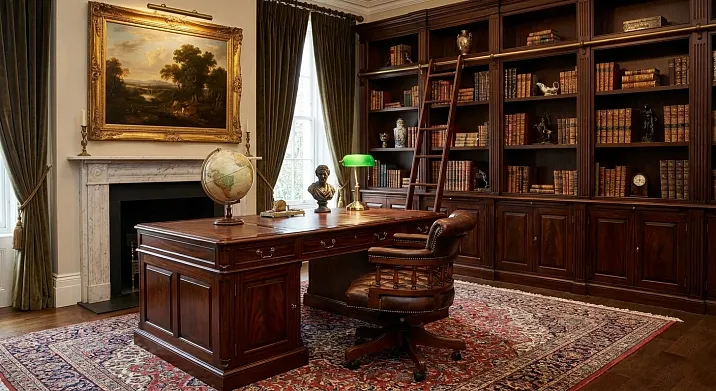
A study is not just a room with a desk. It is a territory for decision-making, a place where ideas are born, contracts are signed, and strategies are formed. It is a space that speaks of the owner's status without words—through wood, carving, books on shelves, through that veryinterior decorationthat transforms an ordinary room into a sanctuary of intellectual labor. And if you chooseclassic furniturefor creating a workspace, it means you understand: style is not decoration, but a philosophy where every detail works to create an atmosphere of concentration, confidence, and solidity.
Study designin a classic style is the art of balance between representativeness and functionality, where a massive desk is not just a work surface but a symbol of steadfast intentions, where bookcases are not paper storage but libraries of knowledge, where an armchair is not a place to sit but a thinker's throne. How to create such a space? Which elements are critical, which are secondary? What wall decor enhances the classic nature of the furniture, and what disrupts harmony? We analyze in detail because a study is too important a place to decorate haphazardly.


Desk: the center of the universe in a classic study
Let's start with the obvious but critically important:classic tableis the heart of the study. Everything else is built around it. A sofa in the living room can be modular, a dining table can be extendable, a console in the hallway can be minimalist. But a desk in a classic-style study must be monumental, weighty, one that cannot be moved with one hand. Why? Because it symbolizes the immutability of the decisions made at it.




Solid wood: why nothing else works
MDF with wood-grain film, veneer on particleboard, laminated surfaces—all of these exist, all are cheaper, easier to produce. But in a classic study, they don't work. Solid oak, beech, walnut, mahogany—these are the materials that create that very aura of solidity. Wood is alive—it has a grain that varies from board to board, it has weight that is felt when you place your palm on the desk, it has a scent, barely perceptible but creating an atmosphere.
A solid wood tabletop 40-50 mm thick withstands not only a laptop and a stack of documents but also years of daily work without deformation, scratches that ruin cheap materials in months. Oak and beech are dense, hard; they don't dent under the weight of elbows, don't give way under sharp objects. Walnut wood is darker, more noble, with a purple sheen that emerges under varnish or oil. Mahogany—mahogany, sapele—has a deep reddish-brown tone associated with the studies of aristocrats, judges, professors.
Our factory also produces:
Carved legs: functional luxury
The legs of a desk in classic style are not just supports. They are sculptural elements that define the character of the entire piece. Turned balusters, carved columns, legs with fluted grooves, with capitals at the top—these details don't just decorate; they structure the form, create visual complexity that holds the gaze.
Carving on legs can be restrained—geometric grooves, simple panels—or lush, with botanical motifs, acanthus leaves, volutes. The choice depends on the overall concept of the study. If the walls are decorated with minimalist moldings, the table legs should also be restrained to avoid overload. If the walls have carved panels, pilasters, rosettes—the legs can be more decorative, echoing the wall decor.
Get Consultation
Hardware: bronze, brass, patina
The handles of the desk drawers—seemingly a small detail. But in classic style, there are no small details. Bronze or brass hardware with patina, with elegant shapes—rings, brackets, handles shaped like lion heads, botanical scrolls—create completeness. Modern chrome handles instantly kill classicism, turning an expensive solid wood desk into something bland.
Patina on hardware—artificial aging that creates an effect of time, history—enhances the feeling that this desk has served not just one generation, that important decisions were made at it long before you, and will be made after. This is continuity, a connection of times, which classic style provides.
Dimensions: space for thought
A desk in a classic study cannot be small. The minimum tabletop width is 140 cm, optimal is 160-180 cm. Depth—at least 80 cm, preferably 90-100 cm. This provides space for working with documents, for a laptop and monitor simultaneously, for a desk lamp, a pen holder, all those little things needed for work.
Desk height—standard 75-78 cm, but can be individual, tailored to the owner's height. A too-low desk makes one slouch, a too-high one raises the shoulders. Classic furniture is often custom-made precisely to adjust dimensions to a specific person.
Bookcases: the library as a declaration
Books in a study are not merely sources of information. They are a declaration of intellect, status, and breadth of interests. Even if half the books remain unread, their presence creates an atmosphere of scholarship and solidity. And bookcases are the frames that transform a collection of volumes into a composition.
Construction: from floor to ceiling
Classical bookcases are tall, often reaching from floor to ceiling, which visually elevates the room, creates vertical lines, and structures the space. Bookcases can be open—shelves without doors, where books are on display—or closed, with glass-paneled doors that protect the volumes from dust while allowing the spines to be seen.
Glass-paneled doors can have muntins—wooden frames dividing the glass into sections. Rectangular sections, arched, diamond-shaped—the form of the muntins influences the style. Rectangular ones are more restrained and versatile. Arched ones are characteristic of Gothic and Neo-Gothic styles, creating a romantic feel. Diamond-shaped ones are for Empire style, more decorative.
Carved cornices: completing the form
The upper part of a classical bookcase cannot be flat. The cornice—carved, with a profile, with projections and recesses—completes the form, creating an architectural quality. The cornice can echo the profile of the room's ceiling cornice, creating a dialogue between the furniture and the architecture. It can be more lavish, with dentils (tooth-like ornaments), with modillions (consoles), with carved appliqués.
The plinth—the lower part of the cabinet—is also not flat. A profiled furniture baseboard, carved supporting legs create solidity, visually lift the cabinet off the floor, making it not just an object standing against a wall, but an architectural element.
Internal filling: organizing knowledge
Shelves inside the cabinet are adjustable in height to accommodate both regular books and folios, as well as albums. Shelf depth is 25-35 cm, sufficient for most editions. Drawers in the lower part of the cabinet are for documents, folders that one does not wish to put on display.
Internal lighting—LED strips built into the shelves or cornice—transforms the cabinet from a mere storage place into an exhibition, a museum of a personal library. The light highlights the spines of the books, creates depth, and makes the cabinet expressive even in the dark hours.
Furniture decor: appliqués and moldings
The facades of bookcases can be adorned with carved appliqués—central, corner, linear. Appliqués create relief, making the flat surfaces of doors and sides three-dimensional and complex. Floral motifs, geometric rosettes, cartouches—all these are elements of furniture decoration that transform a cabinet from a utilitarian object into a work of art.
Furniture moldings—narrow strips framing the door panels—create structure, divide the surface, and set a rhythm. They can be simple, with a bead and a fillet, or complex, with multiple profiles, with carving.
Armchair: a throne for work
The work armchair in a classical study is not an office ergonomic chair on wheels, although such exist in classical execution as well. It is a massive armchair with a high back, with armrests, upholstered in leather or heavy fabric, which creates a sense of power, control, confidence.
Frame: wood and carving
The armchair frame is solid wood, of the same species as the writing desk, creating unity. Carving on the armrests, on the legs, on the top rail of the back echoes the carving of the desk and cabinets. Armrests may end with lion heads, volutes, carved rosettes—these details not only decorate, they provide support for the hands, making the armchair more comfortable.
The armchair legs are turned or carved, sturdy, with stretchers for rigidity. The rear legs often extend upward, forming the back frame, creating structural integrity.
Upholstery: leather or velour
Leather—natural, dense, possibly with a patina—is a classic choice for work armchair upholstery. Brown, burgundy, dark green leather creates severity, solidity. Leather breathes, does not create a greenhouse effect, and as it ages, acquires a noble patina, wear marks that do not spoil but ennoble it.
Velour, velvet—an alternative to leather, softer, cozier. Deep shades—emerald, sapphire, ruby velour—create luxury but require care, collect dust. Diamond tufting—a diamond-shaped quilting with buttons recessed into the fabric—is a classic upholstery technique that creates volume, relief, making the back and seat not flat but sculptural.
Ergonomics: comfort in classic style
Even a classic armchair must be comfortable. The backrest angle—100-110 degrees, supporting the lower back, preventing slouching. Seat height—adjustable or chosen so that feet rest flat on the floor and thighs are parallel to the floor. Seat depth—45-50 cm, sufficient for the back to rest against the backrest, but the front edge of the seat does not press behind the knees.
Armrests at a height that allows resting arms on them without raising the shoulders. Modern classic armchairs may have a rocking mechanism, a gas lift for height adjustment, but all this is hidden inside, not disrupting the external classic appearance.
Wall paneling: the architecture of a classical study
Walls in a classical study cannot be simply painted or wallpapered. They must have architecture—structure created by moldings, panels, pilasters. This is what transforms a room into a study, and a study into a space of status.
Moldings: division into panels
The classic scheme for wall decoration with moldings involves creating rectangular frames, panels, at a height of 80 to 160 cm from the floor. Moldings 4-8 cm wide are attached to the wall, forming rectangles or squares. Inside these frames, the wall can be painted in a contrasting color—darker or lighter than the main tone—or wallpapered with a delicate pattern, damask, stripes.
Such division structures the wall, creates rhythm, visually raises the ceiling, makes the room more proportional. In a study with high walls, panels can be in two tiers—the lower tier up to 100 cm, the upper tier higher. Between the tiers—a horizontal molding, wide, 10-15 cm, which creates a visual pause.
Boiserie: wooden paneling
Boiserie — wooden panels covering the lower third of the wall — is a classic technique, especially relevant in a study. Solid oak or walnut panels, 100-120 cm high, with raised panels framed by moldings, create solidity, warmth, and protect the wall from mechanical damage.
Boiserie can be painted the same color as the moldings on the upper part of the wall, or left in the natural wood color, finished with oil or varnish. The natural wood grain creates texture and richness that paint cannot provide.
The upper part of the boiserie is finished with a profiled molding — a cap molding — which creates a transition from the wood to the painted wall. This molding can be carved, with decorative elements, enhancing the classic feel.
Pilasters: vertical rhythm
Pilasters — vertical elements that mimic columns but are flat, projecting 3-8 cm from the wall — create a vertical rhythm, divide long walls, and make the study more architectural. Pilasters are installed at room corners, on either side of doorways, and bookcases, creating frames and structure.
Pilasters have a base — the lower part, widened and profiled, which rests on the floor or a plinth. A shaft — the central part, smooth or with fluting (vertical grooves). A capital — the upper, decorative, carved part that finishes the pilaster under the ceiling cornice.
The style of the capital determines the overall style. A Doric capital — simple, with an echinus and abacus — for restrained classicism. Ionic — with volutes, scrolls — for a more decorative style. Corinthian — with acanthus leaves — for a luxurious study in the Empire style.
Ceiling cornice: finishing the wall
The ceiling cornice in a classic study is wide, 15-30 cm, with a multi-step profile and carved elements. The cornice creates a transition from wall to ceiling, visually lowers the ceiling making the room cozier if the ceiling is too high, or conversely, raises it if the cornice has a shadow gap with hidden lighting.
The cornice can be adorned with dentils — small tooth-like blocks, modillions — brackets, or carved appliqués. The corners of the cornice — the joints at the internal and external corners of the room — are finished with corner elements that hide seams and create neatness.
Balancing representativeness and functionality: how to avoid overload
A classic study can easily turn into a museum where beauty kills functionality, where it's impossible to work because the setting is oppressive, distracting, and demands contemplation. How to find balance?
The rule of three decorative levels
Decor in a study should be on three levels, no more, to avoid overload. First level — floor: a high, profiled baseboard, possibly with carved elements. Second level — walls: moldings, panels, pilasters at eye level. Third level — ceiling: cornice, possibly a center rosette if there is a chandelier. Between levels — pauses, smooth surfaces that give the eye a rest.
If the decor on all three levels is lavish, with an abundance of carving and gilding — the study becomes a palace hall where it's impossible to concentrate. If the decor on one level is lavish and on the other two is restrained — balance is maintained.
Color restraint
Classicism does not require bright colors. Deep, saturated, but restrained tones — dark brown, burgundy, dark green, gray-blue — create seriousness and do not distract. Walls are often painted a color two to three shades lighter than the furniture, creating contrast but not a harsh one.
Gilding on decor — in moderation. Fully gilded moldings, cornices, pilasters — is overkill. Gilding in the recesses of carvings, on capitals, on individual appliqués — an accent that works.
Functionality first
The beauty of the study should not interfere with work. The desk is beautiful, but is there enough space for a laptop, monitor, documents? The bookcases are carved, but is it convenient to reach books from the top shelves? The armchair is luxurious, but can you sit in it for six hours without back pain?
Functionality is tested by use. If the study is decorated but uncomfortable to work in — decor has overpowered function. If it's comfortable but not beautiful — function has killed aesthetics. Balance is when the space inspires and simultaneously allows for productive work.
Lighting: light as a tool for concentration
Light in a classic study is multi-level, controllable, creating scenarios. Overhead light alone is insufficient, a single desk lamp is also not enough.
Overhead light: chandelier as the center
The chandelier in a classic study is not just a light source, but a decorative centerpiece of the ceiling. A chandelier with pendants, arms, a metal frame in bronze or brass finish, with fabric shades creates diffused light that illuminates the entire room without being glaring.
The chandelier is hung in the center of the ceiling, often in the center of a ceiling rosette — a carved decorative element 40-80 cm in diameter that frames the mounting point, creating an architectural accent. If the ceiling is high, the rosette can be coffered — with recesses, coffers, creating volume and complexity.
Desk lamp: local light
The desk lamp on the writing desk is a functional light source directed at the work surface. In classic style, this is a lamp with a solid base — marble, bronze, wood — with a fabric or glass shade. A green glass shade is a classic library lamp motif that creates soft, directed light that doesn't strain the eyes.
An adjustable lamp arm allows directing the light where needed — on the keyboard, documents, or book. The lamp should not be too bright — 40-60 W is sufficient for local lighting.
Cabinet lighting: accent light
Internal lighting for bookcases, built into shelves or the cornice, creates accent light that highlights books, decorative objects, and makes the cabinets expressive. Warm white LED strips, 2700-3000K, hidden from direct view, provide soft glow that doesn't glare but creates depth.
Sconces: Additional Lighting
Wall sconces placed on either side of a window, by a reading chair, or near cabinets create additional light sources that can be switched on independently. Sconces in a classic style—with fabric shades, bronze-finished metal brackets, and carved wooden details—echo the chandelier, creating a unified style.
Textiles: Softness within Strictness
A classic study is a strict, masculine, business-like space. But without textiles, it becomes cold and unwelcoming. Curtains, a rug, and possibly fabric wall upholstery are elements that soften the strictness and add comfort.
Curtains: Heavy Drapes
Curtains in a classic study are heavy drapes made of dense fabric—velvet, velour, jacquard—that don't just cover the window but create drama. The curtain color should match the walls or furniture, deep and saturated. Burgundy, dark green, blue, brown—these are colors that work.
The drapes hang on a massive cornice—wooden or bronze-finished metal—with decorative finials. Tiebacks—tassels, cords with tassels, metal holders—secure the drapes at the sides of the window during the day, letting in light.
Sheer curtains—light, transparent fabric between the drapes and the window—soften the daylight, create intimacy, and prevent the study from being visible from the street.
Rug: Warmth Underfoot
A rug in the study—Persian with a classic pattern, or solid-colored with a short pile—creates a zone under the desk, visually highlighting the work area. The rug should be large enough to accommodate not only the desk legs but also the chair when it's pulled back from the desk.
The rug color should harmonize with the overall palette, not be loud. A burgundy rug with a gold pattern against a dark brown floor is a classic. A dark blue rug in a gray study is modern classic.
Frequently Asked Questions: What to Consider When Decorating a Study
Can you combine classic furniture with modern wall decor?
Yes, but carefully. Neoclassicism allows for simplified moldings, laconic decorative forms while retaining classic furniture. A complete absence of decor—bare walls—makes classic furniture look heavy and out of place. A minimum of decor—thin moldings, baseboards, cornices—creates balance.
What baseboard height is optimal for a classic study?
A high baseboard—12-18 cm—is a classic standard. It visually raises the walls, creates solidity, hides the gap between the floor and wall, and protects the wall from impacts. The baseboard should be profiled, with moldings, not flat.
Is patina needed on furniture and decor?
Patina creates an effect of time, nobility, and history. Gold patina in the recesses of carvings emphasizes the relief, making the decor more expressive. Graphite patina creates restraint and strictness. The absence of patina makes furniture look new, which isn't always bad, but it lacks the depth that artificial aging provides.
How to choose the wood color for furniture?
Dark wood—walnut, mahogany—creates solidity and strictness, suitable for spacious studies with good lighting. Light wood—beech, ash—makes the study feel lighter, suitable for smaller rooms and neoclassicism. Oak is universal, can be stained any color, from light to wenge.
How many bookcases are needed in a study?
Depends on the size of the library and the study. One large floor-to-ceiling cabinet 2-3 meters wide can hold 300-500 books. Two cabinets on different walls create symmetry if the study is square. Built-in cabinets along an entire wall are a solution for a large library with over a thousand books.
Is a fireplace needed in a classic study?
A fireplace—decorative or real—creates a focal point, a center around which the furnishings are arranged. A classic fireplace portal made of marble or wood, carved, with pilasters, a shelf for clocks, candelabras—is an element that enhances classicism. But a fireplace is not mandatory; a study can be complete without it.
Conclusion: The Study as a Reflection of Personality
Study designA study in a classic style is not just about selecting furniture and decor. It's about creating a space that reflects the owner's status, taste, and intellect. It's a place whereClassic Furniture—a solid wood desk, carved bookcases, a leather-upholstered armchair—works in dialogue withinterior decor—moldings, panels, pilasters, cornices. It's a balance between representativeness, which showcases achievements, and functionality, which allows for productive work.
Every element—from the carved table legs to the ceiling cornice—must be thought out, selected to create not a museum, but a living space where ideas are born, decisions are made, where it's comfortable to spend hours working, where one wants to stay.
The company STAVROS creates elements for classic studies that turn a room into a territory of status.Classic Furniturehandcrafted — writing desks made from solid oak and beech with carved legs, bronze hardware, and patina; bookcases with glass doors and carved cornices; chairs with carved frames and leather upholstery — manufactured according to classical canons, with attention to detail and quality that allows the furniture to serve for decades.
interior decorationmade from solid wood — moldings, baseboards, cornices, pilasters, carved overlays — creates wall architecture, structures space, transforms an ordinary room into a classic-style study. Over 400 models of various profiles, sizes, and styles allow you to select decor for any concept — from restrained neoclassicism to lavish empire style.
Manufacturing from selected oak and beech on high-precision equipment with final manual processing ensures quality that matches the status of a classic study. Each molding is hand-sanded, checked for compliance with standards; each overlay is carved by a master who understands how the carving should look and which details are critical.
The ability to paint in any color from the RAL catalog, patinate with gold or graphite, tint to the colors of noble wood species, and coat with oil or varnish allows you to obtain decor and furniture that fully match your concept. Professional consultations help select elements that work together, create harmony, and do not overload the space.
STAVROS designers analyze the study's dimensions, ceiling height, window placement, style of existing furniture, and your preferences, offering solutions that create a balance between representativeness and functionality. The experience of thousands of completed projects — studies in private homes, offices, and company headquarters — allows us to anticipate problems, avoid mistakes, and create spaces where everything is in its place.
The stock program ensures fast shipment of popular furniture and decor models — orders are processed on the day of receipt and shipped the next day. Custom-made furniture with individual dimensions, exclusive carving, and custom finishing takes 4-8 weeks. Delivery across Russia via transport companies, reliable packaging that protects carved elements, quality guarantee.
By choosing STAVROS, you are choosing not just furniture and decor, but a partner in creating a study that will become your territory, a place where you manage your business, make decisions, and shape the future. A study that speaks of your status without words, through wood, carving, and spatial architecture. A study where each workday begins with the pleasure of surrounding harmony.


