












































































Article Contents:
- Critical Zones: Where Decor Must Be Armor
- Battle of the Titans: MDF or Solid Wood for Baseboards
- Polyurethane Armor: Decor That Isn't Afraid of Life
- Wooden Corner Guards: Protection Where It's Critical
- Slat Protection: When Walls Need to Be Covered with Decor
- Moldings as a Protective Barrier
- High-Strength Baseboards
- Polyurethane or Wood: Selection Principles
- Staircase: Zone of Extreme Wear
- Protective Corners and Edges
- Wear-Resistant Flooring as Part of the System
- Practical Protection Schemes for Specific Zones
- Care and Maintenance of Wear-Resistant Materials
- The economics of durability
- Frequently Asked Questions
- Conclusion: Beauty Without Compromise

The entryway, hallway, and staircase are the spaces that take the brunt first. Here, shoes scratch baseboards, suitcases leave dents in walls, and wet cleaning becomes a daily necessity. Ordinary decor loses its presentability in just a few months under such conditions, requiring constant repair and replacement. But there are materials that withstand aggressive use while maintaining a flawless appearance for decades. Let's figure out how to create a beautiful interior that isn't afraid of real life.


Critical Zones: Where Decor Must Be Armor
The entryway is the area of maximum wear. Every day, dozens of steps pass through the entryway, bags and backpacks are carried through, suitcases and strollers are rolled. In the hallway, walls are constantly bumped when moving furniture, cabinets are opened, and doors slam. The staircase experiences vertical load; its handrails and balusters are subjected to friction hundreds of times a day.
Why are these zones so vulnerable? The concentration of movement here is 5-10 times higher than in living rooms. The entryway receives street dirt, sand, and de-icing agents, which act as abrasives, wearing away the protective coating on baseboards and walls. Humidity fluctuates from 30% in winter (when heating is on) to 80% in autumn (when dampness is brought in from outside). Temperature swings reach 15-20 degrees when the front door is opened. Ordinary materials—plaster, inexpensive MDF, thin polymers—simply cannot withstand such stress.
The lower third of the wall—from the floor to a height of 90-120 cm—is a critical risk zone. This is where luggage impacts occur, where dust and dirt settle, and where hands and clothing make contact.Protective elements in this zonemust be especially durable and resistant to abrasion. Doorway corners, door jambs, wall sections near the entrance—all these are points of concentrated mechanical impact requiring reinforced protection.




Battle of the Titans: MDF or Solid Wood for Baseboards
Choosing between MDF and solid wood for baseboards isn't just a budget question. It's a choice between different philosophies of durability.Wooden baseboardSolid wood made of oak or beech lasts 30-50 years, surviving several renovation cycles. It can be sanded, restored, repainted—the solid wood structure allows the surface to be restored without losing strength. The density of oak solid wood reaches 750-900 kg/m³, Brinell hardness—3.7-4.0 units. This means that an accidental hammer blow or a heavy object falling will leave only a small dent that can be sanded out.
MDF skirting boardsMDF baseboards are a composite material with a density of 600-800 kg/m³. They are made from wood fibers compressed under high pressure using binding resins. Bending strength is 25-35 MPa, which is comparable to some wood species. However, the critical difference lies in behavior when damaged. Solid wood maintains its structure even after a deep scratch; MDF may crumble under a strong impact, exposing its porous internal structure.
Moisture resistance is a key parameter for the entryway, where humidity is unstable. Solid oak or beech wood, dried to 8-10% moisture content and coated with high-quality varnish or oil, practically doesn't react to air humidity fluctuations. The coefficient of linear expansion is minimal; the baseboard doesn't warp or crack. MDF is more sensitive to moisture—upon direct contact with water (leak, heavy wet cleaning), it can swell, increasing in thickness by 2-5%. Modern moisture-resistant MDF baseboards undergo special treatment with hydrophobic compounds, but this doesn't completely solve the problem.
What happens upon impact? Solid wood absorbs impact energy thanks to its fibrous wood structure. Minor impacts leave no marks at all. A strong impact creates a local dent that can be fixed by steaming or sanding. MDF behaves differently upon impact—the surface layer may chip, exposing the looser core. Repairing such damage is more difficult: it requires putty, sanding, and repainting of the entire segment.
Cost and economic feasibility is another aspect of comparison.solid wood skirtingcosts 2-3 times more than its MDF counterpart. However, considering a service life of 40-50 years versus 15-20 years for MDF, the operating costs even out. Solid wood does not need to be replaced when wall finishes are changed—it just needs to be repainted or the varnish refreshed. MDF, in case of serious damage, often needs to be completely replaced.
Which material to choose for specific zones?In a high-traffic hallwaysolid oak is optimal—it can withstand anything. For a corridor with moderate load, high-quality MDF with a density class of 760-850 kg/m³ is suitable. In bedrooms and living rooms, where the load is minimal, MDF becomes an economically justified solution. A combined approach—solid wood in critical zones, MDF in protected ones—allows for budget optimization without losing reliability.
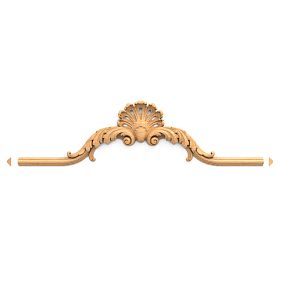
Our factory also produces:


Polyurethane Armor: Decor That Isn't Afraid of Life
polyurethane moldingsrevolutionized architectural decor. This material combines the strength of metal with the lightness of foam, the durability of plastic with the aesthetics of plaster. The secret lies in the molecular structure of polyurethane, where polymer chains form a three-dimensional network with closed cells. The material density is 200-300 kg/m³, but compressive strength reaches 100-200 kPa. This allows for the creation of thin-walled elements that do not break under load.
Wet cleaning is a daily reality in hallways and corridors. Plaster stucco absorbs 5-15% water by mass, swells, loses strength, and becomes covered in mold.Polyurethane is hydrophobic—its water absorption coefficient is less than 1% even after full immersion for 24 hours. In real-world conditions, this means a polyurethane cornice or molding can be washed with a sponge and detergent every day—it won't change dimensions, lose its sheen, or deform.
Temperature fluctuations in the hallway range from minus 5 degrees (when the door is open in winter) to plus 25 (with heating on). Plaster develops microcracks under such cycles, which gradually expand. Wood 'moves,' changing linear dimensions by 0.1-0.3%. Polyurethane is tested for 100 heating-cooling cycles from minus 20 to plus 60 degrees without deformation. Its coefficient of thermal expansion is only 0.00006 per degree Celsius—this is practically unnoticeable.
The impact resistance of polyurethane elements surpasses plaster by 5-7 times. A plaster cornice shatters upon impact with an energy of 3-5 J.A polyurethane cornice withstands15-20 J without visible damage. This means an accidental hit with a mop during cleaning, bumping with a ladder during repairs, or a push from furniture during rearrangement—polyurethane will handle all of this without consequences. The material's elasticity allows it to absorb impact energy and then restore its shape.
Biological resistance is a critical parameter for wet rooms. Plaster becomes covered in mold within 3-6 months in a humid environment. Wood is susceptible to fungus, blue stain, and rot. Polyurethane is biologically inert—it does not create a nutrient medium for microorganisms, does not absorb moisture, and does not rot. Even at 90-95% humidity (common in bathrooms), polyurethane remains stable for decades.
The aesthetic possibilities of polyurethane are not inferior to plaster. Modern casting technologies allow for the reproduction of the finest details—relief depth of 0.5 mm, rounding radius of 1 mm, complex multi-tiered profiles. After painting, a polyurethane cornice is visually indistinguishable from a plaster one, but weighs 5-8 times less and lasts 3-4 times longer.Wall finishing using polyurethane moldingscreates architectural expressiveness that does not deteriorate over time and use.
Get Consultation
Wooden Corner Guards: Protection Where It's Critical
Doorway corners, door jambs, wall joints—these are the most vulnerable points in any interior. This is where plaster chips first, wallpaper tears, and paint wears off.Wooden corner bracketsolves the problem radically—it takes the impact itself, protecting the fragile finish behind it. An oak corner guard with a cross-section of 20×20 mm or 30×30 mm, installed on an external wall corner, creates a strong barrier that withstands tens of thousands of contacts without damage.
Where is the installation of corner guards most justified? Doorways in hallways—here they are hit with bags, suitcases, sports equipment. External wall corners in corridors—they get scratched when moving furniture, hit with a vacuum cleaner, bumped with children's toys. Window jambs—especially if the windowsill is used as a work surface. Corners of columns and niches—decorative elements requiring protection from accidental damage.
A wooden corner guard for protecting wall cornersnot only protects but also decorates. The choice of profile depends on the interior style. A simple rounded corner guard with a radius of 3-5 mm suits minimalist and modern interiors. A corner guard with a chamfer creates a clear geometric line, appropriate in Scandinavian style and loft. A carved corner guard with ornamentation complements classical and neoclassical interiors. All options perform a protective function, but the visual effect differs.
Installing wooden corner guards requires precision. The wall must be level—variations of more than 2 mm per meter of length will create gaps. The corner guard is attached with adhesive (carpenter's PVA or polyurethane) with additional fixation using finishing nails or pins. Joints at corners are made at a 45-degree angle using a miter box or miter saw—this ensures neat joining without gaps. After installation, the corner guard is sanded with fine-grit sandpaper (grit 220-320) and coated with varnish, oil, or paint to match the walls or in contrast.
Why wood, not plastic or metal?A solid oak wooden corner guardis warm to the touch, aesthetically noble, and easy to restore. A scratch on wood can be sanded, a chip can be filled and touched up. A plastic corner guard breaks under a strong impact, a metal one is cold and visually alien in a living interior. Wood creates a sense of solidity and naturalness that cannot be imitated by synthetic materials.
The service life of wooden corner guards made of oak or beech is 30-50 years. They outlast several cycles of wall repainting, changes in floor coverings, and interior updates. This is an investment in durability that pays off by eliminating the need for constant repair of corners and jambs. In homes with children or active use of sports equipment, bicycles, or scooters, corner guards become not a luxury but a necessity.
Slat Protection: When Walls Need to Be Covered with Decor
Decorative wall panelingis a trend that solves two problems at once: it creates an expressive texture and protects the surface from damage. Vertical or horizontal slats with a spacing of 50-100 mm form a protective screen that absorbs mechanical impacts. The wall behind the slats remains untouched—it can be painted any color, wallpapered, or left as concrete.
Horizontal battens at a height of 80-120 cm are a classic scheme for protecting walls in a hallway. This is the zone that receives impacts from chair backs, suitcase handles, and bicycle handlebars.Battens with a cross-section of 20×40 mm or 30×50 mm, installed with a 10-15 mm gap from the wall, creates a buffer zone. The impact falls on the batten, which absorbs the energy, and the wall remains intact. Additional lighting, such as an LED strip, can be placed between the battens to create a floating element effect.
Vertical battens act as protective stiffening ribs. A spacing of 70-100 mm between battens creates a rhythmic structure that visually elongates the space and masks irregularities in the base wall. When struck by an object, the energy is distributed across several battens, reducing the local load.Wooden Planks for Walls can be made from oak, beech, ash, pine — the choice depends on budget and wear resistance requirements.
A combined scheme — a horizontal batten panel at a height of 100-120 cm combined with vertical accents — creates architectural complexity. The lower zone is protected by horizontal battens, which take the main impacts. The upper zone is decorated with vertical elements, creating visual dynamics. Joints are made at 90 or 45-degree angles, forming geometric patterns.
Batten systems protect not only from impacts but also from abrasion. In narrow hallways where contact with walls is unavoidable, battens create distance between the body and the finish. Clothing slides over the smooth surface of the battens without touching the wallpaper or paint. This is especially relevant for families with children, where hallway walls are constantly getting dirty and worn.
Installation of batten panels is performed on a hidden frame made of 20×40 mm battens, secured to the wall with dowels. The frame attachment spacing is 50-70 cm vertically. Battens are fixed to the frame with clips (hidden fastening) or through with finishing nails, sinking the heads and subsequent puttying. The gap between battens is set using calibrated spacers 10-20 mm thick, ensuring perfect parallelism.
The finish of batten panels depends on the wood species and interior concept. Oak and ash are beautiful in their natural state — it's enough to coat them with oil or wax that reveals the texture. Pine and beech can be stained, creating the effect of noble species. Painting to match the wall color creates a monochrome surface with pronounced relief. Contrast painting — battens one color, background another — emphasizes the geometry and creates an accent.
Moldings as a protective barrier
Impact-resistant wall molding — an element often underestimated, perceived merely as decor. In reality, a horizontal molding installed at a critical height of 80-100 cm is a protective buffer that withstands impacts without damaging the wall. A profile 40-60 mm wide protrudes 15-25 mm from the wall, creating a physical barrier between moving objects and the finish.
The optimal hallway protection scheme includes three levels of moldings. Lower level — at a height of 30-40 cm from the floor, protects against impacts from vacuum cleaners, mops, and low-carried items. Middle level — 80-100 cm, the main protective zone. Upper level — 180-200 cm, separates the upper decorative zone from the functional one. The wall is divided into segments, each painted in its own shade or covered with different materials.
Moldings made of impact-resistant polystyrene withstand impact energy up to 100-150 J/m — 5 times more than regular polystyrene. The material is elastic: upon impact, it bends, absorbing energy, then restores its shape without cracks or deformations. This is critical for high-traffic areas where moldings can receive dozens of impacts per month. A plaster molding would crack after the first serious impact, while a polystyrene one lasts for years.
Installing moldings for a protective function requires reinforced fastening. Standard adhesive for polystyrene is supplemented with mechanical fixation — dowel-nails spaced 30-40 cm apart. Corner joints are made at 45 degrees and glued with fiberglass mesh reinforcement — this prevents separation under impact loads. If the molding is installed on an already painted wall, the surface underneath is primed to enhance adhesion.
Combining moldings and panels creates multi-level protection. A lower panel 90-100 cm high protects the main impact zone. A molding along the top edge of the panel serves as a finishing touch and an additional barrier. The upper part of the wall remains light and open — enhanced protection is no longer required here. This scheme visually lightens the space, concentrating protective elements where they are truly needed.
High-strength baseboards
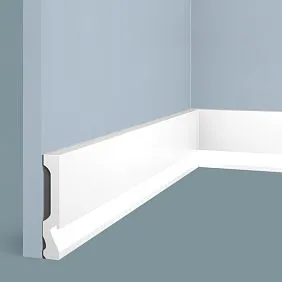
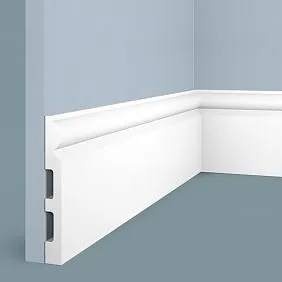
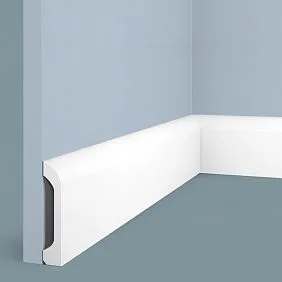
A standard baseboard 50-70 mm high is a decorative element that covers the joint between the wall and floor.A baseboard 100-150 mm high — is already a protective panel that takes impacts upon itself. In the entryway and hallway, a high baseboard made of impact-resistant polystyrene or solid oak becomes the first line of defense against suitcases, shoe boxes, children's toys, and household equipment.
Impact-resistant polystyrene for baseboards has a compressive strength of 100-200 kPa — 2-3 times higher than standard. A flexural strength of 250-350 kPa allows the baseboard to retain its shape even under strong impacts. An impact toughness of 3-5 kJ/m² means the material absorbs impact energy without cracking. A baseboard made of this material can be hit with a hammer — only a small dent will remain, which will partially recover within a few hours due to the polymer's elasticity.
Paintable floor baseboard offers color freedom. A white primed MDF or polystyrene baseboard can be painted any color — to match the walls for visual blending, to match the floor for horizontal unity, or in a contrasting color for an accent. Paint adds an additional protective layer — polyurethane and alkyd enamels create a hard coating resistant to abrasion and washing.
A hidden mounting system for baseboards simplifies the replacement of damaged sections. The baseboard is attached to clips secured to the wall. The profile itself snaps onto the clips, forming a single line. If one segment is seriously damaged, it can be removed and replaced without touching the neighboring ones. This saves time and money on local repairs, which are inevitable in high-load areas.
Combining materials in one baseboard is a modern trend. A base made of impact-resistant polystyrene provides strength and moisture resistance. A faceplate made of veneered MDF or solid wood creates the aesthetics of natural wood. Such a baseboard combines the technical advantages of polymers with the visual nobility of wood. The cost is higher than mono-material analogues, but the result justifies the investment.
Polyurethane or wood: selection principles
Wood carries the energy of nature. Texture, warmth to the touch, ability to be restored, patina of time — all this creates a sense of quality and solidity.solid wood elements are appropriate in classic interiors, in country houses, in spaces emphasizing naturalness and eco-friendliness. Solid wood requires maintenance — regular renewal of the protective coating, humidity control, careful handling. But for many, this very 'liveliness' of the material is valuable.
Polyurethane is a material of the technological era. Stability, predictability, minimal maintenance, absolute moisture resistance — these qualities make it ideal for modern, dynamic interiors.polyurethane elements are appropriate in minimalist spaces, in rooms with unstable microclimates, in projects where durability without the need for maintenance is important. Polyurethane does not age visually — after 10 years it looks the same as on the day of installation.
A combined approach leverages the strengths of both materials. The main architectural elements—cornices, moldings, decorative panels—are made of polyurethane. They create a framework resistant to any impacts. Accent details—mirror frames, portal surrounds, decorative overlays—are made of wood. They bring warmth and tactility. This combination creates a layered perception: the technological reliability of the background and the emotional warmth of the details.
Where is polyurethane preferable? Bathrooms, kitchens, hallways—rooms with unstable humidity. Children's rooms—where decor must be absolutely safe and resistant to active play. Offices and commercial spaces—where minimal maintenance is required despite high traffic. Where is wood irreplaceable? Studies and libraries—where an atmosphere of solidity is important. Bedrooms—where tactile comfort matters. Country houses—where connection with nature is part of the concept.
Staircase: a zone of extreme wear
Stair treads are the most heavily used surface in a house. Each step receives 20-50 footsteps per day, amounting to 7,000-18,000 contacts per year. The tread (horizontal part of the step) experiences abrasive load from shoe soles. The riser (vertical part) receives impacts from shoe toes during ascent. Handrails and balusters are subjected to constant friction from hands. All this requires materials of extreme durability.
Solid oak treads 40-50 mm thick are a classic solution, proven over centuries. Oak density is 750-900 kg/m³, Brinell hardness 3.7-4.0—this provides wear resistance comparable to top-class engineered wood flooring. An oak tread lasts 50-100 years, it can be sanded 3-5 times, each time removing 1-2 mm of the worn layer and exposing fresh wood. The protective coating—polyurethane varnish or oil-wax—is renewed every 3-5 years depending on intensity of use.
Risers are less critical to wear, so they can be made from MDF for painting.High-density MDF760-850 kg/m³, 18-22 mm thick, withstands impacts from shoe toes without damage. A riser painted with polyurethane enamel is easy to clean, does not absorb dirt, and retains its color for decades. The combination of oak treads and MDF risers is an economically justified solution where each material works in its zone of maximum effectiveness.
Stair handrails require special attention to surface treatment. Wood must be sanded to 320-400 grit so the surface is absolutely smooth, without splinters or roughness. The coating—varnish or oil—must be resistant to abrasion and hand perspiration. Polyurethane varnish creates a hard film resistant to scratches but feels cold to the touch. Oil-wax soaks into the wood, preserving tactile warmth but requires renewal every 1-2 years.
Wooden balusters are a traditional staircase element. In high-traffic areas (public buildings, large families), balusters can be replaced with glass panels or metal cables. They do not wear out, do not get dirty, and are easy to clean. Visually, such railings are lighter than wooden ones and do not clutter the space. The combination of wooden handrails and glass panels is a modern solution where the strength of glass complements the tactile comfort of wood.
Protective corners and edges
Protruding wall corners in hallways are points of concentrated damage. Ordinary plaster or drywall on corners gets chipped within months. Corners can be protected in several ways. Metal corner bead—the strongest, but cold and not always aesthetic. Plastic corner bead—cheap, but not durable and visually cheapens the interior.Solid wood corner bead—is the optimal compromise of strength, aesthetics, and durability.
Corner profiles made of impact-resistant polystyrene are an alternative for modern interiors. An L-shaped profile with a flange width of 30-50 mm fits over the wall corner, covering the vulnerable edge. The material withstands impacts without chipping, can be painted any color, and is easily installed with adhesive. Visually, such a corner creates a soft rounding of the angle, making the space less hazardous for children.
Rounding corners is an architectural technique that solves the problem radically. Instead of a sharp 90-degree angle, a radius of 50-100 mm is created. Such a corner cannot be chipped or scraped—impacts slide along the curved surface without concentrating at a single point. Rounding is done during plastering using special templates or ready-made polystyrene corner elements. Visually, rounded corners soften the geometry of the space, making it more fluid and organic.
Decorative corner overlays are a solution for finished interiors where radical changes are impossible. An overlay made of wood, metal, or composite, 10-15 mm thick, covers the corner to a height of 200-220 cm (average human height plus margin). It is attached with adhesive or screws, painted, or left in its natural state. Such an overlay not only protects but also creates a vertical accent, visually raising the ceiling.
Wear-resistant flooring as part of the system
Wear-resistant wall decor and decorative elements will be ineffective if the floor does not match in durability. In the hallway, the floor receives abrasive load from sand and de-icing agents, point impacts from heels, and scratches from suitcase wheels. Porcelain tile with a wear resistance class of PEI 4-5 is the optimal solution for the entry zone. It withstands intensive traffic without wear, does not absorb moisture, and is easy to clean.
Engineered wood flooring with a top layer of oak 4-6 mm thick is a compromise between the aesthetics of wood and practicality. A protective coating of UV-cured varnish 100-150 microns thick creates a hard surface resistant to scratches. A wear resistance class of 32-33 (commercial) ensures a service life of 15-25 years under intensive home use. Damaged planks can be replaced locally without dismantling the entire floor.
The transition between floor coverings is a critical zone. The height difference between tile and wood is 5-15 mm, creating a threshold—a point of concentrated loads and potential damage. A metal threshold profile 30-40 mm smooths the transition and protects the edges of both materials. For invisible transitions, expansion profiles made of cork or silicone are used, installed in the gap between coverings.
Mats and dirt-trapping systems are the first line of defense for the floor. A metal grate mat at the entrance traps large dirt and sand. An absorbent mat 1.5-2 meters long removes moisture from shoes. These two elements reduce the abrasive load on the main floor covering by 70-80%, extending its service life multiple times. Mats require regular cleaning—once a week in dry weather, daily in slush.
Practical protection schemes for specific zones
A 2×3 meter hallway in a typical apartment. Floor—PEI 5 class porcelain tile. Baseboard—impact-resistant polystyrene 120 mm high, painted to match the walls. At a height of 90 cm—a horizontal polystyrene molding 50 mm wide, forming a border between the dark lower zone (practical paint with moisture-resistant paint) and the light upper zone (decorative wallpaper). The external corner by the entrance door is protected by an oak wood corner bead to a height of 220 cm. Result: all vulnerable zones are covered, the interior looks stylish and is easy to clean.
A hallway 8 meters long, 1.2 meters wide. A narrow space where contact with walls is unavoidable. Solution—a slat panel on one wall to a height of 120 cm. Vertical oak slats 20×40 mm in cross-section with an 80 mm spacing create a protective screen and visually expand the space. The opposite wall remains smooth, painted a light color. Baseboards—solid oak 100 mm high. Result: walls are protected, the hallway does not look overloaded, oak elements create a sense of solidity.
A staircase to the second floor in a country house. Treads—solid oak 40 mm thick, coated with oil-wax. Risers—MDF for painting, painted white with polyurethane enamel. Handrail—solid oak 50 mm in diameter, sanded to 400 grit, coated with polyurethane varnish. Balusters—metal rods 12 mm in diameter with powder coating. The combination of materials ensures wear resistance at critical points, savings on less loaded elements, and visual lightness of the structure.
A children's room—a space where decor must withstand active play. All wall corners are rounded with a 50 mm radius. Baseboards—polyurethane 80 mm high, painted with washable acrylic paint. At a height of 60 cm—a horizontal protective panel made of impact-resistant polystyrene 20 cm wide, behind which LED lighting can be placed. Doors and doorways are framed with soft silicone pads to prevent injuries from impacts. Result: a safe space where one can play without fear of damaging the interior.
Care and maintenance of wear-resistant materials
Polyurethane and polystyrene are cleaned with any household cleaners, except solvents and abrasives. A soft sponge with soapy water removes dirt without a trace. For strong stains, alcohol-based cleaners can be used—they do not damage the polymer. Cleaning frequency—as needed, in the hallway this is 1-2 times a week. After cleaning, elements dry quickly without absorbing moisture.
Wooden elements require more delicate care. Wet cleaning—with a slightly damp, not wet cloth. Excess water can penetrate micro-cracks in the coating and cause wood swelling. For cleaning, use water-based, pH-neutral products. Every 6-12 months, oil-finished wood requires renewal—applying a thin layer of oil to restore protection. Varnished wood requires no maintenance, but the varnish needs to be renewed every 5-10 years.
Painted MDF is sensitive to moisture on the edges. When washing, avoid water seeping into the joints between planks. If the edges are exposed, they need to be additionally primed and painted during installation. Painted MDF elements are washed the same way as polymers—with a sponge and detergent. Scratches on the paint can be touched up locally—acrylic paints tint well, allowing for an exact shade match.
Regular inspection of decorative elements allows for early detection of damage. Minor scratches on wood are filled with furniture wax of a matching shade. Chips on MDF are filled with putty, sanded, and touched up. Cracks in the joints of polyurethane elements are filled with acrylic sealant. Timely repair of minor defects prevents them from worsening and preserves the interior's aesthetics.
The Economics of Durability
Investing in wear-resistant materials pays off by eliminating the need for frequent repairs. Standard decor in an entryway requires updating every 3-5 years—repainting baseboards, replacing damaged moldings, repairing corners. Wear-resistant materials last 15-30 years without intervention, aside from regular cleaning. The 30-50% difference in initial cost is offset in the long term.
Solid oak costs 2-3 times more than MDF but lasts 3-4 times longer. An oak baseboard over 30 years of use will be cheaper than two cycles of MDF replacement. Polyurethane molding is 40-60% more expensive than plaster, but plaster in a damp entryway will deteriorate in 5-7 years, while polyurethane will last 25-30 years. The savings are not immediate but are significant.
Local replacement of damaged elements is an option that should be considered during design. Modular systems—baseboards on clips, moldings on segments, slatted panels on a hidden frame—allow for replacing individual parts without dismantling the entire structure. This saves time and money for inevitable local damage. A 5-10% material reserve from the total volume enables repairs without needing to find an exact product match years later.
DIY installation or hiring professionals? Simple elements—baseboards, moldings—can be installed independently with basic skills and tools. Complex structures—slatted panels, multi-level protection systems, stairs—require a professional approach. Installation errors reduce protection effectiveness and aesthetics. Specialist work costs 30-50% of the material price but guarantees a quality result.
Frequently asked questions
Can regular MDF baseboard be used in an entryway?
Yes, but with an understanding of the risks.Regular MDF with a density of 600-700 kg/m³will withstand moderate loads but may chip under strong impacts. For entryways, it's better to choose high-density MDF (760-850 kg/m³) or impact-resistant polystyrene. If the budget is limited, use regular MDF but be prepared for local replacement in 5-7 years.
What baseboard height is optimal for wall protection?
In entryways and hallways, a minimum of 80-100 mm, optimally 100-120 mm. This height protects the wall from most household impacts—from shoes, bags, vacuum cleaners.150 mm high skirting boardis suitable for public buildings and homes with very high traffic. In living rooms, 60-80 mm is sufficient.
Polyurethane or polystyrene—which is stronger?
Polyurethane is denser (250-300 kg/m³ vs. 100-150 kg/m³ for polystyrene) and stronger in bending. However, impact-resistant polystyrene has higher impact toughness—it better absorbs impact energy without breaking. Both materials are suitable for cornices and moldings. For baseboards in extreme load zones, impact-resistant polystyrene is better.
Do corners need protection in an apartment without children?
Yes, if there is high traffic. Corners in hallways are damaged not only by children but also when moving furniture, large purchases, or suitcases.Protecting corners with wooden corner guardsor rounding them is an investment that pays off by eliminating the need to regularly repair damaged corners.
How often should oil coating on wooden elements be refreshed?
In high-load areas (stair handrails, protective rails at hand level)—every 12-18 months. On baseboards and moldings that don't come into contact with hands—every 3-5 years. Signs that refreshing is needed: surface dulling, appearance of dry spots. Refreshing takes 1-2 hours per room—wipe the surface free of dust, apply a thin layer of oil with a cloth.
Can polyurethane molding be painted a dark color?
Yes, polyurethane can be painted with any interior paints—acrylic, latex, alkyd. For dark colors, quality primer is required—it creates a uniform base and reduces paint consumption. Dark shades emphasize the molding's relief, creating a play of light and shadow.Polyurethane molding in dark toneslooks especially expressive in high-ceilinged rooms.
How to avoid chipping MDF when cutting?
Use a saw with a fine-toothed blade (tooth 1.5-2 mm) and high rotation speed. Cut with the face side up if using a jigsaw, and face side down if using a miter saw. Apply painter's tape along the cut line—it will hold the top layer fibers. After cutting, lightly sand the edge with 220-grit sandpaper.
Do slatted panels collect dust between the slats?
Yes, if the gap between slats is 15-30 mm, dust accumulates there. Cleaning is done with a vacuum cleaner with a narrow attachment or a dry brush every 2-4 weeks. To minimize the issue, you can make the gap minimal (5-10 mm) or cover it with a decorative insert of a contrasting color.
Solid oak or solid beech for hallway skirting boards?
Oak is harder (Brinell hardness 3.7-4.0 vs. 3.0-3.5 for beech) and more moisture-resistant. Beech is slightly softer but takes stain more easily and has a more uniform texture. For hallways where humidity fluctuations are possible, oak is preferable. Beech is suitable for rooms with a stable microclimate.
Can polyurethane elements be installed in unheated rooms?
Yes, polyurethane retains its properties in a range from minus 40 to plus 80 degrees Celsius. It does not crack in frost or deform when heated. This allows it to be used in unheated verandas, garages, and utility rooms. The only limitation is that installation must be performed at temperatures above plus 5 degrees Celsius for the adhesive to polymerize.
Conclusion: Beauty without compromise
Wear-resistant decor is not a choice between durability and aesthetics. Modern materials allow creating interiors that are both beautiful and functional.Baseboards made of solid oak, polyurethane moldings, protective wooden corner guards, decorative wall battens— every element contributes to durability without sacrificing visual expressiveness.
Choosing materials for high-traffic areas requires an understanding of the physics of failure. Impacts, abrasion, humidity, temperature fluctuations—each factor acts differently, and the material must withstand the entire complex of influences. Solid oak withstands mechanical loads due to its fibrous structure. Polyurethane resists moisture thanks to its hydrophobic molecular network. Impact-resistant polystyrene absorbs impact energy through elastic deformation. Understanding these mechanisms allows selecting materials not based on the principle 'more expensive means better,' but based on suitability for specific operating conditions.
A comprehensive approach—when all critical zones are protected—creates an interior that does not require constant repairs. High skirting boards cover the lower third of the wall. Horizontal moldings at 80-100 cm height take the main impacts. Corner guards on external corners protect the most vulnerable points. Batten panels create a physical barrier between movement and the finish. Each element complements the other, forming a multi-level protection system.
Investing in quality materials pays off with peace of mind. You don't worry that children will scratch the wall, that a suitcase will leave a dent in the skirting board, that wet cleaning will damage the cornice. The interior withstands real life, remaining impeccable for years. This is freedom from the need to constantly touch up, re-glue, or conceal. This is beauty that is not afraid to be used.
STAVROS Company offers a full range of wear-resistant decorative elements for creating durable interiors. From skirting boards and moldings to stucco and batten systems—each product undergoes quality control and meets high strength standards. Professional consultations will help select materials for specific operating conditions, and the delivery system ensures timely supply to any point in Russia. Create interiors that last for decades with STAVROS—a reliable partner in the world of architectural decor.


