Article Contents:
- Why solid wood in the age of synthetics: returning to roots
- Biophilia: the innate need for nature
- Tactility: what synthetics cannot replicate
- Scent: the invisible presence
- Durability: investment for decades
- Ecology: renewable resource versus plastic
- STAVROS solid wood products: from board to masterpiece
- Raw material selection: only noble wood species
- Drying: the foundation of stability
- CNC processing: precision to tenths of a millimeter
- Sanding: from roughness to velvet smoothness
- Final finishing: protection and beauty
- Solid wood furniture decor: details that create harmony
- Carved overlays: accents of artistry
- Moldings: architecture of surfaces
- Legs and balusters: the verticals of furniture
- Cornices and plinths: furniture framing
- How STAVROS solid wood products complement furniture
- Solid wood as a philosophy: conscious choice
- Against disposability
- For connection with nature
- For repairability
- For passing down as heritage
- Frequently Asked Questions
- Conclusion: wood as the choice of a conscious person
In an era when plastic mimics wood with photographic precision, when laminate is indistinguishable from parquet from a meter away, when synthetics are cheaper, more practical, more technological—whySolid wood productshave not only not disappeared, but are returning as a symbol of conscious choice, status, and life philosophy? Because wood is not just a material, but a living substance that possesses what synthetics will never have: tactile warmth, scent, the ability to breathe, age gracefully, and carry history.Classic FurnitureSolid wood products are not a tribute to tradition, but the choice of those who understand the difference between imitation and authenticity, between fast consumption and long-term investment, between a house as a function and a house as an environment that shapes a person.


Why solid wood in the age of synthetics: returning to roots
We live in a world oversaturated with artificiality. Plastic windows, vinyl floors, particleboard furniture, synthetic fabrics. They are functional, accessible, easily replaceable. But they are not alive. They do not carry energy, do not interact with humans on a sensory level, and do not create a connection with nature, which is genetically embedded in us.




Biophilia: the innate need for nature
The term "biophilia" (from Greek bios — life, philia — love) was introduced by American biologist Edward Wilson, describing the innate human need for contact with living nature. For millions of years of evolution, humans spent their time surrounded by trees, stone, water, and plants. The brain became accustomed to these textures, smells, and sounds. When we touch wood, look at its texture, inhale its scent — ancient parts of the brain responsible for calm, safety, and connection with the environment are activated.
Research shows: people in interiors with natural materials (wood, stone, wool, linen) experience less stress, sleep better, and recover faster from illnesses. Wood lowers blood pressure, slows the pulse, and reduces cortisol levels (the stress hormone). This is not esotericism, but physiology.
Our factory also produces:


Tactility: what synthetics cannot fake
Plastic that imitates wood can be visually convincing. Photo printing conveys the texture, color, even the grain. But run your hand over it — the deception is instantly revealed. Plastic is cold, smooth, lifeless. Wood is warm (its thermal conductivity is lower, it doesn't draw heat from your hand), rough (even when sanded, it retains the micro-relief of its pores, felt by the fingertips), alive (it reacts to humidity — slightly contracting in a dry room, expanding in a humid one, breathing).
Tactile contact with wood is a daily ritual we don't consciously notice, but which affects our mood. A hand on a wooden countertop during breakfast, touching wooden stair railings, grasping a wooden door handle. These moments add up, creating a background of comfort or discomfort. Wood creates comfort. Plastic — neutrality at best, coldness at worst.
Get Consultation
Scent: the invisible presence
Natural wood has a scent. Even years after processing, coating with oil or varnish, it continues to emit volatile organic compounds (terpenes, aldehydes, esters) that create a characteristic smell. Oak smells tart, of tannins (the same substances found in wine, leather). Pine — resinous, coniferous. Walnut — slightly bitter, noble. It's not a strong smell, not perfume. It's a background aroma that the brain registers subconsciously.
Aromatherapy research shows that the scent of wood reduces anxiety, improves concentration, and promotes relaxation. The Japanese practice of "shinrin-yoku" (forest bathing) is based on inhaling volatile substances released by trees. These substances strengthen immunity, reduce inflammation, and improve mood. A house filled with wood is a small forest where these effects work daily.
Synthetics either have no smell (well-processed plastic) or smell of chemicals (new particleboard, vinyl). These are smells you want to air out, escape from, get rid of. Not a background of comfort, but a source of irritation.
Durability: an investment for decades
Particleboard furniture lasts 5-10 years. Scratches cannot be fixed, a board swollen from moisture cannot be restored, loose fasteners cannot be tightened — it's thrown away, a new one is bought. Solid wood lasts 50-100 years and more. A scratch on an oak countertop is sanded, the surface is refinished — it looks like new. A loose joint is disassembled, re-glued, tightened — holds for another half-century. Worn-out finish is removed, a new one is applied (repainting, re-staining, varnishing) — the furniture looks renewed but retains its history.
Solid wood furniture is passed down through generations. Your grandfather's oak table stands in your living room, will stand with your children, grandchildren. This is not romanticization — it's a fact. Antique furniture from the 17th-19th centuries sold at auctions is made of solid wood. It has survived wars, moves, changes of owners, climates. Where is the plastic furniture from the 1970s? In landfills, decomposed (good) or not decomposed (bad for the ecology).
The durability of solid wood is not only long-term savings (a one-time purchase is more expensive, but over 50 years it's cheaper than five purchases of particleboard furniture). It's a philosophy: I'm not buying for a season, for a trend, for a rental apartment, but for life, for a home, for a family.
Ecology: renewable resource vs. plastic
Wood is a renewable resource. An oak grows for 80-120 years, but it grows. A forest managed sustainably (as much is harvested as is planted) is endless. Modern logging (in countries with developed legislation: Germany, Scandinavia, North America, Russia partially) is certified by FSC (Forest Stewardship Council) — a guarantee that the forest is not destroyed, but managed.
Wood absorbs CO₂ and releases O₂ during growth. Even after becoming furniture, it continues to store carbon (does not release it back into the atmosphere until it burns or rots). Solid wood furniture is sequestered carbon, a contribution to reducing greenhouse gases.
Plastic is a product of petrochemistry, a non-renewable resource. Plastic production is energy-intensive, emits CO₂. Plastic does not decompose for centuries. Even "recycled" plastic loses quality with each cycle, ending up in landfills or the ocean anyway. By choosing solid wood, you choose against plastic, against pollution, against disposability.
STAVROS solid wood products: from board to masterpiece
Not all solid wood is the same. Raw wood, improperly dried, will warp, crack, rot. Poorly processed wood will be rough, with splinters. Cheap wood from soft species (pine, spruce) without treatment — will absorb moisture, darken, deform.Solid wood productsHigh-quality solid wood is the result of a technological chain where every stage is critical.
Raw material selection: only noble species
The company STAVROS works with hard deciduous species — oak, beech, ash. These species combine strength, beauty of texture, and stability.
Oak — the king of furniture species. Density 650-750 kg/m³, Brinell hardness 3.7-3.9 (very hard, resistant to dents, scratches). Texture is expressive: large pores, contrasting annual rings, medullary rays (radial lines visible on the cut) which create a "moire" — a shimmering effect. Color from light straw to brown-golden. Oak contains tannins — substances that protect against rot, insects, and give a tart smell. Oak barrels for wine, Viking ships, Versailles parquet — all made of oak, all for centuries.
Beech — the aristocrat species. Density 650-700 kg/m³, hardness 3.8. Texture is fine, uniform, without contrasting rings (pores are small, annual rings are not bright). Color pinkish-beige, warm. Beech is easier to cut than oak (despite similar hardness), holds fine details, ideal for carving — baroque overlays, balusters, furniture legs are made of beech. Minus — hygroscopic (absorbs moisture more actively than oak), requires a stable climate, good finish.
Ash — modern classic. Density 650-700 kg/m³, hardness 4.0 (the hardest of the three). Texture is contrasting, like oak, but lighter — grayish-white color, clear rings. Ash is elastic, withstands impact loads (spears, oars, baseball bats were made from it). Fewer tannins than oak, so the smell is more neutral. Ash takes stains well, accepting dark shades (wenge, black) without losing texture.
All species are purchased from certified suppliers (FSC, PEFC — European and North American logging companies). Each board is checked for the absence of large knots (knots weaken, create potential cracking points), rot, blue stain (fungal infection), cracks.
Drying: the foundation of stability
Freshly cut wood (green lumber) contains 40-80% moisture (of its own weight). Such wood cannot be used — it deforms when drying (shrinks, warps, cracks). Drying to a moisture content of 8-10% is needed (standard for furniture, heated rooms).
STAVROS uses kiln drying — boards are placed in a drying kiln where temperature, humidity, and air circulation are controlled by automation. The drying regime depends on the species, board thickness. Oak 50 mm thick dries for 3-4 weeks. The process is gradual: first temperature 40-50°C, humidity 80%, then temperature rises to 60-70°C, humidity decreases to 10%. Final conditioning (holding at stable temperature-humidity) evens out the moisture throughout the board volume (the center and edges dry unevenly, conditioning eliminates the gradient).
After drying, each board is checked with a moisture meter. Norm 8±1%. Boards with deviations are rejected (re-dried or used for other purposes). Only boards with stable moisture go into production. This guarantees that the product (molding, overlay, leg, panel) will not warp a month or a year after installation in your home.
CNC processing: accuracy to tenths of a millimeter
Classical carving is the handiwork of a carver, using chisels and gouges, months of labor. Modern carving is a CNC milling machine (computer numerical control), which cuts based on a 3D model with an accuracy of 0.1 mm. STAVROS uses both methods: CNC for basic processing, shaping, and carving repetitive elements; manual finishing for finalization, sanding, and emphasizing details.
A CNC milling machine is a machine where a milling cutter (a rotating cutting tool) moves along three (or five) axes, controlled by a computer. The operator loads a 3D model (created by a designer in CAD software), the machine calculates the trajectory and performs the cutting. A carved overlay with an acanthus leaf, which would take a carver 8 hours, the milling machine completes in 20 minutes. Repeatability is absolute—a hundred overlays will be identical down to the micron.
But CNC does not completely replace humans. After milling, the master inspects the part, removes small burrs (remnants of wood fibers that the milling cutter lifts but does not cut off), sands hard-to-reach areas (deep recesses of the carving where a sander cannot reach), and emphasizes edges (with light chisel cuts to reveal the clarity of plane transitions). This is manual finishing, without which the part looks mechanical, soulless.
Sanding: From Roughness to Velvety Smoothness
A raw part after milling is rough. Sanding is needed—sequential treatment with abrasives of increasing grit. STAVROS sands in 4-5 stages: grit 80 (coarse, removes major irregularities, milling marks), 120 (medium, levels), 180 (fine, creates smoothness), 240-320 (finish, creates a velvety texture felt by hand).
Sanding flat surfaces is done by machine (orbital, belt sanders). Sanding carvings, profiles is done by hand (sandpaper, sponges, in recesses—wooden sticks wrapped in sandpaper). This is labor-intensive but critical: poorly sanded carving looks rough, the hand feels roughness, splinters are possible.
Final Finishing: Protection and Beauty
A sanded product absorbs moisture, dirt, and darkens. A finish is needed—a coating that protects, emphasizes the texture, and imparts color.
Oil—penetrates the wood, fills pores, emphasizes the texture (makes the color richer, more contrasting). Oil does not create a film, the wood breathes, remains tactile. STAVROS uses natural-based oils (linseed, tung) or special furniture oils (Osmo, Biofa—German manufacturers). Applied with a brush or pad, excess is wiped off, dries in 12-24 hours. Renewed once a year (tabletops, intensively used surfaces) or every 3-5 years (decorative elements—moldings, overlays).
Varnish—creates a hard film on the surface, protects from moisture, scratches, dirt. STAVROS uses polyurethane varnishes (two-component, maximum durability) or acrylic (water-based, odorless, eco-friendly). Varnish can be matte (5-10% gloss, preserves the natural look of wood), semi-matte (30-40%), glossy (80-90%, creates a mirror shine, luxury). Applied by spraying (with a spray gun) in 2-3 coats, each coat sanded with fine sandpaper (320-400). The final coat is not sanded, creates a perfectly smooth surface.
Enamel + patina—for colored, decorative products. The wood is primed (acrylic primer seals pores), painted with enamel (white, cream, gray, any color), patinated (dark paint or gold in recesses, on edges), coated with varnish. This is a multi-day process, but the result is luxury unattainable with simple oil.
Furniture decorSolid wood: details that create an ensemble
Classic Furniture—is not just carcasses and tabletops. It is a system of elements where decoration—carved appliqués, moldings, cornices, legs, balusters—creates style, character, individuality.
Carved overlays: accents of artistry
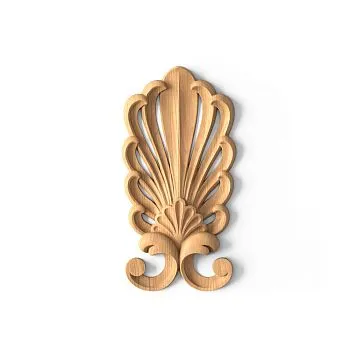
A carved overlay is a small element (usually 5-30 cm) that is glued onto furniture fronts, walls, doors, creating a decorative accent. A cartouche overlay (15x10 cm) in the center of a cabinet door transforms a flat door into a work of art. Corner overlays (8x8 cm) on the corners of a frame create a border. Frieze overlays (horizontal strips with continuous ornament) create rhythm.
STAVROS produces hundreds of overlay models: botanical (acanthus leaves, grapevines, roses, tulips), geometric (rosettes, meanders, squares), zoomorphic (lion heads, griffins, birds), architectural (miniature pediments, arches, columns). Each model is designed by designers, modeled in 3D, cut on CNC, and hand-sanded.
Overlays are supplied unfinished (the client stains/paints to the desired color themselves or through a workshop) or ready-made (white, gold, patinated, stained to match walnut, wenge). Glued with woodworking PVA or polyurethane glue, clamped for 2-4 hours. After drying, sanded flush with the surface, painted together with the furniture—the boundary disappears, the overlay looks like part of the furniture, not a glued-on part.
Moldings: architecture of surfaces
A molding is a profiled strip (with a shaped cross-section) that frames panels, creates divisions, adds chiaroscuro. STAVROS moldings—dozens of profiles: from simple rectangular (for minimalism) to complex classical (ovolo + bead + fillet + flutes—for Baroque).
Moldings are used on furniture fronts (frame structure—moldings frame the panel), on walls (panel systems—moldings divide the wall into rectangles), on ceilings (cornices—moldings along the ceiling perimeter), on doors (casings—moldings frame the opening). A uniform molding profile throughout the house creates visual unity, stylistic integrity.
Legs and balusters: furniture verticals
Furniture legs are not just supports, but decorative elements that define style. A straight square leg 70x70 mm—modern, strict. Tapered (narrowing downwards)—neoclassical, elegant. A carved baluster (with turned swellings, carving)—classical, traditional. Cabriole (curved S-shaped)—Baroque, luxurious.
STAVROS produces over a hundred leg models with heights from 10 cm (for furniture plinths, low cabinets) to 110 cm (for bar tables, consoles). All legs are made of hardwoods (oak, beech, ash), processed on lathes and CNC machines, sanded. Supplied unfinished or ready-made.
Cornices and plinths: furniture framing
A cornice is a horizontal element crowning the top of a cabinet, creating an architectural finish. A plinth is the base on which furniture stands (or an imitation base—a decorative strip hiding the legs). STAVROS cornices and plinths—dozens of profiles, from simple (rectangular strip 5 cm) to complex (carved cornice with modillions 20 cm).
A cornice gives a cabinet monumentality, makes it resemble an architectural element (a column, building facade), not just a box for things. A plinth creates solidity, visually grounds the furniture, makes it part of the floor, not an object standing on the floor.
How STAVROS solid wood products complement furniture
Imagine: you bought ready-made furniture (a cabinet, dresser, table)—quality, but standard, without particular character.interior decorationSTAVROS solid wood products allow you to transform it, add individuality, style, exclusivity.
Scenario 1: A simple white IKEA cabinet (MDF carcass, flat fronts). You buy carved corner overlays (8x8 cm, acanthus fan, white with gold patina)—four for each door. Glue them in the corners, paint together with the door. The cabinet transforms from bland to neoclassical, with distinct decoration that looks expensive.
Scenario 2: Kitchen with simple flat-panel fronts (flat, no moldings). You buy overlay moldings (rectangular strips 3 cm wide) + central overlay rosettes (12 cm diameter). Glue the moldings around the perimeter of each door, creating a frame. Place a rosette in the center. Paint everything white. The kitchen transforms from modern flat-panel to classic framed.
Scenario 3: Dining table with simple straight legs (boring). You buy carved baluster legs of the same height. Unscrew the old ones, screw on the new ones. The table changes style from minimalist to classic, looks more expensive and unique.
Scenario 4: The wall behind the sofa is empty (white, boring). You buy moldings (simple profile, white) + corner blocks. Glue the moldings to the wall, creating three rectangular panels 100x150 cm. Add corner blocks. Paint white (or paint the inside of the panels a contrasting color, like gray). The wall transforms into an architectural, classic feature, like in a museum or palace.
All these transformations are possible without a carpentry workshop, without complex tools. Just PVA glue, clamps (or weights), paint, and a brush. The result is a unique interior where solid wood creates warmth, texture, and character.
Solid wood as a philosophy: conscious choice
Purchasesolid wood products— it's not just buying a material. It's a philosophical choice that reflects values, priorities, and an attitude towards life.
Against disposability
Solid wood is the antithesis of disposability. In a world where things are designed for 2-3 years (planned obsolescence — IKEA furniture, electronics, fast fashion), solid wood says: I'm buying for decades. I'm not participating in the endless cycle of buy-throw away-buy. I'm investing in quality that will outlast trends, fashions, and seasons.
For connection with nature
Solid wood is a piece of the forest in your home. An oak that grew for 100 years, absorbing sun, rain, and wind, now lives in your countertop, your molding, your overlay. You touch history, nature, time. This is a connection that synthetic materials lack.
For repairability
Solid wood can be repaired. A scratch — sand it out. A stain — sand it out, refinish it. A crack — fill it with wood filler, sand it. Worn-out finish — strip it, apply a new one. Solid wood furniture isn't thrown away — it's restored. This is respect for the material, for the labor invested in its making, for the resources used.
For passing on as an heirloom
Solid wood furniture is a family asset. A table where the family gathers is passed down to children, grandchildren. It carries memories: scratches from children's games, a mark from a hot pot (a mistake, but now part of its history), a patina from hundreds of hands that have touched it. This isn't sentimentality — it's creating continuity, a connection between generations through an object that outlives people.
Frequently asked questions
Is solid wood more expensive than particleboard/MDF?
Yes, solid wood is 2-4 times more expensive per unit volume. But if you calculate the cost of ownership over 30-50 years (the lifespan of solid wood), solid wood is cheaper (one purchase vs. 5-10 purchases of particleboard). Plus, the possibility of resale (antique solid wood furniture has value, particleboard furniture is thrown away).
Does solid wood require special care?
Yes, but it's not complicated. Wipe with a damp (not wet) cloth, avoid direct sunlight (fading), maintain stable humidity of 40-60% (if too dry, solid wood shrinks and may crack; if too humid, it expands and may warp). Refresh the finish (oil once a year for countertops, varnish every 5-10 years). This takes minutes per week, not hours.
Which wood species is best for furniture?
Oak — versatile (durable, beautiful, stable, moisture-resistant). Beech — for carved elements (easier to carve, holds detail). Ash — for modern light interiors (light, contrasting grain). Walnut — for dark luxury (expensive, noble, but softer than oak). Pine — budget option (soft, scratches easily, but affordable).
Can solid wood be used in the kitchen, bathroom (wet areas)?
Yes, but with the right finish. Solid wood must be coated with a moisture-resistant varnish (polyurethane) or oil-wax, with sealed edges. Oak and larch are more moisture-resistant than beech. Direct contact with water (countertop near the sink) requires special attention — wipe up spills immediately, don't leave it wet.
How to tell solid wood from imitation (veneer, laminate)?
The end grain. Solid wood end grain shows the wood texture (annual rings, pores), veneer shows layers (thin veneer on an MDF/plywood base), laminate shows MDF/particleboard. Weight: solid wood is heavy (oak 700 kg/m³), MDF is lighter (600-700 kg/m³), particleboard is even lighter (500-650 kg/m³). Sound when tapped: solid wood is dull, noble; MDF is more resonant; particleboard is hollow.
Is solid wood eco-friendly if trees are cut down for it?
Yes, if the forest is managed sustainably (FSC, PEFC certification). Trees grow (unlike oil for plastic), forests absorb CO₂. Solid wood furniture stores carbon for decades (plastic furniture lasts years, then goes to landfill). The key is to buy from manufacturers who specify the wood source and have certifications.
Can solid wood be painted any color?
Yes. Solid wood can be stained (with stain — change color while preserving the grain) or painted with enamel (cover the grain, get any color). White solid wood — classic (French, Scandinavian). Black — modern drama. Gray — neoclassical. Colored (blue, green) — authorial, bold.
Where to buy quality solid wood products?
From specialized manufacturers who work with hardwoods (oak, beech, ash), have drying kilns (8-10% moisture content guaranteed), use CNC + hand finishing, provide a warranty, have a portfolio and reviews. STAVROS is one such manufacturer. Avoid no-name manufacturers who don't specify species, moisture content, or technology.
How long does solid wood furniture last?
With proper care — 50-100+ years. Antique solid wood furniture from the 18th-19th centuries is functional today. Modern solid wood furniture with high-quality finishes will last just as long. Particleboard furniture — 5-10 years, MDF — 10-20 years, solid wood — generations.
Conclusion: wood as the choice of a conscious person
Solid wood productsIn the age of synthetics — this is not nostalgia for the past, but a conscious choice for the future. A future where things serve for decades, not seasons. Where a home is filled with living materials that breathe, smell, age beautifully, not dead plastic. Where ecology is not a word, but an action — the choice of a renewable resource over a petroleum product. Where beauty is not in a trend, but in authenticity — in the texture of real oak that grew for a century, not in a film imitating it.
Company STAVROS has been creatingSolid wood productsThat transform interiors into an environment — a space where a person not only lives but is shaped, rests, and recovers. STAVROS works exclusively with hard deciduous species — oak, beech, ash, sourced from certified suppliers. All wood undergoes chamber drying to 8-10% moisture content, guaranteeing geometric stability for decades.
STAVROS production is a combination of high technology and manual craftsmanship. CNC milling machines create precision, repeatability, and complex forms (carving, profiles, 3D elements). Craftsmen perform manual finishing — sanding hard-to-reach areas, removing burrs, emphasizing edges, quality control. Seven levels of inspection in production (from incoming raw material control to final inspection of packaged products) guarantee: only flawless items reach the customer.
STAVROS assortment — thousands of items:carved appliqués(hundreds of ornaments — floral, geometric, baroque, neoclassical), moldings (dozens of profiles for furniture, walls, ceilings), furniture legs (over a hundred models — from simple straight to carved cabriole), balusters, cornices, plinths, panels, trims, baseboards, handrails, rosettes, consoles, friezes. All made from solid wood, all customizable (any size, any finish — natural wood, tinting, enamel, patina).
STAVROS works with interior designers, architects, furniture factories, and private clients. For designers — custom element development service (you send a sketch, STAVROS models, produces a sample, after approval — a series). For factories — batch component supplies (legs, overlays, moldings for furniture assembly). For private clients — the ability to order through an online store with delivery across Russia, CIS, and Europe.
With STAVROSClassic FurnitureandFurniture decorCease to be just furnishings and become part of a life philosophy — a philosophy where naturalness is valued above synthetic, durability above disposability, authenticity above imitation. Where home is not a function, but an environment that shapes a person. Where every touch of an oak tabletop, every glance at a carved overlay, every breath of the scent of wood — is a micro-moment of comfort that sums up into a feeling: I am home, I am in the right place, I made the right choice.