Article Contents:
- What Wooden Products Are Made from Solid Wood — Complete Overview
- Furniture Legs and Supports: The Foundation of Form
- Molding Products: The Rhythm of Space
- Molding Decor and Decorative Overlays
- Furniture Handles: Tactile Contact with Furniture
- Staircase Components
- Frames and Table Bases
- Rosettes, Capitals, Pilasters, and Columns
- Wooden House Carving
- Mirror Frames, Church Utensils, Home Goods
- Difference Between Solid Wood and MDF, Plywood, Veneer — Why It Matters
- MDF: A Convenient Compromise with Limits
- Plywood: A Structural Material, Not Decorative
- Veneer: Beauty Without Depth
- Why Solid Wood Costs More — And Why This Difference Is Justified
- Wood Species: Oak, Pine, Beech, Birch — Characteristics
- Oak: The Aristocrat with a Strong Character
- Beech: Precision and Uniformity
- Pine: The Workhorse of Woodworking
- Birch: Strength in the Accessible Category
- Comparative Table of Wood Species
- Areas of Application: Furniture, Stairs, Decor, Finishing
- Furniture Manufacturing: Foundation and Accent
- Stairs: Where Safety Meets Beauty
- Facade Decor: Beauty on the Outside
- Interior Decor: From Walls to Ceiling
- How to Order Carved Decorative Elements from Solid Wood
- Define the Task Before Choosing a Model
- Two quality levels: Standard and Prestige
- Warehouse Program and Lead Times
- Delivery Across Russia and CIS
- FAQ: Answers to Popular Questions
- About the Company STAVROS
There are materials that need no advertising. Wood is one of them. It was with humans before writing existed, before they learned to smelt metal. And today, surrounded by polymers, aluminum, glass, and composites, living wood in an interior still evokes one reaction: a person stops and reaches out a hand. To touch. To confirm it's real.
Wooden itemsSolid wood products are not just merchandise. They are a class of things that do not age. Furniture legs, stair balusters, carved window casings, decorative overlays, handles, capitals, table bases — behind each of these items stands a living substance that remembers where it came from and tells that story through texture, tone, and smell. This article is a complete overview of what is produced from solid wood, how it differs from substitutes, and why this choice is never accidental.


What solid wood products are manufactured — a complete overview




Furniture legs and supports: the foundation of form
Perhaps the largest and most in-demand category in the lineupof solid wood— is furniture legs and supports. Over 130 unique models: turned, tapered, straight, carved, square and round cross-section, with a threaded stud or for a mounting plate. Height — from 50 mm (for stools and ottomans) to 710 mm (for bar counters and high work surfaces).
These are the products that define the plasticity of furniture. A turned leg with baluster-like transitions — classic character. A straight tapered support with chamfered edges — modern minimalism. A figured carved cabriole leg with a scroll — Baroque style. One detail changes the type of the entire furniture piece, its mood, its belonging to an era.
All supports are made from laminated panels of oak or beech. Lamination is not a structural weakness but its foundation: a panel glued from blocks with cross-graining is significantly more resistant to deformation due to seasonal humidity changes than solid timber. In production, only pieces without knots and resin pockets are selected — because these become sources of cracks and problems during subsequent processing.
Our factory also produces:


Molding and trim products: the rhythm of space
MouldingsWooden items— are long, profiled components: baseboards, casings, handrails, moldings, glazing beads, coves. Their task is to frame, connect, guide. They work like a musical rhythm: unnoticeable on their own, but without them — there is no harmony.
In an interior, wooden molding creates 'architectural frames': door portals, transitions between 'wall — floor', 'wall — ceiling', framing for niches. It is molding that distinguishes 'characterful' finishing from anonymous renovation. When a wooden door casing is made from the same species as the parquet — that's not a coincidence, it's thoughtful design.
Molding products made of oak and beech — durability and profile precision. These species maintain their geometry well even with humidity changes: the profile does not 'swell' or dry out to the point of deformation under normal operating conditions.
Get Consultation
Molding decor and decorative overlays
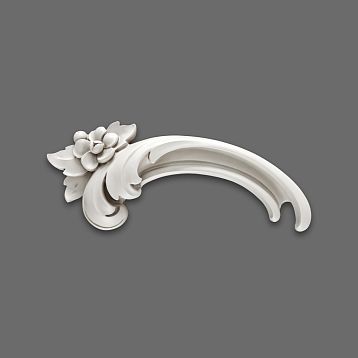
This section is for those who work with details.Carved wooden items occupy a special place in this regard. Wood carving not only emphasizes the aesthetics of a room but also gives it warmth, lively energy, and uniqueness. In modern interiors, carved elements are widely used due to their unique properties and adaptability to any style—from classic to minimalism.in the form of decorative overlays for moldings and profiles — are separate carved elements: rosettes, fleurons, corner blocks, center overlays, brackets. They are mounted on molding profiles or directly onto furniture and wall surfaces, creating ornamental accents at joints and in the center of planes.
Application: corner wooden overlays on framed cabinet fronts; decorative rosettes in the center of doors; fleurons at molding joints; center overlays on cabinets, consoles, mantel shelves. Each of these elements solves a task that would otherwise require expensive hand carving: the ready-made part is simply glued in place.
Furniture handles: tactile contact with furniture
The handle is the first thing you touch when opening a cabinet or drawer. That's why the material of the handle is felt more acutely than the material of the front: the tactile contact is direct and regular. A wooden handle is warm, and that's a physical fact: wood has low thermal conductivity and does not 'draw heat' from the hand, unlike metal.
Wooden handles in the STAVROS assortment — turned, carved, in button or pull form, for screws or with self-tapping screws. They suit furniture in eco-style, Scandinavian interiors, classic styles. Handles made of oak are especially expressive: the dense structure and pronounced grain make each handle a standalone mini-object.
Staircase components
A staircase in a house is one of the most complex design objects. It requires solutions for balusters, newel posts, handrails, sub-baluster rails, wooden support posts. Each of these elements carries both structural and decorative load.
In the sectionof solid woodinclude turned balusters 900 mm high, posts with square and round cross-sections, handrails of various profiles. Oak balusters are the most durable option for residential staircases with intensive use: a child holding onto the railing for years will not damage the surface of this wood.
A fundamental point when designing a solid wood staircase: all elements must be from the same species and the same batch. Oak from different batches can vary in color and structure, and after applying oil or varnish, these differences will become noticeable. That's why ordering a complete set of balusters, handrail, and posts from one manufacturer is a professional's rule.
Frames and table bases
Wooden frames and table bases — the structural foundation for tables and benches, which in itself is a decorative element. An exposed wooden table base structure made of oak is already a statement: industrial style with a warm material, loft with natural texture, Scandinavian style with natural grains.
STAVROS table bases — assembled structures made of solid oak or beech: a central crossbar, two support blocks, connecting hardware. They are supplied disassembled and mounted under a tabletop of any material: wood, MDF, glass, stone.
Rosettes, capitals, pilasters, and columns
This is architectural decor in its pure form. Wooden rosettes — flat carved elements of round or rectangular shape — are mounted on walls, ceilings, furniture fronts as standalone decorative accents. Solid wood capitals — the tops of wooden columns and pilasters, executed in Doric, Ionic, or Corinthian order.
A wooden oak capital, installed on a half-column in the wall space between living room windows — this is an architectural detail you usually see in interiors costing several million rubles. But the principle works with any budget: the part itself costs a few thousand rubles, while the effect is expensive and finished.
Wooden house carving
Carved window casings, cornice bands, brackets, balusters for facades — this entire category forms a separate, powerful section.House CarvingSolid pine is used for decorating the facades of country houses, saunas, and gazebos. Pierced window trims create an effect of wooden lace on windows, brackets support the cornice overhang, and SNL-series connecting elements cover the joints.
Mirror frames, church utensils, home goods
The STAVROS range also covers specialized categories: wooden mirror frames in classic and modern styles; church utensils made of oak and birch; cutting boards, plates, and bowls made of natural wood. This is an example of how widely solid wood products can be applied: from high-end interior tasks to everyday household items.
The difference between solid wood and MDF, plywood, and veneer — why it matters
MDF: a convenient compromise with a limit
MDF is medium-density fiberboard. It is inexpensive, mills well, holds paint, and has no knots or defects. Profiles for moldings are cut perfectly on it. All of this is true. But there is another side.
MDF is pressed fibers with a binder. Near water, it swells and does not recover. Under point loads (a screw into the end), it delaminates. Under prolonged load exposure, it deforms. The service life of an MDF part under moderate humidity and standard use is 10–15 years. A solid oak part — 50–100 years with basic care.
The difference is especially noticeable for load-bearing structures: furniture legs, stair balusters, handrails — these are not made from MDF. For decorative wall overlays inside dry rooms, MDF is quite suitable. But for any part that bears a load or operates under variable humidity conditions — only solid wood.
Plywood: a structural material, but not decorative
Plywood is sheets of veneer glued with perpendicular grain directions. It is strong and stable — stronger than solid timber, all else being equal. It is used for making furniture carcasses, bed bases, and structural panels. But as a decorative material, plywood is limited: it has a visible 'layered' edge that needs to be concealed.
For productiondecorative elements— for turned legs, carved decor, capitals, window trims — plywood is unsuitable: it cannot be turned on a lathe and mills with edge splintering. It is exclusively a structural material, not a competitor to solid wood in the decorative sector.
Veneer: beauty without depth
Veneered furniture is MDF or chipboard with a thin layer of natural wood (0.6–2 mm) on the surface. It looks like solid wood: the same texture, the same tone. But this is an illusion. Veneer cannot be sanded during restoration — the layer thickness does not allow it. It is vulnerable to chipping on edges and corners. It does not 'breathe' like solid wood — beneath it are the binders of MDF or chipboard.
Veneer is an honest solution where beauty is needed on a limited budget for flat surfaces. But for parts requiring durability, volumetric form, and the ability to be restored — only solid wood.
Why solid wood costs more — and why this difference is justified
Wood grows slowly. Oak reaches a diameter suitable for processing in 80–120 years. This is not raw material produced in a factory — it is a natural material with a limited resource. This is precisely what explains the price difference between a product made of solid oak and a similar one made of MDF.
But the price is not just about raw materials. It's about technology: proper kiln drying of the wood to 8–10% moisture content (if violated, the product will crack); precise machining with tolerance adherence; hand sanding of the surface. All of this — time and craftsmanship — is factored into the cost.
The final argument is simple: a solid oak product, with proper use, will outlast several renovations. MDF will not. When calculated over its service life, the price difference is significantly smaller than it seems at first glance at the price tag.
Wood species: oak, pine, beech, birch — characteristics
Oak: an aristocrat with a hard character
Oak is the undisputed leader in application in furniture and decorative production among all hardwood species. Hardness on the Janka scale — about 5,800 N: this is roughly twice as hard as birch and three times as hard as pine. What does this mean in practice? An oak surface does not dent or scratch under moderate mechanical impact. A furniture leg made of oak will not get dents from accidental bumps for years.
The texture of oak is pronounced, with clear vessels and rays. With the proper cut (radial), the pattern becomes mirrored, with characteristic ray sparkles — the 'silk' of oak. This is one of the reasons why oak products are valued higher than beech ones: the visual expressiveness is incomparable.
Oak takes stains and oils well, retaining its pattern when tinted. It is resistant to rot and mold under moderate operating conditions. The only significant nuance: contact with iron on unfinished oak causes bluish or black stains — a reaction of tannins with metal. Therefore, stainless steel or brass fasteners are needed when installing oak parts.
Beech: precision and uniformity
Beech — a species loved by technologists. Its structure has almost no pronounced pattern — it is uniform, fine-grained, without sharp contrasts. This is ideal for turned parts: a beech leg under solid enamel looks flawless because there is no prominent grain that would 'show through' the paint.
The hardness of beech is about 3,500–4,000 N: less than oak, but noticeably more than softwoods. It bends well when steamed — this is why beech has historically been used for Vienna chairs and bentwood furniture.
Beech is less resistant to humidity than oak: it swells more intensely with direct contact with water. For exterior applications, beech requires reliable moisture protection. For interior products — it is optimal.
Pine: the workhorse of woodworking
Pine is a soft coniferous species, the most affordable material in the lineup. It is used for products where budget is important or where wood hardness is not critical:House Carvingwindow trims, cornice strips, decorative elements.
The main advantages of pine: ease of processing (cuts, turns, mills with minimal resistance), high resin content (natural protection against rot, especially valuable for facade products), beautiful grain with pronounced annual rings.
Main drawback: softness. Pine surfaces scratch easily upon mechanical contact and dent. For products requiring abrasion resistance — balusters, steps, furniture legs — pine is unsuitable. For decorative facade applications — it's ideal.
STAVROS uses knot-free and resin-pocket-free glued pine panels forcarved casings. Gluing eliminates the main issues of solid pine timber: knots are cut out during panel assembly, resin pockets are excluded. The result — a stable product without defects.
Birch: strength in the affordable category
Birch is a hardwood species with hardness higher than pine and close to beech. Its grain is fine and uniform, practically without pronounced texture. This makes birch a good material for products intended for solid-color painting.
Birch does not tolerate outdoor conditions well: it is not resistant to fungi and darkens quickly when wet without coating. Therefore, birch products are exclusively for interior use. Traditionally, birch is used for turned handles, small decorative elements, blanks for lathe work.
Comparative table of wood species
| Species | Hardness | Moisture resistance | Grain | Application |
|---|---|---|---|---|
| Oak | High | High | Pronounced, beautiful | Legs, balusters, handrails, steps |
| Beech | Medium | Medium | Fine, uniform | Legs for painting, turned parts |
| Spruce | Low | Medium (due to resin) | Broad, with rings | Casing, decor, facade elements |
| Birch | Medium | Low | Fine, neutral | Handles, small overlays |
Areas of application: furniture, stairs, decor, finishing
Furniture production: foundation and accent
Solid wood products in furniture production are divided into structural and decorative. Structural — these are legs, under-table supports, frames: they bear the load. Decorative — handles, overlays, moldings on facades, carved details: they define the style.
For a small furniture enterprise or workshop producing 50–200 items per month, purchasing ready-made wooden legs and decorative parts from a manufacturer is significantly more profitable than having in-house lathe and milling production. Machine, setup technician, material consumption, defects — all this adds up to a cost that a ready-made leg from the STAVROS catalog covers two to three times over.
For private craftsmen and designers — a catalog of over 130 furniture leg models and more than 4,000 decorative element items covers practically any need without the necessity for custom orders.
Stairs: where safety meets beauty
A wooden staircase in a house is an expensive and long-term project. The average budget for an open wooden staircase with balusters, handrails, and finished steps — from 300,000 rubles. In this budget, the quality of wooden elements — balusters, handrails, posts — is critically important.
A baluster cracked after a year due to improper wood drying or poor gluing — is not just an aesthetic problem. It's a safety issue, especially when it concerns railings that children and elderly people lean on. That is precisely why kiln drying to 8–10% moisture content — is not an option, but a basic requirement for the material for stair elements.
All STAVROS products undergo kiln drying under controlled conditions: temperature 20–24°C, air humidity not less than 40%. This ensures product stability during further processing and in operation — without cracks, without deformations.
Facade decor: beauty on the outside
House Carving— is an independent and important area of application for solid wood products. Carved window casings on a country house, wooden brackets under a cornice, fretwork bands on a pediment, carved balusters on a veranda — all this creates the image of a house long before a guest steps inside.
For facade products, not only aesthetics matter but also technology: the right wood species, proper drying, and correct coating. Knot-free laminated pine architraves — the STAVROS standard — maintain their shape outdoors without cracking, provided that a facade antiseptic and paint coating are applied.
Interior decor: from walls to ceiling
Woodendecorative elementsFor interiors — moldings, rosettes, capitals, wooden mirror frames — create the architectural character of a space. In classic interiors, wooden moldings frame door portals, divide walls into zones, and create frames on furniture facades.
Wooden decor in interiors is an alternative to polyurethane molding where the tactile 'liveliness' of the material is important. Wood feels warm and is 'more alive' than polyurethane — that's why in interiors emphasizing naturalness (eco-style, Scandinavian style, rustic, organic), wooden moldings and overlays are preferable to polyurethane ones.
How to order carved decorative elements from solid wood
Define the task before choosing a model
A professional approach to ordering wooden elements starts not with a catalog, but with a technical specification. Answer four questions:
-
Wood species: oak (maximum strength and decorativeness), beech (turned parts for painting), pine (facade decor, elements with moderate load)?
-
Size: height and diameter (for legs and balusters), length and width (for trim and decor)?
-
Mounting type: threaded stud, mounting plate, dowel, screws?
-
Finish: without coating (self-painting) or with coating?
Answers to these questions narrow the selection from 4,000 items down to several dozen suitable positions — and make the choice simple.
Two quality levels: Standard and Prestige
STAVROS offers products at two quality levels: Standard and Prestige. This is a fundamental difference not in decorativeness, but in the quality of the source material and finishing.
Standard — products made from laminated panels with possible minor color inclusions and small surface defects that are eliminated during final painting by the customer. The optimal choice for solid painting.
Prestige — products made from selected material without color inclusions, surface defects, or noticeable seams. Undergo additional manual sanding. The optimal choice for transparent finishing (oil, varnish): the wood grain must be flawless.
Stock program and lead times
Most popular catalog items are part of the STAVROS stock program: shipping from 1 piece on the order day. This is a fundamental point for workshops and small manufacturers who work on specific orders without long-term planning.
For non-standard requests (custom size, non-standard model) — custom production. Lead times are specified by the manager depending on production load and order volume.
Delivery across Russia and CIS
STAVROS delivers across all of Russia and CIS countries via reliable logistics services. Products are packaged in protective packaging: wooden elements are fragile in terms of ends and relief surfaces, and proper packaging is part of the service.
FAQ: Answers to popular questions
Which wood species is better for furniture legs — oak or beech?
For products under transparent finishing (oil, varnish preserving texture) — oak: its grain is significantly more expressive. For products under solid painting — beech: its even structure provides a smoother surface under enamel.
Can I buy one leg, not a set?
Yes. STAVROS works from 1 piece in the stock program. This is fundamental for situations like 'one leg broke, need a replacement.'
How to determine the right size for a furniture leg?
Required leg height = desired seating height (for sofa/armchair) or top surface height (for table/cabinet) minus furniture frame height. For a sofa with a standard 280 mm frame and desired seating height of 450 mm, a 170 mm leg is needed.
Are solid wood products supplied with or without coating?
Most items are without coating. This is the standard for the professional market: furniture makers and craftsmen choose the finish themselves for a specific project. The surface is sanded and ready for any coating application.
Do wooden products need acclimatization before installation?
For large elements (posts, handrails, wide panels) — recommended. 2–3 days in the room where they will be used allows the product to absorb or release moisture to reach equilibrium. For small parts (legs, handles, overlays) — it's enough to avoid sudden changes: do not install immediately after winter delivery from cold transport.
Can you order carving based on an individual sketch?
STAVROS accepts custom orders for the development and production of non-standard decorative elements. For serial furniture manufacturers, this is an opportunity to create unique collectible legs or decor — exclusively for a specific product line.
What glue should be used for mounting wooden overlays on furniture?
Carpenter's PVA glue (D3 or D4 — moisture-resistant) — standard for wooden overlays on wooden bases. For mounting on MDF or chipboard — acrylic universal glue. For mounting on walls — water-based liquid nails + screws for fixation during setting time.
What is the difference between the 'Standard' and 'Prestige' levels?
Standard — for opaque painting: minor surface defects are covered by paint. Prestige — for transparent finishing: selected material, hand sanding, flawless surface that preserves the beauty of wood under transparent varnish or oil.
About the company STAVROS
Wood is not just a material. It's a choice of position: naturalness versus imitation, durability versus cheapness, character versus blandness. And when you make this choice — it matters who you make it with.
STAVROS is a manufacturersolid wood productswith a catalog of over 4,000 items and 20,000 modifications across 39 product groups. Furniture legs and supports made of oak and beech, stair balusters and handrails, decorative overlays and moldings, carved trims and house carving elements, frames and under-table structures, handles and capitals — all produced at one facility, under controlled conditions, with chamber wood drying and hand finishing sanding.
Two quality levels — Standard and Prestige — allow you to choose a product precisely for the task: for opaque painting or for transparent finishing that showcases the grain. A large stock program ensures shipment from 1 piece on the day of order. Delivery — throughout Russia and CIS countries.
STAVROS is a manufacturer that understands: a good wooden product lives longer than one renovation, and remembers every touch of the hand that made it.