












































































Article Contents:
- The Philosophy of an Interior Salon: More Than Just a Store
- What Makes a Decor Salon Special
- Decor Salon Assortment: From Classic to Avant-Garde
- Wooden Molding: The Foundation of Architectural Expression
- Staircase Elements: Function and Aesthetics
- Decorative appliqués: details that create character
- Furniture Legs and Supports: From Utility to Beauty
- Carved Panels and Rosettes: Art on the Walls
- Criteria for Choosing a Decor Salon: What to Look For
- Product Quality: Primary and Undeniable
- Assortment: Breadth and Depth
- Production Base: Control from Start to Finish
- Staff Expertise: Knowledge Instead of Ignorance
- Service and Support: Before, During, and After
- Interior Styles and Decor Selection: Harmony of Forms
- Classic: Symmetry, Proportions, Nobility
- Baroque and Rococo: Opulence and Theatricality
- Modern and Art Nouveau: Natural Lines and Asymmetry
- Scandinavian Style: Simplicity and Functionality
- Loft: industrial aesthetics
- Woodworking Technologies: From Blank to Masterpiece
- Wood Selection and Drying
- Primary Processing: Creating Blanks
- Profiling: Creating Shape
- Carving: Art and Craftsmanship
- Sanding: The Path to Smoothness
- Final finishing: protection and beauty
- Interior Decor Trends: What's Relevant Now
- Return to naturalness
- Mixing Styles
- Customization
- Technological Tradition
- Large Formats
- Color experiments
- Frequently Asked Questions About Choosing Decor
- STAVROS: 23 Years of Creating Perfection
- World-Class Production
- Assortment Covering Everything
- Individual Approach to Each Project
- Guarantees you can rely on
- Recognition from professionals and clients
- Philosophy of perfection

Have you ever noticed that some interiors stay with you forever, while others fade from memory just five minutes after you leave? What's the secret? Not in the square footage, not in the cost of the renovation, not in the latest trends. The secret is in the details. In those very elements that create the atmosphere, tell a story, and turn an impersonal living space into a home with character. And you can find these elements in a special place —Interior decor salon, where every piece carries a fragment of craftsmanship, tradition, and artistic vision.
What distinguishes a true interior salon from an ordinary hardware store? Why are some people willing to spend hours searching for the perfect baluster or carved overlay when a supermarket on the corner sells something vaguely similar for a third of the price? And most importantly — how can you tell if you're looking at a truly high-quality decor salon and not just another outlet selling mass-produced Chinese goods?
Let's dive in. Today we'll talk about what a real interior salon is, how it operates, how it differs from competitors, and why choosing the right decor supplier can radically change the outcome of an entire interior project. Because beauty is in the details, and the details are in the right hands.




The Philosophy of an Interior Salon: More Than Just a Store
You walk into a typical construction hypermarket — and you're lost. Kilometers of shelves, thousands of items, everything piled together. The consultants only know the SKUs but can't explain how an oak baluster differs from a pine one, other than the price. The atmosphere is that of a warehouse, not a space where ideas are born.
Interior decor salon— is a completely different story. It's not a warehouse with goods, but a creative workshop where every piece has meaning and context. Here you can not only buy a molding or a baluster but also understand how they will fit into your envisioned interior, what they pair with, and what visual effects they will create.




What Makes a Decor Salon Special
Curated approach to the assortment. In a true decor salon, there are no random items. Every single piece is selected with an understanding of its value and application. The owners of such salons are often designers themselves or people with an artistic background who have a keen eye for proportions, styles, and materials.
Expert consultations. A salesperson in an interior salon is not a cashier who scans items. They are an expert who can tell the story of each piece, explain the technology behind its creation, suggest application options, and warn about installation nuances. A good consultant asks questions: What is the interior style? What are the room dimensions? What is the overall concept? And only then do they offer options.
Visual presentation. Items in the salon aren't piled in boxes; they are displayed so you can appreciate their beauty and functionality. Moldings are mounted on stands in different combinations. Balusters are installed as they would be on a real staircase. Overlays are shown on furniture. You see not warehouse stock, but elements of a future interior.
An atmosphere of inspiration. It's pleasant to be in a good decor salon. Proper lighting that shows the pieces in their best light. Comfortable areas for discussing projects. Samples of different wood species you can touch. Albums with completed projects. This is a space where ideas are born.
Individual approach. A mass-market store sells what it has. A decor salon is ready to find, order, or manufacture exactly what you need. The size doesn't fit? They'll make another one. Need a rare wood species? They'll find and order it. Want a unique carved element based on your sketch? They'll organize the production.
Our factory also produces:



The Decor Salon Assortment: From Classic to Avant-Garde
Stepping into a professionalInterior decor salon, you'll discover a stunning variety of pieces. Let's systematize this wealth.
Get Consultation
Wooden Molding: The Foundation of Architectural Expression
Molding refers to long-length items that form the architectural framework of an interior. Baseboards, casings, moldings, cornices, glazing bars — all of this creates structure, rhythm, and completeness in a space.
In a decor salon, you'll find molding made from various wood species — from affordable pine to elite oak and exotic woods like wenge or teak. Each species has its own texture, color, and character. Oak is austere and monumental. Ash is light and elegant. Walnut is deep and noble. Choosing a wood species is not just a budget question, but a stylistic decision.
Molding profiles range from simple rectangular ones to complex multi-level ones with carved details. For classic interiors, moldings with rich relief, imitating stucco, are suitable. For modern ones — laconic strips with clear geometric lines. For eclectic styles — a combination of different profiles and textures.
Staircase Elements: Function and Aesthetics
A staircase is not just a way to get to the second floor. Done right, it's a sculptural object, a focal point of the interior, a work of art. And the key elements of a staircase — balusters, handrails, newel posts — define its character.
Wooden balusters made to order— is an opportunity to create a unique staircase that no one else will have. In a decor salon, you can choose from dozens of ready-made models or order custom fabrication based on your own sketch. Turned balusters with classic vase-shaped balusters. Carved ones with floral ornaments. Square minimalist ones. Combined ones, where turned elements are paired with carved inserts.
Author's carved balusters— are the highest level of craftsmanship. Each baluster is created by a master carver by hand. No stamping, only handwork where you can feel the artist's touch. Such balusters turn a staircase into an art object, becoming the pride of a home.
Handrails are no less important an element.Exclusive round moldingfits perfectly in the palm, provides a secure grip, and looks elegant. A 50 mm diameter is considered optimal for most staircases. But other sizes are possible — tailored to a specific structure and the users' anthropometry.
1,601.29 $
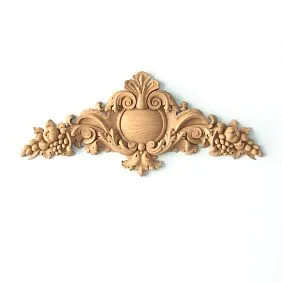
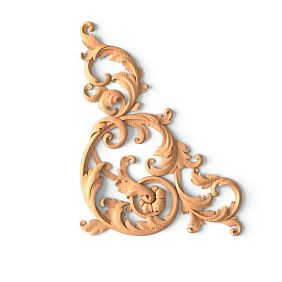
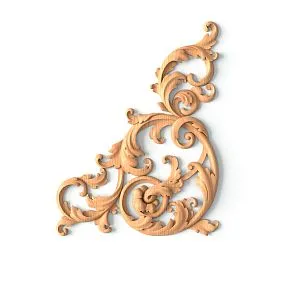
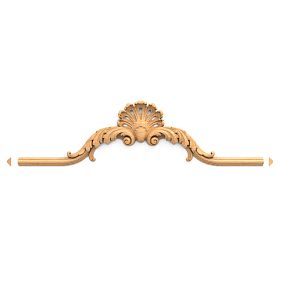
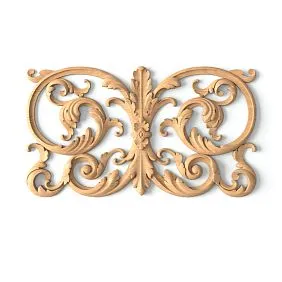
Appliqués are small carved elements that are glued or screwed onto the surface of furniture, doors, or wall panels. Rosettes, corner pieces, central elements, garlands, monograms — all of these are part of the arsenal for creating unique decor.
The decor salon features appliqués in various styles. Baroque with lavish scrolls and cupids. Classical with symmetrical floral patterns. Empire with military attributes and laurel wreaths. Art Nouveau with flowing plant lines. Modern with geometric abstractions.
Appliqués can be miniature — just a few centimeters for pinpoint accents, or large — up to a meter or more for decorating the central parts of furniture facades or wall panels.
Furniture legs and supports: from utility to beauty
Legs for tables, cabinets, dressers, sofas — seemingly purely functional elements. But in an interior salon, you'll discover that a leg can be a work of art.
Turned legs with classic profiles — balusters, vases, goblets. Carved with floral or geometric patterns. Curved cabriole legs in the Rococo style. Lion or eagle paws for palace furniture. Conical minimalist legs for modern interiors.
Height, diameter, shape, wood species, type of finish — all of this can be selected and combined. Replacing the legs on old furniture is the easiest way to transform it. And in the decor salon, you'll find thousands of options for experimentation.
Carved panels and rosettes: art on walls
For those who want to turn a wall or ceiling into an artistic canvas, decor salons offer carved panels. These can be geometric patterns, floral compositions, narrative scenes, coats of arms, monograms.
Carved rosettes are installed on the ceiling around a chandelier, emphasizing the center of the composition. They can be round, oval, polygonal, with varying degrees of relief — from flat to deeply carved, creating a play of light and shadow.
Such elements are made from solid wood or high-density fiberboard, then sanded, primed, painted, or patinated. Each rosette or panel is a small masterpiece requiring dozens of hours of work.
Criteria for choosing a decor salon: what to look for
There are many salons and stores offering decorative products. How to avoid making a mistake in your choice? What criteria should be used for evaluation?
Product quality: primary and indisputable
Quality is where everything begins. Pick up a baluster or molding. The surface should be perfectly smooth, without burrs, tears, or unevenness. The geometry should be precise — if it's a square profile, the corners should be exactly 90 degrees. If it's a carved element — every detail should be clear, without blurriness.
Wood moisture content is critical. Over-dried wood is brittle and cracks. Under-dried wood warps after installation. A professional salon controls moisture content; it should be 8-12% for products to be installed in heated rooms.
The wood species must match the stated one. Unfortunately, there are cases where cheap pine is passed off as valuable oak by staining it with wood stain. You can check by weight (oak is significantly heavier), by texture (oak has pronounced large pores), by smell (pine smells of resin).
The finish — varnish, oil, wax — should be applied evenly, without drips, bubbles, or missed spots. A good finish is not only beautiful but also protects the wood from moisture, dirt, and mechanical damage.
Assortment: breadth and depth
A good decor salon offers not a dozen items, but hundreds and thousands. A variety of wood species, profiles, sizes, styles. This provides the opportunity to find exactly what is needed for a specific project, without compromising.
But the breadth of the assortment should be combined with depth — the availability of different sizes, processing options, and the possibility of ordering modifications. If a salon only has one size of baseboard, this indicates its limitations.
Pay attention to the availability of rare, exclusive items.Shop of very rare interior decordistinguishes itself by offering not only mass-produced items but also unique ones — hand carving, products made from exotic wood species, author's collections. The presence of such an assortment speaks to the salon's seriousness and its connections with craftsmen and manufacturers.
Production base: control from start to finish
The ideal scenario is when an interior salon has its own production or is closely linked to a manufacturer.Factory of interior decor, working directly with the salon, provides several advantages.
First, quality control at all stages. The manufacturer is interested in reputation, monitors every detail, and does not allow defects. Second, flexibility — the ability to produce non-standard sizes, modifications, exclusive items based on individual sketches. Third, reasonable prices — the absence of a long chain of intermediaries reduces markups.
Ask the salon where the products are manufactured. If it's Russia — excellent, you support domestic production and get quality adapted to our climate and operating conditions. If it's Europe — also good, European standards are high. If it's China — be cautious, the quality of Chinese products is extremely unstable, ranging from excellent to frankly poor.
Staff expertise: knowledge instead of ignorance
A consultant in an interior salon should be an expert, not just a salesperson. Ask a few questions: how does oak differ from ash? what molding profile is suitable for a classic interior? how to properly install balusters? what finish is better for damp rooms?
A good consultant will provide a detailed, knowledgeable answer, possibly showing samples, catalogs, or making a sketch. A bad one will start mumbling, offering 'everything good,' and steer the conversation towards prices.
A professional salon invests in staff training. Consultants regularly take courses, attend exhibitions, familiarize themselves with new products, and communicate with designers and architects. This makes them competent advisors.
Service and support: before, during, and after
A good decor salon doesn't just sell a product but accompanies the client through all stages. Assistance in selection, calculation of required material quantities, installation consultations, contractor recommendations, after-sales support.
The availability of delivery services is critical. Wooden products are often large and heavy, making self-transport difficult. A professional salon offers delivery via its own transport or through trusted logistics companies with cargo safety guarantees.
The possibility of returns and exchanges is an indicator of the salon's confidence in product quality. If a salon is willing to accept back an item that doesn't fit in size or color (provided it hasn't been used), it speaks to customer-centricity.
Interior styles and decor selection: harmony of forms
Decor should match the interior style. A Baroque carved molding in a minimalist apartment will look absurd, as will a simple plank in a classic mansion. Let's explore which decor suits the main styles.
Classic: symmetry, proportions, nobility
Classic interiors requirepremium wooden decorclass. Here, saving and compromises are inappropriate. Choose noble species—oak, walnut, mahogany. Molding profiles are complex, multi-level, with floral ornaments. Balusters are turned or carved, symmetrical, with classic proportions.
The color palette is restrained: natural wood shades from light honey to dark chocolate. Glossy varnish or patination for an antique effect is possible. Overlays with classic ornaments—acanthus leaves, rosettes, monograms.
Baroque and Rococo: opulence and theatricality
If classic is restrained, then Baroque and Rococo are a celebration of form. There's no such thing as too much decor here. Carved panels covering entire walls, large ceiling rosettes, abundant gilding, the most complex molding profiles with numerous curls and protrusions.
Balusters turn into sculptures—cupids, atlantes, caryatids. Furniture legs are curved in whimsical cabrioles. Overlays are voluminous, theatrical, with an abundance of details. All this requires the highest skill of carvers, and such products can only be found in specialized salons.
Modern and Art Nouveau: natural lines and asymmetry
Modern rejects right angles and symmetry in favor of flowing plant lines. Moldings curve in waves, balusters resemble plant stems, overlays imitate flowers, leaves, dragonflies, birds.
Modern is characterized by exotic wood species with pronounced texture. Treatment emphasizes the material's naturalness—oils instead of varnish, minimal coloring. Carving is shallow, relief, creating a play of light and shadow.
Scandinavian style: simplicity and functionality
Scandinavia loves light wood—birch, ash, bleached pine. Minimal decor, every element is functional. Moldings are thin, with a simple profile. Balusters are square or rectangular in cross-section, without embellishments. Overlays are absent or extremely laconic.
But simplicity doesn't mean cheapness. Scandinavian decor requires perfect execution quality, flawless geometry, meticulous sanding. Every plank must be perfect because there's no hiding behind an abundance of details.
Loft: industrial aesthetics
Loft uses wood as a contrast to concrete, metal, brick. Wooden decor is deliberately rough—boards with unfinished edges, brushed texture, natural knots and cracks. Moldings are simple, often just rectangular planks. Balusters are thick, massive, square in cross-section.
Colors are dark or, conversely, bleached. An aging effect is often used—wear, traces of time, uneven coloring. But this apparent carelessness requires skill—creating controlled carelessness is harder than perfect smoothness.
Woodworking technologies: from blank to masterpiece
To appreciate products from an interior salon, it's useful to understand how they are created. The process of making wooden decor is a complex multi-stage technology requiring experience, equipment, and patience.
Selection and drying of wood
Everything starts with raw material selection. The wood must be of high quality—without rot, cracks, extensive knots. For decor, select parts of the trunk with uniform texture and color are used.
After sawing, the wood undergoes drying. Natural air drying takes months and years but yields the best quality. Kiln drying is faster—several weeks—but requires precise control of temperature and humidity, otherwise the wood may crack or warp.
The goal is to reduce moisture to 8-12%. At this moisture level, the wood is stable, doesn't shrink or swell with changes in indoor air humidity.
Primary processing: creating blanks
The dried wood is cut into blanks of the required sizes. For moldings, these are long planks. For balusters—square-section blocks. For overlays—thin boards.
Blanks are planed to obtain smooth surfaces. Thickness planers and jointers are used — machines that provide accuracy down to tenths of a millimeter. The quality of planing determines how easily the products will be installed.
Profiling: creating shape
For moldings, handrails, and other products with complex profiles, milling machines are used. A milling cutter is a cutting tool that rotates at high speed and removes wood, creating the desired shape.
Each profile requires its own milling cutter. Decorative manufacturers have dozens and hundreds of cutters, allowing them to create a variety of shapes. Modern CNC machines are computer-controlled, ensuring the highest precision and repeatability.
For round products — balusters, legs, handrails — lathes are used. The workpiece rotates, and the cutting tool removes excess wood, creating a cylindrical shape with various thickenings, thinnings, and grooves.
Carving: art and craftsmanship
Carved elements are the pinnacle of woodworking art. Here, a computer cannot replace the hand of a master. The carver works with special chisels of various shapes, gradually removing wood, creating three-dimensional forms.
There are several types of carving. Bas-relief — the pattern protrudes slightly above the background. Sunken relief — the background remains at the surface level, the pattern is recessed. Openwork (pierced) — the background is completely removed, leaving only the pattern. Sculptural (three-dimensional) — three-dimensional forms are created.
A good carver requires years of training and practice. They feel the wood, know how it will behave when carved in different directions, how to achieve the desired depth and clarity of details. Author's carving is highly valued because each piece is unique.
Sanding: the path to smoothness
After primary processing, the product undergoes multi-stage sanding. First, coarse sanding — with coarse-grit abrasive to remove obvious irregularities. Then medium — with finer abrasive. Final — with the finest sandpaper, bringing the surface to a silky smoothness.
Sanding carved elements is especially difficult — every curve, every recess must be treated without smoothing out the details. This is delicate manual work requiring patience and attention.
Final Finishing: Protection and Beauty
Untreated wood is beautiful but vulnerable. It absorbs moisture, dirt, and changes color. Therefore, finishing is mandatory.
Staining — applying stain, which penetrates the wood and changes its color, emphasizing the grain. You can make pine look like oak, give the wood a warm or cool shade, or create an aged effect.
Varnishing — applying varnish, creating a protective film. Varnishes can be glossy (giving shine), matte (without shine), or semi-matte. Varnish protects against moisture, scratches, and dirt. Applied in several layers with intermediate sanding.
Oils and waxes — penetrate the wood, preserving its tactile feel and breathability. The surface remains natural to the touch but protected. Oils and waxes require periodic renewal.
Patination — creating an aged effect. Light paint or wax is applied to protruding parts, creating wear. The result is the feeling that the product has been in use for decades.
Painting — completely changing the color. Opaque paints — enamels or acrylic compositions — are used. Painting allows wooden decor to fit into any interior color scheme.
Interior decor trends: what's relevant now
The world of design is constantly evolving. New trends emerge, forgotten techniques return, and classic solutions are reinterpreted. What's relevant in interior decor today?
Return to naturalness
Tired of plastic and synthetics, people are returning to natural materials. Wood in interiors is not just beautiful; it's eco-friendly, healthy, and creates a special atmosphere. Emphasizing naturalness is relevant — natural shades, visible grain, minimal processing.
Style mixing
Pure styles are fading. Eclecticism is taking over — a thoughtful mix of elements from different eras and directions. Classic molding in a modern minimalist interior. Loft roughness softened by elegant carving. This requires refined taste and knowledge of proportions, but the result is impressive.
Customization
Mass production has become tiresome. People want uniqueness. Ordering products according to individual sizes and sketches is becoming the norm. Monograms on carved panels, non-standard baluster sizes for a specific staircase, unique molding profiles — all of this is in demand.
Technological tradition
Modern technology allows the creation of what was previously impossible or prohibitively expensive. CNC machines cut the most complex parts with micron precision. 3D modeling allows seeing the result before production begins. Yet, respect for manual labor remains — author's carving, individual fitting, piece-by-piece assembly.
Large Formats
Large, noticeable decorative elements are in fashion. Wide baseboards 150-200 mm high. Massive ceiling cornices. Large carved panels covering an entire wall. This requires high ceilings and large areas but creates an impressive effect.
Color experiments
Wood doesn't have to be brown. Painting in unexpected colors is relevant — gray, black, white, pastel shades, even bright accent colors. The main thing is quality execution and alignment with the overall interior concept.
Frequently asked questions about choosing decor
How to calculate the required amount of materials?
For trim, measure the perimeter of the room, the length of all walls where molding or baseboard will be installed. Add 10-15% for cutting and possible errors. For balusters, calculate the length of the handrail and divide by the installation spacing (usually 15-20 cm between balusters). An interior salon will assist with calculations.
Can I combine different types of wood?
Possible, but with caution. The contrast should be well-considered. A light wood species paired with a dark one looks interesting. But three or four different species mixed haphazardly will create chaos. The general rule is no more than two species in one room, and they should be stylistically connected.
How to care for wooden decor?
Regular dry cleaning with a soft cloth or brush. Once a month, wipe with minimal water. For lacquered surfaces, use special polishes. For oil-wax finishes — periodic renewal of the coating. Avoid aggressive chemicals, abrasives, and excessive moisture.
How long does it take to make custom decor?
Depends on complexity. Simple custom-sized trim — 1-2 weeks. Carved balusters — 3-4 weeks. Large carved panel based on an individual sketch — 2-3 months. Check the deadlines at the salon and allow extra time.
Wood or polyurethane — which to choose?
Wood is natural, warm, noble, but more expensive, heavier, and more demanding in care. Polyurethane is more affordable, lighter, not afraid of moisture, but lacks the natural warmth and texture of wood. The choice depends on budget, interior style, and operating conditions. In classic interiors, wood is preferable. In modern and humid environments — polyurethane.
Is it possible to install wooden decor yourself?
Yes, if you have basic tool skills. Installing moldings and baseboards is accessible to most. Installing balusters requires precision and experience. Installing large carved elements is better entrusted to professionals — the cost of a mistake is too high.
How to check product quality when purchasing?
Visually inspect for cracks, knots, and unevenness. Run your hand over the surface — it should be smooth. Check the geometry — straight lines should be straight, corners should be right. Smell it — there should be no chemical odors (a sign of poor-quality coating). Check the wood moisture content — it should be 8-12%.
What to do if the product is damaged during transportation?
Immediately document the damage — take photos upon receipt from the transport company or courier. Contact the salon — professional companies insure shipments and compensate for damages. Do not attempt to repair it yourself before resolving the issue — this may be considered damage by the buyer.
STAVROS: 23 years of creating perfection
When it comes to a professionalinterior decor salon, where quality is not just declared but is the foundation of the company's philosophy, it is impossible not to mention STAVROS. This is not just a store or a factory. It is a true dream factory where products are born that can transform any space.
STAVROS has been in the interior decor market for 23 years. Almost a quarter-century of experience, accumulated knowledge, refined technologies, and established relationships with wood suppliers and partners. During this time, the company has evolved from a small workshop to one of Russia's leading manufacturers of wood and polyurethane decor.
World-class production
STAVROS is its own production facility, equipped with modern European equipment. Here, CNC machines ensure micron-level precision. Here, carvers with years of training create unique custom pieces. Every stage is controlled — from wood selection to packaging of the finished product.
The quality of STAVROS products meets world standards. The company works not only with Russian clients but also exports products to Europe and Asia. International recognition is the best confirmation of its class.
An assortment covering everything
The STAVROS catalog features thousands of items. All types of wooden trim — baseboards, casings, moldings, cornices, glazing beads. Staircase elements — turned and carved balusters, handrails, newel posts, risers. Furniture parts — legs, overlays, rosettes, panels. Polyurethane products imitating wood and stucco.
The variety of wood species is impressive. From affordable pine to premium oak, ash, walnut, beech. Exotic species available upon request. Various processing and finishing options — from natural color to painting in any RAL catalog shade.
Individual approach to each project
STAVROS understands that every interior is unique. Therefore, the company offers not only ready-made solutions but also custom manufacturing based on individual sketches. Need a baluster of a special shape? Draw a sketch, and the craftsmen will bring it to life in wood. Need a molding with a non-standard profile? They will create a cutter and produce the required number of linear meters.
For designers and architects, STAVROS is a reliable partner. The company participates in projects at the development stage, assists with visualization, consults on materials and technologies, and handles production and logistics. This allows the designer to focus on creativity without being distracted by production issues.
Guarantees you can rely on
STAVROS provides real guarantees. Defect-free product quality is not an advertising slogan but the result of multi-stage control. Each product is checked before shipment. If a defect is discovered (which is extremely rare), the company immediately replaces the product at its own expense.
A large stock program means most items are available from stock, without waiting for production. This is critical when renovation deadlines are tight. Adherence to production deadlines for custom items is another guarantee. STAVROS does not promise the impossible but delivers exactly what is promised on time.
Delivery is organized throughout Russia. From a single piece to a truckload. Moscow and the region receive orders via the company's own transport. Regions — through reliable transport companies with full cargo insurance.
Recognition from professionals and clients
STAVROS is a company that is trusted. Thousands of completed projects — from private apartments to palace interiors, from country houses to commercial spaces. STAVROS works with leading design studios, construction companies, and furniture factories.
Client reviews speak for themselves. High ratings on all platforms. Words of gratitude for quality, service, professionalism. Repeat business is the best indicator of satisfaction.
Philosophy of Perfection
For STAVROS, producing decor is not just a business. It's an art, a craft, a calling. Each piece is created with the understanding that it will become part of someone's home, will bring joy to people for years, and may even be passed down to future generations.
The company builds its work on reliability, responsibility, and a genuine pursuit of excellence. It does not chase quantity at the expense of quality. It does not skimp on materials or technologies. It does not compromise when it comes to reputation.
STAVROS is the choice for those who value true quality, understand the difference between mass production and artisanal work, and want to create an interior that will serve and delight for decades. It is a company that makes the world more beautiful, one interior at a time.
By choosing STAVROS, you choose reliability, proven by 23 years of operation. Quality, recognized by thousands of clients. An assortment that satisfies the most refined requests. Service that makes the purchasing process easy and pleasant. And most importantly — you choose a partner who shares your pursuit of excellence, understands the importance of details, and is ready to make every effort to ensure your interior becomes exactly as you dreamed it would be.
Because a beautiful interior begins with the right choice. With the choice of quality. With the choice of STAVROS.


