












































































Article Contents:
- Symbolism of fish in interior decor
- Fish as an element of the water element
- Movement and dynamics
- Carved wooden elements: technology and craftsmanship
- Choice of wood species
- Stages of creating a carved fish
- Application of marine decor in various interior styles
- Mediterranean Style
- Maritime (nautical) style
- Tropical style
- Scandinavian Style
- Loft
- Carved wooden balusters and marine theme
- Balusters with carving of marine elements
- Balusters as an element of maritime style
- Carved wooden molding: framing marine decor
- Molding with wave-like carving
- Molding with fish ornament
- Installation of decorative overlays with marine motifs
- Surface Preparation
- Marking
- Adhesive Selection
- Applying adhesive
- Pressing and fixing
- Painting and finishing of carved fish
- Preserving natural color
- Staining with wood stain
- Colored painting
- Patina and Aging
- Answers to popular questions
- Can carved wooden fish be used outdoors?
- What size of carved fish is optimal for interior?
- How many fish to place in one composition?
- Can wooden and polyurethane carved fish be combined?
- How to care for carved fish?
- Where to place carved fish in the interior?
- Can a carved fish be ordered according to one's own sketch?
- Conclusion: decor that breathes with the element
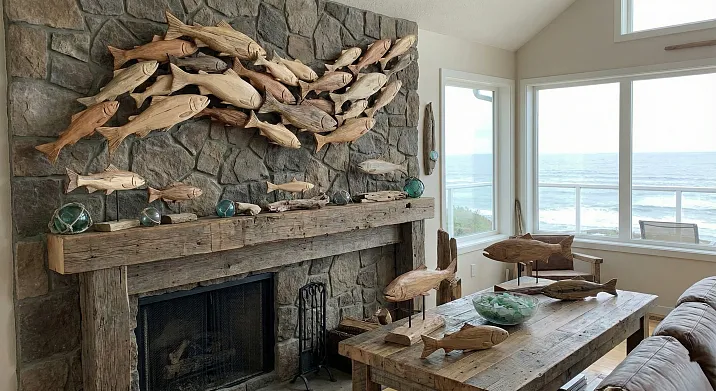
What makes us stop before a certain interior and not just look, but peer, feeling that the space possesses its own soul? Not the furniture itself, not the color of the walls, not the lighting — but the details that tell stories.Interior decor sea fishmade of wood is not just decoration; it is a visual code speaking of the element of water, of freedom, of movement, of depth. A carved fish on a wall, furniture facade, or door panel transforms an interior from a set of functional items into a space with mood, character, and philosophy.
The marine theme in interiors is as ancient as civilization itself. Phoenicians adorned their homes with images of fish—symbols of fertility and wealth. Romans used mosaics with dolphins. Medieval craftsmen carved sea monsters on wooden panels. But if in the past this was the privilege of sailors, merchants, and aristocrats living by the coast, today everyone can introduce a marine motif into their home—throughhandmade interior decorthat preserves the traditions of wood carving but is adapted to modern aesthetic requirements.


The symbolism of fish in interior decor
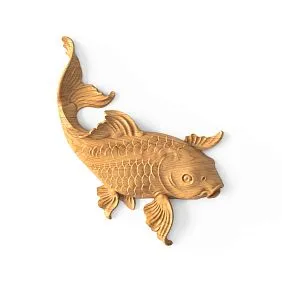
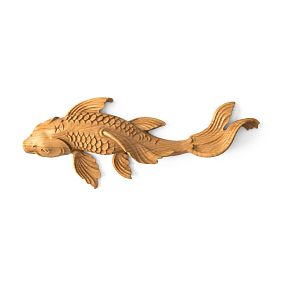
The fish is a universal symbol, understood in practically all cultures. In Christianity, the fish—ichthys—is a sign of Christ, a symbol of faith. In Buddhism, it is a sign of liberation, freedom from desires. In Chinese tradition, the fish (especially the carp) is a symbol of perseverance, overcoming obstacles, moving against the current. In European heraldry, the fish is a sign of abundance, wealth, fertility.
When you place a carved wooden fish in your interior, you are not just adding a decorative element—you are introducing symbolic weight that works on a subconscious level. A guest entering a room where a school of wooden fish swims on the wall reads the message: here lives a person who values movement, freedom, connection with nature. It is not an aggressive symbol (like predatory beasts), not heavy (like mythological figures), but light, smooth, calming.




Fish as an element of the water element
Water is one of the primary elements, associated with emotions, intuition, fluidity, adaptability. An interior saturated with aquatic motifs (sea wave colors, blue, turquoise tones, images of fish, waves, corals) creates an atmosphere of relaxation, meditation, rest. This is especially relevant for urban apartments, where people are overloaded with information, stress, and bustle. The water element in an interior is a way to return to primordial peace.
Wooden decorative stickersin the shape of fish work as visual anchors that attract the gaze, slow down perception, create a pause. The eye, gliding over the fish, stops, follows the curve of the fins, the texture of the scales—and the brain receives a signal: 'Here you can rest.'
Our factory also produces:


Movement and dynamics
A static interior is an interior without life. A carved fish, even when motionless, creates an illusion of movement. The curve of the body, the turn of the head, the flowing tail—all these are directional lines that guide the gaze, create dynamics. If you place several fish moving in one direction, an effect of a school, a moving flow, a river of life arises.
Designers use this technique to enliven empty walls, create accents in minimalist interiors where there is little furniture and decor. Three to five carved fish on a white wall—and the space gains character, ceases to be faceless.
Get Consultation
Carved wooden elements: technology and craftsmanship
A carved wooden fish is not mass-produced, not a machine-made trinket (though modern technologies are used). It is the result of a complex multi-stage process where technique meets artistic vision.
Choice of wood species
For carving fish, wood species with different hardness and texture are used, depending on the style and size of the product.
Linden—a soft hardwood, ideal for fine, detailed carving. Density 450–500 kilograms per cubic meter, texture fine-grained, uniform. Linden cuts easily, does not chip, holds the smallest details—individual scales 2–3 millimeters in size, thin fins a millimeter thick. Color white, slightly creamy. Linden was traditionally used for icon painting, church carving—where maximum detail was required.
Oak—hard wood, difficult to carve, but durable and expressive. Density 700–900 kilograms, texture coarse, with pronounced medullary rays. Oak is suitable for large fish (from 30 centimeters), where massiveness, weight, solidity are important. Carving on oak is coarser than on linden, but noble, masculine.
Beech—medium hardness, density 650–750 kilograms. Texture uniform, pinkish hue. Beech cuts well, holds details, is easily stained. For fish sized 15–30 centimeters, beech is the optimal choice: strong enough to withstand thin elements, pliable enough for carving.
Ash—hardness like oak, but texture more dynamic, striped. Ash emphasizes movement, flow—the wood grain itself creates an illusion of water streams. For fish in a modern style, where graphic quality and contrast are important, ash is ideal.
Stages of creating a carved fish
Sketch and model. The artist draws a sketch of the fish: side view, proportions, details. If the carving is complex, a three-dimensional model is created in CAD programs. The model allows viewing the object from all sides, working out details not visible in a flat sketch.
Workpiece preparation. A board or block of the required thickness (depending on the relief of the carving: flat carving—15–25 millimeters, three-dimensional—40–60 millimeters) is cut out along the fish contour. The contour is applied using a template or drawn by hand.
Rough carving. The master or a CNC machine removes excess wood, forming the general volume: the fish's body, head, tail, fins. At this stage, the basic shape without details is created.
Detailed carving. Details are worked out: scales (each scale is carved separately or texture is created using special chisels), fins (veins, rays), eyes (relief or recessed form), mouth, gills. The higher the class of the product, the more details.
Sanding. The carving is sanded with sandpaper of different grits: from coarse (grit 80–120) to remove large irregularities to fine (grit 220–320) to create smoothness. Not everything is sanded—the recesses of the carving may remain unsanded, creating a contrast of textures.
Finishing. The fish is coated with oil, wax, varnish, or stain. The choice depends on the desired effect: natural wood color, staining to resemble valuable species, colored painting (imitation of real fish—golden, silver, multicolored).
Application of marine decor in various interior styles
A carved fish is a versatile element that adapts to different styles.
Mediterranean Style
The Mediterranean is blue sea, white walls, terracotta roofs, olive groves. Mediterranean-style interiors are light, bright, and airy. Colors: white, blue, turquoise, sandy. Materials: wood, stone, ceramics, textiles (linen, cotton).
A carved fish in a Mediterranean interior is a natural accent. A wooden fish in its natural color or painted white, blue, or turquoise is placed on a white wall, creating a sense of lightness, as if it has just jumped out of the water. A group of fish of different sizes, swimming in the same direction, mimics a school—a typical scene of the Mediterranean coast.
Nautical style
Nautical style is the aesthetic of yachts, ships, and ports. Colors: blue and white stripes, red, wood tones. Elements: ropes, anchors, ship's wheels, compasses, nautical charts, ship models. Furniture is solid, wooden, often distressed.
In nautical style, a carved fish is an essential element. But not a delicate one—rather, a massive, somewhat rough one, as if carved by a ship's carpenter during long evenings in the cabin. The fish is made of dark wood (oak, walnut), with emphasized texture, minimal sanding, possibly with an aged effect (wear, cracks, patina). It is placed above a fireplace, on a plank wall, next to an anchor or ship's wheel.
Tropical style
The tropics are about brightness, vibrancy, and abundance. Colors: green, yellow, orange, turquoise, coral. Furniture made of rattan, bamboo, dark wood. Textiles with botanical and animal prints (palm leaves, parrots, exotic flowers).
A carved fish in tropical style is bright, colorful, imitating real tropical species: parrotfish, angelfish, butterflyfish. It is painted in saturated colors: yellow, orange, blue, green. It is placed against a brightly colored wall or among green plants, creating the effect of an underwater reef.
Scandinavian style
Scandinavia is about minimalism, functionality, light tones, natural materials. Colors: white, gray, beige, accents of blue, green. Furniture is simple, wooden, light (pine, birch, ash).
A carved fish in Scandinavian style is restrained, laconic, without excessive detailing. Silhouette carving: the contour of a fish with minimal details (eye, fins indicated but not detailed). Color: natural light wood or white. It is placed on a white wall as a graphic accent, creating a calm, meditative atmosphere.
Loft
Industrial aesthetic: brick, concrete, metal, rough wood. Colors: gray, black, brown, accents of rusty orange. Exposed utilities, high ceilings, large windows.
A carved fish in a loft is a contrast: an organic element against an industrial space. The fish is made of old wood (possibly ship's wood, with nails, cracks), aged, rough. Or, conversely, perfectly smooth, polished, made of dark wood, contrasting with the texture of concrete. It is placed as an art object, attracting attention with its otherness.
Carved wooden balusters and nautical themes
A staircase is a vertical focal point in an interior, especially in two-story houses, townhouses, and multi-level apartments.Carved wooden balusterscan incorporate nautical motifs, turning the staircase into an extension of the thematic decor.
Balusters with carved nautical elements
Traditional balusters are turned cylinders with a symmetrical profile. But in a nautical or Mediterranean interior, you can use balusters with carvings: waves, stylized fish, anchors, ropes. Such carving is more complex to produce, more expensive, but creates a unique character.
wood baluster manufacturingwith carving requires a highly skilled carver. The cylindrical surface of the baluster complicates the carving—the pattern must wrap around the form while maintaining proportions. The carving is done after turning: first, the basic shape is created on a lathe, then the carver applies the ornament.
Balusters as an element of nautical style
In a nautical interior, balusters can be stylized as ship elements: vertical posts with wraps imitating coiled ropes, bases in the shape of anchors. Such balusters are custom-made based on sketches.
For Mediterranean style, lighter, more elegant balusters are suitable, possibly painted white or blue. Nautical themes can be hinted at: delicate wave carving on the base of the baluster, a shell on the finial.
Carved wooden millwork: framing nautical decor
Carved wooden millworkis used for framing walls, ceilings, door and window openings. In an interior with a nautical theme, millwork can include carvings of nautical motifs: waves, stylized fish, seaweed, shells.
Millwork with wave-like carving
A classic technique is millwork with an ornament imitating a sea wave. The wave creates rhythm, movement, and fluidity. Such millwork is placed horizontally: around the perimeter of the ceiling, at the junction of wall and ceiling, along the wall at a height of 90–120 centimeters (creating a panel).
Wave-like carving can be deep (10–15 millimeters) or shallow (3–5 millimeters). Deep carving creates strong shadows, a dramatic effect. Shallow carving creates a delicate, barely noticeable relief that is perceived under side lighting.
Millwork with fish ornament
A more complex option is millwork where the repeating ornament consists of stylized fish. The fish can be realistic (with scales, fins) or simplified (silhouettes). The repetition creates a frieze—a decorative band characteristic of classical interiors (antiquity, Renaissance).
This type of molding is custom-made, requiring precise pattern repeatability and high-quality carving. It is placed in formal areas: living room, dining room, hallway.
Installation of decorative overlays with marine motifs
Installation of carved elements requires care and proper technique.
Surface preparation
The surface (wall, furniture front, door) must be flat, clean, and dry. Dust, grease, and moisture reduce adhesive adhesion. If the surface is painted with glossy paint, it should be lightly sanded with fine sandpaper (220 grit) to create roughness.
Marking
Before gluing, apply markings with a pencil. If placing several fish to create a composition, marking is critical: distances between elements, tilt angles, direction of movement. Asymmetry is acceptable (and often desirable—imitating natural chaos), but it must be deliberate, not random.
Adhesive selection
For wooden overlays on a wooden surface—moisture-resistant D3 class PVA wood glue. For painted, varnished, smooth surfaces—polyurethane or epoxy glue. For heavy, large fish—additional fastening with finishing nails or screws (heads are countersunk, filled, sanded).
Applying adhesive
Apply glue to the back of the overlay in a thin, even layer. Excess glue will squeeze out when pressed—it must be immediately removed with a damp cloth. Dried glue spoils the appearance and is difficult to clean.
Pressing and Fixation
The overlay is applied to the surface exactly according to the markings and pressed over the entire area. For light, small fish (up to 20 centimeters, weight up to 100 grams), pressing by hand for 30–60 seconds is sufficient. For medium and large ones—temporary fixation with painter's tape or clamps.
Glue setting time—from 30 minutes to 12 hours. The glue reaches full strength after 24 hours.
Painting and finishing of carved fish
After installation (or before it), carved elements are painted or coated with a protective compound.
Preserving the natural color
Clear oil or wax penetrate the wood, emphasize the texture, and create a matte or semi-matte surface. The wood color deepens and becomes richer. The texture is revealed to the maximum. This is the choice for interiors where naturalness is valued.
Clear varnish creates a protective film that is more resistant to wear. Varnish can be matte, semi-matte, or glossy. Glossy varnish on a carved fish creates a wet effect, as if the fish has just been taken out of the water—shiny, wet.
Toning with stain
Stain changes the color of the wood while preserving the visibility of the texture. Light pine or linden can be toned to resemble walnut, mahogany, teak. This allows creating imitations of tropical fish with dark coloration.
Stains can be water-based, alcohol-based, or oil-based. For carving, oil-based or gel stains are better—they do not raise the grain, apply evenly, and do not run into the carving recesses.
Colored painting
If a bright colored fish (tropical style) is needed, acrylic paints or enamels are used. The wood is primed, then painted. Gradients, color transitions imitating real fish coloration can be created.
Realistic painting requires artistic skills: scales are painted in several shades to create volume, fins are semi-transparent with veins. Such work is done by hand with fine brushes.
Patina and aging
For a marine or rustic style, patination is used: a contrasting paint (white, gray, green—imitating oxidation, salt, algae) is applied to the painted surface and rubbed into the carving recesses, creating an aged effect, as if the fish has hung on a ship for many years, washed by splashes.
Answers to Popular Questions
Can carved wooden fish be used outdoors?
Wood is afraid of moisture, sun, and temperature fluctuations. For outdoor use, wood must be treated with a moisture-proof compound (yacht varnish, oil with UV filters) and regularly renewed (every 1–2 years). An alternative is polyurethane overlays imitating wood—they are moisture-resistant, do not fade, and do not deform.
What size of carved fish is optimal for an interior?
Depends on the scale of the room. For small rooms (bedroom, children's room)—fish 15–30 centimeters. For spacious ones (living room, hallway)—40–80 centimeters. For very large spaces (loft, double-height hallway)—100–150 centimeters is possible.
How many fish to place in one composition?
An odd number looks more natural than an even number. Three fish—a classic composition. Five—more complex. Seven or more—a school, creating a movement effect. One large fish—an accent, a solitary piece.
Can wooden and polyurethane carved fish be combined?
Yes, if they are painted the same. Visually from a distance of 2–3 meters, high-quality polyurethane is indistinguishable from wood. Polyurethane fish can be used as a background, and wooden ones as main accents.
How to care for carved fish?
Wipe with a dry soft cloth to remove dust. The finish (oil, wax) can be renewed once a year. Avoid direct sunlight, heat sources, and humidity.
Where to place carved fish in the interior?
Living room: above the sofa, fireplace, console. Bedroom: above the headboard, on a side wall. Bathroom: on the wall above the bathtub (if treated with moisture protection). Children's room: on a play wall. Study: as an accent on a bookshelf, wall behind the desk.
Can I order a carved fish based on my own sketch?
Yes, most workshops and manufacturers accept custom orders. Provide a sketch or photo of the desired fish, specify the size, wood species, and type of finish. Production time ranges from 2 weeks to 2 months.
Conclusion: decor that breathes the element
Why is a carved wooden fish more than just decor? Because wood is alive. It breathes, changes, ages, acquires a patina of time. A synthetic fish made of plastic or plaster will remain unchanged for decades—and that is its weakness. A wooden fish will be slightly darker in five years, will gain color depth in ten, and in twenty will become a family heirloom that you won't throw away because it is part of the home's history.
Interior decor sea fish— is a way to bring the breath of the ocean into an urban interior, a memory of sea voyages, a dream of freedom. It is a visual metaphor: life is movement, like a fish in water, swimming forward, overcoming currents, rising to the surface for air, and diving back into the depths.
For over twenty years, STAVROS has been creating carved wooden elements, preserving the traditions of handcraftsmanship while incorporating modern technologies. The STAVROS range includes carved overlays of all themes: from classic floral patterns to animalistic compositions, including marine motifs. Carved fish are made from oak, beech, linden, ash—selected kiln-dried wood with 8–10% moisture content, ensuring stability and durability.
Carving is performed using a combined method: rough processing on CNC machines from the German manufacturer Morbidelli, followed by final finishing by hand by master carvers. This ensures precision and repeatability (important for series elements) and liveliness, individuality of each piece (important for exclusive projects). Each scale, each fin is worked with attention to detail, creating not just a decorative element, but a small sculpture.
Sanding is multi-stage: from coarse 80-grit to fine 320-grit, achieving perfect smoothness where needed and preserving texture where contrast is important. Coating—professional compositions: Osmo oils (Germany), Sayerlack varnishes (Italy), Borma Wachs stains (Italy). Painting in any color from the RAL or NCS catalog is possible.
STAVROS works not only with private clients but also with interior designers, architects, restaurants, hotels, and yacht clubs. Experience in decorating the Konstantinovsky Palace, the Hermitage, the Alexander Palace, and dozens of mansions and residences has taught an understanding of quality that should serve not for years, but for centuries.
STAVROS offers not only ready-made carved elements from the catalog but also custom production based on individual projects. If you need a carved fish of a unique appearance, size, or with a special pattern—it is achievable. Provide a sketch or photo, describe your preferences for wood species, finish, and STAVROS specialists will create a piece that will become the pride of your interior.
For those decorating their interior independently, STAVROS provides consultations: how to choose the size of a carved element, how to compose a composition, what is best for mounting, how to paint. Knowledge accumulated over years of work helps avoid mistakes, saving time and money.
A carved wooden fish is not just an ornament. It is a message to yourself and guests: here lives a person who values beauty, connection with nature, symbolism, and depth. A person who understands that an interior is not a collection of things, but a space telling a story.


