Article Contents:
- What are interior overlays and why they change the game
- Freedom of placement
- Universality of application
- Ease of installation
- Possibility of restoration and replacement
- Types of overlays: from sockets to panels
- Central overlays
- Corner Overlays
- Vertical and horizontal overlays
- Modular Overlay Constructors
- Panels
- Overlay materials: wood vs polyurethane
- Solid wood overlays
- Polyurethane overlays
- Wooden moldings: structure for overlays
- Moldings: a universal tool
- Cove moldings: smooth transitions
- Picture moldings: frame for compositions
- Combining moldings and overlays
- Decor styles: from Baroque to Minimalism
- Baroque: luxury without limits
- Classicism: Symmetry and Proportions
- Empire: monumentality and grandeur
- Art Nouveau: fluidity and asymmetry
- Neoclassicism: classic today
- Minimalism: decor as an accent
- Application of overlays on different surfaces
- Furniture fronts
- Interior doors
- Walls
- Ceilings
- Staircases
- Fireplaces
- Overlay installation: reliable fastening technology
- Surface Preparation
- Position marking
- Adhesive Selection
- Fixation
- Final finishing
- Color and decorative solutions
- Monochrome: color unity
- Contrast: overlays highlighted by color
- Patina: antique effect
- Gilding and Silvering
- Natural wood with transparent finish
- Comprehensive solution: designing decorative compositions
- Defining the focal point
- Quality of Materials and Manufacturing
- Rhythm and repetition
- Symmetry or Asymmetry
- Answers to popular questions
- Can wooden overlays be installed on wallpaper?
- What is the best adhesive for mounting overlays?
- Do overlays need additional fastening with nails?
- Can overlays be painted after installation?
- How long do wooden overlays last?
- What is the price difference between wooden and polyurethane overlays?
- Can overlays be installed in damp rooms?
- Conclusion: when decor becomes art

Did you know there is a way to instantly transform a boring cabinet facade, a plain door, or an empty wall without a major renovation?Interior stickers for decor— these are not stickers from Chinese stores, but full-fledged carved elements made of solid wood or polyurethane that are attached to the surface and create a three-dimensional relief, turning ordinary furniture into a work of art. Combined with wooden millwork — moldings, covings, baguettes — they form a comprehensive solution capable of radically changing the perception of space. This is not just decor; it is an architectural language with which you can tell the story of your home — from strict classicism to playful baroque, from restrained neoclassicism to luxurious empire style.
Why stickers? Because installation is extremely simple — no milling, inlaying, or complex joinery operations are needed. The element is attached with adhesive or screws, and within minutes, a flat surface gains volume, depth, and character. Why in combination with millwork? Becausedecorative wooden stickerswork as accents, while millwork serves as structure, framing, and borders. Together, they create a cohesive composition where each element enhances the other. Imagine a door: around the perimeter goesCarved wooden millwork, forming a frame, and in the center, an overlay with a floral ornament is placed — this is no longer just a door, but a portal inviting you to enter another dimension.


What are interior overlays and why do they change the game
Traditionally, decor was carved or milled directly onto the furniture facade, door panel, or wall panel. This required the skill of a carver, time, and money. A mistake meant a ruined workpiece. Overlay elements changed the logic: the decor is manufactured separately, as an independent product, and then mounted onto any suitable surface. This opens up enormous possibilities.




Freedom of placement
You can place an overlay anywhere: in the center of a facade, in a corner, asymmetrically, diagonally. You can use one large overlay or compose a pattern from several small ones. You can experiment — place it, evaluate, move it, evaluate again. The overlay is not inlaid into the material; it is autonomous, and this gives creative freedom.
Our factory also produces:


Universality of Application
The same overlay can be installed on a furniture facade, door, wall, ceiling, stair post, even on a mirror or headboard panel. One element — dozens of usage scenarios. You bought a carved rosette with a diameter of 150 millimeters — you can install it on a cabinet door, on a wall as a medallion, or on the ceiling around a chandelier. The versatility of overlays makes them a worthwhile investment.
Get Consultation
Ease of Installation
No professional joiner is needed. Basic tool skills are sufficient. Clean the surface, apply adhesive to the back of the overlay, press it, and secure it during the setting time. For heavy elements, you can additionally use finishing nails or screws, which are later filled. After a few hours, the adhesive sets, and the decor is ready for finishing — priming, painting, patination.
Possibility of restoration and replacement
If an overlay is damaged — it can be replaced without touching the main surface. If you tire of the style — remove the old overlays and install new ones. This is flexibility that integrated decor lacks. A door with inlaid carving cannot be changed without replacing the panel. A door with overlays can be updated endlessly.
Types of overlays: from rosettes to panels
Interior wall stickers for decorand furniture overlays vary in shape, size, style, and function.
Central overlays
These are symmetrical elements placed at the center of a composition. The shape is most often round (rosettes), oval, square, or rectangular. Size ranges from 50 to 400 millimeters. The pattern is symmetrical, with a clear center: a rosette with petals radiating from the center, a cartouche with scrolls, a floral ornament with a central flower.
Central overlays function as focal points. On a door panel—they draw the eye to the center. On a furniture facade—they mark a functional zone (a handle, lock, or hinge may be behind the overlay). On a wall—they serve as a medallion around which a composition of moldings is built.
Corner overlays
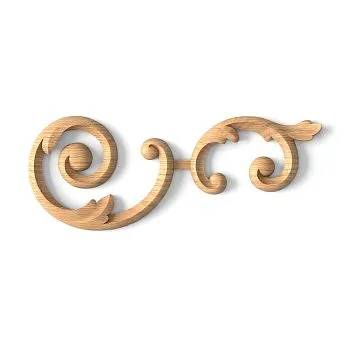
These are asymmetrical elements designed for placement in corners. The shape is triangular with smooth lines, and the pattern develops from the corner toward the center of the composition. Corner overlays are often sold in pairs or sets of four—for decorating all corners of a frame.
Corner elements logically complement linear molding. When molding forms a rectangular frame on a facade or wall, the corners remain empty or are joined at a 45-degree angle. A corner overlay fills this corner with decoration, makes the joint smooth and organic, and visually connects the horizontal and vertical lines.
Vertical and horizontal overlays
These are elongated elements that run along a single axis. Width: 30–100 millimeters, length: from 200 to 1500 millimeters. The pattern is rhythmic and repeating: a floral garland, geometric ornament, or a row of identical elements (leaves, flowers, scrolls).
Vertical overlays are used to visually elongate a plane, creating a sense of height. Horizontal ones—to widen and create a sense of expanse. They are often combined with central and corner overlays to create complex compositions.
Modular constructor overlays
These are sets of elements that join together to form a continuous pattern of any length. The set includes central sections, corner elements, and end caps. The joining points are designed so that the pattern smoothly transitions from one element to another without visible seams.
Modular overlays are ideal for decorating large surfaces—long kitchen cabinet facades, wide sliding wardrobe doors, wall panels. You purchase the required number of modules and assemble a composition to fit a specific size.
Panels
These are large decorative compositions, often consisting of several parts joined into a single whole. Size can reach 600 by 1200 millimeters. The pattern is complex and multi-layered: scenes from mythology, bas-reliefs with figures, intricate floral compositions.
Panels are used as standalone decorative objects. They do not complement a composition; they are the composition themselves. Panels are placed on the facades of formal cabinets, on walls as paintings, on doors as a central element, on stair newels as heraldic shields.
Overlay materials: wood versus polyurethane
Overlays are made from two main materials: solid wood and polyurethane. Each has its own advantages and limitations.
Solid wood overlays
Wood is a natural, noble, living material. Wooden overlays are made from beech, oak, ash. Carving is done on CNC milling machines or by hand by master carvers (for exclusive items).
Advantages of wooden overlays:
-
Naturalness and eco-friendliness
-
Unique texture, visible even under paint
-
Ability to be tinted, patinated, brushed
-
Tactile pleasantness—wood is warm, alive
-
Durability—with proper treatment, they last for decades
-
Restoration possibility—can be sanded, repainted
Limitations:
-
High price compared to polyurethane
-
Reacts to humidity changes—requires a stable climate
-
Greater weight—requires more reliable fastening
-
Limited fineness of details—very thin carved elements are fragile
Wooden overlays are chosen for elite interiors where the naturalness and status of the material are important. They are good for solid wood furniture, wooden doors, classic interiors where authenticity is valued.
Polyurethane overlays
Polyurethane is a synthetic material produced by casting in silicone molds. Modern compositions imitate the texture of wood, plaster, and stone with high accuracy.
Advantages of polyurethane overlays:
-
Low price—2–3 times cheaper than wooden ones
-
Lightweight — easy to install even with adhesive
-
Moisture-resistant — suitable for kitchens, bathrooms
-
High detail — very fine, intricate elements are possible
-
Ready for installation — no sanding required
-
Wide selection — tens of thousands of models
Limitations:
-
Artificial material — lacks wood texture and scent
-
Less tactile appeal — cold, plastic feel to the touch
-
Difficult to restore — scratched elements are easier to replace than repair
-
Less prestigious — wood is preferred for elite interiors
Polyurethane overlays — a choice for budget and mid-range projects, for spaces with unstable climates, for modern interiors where artificial materials are organic.
Wooden millwork: structure for overlays
Interior wall decals for wallpaper wall decorwork most effectively in combination with millwork — moldings, picture rails, coving, architraves. Millwork creates structure, frames, boundaries, and overlays fill this structure with decor.
Moldings: a universal tool
Molding — a strip with a profiled cross-section that is attached to walls, ceilings, or furniture fronts. Width ranges from 20 to 150 millimeters, with profiles from simple rectangular to complex multi-level.
Moldings are used for:
-
Creating frames around overlays on walls and fronts
-
Framing door and window openings
-
Forming wall panels
-
Dividing walls horizontally into zones
-
Decorating furniture fronts
When an overlay is placed within a molding frame, it is perceived as a painting in a frame — organized, complete, valuable. Molding enhances the significance of the overlay and draws attention to it.
Coving: smooth transitions
wooden cornice— a ceiling skirting board that covers the joint between the wall and ceiling. Coving profile typically has a concave part adjacent to the corner and a decorative protruding part.
Coving creates a smooth transition from the vertical wall to the horizontal ceiling. If overlays are placed on the wall, coving logically completes the composition from above, preventing it from 'hanging in the air.' Wide coving (100–200 millimeters) can itself carry decor — carved or milled ornaments that harmonize with wall overlays.
Picture rail: frame for compositions
Wooden molding— a wide profiled molding traditionally used for making frames for paintings and mirrors. In interiors, picture rails are used to create deep, massive frames on walls, fronts, and ceilings.
Picture rail has a complex multi-step profile with protrusions, recesses, and decorative grooves. Width ranges from 50 to 200 millimeters. When an overlay is framed by a picture rail, it transforms into a medallion, coat of arms, or emblem — visually stands out and becomes the main element of the composition.
Combining millwork and overlays
Classic scheme: a rectangular frame is formed on a wall or front using molding. Corner overlays are placed at the frame corners. A central overlay (rosette, cartouche, panel) is placed in the center of the frame. Vertical or horizontal overlays can be placed along the frame sides, between the center and corners.
Such a composition reads as a complete architectural statement. Molding defines the geometry, overlays fill it with decor. Proportions are important: the frame should not be too tight for the overlay (distance from the overlay edge to the molding should be at least 30–50 millimeters) and not too spacious (empty space should not exceed the size of the overlay itself).
Decoration Styles: From Baroque to Minimalism
The choice of overlays and moldings is determined by the interior style. Each style has its characteristic elements, proportions, and materials.
Baroque: luxury without limits
Baroque loves complexity, layering, and an abundance of decoration. Overlays are large, with deep relief: acanthus leaves, shells, cartouches with scrolls, putti (cherubs), garlands of fruits and flowers. Moldings are wide, with a multi-step profile. Colors: gold, gilding, white with gold, dark wood with gold inserts.
Baroque composition is dense: overlays are placed tightly, overlapping each other, creating the effect of a relief carpet. This is the style of palaces, formal halls, and luxurious mansions. In modern interiors, Baroque is used sparingly — in one or two rooms, as a stylistic accent.
Classicism: symmetry and proportions
Classicism is strict and orderly. Overlays are symmetrical, with clear geometry: rosettes with regularly shaped petals, meanders (Greek ornaments), laurel wreaths, columns, and pilasters. Moldings have simple profiles, proportions follow the golden ratio.
Colors are restrained: white, cream, light gray, natural wood. Composition is symmetrical: if there is an overlay on one side, there must be a mirrored pair on the other. Classicism is about nobility, restraint, and timeless elegance. It does not age, does not go out of fashion, and is always relevant.
Empire: Monumentality and Grandeur
Empire is an imperial style, a development of Classicism with an emphasis on monumentality. Overlays are massive, with military and triumphal symbolism: eagles, wreaths, swords, shields, laurel branches, lion heads. Moldings are wide, often with gilding or golden decor.
Colors are contrasting: white with gold, dark blue with gold, burgundy with gold. Empire creates an atmosphere of formality, solemnity, and power. This style is for large spaces with high ceilings, for interiors designed to impress.
Art Nouveau: Fluidity and Asymmetry
Art Nouveau rejects strict symmetry and straight lines in favor of smooth curves and organic forms. Overlays depict stylized plants (irises, lilies, poppies), female figures with flowing hair, insects (dragonflies, butterflies). Moldings have a wavy profile, asymmetrical.
Colors are muted, natural: olive, terracotta, dusty pink, gray-green. Art Nouveau creates a romantic, dreamy atmosphere. It is good for bedrooms, living rooms, studies — spaces for rest and contemplation.
Neoclassicism: Classic Today
Neoclassicism takes the principles of Classicism but simplifies forms, making them more concise. Overlays have simple profiles, without excessive detailing. Moldings are narrow, elegant. Colors are light, monochrome: white, light gray, beige.
Neoclassicism is a compromise between a love for classicism and the demands of modern living. It does not overload the space but retains elegance and nobility. This is the most popular style for city apartments and country houses.
Minimalism: Decoration as an Accent
Minimalism uses overlays extremely sparingly — only where they are functionally or compositionally necessary. Overlays are of simple geometric shapes: round rosettes without ornament, square panels with minimal relief. Moldings are flat, painted the same color as the walls.
Colors are monochrome: white, gray, black. An overlay works as a subtle accent, creating relief without shouting for attention. Minimalist decor requires perfect execution — any installation inaccuracy or unevenness will be noticeable.
Application of Overlays on Different Surfaces
Where exactly can overlays be installed? The range of applications is wide.
Furniture facades
Kitchen fronts, cabinet doors, dresser doors, sideboards — the main area of application for overlays. A simple paneled door turns into a piece of furniture art when a carved overlay is installed on it. You can make one large central overlay or several small ones in the corners and center.
Overlays are especially effective on kitchen fronts in a classic style. A white enamel surface with carved overlays, covered with patina or gilding, creates the atmosphere of a French chateau or an English manor.
Interior Doors
A smooth door leaf is an ideal base for overlays. You can create a composition of moldings and overlays, imitating a classic paneled door. You can place one large central overlay, turning the door into a decorative object.
For entrance doors, overlays add status and a sense of security — a massive carved door is perceived as more reliable and expensive.
Walls
Overlays on walls work as decorative medallions, replacing paintings or posters. You can create a gallery of several overlays of different sizes, united by a common style. You can make an accent wall, completely covered with moldings and overlays in a complex pattern.
In classic interiors, wall panels with overlays create a sense of architectural complexity and historical depth. A room looks as if it has existed for centuries, even though the decor was installed yesterday.
Ceilings
Ceiling rosettes around chandeliers — a traditional application of overlays. A rosette with a diameter of 300–600 millimeters frames the chandelier mounting point, visually enlarges it, and makes it more significant. The rosette can be a simple circle or a complex multi-petal shape, depending on the interior style.
On coffered ceilings, overlays are placed in the center of each coffer, creating a rhythmic decorative pattern.
Stairs
Stair newel posts (newels) — an excellent base for overlays. A large carved overlay on a post turns it into a decorative object that attracts attention. On stair risers, overlays create a vertical decorative rhythm.
Fireplaces
The fireplace portal is a place where decor is especially appropriate. Overlays are placed on the fireplace pediment, on the sides, on the shelf. They emphasize the significance of the fireplace as the center of the room, creating a sense of grandeur.
Overlay installation: technology of reliable fastening
The quality of installation determines the durability and visual perception of the decor.
Surface preparation
The surface must be clean, dry, and degreased. Dust, dirt, and grease reduce the adhesive's adhesion. If the surface is painted with glossy paint or varnished, it needs to be lightly sanded with fine abrasive (220 grit) to create roughness.
Irregularities of more than 2–3 millimeters need to be leveled with putty. The overlay must adhere to the surface with its entire back side — only this ensures reliable fastening.
Marking the position
Before gluing, you need to precisely determine the installation location of the overlay. Use a pencil and level to mark the central axes. If there are several overlays, it is important to maintain equal distances and symmetry.
Place the overlay against the surface, evaluate it visually. Sometimes what looks good on paper requires adjustment in reality. Don't rush — the marking determines the result.
Adhesive selection
For wooden overlays, use woodworking PVA or polyurethane glue. PVA is good for porous surfaces (wood, MDF), polyurethane — for smooth surfaces (painted, varnished). For polyurethane overlays, special polyurethane-based adhesives or liquid nails are suitable.
The adhesive is applied in a thin, even layer to the back side of the overlay. Excess adhesive will squeeze out when pressed and spoil the appearance, insufficient adhesive will not ensure reliability.
Fixation
The overlay is pressed against the surface and fixed for the adhesive setting time (from 30 minutes to 12 hours depending on the adhesive type). Fixation is done with painter's tape, clamps, or weight.
For heavy wooden overlays, headless finishing nails or thin screws are additionally used, which are screwed in from the back side or countersunk and puttied.
Final finishing
After the adhesive sets, excess is removed, and fastening points are puttied. If the overlay and base will be painted the same color, the putty is unnoticeable. If the overlay retains its natural color, wood-tone putty or a wax pencil is used.
Then the entire composition (base + overlays + molding) is primed and painted or varnished. Decorative techniques can be applied: patination (applying dark paint into the recesses of the carving), gilding, brushing.
Color and decorative solutions
How to paint overlays and molding so they work as effectively as possible?
Monochrome: color unity
Overlays, molding, and base are painted the same color. The decor is revealed only through relief, play of light and shadow. This is a restrained, elegant approach, characteristic of neoclassicism and minimalism. White monochrome creates a sense of purity, airiness. Gray monochrome — modern restraint. Black — dramatic expressiveness.
Contrast: overlays highlighted by color
The base is painted one color, overlays and molding — another. Classic combination: white base, gold or silver overlays. Or dark base (graphite, anthracite), light (white, cream) overlays. Contrast makes the decor more noticeable, accent.
Patina: antique effect
After painting in the main color (usually light), patina is applied to the surface — dark paint that is rubbed into the recesses of the carving and partially wiped off the protruding parts. This creates an aged effect, as if the decor has existed for centuries. Patina adds depth, volume, makes the carving more readable.
Gilding and silvering
Overlays are covered with gold or silver paint, imitation gold leaf (imitation of gold leaf) or gold leaf (for elite interiors). Gilding is a classic of Baroque and Empire, silvering is a more modern, cold option. Gilded overlays on a white or pastel background create luxury and grandeur.
Natural wood with transparent finish
Wooden overlays are covered with oil, wax, or clear varnish, preserving the texture and color of the wood. This is an approach for interiors where the naturalness of the material is valued. Overlays made of oak, ash, walnut with a clear finish against a background of painted walls or facades create warmth, connection with nature.
Comprehensive solution: designing a decorative composition
How to design a composition of overlays and molding so that it is harmonious and functional?
Determining the focal point
Each composition must have a focus — a point that attracts the eye first. The focus becomes a large central overlay. Other elements (molding, small overlays) work to enhance the focus, direct the eye towards it.
On a furniture facade, the focus is often in the center. On a wall, the focus can be shifted according to the golden ratio rule. On a door, the focus is usually in the upper third — at eye level of the person entering.
Maintaining Proportions
The size of the overlays should correspond to the size of the base. On a cabinet door 400 millimeters wide, a 300-millimeter diameter overlay is inappropriate—it will occupy almost the entire plane. The optimal ratio is for the overlay to occupy 30–50 percent of the base size, leaving space for perception.
The width of the molding is also important. A molding that is too thin (20 millimeters) will get lost next to a large overlay. One that is too wide (150 millimeters) will compete with it. The optimal width is 3–5 times smaller than the size of the overlay.
Rhythm and Repetition
If there are several overlays, the rhythm of their placement is important. Identical overlays are placed at uniform intervals—this creates a calm, orderly rhythm. Different overlays alternate according to the principle: large—small—large—small. Or: a large central one, two medium ones on the sides, four small ones at the corners.
Symmetry or asymmetry
Classical styles require strict symmetry: what is on the right is also on the left. Modern styles allow for asymmetry: overlays are placed diagonally, shifted to one edge, grouped in unconventional ways. Asymmetry creates dynamism, surprise, and a contemporary feel.
Answers to Popular Questions
Can wooden overlays be installed on wallpaper?
Yes, but with limitations. The wallpaper must be dense and well-adhered to the wall. Light paper wallpaper will not support the weight of a wooden overlay. Non-woven, vinyl, or textile wallpapers on a sturdy base are suitable. Polyurethane overlays, being lightweight, can be mounted on any wallpaper without problems.
What is the best adhesive for mounting overlays?
For wooden overlays on wooden or MDF surfaces—carpenter's PVA glue class D3 or D4. For wooden overlays on painted or varnished surfaces—polyurethane or epoxy adhesive. For polyurethane overlays—special polyurethane adhesives or liquid nails.
Is it necessary to additionally secure overlays with nails?
For light, small overlays (up to 100 grams), adhesive is sufficient. For medium overlays (100–300 grams), additional fastening with finishing nails in 2–4 points is advisable. For heavy, large overlays (over 300 grams), mechanical fastening is mandatory.
Can overlays be painted after installation?
Yes, this is standard practice. Overlays are installed on the base, then the entire composition is primed and painted in one or several colors. This ensures a unified finish with no visible boundaries between the overlay and the base.
How long do wooden overlays last?
With proper installation and finishing—for decades. Wooden overlays coated with quality paint or varnish do not lose their shape, fall off, or crack. They can be restored—sanded and repainted—extending their service life almost indefinitely.
What is the price difference between wooden and polyurethane overlays?
Wooden overlays are 2–4 times more expensive than polyurethane ones of similar size and complexity. A simple wooden rosette with a diameter of 100 millimeters costs from 800 rubles, a polyurethane one—from 200 rubles. A complex wooden overlay measuring 200 by 400 millimeters—from 3000 rubles, a polyurethane one—from 1000 rubles.
Can overlays be installed in damp areas?
Polyurethane overlays are not afraid of moisture and are suitable for bathrooms and kitchens. Wooden overlays require additional moisture protection—impregnation, waterproof varnish. In areas of direct contact with water (near sinks, showers), it is better not to use wood or to protect it with additional barriers.
Conclusion: When Decor Becomes Art
You have seen many interiors. Some are forgotten in a minute, others remain in memory forever. The difference is not in the size of the budget, but in the details.Interior stickers for decorcombined with wooden molding, turn an ordinary space into a work of architectural art. Flat surfaces gain relief, depth, and history. A simple door becomes a portal, a boring facade—a piece of furniture art, an empty wall—a decorative panel. And all this without large-scale reconstruction, without replacing furniture, without major renovation.
Overlays and molding work as a language with which any story can be told: the story of a French castle in Baroque style, an English estate in a classical style, a Viennese salon in Art Nouveau style, a modern city apartment in Neoclassical style. Each style has its characteristic elements, and correctly chosen overlays create an authentic atmosphere of the era.
The choice between wood and polyurethane is determined by budget, operating conditions, and the philosophy of the interior. Wood is for those who value the naturalness, tactility, and status of the material. Polyurethane is for those who value practicality, affordability, and variety of forms. Both materials have a right to exist, both create beauty—just different kinds.
For 23 years, the company STAVROS has been creating decor that turns interiors into spaces with character and soul. The STAVROS assortment includes over 400 models of wooden carved overlays in various artistic styles—from classical acanthus leaves to the author's collection "Summer Garden" with exquisite Baroque carving. Central and corner elements, symmetrical and asymmetrical products, luxurious ornamental panels, modular overlay-constructors—everything needed to create a unique decorative composition.
STAVROS works with beech and oak wood — species that provide strength, durability, and the beauty of natural grain. Each overlay undergoes quality control, is manufactured on modern equipment, yet with adherence to traditional wood carving techniques. This is not mass stamping, but thoughtful production where every millimeter of relief and every line of the pattern matters.
When you choose overlays and molding from STAVROS, you get not just decorative elements, but tools for creating the interior of your dreams. Elements that are easy to install, harmoniously combine with each other, and last for decades. Elements that can be painted, patinated, gilded, adapting to any color scheme and style. This is creative freedom, limited only by your imagination.
STAVROS supplies decor to designers, architects, furniture factories, construction companies, and private clients throughout Russia. A wide stock program allows shipping standard items from one piece on the day of request. Custom production is completed within agreed-upon deadlines. Delivery is organized to any region—from Kaliningrad to Vladivostok.
When decor becomes art, it is backed by craftsmanship, experience, and love for the material. And STAVROS embodies these values in every overlay, in every meter of molding, in every product that leaves the production facility and goes to create beauty in your home.