












































































Article Contents:
- What is the fundamental difference between flexible and rigid panels
- Flexible slatted panel construction: fabric base and battens
- Fabric base: material and parameters
- Battens: profile, material, spacing
- Semi-circular batten profile: chiaroscuro and visual effect
- Structural function of the profile
- Lighting effect of the semi-circular profile
- Tactile effect
- What surfaces can be faced with flexible slatted panels
- Columns: round, square, elliptical
- Arches: vaults, portals, window openings
- Rounded corners and transitions
- Niches, apses and semi-circular finishes
- Wavy partitions and curvilinear walls
- Seamless module connection — joining technology
- MDF and solid oak: two versions of flexible slatted panels
- Flexible MDF panel: precision and color
- Flexible solid oak panel: natural uniqueness
- DIY installation of flexible slatted panels: step-by-step instructions
- Step 1: Base preparation
- Step 2: Calculation and marking
- Step 3: Panel cutting
- Step 4: Adhesive application
- Step 5: Installation and fixation
- Step 6: Finishing joints and edges
- Step 7: Final coating (for solid wood)
- Application in furniture: curved facades for islands and cabinets
- Kitchen island with slatted facade
- Cabinets with radius fronts
- Bar counters
- Application in commercial interiors
- Hotels: lobby, corridors, reception
- Restaurants: zoning and atmosphere
- Retail spaces: slat wall as a signature element
- Offices: acoustics and branding
- Technical parameters: summary table
- Specifics of ordering flexible slat panels
- Combination with other decorative elements
- Frequently Asked Questions

Straight lines are the domain of mediocre solutions. True architecture lives in curves, radii, smooth transitions — where geometry ceases to be predictable and begins to speak to humans in a different language. It is here that the need arises for a material that can bend without breaking, wrap around a form without losing its character.Flexible slatted panelson a fabric base is the answer to a demand that rigid modular systems are fundamentally incapable of satisfying.
Columns, arches, rounded corners, elliptical niches, wave-shaped partitions — until recently, all these forms were either inaccessible for slat cladding or required complex and expensive artisanal solutions. The flexible slat panel has radically changed this situation. Today, cladding a column with wooden slats takes a few hours and requires no special tools. An arch with slat cladding is a standard task, solved without a single cut and without loss of geometric precision.
This article is a detailed professional breakdown: what flexible slat panels are, how their structure is designed, what surfaces they allow to be clad, how to install them, and where to apply them. For those who want to understand the material deeply — not just skim the headlines.


What is the fundamental difference between a flexible panel and a rigid one
To understand a flexible panel, one must first clearly see the limitations of a rigid one — then the difference will become obvious.
A rigid slat panel is a monolithic structure: the slats are fixed to a solid load-bearing base made of MDF or plywood. Such a system is designed for flat surfaces. It works perfectly on straight walls, horizontal ceilings, flat furniture fronts. But as soon as the surface acquires curvature — the rigid panel becomes powerless. It cannot be bent: the MDF load-bearing board will break at a radius of less than 3–4 meters. Cutting it into narrow sections means getting visible joints that destroy the visual continuity. Cutting to fit a radius is incredibly labor-intensive and wasteful in terms of material.
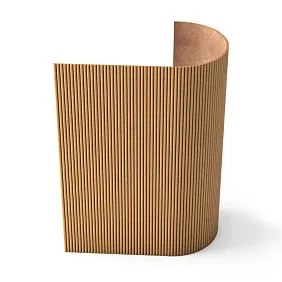
A flexible panel is fundamentally different in design. Its base is not a rigid board, but an elastic fabric or fiberglass backing. The slats (battens) are glued onto this backing at a set pitch, but each slat is not rigidly connected to its neighbors via a board — there is freedom of movement between them. The structure works like chainmail: individual rigid elements (slats) are linked by a flexible matrix (fabric), and the combination provides flexibility while maintaining structure. The minimum bending radius of a flexible slat panel is from 100–150 mm depending on the width and thickness of the slat. This means it can clad a column with a diameter of 20–30 cm — a task absolutely impossible for a rigid system.
This is not just a structural difference — it's a difference in the class of tasks the material solves. A rigid panel is for the architecture of right angles. A flexible one is for the architecture of free forms.




Structure of a flexible slat panel: fabric base and battens
Let's examine the structure in detail — because it is precisely understanding the construction that allows for a competent choice of material and its correct application.
Our factory also produces:
Fabric base: material and parameters
The base of a flexible slat panel is a textile mesh or non-woven material based on fiberglass or polyester. The requirements for the base are strict: it must have high elasticity when bent, zero residual deformation (return to a flat state when the load is removed before installation), and sufficient strength to hold the slats during transportation and laying.
Fiberglass mesh provides higher tensile strength, which is important when working with heavy solid wood slats. Polyester non-woven base is softer, conforms better to surfaces with double curvature (both horizontal and vertical simultaneously). The thickness of the base is 0.5–1.2 mm; it practically does not affect the final thickness of the structure.
The width of a standard flexible panel module is 300 or 600 mm. Length is 1200, 2400, or 2700 mm. Non-standard sizes are made to order, which is especially relevant for large commercial projects where minimizing visible joints is important.
Get Consultation
Battens: profile, material, pitch
Battens are the actual slats that are glued to the fabric base and form the front surface of the panel. The material of the battens inflexible slat panelsis MDF or solid wood. Each material has its own characteristics, which we will examine in detail in a separate section.
Batten width: 20, 25, 30, 40 mm — the most common values. Thin battens (20–25 mm) provide higher flexibility: a smaller bending radius while maintaining the integrity of the slat. Wide battens (30–40 mm) create a more expressive slat pattern but limit the minimum bending radius.
Gap pitch between battens: 5, 8, 10 mm. The gap is not just an aesthetic parameter; it is a functional characteristic: it is precisely the gap that provides freedom of movement during bending. Too small a gap limits flexibility; too large — disrupts the visual density of the slat pattern. The optimal balance for most applications is a gap equal to 25–40% of the batten width.
The adhesive bond between the battens and the fabric base is a technologically critical moment in production. A two-component polyurethane or epoxy adhesive with high adhesion to wood and fabric, resistant to deformation loads during bending, is used. Poor-quality adhesive is a source of batten delamination during installation, which immediately affects the quality of the surface.
Semi-circular batten profile: chiaroscuro and visual effect
Most flexible slat panels are produced with semi-circular or trapezoidal profile battens—and this is no coincidence. The slat profile in a flexible panel solves three tasks at once: structural, aesthetic, and lighting.
Structural function of the profile
A rectangular batten with sharp edges creates significant stress in the adhesive joint when the panel is bent: the sharp edges tend to 'rip open' the fabric base during deformation. A semi-circular profile distributes this stress evenly across the entire width of the contact surface. This increases the durability of the adhesive joint and the reliability of the structure as a whole.
A trapezoidal profile (wide base, narrower front face) also ensures good adhesion due to the wide contact plane at the bottom, while creating a more pronounced relief on the front surface.
Lighting effect of the semi-circular profile
This is perhaps the most poetic property of flexible slat panels with semi-circular battens. The rounded front surface of the slat acts as a cylindrical mirror: it reflects light unevenly, creating a smooth gradient from a light center to dark edges. This effect is called 'specular highlight.' With directional lighting (sconces, spotlights, floor lamps), each batten becomes a source of a soft longitudinal highlight.
Collectively, several dozen battens on a wall or column create a shimmering, lively light pattern that changes as the observer moves or as the lighting angle changes. This is fundamentally impossible to reproduce on flat rectangular slats with their static straight reflections. This is why flexible panels with semi-circular battens are especially in demand in restaurants, hotels, and boutiques—everywhere where atmosphere is created by the play of light.
Tactile effect
The surface of a semi-circular batten is not just a visual story. Running your hand over a wall clad with such slats is a special tactile experience: soft waves of rounded peaks alternate with shadowy recesses of gaps. This is a spatial tactility that cannot be obtained from flat surfaces, and it is precisely this that makes a restaurant guest or boutique customer involuntarily reach out to touch the wall.
Which surfaces can be clad with flexible slat panels
This is perhaps the most practically important section. Let's list them specifically—with parameters and conditions.
Columns: round, square, elliptical
Cladding columns is a classic task for fabric-based slat panels. A round column with a diameter from 150 mm is clad with a flexible panel 300 mm wide in 3–4 passes around the perimeter with seamless joining. A square column with rounded corners—a combination of a flexible panel on the rounded parts and straight rigid inserts on the flat faces.
For a round column, calculating the perimeter development length is important: it must match a whole number of modules or ensure a neat joint in one place (typically behind the column or at the least visible point). The minimum column diameter for standard flexible panels with a batten width of 30 mm is about 120–150 mm. With a smaller diameter, the battens will crack when bent.
For solid oak wooden slat panels on columns, proper tinting is especially important: the rounded surface combined with the circular arrangement of slats creates a multi-layered play of shadow and highlight, and the color of the wood sounds different in this play than on a flat wall. Dark tones on columns look monumental; light tones look elegant and airy.
Arches: vaults, portals, window openings
An arched opening is another area where flexible slat panels are indispensable. Cladding the inner surface of an arch (intrados) with slat battens creates a decorative effect, turning a simple construction opening into an architectural statement.
Installation on an arch requires specific preparation: the flexible panel is cut into strips across the direction of the battens (so that the battens run parallel to the arch radius), and each strip is bent to the arch radius and glued to the base. With proper selection of strip width and bend radius, the joints between strips align exactly with the gaps between battens and become completely invisible.
For arches in classic interiors, wooden slat panels made of oak or painted MDF harmoniously combine with other wooden finishing elements—moldings, cornices,solid wood floor baseboardscreating a unified ensemble of natural materials.
Rounded corners and transitions
A rounded wall corner is a detail that transforms a room from ordinary to designer. A fabric-based flexible slat panel wraps around a rounded corner without tearing and without a visible joint. The corner radius can be any: from a soft rounding R=50 mm to a smooth transition R=300 mm.
In Art Deco and organic design interiors, rounded corners are a mandatory architectural technique. Slat finishing on such corners emphasizes the smoothness of the transition and creates the effect of a continuous sculptural surface.
Niches, apses, and semi-circular finishes
A decorative niche with a semi-circular finish (apse) is an architectural technique rooted in antiquity. In modern interiors, such niches are used to place sculptures, art objects, accent lighting. Cladding the inner surface of a niche with flexible slat panels turns it into a full-fledged decorative object.
Installation in a niche requires precise calculation: panels are cut on-site considering the niche's radius and height, and the end edges are finished with a trim profile or molding.
Wavy partitions and curvilinear walls
The most complex and most impressive area of application for flexible slat panels is free-form curvilinear surfaces: wavy partitions, 'living' walls with variable radii, sloped attic planes. Such structures are often found in custom architectural projects, restaurants with complex spatial concepts, and exhibition pavilions.
Herefabric-backed slat panelsoperate at full capacity: they follow any contour of the supporting frame, maintaining the rhythm and continuity of the slat pattern. The result is a surface that simultaneously serves as a finishing material and an architectural form.
Seamless module connection — joining technology
The joint between modules is a potentially vulnerable point in any slat system. On straight rigid panels, joints are concealed by aligning the slat spacing. With flexible panels, the situation is more complex: when installed on curved surfaces, modules may shift slightly relative to each other, and deviations in spacing become noticeable.
Professional joining technology for flexible slat panels involves several principles. First, joints between modules always fall within the gap between battens — this is the basic layout rule. Second, the end battens of adjacent modules must be at the same distance from the edge of the fabric backing — typically, this distance equals half the standard gap. When two modules are joined, a full gap is created, visually indistinguishable from internal gaps.
Third, when installing on curved surfaces, special mounting templates — guide rails — are used to set the precise position of each module. This is especially important when cladding columns: the slightest angular misalignment when laying the first module leads to cumulative error by the end of wrapping the column.
An additional measure — using a special joining profile made of thin aluminum or MDF with a width equal to the gap between battens. The profile is glued over the joint and visually transforms it into a regular gap in the slat structure.
MDF and solid oak: two versions of flexible slat panels
Choosing between MDF and solid oak for a flexible slat panel is not a choice between 'good' and 'better.' It is a choice between different characters and different tasks.
Flexible MDF panel: precision and color
MDF battens on a fabric backing — this material is for those who prioritize color and geometric precision. MDF is milled to a perfectly smooth surface, accepts paint evenly, and delivers stable, repeatable results. FlexibleMDF slat panelsfor painting allow matching an exact color per RAL or NCS, which is critically important for creating monochromatic interiors or when coordinating the color of the slat surface with other finishing elements.
MDF battens in a flexible panel have several limitations compared to solid wood. First, higher fragility when bending: MDF at minimal radii (less than 100 mm) may develop cracks on the face surface. Second, MDF cut ends require mandatory priming and painting. Third, MDF is sensitive to excess moisture: for spaces with unstable humidity, moisture-resistant MDF (HMR) is preferable.
Nevertheless, for most interior tasks, MDF flexible panels are the optimal choice in terms of price-quality-result ratio. A wide color spectrum, ease of touch-up and repair make it a universal solution for designers working across a broad price range.
Flexible solid oak panel: natural uniqueness
Solid oak in a flexible version — this is a material of a different class. Each batten carries a unique natural grain pattern that cannot be replicated or synthesized. When bending a solid oak panel around a column, the wood grain smoothly follows the form — the surface literally 'hugs' the architectural element, and this organic fit creates an effect that professional designers call 'tectonic honesty': the material does not pretend to be something it's not; it follows the form naturally and convincingly.
The minimum bending radius for solid oak battens is about 150–200 mm with a batten width of 25–30 mm. This is somewhat larger than for MDF counterparts and limits application on very thin columns. For standard architectural columns (diameter from 180 mm) — there are no limitations.
The finish for oak battens in a flexible panel — oil, wax, or varnish — is applied either before installation (to individual battens before gluing to the backing) or after installation. The second option is preferable: the finish conceals minor tinting variations between individual battens and creates a unified, cohesive surface.
Installing flexible slat panels yourself: step-by-step instructions
Installing a flexible slat panel is a task accessible to someone with basic construction skills, provided the technology is followed. Let's consider the process using the example of cladding a round column.
Step 1: Surface preparation
The column surface must be dry, clean, and sturdy. Plaster, concrete, and brick surfaces are primed with universal acrylic primer. Wood and MDF substrates are degreased. Metal surfaces are treated with metal primer. Permissible surface irregularities for adhesive installation — no more than 2 mm over 300 mm length. Significant irregularities are leveled with filler or sanding.
Step 2: Calculation and layout
Measure the column perimeter. Divide the perimeter by the width of a standard panel module (300 or 600 mm) — this gives the number of modules per full wrap. If the perimeter does not divide evenly — choose a position for the joint (preferably behind the column or in the least noticeable spot) and cut one module to the required width.
Apply a vertical guide line on the column — this is the starting point for the first module. For columns taller than 2.4 m, use a level or plumb line for precise vertical alignment.
Step 3: Cutting panels
Flexible slat panels are cut with a sharp knife or a circular saw with a fine-toothed blade. The cut is made along the fabric backing between battens — so the end battens of the module remain intact. For modules on arched surfaces and niches, cuts are made using a template crafted from cardboard to match the specific element's shape.
Step 4: Applying adhesive
Use contact adhesive on a neoprene base or two-component polyurethane adhesive. Contact adhesive is applied to both surfaces — the back of the panel and the substrate. Application is done with a notched trowel with a tooth size of 2–3 mm. Dwell time before installation — 5–10 minutes (until it reaches a 'tacky but not wet' state).
Two-component polyurethane adhesive is applied only to one surface - the substrate. Open time is 15-20 minutes, which allows for precise alignment of the panel before pressing. This option is preferable for complex curved surfaces where precise joining requires time.
Step 5: Installation and Fixation
Apply the panel to the substrate, starting from the guide line. Press evenly across the entire surface - from the center to the edges - to avoid air bubbles. For secure fixation, use a rubber mallet or roll the surface with a rubber roller.
When installing on a column, the fabric backing of the panel tightly wraps around the surface. On a convex surface, the panel bends with the concave side towards the column - the battens fan out, and the gaps slightly increase. This is normal and visually unnoticeable with standard radii. On a concave surface (the inner side of an arch), the battens come closer together - the gaps decrease. The maximum convergence should not bring the battens into contact with each other: leave a minimum gap of 2-3 mm.
Step 6: Finishing Joints and Edges
After the adhesive has fully cured (24 hours), treat the joints, edges, and junctions with other surfaces. Joints between modules - fill with colored sealant matching the battens or install a joining profile. Edges at the floor and ceiling - cover with molding or baseboard. When finishing a slatted column at the floor, it is natural to useWooden baseboard - it creates a clear boundary between the slatted surface and the floor covering and gives the entire composition a finished, professional appearance.
Step 7: Final Coating (for solid wood)
If the solid wood battens were not pre-treated, apply finishing oil or wax after installation. Work in small sections, evenly distributing the product and thoroughly rubbing it into the gaps between the battens. Excess oil is removed with a clean cloth 15-20 minutes after application.
Application in Furniture: Curved Fronts of Islands and Cabinets
The furniture application of flexible slatted panels is a separate big story, deserving detailed consideration.
Kitchen Island with a Slatted Front
A kitchen island with rounded ends is one of the most popular requests in kitchen design in recent years. A rectangular island with sharp corners is safe and convenient, but the end faces often remain visually unfinished. A rounded end faced with a flexible slatted panel turns the island into a sculptural object.
Installing a panel on the rounded end of an island is a typical task for flexible material. The rounding radius of a kitchen island is generally 50-150 mm - within this range, flexible slatted panels with MDF battens work without limitations. The color of the battens is chosen to match the main fronts of the kitchen set, creating a cohesive kitchen image. Details -Furniture wooden handles - complete the look, adding a natural accent to the painted surface.
Cabinets with Radius Fronts
A radius cabinet front is rare in mass production precisely because it is complex to manufacture. Flexible slatted panels make this technique accessible: a curved MDF carcass is faced with a flexible panel that precisely follows the curvature of the front. The result is a cabinet that looks like an author's furniture piece.
In libraries and studies, radius cabinets with oak slatted fronts create an atmosphere of an English club or a private collection - a space shaped by time and character, not by a production standard.
Bar Counters
A bar counter is a furniture element that most often has a complex curved shape: a curved front, rounded corners, sometimes an elliptical or wave-like outline. Facing the front of a bar counter with flexible slatted panels is a professional solution found in high-end restaurants, hotels, and home bars.
Dark oak slats on a bar counter, gently curving around the space's bend, is an image of the kind that stays in a guest's memory for a long time. It is precisely such details that shape an establishment's reputation.
Application in commercial interiors
Hotels: Lobby, Corridors, Reception
Hotel interior is the architecture of first impression. A guest makes a decision about the quality of an establishment within the first 90 seconds after entering. Slatted column cladding in the lobby, slatted panels on radius walls in the reception area, flexible panels in arched corridor openings - all this works to create the desired emotional response even before the guest speaks their first word.
In 4-5 star hotels, flexible slatted panels made of oak or MDF with a wood-like finish have become a standard element of public area decoration. They provide acoustic comfort (critically important in noisy lobbies), create a warm natural atmosphere, and have sufficient durability for intensive use.
Restaurants: Zoning and Atmosphere
In restaurant spaces, flexible slatted panels solve several tasks at once. Slatted partitions between tables - using flexible panels to wrap around columns and create smooth finishes - zone the space without rigid demarcation. Slatted column cladding in the dining hall creates a visual rhythm and makes them part of the decorative concept, not just structural elements.
For restaurant interiors, the material's durability and repairability are especially valuable. Local damage to a few battens can be repaired without dismantling the entire panel: damaged slats are carefully cut from the fabric backing and replaced with new ones. Provided there is a material reserve, replacement takes a few hours and remains unnoticeable.
Retail Spaces: Slatted Wall as a Brand Element
In retail, slatted wall finishes with flexible elements on columns and corners are increasingly becoming part of a brand's corporate style. Monochrome white slats against a white wall - a minimalist 'blank slate' for product presentation. Dark oak slats - an anchor image in the 'organic luxury' concept for brands of natural cosmetics, eco-friendly clothing, or gourmet products.
Retail spaces highly value the possibilitycustom slatted panelsRetail chains require replication of a single design solution with precise repetition of color, profile, and slat spacing from one store to another. Manufacturing panels to standardized orders guarantees such uniformity.
Offices: acoustics and branding
An open-plan office space is an acoustically challenging environment. Echo, reverberation, and extraneous sounds reduce concentration and productivity. Slatted structures diffuse sound waves, lowering the reverberation level. Flexible panels on curved office partitions add an aesthetic dimension to this acoustic function.
Meeting rooms with slatted walls are a professional standard in modern office design. Acoustic comfort in a meeting room is not a luxury but a direct contribution to the efficiency of business communications.
Technical parameters: summary table
| Parameter | Value |
|---|---|
| Minimum bending radius (MDF battens) | 80–100 mm |
| Minimum bending radius (solid oak) | 150–200 mm |
| Batton width | 20, 25, 30, 40 mm |
| Gap between battens | 5, 8, 10 mm |
| Standard module width | 300, 600 mm |
| Standard module length | 1200, 2400, 2700 mm |
| Batton thickness (MDF) | 14–22 mm |
| Batton thickness (oak) | 12–18 mm |
| Fabric backing thickness | 0.5–1.2 mm |
| Panel weight (MDF, 600×2400 mm) | 8–14 kg |
| Panel weight (oak, 600×2400 mm) | 10–18 kg |
Specifics of ordering flexible slatted panels
Not all flexible slatted panels are sold retail from stock—a significant portion are manufactured for specific projects. This makes a correct technical specification for an order especially important. What should be included in the order:
-
Batton material: MDF for painting / natural oak / tinted oak (specify shade)
-
Batton profile: semicircular / rectangular / trapezoidal
-
Batton width: 20 / 25 / 30 / 40 mm
-
Gap: 5 / 8 / 10 mm
-
Module size: width × length
-
Base type: polyester / fiberglass
-
Finish coating (for MDF): for painting / RAL / NCS (specify code)
-
Finish coating (for oak): untreated / oil / wax / varnish (specify gloss level)
-
Number of modules or total area in m²
A precise technical specification speeds up production, eliminates rework, and guarantees results that match the design concept.Slat panels for partitionsand curved structures, manufactured to exact project parameters, are what distinguish professional implementation from amateur work.
Combination with other decorative elements
Flexible slat panels are not solo performers; they are part of an ensemble. In interiors, they interact with other materials and decorative elements, and the result of this interaction is as important as the properties of the material itself.
Oak slat columns in a classic interior are organically complementedclassic furniturein the same tonal range. Wooden tones create a warm, enveloping space with a rich architectural history. MDF slat partitions for painting in a modern office work in tandem with metal profiles, glass inserts, andfurniture handlesstainless steel or matte nickel.
Finishing the slat structure at the base —skirting boardmatching the panel tone or a contrasting molding — determines how professional the final finish looks. This detail is small but noticeable: an experienced eye immediately catches sloppiness where the slat wall meets the floor.
Frequently asked questions
Can flexible slat panels be bent in both directions — convex and concave?
Yes. Standard flexible panels bend in both directions. For concave surfaces (e.g., the inside of an arch), the minimum radius is slightly smaller than for convex ones — the fabric base works in tension, not compression.
Can flexible slat panels be used on ceilings?
Yes, provided they are securely fastened to the frame. Ceiling installation requires enhanced adhesive and additional mechanical fasteners — hidden clips or screws through the fabric base in the gaps between battens.
What is the best adhesive for installation on drywall?
Polyurethane-based mounting adhesive or specialized adhesive for MDF and wood like "Moment Montazh". Apply to the back of the panel in a zigzag or dots; additional fixation — headless finishing nails through the fabric base in the gaps.
How to join flexible and rigid panels on the same plane?
At the transition from a curved to a flat surface, an intermediate molding or special connecting profile is used. In some cases, the transition is masked with a decorative element — a trim or molding covering the joint.
Flexible oak slat panels — is acclimatization needed?
Yes, as with any solid wood products. Minimum acclimatization time — 48 hours in a room with working temperature and humidity. This is especially important for projects with large temperature differences between storage and installation sites.
Can flexible MDF slat panels be painted after installation?
Yes. After installation, panels are primed and painted the same way as flat rigid counterparts. Important: brush or roller strictly along the battens, not across — this ensures even coverage without crosswise marks.
How to store flexible slat panels before installation?
Lay flat on a level surface, without twisting or folding. Storage in a roll is acceptable provided the roll diameter is not less than the permissible bending radius. Storage temperature — +5...+25°C, humidity 40–60%.
Slat panels for partitions — rigid or flexible?
For straight partitions — rigid ones, they are easier to install and cheaper. For curved partitions, partitions with arched openings, and partitions that wrap around columns — flexible. Often, both types are combined in one project.
STAVROS specializes in the production of decorative wooden and MDF products for interiors, includingcustom slatted panels— both rigid modular and flexible fabric-based ones. The STAVROS catalog features a full range of products for creating a cohesive architectural interior: slatted panels in MDF and solid oak,Wooden Skirting Boards, Solid wood skirting boards, Furniture Handlesand much more. The STAVROS team consults at all stages of the project: from selecting the panel type and calculating materials to recommendations for installation and finishing. If your project requires non-standard sizes, a special batten profile, or specific tinting — STAVROS will manufacture panels exactly according to your technical specifications. Curvilinear architecture is no longer the privilege of exclusively premium budgets — with STAVROS, it becomes accessible for any professional project.


