Article Contents:
- Age-Related Changes: Why Standard Furniture Becomes Dangerous After 70
- Seat Height: A Critical Parameter of Ergonomics
- Armrests: Support When Standing Up and Protection from Falls
- Absence of Sharp Corners: Injury Prevention in Case of a Fall
- Seat Firmness: Balancing Comfort and Functionality
- Stability: Protection from Tipping and Slipping
- Lighting and Color Contrasts: Compensating for Deteriorating Vision
- Upholstery Fabrics: Practicality and Tactile Comfort
- Case 1: Adapting a Living Room for a 68-Year-Old Mother with Arthrosis
- Case 2: Furnishing an Apartment for a 75-Year-Old Father After a Stroke
- Why Classic Furniture is Better Than 'Medical' Furniture

Father is 73, mother is 68. You visit your parents and observe how your father struggles to get up from the sofa (leans on his knees with his hands, rocks twice, stands up on the third try, holding onto the back), how your mother clutches the edge of the table when getting up after lunch (her legs have weakened, her knee joints crack, arthrosis is progressing). You suggest buying specialized 'medical' furniture — a lift chair for 45,000 rubles, upholstered in gray leatherette, angular, functional, ugly. Your father categorically refuses: 'I'm not an invalid yet, I don't need those hospital things.' Your mother agrees: 'We have a classic interior, the oak set has lasted 40 years, this plastic monster will ruin the whole living room.'
Dilemma: safety versus aesthetics, functionality versus dignity, medical necessity versus psychological comfort. Elderly people resist adapting their interior because 'medical' furniture stigmatizes them, labels them as frail, dependent, in need of help. It's a blow to self-esteem, an admission of old age, which they run from, denying reality, risking their health, their life (a fall with a hip fracture at 70+ is deadly dangerous, mortality within a year is 20-30%). A solution exists: gerontodesign — adapting the interior to the needs of the older generation without losing style, dignity, beauty.Classic Furnituremade of solid wood, designed with the ergonomics of age-related changes in mind, addresses safety and comfort needs while simultaneously preserving aesthetics, status, pride.




Age-Related Changes: Why Standard Furniture Becomes Dangerous After 70
The human body after 65-70 years undergoes irreversible changes affecting interaction with furniture, space, objects. Muscle mass decreases by 30-50% (sarcopenia — age-related muscle loss, progressing after 60 at a rate of 1-2% per year), strength drops proportionally. An action that at age 40 required an effort of 10 (to stand up from a chair), at 75 requires 25-30 with the same muscle strength, which has halved. Result: getting up from a low chair with a seat height of 380-420 mm (standard for sofas, armchairs) becomes difficult, requires supporting oneself with hands on armrests, rocking the torso, help from others.
Joints wear out: arthrosis of the knee and hip joints (destruction of cartilage tissue, exposure of bone, bone-on-bone friction) causes pain, limited mobility, inability to bend the leg at the knee to less than a 90-100 degree angle. Sitting on a chair 420 mm high requires bending the knee at 70-80 degrees — painful, traumatic for the joint. Standing up from this position loads the joint maximally, accelerates wear, provokes inflammation, swelling.
Balance is impaired: the vestibular apparatus degrades (death of hair cells in the inner ear responsible for sensing body position in space), proprioception weakens (receptors in muscles, tendons, signaling the brain about limb position, work slower, less accurately), reaction time slows (time from stimulus to reaction increases from 200 milliseconds at age 20 to 400-600 at 75). Loss of balance when getting up from a chair (dizziness, body leans forward, legs fail to coordinate in time) — a common cause of falls, fractures.
Vision deteriorates: cataracts (clouding of the lens, reduced contrast, light sensitivity), age-related farsightedness (presbyopia — lens loses elasticity, cannot focus on close objects), macular degeneration (destruction of the central zone of the retina responsible for sharp vision) make navigation in space difficult. Sharp furniture corners, protruding legs, low tables become invisible traps — an elderly person doesn't notice the obstacle, bumps into it, trips, falls.
Cognitive functions decline: memory, attention, information processing speed drop. An elderly person forgets about a wet floor after cleaning, doesn't notice a cord in the way, fails to react in time to a slippery rug. Statistics: in Russia, about 300,000 elderly people 65+ are hospitalized annually with fractures after falls at home, 70% of falls are related to interaction with furniture (getting up, moving, colliding with corners).




Seat Height: A Critical Parameter of Ergonomics
The standard seat height for a chair, armchair according to GOST 13025.3-85 is 420 mm from the floor to the top surface of the seat. This norm was created for the average adult aged 25-50, height 170-175 cm, healthy, active, with preserved musculature, joints. For such a person, a 420 mm seat is comfortable: the knee bends at 90 degrees, the foot rests fully on the floor, standing up requires minimal effort (shift weight forward, push off with legs, stand without supporting with hands).
For an elderly person 70+, a 420 mm seat is a problem. Height by age 70 decreases by 3-5 cm (flattening of intervertebral discs, osteoporosis of vertebrae), but the main thing — leg length remains the same, while muscle strength falls. Sitting on a 420 mm chair, an elderly person is forced to bend the knee at an angle less than 90 degrees (75-85), which loads the knee joint, causes pain with arthrosis. Standing up from this position requires extending the knee under the load of the entire body weight — quadriceps (muscles on the front of the thigh, extending the knee) tense maximally, but weakened by age, cannot cope. The person is forced to support themselves with hands on armrests, transfer part of the weight to the arms, but the arms are also weak (grip strength decreases by 40-60%), armrests slip, slide, the person loses support, falls.
The optimal seat height for the elderly 70+ is 460-480 mm. This height allows sitting with the knee bent at 95-105 degrees (comfortable for the joint, minimal load), standing up with minimal effort (shift weight forward, slightly push off with legs, stand almost without supporting with hands, or with light support, sufficient even with weak arms). Biomechanics research shows: increasing seat height from 420 to 460 mm reduces the effort required for standing up by 35-40%, reduces load on the knee joint by 25-30%, reduces the risk of falling when standing up by 50%.
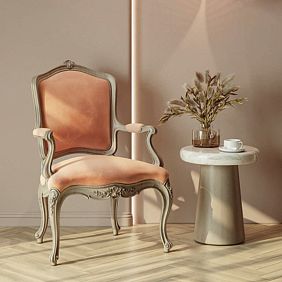
A classic chairThe STAVROS model of the 'Comfort+' series is manufactured with a seat height of 460 mm (adjustable upon order 450-480 mm for a specific person's height — personalization is important, height varies). Externally, the armchair is indistinguishable from a standard classic armchair (carved oak legs, upholstery in velour, jacquard, tapestry, Baroque, Empire, English classic style), but the ergonomics are adapted: the seat is 40 mm higher, which is unnoticeable to the eye (proportions preserved, legs slightly longer), but critical for safety, comfort.
Check: ask your parents to sit in the chair, measure the knee angle with a protractor, angle gauge (smartphone app). If the angle is 85-90 degrees — the seat is low, needs raising. If 95-105 — optimal. If more than 110 — too high (feet don't reach the floor, circulation is impaired, legs go numb, uncomfortable to sit for long). Individual approach: height depends on height, leg length, joint condition (with severe arthrosis better 470-480, with mild 460).
Our factory also produces:


Armrests: Support When Standing Up and Protection from Falls
Armrests on chairs, armchairs are perceived as additional comfort, a place to put hands, elbows while sitting. For the young, this is indeed an additional option, often ignored (chairs without armrests are popular in modern interiors — minimalism, lightness, compactness). For the elderly, armrests are a necessity, a critical safety element, without which an armchair becomes dangerous.
Armrest functions for the elderly: support when standing up (a person leans on the armrests with their hands, transfers part of their body weight to their arms, easing the work of the legs, reducing the load on the knees and hips), support when sitting down (when sitting, a person controls the lowering of their body with their hands, does not fall into the chair abruptly, which is traumatic for the spine and tailbone), stabilization when sitting (leaning elbows on the armrests, a person unloads the spine, sits straighter, gets less tired), protection from slipping (armrests limit sideways body movement, prevent slipping from the chair and falling to the floor).
Armrest requirements: height 200-250 mm from the top surface of the seat (elbow bent at 90 degrees, arm rests on the armrest without tension in the shoulders and neck — comfortable for prolonged sitting, effective when standing up). Armrest length 300-400 mm (sufficient to support the entire forearm, distributing the load when standing up). Armrest width 60-80 mm (sufficient for a comfortable palm grip and stable support). Strength: the armrest must withstand a load of 40-60 kg (half the weight of a person weighing 80-120 kg) without deformation, sagging, or creaking — this is critical when standing up, when a person leans their weight on the armrests.
Armrest material: hardwood (oak, beech, ash) — strong, durable, non-slip (wood texture creates friction, the palm does not slip when leaning), aesthetically pleasing (solid wood fits into a classic interior, carved armrests with milled profiles and curves — an ornament to the chair). Contraindicated materials: plastic (slippery, palm slips when leaning, fragile, breaks under load), metal (cold, unpleasant to the touch, slippery, hazardous in case of impact).
Mounting construction: armrests must be rigidly attached to the chair frame, without play or wobble. Mounting types: through-bolt with M8-M10 bolts (bolt passes through the armrest and frame, tightened with a nut — maximally strong, but bolt heads are visible and need to be covered with wooden plugs), on dowels with glue (wooden cylinders 10-12 mm in diameter inserted into holes in the armrest and frame, fixed with glue — strong, aesthetically pleasing, bolts are not visible), on dovetail tenons (traditional woodworking joint, maximally strong, glue-free, but complex to manufacture, expensive).
A classic chairSTAVROS has armrests made of solid oak, 70 mm thick, 230 mm high from the seat, 380 mm long — optimal for support when standing up. Mounting with M10 bolts and wooden plugs (bolt is screwed from below, head is hidden, armrest holds firmly, withstands a load of 80 kg without sagging). Armrest shape is anatomical: slightly curved outward, following the natural position of the arm, comfortable for prolonged sitting, convenient for gripping when standing up.
Get Consultation
Absence of sharp corners: prevention of injuries from falls
Sharp furniture corners are an invisible danger, ignored by the young (falls are rare, coordination is good, they avoid obstacles intuitively), critical for the elderly. Injury statistics: 15-20% of fractures, bruises, and lacerations in the elderly 70+ occur from impacts on furniture (table corner, chair back, cabinet leg). Falls are inevitable: loss of balance, dizziness when standing up (orthostatic hypotension — pressure drops sharply when transitioning from sitting to standing, blood does not have time to reach the brain, the brain experiences oxygen deprivation, the person loses consciousness and falls), tripping over carpets, wires, stumbling over thresholds — common causes.
When falling, an elderly person does not have time to brace themselves (reaction is slowed), falls uncontrollably, hitting their head, sides, and limbs on furniture. Impact on a sharp table corner 750 mm high (standard dining table height) when falling from one's own height (160-170 cm) creates an impact force of 300-500 joules (comparable to a hammer weighing 1 kg falling from a height of 30-50 cm). Consequences: skin laceration (requires stitches), rib fracture (from a side impact on a table corner), skull fracture (from a head impact on a cabinet or dresser corner), internal bleeding (from an abdominal impact on a dresser corner).
Gerontodesign eliminates sharp corners: tables, dressers, cabinets, chairs have rounded corners with a radius of 15-30 mm (the corner is not sharp but rounded, upon impact the force is distributed over a larger area, reducing trauma by 60-80%), processed by sanding (smooth, without burrs or splinters). Classic solid wood furniture traditionally has rounded corners — this is not only aesthetics (smooth lines, elegance of form, characteristic of Baroque, Rococo, Classicism) but also a safety function, historically important (in the 18th-19th centuries, homes housed the elderly and children, sharp corners were intuitively avoided).
Furniture legs: protruding legs positioned wider than the body are dangerous (leg sticks out 50-100 mm beyond the edge of the table or cabinet — a person does not notice, catches on, trips, falls).Furniture for the elderlySTAVROS has legs positioned flush with the body or slightly recessed (the leg does not protrude, does not create an obstacle). Leg shape: conical, cylindrical, carved, but without sharp edges, corners, or protrusions that one could catch on.
Chair backs: high backs (900-1100 mm) are dangerous when falling backward (a person falls, their back hits the chair back, the spine is injured). Gerontodesign uses medium-height backs (700-850 mm, supporting the back up to the shoulder blades, comfortable for sitting, but do not create a risk when falling), tilted back at an angle of 100-110 degrees (anatomical angle, unloading the spine, eliminating sharp impacts).
Seat firmness: balance of comfort and functionality
Soft furniture — sofas, armchairs with spring blocks, 100-150 mm thick polyurethane foam filling, velour upholstery, creating a feeling of a cloud one sinks into when sitting — is popular, comfortable for the young, dangerous for the elderly. Problem: a soft seat sinks under body weight by 80-120 mm, creating a "pit" that is difficult to get out of. Standing up from a soft armchair requires 50-70% more effort than from a firm one (one must first push the body out of the pit upward, overcoming the resistance of the springs, then stand up — double the effort).
Biomechanics of standing up: optimal when the seat is firm (sags under body weight by 20-40 mm, no more), a person sits on a slightly resilient surface that does not sink. When standing up, the center of gravity easily moves forward (body leans), legs push off from the floor, the body rises without additional effort. On a soft seat, the center of gravity is shifted backward (pelvis sinks down, torso leans back on the backrest), moving it forward is difficult (one must first rise from the pit, then lean forward), legs push off inefficiently (part of the effort goes into overcoming the resistance of the springs and seat).
Seat firmness is measured in newtons per 100 mm of sag (standard test: a load of 500 newtons — approximately 50 kg — is placed on the seat, the sag in millimeters is measured, and firmness is calculated). Optimal firmness for the elderly: 60-90 N/100 mm (sag under a weight of 70 kg about 25-35 mm — comfortable for sitting, not hard like a board, but not soft like a down pillow). For comparison: standard sofas have a firmness of 30-50 N/100 mm (sag 50-80 mm — too soft), orthopedic chairs — 80-120 N/100 mm (sag 15-25 mm — firmer, but safer for the elderly).
Fillers: polyurethane foam with a density of 25-30 kg/m³ (standard for mass-produced furniture) creates a firmness of 30-40 N/100 mm — too soft. Polyurethane foam 35-45 kg/m³ (increased density) — 60-80 N/100 mm — optimal. Natural latex — 70-90 N/100 mm, plus elasticity (latex springs back, returns to shape instantly, comfortable for prolonged sitting). Serpentine springs (metal S-shaped springs attached to the frame) + 40 kg/m³ polyurethane foam on top — 70-100 N/100 mm, durable (springs do not sag for 20-30 years, unlike foam which sags after 5-10 years).
Furniture ergonomicsSTAVROS for the elderly: chair seats are made with serpentine springs (8-10 springs on a seat 600 mm wide, distance between springs 60-70 mm) + 40 kg/m³ density polyurethane foam 50 mm thick + 20 mm synthetic padding (soft surface layer for comfort) + upholstery. Firmness 75-85 N/100 mm, sag under a weight of 70 kg about 30 mm — comfortable for sitting for hours, safe for standing up without extra effort.
Stability: protection from tipping and sliding
Furniture that tips over when leaned on (a person leans on the chair back when standing up, the chair rocks, tips over, the person falls), sliding on the floor (a person sits on a chair, the chair slides back, the person falls past it) — a common cause of injuries in the elderly. Stability depends on the center of gravity (the lower, the more stable), the area of support (the larger, the more stable), and mass (the heavier, the harder to tip over).
Chair center of gravity: for lightweight chairs with high backs and a narrow base (legs positioned close together) the center of gravity is high, stability is low. For massive oak chairs with a wide base (legs spread wide, 500-600 mm between front and rear legs) the center of gravity is low, stability is high. Stability test: tilt the chair 15-20 degrees sideways (simulating a person leaning when standing up) — if the chair returns to its original position, it is stable; if it continues to tilt and tips over — it is unstable, dangerous.
Chair mass: lightweight chairs made of pine, plywood weighing 8-12 kg are easily moved and tipped over. Heavy chairs made of oak, beech weighing 18-25 kg are stable, do not move when leaned on, do not tip over.A classic chairSTAVROS made of solid oak weighs 22-28 kg (oak frame, spring+foam filler, velour upholstery) — mass is sufficient for stability, preventing tipping or shifting during normal use.
Anti-slip pads: felt or rubber pads 3-5 mm thick are glued to furniture legs, preventing sliding on laminate, tile, linoleum (coefficient of friction of rubber on laminate 0.6-0.8 vs. 0.2-0.3 for wood on laminate — three times higher, furniture does not slide). STAVROS equips all furniture with felt pads (felt is softer than rubber, does not scratch the floor, leaves no marks, yet does not slide, coefficient of friction 0.5-0.7).
Leg construction: four legs positioned at the corners of a rectangular base — a classic, stable scheme. Three legs — less stable (the center of gravity must be strictly inside the triangle formed by the legs, otherwise tipping occurs). Central support (one thick leg in the center) — extremely unstable, dangerous (used only in office chairs on casters with a counterweight). Classic furniture is traditionally four-legged — this is ergonomics tested over centuries.
Lighting and color contrasts: compensation for deteriorating vision
Vision after 70 deteriorates irreversibly: cataracts reduce contrast (white appears gray, black appears dark gray, boundaries are blurred), macular degeneration destroys central vision (acuity drops, small details are not visible), glaucoma narrows the field of vision (periphery is lost, leaving "tunnel" vision). An interior designed without considering age-related vision becomes dangerous: an elderly person does not see the edge of a step (step and floor are the same color, contrast is absent, boundary is blurred), does not notice a chair (chair is dark, floor is dark, they blend), bumps into furniture, falls.
Color contrasts: furniture should contrast with the floor and walls in brightness. Dark furniture (stained oak, wenge) on a light floor (natural oak parquet, light laminate) — clearly visible, boundary is sharp. Light furniture (bleached oak, natural beech) on a dark floor (wenge, dark walnut) — similarly. Dangerous: dark furniture on a dark floor (stained oak on wenge — they blend, boundary is not visible), light on light (natural beech on maple — similarly).
Upholstery for armchairs and sofas: bright, contrasting fabrics (red, blue, green velvet, velour) are more visible than neutral ones (gray, beige, brown). However, bright colors are not always appropriate in a classic interior (Baroque, Classicism suggest calm tones — burgundy, emerald, dark blue, not acidic bright ones). A compromise: dark saturated colors (burgundy, emerald green, sapphire blue) against a light background of walls and floor — they are excellently visible, elegant, and classic.
Lighting: the elderly require 2-3 times higher illumination than the young (retinal sensitivity decreases, the lens becomes cloudy, less light reaches the retina). The illumination norm for the young is 150-200 lux (living room, bedroom), for the elderly 300-500 lux. Light sources: ceiling lights (general lighting), floor lamps near armchairs (local lighting for reading), wall sconces (additional lighting for passages, corridors), nightlights in the bedroom, bathroom (night navigation without turning on bright light, which is not blinding after sleep).
Lamp type: LED lamps with a neutral white spectrum of 4000K (not cold 6000K — too harsh, not warm 2700K — too yellow, distort colors, reduce contrast), high power 12-20 W (equivalent to a 100-150 W incandescent bulb), with a color rendering index CRI of 80-90 (colors are rendered naturally, contrasts are preserved). Adjustable brightness (dimmer) — a plus: you can increase light for reading, decrease it for watching TV, adapt it to the task and time of day.
Upholstery fabrics: practicality and tactile comfort
Furniture upholstery comes into contact with skin and clothing dozens of times a day, for hours when sitting. For the elderly, the following are critical: hypoallergenicity (skin is sensitive, prone to irritation, dermatitis, upholstery should not contain allergens), ease of cleaning (spilled tea, food crumbs — frequent incidents, upholstery should be easily cleaned with a damp cloth, not absorb stains), durability (the armchair is used daily for 5-10 years, upholstery should not wear out, tear, or fade), tactile comfort (pleasant to the touch, not rough, not prickly, not slippery).
Types of fabrics: velour (cotton, viscose, polyester) — soft, pleasant to the touch, medium durability (15,000-25,000 abrasion cycles according to the Martindale test), medium cleaning difficulty (water stains are removed with a damp cloth, grease stains require dry cleaning), hypoallergenic (if it does not contain synthetic dyes). Jacquard (woven pattern, cotton+polyester) — durable, high durability (25,000-40,000 cycles), easy cleaning (stains are removed with soapy water), hypoallergenic, tactilely comfortable (smooth but not slippery). Tapestry (thick woven fabric, cotton+wool+synthetic) — maximally durable (40,000-60,000 cycles), medium cleaning difficulty (vacuum, damp cloth, dry cleaning once a year), hypoallergenic (if wool does not cause allergies), tactilely warm, cozy.
Contraindicated fabrics: genuine leather — slippery (an elderly person sits, slides forward, has to constantly adjust, uncomfortable), cold (unpleasant to the touch in winter without heating), expensive (an armchair with leather upholstery costs 50-100% more than a similar one with fabric). Faux leather (eco-leather, leatherette) — does not breathe (skin sweats, sticks to the upholstery, discomfort during prolonged sitting), wears out quickly (cracks, peels after 3-5 years), looks cheap (associated with office, medical furniture, not classic interiors).
Upholstery color: practical colors — dark, saturated (burgundy, emerald, dark blue, brown) hide small stains, dirt, do not require frequent cleaning. Impractical — light (beige, cream, gray) show every stain, require cleaning every week. Patterned fabrics (jacquard, tapestry with ornament) hide dirt better than plain ones.
Furniture for the elderlySTAVROS is upholstered with velour, jacquard, tapestry (at the customer's choice) from Italian, Turkish manufacturers, certified according to the Oeko-Tex 100 standard (hypoallergenicity, absence of toxic dyes, safety for skin contact). Colors: classic palette (burgundy, emerald, dark blue, brown, golden) — practical, elegant, fitting into classic Baroque, Empire, English classic interiors.
Case 1: Adapting a living room for a 68-year-old mother with arthrosis
Client: a 42-year-old woman, her 68-year-old mother lives with her in a three-room apartment of 85 sq.m, classic interior (solid oak furniture set from 1985 — wardrobe, chest of drawers, table, chairs, armchairs), the mother suffers from grade 2 knee arthrosis (walks independently but slowly, with pain, has difficulty getting up from an armchair, chair). Problem: the mother avoids the living room, sits in the kitchen on a hard chair with a height of 470 mm (easier to get up from), refuses the living room because the armchairs are low (seat height 400 mm), soft (old spring block, sagged, seat sinks by 100 mm), without comfortable armrests (armrests are narrow, 40 mm, slippery, polished to a shine, uncomfortable to lean on).
Solution: ordering twoclassic armchairsSTAVROS model "Ekaterina" (Empire style, carved legs, armrests with gilding, upholstered in burgundy velour) with individual parameters: seat height 465 mm (instead of standard 450), seat firmness 80 N/100 mm (snake springs + polyurethane foam 45 kg/m³), armrests wide 75 mm, long 400 mm, with anatomical curve, matte finish (non-slip). Cost: 78,000 rubles for two armchairs (standard similar models 65,000, surcharge for individual parameters 13,000). Production time: 5 weeks (standard 4 weeks, individual +1 week for design adaptation).
Result: the mother returned to the living room, sits in the armchair 3-4 hours a day (reads, watches TV, knits), gets up independently without her daughter's help (leans on the armrests, rises easily, without pain), stopped avoiding social activities (receives guests while sitting in the armchair, previously was embarrassed that she couldn't stand up to greet). Psychological effect: the armchair does not look "medical," does not stigmatize, the mother is proud of the beauty of the armchairs, shows guests the carving, upholstery, tells that they were ordered individually. Daughter: "Mom lives in the living room again, it changed her mood, activity, quality of life. It was worth every ruble."
Case 2: Furnishing an apartment for a 75-year-old father after a stroke
Client: a 48-year-old man, his 75-year-old father suffered an ischemic stroke (mild degree, paresis of the right hand, 70% recovery, walks independently with a cane, right hand weak, grip poor), lives in a separate two-room apartment of 55 sq.m, Soviet interior (chipboard furniture from the 1990s, chairs without armrests, low soft sofa). Problem: the father falls 1-2 times a month (loses balance when getting up from the sofa, leans with his right hand, the hand is weak, slips, the father falls to the floor), two falls ended in bruises, hematomas, once a wrist fracture (wore a cast for 6 weeks), is afraid to live alone but refuses to move in with his son ("I don't want to be a burden").
Solution: complete furniture replacement withsafe interiorSTAVROS: armchair seat height 470 mm, armrests massive oak 80 mm width, length 420 mm, rounded (easy to grip even with a weak hand, do not slip), upholstery jacquard dark green (father's favorite color, contrasts with the light floor); dining table oak with rounded corners radius 25 mm (prevents injuries from collision), four chairs with armrests seat height 470 mm (previously chairs without armrests, getting up was dangerous); bedside table height 600 mm (previously 450, the father bent over for the phone, lost balance, now reaches horizontally, safely); wardrobe for clothes with sliding doors (previously hinged, the father didn't have time to step away, the door hit, now sliding doors are safe). Cost: 320,000 rubles (armchair 42,000, table 65,000, chairs 4×18,000=72,000, bedside table 28,000, wardrobe 95,000, delivery, assembly 18,000). Time: 6 weeks production, 2 days delivery, assembly, removal of old furniture.
Result: the father has not fallen for 8 months after the furniture replacement (previously 1-2 times a month), confidently gets up from the armchair, chair (leans on the armrests with both hands, the right is weak, but together with the left it is sufficient), stopped being afraid to live alone, restored activity (goes for walks, meets friends, previously sat at home, afraid of falling). Son: "The first weeks I called daily, checking if he had fallen. Now I am calm, dad calls himself, tells how his day went. Safe furniture returned his independence to him, and peace of mind to me. It's priceless."
Why classic furniture is better than "medical"
"Medical" furniture for the elderly — armchairs with a lifting mechanism (electric drive raises the seat, pushing the person into a standing position), walkers, canes, beds with adjustable height — is functional but stigmatizing. Appearance: utilitarian, hospital-like (gray, beige faux leather, metal tubular legs, plastic parts), associated with infirmity, disability, nursing homes. Psychological effect: an elderly person using medical furniture perceives themselves as sick, dependent, loses self-respect, motivation for activity (why try to get up myself if the armchair will lift me automatically).
Classic FurnitureClassic furniture made of solid wood, adapted to the needs of the elderly (seat height 460-480 mm, sturdy armrests, seat firmness 70-90 N/100 mm, rounded corners, stability), is functionally equivalent to medical furniture (ensures safety, ease of getting up, reduces the risk of falls) but aesthetically superior. Appearance: elegant, prestigious (carved legs, gilding, upholstery in velour, jacquard, tapestry, classic styles Baroque, Empire, English classic), associated with luxury, culture, dignity. Psychological effect: an elderly person sitting in a beautiful classic armchair perceives themselves as respected, valuable, the master of the house, retains self-respect, motivation for activity (I try to get up myself because I can, the armchair helps but does not replace me).
Social aspect: medical furniture is hidden (placed in the bedroom where guests don't see it, the elderly person is embarrassed to show it), classic furniture is displayed (placed in the living room, dining room, the elderly person is proud of its beauty, shows it to guests, tells about the carving, wood species, upholstery). Guests, seeing beautiful furniture, admire the taste, status of the owner, not noticing that the furniture is adapted (seat height, armrests are invisible to a non-specialist, seem simply features of the style). The elderly person receives social reinforcement (compliments, admiration), which improves mood and self-esteem.
Economic aspect: medical furniture is cheap (a lift armchair 35,000-60,000) but short-lived (the electric drive breaks down after 3-5 years, faux leather upholstery cracks after 2-3 years, appearance deteriorates quickly), does not retain value (after 5 years the armchair looks old, worn out, unusable, is thrown away). Classic furniture is expensive (a solid oak armchair 40,000-80,000) but durable (serves 30-50+ years without loss of function, beauty), retains value (antique solid oak furniture after 50 years is worth more than new, is passed down to children, grandchildren as a family heirloom). Depreciation: medical armchair 50,000 / 5 years = 10,000 rub/year, classic 65,000 / 40 years = 1625 rub/year — classic is 6 times more cost-effective in the long term.
Createsafe interiorSTAVROS creates furniture for parents 70+, where function does not contradict beauty, where ergonomics is built into classic aesthetics, where every armchair, table, wardrobe is not a medical device but a piece of furniture art, adapted to the changing needs of the body, preserving the unchanging beauty of the spirit, the dignity of the individual. Gerontodesign is not a concession to old age, but respect for age, care for parents expressed not in pity but in practical elegance, safe luxury, functional beauty. Invest in furniture that will serve for decades, protect from falls, preserve independence, give comfort, not reminding daily of age, but allowing you to enjoy life in an interior worthy of the years lived.