Article Contents:
- Why architraves are needed: function and aesthetics
- Hides installation irregularities
- Protects reveals from damage
- Creates architectural graphics
- Defines interior style
- Types of architraves: from simple strips to carved masterpieces
- Flat architraves: minimalism of form
- Profiled architraves: play of profile
- Carved architraves: three-dimensional decor
- Telescopic architraves: universal solution
- Wood species for architraves: character and durability
- Oak architrave: the king of reliability
- Beech architrave: strength and lightness
- Pine architrave: economical option
- Ash architrave: light expressiveness
- Calculating the number of architraves for a door opening
- Standard door opening: how many strips are needed
- Non-standard openings: tall, wide, arched
- How to avoid calculation errors
- Where to buy architraves in St. Petersburg: by linear meter or in sets
- Construction hypermarkets: selection exists, quality is questionable
- Door showrooms: beautiful but expensive
- Molding manufacturers: price, quality, assortment
- Architrave installation: DIY or professional
- Installation Tools
- Installation Technology
- Common Installation Mistakes
- Is it worth hiring a professional
- Caring for wooden architraves: how to preserve beauty
- Regular Cleaning
- Recoating
- Protection against damage
- Humidity and Temperature
- Frequently Asked Questions
- Which profile should be chosen for the moulding?
- Can architraves be painted white?
- How much does an oak architrave cost?
- What is the difference between casing and molding?
- Can casing be used for windows?
- Where to buy casing of non-standard length?
- Is delivery needed or can I pick it up myself?
- Conclusion: framing that creates the interior
Do you know what distinguishes a well-thought-out interior from a random collection of items? Details. Those very little things that most people don't notice, but which are subconsciously perceived by the eye and create a sense of completeness, quality, and taste. A door without casing is a bare opening, a technical hole in the wall, reminiscent of unfinished repairs. A door framed with solid oak casing with a beautiful profile is an architectural element that unifies space, creates rhythm, and turns a functional structure into part of a composition.
Casing seems like a small thing. Just a few strips around a door or window opening. But try removing them—and you'll see how the interior falls apart, loses coherence, becomes unfinished. Casings are frames for doors and windows, like a frame for a painting. An incorrectly chosen frame can ruin even a good canvas. The right one elevates it. The same goes for casings. A cheap plastic strip 'under wood' kills the impression even of an expensive door. Solid oak casing with a figured profile turns an ordinary door into an element of a classic interior.
And the questionwhere to buy wooden mouldingsof quality, made from real solid wood, not MDF under veneer, concerns everyone who takes renovation seriously. Because casings are not consumable materials that are replaced every five years. They are elements that last for decades, and they must be chosen once and for all.


Why casing is needed: function and aesthetics
At first glance, casing performs a simple task: it covers the gap between the door (or window) frame and the wall. Technically, even a piece of plastic can solve this task. But if you dig deeper, casing does much more.




Hides installation imperfections
A perfectly installed door frame is rare. Usually, there are gaps of varying widths between the frame and the wall: 5 mm in some places, 15 mm in others. Plaster or putty around the frame rarely lays perfectly flat. Casing covers all these flaws, creating a neat frame 70-90 mm wide, under which all imperfections are hidden.
Without casing, you would have to make the joint between the frame and the wall perfectly—plaster, putty, sand, paint. This is labor-intensive, expensive, and the result is rarely flawless anyway. Casing solves the problem elegantly: it covers the joint, and the issue is resolved.
Our factory also produces:


Protects slopes from damage
Doorway corners are the most vulnerable spots. Bags, suitcases, and furniture hit them when moving. Plaster or wallpaper on corners quickly gets torn, chips and dents appear. Casing takes the blows, protecting the wall. Wood is stronger than plaster, and even if the casing gets scratched or chipped, it can be sanded or one strip replaced without touching the entire finish.
Get Consultation
Creates architectural graphics
Doors and windows are rhythmic elements of the interior. They repeat, creating a pattern. Casings emphasize this rhythm by framing each opening with the same frame. This creates visual order, harmony, and completeness.
Imagine a corridor with five doors without casings. Five uneven openings, five different joints between walls and frames. Chaos. Now imagine the same five doors framed with identical wooden casings. Order, rhythm, symmetry. The space is organized, structured.
Defines the interior style
The shape of the casing is a style marker. A simple rectangular casing—minimalism, Scandinavian style, loft. A figured casing with flutes (vertical grooves)—classic, neoclassical. A carved casing with ornament—Baroque, Rococo, Provence. The same door opening with different casings will look like an element from different eras.
Wooden casingmade from solid wood allows you to choose a shape that matches your interior style and create a unified composition.
Types of casings: from simple strips to carved masterpieces
Casings differ in shape, profile, and mounting method. Let's break down the main types.
Flat casings: minimalism of form
A flat casing is a rectangular strip without milling, with a flat surface. The simplest, most laconic look.
Dimensions: width 70-90 mm (standard), thickness 10-15 mm.
Profile: rectangular cross-section, sometimes with slight rounding of edges (so they're not sharp).
Style: minimalism, modern style, Scandinavian, loft. A flat casing doesn't attract attention; it serves as a background, a neutral frame.
Application: interiors where restraint, absence of decor, and purity of lines are important.
Advantages:
-
Simplicity (easy to make, easy to install)
-
Affordability (minimal processing)
-
Versatility (fits any doors)
Disadvantages:
-
Lack of decorativeness (if an accent is needed, a flat casing won't work)
Shaped casings: profile play
Shaped casing is a strip with a milled profile (roundings, steps, grooves). The profile creates a play of light and shadow, adds volume, decorativeness.
Profiles:
-
Rounded: the front side has a soft rounding (semi-oval). A classic profile suitable for most interiors.
-
Stepped: several planes of different depths creating a stepped relief. More decorative.
-
With flutes: vertical grooves (like on columns). A classic architectural element, suitable for neoclassicism, empire style.
-
Combined: a combination of roundings, steps, grooves. A complex profile for luxurious interiors.
Dimensions: width 70-120 mm (the more complex the profile, the wider the casing), thickness 15-20 mm.
Style: classic, neoclassical, American classic, Provence, country.
Application: interiors where decorativeness, tradition, and architectural quality are valued.
Advantages:
-
Decorativeness (shaped profile creates an accent)
-
Versatility (suitable for most classic styles)
-
Variety (dozens of profiles to choose from)
Disadvantages:
-
More expensive than flat ones (more complex processing)
-
More difficult to join corners (the profile must match exactly)
Carved casings: three-dimensional decor
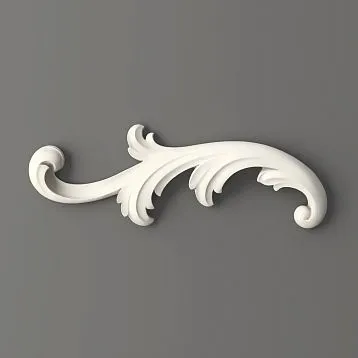
Carved casing is a strip with three-dimensional carving (leaves, scrolls, rosettes, ornaments). This is no longer just a functional element, but a work of decorative and applied art.
Manufacturing: CNC carving based on a 3D model (for serial ornaments) or hand carving (for exclusive projects).
Dimensions: width 100-150 mm (carving requires space), thickness 20-30 mm (carving must have depth).
Style: Baroque, Rococo, Empire, Oriental style. Carved casings are a choice for luxurious, palatial interiors.
Application: living rooms, formal rooms, dining rooms in homes where the budget allows for creating unique interiors.
Advantages:
-
Maximum decorativeness (carved casing is a work of art)
-
Uniqueness (each ornament is one-of-a-kind)
-
Prestige (wood carving is a marker of luxury)
Disadvantages:
-
High price (labor-intensive manufacturing)
-
Not suitable for all styles (carving is inappropriate in minimalism)
-
Complex maintenance (dust gets trapped in the carving, requires regular cleaning)
Telescopic architraves: a universal solution
A telescopic architrave is an architrave with a longitudinal groove that allows adjusting the architrave width and assembling the trim without nails (using snap-on fasteners).
Construction: the architrave consists of a main strip and an insert (extender) that fits into the groove of the main strip. By changing the insert depth, you can adjust the overall width of the architrave (e.g., from 70 to 100 mm).
Mounting: the architrave is attached to door jamb extensions (door frame expanders) via a groove (without nails, screws). This creates a clean installation with no visible fasteners.
Advantages:
-
Adjustability (the same architrave fits different wall thicknesses)
-
Clean installation (no nails, studs, fastener heads)
-
Easy disassembly (can be removed and reinstalled without damage)
Disadvantages:
-
More expensive than regular architraves (more complex construction)
-
Requires precise fitting (the groove must perfectly align with the extension groove)
Application: interior doors with extensions, openings with non-standard wall thickness.
Wood species for architraves: character and durability
Architraves are made from various wood species. The choice of species determines strength, color, texture, and price.
Oak architrave: the king of reliability
Oak casing— the best choice in terms of overall characteristics.
Strength: oak is one of the hardest species (density 700-800 kg/m³). An oak architrave withstands impacts, does not chip, and lasts for decades.
Texture: expressive, with bright annual rings, rays (light stripes running perpendicular to the rings). Oak is a wood with character; its texture is clearly visible even under varnish.
Color: from light yellow (young oak) to dark brown (bog oak). Over time, oak darkens, acquiring a noble shade.
Stability: oak, dried to 8-10%, hardly reacts to humidity changes. An oak architrave does not warp or crack.
Style: universal. Classic, modern, loft, country — oak fits everywhere.
Price: oak is expensive wood (50-100% more expensive than beech, pine). But it's an investment in durability.
Application: entrance doors, interior doors in formal areas (living room, dining room, study), windows (interior trim of reveals).
Beech architrave: strength and lightness
Beech door casing— an excellent alternative to oak if light-colored wood is needed.
Strength: beech is only slightly inferior to oak (density 650-700 kg/m³). A beech architrave is strong and durable.
Texture: uniform, fine-pored, without pronounced annual rings. Beech looks calmer and more neutral than oak.
Color: light, pinkish-cream. Beech is ideal for light interiors where oak would be too dark.
Flexibility: beech bends well after steaming. If curved architraves are needed (for arched openings) — beech is optimal.
Staining: beech takes tinting and painting perfectly. If a white, gray, or colored architrave is needed — beech is the best choice.
Price: beech is 20-30% cheaper than oak, but more expensive than pine.
Application: interior doors, windows, arched openings, interiors in light tones (Scandinavian style, Provence).
Pine architrave: an economical option
Pine is the cheapest and most accessible wood for architraves.
Strength: pine is soft (density 450-500 kg/m³). A pine architrave scratches easily, may have knots, and resin pockets.
Texture: pronounced (alternation of light and dark annual ring stripes). Pine has a 'rustic' appearance.
Color: light yellow, honey-colored. Over time, pine yellows and darkens (especially under varnish).
Resin exudation: pine contains resin that can emerge on the surface (especially when heated). This requires special treatment (deresination).
Price: pine is 2-3 times cheaper than oak and beech.
Application: dachas, country houses in rustic style, budget projects. For city apartments, classic interiors, pine is not recommended (low strength, presence of knots).
Recommendation: if the budget is limited but you want quality, it's better to choose beech than pine. The price difference is not that great, but the quality difference is huge.
Ash architrave: light expressiveness
Ash is a wood similar to oak in strength, but lighter and with a more contrasting texture.
Strength: ash is not inferior to oak (density 650-750 kg/m³).
Texture: expressive, with clearly distinguishable annual rings, creating a contrasting pattern of waves and stripes.
Color: light, from whitish to light brown. Ash is the choice for light interiors with expressive texture.
Style: modern, Scandinavian, loft.
Price: close to oak.
Application: interior doors, modern interiors where light, expressive wood is valued.
Calculating the number of architraves for a door opening
It seems like a simple task: buy architraves for a door. But how many meters are needed? How to calculate? Let's break it down step by step.
Standard door opening: how many strips are needed
A door opening is framed with architraves on three sides: two vertical strips (on the sides) and one horizontal (on top). The fourth side (bottom) is not framed — here are the floor and threshold.
Standard door opening dimensions:
-
Height: 2000-2100 mm (from floor to top of frame)
-
Width: 800-900 mm (door leaf width, frame is 100-150 mm wider)
Calculating architrave length:
-
Two vertical strips: opening height + allowance for miter cuts. Height 2100 mm + 100 mm allowance = 2200 mm per strip. Two strips: 2200 × 2 = 4400 mm = 4.4 meters.
-
One horizontal strip: opening width + two architrave widths + allowance. Opening width 900 mm + (70 mm × 2) + 100 mm allowance = 1140 mm = 1.14 meters.
-
Total for one side of the opening: 4.4 + 1.14 = 5.54 meters ≈ 6 meters (including allowance, offcuts).
If the door is framed on both sides (interior door visible from both sides): 6 meters × 2 = 12 meters.
Standard architrave length: manufacturers sell architraves in strips of 2.2 meters (standard), 2.5 meters, 3 meters.
Number of strips per door (one-sided framing):
-
Two vertical strips of 2.2 meters each (enough with a margin for a height of 2.1 m)
-
One 2.2-meter strip (from which the horizontal part is cut out + a leftover piece remains)
Total: 3 strips of 2.2 meters per side.
For two-sided framing: 6 strips.
Non-standard openings: tall, wide, arched
Tall opening (3 meters and above): requires architraves 3 meters or longer. Ordered individually.
Wide opening (double-leaf door 1600-2000 mm): the horizontal strip must be longer. You will either have to order a long strip (3-4 meters) or join two strips (the joint is made at a 45° angle or straight, covered with a decorative overlay).
Arched opening: the architrave must follow the curvature of the arch. For this, a bent architrave (beech, steamed and bent to the arch radius) or a composite architrave (assembled from short segments) is used. Made to order.
How to avoid mistakes in calculation
Mistake 1: Did not account for cutting allowance. Architrave corners are cut at 45° (for joining vertical and horizontal strips). If the strip is exactly the size of the opening, it will end up shorter after cutting. Always take a 50-100 mm allowance per strip.
Mistake 2: Did not account for wall thickness. If the wall is thicker than the door frame, an extension (widener) is needed between the frame and the architrave. The extension is also framed with an architrave. Consider the width of the extension in your calculation.
Mistake 3: Forgot about the second side of the opening. Interior doors are usually framed on both sides. Consider this when ordering.
Tip: Buy architraves with a 10-15% surplus (one extra strip per set). If you damage a strip during installation (cut incorrectly, split), you will have a reserve. Extra strips will come in handy during the next repair (replacing a damaged architrave).
Where to buy architraves in St. Petersburg: by the meter or in sets
In St. Petersburg, architraves are sold by construction hypermarkets, door salons, and millwork manufacturers. Let's analyze where it's better to buy.
Construction hypermarkets: selection available, quality questionable
Advantages:
-
Accessibility (you can come, look, buy immediately)
-
Wide selection (dozens of items)
-
Average prices
Disadvantages:
-
Quality is inconsistent (architraves from different manufacturers, of varying quality, are mixed)
-
Often sell MDF with veneer, not solid wood (need to read labels carefully)
-
Limited choice of profiles (mostly simple, standard ones)
-
Strip lengths are fixed (usually 2.2 m, no option to order a different length)
For whom: for those who need it fast, cheap, standard.
Door salons: beautiful, but expensive
Advantages:
-
Architraves matched to doors (color, texture, style match)
-
Quality is usually above average
-
Consultants will help calculate the quantity
Disadvantages:
-
High prices (salons add a markup of 50-100%)
-
Limited selection (only trims for specific door collections)
-
Often sold in sets (cannot buy a single strip)
For whom: for those buying doors at a showroom and wanting to immediately complete them with trims.
Trim manufacturers: price, quality, assortment
Advantages:
-
Manufacturer's price (no intermediary markups, saving 30-50%)
-
Wide assortment (dozens of profiles, different wood species)
-
Quality controlled (manufacturer is responsible for every strip)
-
Custom length and individual profile available to order
-
Sold by the meter (can buy exactly as much as needed, or a single strip for replacement)
-
Delivery (no need to transport yourself)
Disadvantages:
-
Need to order in advance (if item is out of stock, production time is 1-2 weeks)
-
Not always a showroom (cannot see all items in person, but can order samples)
For whom: for those who value quality, want a wide selection, save on budget, and are willing to wait for production.
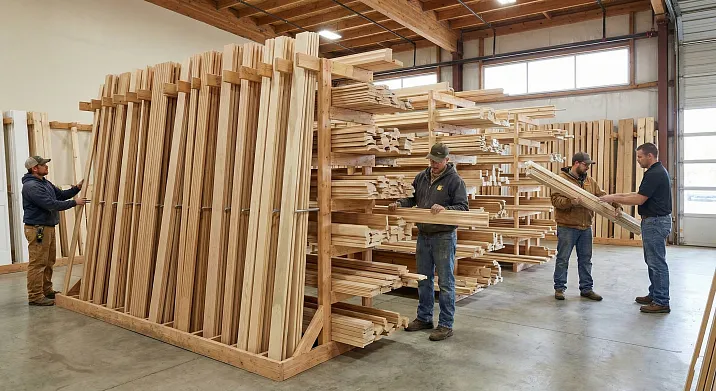
STAVROS — manufacturerof door trimsmade of solid oak, beech, ash. Dozens of trim profiles: from simple flat to shaped and carved. Sold by the meter (from 1 strip) or in sets (6 strips for two-sided framing of one door). Delivery in St. Petersburg 1-2 days. Possibility to order custom length (3-4 meters), individual profile, finish (oil, varnish, stain, patina, painting).
Trim installation: DIY or professional
Installing trims seems like a simple task. Cut at 45°, nail it — done. In practice, there are nuances that determine whether the joint will be neat or crooked.
Tools for installation
-
Miter saw (miter box with handsaw): for cutting 45° angles. A miter saw gives a perfectly even, precise cut. Miter box + handsaw is a budget option but less accurate (requires a steady hand).
-
Tape measure, pencil: for marking.
-
Square: checking right angles.
-
Level: checking vertical and horizontal alignment of trims.
-
Hammer, nail set: for driving nails (if fastening with nails).
-
Finish nails (brads): thin headless nails (diameter 1-1.5 mm, length 40-50 mm). Driven flush, almost invisible.
-
Glue: woodworking PVA or liquid nails (additional fixation, especially at corner joints).
Installation technology
-
Marking: measure the height and width of the door opening. Mark the cutting points on the trims.
-
Cutting angles: vertical trims are cut at 45° at the top (for joining with the horizontal). Horizontal trim is cut at 45° at both ends. Important: angles must be exactly 45°, otherwise the joint won't align.
-
Fitting: place trims against the opening, check if the corners align. If there's a gap — trim.
-
Fastening: trims are attached to the door frame (not to the wall!). Finish nails are driven at 300-400 mm intervals. The nail is not driven completely; the last 2-3 mm are set with a nail set (to avoid damaging the wood with the hammer). The nail head is countersunk 1 mm below the surface. Additionally, corner joints are glued (a drop of PVA on the end, press).
-
Finishing: countersunk nail heads are filled with wood filler (matched to the trim color), sanded after drying. Wipe dust off the trim, apply oil or varnish if necessary (if the trim was purchased unfinished).
Typical installation mistakes
Error 1: Corners don't meet (gap in the joint). Cause: inaccurate cut (not exactly 45°), uneven wall (wall not perpendicular to the frame). Solution: adjusting the angle, filling the gap with putty (if the gap is small, up to 1 mm).
Error 2: Casing doesn't fit flush to the wall (gap between casing and wall). Cause: uneven wall (bumps, depressions). Solution: if the casing is flexible (thin), it can be pressed with nails. If rigid — either level the wall or make the casing wider (so it overlaps the unevenness).
Error 3: Nails are visible (heads protrude, stand out). Cause: used regular nails (thick, with heads) instead of finish nails. Solution: use finish nails, countersink them, cover with putty.
Error 4: Casing installed crookedly (not vertical). Cause: didn't check with a level. Solution: check vertical with a level before fastening, adjust.
Should you hire a professional?
If you have a miter saw, experience working with wood, and a steady hand — installing casings won't be difficult. If not — it's better to hire a professional. The cost of installing casings on one door in St. Petersburg is 1000-2000 rubles. For this money, a professional will do it neatly, quickly, and the corners will meet perfectly. Saving 1000 rubles isn't worth crooked joints that will irritate you for years.
Caring for wooden casings: how to preserve their beauty
Solid wood casings last for decades but require minimal care.
Regular cleaning
Wipe casings with a dry or slightly damp cloth once every 1-2 weeks (during wet cleaning). This removes dust and prevents dirt buildup.
Do not use aggressive cleaning agents (abrasives, solvents, chlorine). They damage the finish.
Recoating
If casings are oiled, the oil wears off and absorbs over time. Renew the finish every 2-3 years: wipe casings with a slightly damp cloth (to remove dust), let dry, apply a thin layer of oil with a rag, let absorb for 10-15 minutes, wipe off excess.
If casings are varnished, the varnish lasts 5-10 years. If the varnish dulls or gets scratched — you can sand the casings with fine grit (320), reapply varnish.
Protection against damage
Casing corners are the most vulnerable spots (get bumped when moving furniture, suitcases). Be careful when carrying large items through the door.
If a casing gets a scratch or chip — not a problem. Minor scratches are filled with furniture wax (matched to the wood tone). Deep chips are filled with putty, sanded, touched up, or oiled.
Humidity and temperature
Wood reacts to changes in humidity and temperature. In dry conditions (winter, when heating is on) wood dries out, small cracks may appear. In humid conditions (spring, autumn) wood swells.
To minimize fluctuations, maintain stable humidity of 40-60% in the house (use humidifiers in winter, dehumidifiers in summer). This is beneficial not only for casings but for all wooden furniture, parquet, doors.
Frequently asked questions
Which casing profile should be chosen?
Depends on interior style. For minimalism, modern style — flat. For classic, neoclassical — profiled (rounded, stepped). For baroque, luxurious interiors — carved.
Can you paint a casing white?
Yes. Beech is best for painting (uniform texture, takes paint well). Painting is done with enamel (paint that hides wood grain). Color can be any: white, gray, black, colored.
How much does an oak casing cost?
Prices depend on profile, dimensions. Flat oak casing 70×15 mm — 500-800 rubles per linear meter. Profiled 90×20 mm — 800-1200 rubles. Carved 120×30 mm — 2000-4000 rubles.
What's the difference between casing and molding?
Casing — element for framing doors and windows (narrow strip 70-120 mm). Molding — decorative strip for walls, ceilings (can be any width, used to create panels, frame mirrors, divide planes).
Can casings be used for windows?
Yes. Casings are used for interior finishing of window reveals. A window framed with wooden casing looks complete, stylish, especially if the window is wooden.
Where to buy casings of non-standard length?
From millwork manufacturers (such as STAVROS). Standard strip length is 2.2 meters. If you need length 3, 4, 5 meters — order custom (production time 1-2 weeks).
Is delivery needed or can you pick up yourself?
STAVROS offers both options: delivery in St. Petersburg and pickup from the warehouse. Delivery is convenient for large orders (dozens of strips). Pickup saves time if you need it urgently.
Conclusion: framing that creates the interior
Architraves are not a minor detail. They are the element that determines whether your doors and windows will be architectural features or remain mere technical openings in walls. A solid oak or beech wooden architrave with a properly selected profile transforms an opening into a frame, creates rhythm, structures space, and completes the composition. It lasts for decades, protects reveals, conceals imperfections, and adds decorative appeal.
Choosing an architrave means choosing style, material, and quality. Flat or shaped, oak or beech, simple or carved—each option creates its own atmosphere. A flat ash architrave will say: here they value minimalism, Scandinavian restraint, and purity of lines. A carved oak architrave will say: here live people of means, taste, respect for tradition, who understand the value of handcrafted work.
The company STAVROS has been manufacturing architraves from solid oak, beech, and ash for over 30 years. Dozens of profiles: from simple flat to complex carved. Any sizes: standard 2.2 meters or custom up to 5 meters. Any finish: natural wood with oil, stained, patinated, painted with enamel. Sold by the meter (from 1 strip) or in kits (a ready-made set for a door). Delivery in Saint Petersburg within 1-2 days. Consultations on profile selection, quantity calculation, and installation.
When you buy architraves from the manufacturer STAVROS, you get a price without intermediary markups (saving 30-50% compared to showrooms), a quality guarantee from the source (each strip undergoes inspection), the widest assortment (hundreds of profile, wood species, and finish options), and the possibility of custom orders (your size, your profile, your finish).
Architraves are the finishing touch of a renovation, the detail that turns a set of materials into an interior. Don't skimp on what will serve for decades and define the impression of every door, every window. Choose solid wood. Choose quality. Choose STAVROS.