












































































Article Contents:
- Advantages of wooden skirting boards over MDF and plastic
- Types of skirting board profiles: from European to classic
- Upper edge shape: from straight to carved
- Wood species for skirting boards: from pine to oak
- Calculating skirting board linear footage for a room
- Installation of wooden skirting boards: mounting methods
- Angle cutting: miter box or miter saw
- Where to buy: STAVROS — molding manufacturer since 2002
- Popular models
- How to buy
- Frequently asked questions about wooden skirting boards

A skirting board is not a decorative whim, not an unnecessary luxury you can do without, but an architectural necessity that finishes the wall-floor junction, conceals the expansion gap (5-10 millimeters between the flooring and the wall, required for thermal expansion of parquet, laminate, plank flooring), protects the lower part of the wall from dirt, mechanical damage (vacuum cleaner, mop, foot impacts), and creates a visual frame for the room.Wooden baseboardSolid oak, beech, ash skirting boards are not a functional minimum, but an aesthetic dominant that sets the tone for the interior, connecting the floor and wall not mechanically but organically, like a tree root transitioning into a trunk. A plastic skirting board at 100 rubles per linear meter is a cheap imitation, hollow inside, flexible (bends when pressed with a finger), with a glossy surface imitating wood as convincingly as photo wallpaper imitates a window. An MDF skirting board at 200-300 rubles is a compromise, dense, paintable, but synthetic, lacking texture, the warmth of natural wood.
Wooden baseboardsSolid planks 60-160 millimeters high, 15-22 thick, 2-3 meters long, milled from solid oak, beech, ash blocks cost 800-2500 rubles per linear meter, 5-10 times more expensive than plastic, 3-5 times more expensive than MDF. But this price buys not just a finishing detail, but material authenticity, tactile warmth, visual depth of natural texture (annual rings, medullary rays, color transitions from light yellow to dark brown), durability of 30-50 years (plastic yellows, breaks after 10-15 years, MDF swells from moisture, crumbles upon impact), repairability (scratches on wood are sanded, tinting is renewed, the skirting board lasts for decades).
where to buy wooden baseboardsConstruction hypermarkets offer a limited selection — 3-5 pine models, simplest profiles, painted with cheap varnish, with defects (knots, resin pockets, milling irregularities). Specialized parquet, decor salons import skirting boards — Italian, German — high-quality, but with a 100-200% markup for brand, logistics, showroom infrastructure. The optimal solution is a manufacturersolid wood trimwith its own woodworking production, four-sided planers, drying chambers, a finished product warehouse with dozens of profiles in stock. Company STAVROS — a St. Petersburg manufacturer since 2002 — offersWooden baseboards30+ profiles 60-160 millimeters high, made of solid oak, beech, ash, pine, with oil finish (8 shades), varnish, untreated (for self-painting). Warehouse in St. Petersburg, delivery to Moscow, regions, online linear footage calculation, installation technical support.


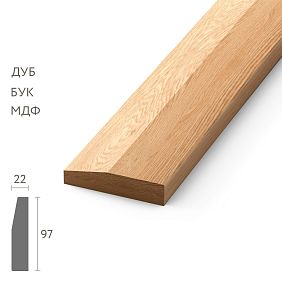


Advantages of wooden skirting boards over MDF and plastic
Natural texture — wood is unique, each plankSolid Wood Skirting Boarddiffers in annual ring pattern, arrangement of medullary rays (radial lines visible on oak, beech with radial cut), color transitions. MDF is homogeneous — each plank is identical to the next, creating monotony, artificiality. Plastic imitates texture with a printed pattern — a photograph of wood applied to film, glued onto a PVC base. The imitation is convincing from 2-3 meters away, but breaks down upon close inspection, touch (cold smooth surface, repeating pattern, visible film seams).
Tactile warmth — wood is warm to the touch (thermal conductivity 0.15-0.20 W/(m·K), slowly releases hand heat, feels pleasant), MDF is neutral (thermal conductivity 0.10, but synthetic structure feels colder), plastic is cold (thermal conductivity 0.16, but high heat capacity quickly draws heat, feels icy). The difference is subtle, not obvious, but significant — touch an oak skirting board with your palm, then a plastic one, the difference is noticeable.
Durability — oak skirting board lasts 50+ years without visible degradation (oak lies for centuries in old houses, palaces, only darkens, acquiring a noble patina). Beech, ash — 30-40 years. Pine — 20-30 (pine is softer, scratches easier, but with careful handling lasts decades). MDF lasts 15-25 years, then degradation begins: delamination upon moisture exposure (leaks, wet cleaning with excess water), crumbling upon impact, fading of painted surface. Plastic yellows from ultraviolet light (especially white), becomes brittle from temperature fluctuations (cracks near cold walls in winter), decorative film peels off.
Eco-friendliness — wood is natural, safe, non-toxic (if coated with natural oil, wax, water-based varnish). MDF contains formaldehyde resins — binder gluing wood fibers — emission class E1, E0 (low formaldehyde emission, safe for living spaces), but still synthetic. Plastic — polyvinyl chloride (PVC) — when heated (nearby heating radiator, summer sun) releases volatile organic compounds, harmless in small concentrations, but noticeable by the 'new plastic' smell.
Repairability — a scratch on a wooden skirting board can be sanded with fine-grit sandpaper P220-P320, retouched with a wax pencil or oil to match the tone, restoring the original appearance. A dent from impact is filled with wood putty, sanded, tinted. A sun-faded skirting board is sanded, coated with oil or varnish anew — renewed. MDF cannot be repaired — a scratch, chip remains forever, painted surface does not allow local restoration (requires repainting the entire skirting board, which is labor-intensive). Plastic is not repairable at all — broken, cracked skirting board is replaced.
Sound insulation — wood absorbs sound (porous structure, especially pine, ash, dampens vibrations), reducing resonance of footsteps, floor impacts. Plastic, MDF resonate — amplify impact sound. The difference is insignificant for one skirting board, but in a room with a perimeter of 20 meters (standard room 5×5 meters, perimeter (5+5)×2=20) wooden skirting boards create a noticeably more acoustically comfortable environment.




Types of skirting board profiles: from European to classic
European skirting board (Scandinavian, modern) — rectangular or trapezoidal plank 60-100 millimeters high, 15-18 thick, with straight edges, no decorative protrusions, chamfers, roundings. Profile maximally laconic — vertical or slightly tilted backward (angle 85-88 degrees from the floor) plane, upper edge straight or with minimal 1-2 millimeter chamfer. European skirting board is characteristic of minimalism, Scandinavian, loft, contemporary styles, where purity of lines, absence of decorative excess is important. Installing European skirting board is simpler than classic — straight edges, straight angles, joints cut at 90 degrees (no need for 45-degree cuts as with profiled skirting boards with protrusions).
European skirting board 60-80 millimeters high — standard for rooms with ceilings 2.5-2.7 meters, where a high skirting board would visually lower the ceiling. European skirting board 80-100 — for ceilings 2.8-3.0, creates a sense of solidity without excessive massiveness. European skirting board above 100 is rare — becomes visually heavy, suitable only for very high ceilings 3.5+ (lofts, reconstructed factories, modern country houses with double-height spaces).
Classic profile skirting board — a plank 80-160 millimeters high with a shaped top edge: a projecting shelf (cavetto), roundings, concave sections (flutes), sometimes carved ornaments. The classic profile creates a play of light and shadow, visual complexity, and richness characteristic of Neoclassicism, Classicism, English, and French styles. The height of a classic skirting board is selected according to the ceiling height and room scale: for standard 2.7 meters, the optimum is 80-100 millimeters; for high ceilings of 3.0-3.5 meters — 120-140; for palatial ceilings of 3.5-4.5 meters — 140-160.
Wide Wooden Skirting Board120-160 millimeters — a trend of the 2020s, reviving the tradition of high skirting boards from the 19th to early 20th centuries, when skirting boards 15-20 centimeters high were the norm in urban mansions and estates. A wide skirting board visually raises the ceiling (creating the impression that the wall starts higher), structures the space (a clear horizontal line along the room's perimeter), and protects the wall more effectively than a narrow one (the protection area is twice as large). A wide skirting board requires high ceilings — on ceilings of 2.5-2.7 meters, a 140+ mm skirting board looks disproportionate and overwhelming. On ceilings of 3.0+ meters — it is harmonious and monumental.
Skirting board with cable channel — a modern modification where a cavity is provided inside the skirting board for laying electrical, television, and internet cables. The top cover of the skirting board is removable (snaps onto clips or is secured with screws), allowing cables to be laid and hidden from view. A cable channel is justified for offices, media rooms where there is a lot of wiring, but in residential interiors, it is often excessive (it is sufficient to lay cables behind the skirting board, not inside). Solid wood skirting boards are rarely made with a cable channel (requires routing a groove from the inside, weakening the structure); cable channels are more often implemented in MDF and plastic skirting boards.
Our factory also produces:


Top edge shape: from straight to carved
Straight top edge — characteristic of Euro skirting boards, minimalist profiles, where the skirting board is a neutral background, not attracting attention. A straight edge is technologically simple (does not require milling a complex profile), inexpensive, and universal.
Cavetto (shelf) — a forward-projecting horizontal section of the top edge, 5-15 millimeters wide, creating a step. The cavetto is a classic profile element, referencing architectural cornices and column plinths. The cavetto creates a shadow (the lower plane of the skirting board remains in shadow, visually receding) and emphasizes the horizontal line.
Rounding (bead) — a smoothly curved top edge, transitioning from the vertical plane of the skirting board to the wall without a sharp angle. Rounding softens the profile, makes the skirting board pleasant to the touch (no sharp edges), and suits classical, Provencal, and country interiors.
Flutes (vertical grooves) — narrow concave strips, milled along the entire length of the skirting board, creating a vertical rhythm. Flutes reference ancient columns and are characteristic of Classicism, Empire, and Neoclassicism. Flutes are labor-intensive to manufacture (require multi-pass milling), collect dust (need to be wiped more often), but create visual luxury.
Carved ornaments — acanthus leaves, rosettes, meanders, milled on the top edge or central part of the skirting board — the pinnacle of decorativeness, characteristic of Baroque, Rococo, and palatial interiors. Carved skirting boards are unique, expensive (2000-3500 rubles per linear meter versus 800-1500 for simple ones), and suitable for premium projects.
Get Consultation
Wood species for skirting boards: from pine to oak
Pine — an affordable species (skirting board 600-900 rubles per linear meter), soft (density 500 kg/m³), light (yellow-white with pronounced annual rings), resinous (contains resin pockets — dark areas that exude resin). Advantages: price, availability, lightness (skirting board weighs 0.8-1.2 kilograms per meter, easy to transport, cut, and install). Disadvantages: softness (scratches easily, dents upon impact), resinousness (resin exudes when heated by radiators or sun, requires desinification before varnishing), low prestige (pine is associated with budget and dachas).
Pine is optimal for dachas, country houses, secondary spaces (hallways, storage rooms) where the budget is limited, functionality is important, and premium aesthetics are not critical. For urban, representative interiors, pine is not solid enough.
Beech — mid-range (skirting board 1000-1500 rubles), a hard species (density 650 kg/m³), uniform structure (fine pores, almost no visible grain), light pink color (after staining becomes reddish, brown, dark chocolate). Beech mills well — the profile comes out clear, without chips or fuzz. Advantages: moderate price, hardness, aesthetically pleasing warm color, good stainability (beech evenly accepts stains, oils, creating saturated tones). Disadvantages: hygroscopicity (beech actively absorbs moisture, swells with humidity fluctuations of 40-70%, requires a stable microclimate), less prestige than oak.
Beech is optimal for interior spaces with good ventilation, stable humidity (bedrooms, living rooms, studies) where a balance of price and quality is important, and the possibility of staining to any tone.
Ash — close to oak in hardness (density 700 kg/m³), lighter (white-yellow, cream), with expressive grain (contrasting annual rings). Ash is elastic — better than oak at withstanding impact loads, does not splinter. Price comparable to oak (1200-1800 rubles). Advantages: hardness, elasticity, beautiful grain, light color (suits Scandinavian, modern style where dark oak is overly heavy). Disadvantages: rarity (ash is less common, not always in stock), less prestige than oak (traditionally oak is considered more noble).
Ash is optimal for modern, neoclassical, Scandinavian interiors where light wood with grain is valued, and strength without the massiveness of oak.
Oak — a premium species (skirting board 1500-2500 rubles), the hardest (density 750 kg/m³), with expressive grain (large pores, medullary rays), color from light brown to dark chocolate. Oak contains tannins — tannic substances that provide natural protection against rot, fungi, and insects. Advantages: hardness (oak skirting board withstands impacts, does not scratch), prestige (oak is a symbol of solidity, status), beauty of grain, possibility of deep staining (oak accepts stains well, creates rich dark tones — wenge, fumed oak, black), durability 50+ years.
Oak is optimal for classical, English, study, and representative interiors where durability, solidity, and willingness to pay a premium price for a material that lasts generations are important.
Calculating skirting board linear footage for a room
Formula: Skirting board linear footage = Room perimeter - Width of door openings + 10% margin
Perimeter of a rectangular room 4×5 meters: (4+5)×2 = 18 meters. Door opening width 0.9 meters (standard interior door). Linear footage: 18 - 0.9 = 17.1 meters. With a 10% margin (for mitering corners, errors): 17.1 × 1.1 = 18.8 ≈ 19 meters.
Skirting boards are sold in sticks 2.0-2.5 meters long (standard) or 3.0 meters (longer, less common, more expensive to transport). For 19 meters required: 19 / 2.5 = 7.6 ≈ 8 sticks of 2.5 meters (total 20 meters, remainder 1 meter — margin). Cost (oak classic profile skirting board 100 millimeters high at 1800 rubles per linear meter): 19 × 1800 = 34,200 rubles. Plus fasteners (clips or finishing nails, glue) 500-1000, corners (internal, external, if not mitered at 45 degrees but ready-made corner elements are used) 200-400 per piece × 4-6 corners = 800-2400. Total for the room: 34,200 + 1000 + 1500 ≈ 37,000 rubles.
For a 70 square meter apartment with the total perimeter of all rooms (living room 20 sq.m, bedroom 15, children's room 12, kitchen 10, hallway 13) approximately ~80 linear meters of skirting boards. Cost (beech Euro skirting board 80 mm at 1200 rubles): 80 × 1200 = 96,000 rubles for material + fasteners, corners 5000 + master's labor (if not DIY) 15,000-25,000. Total 116,000-126,000 rubles. A significant item in the renovation budget, but justified — skirting boards last the entire lifespan of the floor (15-30 years).
Installation of wooden skirting boards: mounting methods
Mounting on clips (concealed) — a modern method for Euro skirting boards, skirting boards with a groove on the back side. Metal or plastic clips are attached to the wall with dowels at 40-60 centimeter intervals, the skirting board is placed onto the clips and snapped into place. Advantages: fasteners are not visible (aesthetically pleasing), skirting board is easily removable (for cable access, replacement), no nails needed (no risk of splitting the skirting board). Disadvantages: requires a perfectly even wall (irregularities over 2-3 millimeters hinder snapping), clips cost extra (50-100 rubles per piece, for a 20-meter room 30-40 clips needed = 1500-4000 rubles).
Mounting on finishing nails — a classic method. Finishing nails 40-60 millimeters long, diameter 1.5-2 mm (thin, with a small head diameter of 2-3 millimeters) are driven through the skirting board into the wall at 50-70 centimeter intervals. The heads are countersunk 2-3 millimeters with a nail set (a metal rod with a blunt end), the holes are filled with a wax pencil matching the wood tone. Advantages: reliability (nails hold more securely than clips), availability (nails are cheaper than clips), works on any walls (brick, concrete, wood, drywall). Disadvantages: visible holes (although filled, noticeable upon close inspection), risk of splitting the skirting board (if a nail hits a hard knot, crack), difficult to dismantle (skirting board is fixed solidly).
Mounting on liquid nails (adhesive) — for perfectly even walls. Polyurethane adhesive like "Liquid Nails" or mounting adhesive is applied in a zigzag pattern to the back of the skirting board, the skirting board is pressed against the wall and held for 1-2 minutes until it sets. Advantages: completely concealed mounting (no nails or clips visible), speed (no need to drill, hammer), aesthetics. Disadvantages: requires a perfect wall (irregularities create gaps), dismantling destroys the skirting board (a glued skirting board can be torn off, but it will split), not suitable for heavy, wide skirting boards (may detach under their own weight).
Combined method — adhesive + finishing nails. Adhesive is applied along the entire length (provides adhesion), plus 3-4 finishing nails per 2.5-meter stick (nails hold the skirting board while the adhesive dries, provide insurance against detachment). The combined method is optimal for wide, heavy skirting boards 120-160 millimeters, ensuring adhesive reliability and nail insurance.
Mitering corners: miter box or miter saw
Internal corners (90 degrees, walls converge into the room) — each of the two skirting boards joining in the corner is cut at a 45-degree angle (totaling 90), creating a joint without a gap. Cutting at a 45-degree angle is done with a miter box (a U-shaped device with slots for 45, 90-degree angles, into which the skirting board is placed, a saw passes through the slot, ensuring an accurate angle) or a miter saw (a power tool with a rotating blade set to the desired angle). A miter saw is more accurate than a miter box (error ±0.5 degrees versus ±2 for a miter box), gives a clean cut without burrs.
External corners (walls diverge outward, e.g., a column, a protrusion) — are similarly cut at a 45-degree angle, but in the mirror direction.
If walls are not at a 90-degree angle (old buildings, uneven masonry), the cutting angle is adjusted: the actual wall angle is measured with a protractor (e.g., 88 or 92 degrees), and the skirting boards are cut at half that angle (44 or 46). Professionals use electronic protractors, providing an accuracy of ±0.1 degrees.
An alternative to cutting — ready-made corner elements (overlays that cover the joint of skirting boards in the corner, not requiring precise cutting). Corner elements are sold separately, cost 200-500 rubles per piece, simplify installation (skirting boards are cut at 90 degrees, straight, the corner element is placed on top, hiding the joint). But corner elements are noticeable, visually stand out, and are not suitable for all styles (good for classic, inappropriate for minimalism).
Where to buy: STAVROS — a manufacturer of millwork since 2002
The company STAVROS specializes in producingsolid wood trim— skirting boards, architraves, cornices, moldings, battens — since 2002. Own production facility of 5000 square meters in St. Petersburg is equipped with German-made four-sided planers (Weinig), Italian drying chambers (Nardi), mitering, and sanding machines. Full cycle — from purchasing wood from FSC-certified suppliers to packaging the finished product — under one roof.
Assortmentwooden baseboards: 30+ profiles with a height of 60-160 millimeters, thickness of 15-22. Species — pine, beech, ash, oak. Finish — untreated (for independent tinting, painting), with natural oil (8 shades: natural, walnut, wenge, stained oak, bleached, mahogany, rosewood, black), with matte/semi-matte polyurethane varnish (clear or tinted). Stick length 2.0, 2.5, 3.0 meters. Price 600-2500 rubles per linear meter depending on species, height, profile complexity, finish.
Popular models
Euro skirting PLT-001 — height 80 millimeters, thickness 16, rectangular profile with minimal chamfer, made of oak 1500 rubles/m, beech 1100, pine 700. Suitable for minimalism, Scandinavian, loft styles.
Classic PLT-003 — height 100, profile with a torus and rounding, made of oak 1800 rubles/m, beech 1300, ash 1600. Suitable for neoclassical, classicism, English style.
Wide PLT-004— height 160, profile with a torus, flutes, made of oak 2500 rubles/m, beech 1900. Suitable for palatial, high rooms 3.0+ meters.
Euro skirting PLT-002 — height 60, minimalist, made of oak 1200, beech 900, pine 600. Suitable for compact rooms with low ceilings.
How to buy
Online catalog stavros.ru — photographs of skirting board profiles, cross-sections (profile drawings), dimensions (height, thickness, stick length), species, finish, price, stock availability. Filters by height, species, style (euro skirting, classic), price. The client selects the model, species, finish, stick length, number of meters, adds to cart.
Specialist consultation — if the client does not know which profile suits their interior, they send a photo of the room, description of the style, ceiling height, flooring (oak parquet, light laminate, dark plank), the specialist recommends the optimal profile, height, species, finish, calculates the footage. Consultation is free, takes 30-60 minutes. Contact via website form, email, WhatsApp, phone.
Production and shipping — standard profiles in pine, beech are in stock (shipping on the day of order or the next day). Profiles in oak, ash, non-standard lengths, specific finishes — made to order, lead time 7-14 days from payment. Carved, non-standard profiles (custom design according to customer drawing) — made to order 14-21 days.
Delivery: within St. Petersburg by own transport 1000-2500 rubles (skirting boards 2.5-3 meters long are transported in a long van). To Moscow via partner logistics 2-3 days, 2000-5000. To regions via transport companies 5-14 days, cost according to carrier rates (skirting boards are light but long, volumetric weight is high — 20 meters of skirting boards weigh 15-25 kg, occupy 0.3-0.5 cubic meters, Moscow-Yekaterinburg ~2000 rubles).
Pickup from the warehouse in St. Petersburg (industrial zone Parnas, Lomonosova St. 83) free of charge, Mon-Fri 9:00-18:00, Sat 10:00-16:00. In Moscow (warehouse near the Moscow Ring Road) pickup by prior order, availability is limited (popular models), non-standard items are ordered from St. Petersburg.
Frequently asked questions about wooden skirting boards
Do skirting boards need to be treated before installation?
If skirting boards from STAVROS have a finish (oil, varnish) — no, they are ready for installation. If untreated — it is advisable to coat with oil or varnish before installation (it's more convenient than painting an installed skirting board).
Can wooden skirting boards be installed in bathrooms, kitchens?
Yes, but protective treatment with moisture-resistant varnish is required (yacht varnish, polyurethane varnish for exterior work). Oak, ash are preferable to pine, beech (more resistant to moisture). Service life in damp rooms is 15-25 years with proper treatment.
How to match the color of the skirting board to the floor?
Three strategies: matching the floor (natural oak skirting board to oak parquet — creates a monolithic look), contrasting (white skirting board to dark floor — graphic, emphasizes lines), neutral (medium-toned skirting board to any floor — versatility). It is recommended to order samples (short pieces 20-30 cm) with different shades, place them against the floor, and choose visually.
How long does it take to install skirting boards in an apartment?
A professional installer installs 15-20 meters of skirting boards in 3-4 hours (cutting, fastening, filling nail holes). An apartment of 70 sq.m with 80 meters of skirting boards — 12-16 hours of work, i.e., 2 working days. For an inexperienced person doing it themselves — 2-3 times longer.
Can skirting boards be replaced without removing the flooring?
Yes, skirting boards are removed (pulled off, nails extracted), new ones are installed in place of the old ones. The flooring is not touched.
where to buy wooden baseboardsWhere to buy high-quality, solid wood skirting boards, with a choice of profiles, species, finishes, at a reasonable price, with delivery to any region? The company STAVROS offers 30+ modelsof wooden skirting boards— from 60mm European-style skirting boards for minimalism towide classic160mm for palatial interiors, made of oak, beech, ash, pine, with oil, lacquer, or untreated. Manufactured on our own machinery, warehouse in St. Petersburg with stock availability, delivery to Moscow in 2-3 days, to other regions in 5-14 days, consultations on profile selection, linear footage calculation, technical support for installation.Pogonazh iz massiva— from STAVROS — not a disposable item, but an investment in durability, beauty, and the material authenticity of your interior, where every detail is thoughtfully designed, high-quality, and serves for generations. Create homes where skirting boards don't fall off after a year, don't yellow after five, don't require replacement after ten, but remain just as beautiful, sturdy, and warm to the touch as on the day of installation — for 20, 30, 50 years, passed down to children and grandchildren as a testament that you chose not cheaply, but correctly.


