Article Contents:
- Types of Balusters: From Simple Turned to Carved Masterpieces
- Wood Species for Balusters: From Economical Pine to Premium Oak
- Standards for Baluster Height and Installation Spacing
- Calculating the Number of Balusters per Stair Flight
- Where to Buy Balusters: STAVROS — Manufacturer Since 2002
- How to Buy: From Calculation to Delivery
- Baluster Installation: Mounting Methods
- Wooden Staircase as a Unified System
- Frequently Asked Questions about Balusters

A staircase is not merely a functional structure for overcoming height differences, but a vertical focal point of the interior, an architectural sculpture, the first thing seen upon entering the hall of a country house, cottage, or duplex apartment. Metal frames, concrete flights, wooden stringers — these are the load-bearing elements, hidden or neutral. The railing — balusters, newel posts, handrails — is the visible, tactile, emotional part of the staircase, defining its style, creating rhythm, safety, and completeness.wooden balusters— vertical posts filling the space between steps and handrail — perform three functions: supportive (support the handrail, bear the load from a leaning hand), protective (prevent people, especially children, from falling through the railing), and decorative (create visual rhythm, ornamentation, stylistic identity).
that will become not just functional details, but true ornaments of your home? Let's explore this question, diving into the amazing world of staircase architecture.? Construction hypermarkets offer a limited range of standard balusters — 5-10 models made of pine, with simple turned profiles, often with defects (knots, uneven turning, poor sanding). Furniture showrooms, positioning themselves as premium, import balusters — Italian, German — high-quality, but with a 100-150 percent markup for brand, logistics, customs. Staircase workshops make custom balusters — individually, precisely for the project, but expensive (2000-5000 rubles per piece), slow (4-8 weeks), with no guarantee of consistency across the entire batch (different batches may vary in shade, size).
The optimal solution is a manufacturer specializing in wooden millwork, staircase components, having its own production with CNC lathes, drying chambers, a finished goods warehouse with constant availability of dozens of models. The company STAVROS — a St. Petersburg manufacturer of solid wood products since 2002 — offersBalusters for staircasefour types: turned round section (50+ models), turned square section (20+ models), carved with hand-detailed work (15+ models), flat milled (10+ models). Wood species — oak, beech, ash, pine. Standard height 900 millimeters (for a handrail at 900 mm from the step according to building codes), custom heights 800, 1000, 1100 mm are possible. Price 400-2500 rubles per piece depending on wood species, profile complexity. Warehouse in St. Petersburg, delivery to Moscow, regions, online calculation of baluster quantity per flight, technical installation support.



Types of Balusters: From Simple Turned to Carved Masterpieces
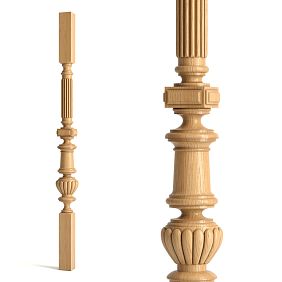
Turned balusters of round cross-section — classic, versatile, technologically advanced. Manufactured on a lathe — a workpiece, a square block with a cross-section of 50x50 or 60x60 millimeters, length 920-950 mm (with allowance for trimming) is clamped between the centers of the machine, rotates at 1500-3000 rpm, processed by cutters forming the profile. The profile — a sequence of geometric elements: balls (round thickenings), balusters (vase-shaped expansions), beads (small-diameter cylinders), necks (narrow waists), cones, straight cylinders. The combination, order, and proportions of elements create an endless variety of forms — from laconic with 3-4 elements to complex with 10-15.
Turned balusters on CNC machines are produced in series — a program records the profile, the machine reproduces it identically on hundreds of workpieces, deviation ±0.1 millimeter. The result — a series of balusters, visually indistinguishable, interchangeable. This is critical for a staircase — 20-40 balusters on a flight must be identical; any difference (one wider, another thinner) is visually jarring, destroying the rhythm. The old technology of manual turning on copy lathes gave a variation of ±1-2 millimeters — the craftsman guided the cutter by hand, copying a template, but the human factor introduced errors. CNC eliminates this.
Turned balusters of square cross-section — a compromise between turning and carving. A workpiece of square cross-section 50x50 or 60x60 millimeters is partially turned (creating round elements — balls, balusters, beads), partially remains square (top and bottom, sometimes the middle). Square sections can be smooth or milled — with flutes (vertical grooves), diamonds, flat facets. Square cross-section simplifies installation — the baluster does not rotate around its axis when fastened, orientation is fixed. A round baluster could theoretically twist (if the fastening loosens), although in practice this is rare with proper installation.
Carved balusters — custom work, where a turned base is complemented by hand carving. The workpiece is first turned on a CNC machine — a basic profile with thickenings, necks is formed. Then a carver manually works on the details — turns a round thickening into an acanthus leaf with veins, a straight cylinder into a twisted spiral, a smooth surface into a scaly texture. Carving can be relief (protruding from the base) or intaglio (cut into the surface). Carved balusters are 3-5 times more expensive than turned ones (1500-2500 rubles vs. 400-800), take longer to produce (turned blank in 5 minutes, carving 1-3 hours per baluster), suitable for premium, palatial, Baroque interiors where budget allows, uniqueness, and craftsmanship are important.
Flat balusters — milled panels of rectangular cross-section (thickness 30-40, width 80-120, height 900 millimeters), where the relief is created not by turning, but by milling on a CNC router. A flat baluster is a vertical slat with a cut-out ornament: floral motifs, geometric patterns, through-cut openings. Flat balusters are installed flush against each other or with a minimal gap of 10-20 millimeters, creating a continuous openwork screen — characteristic of Art Nouveau, Art Deco, Eastern (Moroccan, Indian) styles. Flat balusters are more technologically advanced than carved ones (milling is faster than hand carving), but require more complex fastening (not a round pin in a hole, but plane-to-plane with screws, glue).




Wood Species for Balusters: From Economical Pine to Premium Oak
Pine — the most affordable species (turned baluster 400-600 rubles), soft (density 500 kg/m³), easy to work with, fast-growing (cheap raw material). Pine is light — yellowish, with pronounced annual rings, resin pockets (dark areas that exude resin when heated). Advantages: price, availability, lightness (baluster weighs 400-500 grams, easy to transport, install). Disadvantages: softness (scratches easily, dents on impact), resinousness (resin seeps to the surface, stains hands, requires thorough deresination before varnishing), low prestige (pine is associated with budget, dacha projects).
Pine is optimal for dacha, country house staircases where budget is limited, use is not intensive, and the light natural color is acceptable. For urban, representative interiors, pine is not solid enough.
Beech — mid-price segment (baluster 700-1000 rubles), hardwood (density 650 kg/m³), uniform structure (fine pores, almost no grain), light pink color (after staining becomes reddish, brown). Beech turns well — gives a smooth surface without fuzz, sharp edges on elements, rarely chips. Advantages: moderate price, sufficient hardness for domestic use, aesthetically pleasing warm color. Disadvantages: hygroscopicity (beech actively absorbs moisture, swells, shrinks with humidity fluctuations of 40-70%, requires a stable microclimate), relatively low prestige (beech is cheaper than oak, walnut, perceived as a compromise).
Beech is optimal for interior staircases in houses with good ventilation, stable humidity, where balance of price and quality is important, warm natural color without staining or with light staining in honey, caramel tones.
Ash — close to oak in hardness (density 700 kg/m³), lighter than oak (white-yellow, cream), with expressive grain (contrasting annual rings, wavy lines). Ash is elastic — better than oak at withstanding impact loads, doesn't splinter. Price comparable to oak (baluster 1000-1500 rubles). Advantages: hardness, elasticity, beautiful grain, light color (suits Scandinavian, contemporary style where dark oak is overly heavy). Disadvantages: rarity (ash is less common than oak, beech), lower prestige (oak is traditionally considered more noble).
Ash is optimal for modern, neoclassical, Scandinavian interiors where light wood with grain is valued, strength without the excessive massiveness of oak.
Oak — premium species (baluster 1200-2000 rubles), the hardest of European woods (density 750 kg/m³), with expressive grain (large pores, medullary rays — radial lines creating shimmer), color from light brown to dark chocolate after staining. Oak contains tannins — tannins — giving the wood natural protection against rot, fungi, insects. Advantages: hardness (oak balusters last decades without visible wear), prestige (oak is a symbol of reliability, solidity, status), beauty of grain, possibility of deep staining (oak takes stains, oils well, creates rich dark tones — wenge, walnut, black).
Oak is optimal for classic, English, study, representative interiors where durability, solidity are important, and there is a willingness to pay a premium price for a material that will outlast generations.
Our factory also produces:


Standards for Baluster Height and Installation Spacing
Baluster height is determined by building codes SNiP 31-02-2001 "Single-Family Residential Houses" and SP 54.13330.2016 "Multi-Family Residential Buildings": the height of a stair railing (from the step surface to the top of the handrail) must be at least 900 millimeters for interior stairs, and 1200 mm for exterior stairs and balconies. In practice, this means: a baluster height of 900 mm + a handrail height of 40-50 mm = a total railing height of 940-950 mm, which meets the standard with a margin.
A height of 900 millimeters is the standard for which all mass-produced balusters are made. Ordering a non-standard height (800, 1000, 1100) only makes sense for a non-standard stair configuration: a very shallow flight (angle of inclination less than 30 degrees), where balusters of different heights compensate for the level difference of the steps on the incline. For standard stairs (angle 30-45 degrees), all balusters are the same height of 900 mm; the bottom is cut at the flight angle, and the top is horizontal, for the handrail.
Baluster installation spacing — the distance between the axes of adjacent balusters — is determined by safety requirements: the gap between balusters must not exceed 100-120 millimeters (a child's hand or head cannot pass through). If a baluster has a square cross-section of 50x50 mm and the gap is 100 mm, then the installation spacing = 50 + 100 = 150 mm. If a baluster is round with a diameter of 50 mm and the gap is 100 mm, the spacing is similarly 150 mm.
Installation density affects visual massiveness and cost. Frequent balusters (spacing 100-120 mm, gap 50-70 mm) create dense filling, a sense of protection and massiveness, but are expensive (more balusters = higher cost). Sparse balusters (spacing 180-200 mm, gap 130-150 mm) are visually lighter, cheaper, but may violate safety standards (gap over 120 mm). The optimum is a spacing of 150 mm, gap of 100 mm — a balance of safety, aesthetics, and economy.
Get Consultation
Calculating the number of balusters for a stair flight
Formula: Number of balusters = (Flight length / Installation spacing) + 1
Flight length — not the horizontal projection, but the length of the sloped line from the lower support post to the upper one. For a straight flight with 14 steps, a riser height of 180 mm and a tread depth of 280 mm: vertical component 14 × 180 = 2520 mm, horizontal component 14 × 280 = 3920 mm. Sloped length by the Pythagorean theorem: √(2520² + 3920²) = √(6,350,400 + 15,366,400) = √21,716,800 ≈ 4660 mm ≈ 4.7 meters.
With an installation spacing of 150 mm: Number = (4700 / 150) + 1 = 31.3 + 1 ≈ 32 balusters. Round up, as a fractional number of balusters is impossible. Plus two support posts — one at the bottom, one at the top of the flight — resulting in a set for the flight: 32 balusters + 2 posts.
Set cost (oak turned balusters at 1500 rubles each, support posts at 5000 each): 32 × 1500 + 2 × 5000 = 48,000 + 10,000 = 58,000 rubles for only the wooden railing elements without the handrail (oak handrail 2000-3000 rubles per linear meter, for a 4.7 m flight you need ~5 meters with a margin = 10,000-15,000), without fasteners or labor. Total cost of railing for a flight with materials and installation: 80,000-120,000 rubles.
To save money, you can: replace oak with beech (balusters at 900 rubles, saving 32 × 600 = 19,200), increase spacing to 180 mm (gap 130 mm, at the limit of the norm but acceptable for adults without children) — the number of balusters reduces to 27 (saving 5 × 1500 = 7500). Total savings 19,200 + 7500 = 26,700 rubles — significant.
Where to buy balusters: STAVROS — manufacturer since 2002
The company STAVROS specializes in producingbalusters for staircasemade from solid oak, beech, ash, pine since 2002. Own production facility of 5000 square meters in St. Petersburg equipped with Swiss-made CNC lathes (Tornos, Schaublin), German four-sided planers (Weinig), Italian drying chambers (Nardi). Full cycle — from purchasing wood from FSC-certified suppliers to packaging finished products — under one roof, without intermediaries or subcontracting.
Assortment: 50+ models of turned balusters with round cross-section diameter 45-60 mm, 20+ models with square cross-section 50x50, 60x60, 15+ carved models with hand detailing, 10+ flat models. Standard height 900 mm, custom manufacturing of 800, 1000, 1100 mm possible (lead time 7-14 days). Species — pine, beech, ash, oak. Finish — untreated (for self-staining, varnishing), with natural oil (6 shades from natural to wenge), with matte polyurethane varnish (clear or tinted). Price 400-2500 rubles per baluster, support posts 3000-8000, handrails 1500-3500 per linear meter.
How to buy: from calculation to delivery
Online catalog stavros.ru — photos of baluster models, 3D visualizations as part of a staircase, dimensions (height, diameter/cross-section, tenon diameter for mounting), species, price. Filters by type (turned, carved, flat), species, price, height. Customer selects model, species, finish, quantity, adds to cart. System calculates cost, suggests related products (posts, handrails, fasteners, glue).
Engineer consultation — if the customer doesn't know how many balusters are needed, they send a stair plan (sketch, photo with dimensions), the engineer calculates the number of balusters, posts, handrail length, suggests the optimal model for the interior style and budget. Consultation is free, takes 1-2 hours (complex projects with turning, curved flights — up to a day). Contact via website form, email, WhatsApp, hotline phone.
Production and shipping — standard models in pine, beech are in stock at the warehouse (shipment on the day of order or the next day). Models in oak, ash are made to order (lead time 7-14 days from payment), as oak balusters are stored in smaller volumes (expensive, occupy warehouse space). Carved, non-standard height — made to order 14-21 days (includes manual work requiring time).
Delivery: within St. Petersburg by own transport 1000-2000 rubles (balusters packed in cardboard boxes 1 meter long, easily loaded into a van). To Moscow via partner logistics 2-3 days, 2000-4000. To other regions via transport companies 5-14 days, cost according to carrier rates (balusters are light, volumetric weight is small, delivery is inexpensive — 30 balusters weigh 15-20 kg, 0.2 cubic meters, delivery Moscow-Yekaterinburg ~1500 rubles).
Pickup from the warehouse in St. Petersburg (Parnas industrial zone, Lomonosova St. 83) is free, hours Mon-Fri 9:00-18:00, Sat 10:00-16:00. Customer arrives, pays, picks up.
Mounting balusters: fastening methods
Tenon mounting — classic method. The bottom of the baluster has a cylindrical tenon 8-12 mm in diameter, 30-50 mm long, protruding from the base. The top similarly — a tenon that fits into a groove in the handrail. A hole 40-60 mm deep, diameter 0.5 mm larger than the tenon (for free entry with glue) is drilled into the step (or into a sub-baluster rail — a horizontal strip laid on the steps). The tenon is coated with PVA wood glue, inserted into the hole, the baluster is aligned vertically with a level, fixed until the glue sets (24 hours). The top tenon fits into the handrail groove similarly.
Stud mounting — modern method, allows for disassembly. The bottom of the baluster is without a tenon, flat, a blind hole 8-10 mm in diameter, 50-70 mm deep is drilled. A metal stud (threaded rod) M8 or M10, 80-100 mm long, is screwed into the step — the lower part with threads goes into the step (a dowel is pre-inserted or a sleeve is hammered in), the upper part protrudes 50-70 mm. The baluster is placed over the stud (the hole in the bottom of the baluster aligns with the stud), epoxy or polyurethane glue is poured inside, the baluster is pulled down (the stud fixes it vertically and securely). Advantage — the connection is detachable (the stud can be unscrewed, the baluster removed for replacement or repair).
Through screw mounting — budget, rough method. The baluster is placed against the step, two screws 60-80 mm long are driven through the bottom at an angle (45-60 degrees) into the step. Screw heads are countersunk 3-5 mm, the holes are filled with a wax pencil. The method is fast, but visible (filler is noticeable upon close inspection), less durable (screws hold worse than a glued tenon), suitable for budget, country stairs.
Mounting on a sub-baluster rail — a horizontal strip with a cross-section of 60x40, 80x50 mm, laid on top of the steps along the sloped line of the flight, to which balusters are attached. The sub-baluster rail simplifies installation — no need to drill each step, all balusters are attached to one strip with tenons, studs, or screws. The sub-baluster rail itself is attached to the steps with screws from below (if access is available) or from above with countersunk screws. Disadvantage — the sub-baluster rail is visible, creates an additional horizontal element, visually weighing down the railing. Advantage — reliability, manufacturability, repairability.
— is a vertical dominant feature that attracts the eye, sets the scale, and defines the style of the entire house.as a unified system
Wooden staircase— not a set of disparate elements (steps separately, balusters separately, handrail separately), but a system where each component is coordinated in size, material, style, finish. Steps made of oak, thickness 40 mm, width 300 mm, length 1000-1200 mm depending on flight width. Risers made of oak, thickness 20 mm, height 180 mm (equal to step rise). Stringers (sloping beams supporting steps) made of oak, cross-section 60x300 mm, with milled grooves for steps. Balusters oak turned model Classic diameter 50 mm, height 900 mm. Support posts oak turned diameter 100 mm, height 1200 mm (from floor to top of finial). Handrail oak round cross-section diameter 50 mm, with radius bends at turns. All from one species (oak), one tint (natural oil or walnut stain), unified style (classic).
Buying components from different manufacturers is risky — oak from supplier A may differ in shade from oak from supplier B (wood from different regions, batches, with different processing), dimensions may not match (balusters height 900 from one, 880 from another — the railing will be crooked). STAVROS offers a full set of elements forwooden staircases— steps, risers, stringers, carriage pieces, balusters, posts, handrails, finials, rosettes, fasteners — from the same wood batch, with coordinated dimensions, unified finish. By ordering a set, the customer gets a guarantee of compatibility, harmony, and no unpleasant surprises during installation (doesn't fit, doesn't join, wrong color).
Frequently Asked Questions about Balusters
How many balusters are needed for a 14-step staircase?
Depends on the flight length and installation spacing. For a standard straight flight 4.7 meters long with 150 mm spacing — approximately 32 balusters. For a turning staircase with a landing, the calculation is more complex — a plan is needed.
Can balusters be installed outdoors?
Yes, but protective treatment is required. Wood is impregnated with an antiseptic against rot, fungi, insects, and coated with yacht varnish or exterior oil. Oak and larch are preferable to pine and beech (more resistant to moisture). The service life of outdoor balusters with proper treatment is 15-25 years, after which coating renewal is required.
What to paint balusters with?
For interior ones — natural oil (highlights texture, doesn't form a film, pleasant to the touch) or matte/semi-matte polyurethane varnish (protects better than oil but creates a film, less natural). For coloring — stain + varnish or colored oil. Avoid glossy varnish — looks cheap, reflects glare. For outdoor ones — yacht varnish or exterior oil.
Can one baluster be replaced if it breaks?
Yes, if a spare from the same batch is available (it is recommended to order +2-3 pieces beyond the calculation). If no spare is available, order a similar model from the same manufacturer — the color may slightly differ (different wood batches), but the shape is identical.
Which wood species is better for balusters in a house with children?
Oak — the most durable, withstands impacts, scratches, active use. Beech — a compromise between price and strength. Pine — not recommended (soft, scratches easily).
where to buy balusters for stairs? The company STAVROS offers 100+ modelswooden balustersmade of oak, beech, ash, pine, production on own CNC machines, guarantee of series uniformity, engineer consultations on quantity calculation, delivery to any region, full kitwooden staircasesfrom a single material batch.where to buy balustershigh-quality, precise, beautiful, durable? From a manufacturer who has been making them for 22 years, knows every millimeter detail, guarantees the result. Create staircases that serve generations, please the eye, make you want to run your palm over the warm oak handrail, leaning on which you ascend — not just to the second floor, but to a home where every detail is thoughtful, high-quality, beautiful.