












































































Article Contents:
- What is coving: function and aesthetics of ceiling decor
- Anatomy of coving: profile and its variations
- Functional role of coving in interior design
- Types of wooden coving by profile complexity
- Wooden architraves: framing openings as an art form
- Typology of architraves by profile shape
- Carved architraves: from traditions to modernity
- Wood species: how material defines the character of the product
- Oak: aristocracy and eternity
- Ash: contrasting drama
- Beech: uniformity for flawless geometry
- Spruce: accessibility with caveats
- Production technologies: from timber to finished product
- Wood Drying and Stabilization
- Profile milling: precision to tenths of a millimeter
- Sanding: from coarse to finish
- Carving: manual or machine
- Finishing: coatings and their selection
- Application of coving and architraves in various interior styles
- Classicism and neoclassicism: noble symmetry
- Baroque: Luxury and Excess
- Art Nouveau: fluidity of lines
- Scandinavian style: simplicity and light
- Loft: industrial brutality
- Installation of coving and architraves: quality installation technology
- Surface preparation: foundation of reliability
- Marking and miter cutting: precision of joints
- Fastening methods: adhesive or mechanical fasteners
- Finishing of joints
- Frequently Asked Questions
- How does coving differ from baseboard?
- Can wooden coving be used in bathrooms?
- How to choose architrave width?
- How long do wooden coving and architraves last?
- Can wooden coving be painted a different color after installation?
- How to care for wooden coving and architraves?
- Can coving and architraves be made to a custom design?
- What is the best finish for coving — oil or varnish?
- Conclusion: an investment in atmosphere and durability

Walls are silent. But only until you teach them to speak the language of architectural details.Wooden coving architraves decorcan transform bland planes into an expressive composition, where every line, every profile tells a story of taste, understanding of proportions, and respect for craftsmanship. These are not just strips covering joints and corners. They are tools for creating atmosphere, shaping the character of a space, and visually correcting architectural flaws. When you enter a room and feel harmony, completeness, and nobility — know this: not only the architect and builders have worked here, but also the wooden details that have tied everything together.
Why wood specifically? In an era of polymers, foam plastic, and MDF with imitation textures — why return to a material that is more expensive, more difficult to process, and more demanding in terms of conditions? The answer is simple and profound at the same time: because wood is alive. It breathes with the house, changes with time, ages nobly, not wretchedly.wooden corniceafter twenty years will retain its shape and can be restored by sanding and refinishing. Plastic will yellow, develop micro-cracks, lose its shine — and will only be fit to be thrown away and replaced. Wood is an investment in durability and aesthetics that pays off over decades of impeccable service.




What is coving: the function and aesthetics of ceiling decor
Coving is not just a beautiful word from the professional vocabulary of finishers. It is a specific architectural element with clear geometry and functional purpose. In classical terminology, a coving is a concave profile that forms a smooth transition between two perpendicular planes — most often between a wall and a ceiling, less often between a wall and a floor.




Anatomy of coving: profile and its variations
The shape of a coving is determined by the radius of concavity and the presence of additional decorative elements. The simplest coving is a quarter-circle cut from a block. This profile is called a quarter-round or a torus. The radius of concavity varies from fifteen to eighty millimeters depending on the scale of the room and the overall style.
Complexwooden cornicecombine several geometric elements: the concave part is complemented by straight shelves, beads, ogees, flutes (vertical grooves). A classic profile can include up to five to seven plane transitions, creating a play of light and shadow, and visual depth.
The width of the coving (height on the wall plus projection onto the ceiling) is determined by the height of the room and compositional requirements. The golden rule: the coving should be approximately one-twentieth to one-fifteenth of the wall height. For a ceiling three meters high, a coving one hundred fifty to two hundred millimeters high is optimal. In small rooms with ceilings two meters forty, limit yourself to a coving eighty to one hundred millimeters.
Our factory also produces:


The functional role of coving in interior design
Coving solves several practical tasks simultaneously. The first and most obvious is masking the joint between the wall and the ceiling. This joint is almost always problematic: different materials (plaster on the wall, a stretch ceiling or drywall), inevitable micro-cracks from building settlement, uneven planes. Coving covers all of this, creating a clear, neat line.
The second function is optical correction of room proportions. A wide coving visually lowers the ceiling height, making the space cozier, more intimate. A narrow coving, on the contrary, emphasizes height, creates a sense of airiness, spaciousness. A dark coving on light walls creates a clear boundary, graphic quality. A light coving matching the ceiling color blurs the boundary, visually increasing the room's height.
The third function is acoustic. The concave shape of the coving scatters sound waves reflecting from the wall-ceiling joint, reduces resonances, and makes the room's acoustics more comfortable. This is especially noticeable in rooms with high ceilings and minimal furniture, where echo becomes a problem.
The fourth — hiding utilities. Behind a wide coving, you can run electrical wiring for lighting, ventilation ducts, and low-voltage system cables. This turns a decorative element into a functional duct without compromising aesthetics.
Get Consultation
Types of wooden coving by profile complexity
Smooth covings with a simple radius profile — the base for minimalist, Scandinavian, modern interiors. The absence of decorative excess emphasizes the purity of lines, material quality, and the natural texture of wood. Such covings are made on a four-sided planer with milling heads in one pass, ensuring perfect geometry and profile repeatability.
Profiled covings with additional elements (beads, shelves, ogees) are characteristic of neoclassical interiors. Two or three plane transitions create visual interest without excessive decorativeness. Milling such profiles requires special knives of complex configuration and machine setup with accuracy to tenths of a millimeter.
Carved covings with decorative ornaments — the pinnacle of craftsmanship and an element of luxurious classical interiors. Floral motifs (acanthus leaves, grape clusters, floral garlands), geometric patterns (meander, egg-and-dart, bead-and-reel), sculptural elements (mascarons, putti) turn the coving into a work of art. Making carved covings is either the manual work of a carver (one-off pieces for exclusive projects) or processing on multi-axis CNC machines (serial production while maintaining high detail quality).
Wooden architraves: framing openings as an art
If coving creates horizontal articulation of space, then architraves work with verticals — door and window openings.Wooden casingperforms the same functions: masks the joint between the wall and the frame, protects from drafts and dust, creates a decorative frame. But the psychological impact of architraves is different — they form visual portals, focal points, and guide the gaze.
Typology of architraves by profile shape
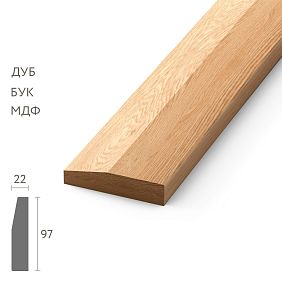
Flat rectangular architraves — a minimalist solution for modern interiors. This is simply a flat strip with a width from fifty to one hundred millimeters, a thickness of twelve to twenty millimeters, without protruding elements. The conciseness of the form emphasizes the material — the texture of wood, the quality of processing, the color of the finish. Flat architraves are appropriate in Scandinavian style, minimalism, and Japanese aesthetics.
Rounded casings with beveled or radiused edges are a softened variant that adds tactile pleasantness. A hand sliding along the edge of the casing does not feel a sharp edge. Light falling at an angle creates a soft shadow on the rounding, enriching the visual image. The rounding radius is typically two to five millimeters.
Profiled casings with decorative elements are a classic that never goes out of style. Protrusions, recesses, and beads create rhythm, depth, and play of light and shadow. The profile of the casing often echoes the profile of coves and baseboards, creating stylistic unity in the interior.
Telescopic casings are a structural solution for openings with non-standard wall thickness. They consist of two parts: a main strip that attaches to the frame, and an extension strip that adjusts in width and covers a reveal of any thickness. The tongue-and-groove system allows changing the framing width from eighty to three hundred millimeters without gaps or cracks.
Carved casings: from tradition to modernity
wooden carved moldings— this is a separate universe where a functional element turns into a decorative panel. The tradition of carved casings dates back to the wooden architecture of pre-Petrine Russia, when house facades were adorned with complex symbolic carvings. Each element of the ornament carried meaning: solar signs protected from evil, plant motifs symbolized fertility, geometric patterns represented the cosmogonic structure of the world.
Modern carved casings have retained their decorative quality but lost their symbolism. Now it is pure aesthetics, a play of forms and lines, a demonstration of the carver's skill or the technological capabilities of a CNC machine. The carving depth varies from five to seven millimeters (low-relief carving) to twenty to thirty millimeters (high-relief carving).
Carving motifs are diverse: plant (leaves, flowers, grapes), geometric (braids, rosettes, meanders), zoomorphic (birds, dragons, griffins), architectural (columns, arches, miniature balusters). The choice of motif is determined by the interior style: classic gravitates towards acanthus leaves and rosettes, Art Nouveau towards stylized plant forms with flowing lines, Russian style towards traditional Slavic ornaments.
Making carved casings is a labor-intensive process. Hand-carving one set of casings (two sides, top crosspiece) takes an experienced carver from forty to one hundred twenty hours depending on the complexity of the ornament. CNC machines reduce the time to eight to twelve hours but require programming a three-dimensional model, selecting tools, and setting processing parameters.
Wood species: how the material defines the character of the product
The choice of wood species for making coves and casings is not only a budget question. It is a choice of texture, color, strength, durability, and workability. Different species create different aesthetics, different tactile sensations, different energy of the space.
Oak: aristocracy and eternity
Oak is the benchmark species for decorative millwork. A density of seven hundred to eight hundred kilograms per cubic meter ensures the highest strength and wear resistance. Oak coves and casings last fifty to seventy years without loss of properties, can be repeatedly restored by sanding and refinishing.
Oak texture is expressive: contrasting annual rings, medullary rays (light streaks running radially from the center of the trunk), large pores. On a tangential cut, the texture forms a wavy pattern; on a radial cut, a characteristic 'mirror-like' effect from the medullary rays. This expressiveness makes oak self-sufficient — even a smooth profile without carving looks rich thanks to the texture.
Oak color varies from light golden (young sapwood) to dark brown (mature heartwood). Bog oak, aged in water or treated with special compounds, acquires gray-black, almost anthracite tones while preserving the texture. Staining expands the palette: from bleached Scandinavian to almost black wenge.
Processing oak requires carbide-tipped tools — high density and tannin content quickly dull ordinary steel cutters and drills. Carving oak is technically challenging but holds the finest details without chipping or crumbling.
Ash: contrasting drama
Ash is close to oak in strength (density six hundred eighty kilograms per cubic meter), but the texture is even more contrasting. Light and dark stripes of annual rings alternate with high frequency, creating a dynamic, active pattern. On coves and casings, this looks like alternating light and dark strokes running along the profile, creating visual movement.
Ash color ranges from light gray to yellowish-brown. Ash takes staining excellently, allowing the creation of rich dark shades while preserving the texture. Staining ash 'to resemble walnut' is popular — the contrasting texture of ash combined with brown tones creates visual richness, surpassing even real walnut.
Ash has high impact toughness and elasticity, allowing the creation of bent elements. After steaming, ash bends with a minimum radius of about one meter, which is important for arched casings, curved coves in bay windows, and complex architectural forms.
Beech: uniformity for flawless geometry
Beech is a species for those who appreciate purity of form without visual texture noise. Beech structure is fine-pored, uniform, annual rings are practically invisible. Color is delicate pinkish, after steaming (stabilization technology) it becomes uniformly pinkish-brown.
Beech density is six hundred twenty to six hundred eighty kilograms per cubic meter — sufficient strength with relative ease of processing. Beech mills, sands excellently, holds thin profiles and medium-complexity carving.
The main advantage of beech is its ideal base for staining and painting. The uniform structure ensures even absorption of stains, absence of spots and streaks. A painted beech casing has a pure, saturated color without texture showing through. This is important for interiors where color, not wood grain, is required.
The disadvantage of beech is increased hygroscopicity. Beech actively reacts to changes in air humidity; with significant fluctuations, it can deform. It is not recommended to use beech in unheated rooms, in bathrooms without good ventilation, or in regions with extreme climatic conditions.
Spruce: accessibility with caveats
Pine is the most budget-friendly species. Density four hundred fifty to five hundred kilograms per cubic meter, soft wood, easy processing. Pine coves and casings cost two to two and a half times less than oak ones.
But there are nuances. Pine is resinous — resin exudation can continue for years, seeping through the finish, creating sticky amber-colored spots. Pine is soft — it scratches easily, dents from impacts, quickly loses its original appearance in areas of intensive contact.
Pine texture is bright, with contrast between early and late wood, resin canals. This creates a characteristic 'rustic' look, which fits perfectly into country, Provence, chalet styles, but is inappropriate in classic or minimalist interiors.
To reduce resin content, deresination is used — treatment with hot solutions that extract resin from the wood. The process increases cost and production time but makes pine more suitable for interior use.
Production technologies: from timber to finished product
The path from raw wood to a finished cove or casing includes many stages, each of which influences the quality of the final product.
Wood drying and stabilization
Freshly cut wood contains sixty to eighty percent moisture. Such material is unsuitable for products—it will warp, crack, and change dimensions. The wood must be dried to an equilibrium moisture content of eight to twelve percent, corresponding to the conditions of use in a heated room.
Drying is carried out in special chambers under controlled temperature and humidity. The process takes from two to four weeks depending on the species and thickness of the blanks. Too rapid drying causes cracking, while too slow drying is economically impractical.
After drying, the wood undergoes acclimatization—conditioning in the production area for two to three weeks to equalize moisture throughout the volume. Only after this is the material ready for processing.
Profile milling: accuracy to tenths of a millimeter
Forming the profile of a cove or casing is performed on a four-sided planer or a CNC milling machine. The blank—a block of the required cross-section—is fed into the machine, where cutters rotating at a speed of six to eight thousand revolutions per minute remove material, forming the specified profile.
Complex profiles require specially sharpened milling knives that replicate the desired shape. Manufacturing a set of knives is a separate technological operation requiring high skill from the sharpener and precise equipment. It is precisely the cost of tooling that explains why custom profiles are more expensive than standard ones.
The tolerance for the dimensions of the finished profile is ±0.3 millimeters, ensuring interchangeability of elements and high-quality corner joining without gaps.
Sanding: from coarse to finish
After milling, the surface has marks from the cutters—fine ridges, roughness. Sanding removes them, creating a smooth surface ready for coating application.
Sanding is performed in several stages with abrasives of increasing fineness: P80 (coarse, removing major defects), P120 (intermediate), P180 (preparation for coating), P240 (final for products under transparent coating).
For coves and casings with complex profiles, manual sanding is used with blocks that replicate the profile shape. This is labor-intensive but ensures quality unattainable by machine methods on complex shapes.
Carving: manual or machine
Carved elements are created in two ways. Manual carving is the work of a master carver using a set of chisels of various shapes. The carver works from a sketch or photograph, interpreting the ornament, adapting it to the specific piece of wood. Each piece is unique, with individual characteristics. Manufacturing time is tens of hours. The cost is correspondingly high.
Machine carving is performed on multi-axis CNC milling centers. First, a three-dimensional model of the ornament is created in specialized software. Then a control program for the machine is generated—cutter movement paths, speeds, cutting depths. The machine removes material layer by layer, forming the specified relief with an accuracy of up to tenths of a millimeter.
The advantage of machine carving is repeatability, speed (one piece in eight to twelve hours), and the ability to create highly complex forms unattainable by manual carving. The disadvantage is that tool marks require subsequent manual refinement by a carver to achieve the quality of handwork.
Finishing: coatings and their selection
Finished coves and casings are rarely used without a finishing coating. The coating serves two functions: it protects the wood from moisture, dirt, and ultraviolet light; and it imparts the desired color and visual texture.
Oil-wax coatings penetrate the wood, do not create a surface film, preserve the natural texture and tactile feel. Wood under oil looks natural, with slightly deepened color. Periodic renewal every three to five years is required.
Varnishes create a protective film on the surface. Water-based polyurethane varnishes are eco-friendly, fast-drying, and create a durable, wear-resistant coating. The gloss level varies from deep matte to mirror gloss. For interior moldings, a semi-matte varnish is optimal—it does not glare, is pleasant to the eye, and emphasizes the texture without excessive shine.
Toning with stains or dyes changes the color of the wood while preserving the visibility of the grain. Water-based stains are eco-friendly but raise the wood grain. Alcohol-based stains dry quickly but have a strong odor. Oil-based stains penetrate deeply, provide even color, and are compatible with oil-based finishing coatings.
Enamel painting creates an opaque colored coating that completely hides the grain. It is used when color is specifically required, not the wood pattern. White enamels for neoclassical interiors, black for contrasting solutions, and pastels for Provence and Scandinavian styles are popular.
Application of coves and casings in various interior styles
The choice of profile, wood species, color, and finish for coves and casings is determined by the interior's style. Each style imposes its own requirements on decorative elements.
Classicism and Neoclassicism: noble symmetry
Classical interiors require complex profiled coves and casings with carved elements. Characteristic motifs: ovolos (egg-shaped elements), dentils (tooth-like), acanthus leaves, rosettes, meanders. The cove profile includes several plane transitions—straight shelves, beads, coves.
Species—oak or ash, emphasizing status. Color—natural shades from light to dark walnut, or painting in noble tones: ivory, antique gold with patination, gray-blue with an aging effect.
The height of the cove in a classical interior is one-tenth to one-eighth of the room's height. For a three-meter ceiling—a cove of three hundred to three hundred seventy-five millimeters. The width of casings is one hundred to one hundred twenty millimeters, with a mandatory decorative profile.
Baroque: Luxury and Excess
Baroque interiors are maximalist in decoration. Carved coves with rich floral ornaments, voluminous casings with mascaron, putti, garlands. Asymmetry, dynamism, complex curvilinear forms.
Carving is deep, in high relief, creating a strong play of light and shadow. Gilding on gesso (chalk ground), patination, artificial aging—mandatory finishing elements. Wood—oak or beech, capable of holding deep carving without chipping.
The height of the cove in Baroque can reach one-fifth of the room's height—four hundred to five hundred millimeters for a two-meter seventy ceiling. Casings one hundred fifty to two hundred millimeters wide, with three-dimensional carving, protruding from the wall plane by thirty to fifty millimeters.
Art Nouveau: fluidity of lines
Art Nouveau style is characterized by smooth, organic forms, asymmetry, and stylized plant motifs. Art Nouveau skirting boards and architraves feature flowing profiles without right angles, with soft transitions between planes.
The carving is shallow, contour-based, emphasizing line rather than volume. Characteristic motifs include curved stems of irises and lilies, dragonflies, and peacock feathers. Asymmetric compositions where the ornament does not repeat mirror-like but develops in one direction.
Wood species — ash or beech, which are well-suited for bending to create curved elements. Color — natural or tinted in green, gray-blue, lilac shades, characteristic of Art Nouveau. Finish — matte oil or semi-matte lacquer.
Scandinavian style: simplicity and light
Scandinavian minimalism implies simple geometric profiles without decorative excess. Skirting boards — a simple quarter-round with a radius of twenty to forty millimeters. Architraves — flat rectangular strips fifty to seventy millimeters wide, without protruding elements.
Wood species — pine or beech. Color — white (painted with opaque enamel) or light natural shades (light pine, whitewashed oak). Finish — matte, without gloss. Goal — maximum naturalness, absence of pretentiousness, purity of lines.
The height of skirting boards is minimal — sixty to eighty millimeters even with high ceilings. Architraves are narrow, visually light, not creating a massive framing of openings.
Loft: Industrial Brutality
Loft style combines industrial materials with wood. Skirting boards may be absent altogether or deliberately simple, roughly finished. Architraves — made of solid timber, preserving saw marks, knots, and natural irregularities.
Wood species — oak or larch. Finish — brushing (removing soft fibers with a stiff brush to emphasize texture), tinting in dark shades, oil finish without gloss. Possibly painting in black or dark gray while keeping the texture visible.
Architrave width — eighty to one hundred twenty millimeters, simple rectangular shape or with one bevel. Mounting is deliberately rough, with visible screw heads or rivets — this is part of the loft aesthetic.
Installation of skirting boards and architraves: technology for quality installation
Even the highest quality skirting boards and architraves will not reveal their beauty with careless installation. Installation requires precision, patience, and an understanding of the material's behavior.
Surface preparation: the foundation of reliability
Skirting boards and architraves are attached to walls and ceilings, which must be level, sturdy, and cleaned of dust and dirt. Irregularities exceeding five millimeters over two meters of length will cause problems — the skirting board won't press flush to the surface, creating gaps.
Check the evenness of walls and ceilings with a long straightedge or a stretched string. Significant irregularities should be leveled with plaster or filler before installing skirting boards. Minor irregularities (up to three millimeters) are compensated by the elasticity of the adhesive joint.
The surface must be dust-free and primed. Primer strengthens the surface layer, improves adhesive adhesion, and prevents moisture absorption from the adhesive compound. For porous substrates (plaster, drywall), use a deep-penetration primer.
Wooden skirting boards and architraves must acclimate in the room for at least forty-eight hours before installation. During this time, the wood will reach equilibrium moisture content, preventing deformation after installation.
Marking and mitering corners: precision of joints
Corner joints are the most complex part of installation. Internal and external corners require mitering elements at a forty-five-degree angle (for a ninety-degree right angle). The precision of the miter determines the quality of the joint.
Mitering is performed on a miter saw (a miter box with an electric saw) with a laser guide. The saw is set to a forty-five-degree angle, the element is placed in the correct orientation, and the cut is made. For complex profiled skirting boards and architraves, it is important to correctly orient the element in the miter box — the profile should be positioned as it will stand on the wall.
After cutting, the end is smoothed with fine sandpaper, removing burrs. Check the joint — the two mitered elements should meet without gaps. Minor inaccuracies (up to half a millimeter) are corrected by lightly sanding the end on a sanding block.
Fastening methods: adhesive or mechanical fasteners
Light skirting boards and architraves (with a cross-section up to forty by forty millimeters, length up to three meters) can be fastened with adhesive only. Polyurethane adhesives like "liquid nails" are used, providing a strong bond while maintaining some elasticity.
Adhesive is applied to the back of the skirting board in a zigzag strip or dots every twenty to thirty centimeters. The element is pressed against the surface and held for two to three minutes until initial adhesive setting. Full curing occurs after twenty-four hours.
Heavy skirting boards (cross-section over fifty by fifty millimeters, carved with significant projection) require mechanical fastening in addition to adhesive. Wood screws with countersunk heads, fifty to seventy millimeters long, are used, screwed through the skirting board into the wall or ceiling at intervals of fifty to eighty centimeters.
Pilot holes three to four millimeters in diameter are pre-drilled for the screws. Screw heads are countersunk into the wood by five to seven millimeters, then the holes are filled with wooden plugs or wood filler matching the skirting board color.
Architraves are primarily fastened mechanically — with finishing nails (thin nails with small heads) forty to fifty millimeters long. Nails are driven at intervals of thirty to forty centimeters, heads are countersunk with a nail set, and holes are filled with filler.
Finishing of joints
Even with precise mitering, small gaps are inevitable — wood is a living material, and minor dimensional deviations are possible. Gaps up to half a millimeter are filled with acrylic sealant matching the wood tone.
Sealant is squeezed from the tube in a thin bead into the seam, smoothed with a wet finger or spatula, and excess is removed with a damp sponge. After drying, the sealant is sanded with fine abrasive and, if necessary, tinted with stain or dye.
Wider gaps (up to two millimeters) require wood filler. The filler is applied with a narrow putty knife, filling the gap flush with the surface. After drying, it is sanded, touched up, and coated with the same finish as the main product (oil or varnish).
Frequently asked questions
What is the difference between a cove molding and a baseboard?
A cove molding is a ceiling element with a concave profile that forms the transition between the wall and ceiling. A baseboard is a floor element that covers the joint between the floor and wall. Their functions are similar (concealing joints, decoration), but their location and profile are different.
Can wooden cove moldings be used in a bathroom?
Yes, provided they are given high-quality moisture protection treatment. Use oak (naturally moisture-resistant) or beech with impregnation and a coat of waterproof varnish. Good bathroom ventilation is essential.
How to choose the width of door casing?
The width of the casing should be proportional to the size of the opening and the room. For standard apartments — seventy to eighty millimeters. For large rooms with high ceilings — ninety to one hundred twenty millimeters. The casing should not be wider than a quarter of the width of the door leaf.
How long do wooden cove moldings and casings last?
Oak — fifty to seventy years. Ash and beech — thirty to forty years. Pine — fifteen to twenty-five years. With proper care (periodic renewal of the finish, protection from mechanical damage), the service life can be extended.
Can wooden cove moldings be painted a different color after installation?
Yes. If the item is finished with oil or stain — light sanding and applying a new finish is sufficient. If finished with lacquer — complete removal of the lacquer by sanding or stripping is required, followed by painting. Enamel finish can be repainted after light sanding for adhesion.
How to care for wooden cove moldings and casings?
Regular dry cleaning with a soft cloth or vacuum with a soft brush. Damp wiping with a well-wrung cloth without aggressive detergents. Renewal of oil finish every three to five years. Avoid mechanical damage and direct water contact.
Can cove moldings and casings be made to a custom design?
Yes, manufacturers offer custom millwork production based on individual drawings. Creating special tooling (router bits) will be required, which increases cost and production time. The minimum order quantity for a custom profile is typically from fifty linear meters.
Which finish is better for cove moldings — oil or varnish?
Oil preserves the natural texture and tactile feel, is easy to renew, but requires periodic maintenance. Varnish creates a durable protective film, does not require frequent renewal, but alters the tactile feel. The choice depends on preference and willingness for regular maintenance.
Conclusion: An investment in atmosphere and durability
Wooden coving architraves decor— is not a consumable material, but a long-term investment in the quality and atmosphere of your home. Properly selected, high-quality, and professionally installed wooden elements last for decades, creating visual harmony, completeness, and a sense of noble space.
Choosing the wood species, profile, color, and finish is a creative process where technical parameters meet aesthetic preferences. Oak for those who value strength and status. Ash for lovers of contrasting, expressive texture. Beech for admirers of pure forms and color. Each species finds its place, its optimal application.
For over twenty years, STAVROS has specialized in the production of high-qualityinterior wall decormade from natural wood and modern composite materials. The STAVROS catalog features over seventy profiles of cove moldings of varying complexity — from simple radius profiles to carved ones with rich ornamentation. Casings are presented in a wide range of styles and widths — from minimalist flat fifty millimeters to classic profiled one hundred twenty millimeters.
The STAVROS production base includes modern European equipment: four-sided planers for forming profiles with an accuracy of up to three-tenths of a millimeter, multi-axis CNC milling centers for carved elements of any complexity, wide-belt sanding machines for perfect surface preparation, and finishing booths for applying final coatings under controlled conditions.
The wood for STAVROS millwork production undergoes strict incoming quality control. Oak, ash, and beech are sourced from trusted suppliers with certificates of origin and quality. Drying is carried out in our own kilns with humidity control at every stage. Finished products have a moisture content of eight to twelve percent, guaranteeing dimensional stability after installation.
STAVROS offers cove moldings and casings in several finishing options: unfinished (for customer's own final finishing), stained in various shades with subsequent oil coating, coated with clear semi-matt varnish preserving the texture, and painted with enamel in white and other colors upon customer request.
For professionals — interior designers, construction companies, furniture manufacturers — STAVROS offers a flexible discount system depending on order volume, the possibility of producing millwork based on custom drawings (minimum order from fifty linear meters), and comprehensive deliveries with other decorative elements made of wood and polyurethane.
STAVROS logistics covers the entire territory of Russia. Our own delivery service ensures prompt delivery in Moscow and the Moscow region. Partner transport companies deliver products to the regions with guaranteed cargo safety. Millwork packaging is done with maximum protection — corrugated cardboard, corner protection, and fixation on rigid pallets. This prevents damage during transportation; products arrive in perfect condition, ready for installation.
STAVROS consultative support helps customers make the right choice. The company's specialists will answer questions about selecting a profile for a specific interior, about combining cove moldings and casings with other finishing elements, and about installation methods and product care. STAVROS's goal is not just to sell a product, but to ensure the successful realization of a design project, to create an interior that will delight the customer for decades.
By choosing STAVROS, you choose a manufacturer with a reputation, experience, and an understanding that details define the quality of the whole. STAVROS cove moldings and casings — precision geometry, dimensional stability, material durability, the beauty of natural wood. Create an interior where every detail contributes to overall harmony, with wooden decor from STAVROS.


