Article Contents:
- Visual impact secrets: how ceiling crown molding changes the perception of space
- Optical illusions in action
- Rhythm and proportions
- Wood species for ceiling crown moldings: choosing the character of the interior
- Coniferous species: accessibility and naturalness
- Hardwood Species: Nobility and Refinement
- Exotic species: exclusivity and luxury
- Profiles and design: from minimalism to baroque luxury
- Simple profiles: elegance of minimalism
- Complex crown molding profiles: aristocratic luxury
- Modern Design Solutions
- Technical aspects: correct calculation and mounting
- Load calculation and fastener selection
- Surface Preparation
- Material acclimatization
- Mounting methods: from adhesive to mechanical
- Adhesive Mounting
- Mechanical Fastening
- Combined mounting
- Corner processing: mastery in details
- Internal corners
- External Corners
- Complex profiles
- Final finishing: protection and beauty
- Preparation operations
- Priming
- Types of Final Finishes
- Stylistic solutions: from classic to avant-garde
- Classical styles
- Modern directions
- Eclecticism and Fusion
- Features of operation and maintenance
- Climate impacts
- Dust and dirt
- Accessibility for maintenance
- Economic aspects: investments in beauty
- Material cost calculation
- Cost of work
- Long-Term Savings
- Impact on property value
- Common Mistakes and How to Avoid Them
- Design errors
- Installation Errors
- Finishing errors
- Modern Trends and Innovations
- Integrated lighting
- Smart technologies
- Ecological innovations
- Personalization
- The future of ceiling crown moldings
- Minimalism versus decoration
- Functionality
- Sustainable development
- STAVROS: where tradition meets innovation
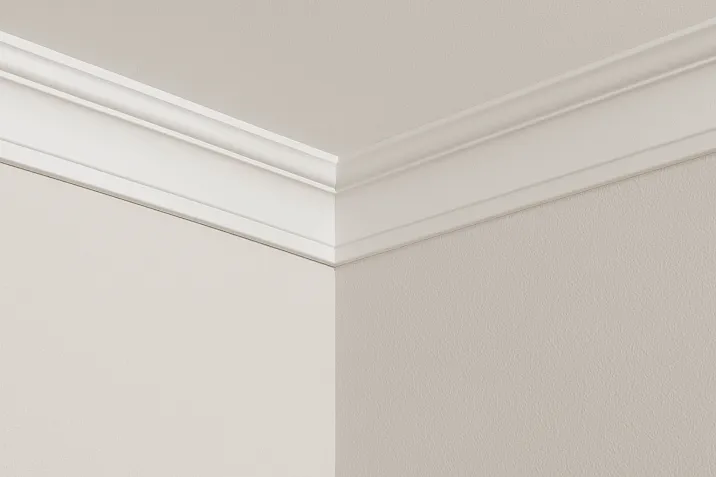
When you enter a room, what first catches your attention? Furniture? Wall color? Yet it is precisely the details that create that sense of completion and harmony that distinguishes professional design from amateur work. And among these details, a special place is held by Wooden ceiling molding — an element capable of transforming an ordinary room into a work of art.
Ceiling crown molding is not just a way to hide the uneven junction between wall and ceiling. It is an architectural element that sets the rhythm for the entire space, creates a visual connection between vertical and horizontal planes, and defines the character of the interior. But why exactly wooden? Because wood is the only material that lives in your home, breathes with it, and becomes even more beautiful over the years.
In the era of plastic imitations and composite materials, natural wood remains a symbol of true quality and impeccable taste. Every wooden crown molding is unique — it has its own history, character, and incomparable texture. And when this uniqueness meets craftsmanship, a true miracle is born.


Secrets of Visual Impact: How a Ceiling Moldings Changes the Perception of Space
The human eye is structured in such a way that sharp angles create a sense of tension, while smooth transitions evoke harmony and calm. A ceiling molding acts as a visual 'bridge' between the wall and the ceiling, softening the sharp angle and creating a sense of spatial continuity.




Optical Illusions in Action
A properly chosen crown molding can dramatically change the perception of a room's height. A narrow, light-colored crown molding visually 'melts' into the space, creating a sense of greater height. Conversely, a wide, contrasting crown molding 'lowers' the ceiling, making the room feel cozier and more intimate.
The play of light and shadow on the profiled surface of the crown molding creates additional depth and volume. Wooden crown molding Classical profiles in the shape of 'goose' or stepped form literally bring the ceiling zone to life, making light dance across its surface.
Our factory also produces:



Rhythm and proportions
Crown molding sets the horizontal rhythm of the room, which must harmonize with other linear elements — baseboards, window casings, cornices. Professional designers know: all these elements must be connected by a unified stylistic and proportional logic.
The height of the crown molding is determined by a simple rule: the higher the ceiling, the heavier the crown molding can be. For standard apartments with ceilings of 2.7–3 meters, the optimal crown molding height is 50–80 mm. In rooms with high ceilings, crown moldings up to 150–200 mm can be used.
Get Consultation
Wood species for ceiling moldings: choosing the character of the interior
Choosing a wood species is not only a matter of budget, but also defines the stylistic direction of the entire interior. Each species has its own energy, color, texture, and technical characteristics.
Coniferous species: accessibility and naturalness
Spruce is the most popular choice for ceiling moldings. Its light-colored wood with pronounced texture creates a sense of freshness and spaciousness. The density of spruce (480–520 kg/m³) provides an optimal balance of strength and weight, which is critically important for ceiling structures.
The natural resinous nature of spruce, which many consider a drawback, is actually an advantage. Resins act as a natural preservative, protecting the wood from fungi and insects. With proper drying and treatment, problems with resin bleeding are eliminated.
Fir has a more uniform structure and a light, almost white color. It is an ideal choice for Scandinavian-style interiors or for creating a neutral background for painting. Fir wood is less resinous, which simplifies finishing.
Larch is a premium representative of coniferous species. Its density reaches 650 kg/m³, and its natural resistance to moisture makes larch moldings an ideal choice for rooms with high humidity — kitchens, bathrooms, swimming pools.
Deciduous species: nobility and elegance
Oak — the king among wood species. Oak baseboard On the ceiling, it instantly transforms an ordinary room into an aristocratic salon. The density of oak wood (650–750 kg/m³) requires secure mounting, but the result exceeds all expectations.
Tannins contained in oak not only protect the wood from biological damage but also impart a distinctive bitter aroma, which many consider a sign of quality interior design.
Beech attracts designers with its uniform structure and ability to be precisely machined. The density of beech wood (680–720 kg/m³) allows for the creation of complex profiles with delicate details. Beech baseboard Especially effective in classical interiors.
Ash demonstrates expressive contrasting texture and excellent mechanical properties. Its strength is comparable to oak, but the price is significantly lower. Ash moldings are perfect for modern interiors where material expressiveness is valued.
Exotic species: exclusivity and luxury
Tropical species — wenge, merbau, teak — impart a special luxury and exclusivity to the interior. However, their use for ceiling moldings is more of an exception due to high cost and processing difficulty. Often, such species are imitated using quality staining of more affordable materials.
Profiles and design: from minimalism to baroque luxury
The profile of the ceiling molding determines the character of the entire room. The choice of a specific shape determines whether your interior will be strict and modern or luxurious and classical.
Simple profiles: elegance of minimalism
Quarter-round molding — the most universal profile, suitable for any stylistic direction. The simple concave shape creates a soft transition between surfaces without drawing excessive attention. Sizes range from delicate 20×20 mm to impressive 80×80 mm.
Rectangular profile meets the requirements of modern architecture with its preference for clear geometric forms. Such moldings are often used in high-tech, minimalism, and loft styles.
Semi-circular moldings create especially soft transitions and combine well with curved interior elements.
Complex molding profiles: aristocratic luxury
When it comes to classical interiors, complex profiled moldings are indispensable. Ceiling wooden molding on paneling With a rich cornice profile, it can transform an ordinary dacha into a noble estate.
Profiles with grooves (vertical channels) evoke classical architecture and create a play of light and shadow that enlivens the ceiling zone.
Stepped profiles with alternating protrusions and recesses form a complex light-and-shadow pattern, especially effective under side lighting.
Profiles with plant motifs — acanthus leaves, grapevines, rosettes — turn the cornice into a work of decorative art.
Modern design solutions
Modern technologies allow creating cornices with integrated functions. Profiles with hidden channels for LED lighting are popular, creating a "floating" ceiling effect.
Asymmetric profiles break traditional canons and create dynamic, modern interiors. Such cornices become independent art objects.
Technical aspects: correct calculation and mounting
Ceiling cornices experience special loads — their own weight tends to detach them from the base. Therefore, technical aspects of mounting are critically important for the longevity and safety of the structure.
Load calculation and fastener selection
The weight per linear meter of the cornice depends on the profile dimensions and wood density. A pine cornice with a 50×50 mm cross-section weighs about 1.2 kg/m, while a similar oak cornice weighs up to 1.8 kg/m.
For secure mounting, ensure at least 2 mounting points per linear meter for light cornices and 3–4 points for heavy ones. Use screws at least 50–60 mm long with pre-drilled holes.
Surface preparation
The quality of the base preparation determines the longevity of the entire structure. Surfaces must be flat, clean, and dry. Deviations from flatness must not exceed 2–3 mm per linear meter.
Sealing surfaces improves the adhesion of adhesive compounds and prevents stains on the finished cornice finish.
Material acclimatization
Wooden Crown Moldings Must undergo acclimatization in the room for at least 48–72 hours. During this time, the wood will reach equilibrium moisture, preventing deformation after installation.
Mounting methods: from adhesive to mechanical
The choice of mounting method depends on the weight of the cornice, the type of base, and the requirements for structural reliability.
Adhesive mounting
For light cornices with a cross-section up to 40×40 mm, quality adhesive mounting is sufficient. Polyurethane adhesives are used, providing strong bonding with various base materials while maintaining some elasticity.
Advantages of adhesive mounting: absence of visible fasteners, quick installation, possibility of disassembly without damaging the base.
Mechanical mounting
Heavy cornices require mechanical fasteners to supplement adhesive connections. Use wood screws with concealed heads, which are masked with wooden plugs or putty after installation.
Combined mounting
The most reliable method combining the advantages of both approaches. The cornice is glued to the base and additionally secured with screws every 60–80 cm.
Corner processing: mastery in details
Corner joints — the most complex and critical part of installing ceiling cornices. The quality of corners determines the professionalism of the installer and the overall impression of the work.
Internal corners
The classical technology involves cutting cornices "on the ear" at a 45° angle. For precise cuts, use a miter saw with a fine-toothed blade or a high-precision miter box.
The accuracy of the room's angle is critically important — deviations from 90° require adjustment of the cut angles. Professional craftsmen use special angle gauges to determine actual angles.
Outside corners
Outside corners are less common, but their processing requires special skill. It is necessary not only to precisely cut the cornices but also to ensure tight fitting along the entire length of the joint.
Special templates are used for cornices with complex molding profiles, ensuring precise replication of the shape during trimming.
Trimming of complex profiles requires the highest level of craftsmanship. Jointing of wooden moldings Complex profiles require the highest level of craftsmanship.
Final Finish: Protection and Beauty
Final finishing of the ceiling cornice performs two functions: it protects the wood from external influences and forms the final appearance of the product.
Preparation Operations
Before applying the coating, the cornice surface must be perfectly prepared. Fasteners are filled, joints are sanded, dust and dirt are removed.
Sanding is performed with abrasives of increasing fineness — from P150 to P320. Final sanding with fine abrasive creates a perfectly smooth surface, ready for coating application.
Priming
Primer performs several functions: it equalizes the wood's absorption capacity, improves the adhesion of the final coating, and prevents resin and tannin bleed-through.
For coniferous species, the use of isolating primers blocking resin is mandatory. For hardwoods, standard wood primers are sufficient.
Types of Final Coatings
Varnish coatings create a durable protective film and highlight the natural beauty of wood. Polyurethane varnishes provide high wear resistance, while acrylics offer eco-friendliness and odorlessness.
Oil-based coatings penetrate into the wood structure, preserving its tactile properties. Oils are ideal for eco-style interiors.
Enamel coatings completely cover the wood texture, allowing any color to be achieved. This is the optimal choice for modern interiors with clear color schemes.
Tinting agents change the color of wood while preserving its texture. It is possible to imitate expensive exotic species.
Stylistic solutions: from classic to avant-garde
The ceiling cornice must harmoniously fit into the chosen interior style, emphasizing its distinctive features.
Classic styles
Baroque and Rococo require cornices with rich profiling and abundant decoration. Characterized by gilded and patinated surfaces, floral ornaments, and complex multi-level profiles.
Neoclassicism prefers strict, solemn forms with military symbolism elements. The color palette tends toward white, gold, and dark green.
English classicism is distinguished by restraint and elegance. Cornices of medium size with moderate profiling, natural wood tones.
Modern trends
Minimalism requires cornices of the simplest forms or complete absence of them. If a cornice is used, it must be of clear geometric shape without decorative excesses.
High-tech allows the use of cornices with metallic coating or integrated technological elements — LED lighting, communication channels.
Loft prefers roughly processed cornices with an emphasized industrial character. Dark tones and imitation of charred wood are popular.
Scandinavian style leans toward light wood species with minimal processing. Characterized by white and light gray tones, simple forms, and natural textures.
Eclecticism and Fusion
Modern designers increasingly resort to mixing styles, creating unique interiors. In such projects, the ceiling cornice can become a unifying element, connecting disparate stylistic elements.
Features of Operation and Maintenance
Ceiling-mounted cornices have specific features in terms of operation and maintenance.
Climate Influences
The ceiling area is characterized by elevated temperature due to rising warm air. This may lead to additional drying of wood and the appearance of cracks.
It is important to maintain stable air humidity in the room — 40-60%. Using humidifiers during the heating season will help prevent wood from drying out.
Dust and Contamination
Horizontal crown moldings actively collect dust, requiring regular cleaning. Use soft brushes or vacuum cleaners with special attachments.
Accessibility for Maintenance
Ceiling placement makes crown molding maintenance difficult. Plan preventive work in advance, ensuring safe access to the moldings.
Economic Aspects: Investments in Beauty
Installing a ceiling crown molding requires certain investments, but these costs are offset by increased comfort and property value.
Material Cost Calculation
When calculating, consider not only the room's perimeter but also waste for trimming — usually 5-10% of total material needed. Complex room configurations may increase waste to 15%.
Labor Costs
Professional installation costs 30-50% of material cost for simple profiles and 80-100% for complex crown molding shapes. These expenses are justified by the quality and longevity of the result.
Long-term savings
High-quality wooden crown molding lasts for decades without replacement. The possibility of restoration allows maintaining the original appearance with minimal costs.
Impact on property value
Professionally executed finishing, including ceiling crown moldings, increases property market value by 8-12%. This makes investments in quality finishing economically justified.
Typical Mistakes and How to Avoid Them
Analyzing the most common mistakes will help avoid problems during ceiling crown molding installation.
Design Errors
Incorrect crown molding size selection — the most common mistake. An overly large crown molding in a small room creates a sense of pressure, while a too small one in a large room becomes lost.
Incompatibility with interior style — a baroque crown molding in a minimalist interior looks ridiculous, as does a simple rail in a classical hall.
Installation Errors
Insufficient base preparation leads to poor crown molding fit and gaps.
Incorrect corner joints — the most noticeable defect, spoiling the overall impression of the work.
Using inappropriate fasteners may cause collapse of heavy crown moldings.
Finishing Errors
Material incompatibility — using alkyd varnishes on water-based primers or vice versa causes coating defects.
Violating drying technology between layers causes cracking and peeling of the coating.
Modern Trends and Innovations
The market for ceiling crown moldings is constantly evolving, offering new solutions and technologies.
Integrated Lighting
Crown moldings with built-in LED strips create a "floating" ceiling effect and provide additional lighting. This is especially relevant in rooms with insufficient natural light.
Smart technologies
Crown moldings with integrated motion, temperature, and humidity sensors are emerging. These data are transmitted to the "smart home" system for optimizing microclimate.
Ecological Innovations
Thermal modification technologies for wood are developing, allowing to improve its properties without using chemicals. Thermally treated wood has increased stability and biostability.
Personalization
3D milling allows creating unique profiles based on individual sketches. This opens up limitless possibilities for creating exclusive interiors.
The Future of Ceiling Moldings
The development of technologies and changes in aesthetic preferences are shaping new trends in the use of ceiling moldings.
Minimalism vs. Ornamentation
A polarization of preferences is observed: some strive for extreme minimalism and reject decorative elements, while others return to classical luxury and abundant ornamentation.
Functionality
Ceiling moldings are becoming not only decorative but also functional elements — carriers of communications, lighting, and climate control systems.
Sustainable development
Demand for products made from certified wood, produced in accordance with sustainable forestry principles, is growing.
STAVROS: Where Traditions Meet Innovations
In the world of wooden products, there are names that have become synonymous with quality and professionalism. The company STAVROS occupies a special place in this gallery of leaders, combining deep traditions of craftsmanship with the most advanced technologies of modernity.
STAVROS is not just a manufacturer — it is a philosophy of relating to wood as a living material that requires special understanding and skill. Every molding leaving the company’s production facilities carries a piece of the soul of the craftsmen who invest not only professional knowledge but also genuine love for their craft.
The company’s history began with a small workshop where experienced carpenters created items exclusively by hand. Over the years, the workshop transformed into a modern, high-tech production facility, but the spirit of original craftsmanship remained unchanged. Each item still passes through the hands of a master who invests it with a portion of his experience and skill.
The STAVROS production complex represents a unique combination of traditional woodworking methods and the most modern technologies. Here, the latest-generation CNC machines operate, but the final quality assessment is always performed by a person with years of experience working with wood.
STAVROS pays special attention to the selection and preparation of raw materials. The company works exclusively with suppliers who guarantee that the wood originates from sustainably managed forests. Each batch of raw material undergoes careful quality control using modern diagnostic methods, including X-ray scanning to detect hidden defects.
Innovative wood drying and stabilization technologies allow STAVROS to produce items with unique characteristics. The company’s own research laboratory continuously works on refining technological processes and developing new products that anticipate market needs by several years.
STAVROS’s quality control system has no analogues in the industry. Multi-level inspection at every stage of production, from raw material receipt to packaging of finished products, guarantees that each item meets the strictest quality standards.
Environmental responsibility is an integral part of STAVROS’s corporate philosophy. The company actively participates in reforestation programs, uses energy-efficient technologies, and implements waste recycling systems. All products have environmental safety certificates and are approved for use in schools and medical facilities.
STAVROS’s customer service is built on the principle of long-term partnership. Each client receives personalized attention from qualified consultants who help select the optimal solution based on the specifics of the project and budgetary possibilities.
Technical support includes developing customized solutions, installation consultations, and training for work crews. The logistics service ensures fast and reliable delivery to any point in the country using specialized transport.
Choosing STAVROS products is not just investing in finishing materials — it’s investing in quality of life, home beauty, and confidence for tomorrow. This is the choice of professionals who understand the true value of craftsmanship and are unwilling to compromise on quality.