Article Contents:
- Historical Symphony: From Ancient Traditions to Modern Craftsmanship
- Evolution of styles and techniques
- Philosophy of wooden architecture
- Technological Mastery: From Concept to Realization
- Material Selection and Preparation
- Assembly and fitting
- Manufacturing: Alliance of Traditions and Innovations
- Stylistic diversity: from classic to avant-garde
- Russian Traditional Style
- Classic European Approach
- Modern Interpretations
- Functionality and practicality
- Protective functions
- Thermal Technical Characteristics
- Acoustic comfort
- Installation and Integration Technologies
- Preparatory work
- Fastening systems
- Care and longevity: preserving beauty for years
- Materials and Their Characteristics
- Traditional Wood Species
- Innovative solutions
- Regional Features and Climate Adaptations
- Northern Regions
- Southern Regions
- Coastal Zones
- Economic Aspects and Investment Appeal
- Cost factors
- Impact on property value
- Operational costs
- Innovations and development prospects
- Digital technologies in design
- Integration with "smart" technologies
- Ecological innovations
- Application and Combination with Other Elements
- Comprehensive Facade Design
- Landscape Integration
- Frequently Asked Questions
- Conclusion: Art Tested by Time
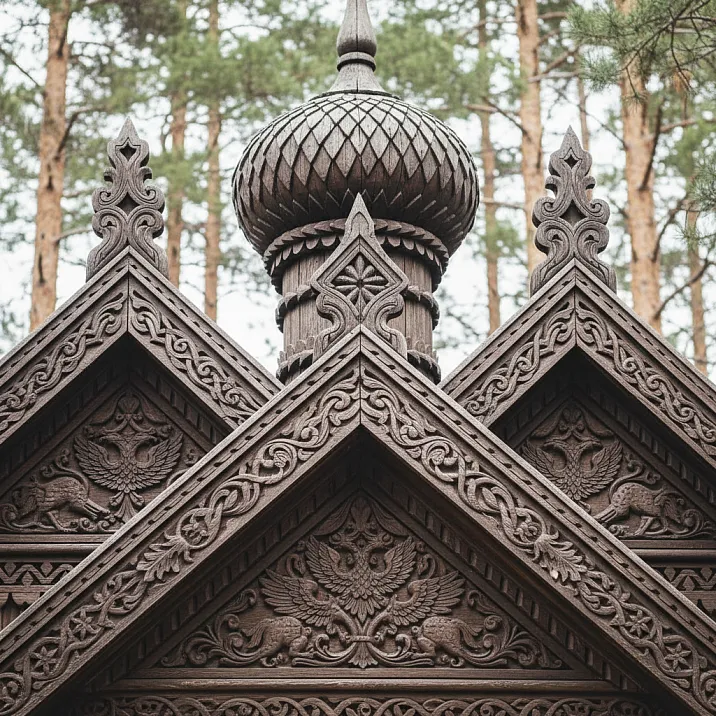
Pause for a moment and imagine: you drive past a house, and suddenly your gaze seems to stick to its facade. What caused you to stop in awe? Most likely, it was carved wooden gables — those very architectural gems that transform an ordinary building into a true work of art.
Carved wooden gables are not just decorative elements. They are living history, captured in patterns and ornaments, the soul of the house speaking to us in the language of ancient masters. In an era of soulless standardized construction, they become true islands of individuality, allowing every house to acquire its own face and character.


Historical Symphony: From Ancient Traditions to Modern Craftsmanship
When we speak of carved wooden gables, we touch the deepest roots of Russian architectural tradition. Our ancestors understood: a house is not merely shelter from the weather, it is a place of power, where every detail carries sacred meaning.
Ancient Russian masters transformed ordinary wooden houses into true teremok, where each element of the facade told its own story. Solar symbols protected against evil forces, plant ornaments invoked fertility, and birds and animals safeguarded family happiness. Gables became sort of books written in the language of carving.




Evolution of Styles and Techniques
Time passed, eras changed, but love for wooden carving remained unchanged. Each period brought its own characteristics to the art of creating carved gables. Baroque offered opulence and dynamism, classicism — strict harmony of proportions, modernism — smoothness of natural lines.
Modern carved wooden elements for home and facade incorporated the best traditions of the past, but received a new embodiment thanks to advanced technologies and innovative approaches to wood processing.
Our factory also produces:


Philosophy of wooden architecture
Why exactly wood became the primary material for creating gables? The answer lies not only in its accessibility, but also in the special energy of this material. Wood 'breathes', lives its own life, reacts to weather changes and seasonal shifts. It creates a unique atmosphere of warmth and coziness that cannot be replicated with artificial materials.
Each wood species has its own character and features. Oak offers nobility and solidity, pine — warmth and coziness, larch — resilience and longevity. Masters know how to read the character of wood and use its features to create truly unique works.
Get Consultation
Technological Mastery: From Concept to Realization
Creating high-quality wooden carved gables is a complex multi-stage process, where each stage is critically important for the final result. Modern technologies allow achieving incredible precision and detail while preserving the soul of handcrafted work.
Material selection and preparation
The quality of a carved gable begins with the proper selection of wood. Not every tree is suitable for facade decoration — the material must have specific characteristics: density, stability, and resistance to external influences.
The wood preparation process includes several critically important stages. First, careful drying in specialized chambers brings the moisture content to the optimal 8-12%. This prevents deformation and cracking during use.
Then comes calibration — bringing blanks to precise geometric dimensions. For carved gables, this is especially important, as even minor deviations can disrupt the overall harmony of the composition.
Design and Planning
Each wooden carved gable project begins with a detailed analysis of the house's architecture. Designers study the building's style, proportions, materials, and surrounding landscape. Only by understanding the context can a gable be created that becomes an organic part of the architectural ensemble.
Modern CAD programs allow creating detailed 3D models of future gables. The client can see how the finished product will look even before production begins. This eliminates misunderstandings and allows adjustments during the design phase.
Manufacturing: the union of tradition and innovation
The production of wooden carved gables combines traditional craftsmanship techniques with modern technological capabilities. Rough processing and basic shapes are created on high-precision CNC machines, ensuring ideal geometry and repeatability of elements.
But it is the handwork of the master that gives the gable its soul. Fine detailing, texture refinement, and creation of unique elements — all of this is done manually by experienced carvers. Their hands feel every fiber of wood, understanding how best to reveal its beauty.
Stylistic diversity: from classic to avant-garde
The world of wooden carved gables is astonishing in its diversity. Each style offers its own understanding of beauty and harmony, its own principles of composition and ornamentation.
Russian traditional style
Russian carved gables are a true encyclopedia of folk wisdom. Each ornament element carries deep symbolic meaning. Sun disks protect against evil forces, birds bring luck, plant motifs symbolize fertility and prosperity.
House Carving — is a special art passed down from generation to generation. Modern masters study old samples not for blind copying, but to understand the principles embedded in them and their creative development.
A distinctive feature of the Russian style is the combination of strict geometric forms with rich decorative elements. Triangular and semi-circular gables are adorned with complex ornaments, creating a remarkable play of light and shadow.
Classic European approach
Classic gables are distinguished by strict proportions and noble forms. There is no room for excess — beauty arises from harmony and proportionality of all elements. Primary motifs are borrowed from ancient architecture: acanthus leaves, rosettes, meanders, palmettes.
European wood carving tradition has brought a particular refinement and delicacy to the art of creating gables. Gothic pointed arches, Baroque opulence, Classicist rigor — all these influences can be traced in modern products.
Modern Interpretations
Modern designers are not limited to reproducing historical samples. They create fundamentally new forms, using the possibilities of modern technologies and materials. Minimalist geometric gables, abstract compositions, biomorphic forms — all this expands the traditional understanding of carved decoration.
Eclectic solutions are especially interesting, where elements of different styles harmoniously combine in a single composition. Such an approach requires high professionalism and refined artistic taste, but the result surpasses all expectations.
Functionality and practicality
Wooden carved gables are not only beauty, but also functionality. A properly designed gable performs multiple practical functions, making the house not only beautiful, but also more comfortable to live in.
Protective functions
The main function of any gable is to protect the upper part of the building from atmospheric influences. Wooden carved gables perform this task no worse, and sometimes even better, than modern materials. Wood possesses natural water-repellent properties, especially after special treatment.
Eaves and overhangs, which are part of the gable composition, effectively divert rainwater from the building's walls. This is especially important for wooden houses, where moisture penetration can lead to serious problems.
Thermal characteristics
Wooden gables can significantly improve the thermal characteristics of a building. Wood has low thermal conductivity, creating an additional barrier against heat loss. Properly designed gables with internal air cavities work as effective thermal insulators.
In summer, wooden gables create shade, reducing facade heating. In winter, they serve as additional protection against wind. Such passive climate regulation can significantly reduce heating and air conditioning costs.
Acoustic Comfort
The relief surface of carved gables effectively scatters sound waves, reducing external noise levels. This is especially important for houses located along busy roads or in industrial areas.
Wood itself possesses good sound-absorbing properties. The complex geometry of carved elements enhances this effect, creating multiple sound reflections that cancel each other out.
Installation and integration technologies
Quality installation is a guarantee of the longevity and safety of wooden carved facades. Modern fastening technologies allow securely fix even the most complex and heavy structures.
Preparation Work
Facade installation begins long before the crew arrives at the site. It is necessary to carefully study the project documentation, prepare all required materials and tools, and develop a work plan.
Special attention is paid to preparing load-bearing structures. Mounting locations must be perfectly level and protected from moisture. Modern waterproofing materials are used, which reliably protect wooden elements from capillary moisture absorption.
Fastening systems
Modern fastening systems differ fundamentally from traditional nails and screws. Special anchors are used, which evenly distribute load across the entire contact area. This eliminates stress concentration and prevents wood cracking.
Hidden fastening systems play a crucial role, as they do not disrupt the facade's aesthetics. Elements are fixed from the inside, leaving only a clean carved surface on the outside. This approach is especially important for delicate, intricate details.
Sealing and protection
Proper joint sealing is the key to the longevity of wooden facades. Modern elastic sealants retain their properties even under wood's thermal deformation.
It is important to ensure not only airtightness but also the possibility of disassembly for maintenance. High-quality sealants allow disassembling connections when necessary without damaging decorative elements.
Materials and their characteristics
Choosing a material for manufacturing carved facades is a compromise between beauty, functionality, longevity, and cost. Each wood species has unique characteristics and specific applications.
Traditional wood species
Oak rightfully ranks as the king among materials for carved facades. Its dense structure ensures exceptional longevity, while its expressive texture creates an elegant appearance. Oak facades can last for centuries, gradually acquiring a noble patina with age.
Larch is an ideal choice for regions with harsh climates. Its high resin content makes this wood naturally resistant to rot and insect damage. Larch facades do not require frequent reapplication of protective coatings.
Spruce remains the most accessible and popular material. When properly processed, spruce facades demonstrate excellent performance characteristics. The softness of the wood facilitates carving complex ornaments.
Thermo-modification of oak wood allows obtaining new color shades without using chemical dyes. The thermo-treatment process alters the wood structure at the molecular level, imparting new properties.
Technological advancements have led to the emergence of new wood-based materials. Glued beams from various species allow combining the best qualities of different woods into a single product.
Thermally modified wood achieves enhanced stability and longevity without using chemical treatments. This treatment alters the wood's color, imparting noble dark tones.
Modern protective coatings based on nanotechnology create an invisible barrier that protects wood at the molecular level from all types of exposure.
Regional characteristics and climate adaptations
Russia is a country with vast climatic diversity, and wooden carved facades must be adapted to specific operating conditions.
Northern regions
In harsh northern climates, wooden facades face extreme loads. Temperatures can drop to -40°C and below, with daily-night temperature fluctuations reaching 20-30 degrees.
For northern regions, specially selected wood species with enhanced frost resistance are used. Special attention is paid to drainage systems — accumulation of moisture under frequent freeze-thaw cycles can quickly lead to structural damage.
Protective coatings for northern conditions must retain elasticity at low temperatures. Special frost-resistant compositions are used, which do not crack or flake even in severe cold.
Southern regions
In southern regions, the primary destructive factors are intense ultraviolet radiation and high temperatures. Sunlight degrades lignin — the substance binding wood fibers — leading to loss of strength and color changes.
Facade decoration made of wood Southern regions require special protective coatings with UV filters. Modern compositions can provide protection for up to 10-15 years without losing properties.
Proper orientation of facades plays an important role. The most complex carved elements are placed on the north side, where direct sunlight exposure is minimal.
Coastal zones
Marine climate creates special conditions for wooden structures. Salty air aggressively affects all materials, while high humidity promotes mold and mildew growth.
For coastal regions, special anti-corrosion compositions are used to neutralize salt effects. Special attention is paid to ventilation of structures — they must 'breathe' to prevent moisture accumulation.
Economic Aspects and Investment Attractiveness
Wooden carved facades represent a significant investment requiring a thoughtful approach. It is important to understand not only initial costs but also long-term effects of such a solution.
Cost factors
The price of a carved wooden facade depends on many factors. Wood species play a significant role — products made from premium species cost more but last significantly longer. The complexity of carving directly affects labor costs and, consequently, the price.
The size of the gable also affects the price, but not always linearly. Large elements are often more economical per square meter due to optimized manufacturing processes.
Custom design increases cost but allows obtaining a unique product perfectly suited for a specific house. Standard solutions are cheaper but may not fully match the building's architectural style.
Impact on property value
Quality decorative facade treatment significantly increases the property's market value. Studies show that unique architectural solutions can increase a home's value by 15-30%.
Authorial works are especially valued, creating a unique building appearance. Such homes stand out in the real estate market and enjoy higher demand from buyers who appreciate individuality and quality.
Operating Costs
When properly manufactured and installed, wooden carved gables require minimal maintenance. Main expenses involve periodic renewal of protective coatings every 5-7 years.
Quality modern coatings significantly extend service intervals. Some compositions retain protective properties for 10-15 years, making operation more economical.
Innovations and development prospects
The world of wooden carved gables is not static. New technologies, materials, and design approaches constantly expand the possibilities for craftsmen and designers.
Digital Technologies in Design
Modern software allows creating gables of any complexity with photographic visualization accuracy. Virtual and augmented reality technologies enable "trying on" a future gable on a house even during the design stage.
Parametric modeling allows quickly generating multiple design variants, adapting the basic concept to specific requirements. This accelerates the approval process and helps find the optimal solution.
Integration with "smart" technologies
Modern gables can become part of a "smart home" system. Decorative elements incorporate LED lighting, sensors, and security components. Hidden lighting dramatically changes the gable's appearance at night.
Humidity and temperature sensors allow creating a monitoring system for the condition of wooden structures. This enables timely detection of problems and prevents serious damage.
Ecological Innovations
The development of "green" technologies also affects the production of wooden gables. New environmentally friendly wood treatment methods using only safe substances are emerging.
FSC certification guarantees that the wood comes from sustainably managed forests without harming the environment. This is becoming an important factor for environmentally conscious buyers.
Application and combination with other elements
Wooden carved gables are rarely used in isolation. They become part of a comprehensive decorative facade treatment, harmoniously combining with other elements.
Comprehensive facade treatment
Carved gables look most effectively when combined with other decorative elements. Decorative Inserts can complement the main composition, creating a unified stylistic ensemble.
Window and door trims, executed in a unified style with the pediment, create a harmonious composition for the entire facade. It is important to maintain proportions and avoid overloading the facade with decorative elements.
Landscape integration
Wooden gables must harmonize not only with the house's architecture but also with the surrounding landscape. In forested areas, more complex, "natural" ornaments are appropriate. In open areas, simple geometric forms look better.
Color selection should also consider the surroundings. Natural wood tones are universal, but sometimes contrasting solutions can create a striking accent in the landscape.
Frequently asked questions
How long do wooden carved gables last?
With proper manufacturing, installation, and maintenance, quality wooden carved gables can last 30-50 years or more. Service life depends on the wood species, climatic conditions, and frequency of preventive care.
Do carved gables require special care?
Primary care involves periodic renewal of protective coatings every 5-7 years. Annual cleaning from contaminants and checking fasteners are also recommended. With modern protective compositions, care is minimal.
Can a wooden gable be installed on a house made of other materials?
Wooden carved gables harmonize beautifully with houses made of any material — brick, blocks, stone. Modern fastening systems allow securely fixing wooden elements to any surface.
How to choose the right gable style?
The gable style should harmonize with the house's architecture and surrounding buildings. Consulting a designer is recommended, who will consider all the object's features and help create a harmonious composition.
Does installing a gable affect the cost of the house?
High-quality carved gables can increase the property's market value by 15-30%. They make the house more attractive to buyers and distinguish it from standard construction.
Can a gable be made according to a custom sketch?
Modern technologies allow creating carved gables of virtually any complexity based on a custom design. This can be either adapting existing designs or creating a completely unique original solution.
Which types of wood are best suited for gables?
The choice depends on climatic conditions, budget, and aesthetic preferences. Oak and larch provide maximum durability, while pine and spruce are more affordable with good performance characteristics.
Do you need permits to install a carved gable?
In most cases, installing decorative gables does not require special permits. However, in city historical centers or protected zones, coordination with architectural authorities may be required.
Conclusion: art tested by time
Wooden carved gables are not just decorative elements; they are a bridge between the past and the future, between traditions and innovations. In each piece, the soul of the craftsman lives, who invests not only professional skills but also a part of their heart into their work.
Choosing a carved wooden gable means choosing beauty, individuality, and quality. You are investing not only in your home but also in preserving ancient craftsmanship traditions, supporting artisans, and promoting eco-friendly technologies.
In a world where standardization often deprives us of the opportunity to express our individuality, carved wooden gables become a way to make a statement, to create a home that will not only be a place of residence but also a reflection of your soul, your values, and aspirations.
For many years, STAVROS has been a recognized leader in manufacturing high-quality wooden carved items. STAVROS masters combine a deep understanding of traditional techniques with the use of modern technologies, enabling them to create items that not only impress with their beauty but also serve for decades. Each gable created by STAVROS specialists is a unique work of art that will transform your home and make it truly one-of-a-kind. Choosing STAVROS means choosing quality proven by time and craftsmanship recognized by professionals.