












































































Article Contents:
- Material and properties: engineering at the molecular level
- Composition and manufacturing technology
- Density and Mechanical Properties
- Moisture and heat resistance
- Ecological Safety
- Comparison with alternatives
- Where FitoPolymer is suitable: optimal application scenarios
- Residential spaces: balance of price and quality
- Commercial spaces with moderate load
- Wet areas: practicality without limitations
- Country houses: stability under variable conditions
- New constructions: compensation for shrinkage
- Compatibility with paints: wide range of finishing options
- Water-based paints: primary choice
- Alkyd and oil-based paints: additional protection
- Decorative coatings: expanded possibilities
- Painting recommendations
- Basic profiles: assortment for any task
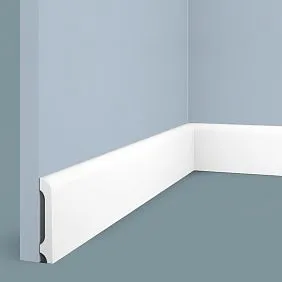
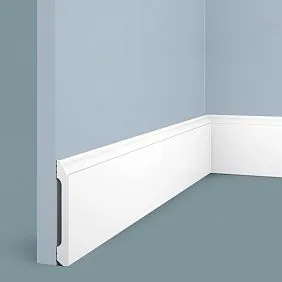
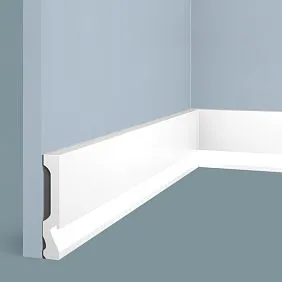
- Floor baseboards: heights and shapes
- Ceiling cornices: from minimalist to ornate
- Wall moldings: horizontal and vertical partitioning
- Components and accessories
- Installation and maintenance recommendations
- Preparation for Installation
- Choosing adhesive and fasteners
- Installation process
- Maintenance in operation
- Frequently Asked Questions
- How does FitoPolymer differ from DuroPolymer?
- Can FitoPolymer be used in a bathroom?
- How much does FitoPolymer baseboard cost?
- How long does FitoPolymer last?
- Can FitoPolymer be painted with alkyd paints?
- Is it necessary to prime before painting?
- Is FitoPolymer suitable for underfloor heating?
- Can FitoPolymer be installed by oneself?
- Does FitoPolymer bend for curved surfaces?
- Is the phytopolymer suitable for children?
- Conclusion: an innovation that became a standard
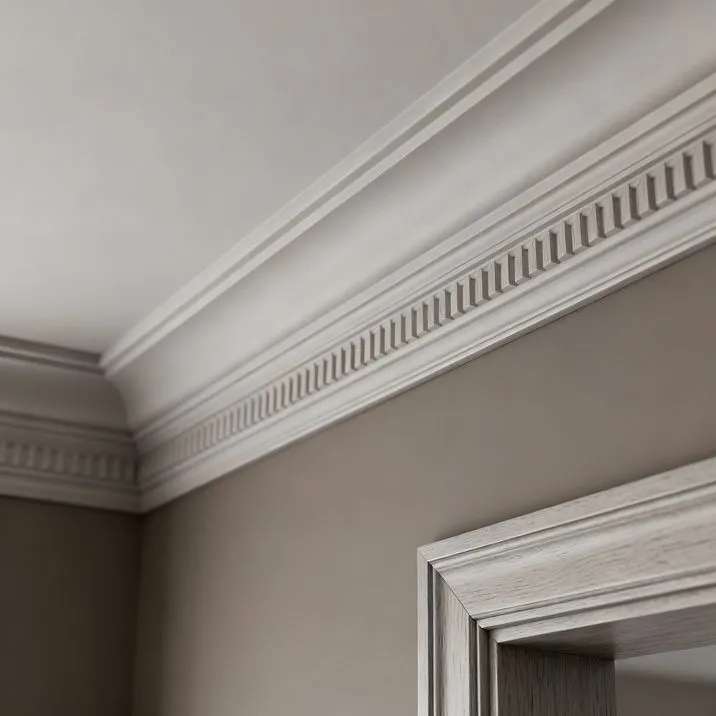
You stand before choosing a material for interior decorative elements. The seller shows samples: polystyrene — cheap, but fragile. Polyurethane — high quality, but expensive. Wood — noble, but fussy. Gypsum — traditional, but heavy. Each option has drawbacks that cause doubt. One wants to find the golden middle — a material combining advantages without critical flaws.
And here comes an unfamiliar word: phytopolymer. The consultant explains — it is an innovative material developed specifically for decorative molding. Lighter than polyurethane, stronger than polystyrene, moisture-resistant like plastic, paintable like wood. It sounds too good to be true. Is this a marketing trick or a real technological achievement?
Phytopolymer molding — it is a material of the latest generation, combining the best properties of synthetic polymers with the eco-friendliness of natural components. Density like duroplastic, but lighter. Strength like polyurethane, but easier to process. Dimensional stability, moisture resistance, resistance to temperature fluctuations, mechanical impacts. Let’s examine in detail what this material is, where it is optimal, how to work with it, and whether it is worth paying extra for innovations.




Material and properties: engineering at the molecular level
Phytopolymer is not a trade name of a specific manufacturer, but a class of materials developed based on modified polystyrene with the addition of natural fillers.




Composition and production technology
The base of phytopolymer — polystyrene, subjected to multi-stage modification. Natural fibers — cellulose, wood flour, plant resins — are added to the base polymer. This is not a mechanical mixture, but a chemical integration at the molecular level.
The production technology includes extrusion with simultaneous compaction. Raw materials are heated, mixed in the extruder, and pressed through a forming head. During this process, polymerization occurs — molecules bond into a strong structure.
The addition of natural components improves physical properties. Cellulose fibers create an reinforcing framework, increasing flexural strength. Plant resins improve adhesion to adhesives and paints. Wood flour reduces the coefficient of thermal expansion.
The result — a material combining the best properties of synthetic and natural materials. Polymer strength plus eco-friendliness of plant components. Plastic moisture resistance plus wood paintability.
Our factory also produces:


Density and mechanical properties
Density phytopolymer molding The density of phytopolymer molding products is 280-350 kg/m³. This is an intermediate value between duroplastic (350-420 kg/m³) and ordinary polystyrene (30-45 kg/m³). The material is 6-8 times denser than expanded polystyrene, but 20-30% lighter than duroplastic.
Flexural strength reaches 12-18 MPa — sufficient for most applications in interior design.
Phytopolymer skirting board Withstands local loads without destruction, does not break during installation, does not crumble during cutting.
Surface hardness is higher than polystyrene, but lower than duroplastic. It scratches easily, but is not as durable as dense duroplastic. For floor skirting boards in high-traffic areas, duroplastic is preferable; for ceiling moldings, phytopolymer is excessive.
The material's elasticity allows it to bend slightly without breaking. This simplifies installation on slightly uneven surfaces — the profile fits more tightly than rigid duroplastic. However, it lacks the flexibility of polyurethane — unsuitable for curved surfaces.
Get Consultation
Moisture and heat resistance
Phytopolymer's water absorption is less than 1% after prolonged immersion. The material does not swell, does not deform, does not lose strength in a humid environment. Can be used in bathrooms, kitchens, laundries without restrictions.
Natural components in the composition are treated with hydrophobic agents — substances that repel water. Even cellulose fibers, which usually absorb moisture, are protected by the polymer matrix in phytopolymer. Water does not penetrate into the structure.
Heat resistance up to 85-95°C — higher than ordinary polystyrene (80°C), but lower than duroplastic (90-110°C) and polyurethane (110-130°C). This is sufficient for residential spaces. Near heat sources — radiators, fireplaces — install with a clearance of at least 30 cm.
The coefficient of linear expansion is intermediate between polystyrene and duroplastic. The material is stable under temperature fluctuations, but in rooms with large windows, where sunlight strongly heats surfaces, micro-deformations may occur. Consider this during installation.
Oak skirting boards are an indispensable element of classic interior styles. In the English style, oak skirting boards with rich carving emphasize the aristocracy and solidity of the space. Dark wood tones harmonize beautifully with traditional materials — natural stone, leather, bronze.
The presence of natural components allows labeling phytopolymer as an 'eco-friendly' material. The content of plant fibers reaches 20-30% of the mass. This is not pure synthetic material, but a composite with natural components.
Emission of volatile organic compounds (VOC) is lower than in pure polymers. Natural components do not release toxic substances. Certificates confirm compliance with sanitary-hygienic norms for residential spaces.
Fire resistance class G2-G3 (moderately and normally flammable) — standard for polymer materials. When burning, it releases fewer toxic gases than PVC, but more than natural wood. Use in residential spaces without concerns, but not in evacuation routes.
High biostability. The material does not rot, does not suffer from mold, fungus, or insects. The polymer matrix protects natural fibers from biological agents. The service life is not limited by biological degradation.
Comparison with alternatives
Compared to polystyrene: phytopolymer is 6-8 times denser, stronger, and longer-lasting. Price is 2-3 times higher, but service life is 3-4 times longer. Economically justified for permanent housing.
Compared to duro-polymer: the bio-polymer is 20-30% lighter for comparable strength. Price is 15-25% lower. More eco-friendly due to natural components. But slightly less heat-resistant and rigid.
Compared to polyurethane: bio-polymer is 1.5-2 times cheaper. But it doesn't flex — not suitable for curved surfaces. For straight sections, it's preferable in terms of price-to-quality ratio.
Compared to wood: bio-polymer is not afraid of moisture, does not require periodic treatment, and maintains geometric stability. It is 2-4 times cheaper than natural wood. But visually and tactilely it lags behind natural material.
Where bio-polymer is appropriate: optimal application scenarios
Understanding the properties of the material determines the correct choice for specific conditions. Where does bio-polymer perform best?
Residential spaces: price and quality balance
Apartments and houses with permanent residence — the main niche of bio-polymer. The material lasts 20-25 years without losing properties, which is sufficient for one renovation cycle. Price is lower than premium materials, quality is higher than budget options.
Phytopolymer skirting board On floors in bedrooms, living rooms, children's rooms, withstands household loads. Accidental vacuum cleaner impacts, foot contacts, and furniture contact — all are tolerated without damage. For high-traffic hallways, duro-polymer is better.
Bio-polymer ceiling cornices maintain ideal geometry over 4-5 meter spans without sagging. Lighter than duro-polymer, simplifying installation, yet stiffer than polystyrene, ensuring stability. Optimal for wide cornices 150-200 mm.
Wall moldings create decorative divisions without overloading the interior. Bio-polymer can be painted any color and integrates into any style. From classic to minimalism — the material is universal.
Commercial spaces with moderate load
Offices, small shops, beauty salons, medical offices — spaces with moderate foot traffic. Bio-polymer withstands operational loads without critical damage. Wear resistance is sufficient for 15-20 years of service.
In office corridors Phytopolymer skirting board Protects walls from office chairs, cleaning equipment, and accidental impacts. Periodic wet cleaning with cleaning agents does not affect the material.
In retail spaces with low foot traffic — boutiques, showrooms, galleries — bio-polymer profiles create an attractive appearance at reasonable costs. After painting, they are indistinguishable from expensive materials.
In spaces with high foot traffic — large stores, shopping centers, train stations — bio-polymer is not sufficiently wear-resistant. Choose duro-polymer or industrial aluminum solutions.
Wet spaces: practicality without limitations
Bathrooms, toilets, kitchens, laundries — everywhere where humidity is elevated.
Bio-polymer cornice And skirting boards are not afraid of steam, water splashes, condensation. The material does not swell, does not deform, does not lose strength.
In bathrooms, bio-polymer is installed along the ceiling perimeter, hiding the joint with walls. After painting with moisture-resistant paint, it serves for decades. Direct contact with water is undesirable, but occasional splashes are not critical.
On kitchens, bio-polymer skirting boards protect walls from water splashes during floor cleaning. The smooth surface does not retain grease and dirt, and is easily cleaned with any household cleaners.
In laundries, where humidity is constantly elevated, bio-polymer remains stable. Wooden skirting boards would swell, MDF would delaminate, polystyrene might possibly withstand it, but bio-polymer guarantees performance.
Country houses: stability under variable conditions
Private homes, cottages — spaces with a wider temperature and humidity range than city apartments. Bio-polymer is more stable than polystyrene and does not deform under microclimate fluctuations.
In homes with intermittent heating — cottages that are not heated in winter — bio-polymer withstands freeze-thaw cycles without damage. Monolithic structure does not delaminate, as polystyrene might.
In wooden houses, where wood constantly 'breathes' and changes size with humidity, bio-polymer profiles remain stable. This creates a visual contrast — wood is mobile, profiles are unchanged.
New constructions: compensation for shrinkage
New homes in the first 2-3 years undergo shrinkage. Walls slightly shift, micro-cracks appear. Rigid materials — duro-polymer, gypsum — may crack at mounting points. Bio-polymer, with its slight elasticity, compensates for micro-movements.
The material's lightness reduces load on walls. In new constructions, where structures are still gaining strength, every kilogram of load matters. Bio-polymer is 20-30% lighter than duro-polymer for the same profile height.
Compatibility with paints: wide finishing options
Paintability is a critical property of decorative molding. Fitopolymer accepts a wide range of paints and coatings.
Water-based paints: primary choice
Water-emulsion, acrylic, and latex paints are the optimal choice for fitopolymer. They apply evenly, form a durable coating, dry quickly, and have no odor.
Priming is not necessary due to good adhesion. However, for an ideal result, apply an acrylic primer. This will level the surface absorption, improve the final color, and reduce paint consumption.
The number of coats depends on the paint's coverage. Premium paints cover in 2 coats. Budget paints require 3-4 coats. Three thin coats yield better results than two thick ones — the coating is smoother and stronger.
Choose the gloss level according to preference. Matte paints conceal minor defects. Satin finishes create a soft silk-like sheen. Glossy finishes highlight quality but require perfect surface preparation.
Alkyd and oil-based paints: additional protection
Fitopolymer withstands alkyd enamels and oil-based paints, distinguishing it from ordinary polystyrene. Organic solvents in such paints do not damage the material due to its modified structure.
Alkyd enamels create a harder and more durable coating than water-based paints. They are easier to clean, retain color longer, and are more resistant to abrasion. For floor molding in high-traffic areas, this is an advantage.
But working with alkyd paints is less comfortable. The strong odor requires ventilation. They take longer to dry — 12-24 hours between coats. Tools must be cleaned with solvents, not water. For most applications, water-based paints are more convenient.
Decorative coatings: expanding possibilities
Patina is created using special compounds or ordinary paints with dry brush technique. Dark paint in relief grooves imitates the effect of aging. Relevant for fitopolymer molding in classic interiors.
Metallic finishes — application of paints with metallic pigments (gold, silver, bronze, copper). Fitopolymer accepts them just like wood. After drying, the surface appears metallic or gilded.
Pearl and chameleon paints create color shifts at different viewing angles. A modern decorative effect popular in eclectic interiors. Fitopolymer is a suitable base for such coatings.
Lacquering — application of semi-transparent colored layers to create depth of color. A technique used in restoration and decorative painting. Works the same way on fitopolymer as on wood.
Painting recommendations
Paint after assembly following installation. This hides joints, mounting points, and creates a uniform coating along the entire perimeter. Painting before installation leaves visible unpainted areas at the joints.
Protect adjacent surfaces with painter's tape. Apply it tightly against the profile on the floor and walls. Remove the tape while the paint is still wet — this will result in a clean, sharp edge.
Use quality tools. Natural or mixed bristle brushes for water-based paints. Short-pile rollers for smooth surfaces, medium-pile for textured surfaces. Cheap tools leave bristles on the coating.
Work at 15-25°C and 40-70% humidity. Too cold — paint dries slowly and may bleed. Too hot — dries instantly, leaving no time to level. Humidity affects drying time.
Basic profiles: assortment for any task
Fitopolymer molding products include a full range of decorative elements.
Floor molding: heights and shapes
Classic heights of 60-80 mm suit standard apartments with ceilings of 2.5-2.7 m. Simple geometry with a smooth rounded top edge. Universal, fits any style.
European heights of 100-120 mm for modern interiors and rooms with ceilings of 2.7-3.0 m. Rectangular cross-section or with minimal relief. Visually elongates space, creates a sense of height.
High 150 mm for rooms with ceilings 3 meters and higher. Complex geometry with multiple relief levels. Architectural element creating a sense of respectability and solidity.
The fitopolymer provides rigidity for high profiles without sagging. A 150 mm polystyrene profile sags over long spans. Fitopolymer maintains its shape.
Ceiling moldings: from minimalist to ornate
Simple moldings 40-70 mm for minimalist interiors. Smooth surface without relief or with minimal profiling. After painting, they create a clear horizontal line.
Medium moldings 80-120 mm with moderate relief for most styles. Smooth transitions, delicate ornaments, classic profiles. Universal, suitable for 70% of interiors.
Wide moldings 150-250 mm with rich relief for classical interiors. Complex ornaments, multi-level profiling, imitation of plaster moldings. After painting, indistinguishable from historical moldings.
Bio-polymer cornice With a shelf for LED lighting — a specialized category. The construction includes a horizontal shelf 20-50 mm wide for mounting LED strips.
Wall moldings: horizontal and vertical divisions
Narrow moldings 20-40 mm for creating frames, borders, delicate divisions. Simple geometry, minimal relief. Used for framing wallpaper, pictures, mirrors.
Medium moldings 50-80 mm for panel solutions. Profiled surface with classic relief. Installed horizontally at 80-120 cm height, dividing walls into zones.
Wide moldings 100-150 mm for architectural compositions. Complex relief, multiple levels of profiling. Create expressive divisions in high rooms.
fitopolymer molding Corner — special profiles for finishing internal and external corners. Triangular or trapezoidal cross-section for tight fitting to two planes.
Components and accessories
Corner elements — pre-made internal and external corners for quick installation. Eliminate the need for precise 45-degree trimming. Especially useful for beginners.
Connectors — elements for joining straight sections on long walls. Conceal gaps, create neat transitions. After painting, they are not noticeable.
End caps — decorative elements for ends of profiles in door openings. Create a finished look, hide the raw edge of the material.
Rosettes and brackets — decorative elements for decorating ceilings and walls. Round, oval, square rosettes for ceiling centers. Brackets for visual support of moldings.
Installation and care recommendations
Correct installation and use determine the longevity of fitopolymer products.
Preparation for Installation
Material acclimatization is mandatory. If you bring profiles in winter, let them sit in the room for 24 hours. Temperature adaptation prevents deformation during installation.
The base must be flat, clean, dry, and strong. Remove peeling coatings, wash away dust, humidity no more than 10%. Fill in irregularities over 5 mm with putty.
Laser level marking guarantees horizontal alignment. Draw a line around the perimeter at the desired height. Even a millimeter deviation from horizontal is noticeable to the eye.
Tools: miter saw for cutting angles, drill or perforator for mounting, putty knife for applying adhesive, tape measure, level, pencil. Quality tools simplify the work.
Choosing adhesive and fasteners
Polymer adhesives, liquid nails, acrylic mounting adhesives — primary fasteners. Apply in zigzag or dots with 10-15 cm spacing. For heavy profiles, apply over the entire surface.
Additional mechanical fastening is desirable for profiles over 100 mm. Self-tapping screws or finishing nails with 40-50 cm spacing on straight sections, 20-30 cm in corners. Sink heads, fill holes with putty.
Mechanical fastening is mandatory for ceiling moldings. Only adhesive is not enough — the profile may detach after several years. Self-tapping screws every 30-40 cm guarantee reliability.
Installation process
Start with the internal corner of a long wall. The first profile sets the direction of the entire line. Check horizontal alignment with a level. Apply adhesive, secure with self-tapping screws, remove excess adhesive.
Join subsequent profiles tightly, without gaps. The geometric precision of fitopolymer allows a gap of less than 0.5 mm. Fill with acrylic sealant, smooth with a damp finger.
Cut corners at 45 degrees with a miter saw. Accuracy is critical — a 1-degree error creates a noticeable gap. Check on scraps, adjust on-site if necessary.
Allow adhesive to fully dry before painting. Usually 24 hours at 20°C and 50-60% humidity. Do not load profiles prematurely.
Maintenance in use
Regular dry cleaning with soft cloth or brush preserves appearance. Once a month, wipe with a damp cloth and neutral cleaning agent. This is sufficient to maintain cleanliness.
Stains are removed with any household cleaning agents. Fitopolymer is resistant to household chemicals. You can use chlorine, acid, or alkaline cleaners without damaging the material.
Use abrasive cleaners carefully. A painted surface may scratch when rubbed vigorously with a stiff sponge. For stubborn stains, it is better to use chemical stain removers rather than mechanical rubbing.
Damage is repaired locally. Fill scratches with acrylic putty, sand, and repaint. Dents are repaired similarly. Chips require replacement of the damaged area.
Frequently asked questions
How does phytopolymer differ from duropolymer?
Phytopolymer contains natural components (20-30% cellulose and plant fibers), while duropolymer is pure polystyrene. Phytopolymer is 20-30% lighter for comparable strength. Duropolymer is slightly harder and more heat-resistant. The price of phytopolymer is 15-25% lower.
Can phytopolymer be used in a bathroom?
Yes, the material is completely moisture-resistant. It does not fear steam, water splashes, or condensation. It does not swell, deform, or lose strength. After painting with moisture-resistant paint, it serves in bathrooms for decades.
How much does phytopolymer molding cost?
The price depends on height and profile complexity. Simple 70 mm skirting boards — 400-700 rubles/m. Medium-complexity 100 mm cornices — 600-1000 rubles/m. Wide ornate 200 mm cornices — 1200-2000 rubles/m. More expensive than polystyrene by 2-3 times, cheaper than polyurethane by 1.5-2 times.
How long does phytopolymer last?
Service life of 20-25 years under normal operating conditions. The material does not chemically age, does not lose strength, does not yellow. For comparison: polystyrene lasts 10-15 years, duropolymer 25-30 years, polyurethane 25-30 years.
Can phytopolymer be painted with alkyd paints?
Yes, the material withstands organic solvents in alkyd enamels. This distinguishes it from ordinary polystyrene, which dissolves upon contact with solvents. However, water-based paints are more convenient and sufficient for most applications.
Is priming needed before painting?
Not mandatory, but recommended for an ideal result. Acrylic primer equalizes absorption, improves color, reduces paint consumption. Without primer, paint also adheres well, but may require an additional layer.
Is phytopolymer suitable for heated floors?
Yes, the temperature of heated floors rarely exceeds 30-35°C on the surface, which is significantly below the heat resistance limit of phytopolymer (85-95°C). The material remains stable at such temperatures.
Can phytopolymer be installed by oneself?
Yes, installation is accessible for a homeowner with basic skills. Cutting with a circular saw or jigsaw, gluing, securing with self-tapping screws, spackling joints, and painting — all of this can be done by yourself in 1-2 days for an apartment.
Does phytopolymer bend for curved surfaces?
No, the material is rigid and does not bend without breaking. For arches, columns, and curved walls, flexible polyurethane is required. Phytopolymer is suitable only for straight sections and standard 90-degree angles.
Is phytopolymer eco-friendly for children?
Yes, the material is certified for residential use, including children’s rooms. The content of natural components (up to 30%) reduces the emission of synthetic substances. It does not emit toxic compounds under normal conditions.
Conclusion: an innovation that has become a standard
Phytopolymer molding A material combining the advantages of synthetic polymers and natural components. The strength of duropolymer at a lower weight. The stability of plastic with the eco-friendliness of plant fibers. Affordable price for premium quality.
Fitopolymer molding Products are suitable for most interior tasks. Skirting boards, cornices, moldings — a full range of decorative elements. Heights from 40 to 250 mm, geometries from minimalist to ornate, styles from minimalism to classic.
Compatibility with any paints expands possibilities. Water-based, alkyd, decorative — phytopolymer accepts everything. Paint in wall or floor colors, create contrasts, apply complex techniques. The material is universal.
Installation is accessible for self-execution. No special skills or expensive tools required. Follow instructions, work carefully — the result will be professional. Savings on labor cost 50-70% of material cost.
Durability of 20-25 years pays for the investment. The material does not require replacement during one repair cycle. Compare with polystyrene, which requires replacement every 5-7 years. Phytopolymer is more economically efficient.
Company STAVROS offers a full range of Phytopolymer skirting board Bio-polymer cornice, fitopolymer moldingProfiles of all sizes, styles, configurations. Accessories, fittings, professional consultations.
Choose phytopolymer — choose an innovative solution that has become a new quality standard. A material combining the best of polymer and natural components. Molding that serves for decades, pleasing the eye and requiring no maintenance.


