












































































Article Contents:
- Enemies of Facade Decor: What Kills Wood Outdoors
- Moisture: The Main Destroyer of Structure
- Ultraviolet: The Invisible Aggressor
- Biological Agents: Silent Destroyers
- Thermal Deformations: Invisible Stresses
- Material Selection: From Wood Species to Finished Product
- Wood Species: Comparative Analysis for Facades
- Blank Quality: Selection Criteria
- Protection System: Multi-Layered Wood Defense
- Antiseptic Treatment: Protection from Biological Damage
- Primer: Foundation for Finish Coating
- Finish Coatings: Varnishes, Paints, Oils
- Critical Points: Where Decor is Most Vulnerable
- Gable and Roof Junction: Maximum Risk Zone
- Cornice and Roof Overhang: Functional Protection
- Corner Elements: Joints and Connections
- Corbels and Brackets: Load-Bearing and Decorative
- Installation: Structural Protection from Damage
- Ventilation Gap: Wood Breathing
- Fastening: Balance Between Strength and Freedom
- Sealing and End Protection
- Maintenance Schedule: Culture of Care
- Annual Inspection: Early Problem Detection
- Cleaning: Delicacy and Regularity
- Touch-Up and Local Repair: Timely Response
- Frequency of Complete Coating Renewal
- Popular Questions About Facade Decor Protection
- Can Interior Varnishes Be Used on Facades?
- Is it necessary to remove the old coating before updating?
- How often should the ends of elements be treated?
- Which wood species is the most durable for an untreated facade?
- What should be done if rot is discovered in a carved element?
- Can carved decor be painted in winter?
- Company STAVROS: Craftsmanship, Time-Tested
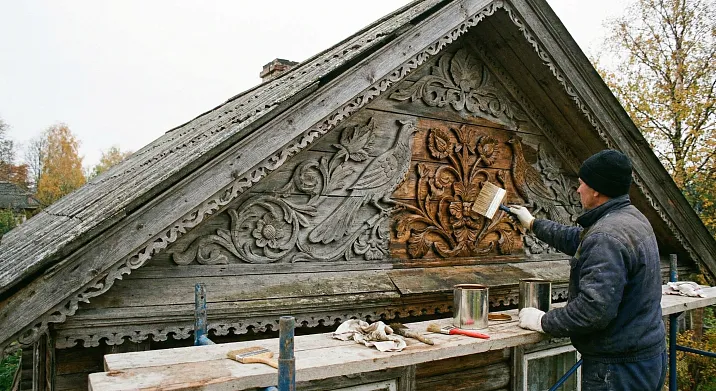
You have invested your soul and considerable funds into creatingof the house gable— the openwork carving plays in the sunlight, the wood exudes the aroma of resin, neighbors slow their pace, admiringly examining this beauty. But after two or three seasons, the first signs of deterioration become noticeable: darkening of the wood, small cracks, peeling of the coating, and in the worst case — mold in the recesses of the carving. A familiar picture? It's painfully frustrating when a work of art turns into a source of problems due to improper protection or lack of regular maintenance. Yet, with a competent approach, wooden facade decor can serve for half a century or longer, preserving its original beauty and structural strength. The difference between durability and rapid deterioration lies not in the whims of the weather, but in understanding the nature of wood, the correct choice of protective compounds, installation culture, and a systematic approach to maintenance.


Enemies of facade decor: what kills wood outdoors
Before discussing protection, we need to understand what exactly we are protecting against. Wood in the open air is subjected to a complex impact of factors, each capable of leading to deterioration, and together they work with double force. Understanding the mechanisms of deterioration allows for building an effective protection system, where each element addresses a specific threat.




Moisture: the main destroyer of structure
Water is the primary enemy of wood. Rain, snow, fog, dew, condensation — all these forms of moisture penetrate the structure of wood, causing fiber swelling. Upon drying, the wood contracts. Swelling-drying cycles create internal stresses that manifest as cracks, deformations, and fiber delamination. The ends are especially vulnerable — open cuts where wood capillaries are exposed and moisture absorption occurs tens of times more intensively than through the lateral surface.
Wet wood loses strength. If dry wood withstands compression along the fibers at 40-60 MPa, at 30% moisture content this indicator drops to 25-35 MPa. For massive timber, this is not critical, but for openwork carving, where element cross-sections are 15-30 millimeters, loss of strength can lead to parts breaking off under wind loads or snow accumulation.
Freezing of water inside wood creates pressure up to 200 atmospheres — sufficient to rupture fibers. During a winter season in central Russia, 30-50 freeze-thaw cycles occur. Each cycle creates microcracks that accumulate, expand, and turn into visible damage.Carved Gable on a Wooden Housewithout moisture-protective treatment begins to deteriorate under such conditions in 3-5 years.
Our factory also produces:




Ultraviolet: the invisible aggressor
Solar radiation is imperceptible but merciless. The ultraviolet component of the spectrum destroys lignin — the natural polymer that binds cellulose fibers of wood. The process is slow but continuous. The first sign is color change: light wood of pine or spruce turns gray, a characteristic silvery coating appears. This is not the patina of noble age, but a sign of surface layer destruction to a depth of 0.5-2 millimeters.
Further UV exposure leads to surface softening, loss of fiber cohesion. The wood becomes loose, easily scratched, and turns into mush when moistened. In the recesses of carving, where moisture accumulates, the process accelerates — the combination of UV degradation and moisture creates ideal conditions for biological damage.
The intensity of UV exposure depends on facade orientation. Southern facades receive maximum radiation and require enhanced protection. Western facades are subjected to combined impact — evening sun plus prevailing western winds with rain. Eastern and northern facades receive less UV but remain moist longer due to less solar heating — here the risk of biological damage increases.
Get Consultation
Biological agents: silent destroyers
Fungi, mold, wood-boring insects — biological enemies of wood. Fungal spores are present in the air everywhere, waiting for suitable conditions to germinate. These conditions: wood moisture content above 20%, temperature in the range of +5…+40°C, presence of oxygen. Outdoors, all these conditions are regularly met.
Staining fungi do not destroy the structure but change the color — bluish, blackness, pink spots. The aesthetic damage is obvious, but the danger is deeper: staining fungi prepare the ground for wood-destroying fungi, which feed on cellulose, turning strong wood into dust. White house fungi are especially dangerous — they can destroy 30-50 millimeters of timber thickness in a year.
Wood-boring insects are less common on facades than indoors, but they cannot be ignored. Longhorn beetles, powderpost beetles lay eggs in cracks and crevices of wood. Larvae bore tunnels, feeding on wood and weakening the structure. Sapwood layers of softwood species — pine, spruce — are especially vulnerable. Heartwood of larch and oak is more resistant due to natural insecticides.
Thermal deformations: invisible stresses
Wood expands when heated and contracts when cooled. The coefficient of linear expansion of wood along the fibers is insignificant — 3-5×10⁻⁶ per degree Celsius. But across the fibers, the coefficient is 10-15 times greater. For an element 200 millimeters wide, a temperature change from -30°C in winter to +50°C in summer (temperature of a dark surface in the sun) results in a size change of 1-1.5 millimeters — enough to create stresses in rigidly fixed parts.
Uneven heating exacerbates the problem. The front surface of a carved element heats up to 40-60°C in the sun, the back side remains in shade at 20-25°C. The temperature difference creates an expansion gradient, the element bends, internal stresses arise. If the wood is rigidly fixed to the base, stresses lead to cracks at fastening points or splitting of the element itself.
Daily heating-cooling cycles are less critical in amplitude but occur daily. Annual cycles — spring-summer-autumn-winter — have greater amplitude but lower frequency. Accumulated material fatigue from cyclic loads manifests after several years as a network of fine cracks, delaminations, loss of elasticity.
Material selection: from wood species to finished product
The first line of defense is the correct choice of material. Wood species differ radically in resistance to external influences. The quality of the blank, drying method, presence of defects determine durability no less than protective coatings.
Wood species: comparative analysis for facades
Larch is the optimal choice for facade decor in Russian conditions. Density of 650-750 kg/m³ provides strength comparable to oak. High content of gum — natural resin — gives the wood natural water resistance and fungicidal properties. Fungi cannot germinate in larch structure, insects avoid it due to the bitter taste of gum. With proper treatment, larch on a facade serves 50-80 years without signs of rot.
Larch has an expressive texture — contrasting annual rings, a reddish heartwood tint, and a clear fiber structure. Workability is good, although the high density requires sharp tools and powerful equipment. Once dried, larch is stable — warping and cracking are minimal when proper drying technology is followed. The price is 2-3 times higher than pine, but its durability justifies the investment.
Oak is a premium choice for facades of special status. Density 700-900 kg/m³, high content of tannins, which have antiseptic properties. Oak practically does not rot even without protective treatment. Mechanical strength is outstanding — carved oak decor withstands extreme wind and snow loads. The texture is noble, color ranges from light yellow to dark brown depending on the subspecies.
Disadvantages of oak: difficulty in processing due to high density, tendency to crack during rapid drying, high price — 4-6 times more expensive than pine. For large facade elements — pediments, cornices — oak may be excessive. For accent details — carved overlays, consoles — oak creates a sense of premium quality and ensures century-long durability.
Pine is a mass material for facade decor, affordable and technologically advanced. Density 450-550 kg/m³, softness ensures ease of processing, possibility of fine carving. The texture is pleasant, resinousness protects from moisture, though not at the level of larch. The main disadvantage is low biostability. Without protective treatment, pine on a facade turns blue and blackens within 1-2 seasons, and decay begins after 5-7 years.
Proper treatment with antiseptics turns pine into a durable material. Deep pressure impregnation creates a protective barrier to a depth of 10-20 millimeters — sufficient for 20-30 years of service. Surface treatment with a brush is less effective, requiring regular renewal every 3-5 years. For budget projects, pine is optimal provided there is high-quality protection.
Quality of blanks: selection criteria
Wood grade is critical for facade decor. Knots are not just an aesthetic defect, but also a structural weakness. Live knots (fused with the surrounding wood) are relatively safe if their diameter does not exceed 30% of the element's thickness. Dead knots (unfused, surrounded by a dark ring) are a source of problems. They fall out after 2-3 years of operation, leaving through holes through which moisture penetrates.
Cracks are unacceptable in facade decor. Heart shakes (radial, from the center to the edges) occur during tree growth due to internal stresses. Drying cracks appear due to improper drying. Any crack is a channel for moisture penetration into the part, a source of further destruction. When accepting lumber, reject boards with cracks longer than 50 millimeters or deeper than 5 millimeters.
Wood moisture content for facade decor should be 12-15% — equilibrium moisture content for outdoor use in the middle zone. Freshly sawn wood has a moisture content of 60-80%, after natural air drying — 20-25%, after kiln drying — 8-12%. Installation of decor from overdried wood (moisture content below 10%) leads to swelling and deformation after installation. Installation from underdried wood (moisture content above 18%) leads to drying cracks and warping.
The geometry of blanks must be stable. Warping, twisting, bending — signs of internal stresses that will intensify during operation. Permissible deviation from plane — no more than 2 millimeters per meter of length. Carved decor is made from glued panels — lamellas glued edge-to-edge. This increases stability, reduces the likelihood of warping and cracking compared to solid boards.
Protection system: multi-layer defense of wood
Effective protection of facade decor is not one magic product, but a system of sequential treatments, where each layer performs its function. Skipping or incorrectly performing one stage weakens the entire system.
Antiseptic treatment: protection from biological damage
Antiseptics are the first and mandatory stage of protection. They penetrate the wood structure, creating an environment unsuitable for fungi and insects. Antiseptics are divided into water-soluble, oil-borne, and oil-based. For facade decor, only non-leachable oil-borne and oil-based compositions are suitable.
Water-soluble antiseptics based on copper, chromium, and boron salts are effective against biological damage but are gradually washed out by rain. Protection period is 3-5 years, after which re-treatment is required. They are used for temporary structures or as preliminary treatment under subsequent varnish or paint coating.
Oil-borne antiseptics based on organic biocides (triazoles, carbamates) are dissolved in white spirit or other hydrocarbon solvents. They penetrate deeply into the wood — 5-15 millimeters with brush application, 20-40 millimeters with pressure impregnation. They are not washed out by water, creating long-term protection for 15-25 years. Disadvantage — strong odor during application, toxicity to humans until completely dry.
Oil-based antiseptics based on natural (linseed oil) or synthetic oils with added fungicides and insecticides. They not only protect against biological damage but also create a water-repellent impregnation, reducing wood swelling. Oils enhance the wood grain, do not create a film, and allow the wood to breathe. Disadvantage — the need for regular renewal every 2-3 years, as the oil gradually washes out and oxidizes.
The application technology of antiseptic is critical for effectiveness. The wood must be dry — moisture content no more than 20%, otherwise the composition will not penetrate inside. Air and wood temperature above +10°C, otherwise the antiseptic is not absorbed. Application with a brush in 2-3 coats with intermediate drying of 4-6 hours. Special attention to end grains — they are treated separately, with increased concentration of the composition or a greater number of coats.
Primer: the base for the finish coating
Primer creates a bonding layer between the wood and the finish coating, improves adhesion, evens out absorbency, blocks the release of resins and tannins that could stain the finish coating. For exterior wood, alkyd, acrylic, or oil-based primers are used.
Alkyd primers based on alkyd resins dissolved in white spirit penetrate deeply into the wood, creating a strong base for alkyd varnishes and paints. Drying time 12-24 hours, have a characteristic solvent odor. Provide excellent adhesion, but may yellow over time, which is critical for light coatings.
Acrylic primers on a water base are eco-friendly, odorless, dry quickly — 2-4 hours. Create a vapor-permeable film, allowing the wood to breathe. Suitable for acrylic paints and varnishes. Penetrate less deeply into the wood compared to alkyd, adhesion is slightly worse, but sufficient for most applications.
Oil-based primers based on linseed or tung oil maximally enhance the wood grain, create a water-repellent layer. Dry slowly — 24-48 hours, require ideal weather conditions during application. Suitable for oil-based finish coatings. Create a flexible, non-cracking base, ideal for parts with thin cross-sections.
Primer application is performed on dry wood, treated with antiseptic and dried for a day. Primer is applied with a brush in one or two coats, depending on the wood's absorbency. Porous species (pine, spruce) require two coats, dense species (larch, oak) — one. Intermediate drying between coats according to the manufacturer's recommendations. After the primer dries, the surface is sanded with fine abrasive P220-P280 to remove raised fibers.
Finish coatings: varnishes, paints, oils
The finish coating is the last line of defense and the main decorative layer. The choice of coating type is determined by aesthetic preferences and durability requirements.
Varnishes create a transparent or semi-transparent film that enhances the wood grain. For facades, only varnishes with UV filters are suitable; without them, the wood under the varnish will darken in one season. Alkyd-urethane yacht varnishes are the classic of facade protection. They create an elastic, durable film that withstands thermal deformation, resistant to abrasion and moisture. Service life 5-7 years, after which sanding and reapplication are required.
Acrylic varnishes on a water base are more eco-friendly, vapor-permeable, do not yellow over time. But they are less durable than alkyd ones and require renewal every 3-4 years. However, they are easier to renew — complete sanding of the old coating is not required, light matting and application of a new coat are sufficient.
Stains — semi-transparent coatings with pigments that color the wood but preserve the visibility of the grain. They contain a high concentration of UV filters, protecting the wood from solar radiation better than transparent varnishes. Stains are ideal for facades with southern orientation. The color palette is wide — from light tinting, almost not changing the wood color, to saturated shades that radically change the appearance.
Paints create an opaque, covering coating that completely hides the wood grain. For facade decor, alkyd or acrylic exterior paints resistant to atmospheric influences are used. The advantage of paints is maximum protection of wood from UV and moisture. The opaque film completely blocks solar radiation, preventing lignin destruction. Disadvantage — loss of the natural beauty of wood.
Oils for external use are a modern alternative to varnishes. Oils do not form a film but impregnate the wood, creating a water-repellent effect from within. Wood under oil breathes, does not crack, and is easily repaired locally. Oils with wax enhance water-repellent properties. The drawback is the need for regular renewal every 1-2 years, as the oil gradually washes out and oxidizes.
The technology for applying the finish coating requires ideal weather conditions. Air temperature +15…+25°C, air humidity not higher than 70%, no precipitation or dew for 24 hours after application. Varnishes and paints are applied in 2-3 coats with intermediate drying and sanding. Oils — in 2-3 coats with a 12-24 hour interval, excess is removed with a rag 20-30 minutes after application. End grain is treated with an increased number of coats — it is the most vulnerable.
Critical nodes: where decoration is most vulnerable
Facade Corner Elements, gable-to-roof joints, attachment points for consoles and brackets — these are high-risk zones where destructive factors concentrate. This is where most problems begin, and they require special attention during installation and maintenance.
Gable and roof abutment: the zone of maximum risk
The upper part of the gable abuts the roof slope — a place where snow accumulates, meltwater flows, creating constant moisture. Improper abutment turns this zone into a chronic source of problems. A carved gable must be separated from the roofing material by a ventilation gap of at least 20-30 millimeters, ensuring air circulation and condensation evaporation.
A canopy or drip edge over the gable is critical for protection. It is a metal or wooden strip, protruding 50-100 millimeters above the gable plane and diverting water flowing from the roof. Without a canopy, water flows over the carving, accumulates in recesses, creating constant wetting. The canopy is installed with a slope away from the gable, the lower edge is equipped with a drip edge — a bend that interrupts the water flow, causing it to drip rather than run down the surface.
Sealing the gable-to-roof joint is done with elastic sealants that compensate for thermal deformations. Rigid sealants crack within one or two seasons. Acrylic or polyurethane facade sealants retain elasticity at temperatures from -40 to +80°C. The sealant is applied into the gap between the gable and the roofing element, smoothed out, creating a smooth transition that does not impede water runoff.
Eaves and roof overhang: functional protection
The eave overhang — the horizontal projection of the roof beyond the wall plane — is one of the most important elements of facade protection. The optimal overhang projection is 600-800 millimeters for a two-story house, 800-1000 millimeters for a three-story one. Such a projection diverts water flowing from the roof to a safe distance from the walls, protects facade decoration from direct rain and splashback reflected from the plinth.
The eave soffit — boards closing the lower part of the overhang — can be decorated with carving, becoming an element of facade decoration. But the function of the soffit is not only decorative — it protects rafter ends from wetting, creates visual completeness of the roof. The soffit must be ventilated — with gaps or perforation, ensuring air circulation in the roof space.
A gutter system is a mandatory element for houses with carved facade decoration. Without gutters, water flows from the roof in a powerful stream, creating splashes, wetting walls and decoration. A properly designed gutter system collects water from the roof, directs it through pipes, diverts it to storm sewer or drainage. Carved consoles and brackets can serve as elements for attaching gutter troughs, combining functionality and decorativeness.
Corner elements: joints and connections
Building corners — zones where two planes meet, end cuts are created, and sealing difficulties arise.Corner decorative elements not only decorate corners but also protect them, covering joints, creating a structural barrier against moisture. Carved corner overlays, pilasters, corner boards must overlap both adjacent walls by at least 50-80 millimeters, ensuring reliable corner closure.
Fastening corner elements is done considering thermal deformations. Rigid fastening of a long element (2-3 meters) leads to cracking during temperature fluctuations. A rational solution is to fasten the element at several points, where the central point is fixed rigidly, the others — with the possibility of sliding (oval holes for fasteners, allowing the part to expand and contract without creating stress).
Sealing the joints of corner elements with the main wall plane is mandatory. Even tight fit does not guarantee protection against snow blowing and moisture penetration. A sealant strip 5-8 millimeters wide is applied around the perimeter of the element, which compresses during installation, creating an elastic waterproof seam. Excess sealant squeezed out along the edges is immediately removed with a damp cloth.
Consoles and brackets: load-bearing and decorative
Consoles — projecting elements that visually support eaves, balconies, canopies. Structurally, a console works in bending — the upper part experiences tension, the lower part — compression. Cracks in consoles usually start from the top, in the tension zone, where wood is most vulnerable. Fiber orientation is critical: fibers should run along the bending element, not across, otherwise bending strength is reduced multiple times.
Fastening the console to the wall — a node where loads concentrate. The console is fastened with at least two points: at the base and in the middle. Fasteners — through bolts 10-12 millimeters in diameter, passing through the console into the wall body to a depth of 100-150 millimeters. Using screws for fastening load-bearing consoles is unacceptable — they do not provide sufficient strength, especially under dynamic loads (wind, snow).
Waterproofing under the console protects the wall from moisture that may accumulate at the abutment point. A strip of bitumen or polymer waterproofing is laid under the console base, preventing moisture penetration into the wall. The console base itself is coated with waterproofing mastic before installation. These simple measures extend the service life of both the console and the wall.
Installation: structural protection against destruction
Proper installation is not only precision and aesthetics but also the foundation of durability. Installation errors do not appear immediately, but after 2-3 years, when correction requires dismantling and rework.
Ventilation gap: wood breathing
There must be a ventilation gap of 10-20 millimeters between the carved element and the wall, ensuring air circulation and condensation evaporation. If the element fits tightly against the wall, condensation accumulates between it and the wall, creating a zone of constant humidity, ideal for fungal development. After 2-3 years, the back side of the element begins to blacken, then rot.
The ventilation gap is created by mounting strips — vertical bars with a cross-section of 20×40 or 30×40 millimeters, which are attached to the wall. The carved element is attached to the strips, forming a gap between the element and the wall. The strips are placed vertically with a pitch of 400-600 millimeters, providing sufficient support. The gap remains open at the bottom and top, creating through ventilation on the chimney principle — warm moist air rises upward, drawing out moisture.
An alternative to strips — spacer washers or bushings, which are placed on fastening elements, creating a gap between the decoration and the wall. This method is simpler but less effective for large elements where uniform support over the entire area is required. For small overlays and corner elements, spacer bushings are quite acceptable.
Fastening: balance between strength and freedom
Wood lives — expands and contracts depending on humidity and temperature. Rigid fastening that does not allow this movement creates internal stresses, leading to cracks and deformations. Elements longer than 1 meter require movable fastening, where the part can shift in a plane parallel to the wall surface.
Movable fastening technology: the central point of the element is fastened rigidly — with a through bolt or screw, allowing no play. The remaining fastening points are made with oval holes in the part, where the oval length is 3-5 millimeters larger than the fastener diameter. This allows the part to shift along the oval during expansion or contraction without creating stress. A wide washer is installed under the fastener head, distributing the load and preventing wood indentation.
For heavy elements—large pediments, consoles—a combined fastening system is used: the lower part is rigidly fixed to bear the weight, while the upper part is flexibly attached to accommodate thermal expansion. This scheme ensures structural reliability while maintaining freedom of movement.
Sealing and end grain protection
The end grain of carved elements is the most vulnerable area. Exposed wood capillaries absorb moisture 10-15 times more intensely than side surfaces. An unprotected end grain can absorb as much moisture in one rainy season as a protected side surface does in 5-10 years. The result is swelling, cracking, darkening, which always starts at the ends.
End grain protection begins during the manufacturing stage. After cutting and milling, all end grains are treated with a concentrated antiseptic—applied in 3-4 coats with intermediate drying. Then the ends are primed with a specialized end grain primer that has increased viscosity and penetration depth. After priming, a finish coating—varnish or paint in 2-3 layers—is applied. This treatment reduces end grain absorbency to a level comparable to side surfaces.
For particularly critical elements, end grains receive additional protection with overlays—thin strips of the same wood that cover the end like a lid. The overlay is glued with waterproof adhesive and painted to match the main element. This adds manufacturing labor but significantly increases durability in critical areas—exposed pediments, consoles, protruding parts.
Maintenance protocol: a culture of care
Even perfectly protected and installed decorative elements require regular maintenance. Preventive inspection and timely intervention prevent problems from developing when they are still small and easily fixable.
Annual inspection: early problem detection
In spring, after snow melts and the facade dries, conduct a thorough inspection of all carved decorative elements. Use binoculars to examine high pediments and cornices. Look for: color changes (darkening, stains, gray patina), cracks, coating delamination, element deformations, signs of biological damage (mold, blue stains in carving recesses), damage from birds or insects.
Document any issues found with photographs noting date and location. This allows tracking dynamics—whether the problem is progressing, stable, or resolved. Create a maintenance checklist where you record the condition of each element: good, requires monitoring, requires intervention. This systematization turns care from chaotic actions into a managed process.
In autumn, before cold weather sets in, conduct another inspection focusing on winter preparation. Check if debris (leaves, twigs) has accumulated in carving recesses and on horizontal surfaces—remove it to prevent moisture retention zones. Ensure gutters are clean and functioning—clogged gutters cause overflows that wet the facade. Check sealing of critical joints—refresh if necessary.
Cleaning: delicacy and regularity
Dust, cobwebs, bird droppings, insect traces, pollen, tree resin secretions—all accumulate on facade decorations, creating not only aesthetic defects but also areas of increased moisture. Regular cleaning—at least once a year, and for facades facing roads or industrial areas—twice a year.
Cleaning technology depends on the coating type. Varnished and painted surfaces are washed with water and mild detergent (liquid soap, non-abrasive dishwashing liquid). Water is applied with a sponge or soft brush, dirt removed with gentle motions without strong pressure. Complex carvings are cleaned with a soft long-bristle brush that reaches into recesses. After washing, rinse the surface with clean water, wipe with a soft cloth, or let it air dry naturally.
Oil finishes are cleaned without water—using a dry soft brush or cloth. Using water on oiled surfaces can cause whitish stains. For stubborn stains, use mineral spirits applied to a cloth, but the surface will then require oil renewal, as the solvent partially removes the protective layer.
Do not use high-pressure washers (power washers) to clean carved decorations. Powerful jets damage coatings, tear fibers from soft wood areas, and force water into joints and end grains. For facades, power washers may be used at minimum power with wide spray patterns from at least 50 centimeters away, but for delicate carved decorations, manual cleaning is preferable.
Touch-up and local repair: timely response
Found an area with peeling coating, a small crack, darkening in a carving recess? Don't postpone repair—a small problem will become major in one or two seasons. Local repair is done precisely, without needing to repaint the entire element.
Coating delamination: clean the damaged area with a scraper or putty knife, removing all loose fragments down to solid substrate. Sand the edges of the cleaned area with fine P220 abrasive to create a smooth transition. Degrease the surface, apply primer, after drying—finish coating in 2-3 thin layers with intermediate drying. With quality work, the repaired area becomes invisible after drying.
Cracks are filled with exterior wood filler. The filler must be elastic, non-shrinking, matching wood color or tintable to match the finish coating. The crack is widened—expanded and deepened with a knife or router to create a profile that holds the filler. The crack is primed, filled with excess filler, after drying the excess is sanded flush, and the area is painted.
Darkening and mold are removed with specialized products—fungicidal cleaning agents that kill fungal spores. The affected area is treated according to instructions, rinsed with water, and dried. After complete drying, the area is treated with antiseptic, primed, and painted. Without antiseptic treatment, mold will return within months.
Full coating renewal frequency
Even quality coatings aren't eternal. Under UV exposure, moisture, and temperature cycles, they degrade and lose protective properties. Full coating renewal is labor-intensive but essential for preserving decorations. Frequency depends on coating type and operating conditions.
Alkyd varnishes on south-facing facades require renewal every 4-5 years, on north-facing facades—every 6-8 years. Acrylic varnishes—every 3-4 years regardless of orientation. Paints are more durable—7-10 years for alkyd, 5-7 years for acrylic. Oil finishes require renewal annually or biennially, but renewal is simple—just cleaning and applying a new oil coat without sanding.
Complete renewal technology: cleaning from contaminants, sanding with P120-P150 abrasive to remove the top damaged layer of coating and create roughness for adhesion of the new layer, dust removal, application of primer (if the coating is sanded down to the wood), application of finish coating in 2-3 layers. The work is performed in dry, warm weather, in one go, to avoid color unevenness.
Frequently asked questions about facade decoration protection
Can interior varnishes be used on facades?
Absolutely not. Interior varnishes lack UV filters, quickly degrade in sunlight, crack from temperature fluctuations, and wash away in rain. In one season, interior varnish on a facade will become a peeling crust under which wood begins to deteriorate. Use only varnishes marked for exterior use, containing UV stabilizers and plasticizers.
Should old coating be removed before renewal?
Depends on the old coating's condition. If it adheres firmly without delamination or cracks, sanding to create roughness and applying a new layer over it is sufficient. If the coating is peeling, cracking, flaking—it must be completely removed down to bare wood. Partial removal will cause unevenness in the new coating, which will delaminate where old degraded coating remains.
How often should the ends of elements be treated?
Ends are the most vulnerable area requiring increased attention. During annual inspections, check the condition of the ends first. If the coating on the end has lost integrity, cracks or darkening have appeared — immediately renew the protection. Ideally, ends require coating renewal twice as often as the main surfaces.
What type of wood is the most durable for a facade without treatment?
Absolute durability without treatment does not exist. Even the most resistant species — larch, oak, exotic types (teak, ipe, cumaru) — eventually deteriorate under UV and moisture exposure. Untreated larch darkens and grays but retains structural strength for 20-30 years. Oak lasts longer — 30-50 years, but also loses aesthetics. For maximum durability, any species requires protective treatment.
What to do if rot is found in a carved element?
Rot is a sign of deep wood damage by fungi that destroy the structure. If the rot is superficial (damage depth up to 5 millimeters), you can try to save the element: cut out the affected area down to healthy wood, treat with an enhanced-action antiseptic, fill with putty, paint. If the rot is deep or occupies more than 30% of the element's cross-section — the element needs to be replaced. Attempts to preserve a rotten element are dangerous — it can collapse under load.
Can carved decor be painted in winter?
Painting at sub-zero temperatures is strictly prohibited. Water in water-based compositions freezes, solvents in organic-based compositions lose volatility, the coating does not form a film. Minimum temperature for painting — +10°C for solvent-based compositions, +15°C for water-based. Optimal — +18…+25°C. Painting is performed in spring, summer, or early autumn during stable warm weather.
When it comes to creating a staircase that will serve for decades and delight with beauty every day, it is important to choose a reliable partner. The company STAVROS is synonymous with quality in the world of wooden products. For more than twenty years, STAVROS has produced
When it comes to facade decor that should last for decades, withstanding the whims of the Russian climate, the name STAVROS sounds like a guarantee of quality. This is not just a decor manufacturer, but a company with a 23-year history, behind which stand thousands of completed projects from Kaliningrad to Vladivostok, from modest country houses to premium segment estates.
STAVROS production specializes in products for extreme operating conditions.Facade Decorationis made from selected larch and oak, which have undergone chamber drying to a moisture content of 12-14% — optimal for facade application. The wood undergoes multi-stage control: boards with knots, cracks, resin pockets, rot, any defects that could reduce durability are rejected.
STAVROS protective treatment technology is a multi-level system where each layer reinforces the previous one. Antiseptic treatment is carried out in baths, where elements are immersed in the composition for 15-30 minutes, ensuring deep impregnation. Ends are treated separately, using the end-soaking method — multiple immersions until complete saturation. Priming is performed in painting chambers with controlled climate, ensuring uniform drying without defect formation.
The final coating is applied with a professional spray gun in several layers with intermediate drying and sanding. Only premium-class facade compositions from European manufacturers — Tikkurila, Belinka, Remmers — with proven durability in the northern European climate are used. The color palette includes 200+ shades, from natural wood tones to avant-garde designer colors. Custom tinting to any color according to the customer's sample is possible.
The STAVROS assortment covers all categories of facade decor: pediments, platbands, cornices, consoles, brackets, corner elements, balusters, pilasters. Each category is represented by dozens of models in different styles — from traditional Russian carving to modern minimalist forms. Custom manufacturing based on individual sketches is possible — from technical drawing to implementation in wood within 15-30 working days.
STAVROS installation teams are a team of professionals with many years of experience working with facade decor. They know all critical nodes, master structural protection technologies, ensure installation quality that guarantees durability. Installation includes creating ventilation gaps, proper fastening considering thermal deformations, sealing joints, final on-site finishing.
Service maintenance is another competitive advantage of STAVROS. The company offers contracts for regular maintenance of facade decor: annual inspection, cleaning, local repairs, coating renewal as needed. This relieves owners from the need to independently monitor the condition of the decor, guarantees timely identification and elimination of problems at early stages.
Choosing STAVROS, you choose not just beautiful decor, but a system ensuring its durability. You get products made from the right material, with professional protective treatment, installed according to all rules, with warranty and service support. You gain confidence that your facade decor will delight with beauty not for a year or two, but for decades, becoming part of the house's history, a testament to your taste and wisdom of choice.
Create facades that withstand time. Choose materials that serve generations. Trust professionals for whom quality is not a marketing slogan, but a way of life. STAVROS — your reliable partner in creating beauty that lasts.


