Article Contents:
- Climate Challenges of the Northern Capital
- Features of the Petersburg Climate
- Marine Salts and Urban Aggression
- Architectural Heritage and Modern Solutions
- Stylistic Diversity of St. Petersburg
- Restoration Requirements
- Technological Solutions for St. Petersburg Conditions
- New Generation Polyurethane Compositions
- Special Additives and Stabilizers
- Production Technologies and Quality
- Precision injection molding
- Multi-Level Quality Control
- Installation Features in St. Petersburg Conditions
- Seasonal Work Restrictions
- Specifics of Mounting
- Aesthetic Aspects of St. Petersburg Decoration
- Color Palette of the Northern Capital
- Stylistic Integration
- Economic aspects of the St. Petersburg market
- Pricing Specifics
- Impact on property value
- Logistical advantages of the region
- Transport Accessibility
- Warehouse Infrastructure
- Technical Support and Maintenance
- Skilled workforce
- Service Maintenance
- Innovations and development prospects
- Digital technologies
- Ecological innovations
- Segmentation of the St. Petersburg Market
- Luxury Construction
- Mass Housing Construction
- Reconstruction of Industrial Buildings
- Regulations and Standards
- Urban Planning Requirements
- Environmental Standards
- Frequently Asked Questions about Facade Decoration in St. Petersburg
- Is polyurethane decoration suitable for St. Petersburg's climate?
- Can decoration be used during restoration of historical buildings?
- How long does it take to manufacture decoration according to an individual project?
- Which season is best for installation?
- Does decoration require special care in St. Petersburg conditions?
- What warranties are provided for facade decoration?
- Can the color of decoration be changed after installation?
- Is decoration compatible with insulation systems?
- How to choose a reliable supplier in Saint Petersburg?
- What development trends are relevant for the St. Petersburg market?
- Conclusion: Traditions and innovations in the architecture of the northern capital
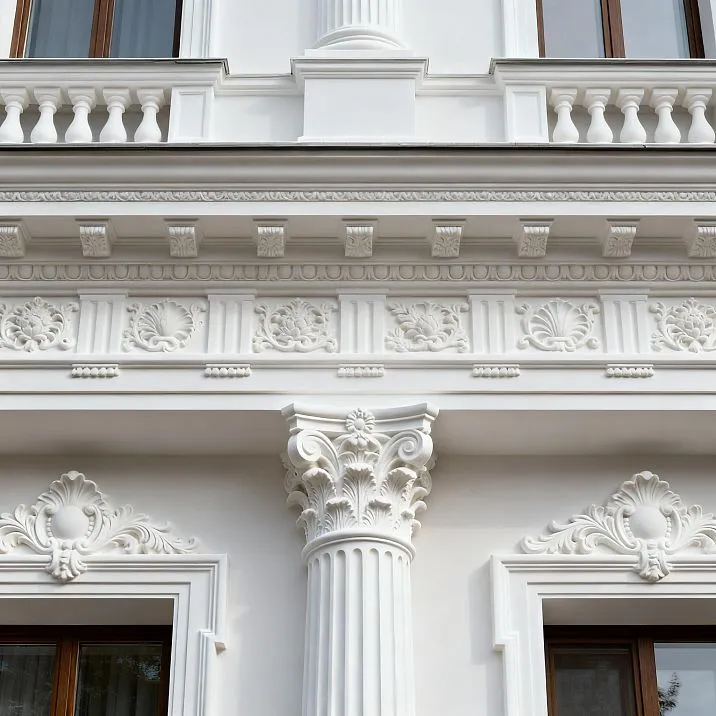
Saint Petersburg has always been the architect of architectural trends in Russia. Here, among the majestic facades of the Hermitage and the elegant lines of the Peterhof palaces,Facade Decoration SPBmust meet the highest standards of beauty and functionality. Every architectural element in the city on the Neva bears the imprint of centuries-old architectural traditions and modern technological achievements.
Saint Petersburg architecture is living history, where every facade tells its own era. From the baroque opulence of Rastrelli's creations to the strict classicism of Russia — the city demonstrates all the diversity of architectural styles. In this context, a modern decorative element must not merely adorn a building, but also organically fit into the historical environment, continuing the great traditions of St. Petersburg architecture.
Climate challenges of the northern capital




Features of the St. Petersburg climate
Saint Petersburg poses a serious challenge to any building materials. High humidity, reaching 85-90% during autumn-winter, frequent fogs, drizzling rains create an aggressive environment for facade structures. This is compounded by sharp temperature fluctuations — from -30°C in winter to +30°C in summer — which create significant stress on materials.
Traditional materials do not always cope with St. Petersburg conditions. Gypsum stucco, which has adorned the city's palaces for centuries, requires constant care and regular restoration. Limestone and sandstone are susceptible to weathering under acidic rains and sea salts brought by Baltic winds.Facade decoration manufacturermust take into account all these factors when developing products for the St. Petersburg market.
Our factory also produces:


Marine salts and urban aggression
Proximity to the Baltic Sea creates additional complications. Sea salts carried by the wind settle on building facades, causing corrosion of metallic elements and degradation of porous materials. The urban environment adds its own negative factors — exhaust gases from cars, industrial emissions, road de-icing agents.
ModernPolyurethane Itemsare specifically designed to withstand such an aggressive environment. The chemical inertness of polyurethane eliminates interaction with salts and acids. Low water absorption — less than 1.5% — prevents moisture accumulation within the material structure. This is critically important in St. Petersburg's climate, where freeze-thaw cycles may occur dozens of times during winter.
Get Consultation
Architectural Heritage and Modern Solutions
Stylistic diversity of St. Petersburg
Saint Petersburg is a unique open-air museum of architecture. Here you can see all the main styles of European architecture: from Peter's Baroque to Stalinist Empire. Each era has left its mark on the city's appearance, creating an unparalleled stylistic palette.
Decor collectionsfor St. Petersburg buildings must take into account this diversity. For the reconstruction of historical buildings, precise reproduction of canonical elements — from Corinthian capitals to Baroque cartouches — is required. Modern construction, on the contrary, tends toward minimalist forms, where every detail must be functionally justified.
Restoration requirements
Saint Petersburg is a city-heritage site listed in UNESCO's World Heritage List. This imposes special requirements on all restoration and construction work in the city's historical part.Architectural decorationfor such objects must exactly match historical prototypes in dimensions, proportions, and decorative details.
Modern technologies allow achieving exceptional accuracy in reproduction. 3D scanning of historical elements with precision down to fractions of a millimeter enables creating identical copies of lost details. At the same time, new materials surpass historical analogs in durability and resistance to atmospheric effects.
Technological solutions for St. Petersburg conditions
is manufactured from special polyurethane compositions adapted to the northern climate. The frost resistance of these materials exceeds 500 freeze-thaw cycles without loss of strength characteristics. This is several times more than Russian standards require.
ModernFacade Decoration SPBIt is made from special polyurethane compositions adapted to the northern climate. The frost resistance of these materials exceeds 500 freeze-thaw cycles without loss of strength properties. This is several times greater than Russian standards requirements.
What makes polyurethane an ideal material for St. Petersburg? Primarily, its closed-cell structure. Unlike traditional porous materials, polyurethane does not accumulate moisture within its structure. The water absorption coefficient is less than 0.8% by volume, which prevents damage from water freezing in pores.
Special additives and stabilizers
Polyurethane compositions for the St. Petersburg market contain special additives that enhance resistance to aggressive influences. UV stabilizers based on benzotriazoles protect the material from degradation by solar radiation. Antioxidants prevent oxidative processes that could lead to polymer aging.
Biocides in the material composition prevent the development of mold and fungi — a serious problem in the humid St. Petersburg climate. These additives remain effective throughout the product's service life, ensuring consistent appearance and hygienic safety.
Production technologies and quality
Production of high-quality
Manufacturing high-quality facade decoration requires advanced equipment and strict adherence to technological parameters. Pressure casting up to 2500 bar ensures filling of the finest details of the mold, accurately reproducing all nuances of the original sample.
Temperature control with precision ±0.5°C is critically important for obtaining stable material characteristics. Deviations from the optimal regime may lead to uneven density, internal stresses, and reduced strength indicators. Modern production lines are equipped with automated control systems that eliminate human error.
Multi-level quality control
Each production stage is accompanied by quality control. Incoming raw material inspection includes checking chemical composition, viscosity, melting temperature. Technological control monitors mixing parameters of components, temperature regime, pressure in molds.
Final inspection of finished products includes checking geometric parameters, appearance, and absence of internal defects. Modern non-destructive testing methods — ultrasonic testing, X-ray scanning — allow detecting hidden defects without damaging the product.
Installation specifics in St. Petersburg conditions
Seasonal work restrictions
St. Petersburg's climate imposes serious restrictions on the timing of facade works. The optimal period is from May to September, when air temperature is consistently positive and humidity is relatively low. Installation during off-season is possible but requires additional protective measures and special materials.
Winter work is severely restricted and can only be performed at temperatures not lower than -10°C using frost-resistant adhesive compositions and temporary coverings. In this case, labor costs increase by 40-60%, and quality may suffer due to adverse conditions.
Fastening specifics
High humidity of St. Petersburg's climate requires special attention to sealing fasteners. Any imperfections may become entry points for moisture and subsequent system degradation. Special sealants with enhanced elasticity and adhesion to polyurethane are used.
Decor SetsInclude all necessary fastening elements and consumables. This ensures compatibility of all system components and guarantees reliable fastening throughout the entire service life.
Aesthetic aspects of St. Petersburg's decor
Color palette of the northern capital
St. Petersburg architecture traditionally favors a restrained color palette. Dominant shades are ochre, umber, and classic white. This palette developed historically and is linked both to climatic conditions and aesthetic preferences of different eras.
Modern coloring technologies allow achieving any shades of this classic palette. Special pigments ensure color resistance to fading and atmospheric precipitation. Matte finishes are preferable to glossy ones, as they better conceal minor defects and dirt.
Stylistic integration
New buildings in St. Petersburg must harmoniously integrate into the historical environment. This does not mean mechanical copying of historical forms, but requires a deep understanding of St. Petersburg architectural principles.Moldings, cornices, pilastersMust match the scale of surrounding buildings, maintain facade rhythm, and not disrupt the overall composition.
Economic aspects of the St. Petersburg market
Pricing specifics
The St. Petersburg facade decor market has its own pricing specifics. High quality requirements, need to comply with historical standards, complex climatic conditions — all this affects product cost. At the same time, St. Petersburg consumers are willing to pay a premium for guaranteed quality.
Competition among suppliers contributes to optimizing the price-quality ratio. Manufacturers are forced to constantly improve technologies, reduce costs, and offer more favorable cooperation terms. This positively impacts the overall market development.
Impact on property value
Quality architectural finishing in St. Petersburg is considered a serious factor affecting real estate value. Buildings with expressive facades enjoy higher demand from buyers and tenants. Investments in facade decor pay off not only through durability but also through increased asset capitalization.
Logistical advantages of the region
Transport accessibility
St. Petersburg is a major transportation hub of Northwest Russia. A well-developed network of roads and railways ensures rapid delivery of materials from manufacturers located in various regions of the country. The seaport allows importing materials and equipment.
Proximity to the Finnish border and other EU countries facilitates access to European technologies and materials. Many European manufacturers consider St. Petersburg as a gateway to the Russian market, which contributes to the development of local distribution networks.
Warehouse infrastructure
The St. Petersburg region has a network of specialized warehouses for construction materials. This allows maintaining significant stockpiles of popular items, ensuring rapid order fulfillment. Construction companies can obtain necessary materials in the shortest possible time.
Technical service and support
Qualified workforce
St. Petersburg is one of Russia's leading educational centers in architecture and construction. Here, highly qualified specialists are trained who can work with modern materials and technologies. Availability of skilled personnel is an important competitive advantage for the region.
Many facade decor manufacturers and suppliers organize training centers in St. Petersburg, where they train installers, architects, and designers. This contributes to improving work quality and expanding the application of modern materials.
Service Maintenance
A well-developed service network provides technical support at all stages of the project — from design to warranty service. Experienced specialists help architects select optimal solutions, calculate material requirements, organize logistics and installation.
Innovations and development prospects
Digital technologies
The adoption of digital technologies fundamentally changes approaches to architectural decor design and manufacturing. BIM technologies allow creating accurate digital building models including all decorative elements. This simplifies design, reduces error likelihood, and accelerates approval procedures.
3D scanning of historical buildings creates accurate digital archives of St. Petersburg architecture. These data are used not only for restoration work but also for creating new elements in historical style. Virtual reality allows clients to evaluate results even during the design stage.
Ecological Innovations
Growing attention to environmental issues stimulates the development of "green" technologies in construction material production. Modern polyurethane compositions do not contain ozone-depleting substances, heavy metals, or toxic solvents. Production processes are optimized to reduce energy consumption and emissions.
Segmentation of the St. Petersburg market
Luxury construction
The market for elite real estate in St. Petersburg demands special requirements for architectural decoration quality. Here, unique solutions created according to individual projects, handcrafted elements, use of exclusive materials and technologies are in demand.
Elite projects often involve recreating historical interiors and facades with maximum authenticity. This requires in-depth study of archival materials, consultations with architectural historians, and the use of traditional technologies in a modern interpretation.
Mass housing construction
Housing development programs in St. Petersburg and its region create significant demand for standard decorative solutions. Here, optimizing the price-to-quality ratio while preserving aesthetic merits is important.
Standardizing elements allows reducing product cost without compromising quality. At the same time, the variety of basic elements enables creating different compositions, avoiding monotony of standardized construction.
Industrial building reconstruction
St. Petersburg actively develops projects for reconstructing industrial buildings into residential, office, and cultural facilities. Lofts, art spaces, business centers in historic buildings are highly popular. Such projects require a special approach to architectural decoration.
Industrial aesthetics implies using minimalist forms, highlighting structural elements, and playing with textures and materials.Decorative InsertsIn such projects, they should emphasize, not conceal, the industrial character of the architecture.
Regulation and standards
Urban planning requirements
As a federal city, St. Petersburg has a special status in urban planning regulation. The Committee for Urban Planning and Architecture strictly controls compliance of new projects with the city’s historical environment. All facade works in the city center require approval from relevant authorities.
Requirements for materials and technologies are constantly becoming stricter. Priority is given to solutions that ensure longevity and minimal operating costs. This encourages the use of modern high-quality materials.
Environmental standards
As a major metropolis, St. Petersburg pays special attention to ecological aspects of construction. All materials must comply with strict ecological standards, have safety certificates, and not negatively impact the environment.
Frequently Asked Questions about facade decoration in St. Petersburg
Is polyurethane decoration suitable for the St. Petersburg climate?
Modern polyurethane decoration is specifically adapted for harsh climatic conditions of the Northwest. Freeze resistance exceeds 500 freeze-thaw cycles, water absorption is less than 1%, UV resistance is ensured by special stabilizers. The material has been successfully used in St. Petersburg conditions for over 20 years.
Can decoration be used during the restoration of historical buildings?
Modern polyurethane materials are widely used in the restoration of architectural monuments. They allow accurately reproducing lost historical elements while providing better durability compared to traditional materials. For cultural heritage objects, approval from the State Committee for Architectural Heritage (KGIOP) is required.
How long does it take to manufacture decoration according to an individual project?
Standard elements are delivered within 2–4 weeks. Manufacturing unique elements according to individual sketches may take 6–12 weeks depending on complexity. For restoration projects, timelines may be extended due to the need for detailed study of historical analogs.
What season is best for installation?
The optimal period for installation in St. Petersburg is from May to September, at air temperatures from +5°C to +25°C and humidity not exceeding 80%. Works during off-season are possible using special materials and additional protective measures, but cost increases by 30–50%.
Does decoration require special care in St. Petersburg conditions?
Polyurethane decoration requires almost no maintenance. In high humidity, it is recommended to perform preventive washing 1–2 times per year to remove dirt and prevent microbial growth. Inspection of the mounting system is advisable annually.
What warranties are provided for facade decoration?
Quality manufacturers provide a 15–25 year warranty on the material’s operational properties under St. Petersburg climate conditions. The warranty includes freeze resistance, water resistance, geometric stability, and UV resistance. It is important to follow installation technology and operating conditions.
Can the color of decoration be changed after installation?
Polyurethane elements can be repainted using special exterior paints. In St. Petersburg, it is recommended to use water-dispersed paints with increased vapor permeability. Quality coating lasts 7–10 years, after which renewal is required.
Is decoration compatible with insulation systems?
Modern facade decoration systems are fully compatible with suspended ventilated facades and external insulation systems. Elements can be installed over insulation or integrated into the insulation system. It is important to use compatible materials and follow installation technology.
How to choose a reliable supplier in St. Petersburg?
When choosing a supplier, pay attention to their experience in the St. Petersburg region, presence of completed projects, product quality certificates. Important are warranty obligations, technical support, and ability to fulfill individual orders. It is recommended to review production capacities and technologies.
What development trends are relevant for the St. Petersburg market?
Key trends: integration of decoration with engineering systems, use of BIM technologies for design, development of individual solutions for the elite segment, increased ecological requirements for materials. Demand for restoration work and adaptation of historical buildings to modern functions is growing.
Conclusion: traditions and innovations in the architecture of the northern capital
Saint Petersburg is a city where history and modernity exist in a remarkable harmony. Here, every new building must not only meet modern requirements of comfort and functionality, but also seamlessly integrate into the unique architectural ensemble of the northern capital. Facade decoration plays a key role in this process, linking the past and the present, traditions and innovations.
The severe climatic conditions of St. Petersburg impose special requirements on materials and technologies. Only the highest quality, time-tested solutions can withstand the test of St. Petersburg’s fogs, rains, and frost. Modern polyurethane materials have proven their effectiveness in these challenging conditions, combining the beauty of classical forms with the reliability of innovative technologies.
Investments in quality architectural decoration are investments in the long-term future. In a city that values beauty and historical continuity, properly selected decorative elements become not just embellishments of buildings, but also contributions to preserving and developing the unique architectural heritage of St. Petersburg.
The future of facade decoration in St. Petersburg is linked to further development of technologies, higher ecological standards, and integration of modern engineering systems. At the same time, requirements for quality, durability, and aesthetic perfection remain unchanged — principles that have always defined the face of the northern capital.
STAVROS deeply understands the specifics of the St. Petersburg market and the unique requirements of the northern climate. Years of experience working in the region, deep knowledge of local architectural traditions, use of the most modern technologies and materials enable STAVROS to offer high-quality solutions for any project. Own production facilities equipped with high-tech equipment ensure strict adherence to technological processes and stable product quality. A wide range of products includes elements for all architectural styles — from historical classicism to modern minimalism. Professional technical support, warranty service, and flexible discount system make cooperation with STAVROS maximally comfortable and beneficial. Choosing STAVROS, St. Petersburg architects and developers get a reliable partner capable of realizing the most ambitious projects while taking into account all the specifics of the northern capital.