












































































Article Contents:
- Neolithic: When the First Tables Appeared
- From Floor to Elevation: Social Revolution
- Ancient Egypt and Mesopotamia: Tables as Status Markers
- Table as a Boundary Between Classes
- Antiquity: Triclinia and the Philosophy of Communal Dining
- Construction of Roman Tables
- Middle Ages: Trestle Boards and the Great Hall
- Why Weren't Stationary Tables Made?
- Renaissance: Table as a Work of Art
- Construction of Renaissance Tables
- 18th Century: The Revolution of the Extension Mechanism
- English Innovations: Pembroke Table and Accordion
- 19th Century: Mass Production and Standardization
- 20th Century: New Materials and Minimalism
- Modern Extension Systems: Engineering Excellence
- Why Extension Tables Are More Complex Than Stationary Ones
- Why Humanity Spent 300 Generations Learning to Eat Together
- Anthropology of the Table: Cultural Differences
- Table Shape and Social Structure
- Frequently Asked Questions About Table Construction and Selection
- What Size Table Is Needed for a Family of 4-6 People?
- Extension or Stationary — Which Is More Practical?
- Why Is an Oak Table Heavier Than a Pine Table?
- What Is the Optimal Tabletop Thickness?
- Are Stretchers Needed Between Table Legs?
- How to Care for an Extension Mechanism?
- Can a Broken Mechanism Be Repaired?
- Which Table Is Better for a Small Kitchen?
- Answers to frequently asked questions (FAQ)
- Conclusion: Table as the Center of the Home

Humans have always eaten. But gathering together around a common surface, sharing a meal within the family or community circle, turning food consumption into a ritual — this need did not arise immediately. The dining table is not a utilitarian necessity but a social invention that has evolved alongside civilization over ten millennia. From flat stones in Neolithic settlements to extension systems with telescopic guides —classic tableit has undergone a journey reflecting changes in architecture, technology, and the social structure of society.


Neolithic: When the First Tables Appeared
Çatalhöyük — a Neolithic settlement in Anatolia (modern-day Turkey), existing from 7400 to 5600 BCE — is one of the first proto-cities in human history. Excavations begun in the 1960s by British archaeologist James Mellaart revealed a surprisingly advanced material culture: multi-room houses made of mudbrick, wall paintings, cult figurines, and pottery.
Among the finds were clay platforms 30-40 centimeters high, built into the structure of houses or standing separately. These elevations were used for placing food, tools, and cult objects. They cannot be called tables in the modern sense — they had no legs, were not mobile, and did not imply sitting around them. But functionally, these are the first horizontal surfaces specifically created for working with objects at a level above the floor.




From Floor to Elevation: A Social Revolution
Why did people start raising work surfaces above the floor? Because it is more physiologically convenient and hygienic. Eating while sitting on the floor is possible — billions of people have done and still do so. But working with objects (butchering meat, preparing food, making tools) is more convenient on an elevation — there's no need to bend over significantly, hands work at a comfortable height, and the back doesn't get tired.
The transition to a sedentary lifestyle, agriculture, and permanent dwellings made it possible to create permanent infrastructure inside the home. Nomads don't need tables — everything they own must be mobile. Farmers, living in one place for decades, could build ovens, platforms, storage facilities — elements integrated into the architecture.
Our factory also produces:


Ancient Egypt and Mesopotamia: Tables as Status Markers
By the third millennium BCE in Egypt and Mesopotamia, tables had evolved into separate pieces of furniture — wooden or stone structures on legs, used for dining, rituals, and writing. Images on frescoes and reliefs show low tables (20-30 cm high), around which people sat on mats or cushions.
The form was simple: a rectangular tabletop, four legs, sometimes connected by horizontal crosspieces for rigidity. Materials included wood (acacia, sycamore, cedar), stone (limestone, granite), and bronze for elite specimens. Tables of the nobility were decorated with inlays of ivory, gold, semi-precious stones, and carvings depicting gods and symbols of power.
Get Consultation
The Table as a Boundary Between Classes
In ancient societies, access to a table defined social status. Pharaohs, priests, and aristocrats ate at tables. Common people ate on the floor, holding a bowl in their hands or placing it on the ground. A table was not just a convenience, but a privilege, a sign of belonging to the upper class.
This social demarcation persisted for millennia. Even in medieval Europe, the expression 'to sit at the lord's table' meant belonging to his household, dependence on him, and inclusion in the hierarchy.
Antiquity: Triclinia and the Philosophy of Communal Dining
Ancient Greeks ate while reclining on couches (klinai) arranged around low tables. Romans adopted this tradition, developing it into the triclinium system — dining rooms where three couches (with three people on each) were arranged in a U-shape around a square table. The fourth side remained free for servants serving dishes.
This configuration had not only practical but also symbolic meaning. Guests could see each other, converse, debate, and recite poetry. The table became the center of intellectual and political life — deals were struck, laws discussed, and alliances formed at the table. Plato, Aristotle, and Cicero held philosophical conversations at dining tables — symposia were a crucial form of ancient intellectual culture.
Construction of Roman Tables
Roman tables (mensa) were made of wood (oak, beech, cedar, cypress), bronze, and marble. The construction varied from the simplest — four legs and a tabletop — to complex ones with carved supports in the form of griffins, lions, and atlantes. Tabletops were inlaid with mosaics, marble, and semi-precious stones.
An interesting detail: Romans did not keep tables fixed in place.dining tableThey were brought into the triclinium before a meal and removed afterward. This required a light yet sturdy construction — a task Roman craftsmen solved by using bronze folding legs or collapsible wooden frames.
Middle Ages: Boards on Trestles and the Great Hall
The fall of the Roman Empire and the onset of the Early Middle Ages changed domestic culture. The luxury of antiquity gave way to harsh utilitarianism. There were no permanent dining tables in castles and homes — long boards laid on trestles (tripod or four-legged supports) were used.
Before a meal, servants would set up the trestles, place boards on them, and cover them with a tablecloth. After eating, the structure was dismantled, the boards were stored against the wall, freeing up the hall space for other needs — meetings, dancing, sleeping. The great hall of a castle was a multifunctional space, and furniture had to be quickly transformable.
Why weren't permanent tables made?
There were several reasons. First — a shortage of wide boards. Sawmills in the modern sense only appeared in the 15th-16th centuries. Before that, boards were split from logs by hand — a labor-intensive process yielding limited width. Making a wide tabletop was difficult and expensive.
Second — a lack of heated space. In a castle, usually only one hall was heated — by a hearth or fireplace. People slept in the same place where they ate and gathered. Furniture had to free up space for sleeping.
Third — mobility. Feudal lords often moved between residences, taking movable property, including furniture, with them. A collapsible table was easier to transport than a massive permanent structure.
Renaissance: The Table as a Work of Art
From the 14th-15th centuries in Italy, and then throughout Europe, the Renaissance began — a return to ancient ideals, a flourishing of the arts, and the development of crafts. Tables once again became stationary, permanent elements of interior decor. Workshops of cabinetmakers specializing in furniture making appeared.
The history of furnitureof the Renaissance era is a history of transition from utility to aesthetics. Tables were decorated with carvings, inlays, and turned columns as legs. Tabletops were made from solid oak or walnut boards up to a meter wide — an achievement made possible by the development of sawmilling.
Renaissance table construction
A typical Renaissance table features a massive rectangular tabletop resting on four or six legs, connected by aprons and stretchers. The legs are turned, often shaped like balusters, columns, or vases. The under-table area was frequently adorned with carved friezes featuring plant or geometric patterns.
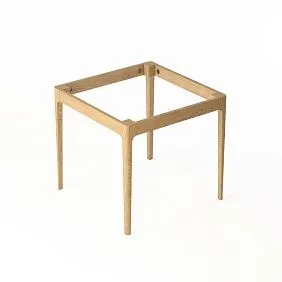
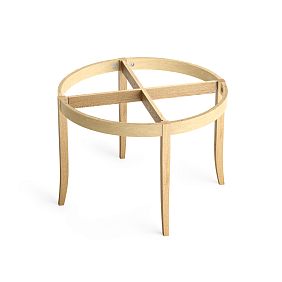
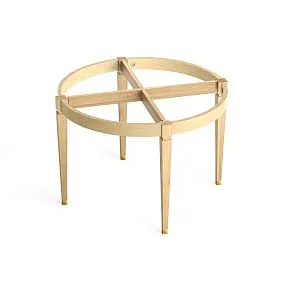
Table FrameIt was assembled using mortise and tenon and wedge joints—without nails or screws. This ensured rigidity and durability. The tables weighed tens, sometimes hundreds of kilograms, and were built to last for centuries.
18th century: The revolution of the extension mechanism
The eighteenth century became a turning point in the evolution of the dining table. The development of mechanics, precision metal and woodworking, and the spread of the middle class with a need for functional yet compact furniture led to the invention of the extension mechanism.
The first extension tables appeared in France at the end of the 17th century. Master cabinetmaker Thomas Nouvel created a gateleg table—a design where the side sections of the tabletop fold down on hinges, doubling the surface area. The mechanism was simple but effective: when folded, the table took up minimal space; when unfolded, it became a full dining surface for 6-8 people.
English innovations: The Pembroke table and the concertina
In the mid-18th century, the Pembroke table appeared in England, named after the Countess of Pembroke who commissioned the first specimen. It was a small table with drop-leaf sides supported by pull-out brackets. Elegant, light, mobile—an ideal solution for city houses where space was highly valued.
At the end of the 18th century, English craftsman Wilkinson patented an extension table with a 'concertina' or 'scissor' mechanism. The tabletop extended in the middle, with additional sections (leaves) inserted into the gap, increasing the table length up to 3.6 meters. The mechanism worked on the parallelogram principle—when extended, the legs spread apart, maintaining stability.
This was a breakthrough. For the first time, a table could adapt to the number of guests without requiring the storage of separate boards or trestles. Everything was integrated into a single structure.
19th century: Mass production and standardization
The Industrial Revolution changed furniture production. Manual labor was partially replaced by machines—steam sawmills, planing and milling machines, lathes. Furniture became more accessible, cheaper, and more technological.
Extension mechanisms were improved. Telescopic slides appeared—metal profiles along which tabletop sections slid smoothly and precisely. Leaves began to be stored inside the table structure, extending automatically when the table was opened—no need to search for them in the closet.
At the end of the 19th century, the first transformer tables appeared—designs that changed not only size but also height and configuration. American inventor Sarah Goode patented a bed-table in 1885—a work desk by day, a sleeping place by night. This was a response to urbanization and the housing shortage in growing cities.
20th century: New materials and minimalism
The twentieth century brought experiments with materials and forms. Modernism, functionalism, and Bauhaus rejected decoration, focusing on function. Tables became simpler, more concise, and more technological.
Tables made of plywood, plastic, metal, and glass appeared. Chrome-plated tubular legs, laminated tops, stackable designs—all of this reduced production costs, sped up assembly, and simplified transportation.
But simultaneously, a demand for a return to tradition arose.Dining setmade of solid wood, crafted according to classical patterns, became a symbol of stability, quality, and connection to the past. The market split: the mass segment moved towards cheap industrial solutions, while the premium segment retained traditional technologies and materials.
Modern extension systems: Engineering perfection
A modern extension table is a high-tech product where the mechanics are honed to perfection. Telescopic slides made of anodized aluminum ensure smooth, effortless sliding. Synchronizers—systems of gear racks and pinions—guarantee that both halves of the tabletop extend symmetrically, without distortion.
Leaves are stored under the tabletop, extended and installed with a single motion. Locks—magnetic or mechanical latches—hold the sections in both folded and unfolded states, preventing spontaneous movement.
All of this is hidden inside the structure. On the outside—only the clean surface of the tabletop made of solid oak, beech, ash, or walnut, with no visible seams or fasteners when folded. Engineering is subordinated to aesthetics.
Why extension tables are more complex than stationary ones
Because every moving part is a potential source of failure. Slides must withstand loads of tens of kilograms without deforming. Synchronizers must operate smoothly, without jamming, for decades. Leaves must fit precisely into the gap, without gaps or height differences.
This requires machining precision to tenths of a millimeter, quality materials, and careful assembly. A good extension table is more expensive than a stationary one not due to manufacturer whim, but because of the objective complexity of the design.
Why humanity spent 300 generations learning to eat together
Because a shared meal is not just about nourishment, but also communication, ritual, and the foundation of social life. A family gathering around the dinner table strengthens bonds, passes on values, and shares experiences. Friends meeting at the table create shared memories and build relationships.
The table is a place for negotiations, reconciliation, celebrations, and important decisions. The English expression 'to bring to the table' literally means to contribute, to offer something valuable. The Russian phrase 'to sit down at the negotiating table' means to begin a dialogue, to seek compromise.
The evolution of the dining table is the evolution of human interaction methods. From Neolithic platforms where food was stored, to Roman triclinia where philosophical debates were held, to medieval boards that united feudal lords and vassals, to modern extendable tables that adapt to family size and number of guests.
The Anthropology of the Table: Cultural Differences
In different cultures, the table has different meanings and forms. In Japan, the traditional low table (chabudai) 20-30 cm high is used for sitting on the floor on cushions. This reflects the Japanese philosophy of closeness to the earth, minimalism, and respect for space.
In the Arab world, people traditionally eat at low round tables while sitting on carpets. Food is served in shared dishes, and everyone takes food with their hands or bread—a gesture of community, equality, and trust.
In Europe and North America, the dominant form is a high rectangular or round table 70-80 cm tall, where people sit on chairs. This is related to climate (cold floors), architecture (high ceilings), and social norms (greater distance between people than in Asian cultures).
Table Shape and Social Structure
A rectangular table is hierarchical—there is a main seat (the head, where the head of the family or host sits), secondary seats on the sides, and less prestigious seats at the far end. A round table is egalitarian—all seats are equal, with no main or subordinate positions. It is no coincidence that the legend of King Arthur speaks of a Round Table—a symbol of knightly equality, where even the king does not rise above the others.
An oval table is a compromise: it preserves hierarchy (the ends are still distinguished) but softens it, creating a sense of community.
Frequently Asked Questions about Table Construction and Selection
What size table is needed for a family of 4-6 people?
For comfortable seating, one person requires 60 cm of table width and 40 cm of depth. A 120x80 cm table accommodates 4 people (two on each long side). A 160x90 cm table accommodates 6 people (three on each long side or four on the sides plus two at the ends).
Extendable or stationary—which is more practical?
It depends on the frequency of hosting guests. If guests are rare, a stationary table for the everyday number of family members is sufficient. If large gatherings are frequent, an extendable table solves the problem without cluttering the space.
Why is an oak table heavier than a pine table?
The density of oak is 700-800 kg/m³, while pine is 450-500 kg/m³. With the same volume, an oak tabletop weighs 1.5 times more. However, this provides stability, durability, and resistance to mechanical damage.
What tabletop thickness is optimal?
For solid wood—30-40 mm. Less—insufficient rigidity, possible sagging. More—excessive weight and material consumption without functional benefit. A 35 mm thick tabletop made of oak or beech does not sag even under significant load.
Are stretchers needed between table legs?
Stretchers (horizontal crosspieces at the bottom, near the floor) increase rigidity, prevent wobbling, but may interfere with legs. For tables with massive legs and sturdy aprons, stretchers are not necessary. For lightweight constructions—they are desirable.
How to care for an extendable mechanism?
Once a year, lubricate the guides with silicone lubricant or a wax pencil, remove dust and dirt with a soft cloth, and check the tightness of the mounting screws. Avoid sudden jerks when extending, and do not exceed the calculated load on the extended sections.
Can a broken mechanism be repaired?
Yes, if it is a quality table with accessible components. Guides, synchronizers, and locks are standard parts that can be ordered and replaced. Cheap tables with integrated plastic mechanisms cannot be repaired.
Which table is better for a small kitchen?
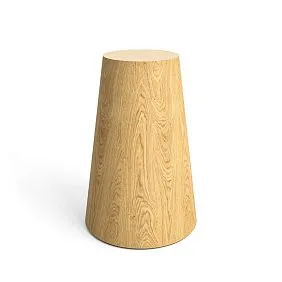
A round or oval table on a central support (a single leg/column). The absence of corner legs frees up space for movement, the round shape is safer (no sharp corners), and it visually takes up less space.
Answers to frequently asked questions (FAQ)
Why are classic tables made from solid wood and not particleboard?
Solid wood is stronger, more durable, more stable, and more noble in appearance and feel. Particleboard is cheaper but is afraid of moisture, deforms, cannot withstand repeated screw insertions (important for repairs), and has a limited lifespan of 10-15 years compared to 50-100 years for solid wood.
How much does an oak dining table weigh?
It depends on the size. A 160x90 cm table with a 35 mm thick tabletop and massive legs weighs 50-70 kg. This provides stability but requires effort when moving. An extendable table of the same size may weigh 70-90 kg due to metal mechanisms.
Can a table of non-standard size be ordered?
Yes, custom manufacturing allows you to specify any dimensions, shape, wood species, finish, and decor. It is more expensive than standard models but guarantees an exact fit to the room's dimensions and the customer's wishes.
How to choose a table shape to match the interior?
A rectangular table is a classic, versatile, and suitable for elongated rooms. A round one is for square rooms, creating a cozy, intimate atmosphere. An oval table is a compromise, combining the capacity of a rectangular table with the softness of a round one.
Is a tablecloth necessary on a wooden table?
Not necessary if the tabletop is coated with oil, wax, or varnish. The coating protects against moisture and dirt. A tablecloth is used for special occasions, to protect from hot dishes, or to create a certain atmosphere.
Why are extendable tables more expensive than regular ones?
Due to the complexity of the construction: guides, synchronizers, inserts, and precise fitting of parts require more time, materials, and skilled craftsmanship. A high-quality mechanism is an expensive component that pays off with decades of flawless operation.
Which wood species is best for a dining table?
Oak is the most durable, with a pronounced grain, high resistance to moisture and damage. Beech is slightly softer, with an even pattern and lighter color. Ash is resilient, with a beautiful contrasting grain. Walnut has a noble dark color and is expensive. All are suitable; the choice depends on aesthetic preferences and budget.
How to check the quality of a table in a store?
Inspect the tabletop — it should be even, without dents, cracks, or knots (or with a minimum of knots in decorative models). Check stability — slight rocking is acceptable, significant rocking is a sign of a weak frame. Open the extension mechanism — it should move smoothly, without jamming or squeaking. Inspect the joints — tenons should be tight, glue without drips, and aprons without play.
Conclusion: The Table as the Heart of the Home
Ten thousand years of evolution have led to the creation of the dining table in its modern form — functional, beautiful, adaptable. From the Neolithic platforms of Çatalhöyük to the extendable systems of the 21st century, humanity has perfected the construction, mechanisms, and materials, creating a piece of furniture that serves not just for eating but for bringing people together.
classic tableA solid wood dining table is a synthesis of millennia of experience and modern technology. The basic construction — four legs, aprons, a tabletop — has remained unchanged since Ancient Rome. But the materials, processing, and mechanisms have reached a level of perfection unattainable in past eras.
The company STAVROS has been producing dining tables from solid oak and beech for over twenty years, following the traditions of the classical carpentry school and using modern equipment. EachTable Frameis made from selected wood with dense annual rings, kiln-dried to a moisture content of 8-10%. Joints are made using mortise and tenon technology, ensuring rigidity and durability without metal fasteners.
STAVROS extension mechanisms feature European guides made of anodized aluminum, synchronizers made of hardened steel, and magnetic locks. They operate silently, smoothly, and withstand hundreds of extension cycles without wear. Inserts are made from the same solid wood as the main tabletop, matched for grain and color, creating a unified surface when extended.
By choosing tables from STAVROS, you are not just getting furniture, but the heart of your home — a place where family will gather, friends will meet, events will be celebrated, and important decisions will be made. A table that will serve not only you but also your children and grandchildren — because a quality solid wood table is designed not for decades, but for centuries. It is a legacy, a tradition, a connection between generations, embodied in wood and craftsmanship.


