Article Contents:
- Architectural Logic of Details
- Historical Perspective of Architectural Detail
- Functions of Architectural Detail
- Proportions and rhythm
- Material and Detailing
- Sash Elements and Their Functions
- Anatomy of a Sash
- Stylistic Variations of Sashes
- Functionality of Sashes in Interior Design
- Application in Modern Design
- Wooden Decorative Items
- Carved elements and inlays
- Moldings and Cornices
- Balusters and Columns
- Decorative Panels and Screens
- Doorway Framing
- Baseboards and their role
- Pilasters and Half Columns
- Upper Finishing of Openings
- Decorative accents
- Color and finish
- Conclusion
- Frequently Asked Questions

Architecture is the art of details, where perfection is born from the precision of each element. In a world where technology creates increasingly impersonal spaces, it is precisely attention to the small things, to every architectural nuance, that becomes a sign of high culture and refined taste.Cornice elementsandWooden decorative items for decorating the houseThey embody the philosophy that beauty is hidden in details, and perfection is achieved through precise execution.
What is the aesthetics of precision in architecture? It is not merely technical neatness or adherence to dimensions. It is a deep understanding of how each line, each curve, each transition between elements affects the perception of the entire space. It is the ability to see the relationship between part and whole, understanding that even the smallest decorative element can radically change the character of an interior.
Modern interior architecture is experiencing a period of returning to the values of craftsmanship and quality. After decades of minimalist asceticism and industrial production, people are once again beginning to value handmade, unique, meticulously crafted items.Framing a Doorway Without a DoorIt becomes not merely a functional solution, but an opportunity to demonstrate understanding of architectural traditions, taste, and attention to detail.
Wooden items occupy a special place in the palette of architectural materials. Wood is a living, breathing material that preserves the memory of nature and carries the energy of growth and development. Each solid wood item is unique, possessing its own texture, pattern, and character. This makes wooden decorative elements not merely ornaments, but true works of art, created through the collaboration of nature and human craftsmanship.


Architectural Logic of Details
Every detail in architecture adheres to strict logic, has its place and purpose. Understanding this logic distinguishes a professional architect or designer from an amateur randomly placing elements in space. An architectural detail always performs several functions simultaneously — constructive, aesthetic, and psychological.




Historical Perspective of Architectural Detail
The history of architecture is, to a significant extent, the history of the development of architectural detail. Each era developed its own language of details, its own system of proportions and ornamentation, allowing one to unambiguously determine the time of a building's creation. Classical orders, Gothic arches, Baroque volutes, modernist pylons — all of this is not merely decoration, but elements of architectural language carrying specific meaning and function.
Classical architecture developed the most rigorous system of architectural details — the order system, where each element has its place, proportions, and name. Base, shaft, capital of a column, architrave, frieze, cornice of an entablature — all these elements are not only structurally connected to each other, but also form a harmonious visual system based on mathematical proportions and human scale.
Medieval architecture developed its own system of details based on different principles. Here, symbolic meanings of elements played an important role, their ability to create a sense of upward movement, towards heaven. Counterforts and arches were not merely constructive elements allowing for the construction of higher and brighter churches, but also expressive details creating a distinctive Gothic aesthetic.
The Renaissance returned to the classical system, but reinterpreted it in the context of new technologies and aesthetic perceptions. Renaissance architects did not merely copy classical models, but creatively interpreted them, creating new combinations and proportions. It was precisely during this period that the principles of working with architectural detail, which remain relevant to this day, were formed.
Baroque took the work with detail to a virtuoso level. Complex curved forms, abundance of sculptural decoration, play of light and shadow created dramatic effects, transforming architecture into frozen music. Every detail in a Baroque interior is carefully thought out and aimed at creating a unified emotional impact.
Modernism of the twentieth century attempted to abandon architectural detail in favor of pure forms and structures. However, practice showed that complete abandonment of details makes architecture inhuman and cold. Postmodernism returned details to architecture, albeit in an ironic, playful form. Contemporary architecture found a balance between minimalist purity and richness of detail, creating expressive spaces where each element has its place.
Our factory also produces:


Constructive function - the primary and most obvious task of architectural details. Eaves divert water from walls, pilasters reinforce corners and openings, bases of columns distribute loads. Even when a detail loses its constructive necessity, it retains the visual logic of the structure, which is important for the correct perception of architecture.
The scaling function of architectural details is often underestimated, but it is precisely this function that makes a building proportional to humans. Large forms - walls, roofs, facades - may appear monumental and overwhelming. Details of medium and small scale create visual anchor points, by which the eye can assess the size of the building and relate it to the human scale. Height of railings, size of door handles, spacing of balusters - all these elements are related to human body dimensions and make architecture understandable and comfortable.
The tectonic function of details consists in the visual expression of the structure's work. The base of a column visually spreads out, taking the load, the capital opens up towards the architrave, the cornice projects, protecting the wall. Even when the actual structure works differently, the tectonic logic of the details creates a sense of stability and correctness of the building.
The aesthetic function of details is most obvious and diverse. Details create the rhythm of the facade, organize the viewer's gaze, establish accents, create transitions between different elements of the building. Profiles of moldings, frieze ornaments, carved capitals - all this richness of forms creates visual pleasure, enriches the perception of architecture.
The semantic function of details is related to their ability to carry semantic load, tell a story, refer to cultural traditions. Acanthus leaves of the Corinthian capital remind of antiquity, Gothic crockets symbolize the aspiration towards heaven, mascarons on facades ward off evil spirits. Understanding these meanings enriches the perception of architecture, making it more substantive.
Proportions are the foundation of architectural harmony, and it is precisely the details that have the greatest influence on the proportional structure of a building. The golden section, classical proportions of orders, modular systems - all these tools for working with proportions are realized through specific dimensions and ratios of architectural details.
Get Consultation
Proportions and Rhythm
Rhythm in architecture is created by the repetition of elements at a certain interval. Columns of a portico, windows of a facade, balusters of railings - all these repeating elements create a rhythmic structure that organizes perception and makes architecture more orderly and understandable. Rhythm can be uniform, creating a calm, static impression, or accelerating or slowing down, creating dynamics and tension.
Contrast of scales - an important technique for working with details. The combination of large and small elements creates richness of forms and allows perceiving the building at different distances. From afar, large forms and main composition are readable, upon approaching, medium-scale details become visible, and up close, fine detailing of small elements is apparent. This multi-layered perception makes architecture interesting and inexhaustible.
Transitions between elements - a delicate art, where precision is especially important. Abrupt, unprepared transitions create a sense of discomfort and poor craftsmanship. Smooth, logical transitions, where each element naturally flows into the next, create a sense of mastery and perfection. Moldings, profiles, bevels - all these elements serve to create harmonious transitions between different planes and volumes.
Material and Detailing
The choice of material for architectural details determines their detailing possibilities and execution character. Each material has its own limits and possibilities, its own logic of processing and shaping. Stone allows creating monumental, durable details, but requires significant effort for processing. Wood is pliable, easy to process, but requires protection from moisture and pests. Gypsum and polymers allow reproducing complex forms, but are less durable and prestigious.
Wooden decorative elements occupy a special place due to their unique combination of properties. Wood is sufficiently strong to create structural elements, yet it is easy to process, allowing for fine detailing. The natural texture of wood adds richness even to simple forms, making them lively and expressive. The warmth of wood to the touch, its scent, acoustic properties create a special atmosphere that artificial materials cannot provide.
Modern wood processing technologies - CNC milling, laser cutting - allow achieving precision in details that is unattainable with manual work. Meanwhile, finishing, patination, toning remain within the sphere of manual craftsmanship, imparting individuality and soul to the items. The combination of technological precision and manual craftsmanship creates an ideal balance of accuracy and liveliness, characteristic of the best modern products.
Modern wood processing technologies — CNC milling, laser cutting — enable achieving precision in details unattainable with manual work. Meanwhile, finishing, patination, and tinting remain within the realm of handcraft, imparting uniqueness and soul to the pieces. The combination of technological precision and handcraft creates an ideal balance of accuracy and liveliness, characteristic of the finest contemporary pieces.
Sash - one of the key elements of classical architecture, a small cornice above a window or door, which performs both protective and decorative functions.
represent a complex system, where each detail has its own purpose and name, derived from ancient architectural terminology.Cornice elementsAnatomy of the sash
A classical sash consists of several elements that form a unified composition. Understanding this structure is important for the correct application of the sash in interiors and on facades.
Architrave - the lower, supporting part of the sash, which directly rests on the jambs or consoles. In classical architecture, the architrave symbolizes a beam spanning between supports. It can be smooth or divided into several bands - fasciae. The profile of the architrave is usually simple - rectangular or with slight rounded edges.
Frieze - the middle part of the sash, located between the architrave and the cornice. This is the main field for decorative elements. The frieze can be smooth, profiled, or adorned with ornamentation. In classical orders, the Doric frieze is divided into triglyphs and metopes, Ionic and Corinthian usually have smooth or ornamented fields. In modern interpretations, the frieze can have the most diverse forms and decoration.
Cornice - the upper, projecting part of the sash, which protects the structure from precipitation and creates expressive play of light and shadow. The cornice usually has a complex profile, consisting of several elements: a drip - a horizontal ledge protecting from water, a cove or gusset - a concave profile, a cove - a convex profile, a roundel - a semicircular element. The combination of these elements creates a characteristic cornice profile, by which the style and era can be determined.
Pediment - a triangular or semicircular finish of the sash, which gives it solemnity and monumentality. A triangular pediment is characteristic of Greek classicism and strict styles, a semicircular one - of Roman architecture and Baroque. A broken pediment, where the apex or base is interrupted, is characteristic of Baroque and Mannerism, creating dynamism and tension in the composition.
Brackets or modillions - decorative consoles that visually support the sash cornice. They can have the form of volutes, acanthus leaves, geometric elements. Brackets are not only decorative, but also emphasize the tectonic logic of the structure, creating the impression that the cornice actually rests on these elements.
Stylistic variations of sashes
Each architectural style has developed its characteristic forms of sashes, which allow unambiguously determine the stylistic affiliation of a building.
Classical sashes are characterized by strict proportions, symmetry, use of elements of the order system. Triangular pediment, profiled cornice with dentils or modillions, smooth or ornamented frieze - these are the main features of a classical sash. Colors are usually restrained - white, beige, natural tones of wood or stone.
Baroque sashes impress with their richness and ornamentation. Broken pediments, volute-shaped brackets, abundance of carved decoration, gilding - all this creates a sense of luxury and theatricality. Profiles of Baroque sashes are often curved, creating dynamic play of light and shadow. The central part may be decorated with a cartouche, coat of arms, mascaron.
Renaissance sashes combine classical clarity with richness of decoration. Clear proportions, symmetry, but with an abundance of ornamentation - plant motifs, geometric patterns, sculptural elements. A distinctive feature of Renaissance sashes is meticulous detailing of all elements, attention to details.
Modern sashes are characterized by smooth, flowing lines, rejection of symmetry, use of plant motifs in stylized form. Instead of classical profiles - smooth curves, instead of geometric ornamentation - stylized flowers, leaves, insects. Modern sashes are often asymmetrical, which gives them a particular expressiveness.
Modernist sándrikas feature smooth, flowing lines, rejection of symmetry, and use of stylized botanical motifs. Instead of classical profiles — gentle curves, instead of geometric ornaments — stylized flowers, leaves, insects. Modernist sándrikas are often asymmetrical, which gives them a distinctive expressiveness.
Modern minimalist cornices reduce form to the necessary minimum. A simple projecting cornice without ornamentation, clear geometric lines, monochromatic coloring. At the same time, precision of execution, quality of materials, and thoughtful proportions are important. In minimalism, there is no room for random elements — every line has meaning and purpose.
Functionality of the cornice in interior design
In interior design, a cornice performs several important functions, making it not just a decorative element, but a necessary part of the architectural composition.
Completion of verticality — the main compositional function of the cornice. A door or window opening creates a vertical axis in the room's space. The cornice completes this verticality, creating a visual point where the eye's movement upward stops. Without this completion, the opening appears unfinished, hanging in the air.
Creating scale — the cornice helps relate the size of the opening to the size of the room and human proportions. The height and proportions of the cornice influence the perception of the opening's height and ceiling height. A massive cornice makes the opening more monumental, while a light one makes it more elegant and airy.
Zoning space — a cornice above an opening without a door emphasizes the boundary between rooms without creating a physical barrier. This is especially important in open floor plans, where it is necessary to structure the space while preserving its unity and accessibility.
Decorative function — the cornice creates richness of form, play of light and shadow, adds volume and depth to the interior. Carved decoration on the cornice can become a striking accent, drawing attention and setting the tone for the entire room.
Psychological function — a cornice above a door creates a sense of protection and shelter. This is an ancient archetype associated with a canopy protecting the entrance to a dwelling. Even a purely decorative cornice in interior design is subconsciously perceived as a protective element, creating a feeling of coziness and safety.
Application in modern design
Modern interior design freely interprets classical elements, adapting them to contemporary aesthetic perceptions and functional requirements. Cornices are no exception — they are actively used in various stylistic contexts.
Neoclassical interiors use cornices in their classical form, but often simplify decoration, making elements more laconic and modern. White cornices on light walls create elegant, bright interiors with a hint of historical memory.
Eclectic interiors boldly combine cornices with elements of other styles. A classical cornice can coexist with modern minimalist furniture, creating an interesting contrast between history and modernity. The key in such interiors is a sense of proportion and understanding of how different elements interact with each other.
Modern interpretations of classical forms create simplified, stylized cornices that hint at classical prototypes but are executed in a contemporary aesthetic. Simple geometric shapes, monochromatic coloring, absence of fine detailing — such cornices suit interiors where a light reference to classicism without direct citation is needed.
Art Deco actively uses cornices, reinterpreting classical forms in the spirit of geometry and glamour of the 1920s. Stepped profiles, geometric ornaments, use of contrasting materials — wood and metal, matte and glossy surfaces — create the characteristic Art Deco aesthetic.
Decorative wooden items
Wooden decorative items for decorating the houserepresent a broad category of elements that enrich interiors, create individuality, fill space with the warmth and character of natural material.
Carved elements and appliqués
Carved elements are fine woodworking, where the craftsman's skill transforms a piece of wood into a work of art. Modern technologies allow creating carving of any complexity, but the best examples always include a handcrafted element, which gives them liveliness and individuality.
Applied carved elements are a universal tool for decorating furniture and interiors. They can be of various sizes and shapes: from miniature corner ornaments to large central panels. Rosettes, cartouches, volutes, acanthus leaves — traditional carving motifs used for centuries and remaining relevant.
Geometric carving creates patterns from repeating geometric elements — rhombuses, triangles, circles, stars. Such carving is characteristic of folk traditions of many cultures and fits beautifully into ethnic and eclectic interiors. Despite its apparent simplicity, geometric carving requires high precision — even minor deviations disrupt the pattern's rhythm.
Plant carving reproduces forms of nature — leaves, flowers, branches, fruits. It can be naturalistic, accurately reproducing botanical details, or stylized, where natural forms are transformed into decorative ornament. Plant motifs create a sense of connection with nature, introducing organic elements into the interior.
Sculptural carving creates three-dimensional images — figures of people and animals, mythological scenes, allegorical compositions. Such carving requires the highest level of craftsmanship and is usually done by hand. Sculptural elements become true works of art, unique accents in the interior.
Moldings and cornices
Moldings and cornices — these are elongated profiled elements used for decorating transitions between planes, creating frames, and dividing surfaces. Despite their apparent simplicity, they play a critically important role in organizing the interior.
Ceiling cornices create a transition between wall and ceiling, completing the room's composition. A wide cornice can visually lower the ceiling, creating a more cozy atmosphere. A narrow cornice is almost invisible but creates a clear boundary, organizing the space. A cornice with hidden lighting creates a floating ceiling effect, visually increasing the room's height.
Wall moldings are used to create panels, frames, and decorative compositions on walls. Classical panels with moldings create rhythmic structure, dividing large surfaces into proportional fragments. Such division is characteristic of classical interiors but is actively used in modern design as well.
Baseboards — lower moldings creating a transition between wall and floor. They are not only decorative but also functional — protecting the lower part of the wall from damage, concealing the gap between wall and floor, and potentially housing cable channels for wiring. High baseboards are characteristic of classical interiors with high ceilings, while low baseboards suit modern minimalist spaces.
Architectural profiles — specialized moldings of complex shapes reproducing classical architectural elements. Architraves, astragals, coves, gussets, beads — all these elements have their canonical proportions and forms, tracing back to ancient architecture. Their proper use creates authentic classical interiors.
Balusters and columns
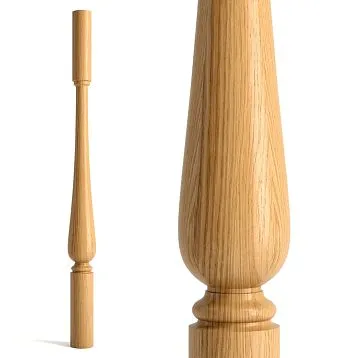
Balusters — vertical supporting elements of railings, which can be both functional and purely decorative. They create rhythm, fill space with vertical accents, and can be true masterpieces of turning art.
Turned balusters are made on a lathe and have a characteristic shape of rotation — alternating bulges and grooves, beads and discs. Classical balusters follow certain proportional canons, where the sizes of various elements are mathematically related to each other. Modern balusters may be more free in form, but the basic principles of proportioning are preserved.
Carved balusters are additionally decorated with carving — fluting, plant motifs, geometric patterns. Such balusters require complex combined manufacturing — first turning, then carving. They are more decorative and are used in representative interiors.
Posts are more massive vertical elements that can serve as porch supports, gazebo elements, decorative accents in interiors. They may have a base, shaft, and capital, similar to columns, or be more free-form. Wooden posts are often decorated with carving, creating a rich, textured surface.
Decorative panels and screens
Decorative panels and screens are used to decorate walls, doors, furniture, create decorative partitions and screens. They can be solid or lacy, smooth or carved, creating various visual and functional effects.
Wooden wall panels create noble, respectable finishes typical for offices, libraries, living rooms. They can be made from solid precious wood or veneered. Panels with dados, framed by moldings, create a classic look. Smooth panels with emphasized wood texture are more modern.
Lacy carved panels create semi-transparent partitions that zone space without fully dividing it. Light passes through the carved pattern, creating play of shadows and half-shadows. Such panels can be executed in various styles — from traditional Arabic geometry to modern abstract compositions.
Decorative inserts for doors and furniture transform simple flat surfaces into decorated artistic objects. Carved or inlaid inserts may depict geometric patterns, plant motifs, narrative compositions. They create accents, attract attention, emphasize the significance of an element.
Framing doorways
Framing a Doorway Without a Door— a special case of architectural detailing, where the opening becomes an independent architectural element, a portal, connecting different spaces.
Pilasters and their role
Lintels — basic elements of opening framing, vertical strips that conceal the joint between the wall and door frame or simply frame the opening. They define the character of the entire composition and must match the interior style.
Simple rectangular lintels — a universal solution for modern interiors. Their width and thickness determine the visual weight of the framing. Narrow lintels create a light, unobtrusive frame. Wide ones are more noticeable and representative. The thickness of the lintel affects the play of light and shadow — thin lintels almost do not cast shadows, thick ones form a pronounced relief.
Profiled lintels have shaped sections — rounded corners, bevels, chamfers, coves. The profile enriches the simple form, creates play of light, makes the lintel more expressive. Classical profiles follow the canons of order architecture, modern ones may be more free-form and experimental.
Carved lintels — the pinnacle of craftsmanship, where a simple functional detail becomes a work of art. Carving may cover the entire surface of the lintel or be placed in fragments — at the top, at the corners, in the center. Carving motifs vary from abstract geometry to naturalistic plant motifs and figurative compositions.
Composite lintels are assembled from several elements — bases and attached decorative parts. This allows creating complex, rich compositions by combining different elements. This approach provides greater flexibility — you can change the decoration while keeping the base, or create individual solutions from standard components.
Pilasters and half-columns
Pilasters and half-columns — vertical elements that flank the opening on both sides, creating a portal effect. They give the opening monumentality, solemnity, architectural significance.
Classical pilasters consist of three parts — base, shaft, and capital. The base — the lower part, visually spreading out, bearing the load. The shaft — the main vertical part, which may be smooth or decorated with fluting. The capital — the upper part, opening towards the entablature. The shape of the capital determines the order — Doric, Ionic, Corinthian.
Simplified pilasters retain the general structure of classical pilasters but simplify details. Simple base without complex profiles, smooth shaft, stylized capital. Such pilasters suit neoclassical and modern interiors where a light reference to classicism without literal citation is needed.
Half-columns — elements protruding from the wall by half or more of their diameter, more voluminous and sculptural than flat pilasters. They create a more expressive play of light and shadow, a more obvious architectural effect. Half-columns require more space and suit spacious rooms with high ceilings.
Modern interpretations of pilasters can be very free-form — abstract vertical elements, geometric constructions, minimalist volumes. The main thing is to preserve the core idea: vertical elements flanking the opening and creating a portal effect.
Top finish of the opening
Top finish of the opening — a critically important element that completes the composition. It may be a cornice, a frieze, a pediment, an arch — different forms create different effects and refer to different stylistic traditions.
Simple horizontal cornice — a minimalist solution creating a clear upper boundary of the opening. Such a cornice may be straight or profiled, but always retains horizontality and straightness. It is a universal solution suitable for most styles.
Frieze with pediment creates a more solemn, classical finish. Triangular pediment is associated with Greek classicism, semicircular — with Roman architecture. Broken pediment adds Baroque dynamism. The size and proportions of the pediment must correspond to the size of the opening and the height of the room.
Arched finish softens the rectangularity of the opening, creating a more organic, flowing form. Semi-circular arch — classical form, pointed arch — Gothic, horseshoe arch — Moorish, elliptical arch — Renaissance. The choice of arch form determines the stylistic coloring of the entire opening.
Modernist finishes may have asymmetrical forms, flowing lines, unusual profiles. They reject classical canons in favor of free-form creation, producing unique, authorial solutions. Such finishes require boldness and good taste to avoid descending into chaos and caprice.
Decorative accents
In addition to basic structural elements, opening framing may include various decorative accents that enrich the composition, create focal points, add individuality.
Keystone — a decorative element at the apex of an arch, visually fixing the structure, creating an accent at the center of the upper part of the opening. The keystone may be a simple geometric element or an ornate cartouche, mask, or coat of arms.
Rosettes — round or oval decorative elements placed in the corners of the framing or at other compositionally significant points. They may be smooth or carved, with plant, geometric, or figurative motifs.
Consoles and brackets — elements that visually support the cornice or frieze. Even if they do not carry real loads, visual logic of the construction is important for correct perception. Consoles may have the form of volutes, acanthus leaves, or geometric brackets.
Ornamental strips and borders may frame the opening around its perimeter, creating an additional decorative layer. They may be executed in carving, inlay, or painting, creating a rich, textured surface.
Color and finish
Color solution of the opening framing is critically important for its perception in the interior. Color may either emphasize the framing, making it a bright accent, or blend it into the surrounding space.
White trim - a classic solution creating a clean, light, elegant look. White color is universal, harmonizes with any wall and floor colors, visually expands the space. However, imperfections are especially noticeable on white, so high-quality execution is required.
Natural wood - a solution emphasizing materiality, warmth, and organic qualities. The natural color of wood varies from light, almost white (ash, maple) to dark, chocolate (walnut, wenge). Wood texture adds richness even to simple forms.
Stained wood allows changing the color while preserving visible texture. Stains, dyes, and oils enable creating any shades - from light natural tones to deep, saturated hues. Staining can imitate valuable wood species on more affordable materials.
Painted wood completely hides texture, creating a uniform colored surface. This allows using any colors - from pastel to saturated, from classic to avant-garde. Painted elements are easier to integrate into colorful interiors and create color accents.
Patina and aging create an effect of noble antiquity, traces of time. Light patina in carved recesses, wear on protruding parts, uneven color - all this creates a sense of history, authenticity, handcrafted quality.
Conclusion
The aesthetics of precision in architectural details - this is not merely technical perfection, but a philosophy of relationship to space and its shaping.Cornice elementsandWooden decorative items for decorating the houseDemonstrate how attention to details, precision of execution, and understanding of architectural logic create spaces that are not only functional and beautiful, but also possess a special quality - harmony.
In a world of mass production and standardization, paradoxically, the value of individual, handcrafted, meticulously detailed items increases. Interiors created with attention to every detail, using quality materials and professional craftsmanship, stand out against standard solutions, create a unique atmosphere, and become true works of architectural art.
Wooden decorative elements occupy a special place in this aesthetics of precision. Wood is a material that demands respect and understanding, which does not tolerate carelessness, but generously rewards craftsmanship. Working with wood is a dialogue between the craftsman and the material, where the result depends on experience, sense of form, understanding of properties of different species.
Framing a Doorway Without a DoorAn architectural detail becomes an important element of space organization. The opening ceases to be merely a technical necessity and transforms into a portal, an architectural event, a moment of transition between different zones of the house.
Investing in high-quality wooden decorative elements is an investment in long-term value. Unlike fashion trends that quickly become outdated, well-designed and high-quality architectural details remain relevant for decades. They not only beautify the home today, but will delight future generations, possibly gaining additional value as antique items over time.
For many years, STAVROS has been creating high-quality wooden decorative elements. Using premium wood, modern processing technologies, and the handcraft of experienced carvers, STAVROS produces items embodying the aesthetics of precision. Each sash, each carved applique, each casing undergoes rigorous quality control, ensuring perfect execution.
STAVROS offers a wide range of products allowing to find solutions for any interior style - from strict classicism to modern minimalism. The company also offers custom manufacturing of elements according to original projects, enabling the creation of unique interiors reflecting the owner's personality and taste.
Working with STAVROS, you receive not only decorative elements, but also consultations on their application, assistance in selection, recommendations on installation and maintenance. This comprehensive approach ensures an ideal result and many years of enjoyment living in a beautiful, harmonious space.
Frequently asked questions
What is a sash and why is it needed?
A sash is an architectural element in the form of a small cornice above a window or door. Historically, it served a protective function, diverting water away from the opening. In modern interiors, a sash has primarily decorative purposes - it completes the opening composition, creates a visual focal point where the eye stops moving upward, and adds architectural expressiveness to the opening. A sash consists of several elements - architrave, frieze, and cornice, forming a unified composition.
Which wood species are best suited for decorative elements?
The choice of wood species depends on the element's purpose, operating conditions, and budget. For interior elements, oak - a hard, durable species with expressive texture, beech - uniform structure, good workability, ash - beautiful texture and high strength - are ideal. For carved elements, lime is preferred - soft, easy to cut, retains details. Coniferous species are more affordable but less durable. Premium-class elements use valuable species - walnut, mahogany, cherry.
How to properly combine classic decorative elements with a modern interior?
Combining classic elements with a modern interior requires a sense of proportion and understanding of context. Main principles: simplify forms - use classic elements in a more restrained form without excessive decoration, limited application - one or two classic accents in a modern space, not total decoration, color harmony - classic elements must fit the interior's color scheme, scale - element sizes must correspond to room proportions. White classic moldings on neutral walls in a minimalist interior - a good example of such combination.
Do wooden decorative elements require special maintenance?
Wooden decorative elements require regular but simple maintenance. Main recommendations: regular dry cleaning with a soft cloth or brush, especially in carved recesses, wet cleaning if necessary, but without excess water, use special wood care products that clean and nourish the surface, protect from direct sunlight causing fading, maintain optimal air humidity at 40-60 percent, periodically renew protective coating every few years. With proper care, wooden elements last for decades.
Can decorative elements be installed by oneself?
Installation of simple decorative elements - casings, baseboards, moldings - is quite accessible for self-installation with basic skills and tools. A miter saw or miter box is needed for precise corner cutting, a level for checking vertical and horizontal alignment, adhesive and fasteners, putty for filling joints. For more complex elements - pilasters, capitals, carved compositions - it is recommended to involve professionals. Incorrect installation can damage even high-quality elements, so if unsure, it is better to consult specialists.
How to choose the size of decorative elements for a specific room?
The size of decorative elements should correspond to the room's scale. Main principles for selection: for standard rooms with 2.5-2.7 meter ceilings, optimal casing width is 7-10 cm, baseboard height 7-10 cm, ceiling cornice width 8-12 cm. For high rooms over 3 meters, more substantial elements can be used - casings 10-15 cm, baseboards 12-15 cm, cornices 15-20 cm. For small rooms, it is better to choose more compact elements to avoid overcrowding the space. It is also important to consider proportions - all elements must harmonize with each other.
Which interior styles best combine with wooden decorative elements?
Wooden decorative elements are universal and can be used in various styles. Classic styles - baroque, empire, neoclassicism - traditionally use rich wooden decoration with carving, gilding, complex profiles. Scandinavian style prefers light wood, simple forms, minimal decoration. Loft and industrial styles use rough, aged wood, simple geometric forms. Provence and country styles love wood with patina effect, simple carved elements. Even minimalism can include wooden elements, but in a very restrained form.
Does the quality of decorative elements affect property value?
High-quality wooden decorative elements positively affect perception and property value. They indicate attention to detail, quality finishing, and the owner's taste. This is especially relevant for the premium segment, where individuality and high-quality execution are valued. Elements made from solid valuable species, hand-carved, original design - all this increases the property's attractiveness to potential buyers. However, it is important that the decoration is harmonious, matches the style and scale of the room - excessive or inappropriate decoration may have the opposite effect.