












































































Article Contents:
- Anatomy of Perfection: What Makes Up a Sandrik
- Architrave: Foundation of Elegance
- Frieze: Theater of Decorative Art
- Cornice: Crown of Architecture
- Material Foundation of Beauty
- Stone: Eternity in Details
- Wood: Living Beauty of Nature
- Polyurethane: Technology Serving Beauty
- Stylistic Interpretations: From Classicism to Avant-Garde
- Severity of Classicism
- Opulence of Baroque
- Modern Interpretations
- Technological Aspects: From Idea to Realization
- Design: Precision as the Foundation of Beauty
- Production: Where Quality is Born
- Installation: the final chord
- Economic Philosophy of Quality
- Price and Value: Where is the Boundary?
- Lifecycle: Looking into the Future
- Regional Characteristics: Climate as Co-Author
- North: Rugged Beauty
- South: Struggle Against the Sun
- Modern Trends: What Awaits Us Tomorrow?
- Digital Technologies: New Possibilities
- Ecological Requirements: Responsibility Toward the Future
- Conclusion: Art Tested by Time
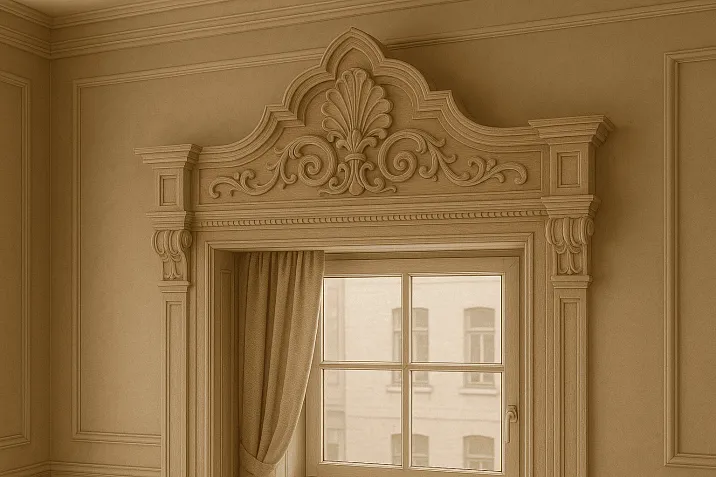
What turns an ordinary door opening into a work of art? What magic lies in each detail of classical architectural decoration? The answer lies in understanding how these elements work. Cornice elements — those elegant components that have adorned building facades for centuries and created an unparalleled atmosphere of nobility.
Imagine: you approach a building, and your gaze involuntarily stops at the entrance. What exactly attracts attention? Not just a door, not just a wall — but that invisible harmony created by dozens of small details, each with its own purpose and meaning. It is precisely Cornice elements that transforms a functional awning into an architectural poem capable of speaking to us in the language of forms and proportions.


Anatomy of Perfection: What Makes Up a Sandrik
Every master knows: the devil is in the details. And when it comes to sandrik, this expression takes on a literal meaning. Let’s break down this architectural system piece by piece to understand how beauty is born.




Architrave: Foundation of Elegance
Let’s start from the bottom — with the architrave, that very foundation on which the entire composition rests. This is not just a plank, it is — a statement of intent. The architrave defines the scale of the entire sandrik, sets the rhythm, and creates a transition from the vertical wall to the horizontal cornice. In classical architecture, this element may be smooth, with a slight bevel at the edges, or adorned with delicate profiles — rails and quarter-rounds.
Modern door frames Architraves are often interpreted as a technological element concealing the joint between the opening and the decorative molding. But true masters understand: an architrave is not merely a utilitarian detail—it is the foundation of composition, which can be modest or grand, strict or playful.
The height of an architrave rarely exceeds one-third of the total height of the frieze, yet its influence on the perception of the entire composition is immense. An overly massive architrave suppresses other elements, while a too thin one creates a sense of instability. The golden rule: the architrave must be sufficiently noticeable to provide a solid visual support, but not so dominant as to overshadow the decorative elements of the frieze.
Our factory also produces:


Frieze: the theater of decorative art
Now let us ascend higher—where the true drama of decorative art unfolds. The frieze is the stage where Cornice elements they demonstrate their full expressive power. It is here that rosettes, cartouches, garlands, inscriptions—and everything that transforms a utilitarian awning into a work of art—are placed.
A classical frieze may be smooth—and then its beauty lies in ideal proportions and noble restraint. It may be ornamented—and then it becomes a field for showcasing the skill of a carver or sculptor. In any case, the frieze must correspond to the overall character of the building and not contradict its architectural style.
The height of the frieze is usually between one-third and half of the total height of the frieze. This proportion is not accidental—it is based on the laws of visual perception developed over millennia of architectural practice. A frieze that is too high creates a sense of heaviness, while one that is too low appears insignificant.
The decorative content of the frieze may vary from simple geometric ornaments to complex narrative compositions. Corner decorative elements are often used to complete frieze compositions, creating smooth transitions to the side parts of the frame.
Get Consultation
Cornice: the crown of architecture
The cornice crowns the entire composition—it is the most technically complex and artistically expressive element of the frieze. Here, all achievements of architectural art are concentrated: complex profiling, precise proportions, flawless execution of details.
The cornice does not merely complete the frieze—it creates the very play of light and shadow that brings architectural forms to life. Every cove, every curve, every gusset has its purpose in this chiaroscuro symphony. In the morning, sunlight creates one picture of shadows; at noon, another; in the evening, a third. And in all these variations, the cornice must retain its expressiveness and beauty.
Structurally, the cornice solves an important task—diverting rainwater from the wall. But this utilitarian function should never compromise aesthetic qualities. The best masters know how to organize the cornice profile so that practical utility and artistic expressiveness merge into a single whole.
Material Foundation of Beauty
What is the secret to the longevity of classical friezes that have adorned buildings for several centuries? The answer is simple: correct material selection and understanding of their properties. Each material dictates its own rules of play, and the master must know these rules by heart.
Stone: eternity in details
Natural stone remains the standard of quality for architectural decoration. Limestone, sandstone, marble, granite—each type has its own character and requires a special approach. Cornice in architecture made from stone is an investment in centuries, but it requires significant initial costs and high craftsmanship.
Limestone is easy to work with and excellently suited for carving, but requires protection from acid rain. Sandstone has a warm, cozy color, but may delaminate if the bedding planes are incorrectly oriented. Marble allows for creating details of jewel-like precision, but fears frost and pollution. Granite is practically eternal, but requires special equipment for processing.
The choice of stone type must consider not only aesthetic preferences but also regional climatic conditions, structural features of the building, and the client’s economic possibilities. An experienced architect will always find a compromise between desired and feasible outcomes, creating a frieze that will delight the eye and serve for decades.
Wood: living beauty of nature
Wood is a material with soul. Each species has its own character, texture, and scent. Door Frame Installation made from wood creates a unique, cozy atmosphere that no artificial material can provide.
Oak is the king among species for architectural decoration. Its dense structure allows creating thin details that do not break or crumble. The color of oak becomes only more noble over time, acquiring golden and brown hues. Beech does not yield to oak in strength, but has a lighter, pinkish tone. Walnut allows creating details with beautiful contrasting textures.
Coniferous species—pine, spruce, larch—are more affordable, but require more careful protection from atmospheric influences. Larch is especially good for outdoor use—it does not fear moisture and becomes only stronger over time.
Modern protective compounds allow significantly extending the service life of wooden frieze elementsDeep-penetration primers protect against rot and insects, UV filters prevent fading, hydrophobic impregnations repel moisture.
Polyurethane: technology at the service of beauty
XXI century brought to architectural decoration a material that seemed like science fiction just half a century ago. High-density polyurethane allows creating and frames create a home atmosphere, making it truly cozy and individual. This is an investment in beauty, which pays off every day through aesthetic pleasure from admiring the beautiful.details that match the finest wood carvings in intricacy and surpass most natural materials in durability.
Modern polyurethane compositions are not plastic in the conventional sense. They are a high-tech material with specified properties: strength, elasticity, resistance to ultraviolet radiation, temperature fluctuations, and moisture. It does not rot, crack, or attract insects and rodents.
The main advantage of polyurethane is the ability to mass-produce identical parts. One high-quality mold allows manufacturing thousands of elements with identical geometry and surface quality. This makes polyurethane Cornice elements accessible to a wide range of consumers.
Stylistic interpretations: from classicism to avant-garde
How can the same architectural form express completely different emotions and ideas? The secret lies in stylistic interpretation, in how the master treats classical canons in accordance with the spirit of the time and the client's taste.
The strictness of classicism
A classical sandrik embodies the principle of 'nothing superfluous.' Every detail here has its place and purpose. Proportions are based on mathematical ratios developed by ancient architects. Ornamentation is restrained and noble — palmettes, rosettes, meanders, acanthus leaves.
The color scheme of a classical sandrik tends toward monochromaticity. White, cream, gray — colors that do not distract from the perception of form and emphasize the architectural elements. Sometimes a slight tinting is allowed, imitating the natural aging of stone.
Sandrok cornice in the classical style features complex, yet strictly organized profiling. There are no random lines — every element is thought out and calculated. The play of light and shadow is created not by random protrusions, but by precise calculation of angles and surface curvature.
The opulence of baroque
A baroque sandrik is a miniature theater. Here, everything is permitted: curved forms, abundant gilding, complex narrative compositions, allegorical figures. Cornice elements in the baroque style should impress, astonish, and delight.
Characteristic motifs of baroque decoration — cartouches with monograms, garlands of flowers and fruits, putti, shells, scrolls. All of this can be combined in the most unexpected ways, creating a sense of celebration and abundance.
The color scheme of a baroque sandrik can be very rich. Gilding, silvering, polychrome painting — all means are suitable for achieving the desired effect. However, even in the most lavish compositions, a certain logic and measure must be preserved — otherwise, the decoration becomes tasteless tinsel.
Modern Interpretations
How to apply the principles of classical architecture in a modern context? This question has been preoccupying architects for more than a decade. The answer lies in understanding the essence, not the form, of classical elements.
A modern sandrik can be extremely minimalist — a simple horizontal protrusion without any decoration. But if it is properly proportioned and correctly positioned, it will work no worse than a baroque masterpiece. Beauty here is achieved not through ornamentation, but through the perfection of form.
Paintable Molding allows creating modern interpretations of classical forms. Simple profiles, clear geometry, any color solution — this approach meets the needs of modern architecture.
Technological aspects: from idea to realization
How is an architectural detail born? What path does an idea take from a sketch on paper to a finished product installed on a facade? Understanding technological processes helps better assess the craftsmanship and cost of the work.
Design: precision as the foundation of beauty
Everything begins with a drawing. An experienced craftsman knows: a good drawing is half the success. Here, everything must be considered: dimensions, proportions, details of mounting, installation specifics. Modern CAD systems allow creating three-dimensional models with photorealistic visualization, but the fundamentals remain unchanged — precision, attention to detail, understanding of the material.
When designing frieze elements Both aesthetic and constructive requirements are taken into account. How will the detail be mounted to the wall? How to ensure the seam's airtightness? How to account for thermal deformations? All these questions must be resolved at the design stage.
Special attention is paid to the manufacturability. The most beautiful detail is useless if it cannot be manufactured or if it will cost an astronomical amount. An experienced designer always finds a balance between artistic requirements and technological limitations.
Production: where quality is born
Manufacturing architectural decoration is always a compromise between handcraft and machine production. Full automation provides stable quality and low cost, but deprives the product of individuality. Pure handcraft ensures uniqueness, but requires enormous time and financial investment.
Modern Production decorative door frame trim uses the best of both technologies. CNC machines ensure the accuracy of the basic shape, while manual finishing adds liveliness and individuality. This approach allows achieving an optimal price-to-quality ratio.
Quality control at all production stages is a mandatory condition for achieving a worthy result. Incoming raw material inspection, intermediate checks during processing, final acceptance of finished products — only in this way can we guarantee that the product meets the declared specifications.
Installation: the final chord
The highest-quality details can be ruined by improper installation. Installation sash above the door requires no less skill than its manufacture. Here, everything matters: marking, preparing the base, selecting fasteners, sealing joints.
An experienced installer sees not only what is there, but also what will be. How will the structure behave under temperature fluctuations? Where might cracks appear? How to ensure the longevity of connections? Foreseeing possible problems and preventing them — this is what distinguishes a master from a craftsman.
Final finishing is the last and very important stage. Even a perfectly manufactured and installed component can be ruined by poor painting. Surface preparation, material selection, application technology — all of this affects the final result.
Economic Philosophy of Quality
Is it worth investing in quality architectural decoration? This question arises for anyone faced with the choice between cheap and good. The answer is not as simple as it may seem.
Price and Value: Where is the Boundary?
Cost frieze elements It consists of many factors: material, manufacturing complexity, batch size, order urgency, manufacturer's reputation. Cheap items may turn out to be expensive to operate, while expensive ones may justify their cost over decades of flawless service.
Quality decoration is an investment in long-term prospects. Good materials, professional manufacturing, proper installation ensure minimal operating costs. Cutting corners on quality often results in higher expenses in the future — for repairs, replacements, and additional maintenance.
But there is another side of the coin — prestige. Quality architectural decoration enhances the building's status, its market value, and forms a positive image of the owner. This is especially important for commercial real estate, where appearance directly affects business success.
Life Cycle: Looking Ahead
Correctly selected and installed Cornice elements Can serve for decades with minimal maintenance costs. Ownership cost calculation must consider not only initial expenses but also operating costs over the entire service life.
Wooden elements require periodic re-coating — every 3-5 years depending on operating conditions. Stone requires almost no maintenance but has a high initial cost. Polyurethane combines durability with affordability, but may appear less prestigious.
The possibility of modernization and modification — another factor worth considering. SANDRIK buy Modular construction allows changing the configuration or replacing individual elements in the future without completely redoing the entire system.
Regional Characteristics: Climate as a Co-Author
Architecture cannot ignore climate. What works well in the Mediterranean may be unsuitable for Siberian conditions. Regional characteristics must be considered even at the design stage.
North: Rugged Beauty
Northern regions impose strict requirements on materials and structures. Temperature fluctuations from -40°C to +30°C, high humidity, aggressive reagents — all of this tests Cornice elements Strength.
Here, frost-resistant materials and reliable fastening methods are especially valued. Wood must be carefully dried and protected with special compounds. Polyurethane must contain frost-resistant additives. Metal fastening elements require anti-corrosion protection.
Structural solutions also have their own specifics. Eaves must have sufficient overhang to protect against slanted rain and snow. Profiles must prevent ice accumulation. Joints require especially careful sealing.
South: Battle Against the Sun
Southern regions create other problems — intense ultraviolet radiation, high temperatures, sharp daily fluctuations. Buy a Door Sondrik Here, this means selecting materials resistant to fading and cracking.
UV stabilizers in polyurethane, special high-lightfastness paints, protective coatings for wood — all of this helps preserve the original appearance of decoration under aggressive sunlight.
Structural features of southern facades also have their own specifics. A large eave overhang creates shade, protecting the wall from overheating. Light colors reflect sunlight. Ventilated structures prevent overheating and deformation.
Modern Trends: What Lies Ahead for Us?
Architectural fashion is changeable, but core principles remain unchanged. What new developments will the near future bring in the field of architectural decoration?
Digital Technologies: New Possibilities
3D modeling and virtual reality have fundamentally changed the design process. Now, the client can 'walk through' the future building, examine every detail, and make changes even before production begins. This reduces the risk of errors and misunderstandings, improving the final result's quality.
3D printing opens new possibilities for creating complex shapes and unique details. Currently, this technology is mainly used for producing master models, but advances in materials science may make 3D printing the primary method for producing architectural decoration.
Digital technologies also change approaches to documentation and quality control. Each detail can have a digital passport with a complete history of manufacturing, transportation, and installation. This simplifies maintenance and warranty repairs.
Environmental Requirements: Responsibility to the Future
Environmental responsibility is becoming an increasingly important factor when selecting materials and technologies. Cornice elements They must not only be beautiful and durable, but also safe for people and the environment.
Biodegradable polymers, recycled materials, renewable resources — all of this is becoming a reality in the architectural industry. Manufacturers are paying more attention to the full life cycle of products — from raw material extraction to waste disposal.
Energy efficiency in production is also becoming an important competitive advantage. Solar panels on factory roofs, heat recovery, logistics optimization — all of this reduces the carbon footprint of products.
Conclusion: Art Tested by Time
In a world where everything changes with kaleidoscopic speed, architectural decoration remains an island of stability and beauty. Cornice elementscreated by master craftsmen, continue to delight the eye and serve people for decades after their creation.
Choosing architectural decoration, we choose not just functional elements — we choose a philosophy of quality, invest in beauty, and create a legacy for future generations. Every detail, every profile, every ornament carries a piece of the soul of the craftsman who created it.
For many years, STAVROS has proven that craftsmanship traditions and modern technologies can harmoniously coexist, creating products of the highest quality. Working with the best materials, using advanced manufacturing technologies, attracting talented designers and skilled craftsmen, STAVROS creates architectural elements that will become a decoration for any building.
An individual approach to each project, a flexible pricing system, professional technical support — all of this makes cooperation with STAVROS beneficial and pleasant. From sketch to installation, from standard solutions to exclusive projects — STAVROS is ready to bring to life the boldest architectural concepts, creating beauty that outlives its creators.


