Article Contents:
- A History Spanning Millennia
- Middle Ages and Renaissance
- Classicism and Modernism: Rejection and Return
- Postmodernism: Irony and Return
- Typology of Molded Elements
- Ornamental Motifs
- Materials: From Gypsum to Polyurethane
- Polyurethane: Technological Revolution
- Application in Interior Design
- Fireplace Zones and Niches
- Stylistic solutions
- Eclecticism and Fusion
- Installation and Maintenance
- Operation and maintenance
- Conclusion: Timeless Beauty

There are things that do not submit to fashion. They exist outside of time, remaining relevant across centuries, eras, stylistic revolutions.— everything must correspond to the chosen era.— precisely such a phenomenon. Born in antiquity, flourishing in Baroque, reinterpreted by Classicism, rejected by Modernism, and triumphantly returning in Postmodernism — they have undergone a full cycle of rejection and recognition. And each time they returned, because they respond to the fundamental human need for beauty, spatial organization, and connection with cultural heritage.
Moldings are the language of architecture, a way to make silent walls and ceilings speak. Each element carries meaning, tells a story, creates an atmosphere.Decorative InsertsThey transform flat surfaces into relief compositions. Cornices define boundaries, structure space. Rosettes mark centers, points of visual attraction. Moldings create frames, highlight zones, direct the gaze. These are not mere decorations — they are tools of spatial organization, architectural grammar.


A History Spanning Millennia
Ancient Egyptians adorned temples and tombs with relief images of gods, pharaohs, scenes of afterlife. This was not pure molding — rather, bas-reliefs carved into stone. But the principle was the same: volumetric decoration on a flat wall surface. Mesopotamia added glazed ceramic panels with relief ornamentation — lions, dragons, plant motifs. The art of volumetric decoration slowly but surely developed, accumulating techniques and motifs.
Greece perfected decorative molding. The order system with its capitals, cornices, friezes became a canon, defining the development of European architecture for millennia. Doric, Ionic, Corinthian orders — each with its own set ofarchitectural ornaments, proportions, decorative elements. Acanthus leaves of the Corinthian capital, volutes of the Ionic, triglyphs and metopes of the Doric frieze — all of this became the basic vocabulary of architectural decoration.
Rome inherited and scaled up Greek achievements. More complex forms emerged — domes, vaults, arches, requiring new decorative treatments. Coffered ceilings, rosettes for domed ceilings, complex multi-tiered cornices.polyurethane decorModern times largely reproduce Roman examples — rosettes, capitals, console brackets retained forms developed two thousand years ago.




Middle Ages and Renaissance
The Middle Ages simplified decoration, making it more symbolic. Romanesque churches used molding sparingly — emphasis on massiveness, severity. Gothic architecture moved decoration outward, into stone carvings on facades. Interiors of Gothic cathedrals were adorned not with molding, but with stained glass and painting.interior moldingsIt temporarily took a back seat.
The Renaissance revived ancient forms. Palladio, Brunelleschi, Bramante revived the order system, cornices, pilasters, rosettes. But they did not copy blindly — they reinterpreted, adapted, created new combinations of classical elements.Decorative InsertsIn the form of cherubs, garlands, cartouches, they enriched the strict geometry of the order. Molding became richer, more varied, more individual.
Baroque exploded Renaissance restraint. Decorative molding became lavish, dynamic, excessive. Walls and ceilings were covered with complex compositions ofceiling elements, overlays, rosettes. Relief deepened, forms curved, plant motifs intertwined with figurative ones. Gilding, painting, alternating textures created a fairy-tale, dizzying sense of luxury. Baroque molding — the apotheosis of decoration.
Rococo softened Baroque power, transforming it into elegance.— everything must correspond to the chosen era.became lighter, airier, more asymmetrical. Characteristic rocaille — shell-like forms, S-shaped scrolls, asymmetrical cartouches. Colors are lighter, gilding more delicate, forms more whimsical. This is the swan song of the old regime, the last flourish of aristocratic luxury before revolutions and empires.
Our factory also produces:


Classicism and Modernism: Rejection and Return
Classicism returned to the strictness of ancient models. Baroque excess was replaced by order.Architectural ornamentsThey became symmetrical, proportional, subordinate to strict canons. Meander, Ionic, egg-and-dart — classical Greek motifs returned in pure form. This was a reaction against decorative overload, a return to fundamentals.
Modernism at the end of the 19th century proposed a radically new approach. Plant forms, but not classical acanthus leaves, but stylized irises, lilies, vines. Smooth, asymmetrical lines, rejection of right angles.Wall moldingIn the style of modernism — this is organic, natural forms, frozen in plaster. A short but vivid era, leaving a recognizable visual language.
Modernism of the 20th century rejected ornament entirely. 'Ornament is a crime,' proclaimed Adolf Loos. Functionalism, constructivism, international style — all these directions saw beauty in pure geometry, open structures, honesty of materials.decorative elementsThey disappeared from architecture, leaving bare concrete and glass surfaces. This was a total rejection of a thousand-year tradition.
Get Consultation
Postmodernism: Irony and Return
Postmodernism returned ornament, but with irony. Classical elements were used not according to canons, but freely, playfully, sometimes absurdly. A huge rosette on an industrial facade. A classical portico made of neon-colored plastic.interior moldingsPainted in unexpected colors, ripped from context. This was a dialogue with history, but without reverence, with a touch of mockery.
Contemporary design reconciled modernism and classicism. Ornament returned not as a mandatory canon, but as an option, a designer’s tool. You can use it, or you can reject it. You can follow classical rules, or break them.polyurethane decorIt democratized ornament, making it accessible not only to palaces and mansions, but to ordinary apartments. It is no longer a status marker, but an aesthetic choice.
Typology of ornamental elements
Decorative Inserts— the most extensive and diverse category. These are three-dimensional elements applied to flat surfaces to create relief. They can be symmetrical or asymmetrical, vegetal or geometric, large or miniature. Corner appliqués for framing panels and mirrors. Central — for creating focal points. Linear — for forming borders and friezes.
Rosettes — circular or polygonal elements, traditionally placed on ceilings at the point of chandelier attachment. But modern usage is not limited to this function.Ceiling elementsIn the form of rosettes, they can be placed on walls as standalone decor, arranged in groups, used as frames for wall-mounted lighting fixtures. Size ranges from compact 20–30 cm to large-scale 100+ cm in diameter.
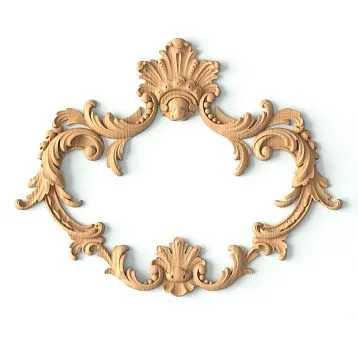
Cartouches — decorative frames, often with scrolls and volutes around the perimeter. Inside may be a smooth surface for placing a monogram, crest, or inscription. Or a relief image — vegetal ornament, cherub, scene.— everything must correspond to the chosen era.This type is characteristic of Baroque and Rococo, but is also used in Neoclassicism with appropriate stylization.
Ornamental motifs
Vegetal ornaments — the largest group. Acanthus leaves — classic Greek-Roman tradition, recognizable carved forms with deep cuts. Laurel wreaths and garlands — symbols of glory and victory, often in classical interiors. Grapevines with clusters — Christian symbolism, Renaissance and Baroque motifs.Architectural ornamentFrom vegetal forms, it is infinitely diverse.
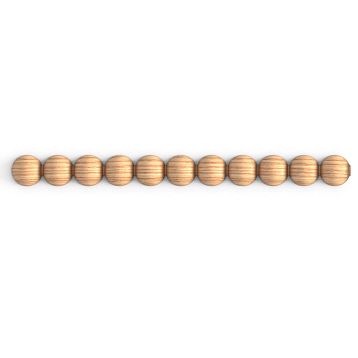
Geometric patterns are more strict and universal. Meander — Greek key, an endless broken line, symbol of eternity. Ionic — egg-shaped elements alternating with darts, classic motif of the Ionic order. Beads, ribbons, braids — simple but effective ornaments for moldings and borders.Wall moldingWorks well with geometric patterns in any style, from classicism to minimalism.
Figurative elements add narrative. Cherubs and angels — frequent guests in Baroque and Rococo interiors. Maskron — stylized masks of people or animals, often on keystone stones of arches. Mythological characters — satyrs, nymphs, muses in Renaissance and classical compositions.Decorative InsertsFigurative elements require delicate use to avoid overloading the interior.
Abstract and stylized forms are characteristic of modernism and contemporary design. Smooth organic lines resembling plants, but not copying them literally. Geometric stylization of natural forms. Art Deco with its solar motifs, zigzags, stepped forms.polyurethane decorIn contemporary design, they are often abstract, freed from direct historical references.
Materials: from plaster to polyurethane
Traditionally, stucco was made from plaster. The master stucco artist would create a model from clay or wax, then make a mold, pour plaster into it, and obtain a cast. Or, he would sculpt directly on-site, forming the decoration directly on the wall or ceiling. Plaster stucco is beautiful, durable with proper care, and has a noble matte surface. However, it is heavy, fragile during transport, afraid of moisture, and difficult to install.
Cement and concrete were used for exterior stucco — facade cornices, balustrades, decorative panels. Strength and weather resistance are the main advantages. Disadvantages include enormous weight, difficulty in manufacturing thin details, an industrial appearance requiring high-quality painting.Architectural ornamentsConcrete elements are massive and substantial, but lack the lightness of classical samples.
Wood is a material for carved decoration, related to stucco but technologically different. Wooden carving adorned interiors alongside plaster stucco, sometimes imitating its forms. Advantages include the warmth of the material and the ability to finely work out details. Disadvantages include high cost, labor-intensive manufacturing, and sensitivity to humidity and temperature.
Polyurethane: a technological revolution
Polyurethane radically changed the stucco decoration industry. Lightweight —— everything must correspond to the chosen era.it weighs several times less than plaster equivalents. Durable — it won't break when dropped or crumble over time. Moisture-resistant — suitable for bathrooms, kitchens, pools, and facades. Easy to cut and install — standard tools, special adhesive, accessible to a home handyman.
Accuracy in reproducing details — polyurethane molds allow obtaining casts with micron-level precision. The finest ornament, barely noticeable relief transitions — all are reproduced perfectly.Ceiling elementsPolyurethane elements are visually indistinguishable from plaster, yet far more practical.
Paintability — polyurethane accepts any paint. You can create classic white decor, tone it to match wood, paint it in bright colors, apply gold leaf or patina.interior moldingsPolyurethane elements — a clean canvas for implementing any color concept.
Durability and stability — polyurethane does not shrink, crack, or deform with temperature fluctuations. Service life of decades without loss of quality.polyurethane decorOnce installed, it requires no maintenance, only periodic dust cleaning.
Application in interior design
Ceilings — a traditional place for stucco decoration. Cornices along the perimeter mark boundaries, creating a smooth transition from walls to ceiling.Ceiling elementsRosettes mark lighting zones. Cores — recessed panels framed with moldings — structure large ceiling planes. Decorative beams, even non-load-bearing, add architectural expressiveness.
Walls gain volume and character thanks tostucco on the wallMoldings divide the plane into panels, creating classic boiserie. Pilasters — vertical elements imitating columns — add rhythm and visually raise the ceiling.Decorative InsertsAbove doorways, at panel corners, and at wall centers, they become focal points.
Door and window openings are framed with stucco moldings. This is not just decoration, but architectural emphasis on functionally important elements.Architectural ornamentAbove the door — a sash, pediment, cartouche — transforms a simple opening into a portal, emphasizing the importance of the entrance.
Fireplace zones and niches
Fireplace — a natural focal point in a room, requiring appropriate treatment. A fireplace portal made ofof stucco elementscan be of any complexity — from simple molding framing to complex compositions with columns, pediments, and caryatids. Polyurethane is especially suitable here — it is not afraid of temperature and does not deform from heat.
Niche walls are highlighted with stucco framing. A molding along the perimeter,Decorative Insertspossibly a small pediment or basin at the top — and a simple recess becomes an architectural element. Inside the niche, a sculpture, vase, or lighting is placed. Stucco creates a frame drawing attention to the content.
Furniture is also adorned with stucco decoration. Cabinet, chest, and table facades gain volume thanks to applied elements.polyurethane decorIt is glued onto a flat door panel, transforming standard furniture into exclusive pieces. After painting to match the furniture color, the appliqués look like wood carving, but are incomparably cheaper.
Stylistic solutions
Classic interiors are unthinkable without stucco. Strict symmetry, proportionality, use of canonical orders.interior moldingsHere, time-tested rules apply. Acanthus leaves, meanders, Ionic capitals, rosettes with proper ornamentation. Color is traditionally white or bone, with delicate gold leaf on the most important elements.
Baroque and Rococo demand opulence. AbundantDecorative Inserts, complex compositions, dynamic forms. Scrolls, cartouches, garlands, cherubs. Gilding, painting, texture play. This is maximalism, luxury, demonstrative excess. Polyurethane allows reproducing baroque complexity without astronomical costs for plasterwork.
Modern interiors use stucco sparingly and consciously. One or two expressive elements instead of total decoration.Architectural ornamentscan be classical in shape but painted in unexpected colors. Or conversely — abstract modern forms in traditional white. This is a dialogue between eras, eclecticism, conscious play with context.
Eclecticism and fusion
Mixing styles — a characteristic feature of modern design. ClassicalWall moldingin loft spaces with exposed brick and industrial lighting. A baroque rose in the ceiling of a minimalist apartment. This works if done consciously, with understanding of balance and contrast.
Monochromatic palette unifies disparate elements. Even complex stucco, painted in one color with walls, appears restrained. Relief creates play of light and shadow, but not color contrast.Ceiling elements, walls, furniture in a single tone — this creates unity despite differences in texture and form.
Unexpected colors refresh classical forms. Graphite stucco on white walls. Gold — in black-and-white interiors. Colorful — in children's or creative studios.— everything must correspond to the chosen era.stop being background, become active design elements.
Installation and maintenance
Installationpolyurethane decoris accessible to a home handyman. Surface must be clean, flat, primed. Special adhesive is applied to the back of the element in dots or a zigzag pattern. The element is pressed against the wall and held for a minute until the adhesive sets. For heavy elements, additional finishing nails or screws are used, which are removed after the adhesive dries, and holes are filled with putty.
Joints between elements are filled with acrylic sealant. It is applied in a thin bead into the seam, smoothed with a wet finger, excess is immediately removed. After drying, the seam becomes invisible. Well-installedDecorative Insertsappear monolithic, with no visible joints.
are painted after the adhesive has fully dried and seams have been filled. Surface is primed with acrylic primer, then painted in two coats. Forinterior moldingssuitable paints are water-emulsion, latex, or acrylic. Decorative techniques such as patination, gilding, or artificial aging can be used.
Operation and Maintenance
Maintenance of polyurethane stucco is minimal. Dry cleaning with a soft cloth or feather duster once every week or two removes dust. Wet wiping with a slightly damp cloth as needed. Abrasives, solvents, or aggressive chemicals must not be used — they may damage the finish.Ceiling elementswith relief ornamentation are cleaned with a soft brush to remove dust from recesses.
Repair of damage is simple. Scratches and chips on painted elements are filled with acrylic putty, sanded after drying, and touched up. If an element is severely damaged, it is easy to replace — remove the old one and install the new one.— everything must correspond to the chosen era.made of polyurethane are available, replacement is not a problem.
Repainting refreshes the interior without dismantling. Old paint is lightly sanded to improve adhesion, then a new color is applied. It is possible to radically change the concept — make white stucco contrasting, or colorful stucco neutral.polyurethane decortolerates multiple repaints without losing relief clarity.
Conclusion: Timeless beauty
Eras pass, styles change, design directions are born and die.— everything must correspond to the chosen era.remain. Because they respond to fundamental human needs for beauty, spatial organization, and connection to culture. This is not nostalgia for the past, but a living tradition, constantly reinterpreted and renewed.
Decorative Insertscornices, moldings — these are tools of architectural expression. With them, flat, featureless surfaces become relief compositions. Space is structured, zoned, and imbued with meaning. This is the language on which walls and ceilings speak.
polyurethane decordemocratized stucco. What was once accessible only to palaces and mansions can now adorn a regular apartment. Technology simplified installation, reduced cost, expanded possibilities. But the essence remained the same — creating beauty through volume, relief, and organized forms.
Company STAVROS offers a wide rangepolyurethane molding elements. From classicaldecorative insertswith vegetal ornamentation to modern abstract forms. From miniature corner elements to large-scaleceiling rose. Each item reproduces classical samples with high accuracy, preserving detail clarity, relief depth, and proportional forms.
Production uses high-density quality polyurethane. This ensures strength, durability, and resistance to external influences.Architectural ornamentsSTAVROS do not yellow over time, do not deform from temperature, do not absorb moisture. The quality of the material guarantees that the decor will last for decades, retaining its original appearance.
The catalog covers all major styles and eras. Classic acanthus leaves and meanders for fans of tradition. Baroque cartouches and cherubs for lovers of opulence. Modern botanical stylizations for admirers of organic design. Contemporary abstract forms for minimalist interiors.interior moldingsSTAVROS is the choice for any project.
Custom production is available for exclusive projects. If the catalog does not contain the required element, STAVROS specialists will develop it according to your sketch. 3D modeling allows visualizing the result. Sample production for approval. Mass production in the required volume.Decorative InsertsCustom order — the opportunity to obtain absolutely unique decor.
Consultations help make the right choice. Specialists take into account the interior style, room dimensions, ceiling height, and layout specifics. Recommend elements that will look naturally integrated, without overcrowding the space. Calculate the required quantity, explain installation specifics. Professional support at every stage — from selection to installation.
Deliveryof stucco elementsDelivered throughout Russia. Reliable packaging protects delicate elements with fine relief during transportation. Logistics partners ensure timely delivery. Courier delivery to the site is available for Moscow and its region. Convenience of order pickup — part of quality service.
Create interiors that will outlast trends. Choose decor with a history spanning millennia. Trust the quality of proven manufacturers. STAVROS — your guide to the worldstucco decorationwhere classical beauty meets modern technologies.— everything must correspond to the chosen era.STAVROS — the choice for those who understand: true elegance does not age, traditions do not become outdated, and beauty remains relevant beyond time and trends!