












































































Article Contents:
- What is a pediment and why is it important for the entrance group
- Functions of pediments in modern architecture
- Materials for door cornices: wood, MDF or polyurethane?
- How to choose material for your entrance group
- Pediment styles: from classic to modern
- Color and finish selection
- Door cornice installation: step-by-step instructions
- Installation mistakes and how to avoid them
- Decorative elements for pediments: rosettes, consoles, pilasters
- How to combine elements without overloading the facade
- Ready-made solutions and custom projects
- Criteria for choosing a ready-made pediment
- Care for door cornices and pediments
- Restoration and renewal
- Pediment as part of the architectural ensemble
- Landscape surroundings
- Trends in entrance group decor
- Design Possibilities and Stylistic Solutions
- Frequently Asked Questions
- Can a pediment be installed on a metal door?
- How much does a wooden cornice weigh?
- Does a polyurethane cornice need painting?
- How to protect a wooden pediment from moisture?
- Can a pediment be made DIY?
- How to choose cornice size for a door?
- How much does lintel installation cost?
- Conclusion: transforming the entrance group with STAVROS
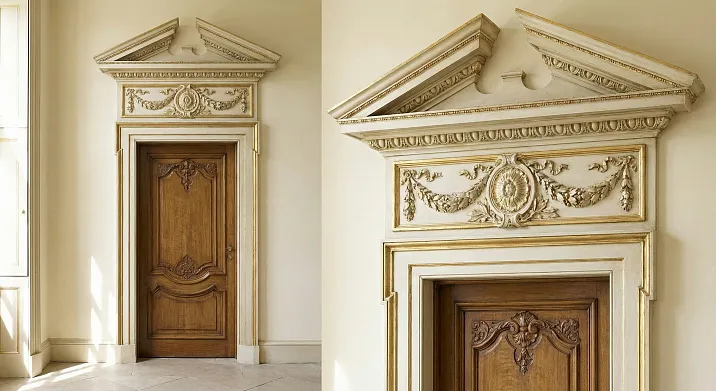
The entrance group is the calling card of any house, the first thing guests and passersby see. And it's precisely the decorative framing of doors that can turn an ordinary opening into an architectural masterpiece. The door cornice placed above the entrance and the decorative panel form that very pediment - an exquisite element that has adorned palace and mansion facades for centuries. Today this tradition is returning, and buying ready-made pediments for entrance groups has become easier than ever.
Why are door cornices popular again? Because they solve several tasks at once: protect from precipitation, visually increase the opening height, give the facade status and completeness. Meanwhile, modern technologies allow creating entrance door decor from various materials - from classic wood to practical polyurethane.


What is a pediment and why is it important for the entrance group
A pediment is a horizontal decorative element placed above a door or window opening. Historically it served a protective function: diverted rainwater from the entrance, preventing door and threshold wetting. But over time, the pediment transformed into a full-fledged facade decoration, a symbol of architectural taste and homeowner prosperity.
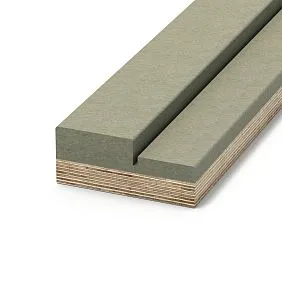
Moderndoor cornice KZ-006— this is precisely the element that forms the basis of a pediment. The compact 55×20 mm profile is ideal for creating an elegant door crown. Made from oak, beech, or MDF, such a cornice combines strength with aesthetics, and the choice of finish—enamel or tinting—allows it to be harmoniously integrated into any architectural style.
Why is a decorative panel needed above a door? It creates a visual transition between the wall and the door leaf, making the opening more expressive and proportional. When the panel is complemented by a cornice, it forms a classic pediment—an element that instantly transforms the entrance group, making it memorable.




Functions of pediments in modern architecture
Practical protection remains relevant today. A properly installed cornice above the entrance door forms a small canopy that diverts rain and snow to the sides, extending the lifespan of the door and hardware. This is especially important for wooden doors, which are sensitive to moisture.
Visual correction of proportions is another task. A narrow door appears wider when crowned with a horizontal cornice. A low opening visually 'grows' when a decorative panel is placed above it. Door framing creates a picture frame effect: the entrance becomes a focal point of the facade, attracts attention, and stands out among other elements.
Prestige and style—that's what distinguishes thoughtful design from random. An entrance group with a pediment speaks of attention to detail and an understanding of architectural traditions. This is not just a door—it's a grand entrance that creates the right first impression of the house and its inhabitants.
Our factory also produces:


Materials for door cornices: wood, MDF, or polyurethane?
The choice of material for a decorative cornice depends on operating conditions, budget, and the desired aesthetic effect. Each option has its advantages, and understanding their features will help make the right decision.
Wood is a classic that never goes out of style.Wooden cornicesOak and beech cornices possess natural texture, warmth, and nobility. Solid wood is strong, durable, and can be tinted to any shade. An oak cornice can last for decades, maintaining its original appearance with proper care. However, wood requires protection from moisture: it must be coated with varnish or paint, and the coating periodically renewed.
MDF is the optimal balance between price and quality. The material does not warp from temperature fluctuations, does not crack, and is easily painted and tinted. MDF cornices are ideal for interior spaces and for facades under a canopy. They look like wood but require less maintenance and are cheaper.
Polyurethane is a modern solution for those who value practicality. Lightweight, moisture-resistant, does not rot or deform. Polyurethane elements can be painted any color, are resistant to frost and heat, and require no special maintenance. At the same time, they can imitate carving, stucco, complex profiles—all of which in wood would require manual labor and high costs.
Combined solutions are becoming increasingly popular. For example, an MDF cornice with polyurethane inserts combines the strength of the base with the decorativeness of overlays. This allows for creating complex compositions without increasing the cost of the structure.
Get Consultation
How to choose the material for your entrance group
For a facade exposed to all winds and rain, it's better to choose polyurethane or wood with high-quality protective treatment. If the entrance is under a canopy or in a deep niche, MDF is suitable. For interior doors—any material, here the choice is dictated solely by aesthetic preferences.
The style of the house is also important. A classic mansion requires wooden or highly realistic imitations. Modern minimalism pairs well with smooth polyurethane profiles. Country and Provence styles favor textured wood with visible grain. Eclecticism allows mixing materials to create unique compositions.
Project budget is another factor. Polyurethane is the most affordable, MDF is in the mid-price range, solid oak or beech is premium class. But it's important to remember: quality decoration for an entrance door is an investment that pays off with years of impeccable appearance and increased property value.
Pediment styles: from classic to modern
The architectural style of the pediment should harmonize with the overall appearance of the building. Dissonance between the facade and the entrance group decor will create a sense of incompleteness and randomness. Therefore, it's important to understand which elements suit different styles.
Classical style implies strict proportions, symmetry, and moderate decor. A rectangular cornice with a slight projection, a smooth or slightly profiled surface, and restrained colors—these are its characteristics. Such a pediment suits buildings in classicism, neoclassicism, and modern homes with elements of traditional architecture.
Baroque and Empire demand opulence. Here, wide cornices with rich profiling, applied decorative elements, gilding or patina are appropriate. Carved rosettes, volutes, consoles—all this creates solemnity and theatricality. Suchready-made pediments for entrance groupstransform an ordinary entrance into a grand portal.
Modern and Art Deco prefer flowing lines, asymmetry, stylized plant motifs. The cornice may have a wavy profile, the decorative panel—images of flowers, stems, abstract patterns. Colors are muted, often with an aged effect.
Scandinavian and minimalism are about simplicity and functionality. A laconic cornice without unnecessary details, natural wood tones or pure white. The door decor here is maximally restrained, but no less expressive for it. Beauty in simplicity is the main principle of these styles.
Country and rustic styles love rough texture, visible wood grain, and deliberately simple forms. The cornice can be massive, with minimal processing, emphasizing the naturalness of the material. This is an ideal choice for country houses, dachas, and cottages in traditional style.
Color and finish selection
The color of the pediment should either match the door color (creating a unified composition) or contrast with the wall (highlighting the entrance). A white cornice on a dark wall is a classic technique that always works. A dark cornice on a light facade is a bolder but equally effective solution.
Natural wood tinted to walnut, oak, or mahogany gives the entrance warmth and coziness. Enamel coating in white, beige, or gray creates a fresh, modern look. Metallic shades—gold, bronze, copper—add luxury and suit classic interiors.
It's important to consider the surroundings: the color of the roof, window frames, and downpipes. All these elements should form a harmonious palette. Disparate colors will create visual chaos, whereas a well-thought-out color scheme will unite the facade into a cohesive composition.
Door Cornice Installation: Step-by-Step Guide
Installing a cornice above a door is a process that requires precision and care. Proper installation ensures the durability of the structure and its aesthetic appearance. Let's break down the main stages.
Surface preparation is the first and most crucial step. The wall above the door must be level, clean, without peeling plaster or paint. If the surface is uneven, it is leveled with putty or plaster. Dust and dirt are removed, and the surface is primed for better adhesion.
Marking the cornice position is done using a level and a tape measure. The cornice must be positioned strictly horizontally, at an equal distance from the edges of the door opening. It is usually centered relative to the door, but sometimes intentionally offset to create asymmetry. Mark the line of the cornice's lower edge and the attachment points on the wall.
Cutting elements is required if the cornice is longer than the opening or consists of several parts. Wood and MDF are cut with a miter saw at a 45-degree angle at the joints (if forming a frame around the door). Polyurethane is easily cut with a fine-toothed saw or a special knife.
Wall mounting depends on the material and weight of the cornice. Light polyurethane elements are glued with special mounting adhesive.Wooden cornices and corner piecesare heavier, so they are additionally secured with screws. Screws are driven into pre-drilled holes, countersinking the heads to later conceal them with putty.
Sealing joints and holes is done with acrylic or polyurethane putty. Seams between elements are carefully filled, excess is removed with a damp sponge. After drying, the surface is sanded with fine sandpaper until smooth.
Finishing is the final stage. If the cornice is wooden, it is coated with primer, then painted or varnished in two to three coats with intermediate sanding. MDF and polyurethane can be left in their factory finish or repainted to the desired color. Joints with the wall are sealed with silicone sealant matching the color of the cornice or wall.
Installation Mistakes and How to Avoid Them
Uneven mounting is the most common mistake. Even a slight tilt of the cornice is immediately noticeable. Always use a level, check the horizontal in several points.
Weak fastening leads to the cornice pulling away from the wall or sagging over time. Don't skimp on fasteners, use a sufficient number of screws or anchors. For heavy elements, use reinforced brackets.
Visible joints spoil the appearance. Carefully fit elements together, use high-quality putty, sand seams until completely smooth. If a joint is still noticeable, it can be masked with a decorative overlay.
Lack of wood protection from moisture is a critical mistake for exterior cornices. Unprotected wood quickly darkens, cracks, and becomes affected by fungus. Be sure to apply moisture-resistant impregnations, varnishes, or paints.
Decorative Elements for a Pediment: Rosettes, Consoles, Pilasters
A pediment is not just a cornice above a door. It is an entire composition that can be enriched with additional elements, creating a unique look for the entrance group. Which decorative details best complement a door cornice?
Consoles are vertical or inclined elements that visually support the cornice. They are placed at the edges of the cornice and create the effect that the crowning element rests on these supports. Consoles can be simple, in the form of rectangular blocks, or carved, with floral ornaments, volutes, acanthus leaves. Properly chosen consoles turn a simple cornice into a full-fledged architectural element.
Rosettes are round or oval overlays with a relief pattern. They are placed in the center of the panel under the cornice, at the edges, sometimes symmetrically on both sides of the door. Rosettes set the rhythm, draw attention, add sophistication. In classical interiors, a rosette often depicts a stylized flower; in Baroque, a complex monogram or coat of arms.
Pilasters are vertical flat columns framing the door on the sides. They visually increase the height of the opening, adding solemnity. Pilasters have a base (lower part), a shaft (central part), and a capital (upper part). The capital often serves as a continuation of the cornice, creating a unified structure.
Friezes are horizontal strips with a repeating pattern, placed under the cornice. A frieze can be smooth or relief, with a geometric or floral pattern. It fills the space between the door and the cornice, making the composition more saturated.
Keystones are decorative inserts in the center of the upper part of the opening, imitating ancient stonework. A keystone is an accent that draws the eye and emphasizes the central axis of the entrance.
How to Combine Elements Without Overloading the Facade
It's important to remember a sense of proportion. An abundance of decoration can turn an entrance group into an overloaded, tasteless composition. It's better to choose two or three key elements and execute them with quality than to pile up many disparate details.
Unity of style is a mandatory condition. All elements should be executed in the same style, from one or harmonizing materials. Baroque consoles do not combine with a minimalist cornice, and strict pilasters look absurd with ornate rosettes.
Proportions are also important. Large elements are good for large entrance groups, small ones for compact doors. A massive console on a small door will look comical, and a thin cornice on a wide opening will look unfinished.
Color harmony unites the composition. Decorative elements can be the same color as the cornice, or contrasting. The contrast should be meaningful: for example, white rosettes on a dark cornice, gold consoles on a white background.
Ready-Made Solutions and Custom Projects
The modern market offers two paths: buy ready-made pediments for the entrance group or order custom manufacturing. Each option has its advantages.
Ready-made kits offer speed, convenience, and predictability. Manufacturers offer standard pediments in different sizes and styles. You choose a suitable option, order delivery, and within a few days you can start installation. Ready-made solutions are already tested, have a proven design, and clear installation instructions.
solid wood cornicesAvailable in a wide range: from simple profiles to complex shapes. Each model has an article number, precise dimensions, material description, and finish. This simplifies selection and eliminates errors.
Custom projects are needed when standard sizes don't fit, when you want to create something unique that reflects the owner's personality. A designer or architect develops a sketch, taking into account the facade features, customer wishes, and architectural context. Then the elements are custom-made — carved, turned, with an individual profile.
A custom project is more expensive and takes longer, but the result is truly one-of-a-kind. Such a pediment will become the house's signature, its highlight, which cannot be bought in a store.
Criteria for selecting a ready-made pediment
Opening size is the first thing to consider. The cornice should be 10-20 cm wider than the door on each side to create proper framing. A too-short cornice looks stubby, a too-long one looks disproportionate.
The facade style dictates the choice of shape and decor. For a classic house, choose cornices with soft profiles; for a modern one — with clear lines; for country style — with pronounced wood texture.
Material depends on operating conditions. For exposed facades — polyurethane or protected wood; for covered ones — any material.
Completeness is an important point. Some manufacturers sell only the cornice, others offer a full set: cornice, consoles, rosettes, fasteners. A set is more convenient, as all elements are guaranteed to match each other.
Price does not always reflect quality, but overly cheap products should raise concerns. Quality front door decor cannot cost pennies — it is the result of the work of designers, technologists, and craftsmen.
Care for door cornices and pediments
The longevity of a pediment depends not only on material quality and installation but also on proper care. Regular maintenance extends the life of decorative elements and preserves their original appearance.
Wooden cornices require the most attention. Inspect the coating once a year: check for cracks, peeling, or darkening. If the varnish or paint is damaged, it is necessary to clean the problem areas, treat with an antiseptic, and repaint. Wood should not be left unprotected even for a short time.
Polyurethane elements are low-maintenance, but they also need cleaning. Dust, dirt, and insect traces are washed off with water and a mild detergent. Do not use abrasives or solvents — they can damage the surface.
MDF cornices are wiped with a damp cloth, avoiding excessive wetting. MDF is afraid of water, so it is important to prevent moisture accumulation in joints and recesses.
In winter, it is especially important to monitor the condition of the cornice. Snow and ice accumulating on horizontal surfaces create load and can lead to deformation. Snow should be gently brushed off with a soft brush, without using a shovel or scraper.
Seal the joints are checked annually. If the sealant has cracked or peeled off, it is removed and a new layer is applied. This prevents moisture from penetrating under the cornice and its destructive effects.
Restoration and renewal
Even a quality cornice may require updating over time. Wood darkens, paint fades, decor loses clarity. Restoration returns elements to their original appearance.
Repainting is the simplest way to update. The old coating is removed by sanding or stripping, the surface is primed, and new paint or varnish is applied. You can change the color, refresh the interior without replacing elements.
Restoring damaged areas requires skill. Cracks and chips are filled with wood putty, forming the missing volume. After drying, the area is sanded and painted to match the rest of the cornice.
Replacing individual elements is necessary if the damage is serious. Fortunately, the modular design of pediments allows replacing one console or rosette without dismantling the entire complex.
Prevention is better than repair. Regular inspection, timely cleaning, updating the protective coating — these simple actions will eliminate the need for costly restoration.
Pediment as part of the architectural ensemble
The entrance group does not exist in isolation — it is part of the facade, which in turn is part of the house's architectural ensemble. The pediment should echo other elements, creating unity.
Windows and doors are often decorated in a unified style. If a cornice of a certain profile is installed above the front door, it is logical to use similar cornices above the windows. This creates rhythm, unifies the facade, and makes it harmonious.
The pediment and entrance cornice can mirror each other's shape. A triangular house pediment and a triangular pediment top — a classic technique that enhances the sense of stability and symmetry.
Pilasters on the building corners and pilasters framing the door connect the entrance group with the overall architecture. Using elements of the same style and size achieves visual unity.
The facade color palette includes the pediment color. If the house is executed in two or three colors, the cornice should be one of these colors. An additional color not found elsewhere will disrupt the harmony.
Lighting the entrance group highlights the beauty of the pediment. Fixtures placed on the sides of the door or under the cornice create play of light and shadow, revealing the decor's relief. In the evening, an illuminated pediment looks especially impressive, making the entrance welcoming and safe.
Landscape surroundings
The path leading to the entrance should visually lead to the pediment. A wide, stone or tile-paved path corresponds to a solemn, richly decorated entrance. A narrow gravel path — to a modest, rustic pediment.
Plants at the entrance complement the architecture. Symmetrical tubs with thujas or boxwoods on either side of the door enhance the classical style. Climbing roses or ivy add a romantic touch. Strict grasses suit contemporary minimalism.
The fence, gate, and wicket should also stylistically match the entrance group. Wrought iron patterns on the gate echo the carving of the pediment, a wooden palisade matches a wooden cornice, and metal minimalism pairs with laconic polyurethane profiles.
Trends in decorating entrance groups
Fashion for architectural elements changes more slowly than for clothing or interiors, but there are trends here too. What is relevant today in the design of entrance groups?
A return to classicism is the main trend of recent years. People are tired of faceless minimalism and strive for beauty, traditions, and time-tested forms. Pediments, pilasters, and consoles are once again adorning facades, but in a modern interpretation: made from lightweight materials, with convenient installation, and in current colors.
The naturalness of materials is highly valued. Wood, stone, metal—what nature provides—is perceived as a benchmark of quality and eco-friendliness. Even imitations strive to replicate the texture of natural materials as accurately as possible.
Contrasting combinations create expressiveness. A dark cornice on a light facade, a white panel on a brick wall—such solutions attract attention and make the entrance memorable. The contrast should be appropriate and supported by other elements.
Geometry and clear lines are relevant for modern houses. Cornices with a rectangular cross-section, without complex profiles, combined with minimalist consoles create a laconic, graphic image.
Individuality above all. Standard solutions are giving way to unique projects. People want their home to stand out from neighboring ones, for the entrance group to tell a story and reflect the character of the owners.
Production technologies
Modern technologies allow for the creation of decorative elements of the highest quality. CNC milling makes it possible to cut the most complex patterns from wood with millimeter precision. Pressure casting of polyurethane ensures perfect repeatability of shape and clarity of the smallest details.
3D modeling allows the customer to see the future pediment before manufacturing, assess proportions, and make adjustments. This saves time and eliminates disappointment.
Powder coating of metal elements provides a durable, long-lasting finish that does not fade or peel. Patination and artificial aging create an antique effect, giving the elements a noble appearance.
All these technologies make quality door decor accessible not only to palaces but also to ordinary residential houses. You can order a pediment that matches historical samples in quality and beauty but costs a reasonable amount of money.
Frequently asked questions
Can a pediment be installed on a metal door?
Yes, it can. A metal door does not prevent the installation of a decorative cornice. The pediment is attached not to the door but to the wall above the opening. It is only important that the gap between the top of the door and the cornice is sufficient—usually 10-15 cm. This ensures both visual harmony and freedom of door movement.
How much does a wooden cornice weigh?
The weight depends on the size and type of wood.Cornice KZ-006made of oak, 2 meters long, weighs about 3-4 kg. Beech is slightly lighter—2.5-3.5 kg. MDF of the same size—about 2 kg. Polyurethane is the lightest—around 1 kg. These figures are approximate and depend on the specific profile.
Does a polyurethane cornice need to be painted?
Polyurethane is usually sold already primed and white. If white suits you, additional painting is not necessary—just wipe the cornice from dust. If a different color is needed, polyurethane can be easily painted with acrylic or alkyd paints. The surface is lightly sanded beforehand for better adhesion.
How to protect a wooden pediment from moisture?
The best protection is a high-quality paint and varnish coating. The wood is primed with an antiseptic composition, then two to three layers of yacht varnish or facade paint are applied. It is important to treat all surfaces, including the ends and the back side. The coating is renewed every 2-3 years. Proper installation also helps: the cornice should not fit tightly against the wall—a gap for ventilation is needed.
Can a pediment be made by yourself?
Yes, if you have woodworking skills and tools. A simple cornice made from a planed and sanded edged board is not difficult to make. Complex profiles will require a router. Carved elements without carving experience will not turn out—it's better to buy them ready-made. The main things are marking and fastening accuracy, and neatness in finishing. But if it's about the entrance group—the face of the house—it might be worth entrusting the work to professionals.
How to choose the size of a cornice for a door?
The width of the cornice usually exceeds the width of the door by 20-40 cm (10-20 cm on each side). For a standard 90 cm door, a cornice 110-130 cm long is suitable. The height (projection) of the cornice depends on the style: for classic—5-10 cm, for baroque—up to 15 cm, for minimalism—3-5 cm. The thickness is determined by proportions: the wider the cornice, the thicker it should be to avoid looking fragile.
How much does pediment installation cost?
The cost of installation depends on the complexity of the structure, material, and region. On average, installing a simple cornice costs 2000-3000 rubles. A complex pediment with consoles, rosettes, and pilasters—from 5000 to 15000 rubles. The cost of the elements themselves is added to this. A ready-made set of cornice, consoles, and fasteners will cost from 3000 to 30000 rubles depending on the material and size.
Conclusion: transforming the entrance group with STAVROS
The entrance group is not just a door in the house. It is the first impression we make on guests, the business card of our taste, style, and attention to detail. And the door cornice, door framing, decorative panel above the entrance—all these elements play a key role in creating the image.
Modern technologies and materials have made high-quality entrance door decor accessible. There's no longer a need to hire wood carvers or plasterers — ready-made pediments for entrance groups are offered in a wide range. From minimalist profiles to lavish Baroque compositions — the choice is limited only by your imagination and the style of your home.
The company STAVROS specializes in producingdecorative elements made of solid woodof the highest quality. Every cornice, every console, every carved rosette undergoes strict quality control, is processed on modern equipment, and is coated with protective compounds. STAVROS offers not just a product — we offer a solution for those who value beauty, durability, and individuality.
In the STAVROS catalog, you will find dozens of cornice models suitable for any style and size of door opening. Classic profiles, modern forms, exclusive collections — all available with delivery across Russia. STAVROS consultants will help you choose the optimal solution, calculate the required amount of material, and provide recommendations for installation and care.
By creating an entrance group with STAVROS products, you are investing in the long-term beauty of your home. Our cornices will last for decades, maintaining their original appearance, delighting the eye, and evoking admiration. Transform your entrance, make it memorable, status-worthy, unique — with STAVROS, it's simple!


