Article Contents:
- Carving as Language: What an Adorned House Says
- Symbolic Code: Reading the Wooden Book
- Status Function: Carving as a Currency of Prestige
- Emotional Impact: The Psychology of a Carved House
- Identity Role: The House as a Self-Portrait
- Elements of House Carved Decor: Anatomy of Beauty
- Pediment: The Crown of the House
- Window Trims: Framing the House's Gaze
- Cornices: Protection and Decoration
- Porch and Terrace: An Invitation to Enter
- Corners and Pilasters: Architectural Frame
- Styles of Carved Decor: From Antiquity to Modernity
- Russian Wooden Architecture: Roots of Tradition
- Scandinavian Minimalism: Beauty of Simplicity
- Alpine Chalet: Harmony with the Mountains
- Classicism: Antique Harmony
- Art Nouveau: Natural Curves
- Materials and Technologies: From Wood Selection to Installation
- Wood Species: Characteristics and Applications
- Manufacturing Technologies: Handcraft and CNC
- Protective Treatment: Durability of Decor
- Installation: Proper Mounting
- Modern Application: Carving in the 21st Century
- Restoration and preservation of heritage
- New Construction: Traditions in Modern Architecture
- Commercial Real Estate: Carving as Branding
- Interior Application: From Facade to Inside
- Frequently Asked Questions: Carving Without Secrets
- Is It Expensive to Adorn a House with Carving?
- Can Carving Be Installed on a Brick or Block House?
- How Long Does Carved Decor Last?
- Is Special Care Required?
- Can I order carving based on my own sketch?
- What style should I choose for a modern house?
- Is carving eco-friendly?
- Can carving be combined with other materials?
- Is a permit required to install carved decor?
- Does carving fade in the sun?
- Conclusion: decorate your home with STAVROS

What turns a house into a legend? Why do you walk past some buildings without noticing, while others make you stop, look up, and freeze in admiration? The secret is simple yet complex—it's in the details. In those very carved patterns that transform an ordinary structure into a piece of folk art.A house adorned with carvingis not just a dwelling. It is a manifesto, frozen in wood. It is a dialogue between the master and time, between tradition and modernity, between utility and beauty.
Recall the old Russian cities, where every street is an open-air museum. Tomsk with its wooden lace, Kostroma with its towers resembling fairy-tale illustrations, small villages lost in the forests, where every window is framed by carving telling its own story. This tradition is alive. It has not frozen in the past—it transforms, adapts, finds new forms, but retains the main thing: the ability to make a house alive, spiritual, speaking.


Carving as a language: what an adorned house says
A house is a text. And carving is its script. When a master carves a pattern on a window frame, they are not just decorating a surface. They are writing a message. To neighbors, passersby, future generations. To themselves, ultimately.




Symbolic code: reading the wooden book
Carved patterns on a house are not random. Every curl, every rosette, every sun carries meaning, rooted in pagan times when people believed: the right sign would protect the home from misfortune, attract prosperity, ensure the family's health.
Solar symbols—circles with rays, diamonds with dots, swastikas (before their tragic reinterpretation in the 20th century)—personified the sun, light, life force. Placed above windows, they were meant to keep darkness out of the house. Not only physical but metaphysical—illness, quarrels, misfortune.
Floral motifs—grapevines, oak leaves, floral garlands—symbolized fertility, growth, prosperity. A house entwined with wooden branches seemed to grow into the earth, becoming part of nature, drawing strength and protection from it.
Zoomorphic images—horses, birds, snakes—guarded the boundaries of the home. The horse—a solar symbol, carrying light. The bird—a connection between earth and sky, a mediator between worlds. The snake—a guardian of underground riches, a symbol of wisdom and renewal.
Geometric patterns—meanders, diamonds, triangles—created cosmic order, reflecting ideas about the harmony of the universe. Their rhythmic repetition calmed, structured space, brought balance.
Our factory also produces:


Status function: carving as a currency of prestige
A house adorned with carving has always been a sign of prosperity. Carving is expensive—it requires time, skill, materials. Not everyone could afford to decorate their home. Rich carved decor said: here live wealthy, respected people with taste and an understanding of beauty.
This function has survived to this day. A modern cottage withcarved window decorstands out among standard constructions, demonstrates the owner's individuality, their willingness to invest not only money but also soul into the home.
Get Consultation
Emotional impact: the psychology of a carved house
Why does a carved house evoke positive emotions? Psychologists explain this with several factors.
First, pattern complexity. The human brain loves tasks. Examining a complex carved pattern, we engage visual analysis, recognize repeating elements, find symmetry. This activates neural networks, bringing pleasure from cognitive work.
Second, connection with nature. Carving is made from wood—an organic, living material. Wood smells, breathes, changes over time. Contact with natural materials reduces stress, improves mood, creates a sense of harmony.
Third, historical memory. A carved house awakens archetypal images—the hut from a fairy tale, the princess's tower, the ancestors' home. This creates a feeling of rootedness, connection with tradition, with something greater than fleeting modernity.
Identification role: the house as a self-portrait
A house reflects its owner. By choosing the style of carving, its density, and motifs, we create a self-portrait, a visual autobiography.
Traditional RussianHouse Carving with bright window surrounds, sun symbols, and Bereginya figures says: the owner values roots, respects tradition, and wants to pass it on to their children. Concise Scandinavian carving—minimal decoration, maximum functionality—demonstrates restraint, rationality, and a modern view of aesthetics. Abundant Baroque-style carving—opulence, theatricality, a love of luxury. Every choice is a statement about oneself.
Elements of a house's carved decor: the anatomy of beauty
A house is a complex organism. And carving lives on it in different places, performing different functions. Let's examine the anatomy of a carved house, from the roof to the porch.
Pediment: the crown of the house
The pediment is the triangular or trapezoidal part of the facade between the roof slopes. It is the crown of the house, its pinnacle, the most noticeable detail from afar.Carved pediment turns a technical necessity into a work of art.
Pediments can be solid (a solid board with carving) or openwork (pierced carving that lets light through). An openwork pediment is especially effective in the evening when light shines through from inside the attic, and the patterns glow, turning the house into a lantern.
Carving on a pediment is usually symmetrical. A central axis divides the composition into two mirrored parts. In the center is the dominant element: a large rosette, sun, coat of arms, or the owners' initials. From the center to the edges, the ornament develops: garlands, scrolls, geometric patterns.
The style of pediments is diverse. Traditional Russian ones—with an abundance of small details, a frequent rhythm, and bright colors. Scandinavian ones—restrained, with simple forms and the natural color of wood. Alpine ones—massive, with large elements emphasizing solidity.
Window surrounds: framing the house's gaze
Windows are the eyes of the house.Carved Mouldings are the framing of these eyes, giving them expressiveness, character, and mood.
A traditional Russian window surround consists of several parts. The headpiece (kokoshnik) is the upper part, often shaped like a semicircle or pediment. This is where the main carving is concentrated—solar symbols, rosettes, plant garlands. The side pieces (jambs) are the vertical planks framing the window on the left and right. They can be smooth or decorated with vertical ornaments. The sill board (apron) is the lower part, protecting the wall from water running off the window.
Pierced carving on window surrounds creates a lace-like effect. The wood becomes almost weightless, airy. Such surrounds require delicate work—openwork elements break easily and require careful handling.
Relief carving is more massive, sturdier. The pattern protrudes above the background, creating a play of light and shadow. With side lighting, the carving 'comes to life'; shadows emphasize the volume, making the composition more expressive.
Modern window surrounds often combine techniques. The base is a smooth or profiled board. Carved elements are applied to it—corner rosettes, central panels, ornamental inserts. This simplifies production, reduces cost, and allows combining elements to create unique compositions.
Cornices: protection and decoration
A cornice is a horizontal projection running along the perimeter of the house at roof level. Its function is to divert rainwater from the walls. But a carved cornice is not just protection; it is also a crucial decorative element.
The cornice creates a horizontal line that balances the verticals of windows, doors, and corners. It divides the facade, creates proportions, and completes the composition. Without a cornice, a house looks unfinished, like a person without a hat.
Carving on a cornice can be simple—a profiled plank with smooth curves. Or complex—a repeating ornament stretching along the entire perimeter. Plant motifs are popular—stylized leaves, flowers, berries. Geometric patterns—meanders, waves, dentils.
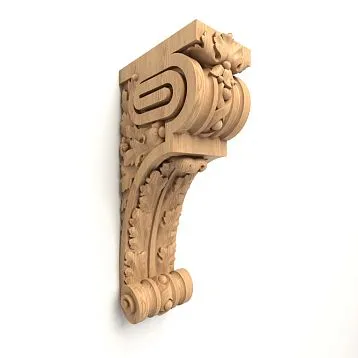
Brackets are often placed under the cornice—supporting elements that hold up the roof overhang.Carved brackets turn a structural necessity into a decorative accent. They can be simple (a triangular console with smooth lines) or complex (scrolls, acanthus leaves, masks).
The number of brackets determines the rhythm of the facade. Frequent brackets (every 50-70 cm) create a detailed, decorative look. Sparse ones (1-1.5 meters apart)—monumentality, solidity.
Porch and terrace: an invitation to enter
The porch is the house's calling card, the first thing a guest sees. A carved porch creates a sense of ceremony, hospitality, and prepares one to enter the house.
The posts (columns) supporting the porch canopy are decorated with carving. These can be vertical flutes (fluting), twisted spirals, plant garlands. The capital (the top part of the post) is especially important. It bears the load from the beam, and its carved design turns a technical detail into a work of art.
Porch and terrace railings are a field for installing balusters.terrace balustrade with carved balusters creates an openwork railing that protects from falling but does not block the view.
Balusters can be turned (round, with figured thickenings and waists) or flat carved (boards with openwork patterns). Turned balusters are classic, resembling miniature columns. Flat ones are more folk-style, characteristic of the Russian style.
The distance between balusters is an important safety parameter. According to building codes, it should not exceed 10-12 cm to prevent a child from falling. This requirement influences the design - balusters are placed densely, creating a dense, almost solid fabric.
Corners and Pilasters: Architectural Frame
House corners are the points where two facade planes meet. Decorative corner treatment with pilasters (flat vertical projections imitating columns) creates an architectural frame, emphasizing the building's geometry.
A pilaster consists of three parts: a base (foundation), a shaft (body), and a capital (top). The base can be simple (rectangular projection) or profiled (with curves, coves). The shaft is decorated with vertical flutes, carved panels, ornaments. The capital is the most decorative part, with carvings in the form of acanthus leaves, scrolls, rosettes.
Corner pilasters give a house monumentality, solidity, and connect it to the grand architectural tradition. Even a small house with properly designed corners appears more significant, more respectable.
Styles of Carved Decoration: From Antiquity to Modernity
Carving does not exist in a vacuum. It is part of an architectural style, an era, a cultural tradition. Each style imposes its own requirements on carved decoration.
Russian Wooden Architecture: The Roots of Tradition
The Russian style features recognizable openwork window surrounds, lacy pediments, solar symbols, and bright colors. The carving is abundant, detailed, covering a significant part of the facade.
The color palette is traditional: white, blue, green, red against a background of natural wood or dark cladding. Contrast enhances the expressiveness of the carving, making it noticeable from afar.
Ornaments are diverse. Floral: flowers (roses, daisies), leaves (grape, oak), berries (rowan, viburnum). Geometric: diamonds (symbol of a sown field), triangles (mountains, roofs), circles (sun). Zoomorphic: horses, birds (roosters, peacocks), snakes.
Russian carving is not restrained. It is joyful, festive, open. It is not aristocratic - it is folk, close to the earth, nature, and peasant life. In modern interiors, the Russian style is applied cautiously to avoid creating a museum-like stylization. But individual elements - a carved window surround, an overlay with a traditional ornament - become bright accents.
Scandinavian minimalism: beauty of simplicity
Scandinavian style is the opposite of Russian abundance. Here, conciseness, functionality, and restraint are valued. Carving is minimal but expressive.
Window surrounds are simple, rectangular, without complex shapes. Cornices are wide, massive, protecting walls from snow and rain. Decoration is dosed: one rosette above the entrance, simple brackets under the cornice, laconic balusters for railings.
Colors: white, gray, traditional red (Falu red), natural light wood. Surfaces are matte, without gloss. Wood is often not painted, preserving its natural texture.
Scandinavian style is universal. It suits houses of any architecture, creating a feeling of cleanliness, order, and calm. It is especially popular in northern regions, where the climate requires sturdy, reliable structures.
Alpine Chalet: Harmony with the Mountains
The chalet style was born in the Alps. Massive houses made of thick timber, wide roof overhangs, minimal carving, but maximum expressiveness.
Cornices are very wide (1-1.5 meter overhang), protecting walls from heavy snowfall. Under them are powerful brackets, often carved, with Alpine motifs: edelweiss, mountain goats, snowflakes.
Balconies with carved balusters are a characteristic feature of a chalet. Balusters are massive, with large details visible from afar. Colors are natural: dark brown wood, gray stone plinth, green metal roof.
The chalet is ideal for houses in mountainous areas, in the forest, by a lake. It creates a feeling of reliability, shelter, and protection from the elements.
Classicism: Antique Harmony
The classical style draws inspiration from Greek and Roman architecture. Symmetry, proportions, use of the order system (columns, pilasters, entablatures).
Carving is restrained, noble. Ornaments: meanders (Greek key), acanthus leaves, palmettes, laurel garlands, Ionic volutes. Carving is relief or bas-relief, not deep.
Colors: natural wood in noble tones (oak, walnut), white, cream. Gilding is often applied - on pilaster capitals, on rosettes, on cornice brackets.
A classical carved house looks solemn, respectable, timeless. This is architecture that does not age, does not go out of fashion.
Art Nouveau: Natural Curves
Art Nouveau (Art Nouveau) of the late 19th - early 20th century was inspired by nature. Flowing lines, asymmetry, stylized plants (irises, lilies, bindweed), images of insects (dragonflies, butterflies).
Carving avoids right angles. Everything flows, bends, intertwines. The ornament does not repeat mechanically - it develops organically, like a living plant.
Natural colors: green, lilac, golden-brown, pearl-gray. Carving is often combined with stained glass, forged elements, and ceramics.
Art Nouveau requires refined taste. But when executed correctly, it creates interiors and facades of fantastic beauty that connect humans with nature.
Materials and technologies: from wood selection to installation
The quality of carved decor depends on the material and manufacturing technology. Let's examine the nuances.
Wood species: characteristics and application
Pine is the most affordable species. Soft, easy to work with, contains resin (a natural antiseptic). To eliminate defects, a glued panel is used—a material from which knots and resin pockets are cut out, and the remaining parts are glued together. Such pine is stable, does not warp, and does not release resin. Requires protective treatment but lasts 30-50 years.
Larch is the champion of moisture resistance. Contains gum—a substance that repels water. Under moisture exposure, larch becomes harder. Ideal for exterior elements—window trims, cornices, pediments. Denser and heavier than pine, more difficult to work with, but the result is impressive.
Oak is the king of wood. Hard, dense, practically eternal. Oak carving lasts for centuries, darkening over time, acquiring a noble hue. Difficult to work with, expensive, but it's an investment for centuries.
Linden is a favorite among carvers. Soft, uniform, without pronounced grain, ideal for fine detailed carving. Cuts easily in all directions, does not splinter. Disadvantage—softness. For exterior use, requires good protective treatment.
Beech is durable, with a delicate pinkish grain. Well-suited for load-bearing elements (brackets, balusters), holds carving details. Sensitive to humidity, requires protection.
Manufacturing technologies: handcraft and CNC
Hand carving is the highest form of craftsmanship. The carver works with chisels, knives, creating unique pieces. Each movement is unique. Hand carving is slow, expensive, but the result is priceless—an object carrying the master's energy.
CNC machines revolutionized production. A computer program controls the milling cutter, reproducing the most complex patterns with micron precision. Advantages: speed, repeatability, ability to create forms impossible by hand. Disadvantage: lack of individuality.
A combined approach is optimal: rough machining on CNC, final finishing by hand. This ensures productivity while maintaining quality.
Protective treatment: durability of decor
Wood on a facade is subjected to harsh conditions: rain, snow, sun, temperature fluctuations. Without protection, it deteriorates within a few years.
Antiseptic treatment is the first stage. Impregnation penetrates deeply, protects against rot, mold, insects. Primer creates a base for the finishing coat. Paint or varnish is the finishing layer. Paint is opaque, hides the grain, but provides maximum protection. Varnish is transparent, preserves the beauty of the wood.
For facades, weather-resistant coatings are used, withstanding temperatures from -40°C to +40°C, ultraviolet light, and moisture.
Installation: proper mounting
Carved elements are fastened with stainless steel screws (do not rust, do not leave stains). Heavy elements (brackets, cornices) require reinforced fasteners—anchors, bolts.
A ventilation gap of 5-10 mm between the element and the wall is important, preventing moisture accumulation. Joints are treated with sealant. Proper installation is a guarantee of durability.
Modern application: carving in the 21st century
The tradition is alive. Carving is not a museum relic—it lives, evolves, and finds new forms.
Restoration and preservation of heritage
Ancient wooden houses with carving are architectural monuments. Their restoration requires precise reproduction of lost elements. Masters study surviving fragments, create analogs, and restore the original appearance.
Restoration is not only technique but also respect for history, a desire to preserve cultural heritage for future generations.
New construction: traditions in modern architecture
Owners of new houses increasingly choose carved decor. It's a way to stand out, create a unique appearance, and connect a modern building with tradition.
Architects combine traditional forms with modern materials. Wood carving is combined with glass, concrete, and metal, creating interesting contrasts.
Commercial real estate: carving as branding
Restaurants, hotels, and tourist complexes use carving to create an authentic atmosphere. This is especially relevant for establishments with ethnic cuisine, eco-hotels, and estate museums.
Carving becomes part of the brand, a memorable visual image that attracts customers.
Interior application: from the facade inward
Carving penetrates into the house. Carved doors, panels, cornices, and furniture create a cohesive style where exterior and interior harmonize.
Interior carving is finer and more detailed than facade carving. It is not exposed to atmospheric influences and can be made from softwoods (linden) with the finest details.
Frequently Asked Questions: Carving Without Secrets
Is it expensive to decorate a house with carving?
Depends on the volume and complexity. A minimal option (trims for several windows, simple carving) — from 80,000 rubles. Full facade decoration of a house (trims, pediment, cornices, brackets, porch) — from 500,000 rubles. Exclusive hand carving is significantly more expensive. But it is an investment that pays off with beauty, uniqueness, and increased property value.
Can carving be installed on a brick or block house?
Yes, wooden elements can be attached to any surface. Appropriate fasteners are used — dowels, anchors. Carving on a brick house creates an interesting contrast of materials.
How long does carved decor last?
With proper treatment and care — decades. Larch and oak — 50-100 years. Pine with protective coating — 30-50 years. The key factor is timely renewal of the coating every 5-7 years.
Is special care required?
Annual inspection, cleaning from dust and dirt, checking the coating. If cracks or peeling appear — restoration. Renewal of paint/varnish every 5-7 years. Maintenance is not complicated but necessary.
Can I order carving based on my own sketch?
Yes, most workshops accept individual orders. You provide a sketch or description — the master creates a project, coordinates it, and manufactures it. Individual carving is more expensive than serial production, but the result is unique.
Which style to choose for a modern house?
Depends on the architecture and surroundings. For a timber house — Russian or Scandinavian style. For a modern cottage — minimalism with laconic carving. For a house in the mountains — Alpine chalet. Consult with a designer or architect.
Is carving eco-friendly?
Absolutely. Wood is a renewable material. With proper forest management, the production of carved items is sustainable. Wood does not emit harmful substances and is safe for health.
Can carving be combined with other materials?
Yes, carving combines beautifully with stone (plinth), metal (forged elements), glass (stained glass). The combination of materials creates a richness of textures and interesting contrasts.
Is a permit required to install carved decor?
For a private house on your own plot — usually not. But if the house is an architectural monument or located in a historical zone, approval from heritage protection authorities is required.
Does carving fade in the sun?
Unprotected wood fades. But modern weather-resistant varnishes and paints contain UV filters that prevent fading. With proper treatment, carving retains its color for decades.
Conclusion: Decorate Your Home with STAVROS
A house decorated with carving is not just beautiful. It is meaningful. It is a connection with tradition, with roots, with culture. It is a way to make a house alive, speaking, unique. In an era of mass production, when all houses look alike, carving is a statement of individuality, that you do not agree to live in a faceless box, that beauty, history, and craftsmanship are important to you.
A carved house is a house with a soul. It brings joy not only to its owners but also to neighbors, passersby, and guests. It becomes a landmark, a point of reference, an object of admiration. Children growing up in such a house absorb aesthetics, learn to appreciate beauty, craftsmanship, and tradition.
Investing in carved decor means investing in durability (quality carving lasts for decades), in beauty (which never goes out of style), in value (a carved house sells for more than a standard one), and in culture (preserving and passing on tradition).
For over twenty years, STAVROS has been creating carved products of the highest quality, combining centuries-old craftsmanship traditions with modern production technologies. Every STAVROS product is the result of a deep understanding of the material, respect for the craft, and a pursuit of perfection.
The STAVROS catalog features a huge selection of elements for decorating a house with carving. Carved trims of all styles — from traditional Russian with solar symbols to laconic Scandinavian ones. Openwork and solid pediments, with classical ornaments and author's compositions. Cornices with carving that complete the facade. Brackets of all sizes and shapes — from simple triangular ones to richly decorated with acanthus leaves. Balusters for the porch and terrace — turned and carved, sturdy and elegant.
All STAVROS products are made from selected solid wood — oak, beech, pine, larch. The wood undergoes chamber drying to an optimal moisture content of 8-10%, guaranteeing dimensional stability, absence of deformation and cracks during use.
Production is carried out on modern European CNC equipment, ensuring micron-level geometric precision. However, technological advancement does not exclude manual labor—after machine processing, each piece is refined, polished, and inspected by craftsmen with years of experience. This guarantees quality unattainable with fully automated production.
STAVROS works with both professionals (architects, designers, construction companies) and private clients who wish to decorate their homes themselves. The minimum order starts from a single item, allowing you to purchase exactly what you need.
A special point of pride for the company is the possibility of custom manufacturing. If the desired element is not in the catalog, STAVROS will develop and create it based on your sketch or photograph. The company's designers will help adapt the idea to technological capabilities, offering optimal solutions that consider the house's style, climatic conditions, and budget.
The STAVROS website provides detailed information about each product—dimensions, material, finishing options, cost. High-quality photographs show the elements from all angles, conveying texture and carving detail. A convenient filter system allows you to quickly find what you need—by style, element type, size, wood species, price.
Products can be ordered online on the website or by phone. The company's specialists will advise on element selection, help calculate the required quantity, and suggest options for installation, protective treatment, and maintenance.
Delivery is carried out throughout Russia by reliable transport companies. Products are carefully packaged in protective film and wooden crates to prevent damage during transportation. For Moscow and St. Petersburg, self-pickup from STAVROS warehouses is available, where you can personally see the products, assess the quality of carving, choose your favorite elements, and receive advice from specialists.
STAVROS is not just a manufacturer of carved products. It is a team of enthusiasts in love with wood, carving, and the traditions of Russian architecture. Every company employee—from designer to carver, from technologist to manager—understands their responsibility for preserving and developing the traditions of wooden art.
By choosing STAVROS, you choose quality tested by time and thousands of satisfied clients. You choose traditions combined with innovations. You choose decor that will serve for decades, delight with beauty, evoke admiration, and be passed down to future generations as a family heirloom.
Turn your house into a masterpiece of wooden architecture. Create a facade that stands out among faceless buildings, tells its own story, and reflects your values and taste. Let your house become a carved monument to beauty, craftsmanship, and tradition.
Wooden art from STAVROS is where functionality meets beauty, where tradition merges with modernity, where a house ceases to be just a structure and becomes a home with a soul, a home that lives, breathes, and speaks the language of carving, understandable to the heart of everyone who appreciates the beautiful!