Article Contents:
- Furniture handles as the architecture of touch
- Tactility: the forgotten dimension of quality
- Exclusive solid wood hardware: the philosophy of material
- Oak: Nobility of Centuries
- Beech: warmth and uniformity
- Creation process: from wood to masterpiece
- Author collections: when hardware becomes art
- Geometric shape collections
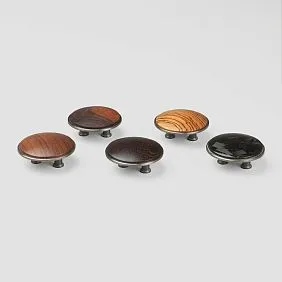
- Collections with combined materials
- Collections with carving and ornamentation
- Geometry of shapes: round, triangular, oval
- Round handles: universal classic
- Triangular handles: geometric boldness
- Oval handles: elegant elongation
- Premium-class handles: distinguishing criteria
- Material: only natural solid wood
- Manufacturing precision: to tenths of a millimeter
- Surface treatment quality
- Finish coating: protection and aesthetics
- Color Solutions: Palette of Possibilities
- Natural wood: the warmth of nature
- Black: graphics and contrast
- White: freshness and lightness
- Natural toning: play of shades
- How to choose designer handles for furniture
- Style Compatibility with Interior
- Proportionality of size
- Color Harmony
- Functional Requirements
- Frequently asked questions about designer handles
- How do designer handles differ from ordinary ones?
- Can wooden handles be used in the kitchen?
- How to determine the correct handle size?
- Do I need to drill new holes when replacing handles?
- How to care for wooden handles?
- Can wooden handles be painted a different color?
- Which handles are better: coated or uncoated?
- How long do wooden handles last?
- Conclusion: hardware as a philosophy of quality

Touch a standard stamped handle from mass-market furniture — and you'll feel cheapness. Now wrap your fingers around a solid oak piece with perfect polishing, feel the weight, the warmth of natural wood, the expressive grain. The difference is colossal.Designer furniture handlescan transform even the most ordinary furniture, turning a standard dresser into an author's piece, and a typical kitchen into a model of taste. Why does one apartment look expensive and another look budget, even though the furniture costs the same? Often it's precisely in the details: in the hardware that either emphasizes quality or mercilessly reveals it.




Furniture handles as the architecture of touch
Every day we open dozens of cabinets and drawers without even thinking about the motion. The hand reaches for the handle automatically — but it is precisely at this moment that the feeling of the furniture, the space, the entire interior is formed. Cold plastic signals mass production. Peeling chrome reveals age and low quality of the original hardware. And a premium wooden handle tells a completely different story.
A furniture handle plays a dual role: functional and aesthetic. On one hand, it is a tool — an element that allows you to open a door or pull out a drawer conveniently, effortlessly, with a proper grip. On the other — it is a decoration, a visual accent that either blends into the overall composition of the facade or stands out as a contrasting spot that attracts attention.
In premium interiors, furniture handles cease to be utilitarian devices and become small architectural forms. They set the rhythm, create a repeating motif, connect disparate pieces of furniture. Imagine a living room where all the case elements — from bookcases to TV stands — are united by a single language of hardware: the same shape, material, finish. This creates visual unity, turning a set of separate items into a thoughtful ensemble.




Tactility: the forgotten dimension of quality
Modern design is often focused on the visual. We scroll through pictures on Pinterest, choose based on photos, evaluate by image. But an interior is not only what we see. It is what we touch daily. And here the magic of natural materials begins.
Wood has a unique tactile temperature. It is always warmer than metal and more pleasant than plastic. In winter, a wooden handle doesn't chill the palm; in summer, it doesn't heat up to an uncomfortable temperature. The texture of solid wood — slightly rough or perfectly smooth after multi-stage polishing — creates pleasant sensations with every touch.
Weight matters. A light plastic handle feels flimsy, unreliable. A massive wooden or metal hardware piece gives a sense of solidity, quality, durability. It's a subconscious signal: if the manufacturer didn't skimp on a quality handle, then the entire furniture is made to a high standard.
Our factory also produces:



Exclusive solid wood hardware: the philosophy of material
Why has solid wood become the benchmark forexclusive furniture hardware? The answer lies in the unique combination of characteristics of this material.
Get Consultation
Oak: Nobility of Centuries
Oak wood is a symbol of strength and durability. A density of 700-750 kg/m³ makes oak one of the hardest materials among European species. Furniture handles made of solid oak withstand decades of intensive use without the slightest signs of wear.
The grain of oak is nature's art. Pronounced annual rings, medullary rays creating a characteristic sheen on radial cuts, the natural play of shades from light golden to rich brown. Each handle is unique: the wood pattern never repeats, making the hardware truly exclusive.
Oak has natural resistance to moisture, fungi, and insects due to its high tannin content. This makes oak handles ideal for kitchens and bathrooms where humidity is elevated. Properly treated with a protective coating, oak lasts for centuries, acquiring a noble patina over the years that only increases its decorative value.
Beech: warmth and uniformity
Beech wood is lighter than oak — its natural shade ranges from creamy pink to light brown. This warm color palette creates coziness, especially in interiors of Scandinavian style, Provence, and modern classics.
The structure of beech is more uniform and fine-pored compared to oak. This ensures exceptional smoothness after sanding and polishing.Wooden handles made of beechare pleasant to the touch, have no pronounced roughness, and are ideal for those who value tactile comfort.
Beech takes staining excellently, allowing the creation of handles in almost any color — from snow white to deep black — while maintaining the smoothness and uniformity of the surface. This opens up limitless possibilities for design experiments and adapting hardware to a specific interior.
The strength of beech is comparable to oak. A density of 650-680 kg/m³ ensures reliability and durability. Beech handles do not deform or crack when drying and processing technology is followed.
The creation process: from wood to masterpiece
Producing high-quality solid wood furniture handles is a multi-stage process where each stage is critical to the final result.
Wood selection begins with choosing healthy trees of optimal age — 80-100 years for oak, 60-80 for beech. Only such wood possesses the required density, stability, and expressive grain. After sawing, strict sorting takes place: only sections without knots, cracks, rot, and with uniform grain pattern are selected.
Drying is the foundation of quality. The wood undergoes kiln drying to a moisture content of 8-10% — the optimal level for furniture used in heated interiors. The process takes weeks, occurs gradually, with temperature and humidity control to avoid internal stresses that could lead to deformation of finished products.
CNC milling ensures perfect geometry and repeatability of shapes. Modern technology allows for creating complex three-dimensional handles with precision down to tenths of a millimeter — a level unattainable with manual processing. At the same time, the possibility of manual finishing remains to give the product final smoothness and uniqueness.
Sanding takes place in several stages with a gradual reduction in abrasive grit. It begins with coarse sanding using 80-120 grit to remove milling marks, continues with medium 180-240 grit to level the surface, and finishes with fine 320-400 grit to achieve a mirror-like smoothness.
The final finish determines not only the appearance but also the protective properties of the handle. Oil penetrates deeply into the wood structure, highlights the grain, and preserves the tactile feel of natural wood. Varnish creates a durable protective film resistant to moisture, dirt, and mechanical impact. Wax provides a velvety surface with a slight sheen, is eco-friendly, but requires periodic renewal.
Author's collections: when hardware becomes art
Designer handles differ from mass-produced items not only in material but also in their conceptual approach. This is not just a functional element, but the result of a designer's work who considers the form, proportions, ergonomics, and visual character of the product.
Collections of geometric shapes
Geometry is the foundation of modern design. Simple shapes — circle, triangle, rectangle, oval — gain new resonance in the hands of a talented designer when it comes to creating furniture hardware.
Round knob handles are a classic that never goes out of style. Diameter varies from compact 30 mm for small drawers to impressive 60-70 mm for large doors. The circle is the most natural shape for gripping, comfortable for any palm size. A wooden round handle can be completely smooth, emphasizing the purity of form, or have a textured finish — knurling around the perimeter, radial notches, slight faceting.
Triangular handles are a bold modern solution. The asymmetrical shape creates dynamism, standing out against standard round and rectangular counterparts. The triangle can be equilateral, creating visual stability, or asymmetrical, adding intrigue. Edges can be sharp and graphic or rounded and softer. Triangular handles are especially effective in minimalist interiors where geometric purity is valued.
Oval handles combine the convenience of round shapes with the elegance of elongated forms. The oval can be oriented horizontally or vertically, creating different visual impressions. A horizontal oval appears calmer, more stable; a vertical one — more dynamic, upward-aspiring. Oval handles are versatile: suitable for both classic and contemporary interiors.
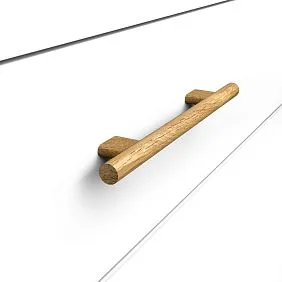
Rectangular pull handles are the workhorses of furniture hardware. Length varies from compact 96 mm (center-to-center mounting distance) to impressive 300-500 mm for wide fronts. The rectangular cross-section provides a reliable grip with the entire palm — critical for heavy doors, drawers with large loads. A wooden rectangular pull can have different cross-sections: square (equal width and height), rectangular (elongated in height or width), trapezoidal (widening towards the edges or center).
Collections with combined materials
Wood is beautiful on its own, but combined with metal, it gains a new dimension. Combined handles are a play of contrasts, where the warmth of wood balances the coolness of metal, the organic nature of the natural material — the strictness of the industrial.
Wood with brass — a combination tested by centuries. Brass has a warm golden hue that harmonizes with the natural tones of oak and beech. Over time, brass develops a patina — it dulls, acquires a noble matte sheen, sometimes greenish hues. This natural transformation is valued in interiors with a historical character, adding a sense of lived-in time.
Wood with black steel — a choice for modern minimalist interiors. Matte black steel creates a graphic contrast with the natural color of wood, emphasizes lines, makes the handle more noticeable on light-colored fronts. Black metal is neutral in temperature — neither warm nor cold — allowing it to be combined with any colors and materials.
Wood with copper — an option for those who value expressiveness. Copper is warmer than brass, more reddish, vibrant. It oxidizes actively, developing a multi-colored patina — from brown to green-blue. This process makes each handle unique, unlike even its twins from the same batch.
Combined handles create visual connections in the interior. Wooden handles with brass inserts echo brass light fixtures, kitchen faucets, door handles. Handles with black steel elements link furniture with black window frames, metal table legs, industrial light fixtures.
Collections with carving and ornament
Carving transforms a functional handle into a decorative object, a miniature work of art. In the era of mass production, hand carving or detailed milling imitating carved ornamentation becomes a marker of premium quality, a demonstration of craftsmanship.
Floral motifs — the classic of carved decor. Acanthus leaves, grapevines, floral rosettes adorn handles for furniture in Baroque, Empire, Neoclassical styles. The depth of carving varies from a light relief, barely protruding above the background, to voluminous sculptural carving where each leaf is worked with botanical precision.
Geometric ornaments — meander, interlace, diamond mesh — are more restrained, suitable for classic interiors where structure, repeatability, and visual rhythm are important. Such carving does not overwhelm, works as texture, adding visual interest without excessive decorativeness.
Abstract forms — organic waves, smooth lines, asymmetrical compositions — a modern interpretation of carved decor. These handles are unique, make furniture authorial, distinguish it from mass-produced items. They are suitable for eclectic interiors where styles, eras, and materials are mixed.
Geometry of forms: round, triangular, oval
The shape of a handle determines not only its aesthetics but also its functionality. Different shapes are suitable for different types of furniture, different interior styles, different gripping methods.
Round handles: universal classic
The circle is the most ancient and natural shape for a furniture handle. Archaeological finds testify: even in antiquity, furniture was equipped with round rings and knobs for opening.
The ergonomics of the round shape are optimal. A knob handle is convenient to grasp with two or three fingers from any side. There's no need to find the correct hand position — the circle is symmetrical in all directions. This is especially convenient for furniture in children's rooms, where ease of use is important.
Visually, round knobs are neutral—they do not create directionality or dominate the facade's composition. This makes them universal: they are equally suitable for dressers, kitchen cabinets, wardrobes, and nightstands. A round knob can be minimalist—simply a turned cylinder with a rounded end—or decorative, with carving, inlay, or metal inserts.
The size of a round knob is selected based on the size of the facade and the overall style. Compact buttons with a diameter of 30-40 mm are suitable for small dresser drawers. For large cabinet doors, more substantial knobs of 50-70 mm are used, which won't get lost on a large surface and will provide a secure grip.
Triangular knobs: geometric boldness
The triangle in furniture hardware is a relatively new phenomenon that has gained popularity with the development of modern minimalism and geometric design. A triangular knob makes a statement: here, unconventional solutions, boldness, and modernity are valued.
The shape of the triangle can vary. An equilateral triangle creates visual stability and harmony of proportions. An isosceles triangle with an elongated apex appears more dynamic and upward-reaching. An asymmetrical triangle adds intrigue, making the knob a focal point.
The orientation of the triangle in space changes perception. A triangle with the vertex pointing upward suggests aspiration, growth, and activity. With the vertex pointing downward, it conveys stability and groundedness. A triangle on its side creates directional movement—to the left or right.
The edges of a triangular knob can be sharp, emphasizing geometricity, or rounded, softening the form and making it more tactilely comfortable. Sharp edges are visually striking but less pleasant to grip. Rounded edges are a compromise between geometric purity and ergonomics.
Triangular knobs are especially effective when placed in groups. A row of triangular buttons on a dresser facade, oriented in the same direction, creates a visual rhythm. Chaotic placement with different orientations adds playfulness and dynamism.
Oval knobs: elegant elongation
An oval is a circle that has gained direction. The elongated form is more elegant and refined than a simple circle, yet retains smoothness and softness of lines.
A horizontal oval visually expands the facade, creating a sense of calm stability. Such knobs are suitable for wide drawers and horizontally oriented doors. They do not conflict with the horizontal lines of the furniture but rather emphasize them.
A vertical oval, on the contrary, creates dynamism and vertical movement. These knobs are appropriate for tall, narrow cabinet doors where it is important to emphasize vertical proportions. A vertical oval visually elongates the facade, making the furniture appear more slender.
Oval pull handles are an intermediate option between round buttons and rectangular pulls. They provide a comfortable grip for the entire palm but look more elegant than angular rectangular counterparts. The oval cross-section of the pull is more pleasant in the hand—there are no sharp edges pressing into the palm during a firm grip.
The decoration of oval knobs is diverse. A smooth polished surface emphasizes the purity of the form. Perimetric ribbing adds texture and improves grip. Inlay with a metal strip along the center creates a decorative accent, linking the knob with other metal elements in the interior.
Premium-class knobs: distinguishing criteria
What makes a furniture knob premium? Not just price and brand. There are objective criteria that distinguish quality hardware from mass-produced items.
Material: only solid natural wood
The first and main criterion is material. Premium knobs are made exclusively from solid wood of noble species. No composites, veneers, or imitations. Only oak, beech, ash, walnut—wood with a density of at least 600 kg/m³, kiln-dried to a moisture content of 8-10%.
The quality of the wood is determined by the absence of defects: knots, cracks, rot, blue stain, or wormholes. Premium hardware uses only first-grade wood—clean wood with uniform texture and no defects. Second and third grades, which allow small knots and uneven coloring, are unacceptable in the premium segment.
The wood grain is carefully selected. For collections where expressiveness of the pattern is important, boards with bright contrast in annual rings, curly grain, and beautiful medullary ray patterns are chosen. For minimalist collections, on the contrary, wood with even, uniform texture and no sharp color transitions is selected.
Manufacturing precision: to tenths of a millimeter
Premium hardware is distinguished by perfect geometry. A round knob is perfectly round, without ovality. A rectangular pull has parallel sides and right angles. An oval is symmetrical, with a smooth transition of curvature.
Such precision is achieved using high-precision CNC machines, where milling tolerances are within hundredths of a millimeter. Program control ensures absolute repeatability—all knobs from the same batch are identical, which is critical in furniture manufacturing where symmetry and uniformity are important.
Holes for fasteners are drilled with precision to tenths of a millimeter. The center-to-center distance complies with standards—32, 64, 96, 128, 160 mm and further in 32 mm increments. The drilling depth is calculated so that the mounting screw enters completely without protruding from the back side.
Surface Processing Quality
The surface of a premium knob is perfectly smooth to the touch. There are no roughnesses, tears, milling marks, or unpolished areas. This is achieved through multi-stage sanding with a gradual transition from coarse to fine abrasives.
Edges and corners are rounded—there are no sharp edges that could scratch the hand or snag clothing. Even in knobs with emphasized geometric forms, the edges have a micro-rounding with a radius of 0.5-1 mm, invisible to the eye but perceptible to the touch.
The ends of the knobs are finished with the same quality as the main surfaces. In cheap hardware, the ends often remain rough, with sawing marks. In premium hardware, they are sanded, polished, and coated with a protective compound.
Finish coating: protection and aesthetics
The coating of a premium knob serves a dual function: it protects the wood from moisture, dirt, and mechanical damage, and it highlights its natural beauty.
Oil—a natural coating that deeply penetrates the wood structure. It does not create a surface film, preserving the tactile feel of natural wood. Modern oils based on linseed or tung oil with added wax have water-repellent properties, protect against stains, and are easy to renew.
Varnish is a more durable coating that creates a protective film on the surface. Water-based polyurethane varnishes are eco-friendly, have no strong odor, and create a transparent coating that does not distort the wood's color. The gloss level of varnish ranges from high-gloss (80-90% shine) to matte (5-10% shine).
Wax is a traditional coating that provides a velvety surface with a slight sheen. Wax coatings are eco-friendly and create pleasant tactile sensations, but are less resistant to moisture and dirt, requiring periodic renewal.
In premium hardware, the coating is applied evenly, without drips, runs, or unpainted areas. The number of layers reaches 3-5 for oil and 5-7 for varnish, with intermediate sanding of each layer.
Color solutions: palette of possibilities
The color of a furniture handle is a powerful design tool that can either emphasize the interior's style or ruin it with the wrong choice.
Natural wood: the warmth of nature
Natural wood color without tinting is a choice for those who value the authenticity of the material. Each wood species has its own color palette.
Oak in its natural state has a warm honey-golden hue with a slight gray undertone. The texture is pronounced: contrasting annual rings and medullary rays that create a characteristic moiré sheen on radial cuts. Over time, oak darkens, acquiring a richer brown color and a noble patina.
Beech is lighter than oak—its natural color ranges from creamy pink to light brown. The texture is fine, uniform, without sharp transitions. This creates an impression of visual lightness and airiness. Beech handles are ideal for light Scandinavian interiors where softness, coziness, and the absence of aggressive contrasts are important.
Ash has a cooler color palette—grayish-beige with a slight pinkish tint. The texture is contrasting, with a clear pattern of annual rings creating dynamic stripes. Ash handles are graphic and suitable for modern minimalist interiors.
Walnut is the darkest and most noble of the common wood species. The color ranges from light brown with a gray tint to rich chocolate. The texture is complex, wavy, with iridescent shades. Walnut handles are luxurious and suitable for classic interiors where the nobility of materials is valued.
Black: graphics and contrast
Black wooden handles are created by tinting solid wood with special stains or paints. Black is universal and suits almost any style—from classic to minimalist.
In modern interiors, black handles create graphic accents on light facades. The contrast is maximal: white facades with black handles are a classic of Scandinavian design—clear, crisp, and elegant. Light gray facades with black handles are a softer combination, creating depth without harshness.
In classic interiors, black handles with gilded elements work as a luxury feature. Black wood combined with gold hardware is a tradition of the Empire style, where the contrast of dark and gold created a sense of wealth and grandeur.
Black handles are practical: dirt, wear, and minor scratches are less noticeable on them. This is important for kitchens, where hardware is subjected to intensive use and contact with greasy, wet hands.
Matte black coating creates a noble, velvety surface that absorbs light. Glossy black is dramatic, mirror-like, and reflective. The choice depends on the overall interior concept.
White: freshness and lightness
White wooden handles are a choice for light, airy interiors. The white color is created by painting solid wood with opaque paints or enamels that completely hide the wood grain.
In Scandinavian interiors, white handles on white facades create an effect of integrity and monolithic appearance. The furniture appears to lack hardware—the handles blend into the facade plane without disrupting visual purity. The only thing that gives them away is a slight relief, noticeable at a certain lighting angle.
In Provence style, white handles are often combined with colored facades—light blue, mint, lavender, peach. White hardware refreshes, prevents colored facades from becoming overly sweet, and creates visual pauses.
White handles with artificial patina—aged, with a slight yellowing, wear, and marks imitating the traces of time—are popular in vintage and shabby chic interiors. This creates a sense of history, lived life, and the atmosphere of a grandmother's house with its warmth and coziness.
The practicality of white handles is lower than that of black ones: dirt is more noticeable on them, requiring more frequent cleaning. But the visual effect of freshness, lightness, and airiness often justifies the extra maintenance effort.
Natural tints: playing with shades
Tinting allows you to change the wood color while preserving the visibility of the grain. Unlike opaque paints, tinting compositions penetrate the wood structure, coloring it from within but leaving the annual ring pattern visible.
Honey tinting emphasizes the warmth of oak, making it more golden and sunny. This is a popular choice for classic and country interiors where a cozy, homely atmosphere is important.
Brown tinting of varying saturation—from light brown to dark chocolate—is universal and suitable for furniture in most styles. Dark brown handles are elegant and create a sense of solidity and reliability.
Gray tinting is a modern trend. Gray wood looks stylish and refined, suitable for minimalist, Scandinavian, and loft interiors. The shade can range from light gray, almost white, to dark graphite.
Colored tints—green, blue, red—are exotic and suitable for eclectic, avant-garde interiors. Colored wood with visible grain creates an unusual effect, turning furniture into an art object.
How to choose designer handles for furniture
Choosing handles is not an intuitive process but a task that requires analyzing the style, proportions, colors, and functional features of the furniture.
Style compatibility with interior design
First rule: handles should match the style of the furniture and the interior as a whole.Furniture hardwareClassical style requires traditional forms — round knobs, curved brackets, possibly with carving or metal overlays. Modern minimalism gravitates towards geometric forms — rectangular brackets, triangular knobs, inset profiles.
Baroque and Rococo require an abundance of decoration: carved handles with floral ornaments, gilding, curved asymmetrical forms. Neoclassicism is more restrained: symmetrical forms, moderate carving with geometric motifs, noble materials without excess.
Scandinavian style values simplicity: smooth wooden handles in natural light tones, minimal decoration, maximum functionality. Loft allows for roughness: textured handles with visible wood grain, combinations with black metal, asymmetrical forms.
Provence loves romance: light handles, possibly with floral carving, artificial patina creating an antique effect. Country style — rustic simplicity: handles made of light wood, possibly unpainted, preserving natural imperfections.
Proportionality of size
The size of the handle should correspond to the size of the facade on which it is placed. A handle that is too small on a large door gets lost, looks stubby and insubstantial. One that is too large on a small drawer overloads it, leaving no visual space.
For knobs, the rule is: the diameter should be 8-12% of the facade width. A facade 40 cm wide — a knob 35-50 mm in diameter. A facade 60 cm wide — a knob 50-70 mm. This ensures visual balance.
For brackets, the rule is different: the bracket length should be 30-50% of the facade width. A facade 40 cm wide — a bracket 12-20 cm long (center-to-center fastener distance 96-160 mm). A facade 80 cm wide — a bracket 24-40 cm (center-to-center distance 192-320 mm).
The height of the drawer also influences the choice. For low drawers 10-15 cm high, compact knobs or short horizontal brackets are suitable. For high drawers from 30 cm, vertically oriented brackets can be used, emphasizing the height.
Color Harmony
The color of the handles is selected in accordance with the color of the facades and the overall color scheme of the interior. There are three main approaches: tone-on-tone, contrast, accent.
Tone-on-tone: handles of the same color as the facades. White handles on white facades, dark brown on dark brown. This creates visual integrity, the hardware dissolves, not distracting attention. Suitable for minimalist interiors where purity of lines is important.
Contrast: handles of a color opposite to the facade color. Black handles on white facades, white on black. This creates graphic quality, clarity, emphasizes lines. Suitable for modern, Scandinavian interiors.
Accent: handles of a color different from the facades, but not contrasting. Oak handles on gray facades, light beech on mint. This creates visual interest, adds warmth without creating sharpness. Suitable for most styles.
The connection of the handle color with other interior elements is important. If there is a wooden floor in the room, the handles can repeat its shade. If there are metal elements — light fixtures, faucets — metal inserts on the handles should match in color and finish.
Functional Requirements
Besides aesthetics, handles must be functional. For heavy wardrobe doors, sturdy, massive handles are needed, providing a reliable grip. For light dresser drawers, compact knobs are sufficient.
In the kitchen, where hands are often wet or greasy, handles with a non-slip surface are preferable — textured, ribbed, with a matte finish. Smooth glossy handles can slip in the hand, causing inconvenience.
For furniture in children's rooms, safety is important: handles without sharp edges, securely fastened, made of eco-friendly materials. It is advisable to choose shapes that do not catch on clothing or cause injury upon impact.
For elderly people, large, ergonomic handles are preferable, which are easy to grasp even with reduced finger mobility. Brackets are more convenient than knobs, long brackets are more convenient than short ones.
Popular questions about designer handles
What is the difference between designer handles and ordinary ones?
Designer handles are made from high-quality natural materials — solid oak, beech, ash — with high precision processing and thoughtful design. They undergo multi-stage sanding, are coated with eco-friendly protective compounds, and have perfect geometry. Ordinary handles are often made from composite materials, plastic, stamped metal, have simplified design and lower quality of execution. Designer handles last for decades, maintaining their appearance, while ordinary ones require replacement after a few years.
Can wooden handles be used in the kitchen?
Yes, provided there is a high-quality protective coating. Modern water-based oils and varnishes create a water-repellent layer that protects the wood from moisture, grease, and dirt. Regular care is important: wiping with a dry or slightly damp cloth, periodic renewal of the oil coating every 1-2 years. Avoid aggressive cleaning agents and abrasives. Oak handles are especially suitable for the kitchen due to oak's natural resistance to moisture.
How to determine the correct handle size?
For knobs: the diameter should be 8-12% of the facade width. For a drawer 40 cm wide, choose a knob 35-50 mm in diameter. For brackets: the length should be 30-50% of the facade width. For a door 60 cm wide, a bracket with a center-to-center fastener distance of 160-192 mm is suitable. Also consider the height of the drawer or door: for low elements — compact handles, for high ones — larger ones can be used.
Do new holes need to be drilled when replacing handles?
It depends on the center-to-center fastener distance. If the new handles have the same center-to-center distance as the old ones, new holes are not needed. Standard distances are 32, 64, 96, 128, 160, 192, 224, 256, 320 mm. If the center-to-center distance differs, you either need to drill new holes and fill the old ones, or choose handles with a wide base that will cover the old holes. Some manufacturers offer overlay plates that hide mismatched holes.
How to care for wooden handles?
Regularly wipe with a dry, soft cloth to remove dust. If necessary, use a slightly damp cloth, then immediately wipe dry. Do not use aggressive cleaning agents, solvents, or abrasives — they damage the coating. For oiled handles, renew the oil once a year: apply a thin layer of special wood oil, leave for 10-15 minutes, remove excess with a dry cloth. For varnished handles, special care is not required; regular wiping is sufficient.
Can wooden handles be painted a different color?
Yes, wooden handles are easy to repaint. Remove the old finish by sanding (180-240 grit abrasive), clean off dust, apply wood primer. After the primer dries, apply paint or stain of the desired color in 2-3 coats with intermediate drying. Finish with a top coat—varnish or oil. If the handles have threading or complex relief, be careful: do not clog the details with a thick layer of paint. It's better to apply several thin coats than one thick one.
Which handles are better: with a finish or without?
It depends on your preferences and tasks. Handles with a finish (oil, varnish, paint) are ready for installation immediately, protected from moisture and dirt, and have a finished look. Handles without a finish (unpainted) offer freedom in choosing the final finish: you can tint them any color, match the shade to specific furniture, create a unique solution. Unpainted handles are cheaper but require additional finishing work before installation.
How long do wooden handles last?
With quality manufacturing and proper care, solid wood handles last 20-30 years or more. Oak and beech are exceptionally durable species, resistant to wear. A protective coating safeguards the wood from moisture and dirt. Over time, handles may develop a patina—a slight color change, wear in areas of frequent contact—which adds nobility to them. Unlike plastic and cheap metal, which crack and peel, wood ages beautifully, becoming only more valuable.
Conclusion: Hardware as a Philosophy of Quality
Furniture handles are the point of contact between a person and an interior item. Dozens of times a day we touch them, opening cabinets and drawers. It is in these moments that the feeling of the furniture, the surrounding space, the entire home is formed. QualityWooden furniture handlessolid oak or beech handles turn a routine action into a pleasant tactile experience, demonstrate respect for details, and create an atmosphere of genuine comfort.
Choosing designer handles is an investment in durability, beauty, and eco-friendliness. Natural wood serves for decades without losing appeal, moreover—acquiring a noble patina that adds character. The geometric variety of forms—from classic round knobs to modern triangular ones—allows finding a solution for any interior style. The color palette—from natural wood tones to deep black and fresh white—provides freedom in creating harmonious or contrasting compositions.
Properly chosen handles can transform even standard mass-market furniture, adding individuality, premium quality, and character. They connect disparate items into a single ensemble, create visual rhythm, and emphasize the stylistics of the space. The combination of wood with metal—brass, black steel, copper—opens additional possibilities for creating accents and linking furniture with other interior elements.
The company STAVROS has specialized in the production of premium-class wooden furniture hardware for over twenty years. The 6000 m² production complex in St. Petersburg is equipped with modern CNC machines, ensuring milling accuracy up to 0.1 mm—a level unattainable with manual processing. All handles are made from kiln-dried solid oak and beech with 8-10% moisture content, eliminating deformation and cracking. The collection includes over 30 models of various shapes—round knobs, oval, triangular, rectangular pulls, T-shaped, shell handles—in a size range from compact 32 mm to impressive 320 mm center-to-center distance.
Each STAVROS handle undergoes multi-stage sanding, ensuring perfect surface smoothness. The final finish—natural oil, water-based varnish, or opaque paint—is applied in several layers, creating reliable protection from moisture, dirt, and mechanical impacts. The option to order handles without a finish allows you to independently tint them any color, creating unique solutions for a specific project.
STAVROS offers not only standard models but also the production of handles according to individual sketches for designers, architects, and furniture manufacturers. The minimum order is from one piece; the warehouse program ensures shipment on the day of order or the next day. Delivery is carried out throughout Russia and CIS countries via reliable transport companies. Professional consultants help select handles for specific furniture, considering stylistics, facade dimensions, color scheme, and functional features.
Choosing STAVROS means choosing hardware that turns ordinary furniture into premium furniture, adds status to the interior, creates that very effect where every touch of the furniture brings pleasure. Designer handles made from natural wood are not just a functional element, but a philosophy of quality, respect for material, and attention to detail. Let your home speak of your taste through the little things that actually define everything.