Article Contents:
- Relevant Trends 2026: Where Design is Heading
- Environmental Awareness and Biophilic Design
- Personalization and uniqueness
- Technological Integration
- Sustainability and Durability
- Mixing Textures and Materials
- Minimalism and Moldings: A Paradox That Became a Trend
- Concise Profiles Instead of Carved Ones
- Monochromatic: Blending with the Background
- Accent Use: Less is More
- Functionality: Decor with Meaning
- Accent Use of Decor: Targeted Solutions with Maximum Effect
- Accent Wall with Moldings
- Ceiling Rosette as a Sculptural Object
- Framing Openings: Portals and Architraves
- Decorative Panels in Zones
- Monochromatic Solutions: When Color is One, But the Effect is Maximum
- White on White: Classic Monochrome
- Gray Gradations: Modern Elegance
- Colored Monochromes: Boldness and Individuality
- Moldings in Scandinavian Style: Northern Restraint
- Thin White Cornices: Almost Invisible
- Moldings as Functional Zoning
- Baseboards: Tall and Functional
- Absence of Rosettes and Excessive Decor
- Eclecticism: When Classic Meets Modern
- Rule of Common Denominator
- Contrast as a Compositional Technique
- Transitional Elements: Bridges Between Styles
- Color Discipline: Unified Palette
- Practical Ideas: Specific Solutions for Different Rooms
- Living Room: The Focal Point
- Bedroom: Intimacy and Coziness
- Kitchen: practicality above all
- Bathroom: Moisture Resistance and Style
- Entryway: First Impression
- Frequently Asked Questions About Molding Design
- Is Molding Suitable for Small Apartments?
- Can Polyurethane Molding Be Combined with Stretch Ceilings?
- How to Choose a Molding Style for a Modern Interior?
- Is a Design Project with Molding Expensive?
- How to care for molding in interior design?
- Can Molding Be Painted in a Color Other Than White?
- What Mistakes Are Often Made in Molding Design?
- How Long Does It Take to Implement a Design Project with Molding?
- Conclusion: Molding as the Language of Modern Design
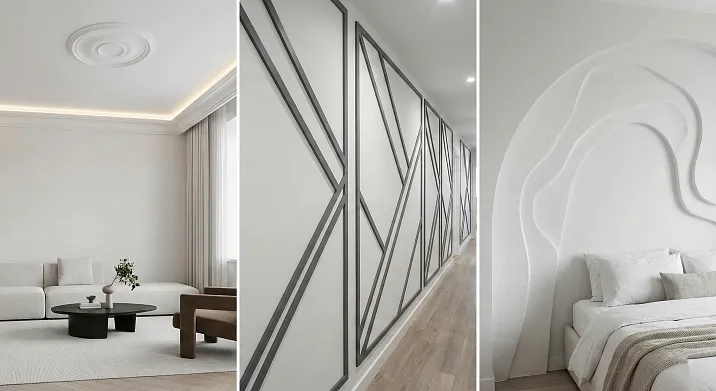
Molding is no longer the privilege of palaces and museums. In 2026, it confidently enters apartments, townhouses, country houses, offices, and public catering establishments.Polyurethane Molding Designhas evolved from exclusively classical forms to a variety of stylistic solutions—from Baroque opulence to Scandinavian minimalism, from monochrome strictness to color experiments. Modern interior designers use polyurethane molding not as a tribute to tradition, but as a tool for creating spatial dramaturgy, play of light and shadow, and architectural rhythm.
Why has polyurethane become the material of choice? Because it gives freedom. Freedom from weight limitations (does not require structural reinforcement), freedom from high cost (accessible to a wide audience), freedom from installation complexity (adheres without special equipment), freedom from fear of damage (does not crumble or crack from minor impacts), freedom to experiment with shape and color (can be painted, patinated, gilded). This freedom opens up limitless possibilities for implementing any design ideas.
In this article, we explore current trends of 2026, show how molding works in different styles—from classic to avant-garde, analyze techniques of leading designers, and draw inspiration from examples of completed projects. This is not just theory—it's a practical guide for those who create interiors professionally or furnish their own homes.

Current Trends 2026: Where Design is Heading
Interior design is a living organism, constantly evolving under the influence of cultural, technological, and social changes. What is relevant in 2026? What trends definemodern design with molding?




Ecological Awareness and Biophilic Design
Connection with nature is one of the main trends of recent years, intensified after pandemic restrictions. People strive to bring nature into their homes—plants, natural materials, organic forms. Molding supports this trend through organic motifs.
Plant-based ornaments on rosettes, overlays, moldings—acanthus leaves, grapevines, floral compositions—create a visual connection with nature. Painted in natural shades (terracotta, olive, sandy, clay), they enhance the biophilic effect. Smooth curves of cornices, imitating natural lines, counteract urban linearity.
Polyurethane as a material is eco-friendly—does not emit harmful substances, durable (does not require frequent replacement), and recyclable. This is important for consumers who choose products consciously.
Our factory also produces:


Personalization and uniqueness
The era of mass-produced, standard interiors is ending. Buyers want uniqueness that reflects their individuality. Molding is a tool for personalization. By combining different elements (cornices, rosettes, moldings, overlays), choosing non-standard colors, and creating original compositions, designers make each interior unique.
The trend toward customization manifests in color solutions. Instead of universal white—individually selected shades matching a specific interior palette. Instead of standard single-color painting—multi-layered decorative techniques (patina, gilding, ombre). Instead of symmetrical compositions—asymmetry, creating dynamics and character.
Get Consultation
Technological Integration
Modern interiors are saturated with technology—hidden lighting, smart home systems, audio systems. Molding integrates with technologies, either masking or accentuating them.
Cornices with hidden lighting create a floating ceiling effect—LED strips are hidden in a special cornice groove, lighting reflects off the ceiling, creating soft diffused glow. Moldings mask cable channels, smart home sensors, acoustic systems—technology is present but not conspicuous. Ceiling rosettes are used not only for chandeliers but also for integrating projectors, speakers, ventilation grilles—functionality plus aesthetics.
Sustainability and Durability
The trend toward sustainable consumption opposes the culture of disposability. Buyers prefer high-quality, durable items that will last for decades, not seasonal fashionable solutions.
Polyurethane molding fits perfectly into this trend. Service life of 30-50 years without loss of quality. Requires no special maintenance (periodic wet cleaning). Resistant to mechanical damage (does not crumble from impacts). Moisture-resistant (suitable for bathrooms, kitchens). Possibility of multiple repainting (the interior can be updated without dismantling the decor). This is an investment that pays off in the long term.
Mix of textures and materials
Modern interiors are rarely homogeneous in materials. Wood is combined with metal, concrete with textiles, glass with stone. Molding fits organically into this multi-textured approach.
Interior with polyurethane moldingoften includes contrasting materials: smooth molding on rough plaster (play of textures), white moldings on wooden panels (classic plus naturalness), matte molding on glossy painted walls (contrast of finishes), polyurethane cornices on concrete ceilings (industrialism plus decorativeness). These combinations create richness of visual perception, multi-layeredness, interest.
Minimalism and molding: a paradox that has become a trend
Minimalism preaches the rejection of excess, purity of lines, functionality. Molding is traditionally associated with decorativeness, ornamentation, excess. How are they compatible? It turns out they are very compatible — if you choose the right elements and use them in moderation.
Concise profiles instead of carved ones
Minimalist molding consists of simple geometric profiles without ornamentation. Cornices with one or two beads, without curls or carvings. Baseboards with a rectangular cross-section and a slight chamfer. Moldings with smooth curves, but without molded details. Such elements create architectural structure without overloading the space with decorativeness.
The width of the elements is moderate — cornices 50-80 mm, baseboards 60-100 mm, moldings 30-60 mm. Wide, lush profiles are alien to minimalism; they create visual noise that minimalism seeks to eliminate.
Monochromaticity: merging with the background
In minimalist interiors, molding is painted the same color as the walls or ceiling. White molding on white walls, gray on gray. It does not stand out by color, it is perceived only due to the relief and play of light. This creates subtlety, unobtrusiveness, calmness.
Contrast solutions (white molding on dark walls) are rarely used, only when a graphic accent is needed. But even in this case, the profile should be simple so as not to conflict with the minimalist philosophy.
Accent use: less is more
Minimalism does not tolerate excess. Instead of abundant decor (cornices, moldings, rosettes, overlays all at once), one or two elements are chosen. For example, only a ceiling cornice emphasizing the transition from wall to ceiling. Or only moldings creating horizontal wall division at the level of the sofa back. Or only a baseboard that finishes the bottom of the wall.
This measured approach creates an accent without overloading. Molding is present, enriches the space, but does not dominate.
Functionality: decor with meaning
Minimalism loves functionality. Every element should have practical use, not be purely decorative. Molding in minimalism often performs functions: a cornice with hidden lighting (decor plus illumination), moldings dividing the wall into zones of different colors or textures (decor plus zoning), baseboards hiding cable channels (decor plus technological concealment).
When decor is functional, minimalism accepts it. When decor is for decor's sake — it rejects it.
Accent use of decor: targeted solutions with maximum effect
The trend for accentuation — when decor is applied not everywhere, but locally, creating bright visual points — is gaining popularity in modern interiors. This is the opposite of the classical approach (where molding is present everywhere) and a compromise for those who love decorativeness but do not want overload.
Accent wall with moldings
One wall in the room is highlighted with moldings — rectangular or square frames are created, inside which the wall is painted in a contrasting color or covered with patterned wallpaper. The other walls are smooth, neutral. The accent wall becomes a focal point organizing the space.
This technique is typical for bedrooms (accent wall behind the bed headboard), living rooms (wall behind the sofa or TV), dining rooms (wall behind the dining table). Moldings create an architectural frame for the accent, enhancing its significance.
Ceiling rosette as a sculptural object
Instead of abundant ceiling decor (cornices around the perimeter, coffers, panels), one large ceiling rosette for the chandelier is used. It becomes a sculptural art object attracting the eye. The rosette can be classic carved or modern geometric — depending on the interior style.
Rosette diameter 60-120 cm, relief expressive, multi-layered. Painted in contrast (e.g., gold rosette on a white ceiling) or using patination technique (emphasizing the depth of the relief). The rest of the ceiling is smooth, without decor — all compositional energy is concentrated in the center.
Framing openings: portals and architraves
Instead of decorating all walls, the accent is placed on door and window openings. Decorative architraves or full portals (pilasters with capitals and architraves) turn openings into architectural events. The walls remain neutral, all the decorative budget goes to the frames.
This technique visually structures the space, creates rhythm (repeating door frames in the hallway), emphasizes functional boundaries (the transition from room to room becomes noticeable, conscious).
Decorative panels in zones
Moldings are used to create decorative panels in functional zones. In the dining area of the living room, moldings frame the wall section behind the dining table. In the home office — the wall behind the desk. In the bedroom — the wall behind the headboard. The remaining space is without moldings.
Panels can be painted in a color different from the walls, wallpapered, decorated with artistic painting, or finished with decorative plaster. Moldings serve as a frame, separating the decorative zone from the neutral background.
Monochromatic solutions: when one color creates maximum effect
Monochromatism — using one color in different shades and textures — creates sophistication, depth, and refinement. Moldings in monochromatic interiors work through relief, form, and light play, rather than through color contrast.
White on white: the classic monochrome
White moldings on white walls — an eternal classic, relevant in any era. Simplicity, freshness, purity. But monochromatism does not mean flatness. Different shades of white (milky, ivory, arctic, alabaster), different textures (smooth paint, matte, silky), different levels of gloss (matte molding on semi-matte walls) create depth.
Lighting plays a key role. Directed light (spotlights, sconces) emphasizes the relief of the molding, creates shadows in recesses, and highlights protrusions. At different times of the day, the white interior looks different — fresh and energetic in the morning, soft and cozy in the evening.
Gray gradations: modern elegance
Gray — the color of the 2020s, a symbol of restraint, urban sophistication. A monochromatic gray interior with moldings — the embodiment of modern elegance. Walls are light gray (RAL 7047, 7035), moldings are 2-3 tones darker (RAL 7043, 7037) or vice versa. The difference is barely noticeable but creates volume and structure.
Gray pairs well with different materials — concrete, metal, wood, textiles. Gray moldings on concrete walls create industrial sophistication. On wooden walls — Scandinavian warmth. On textile wallpapers — boudoir intimacy.
Colored monochromes: boldness and individuality
Monochromatism is not limited to white and gray. Bold designers create monochromatic interiors in blue, green, terracotta, burgundy. All elements — walls, ceiling, moldings, furniture, textiles — in different shades of one color.
Blue monochrome with moldings creates marine freshness or deep intimacy (depending on the shade — light aquamarine or dark indigo). Green — connection with nature, calmness (olive, pistachio, emerald). Terracotta — warm Mediterranean atmosphere. Burgundy — dramatic luxury.
Moldings in colored monochromes are painted either to match the walls (blending) or in a lighter shade of the same color (subtle contrast). The result — a deep, emotionally rich interior where moldings enhance the color impact.
Moldings in Scandinavian style: northern restraint
Scandinavian style — light tones, natural materials, functionality, coziness without excess. It would seem that moldings are an element alien to this philosophy. But Scandinavians prove otherwise, using moldings minimally, subtly, and functionally.
Thin white cornices: almost invisible
Scandinavian interiors often include thin ceiling cornices — 40-60 mm wide, simple profile (one bead or smooth with rounding), white. They are almost invisible, create a smooth transition from wall to ceiling, visually raise the ceiling (especially in standard apartments with heights of 2.5-2.7 m).
Cornices do not contrast, do not attract attention. They are delicately present, performing the function of completion, architectural correctness. Often, hidden lighting is integrated into such cornices — an LED strip is hidden in the cornice groove, creating soft reflected lighting that enhances the feeling of height and light (which is critical for northern countries with a lack of sun).
Moldings as functional zoning
Scandinavians use moldings not for decorativeness, but for functional zoning. A horizontal molding at a height of 90-100 cm from the floor divides the wall into two zones — the lower part is painted in a darker shade or finished with wooden panels (protection from damage, practicality), the upper part remains light.
The molding serves as a boundary between zones, creates architectural logic, without claiming decorativeness. The profile is simple, width 30-50 mm, color white or matching the lower panel.
Baseboards: tall and functional
Scandinavian baseboard — tall (100-150 mm), white, smooth or with a simple profile. It not only covers the joint between wall and floor but creates a visual foundation for the interior, emphasizes horizontality (which is important for perceiving the space as wide, stable).
A tall baseboard protects walls from damage during cleaning, from furniture, from children's play. This is practicality disguised as aesthetics. The white color of the baseboard contrasts with the wooden floor (oak, ash, pine), emphasizing clean lines, freshness, northern conciseness.
Absence of rosettes and excessive decor
Scandinavians almost never use ceiling rosettes, decorative overlays, or portals. These elements are too decorative for Scandinavian philosophy. Moldings are present minimally — only what is functionally justified (cornice, molding, baseboard). Everything else is unnecessary.
In Scandinavian interiors, the chandelier is mounted to the ceiling without a rosette or with a minimal rosette 20-30 cm in diameter, smooth and without ornamentation. Doors are framed with simple trims or none at all (concealed doors, where the panel and frame blend into the wall).
Eclecticism: when classic meets modern
Eclecticism — the mixing of styles — is one of the most interesting and complex trends in modern design. Classical moldings coexist with industrial elements, Baroque rosettes with minimalist furniture, traditional cornices with avant-garde light fixtures. How does it work? Why doesn't it turn into chaos?
The Rule of a Common Denominator
Eclecticism requires a unifying factor — a common denominator that connects disparate elements. This could be color (all elements — classical moldings, modern furniture, industrial light fixtures — are in the same color palette), scale (elements of different styles have comparable sizes and don't overpower each other), material (everything is made from natural materials or everything is artificial), or emotion (everything creates a single mood — luxury, coziness, or drama).
Without a common denominator, eclecticism falls apart into a random collection of things. With a common denominator, it becomes a harmonious symphony where every note is in its place.
Contrast as a Compositional Technique
Eclecticism is built on contrast — old and new, ornamental and smooth, heavy and light. Classical carved ceiling cornices contrast with the smooth white walls of a modern interior. A Baroque gilded rosette hangs over a minimalist Scandinavian table. Carved moldings frame an industrial brick wall.
These contrasts create tension, dynamism, and interest. The interior stops being predictable, becomes lively and multi-layered. The eye constantly finds new combinations, nuances, and dialogues between elements.
Transitional Elements: Bridges Between Styles
To prevent contrast from turning into conflict, transitional elements are used — items that belong to both styles or are neutral. Modern furniture with subtle classical details (curved legs but a simple shape). Moldings with a simple profile that can be read as both classic and modern (depending on the context). Textiles in neutral colors that don't belong to a specific style.
Transitional elements soften contrasts, create a smooth transition from one style to another. They are the diplomats reconciling opposites.
Color Discipline: A Unified Palette
An eclectic interior can mix different styles, but the color palette must be disciplined. Usually 2-3 main colors plus 1-2 accent colors. All elements — furniture, moldings, textiles, accessories — adhere to this palette.
For example, a white-gray-turquoise palette. White moldings, gray walls, turquoise accent furniture. The styles are different (classical moldings, Scandinavian furniture, vintage light fixtures), but the colors unite them. The result is an eclectic yet harmonious interior.
Practical Ideas: Specific Solutions for Different Rooms
Theory is good, but practice is better. Let's look at specific design solutions for different rooms where moldings play a key role.
Living room: the focal point
Living Room — a formal space where moldings are most appropriate. A ceiling cornice around the perimeter creates an architectural frame for the room. Wall moldings form panels — symmetrical rectangular frames behind the sofa, with a contrasting color or wallpaper inside. The ceiling rosette for the chandelier becomes the compositional center. A door portal (if the living room connects to a dining room or hall) emphasizes the solemnity of the transition.
The color scheme depends on the style. Classic — white or cream moldings, possibly partial gilding of the rosette and portal capitals. Modern — moldings in the wall color (gray, beige), a monochrome solution. Eclectic — white moldings, but the accent wall behind the sofa is dark (graphite, emerald), creating contrast.
Bedroom: Intimacy and Coziness
The bedroom requires a more restrained approach. An abundance of moldings creates overload and hinders relaxation. The optimal solution is an accent wall behind the headboard, framed by moldings. Inside the frame, the wall is painted a soft shade (lavender, dusty pink, gray-blue) or covered with textile wallpaper. The ceiling cornice is thin and unobtrusive. The rosette for the chandelier is small (40-60 cm in diameter) or absent altogether (if lighting is provided by sconces and floor lamps).
High baseboards (100-120 mm) create a sense of stability and security. The color of the moldings is neutral, not attention-grabbing. The bedroom is a place for rest; moldings here are the background, not the main character.
Kitchen: practicality above all
Kitchen — a zone of high humidity, grease vapors, and temperature fluctuations. Moldings here must be practical. Polyurethane is ideal — moisture-resistant, washable, doesn't absorb odors.
Moldings in the kitchen are usually minimal. A ceiling cornice (if the ceiling is not a stretch ceiling) and a baseboard (if the kitchen is not a built-in one where the baseboard is covered by furniture). Moldings are rarely used, only for zoning (if the kitchen is combined with a dining area — moldings separate the zones).
The color of moldings in the kitchen is white or matching the color of the cabinet fronts. Avoid complex relief profiles where grease and dust can accumulate. Choose smooth or minimally profiled moldings that are easy to wipe clean.
Bathroom: Moisture Resistance and Style
The bathroom is the most humid room. Polyurethane is not afraid of water, doesn't swell, doesn't get moldy — ideal for bathrooms. Moldings turn a utilitarian space into a stylish one.
A ceiling cornice creates a finished look (especially if the ceiling is painted a different color from the walls). Moldings frame the mirror (instead of a standard frame — polyurethane moldings glued to the wall around the mirror create a custom-sized frame of any size). The baseboard protects the wall-floor joint (especially important in the bathroom where this joint is exposed to water).
After installation, be sure to paint the moldings in the bathroom with moisture-resistant acrylic paint or enamel, then coat with a protective varnish. This creates an additional barrier against moisture and makes maintenance easier.
Entryway: first impression
Hallway — the first thing guests see. It sets the tone for the entire home. Moldings in the hallway create an impression of solidity, care, and style.
High baseboards (120-150 mm) protect walls from damage by shoes, umbrellas, and bags. Moldings at a height of 90-100 cm divide the wall into two zones — the lower practical one (washable paint, panels) and the upper decorative one (wallpaper, decorative plaster). Door casings or portals (if the hallway leads to the living room) create architectural accents.
The color of moldings in the hallway should be practical. White gets dirty quickly (especially baseboards). Choose gray, beige, or a color matching the walls. Or white, but with a washable enamel that is easy to wipe clean.
Frequently Asked Questions about Moldings Design
Is molding suitable for small apartments?
Yes, if used correctly. Avoid wide profiles and excessive decoration—they visually consume space. Choose thin cornices (40-60 mm), narrow moldings (30-50 mm), small rosettes (up to 50 cm in diameter). Paint the molding the same color as the walls—this creates a blend and visually expands the space. Use vertical elements (high baseboards, vertical moldings)—they visually raise the ceiling.
Can polyurethane molding be combined with stretch ceilings?
Yes, this is a popular combination. The ceiling cornice is mounted on the wall (not on the stretch ceiling), creating a transition. A 2-3 cm gap is left between the cornice and the stretch fabric, where an LED strip is hidden—resulting in a floating ceiling effect. Moldings and baseboards are mounted on the walls as standard. Rosettes are not installed on stretch ceilings (technically difficult), the chandelier is attached via a mounting platform without a decorative rosette or with a minimal one.
How to choose a molding style for a modern interior?
For modern interiors (minimalism, Scandinavian, loft, contemporary), choose laconic profiles without ornamentation. Rectangular, with smooth curves, with minimal relief. Avoid carved, baroque, with sculpted swirls—they conflict with modernity. Element width is moderate (cornices 50-80 mm, moldings 30-60 mm). Color—white, gray, matching the walls. Use it as an accent, not everywhere.
Is a design project with molding expensive?
Polyurethane molding is affordable. Simple cornices from 200 rubles/meter, moldings from 150 rubles/meter, rosettes from 500 rubles each. For a standard 18 sq. m room (ceiling cornice, baseboard, moldings on one wall, rosette), materials cost 3000-8000 rubles. Installation can be done yourself (polyurethane glues easily) or hire a professional (2000-5000 rubles per room). Total 5000-15000 rubles—affordable for most.
How to care for molding in interior spaces?
Wipe with a dry soft cloth once a month (dust removal). Every 3-6 months, wipe with a slightly damp cloth with mild detergent. For relief molding, use a soft brush that penetrates into the recesses. Do not use abrasives or aggressive chemicals. If the paint is damaged—touch up with a fine brush. Molding lasts for decades without special care.
Can molding be painted a color other than white?
Yes, polyurethane can be painted any color with acrylic paints. You can paint it the same color as the walls (monochrome solution), a contrasting color (accent), or use decorative techniques (patina, gilding, gradient). Choose high-quality paint (Dulux, Tikkurila, Caparol) with good coverage and durability. Apply 2-3 thin layers for dense coverage.
What mistakes are often made in molding design?
Main mistakes—excessiveness (too many elements, overload), style mismatch (baroque molding in a minimalist interior), incorrect scale (too wide cornices in low rooms), ignoring proportions (asymmetrical compositions where symmetry is needed), lack of color harmony (molding conflicts in color with walls and furniture). Avoid these mistakes, consult with designers, look at references of completed projects.
How long does it take to implement a design project with molding?
Design project development—1-2 weeks (if working with a designer). Ordering and delivery of materials—3-7 days (polyurethane molding is usually in stock). Installation—1-3 days for a standard apartment (depending on volume). Painting—1-2 days (applying layers, drying). Total 2-4 weeks from idea to result.
Conclusion: Molding as the Language of Modern Design
Interior design is the language spoken by space. Molding is one of the most expressive dialects of this language. It tells stories—about traditions and innovation, about luxury and restraint, about the owner's personality and the character of the home.Polyurethane Molding Designin 2026—it's not copying palace interiors of the past, but creating new meanings relevant today.
The company STAVROS understands this new language and offers tools to master it. Over 500 polyurethane molding SKUs—cornices from minimalist to luxurious, moldings for any style, rosettes from modest to grand, overlays in thousands of designs, portal elements, columns, pilasters. This is a dictionary from which a designer or homeowner composes their own sentences.
STAVROS quality is not a marketing slogan, but a physical reality. Polyurethane density of 280-350 kg/m³ ensures relief clarity, resistance to deformation, durability. Factory white primer is ready for any type of finishing—from simple painting to complex decorative techniques. Precise geometry guarantees perfect element joining—corners meet without steps, long runs are installed without visible seams.
STAVROS works not only as a materials manufacturer but also as a consultant, partner, inspirer. The website features dozens of articles on design, styles, molding application techniques. Training videos show step-by-step installation. Consultants help select elements for a specific project, calculate quantities, suggest color solutions. For professional designers and architects—special conditions, personal managers, support at all stages from concept to implementation.
Delivery across Russia is organized through verified partners. Packaging protects fragile elements from damage in transit. Terms 1-10 days depending on the region. Cost is calculated automatically when placing an order—transparently, without hidden fees.
STAVROS guarantees are a reputation earned by 23 years of impeccable work. Thousands of completed projects across Russia and abroad. Positive client reviews—from private homeowners to large construction companies. If a problem arises (which is extremely rare)—it is resolved promptly, without bureaucracy, with respect for the client.
Start creating your interior with STAVROS. Open the catalog, be inspired by the variety. Choose elements that resonate with your vision of home. Order, receive, install (yourself or with the help of professionals). Paint in the colors of your dreams. In a few days, your home will gain a new dimension—architectural expressiveness, stylistic definition, individuality that belongs only to you.
Interior design with molding is not a whim, not luxury, not a tribute to fashion. It is an investment in quality of life, in the beauty of everyday life, in a space that inspires, supports, delights every day. With STAVROS, this investment is accessible, reliable, beautiful. Welcome to a world where architecture meets art, where traditions are renewed by modernity, where your home becomes a design masterpiece.