












































































Article Contents:
- Unified language of wood: why trim, planks, profiles, and moldings must work together
- Vertical line: planks, profiles, decorative elements
- Horizontal line: baseboard, cornice, picture molding, skirting
- Transitional elements: moldings, skirting, corner profiles
- Furniture level: continuation of architecture in furniture
- Material and species: oak, beech, solid wood as the basic standard STAVROS
- Practical schemes: classic, neoclassic, modern minimalism
- Checklist for selecting a set of trim elements for one object
- Conclusion: STAVROS — a unified system of trim for interiors
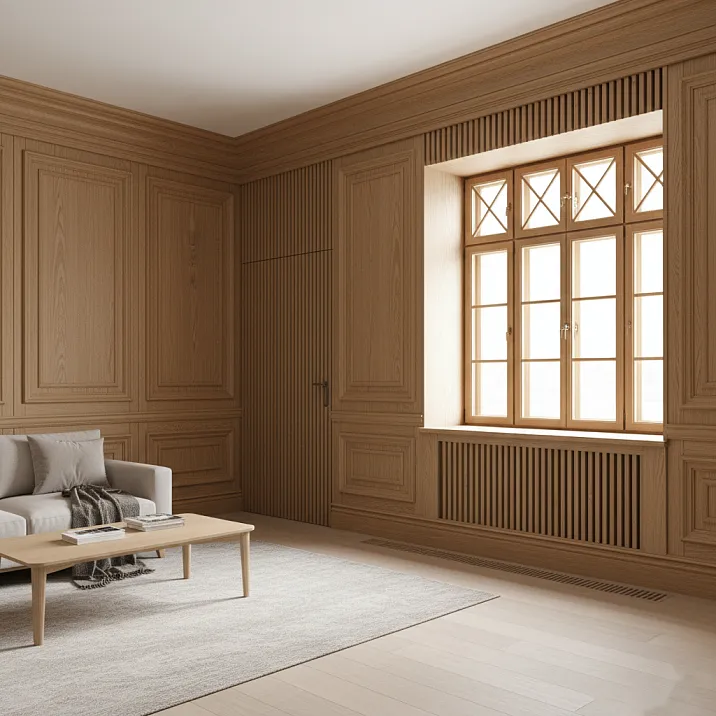
Interior is not a set of separate elements purchased from different places and assembled together. Interior is a system where each element is connected to others, where all parts speak the same language of forms, materials, proportions.Trimming Items, Wooden trim, wooden planks on the wall, Wooden molding, Wooden skirting boards, Furniture moldingThese are elements of one language that creates visual rhythm, structures space, connects vertical and horizontal, floor and ceiling, walls and furniture. A room where all these elements are coordinated by wood species, profiles, and color appears as a single architectural work. A room where elements are disjointed, incompatible, purchased from different manufacturers without coordination appears as a random collection, where each element stands alone, there is no connection, no system, no professionalism.Wood TrimIt works as an interior language — and this language must be unified from floor to ceiling, from walls to furniture, from doors to decorative elements.


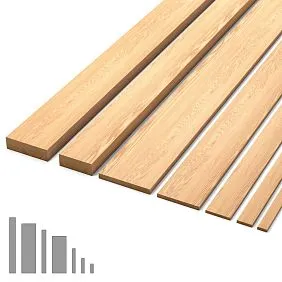


Unified language of wood: why trim, planks, profiles, and moldings must work together
Natural wood in interior — it is not just a material, it is a carrier of information about style, budget, attention to detail. Wood has texture (visible structure of fibers, pores, growth rings), color (from light to dark, from warm to cool), density (hard species like oak, beech, soft species like pine, spruce), smell (fresh wood smells like resin, oil, varnish). All these characteristics are perceived by the eye and create an impression. If several wood species are used in the interior under transparent coating (oak doors, pine baseboards, beech planks), the eye sees differences in texture and color — and perceives this as inconsistency, chaos, lack of thought. If one wood species is used (all oak or all beech) or different species under a single opaque paint (texture hidden, color uniform), the eye perceives unity — and reads this as a system, thoughtfulness, professionalism.
A unified profile series — is a set of profiles (cross-section shapes of trim elements) belonging to one family, coordinated with each other, forming a visual system. For example: baseboard with two rounded edges and bevel, window casing with similar profile (rounded edge + bevel), wall molding with the same motif (rounded edge), furniture cornice with an elaborated version of the same profile (two rounded edges + bevel + groove). All these profiles are related, belong to one family of forms — the eye perceives the repeating motif (rounded edge) and sees a system. If the baseboard has one profile, the window casing another, the wall molding a third, the furniture cornice a fourth — and all profiles are incompatible, from different families — the eye does not find repetitions, does not see a system, perceives chaos.Buy wooden profiled productsThey must be from one collection, where profiles are pre-coordinated by the designer and form a system.
Visual rhythm — is the repetition of elements that creates order, predictability, harmony. In music, rhythm — is the repetition of beats, accents. In interior design, rhythm — is the repetition of lines, forms, proportions.wooden planks on the wallInstalled vertically with gaps, they create rhythm: plank — gap — plank — gap, repeating the same module dozens of times. This rhythm structures the wall, making it not a flat surface, but a rhythmic texture.Wooden moldingOn the wall, forming rectangular frames, they create rhythm: frame — frame — frame, repeating identical or proportionally similar rectangles.Wooden baseboardEncircling the floor around the room perimeter, they create a horizontal rhythm repeated on all walls. All these rhythms must be coordinated: if vertical planks are 40 mm wide with 40 mm gaps (rhythm 1:1), horizontal moldings must also have proportional rhythm (not chaotic). Coordinated rhythms create harmony.
The architecture of the room — is the structure of space defined by verticals (walls, columns, vertical planks), horizontals (floor, ceiling, baseboards, cornices, horizontal moldings), diagonals (stairs, ceiling slopes, diagonal planks).Wooden trimThey strengthen this structure, making it readable, visually expressed. Without trim, walls are just flat surfaces, without structure, without articulation. With trim, walls become architectural elements: vertical planks create verticality (visually raising the ceiling), horizontal moldings divide the wall into sections (creating proportions), baseboards frame the lower part (creating a base), cornices frame the upper part (creating a crown).Wooden moldings, Wooden profilesThey are tools by which an architect or designer creates the structure of space.
Classic and modern styles use trim differently, but in both cases, trim must be a system. Classic style (baroque, empire, classicism) uses complex profiles (multi-step, with protrusions, recesses, curved transitions), rich decoration (carving, gilding, patina), abundance of elements (moldings on walls, cornices on furniture, picture moldings on ceilings). But all these elements are coordinated: profiles are related, one wood species (oak, walnut, mahogany), one color (natural wood under varnish or gold-tinged paint). Modern style (minimalism, Scandinavian, loft) uses simple profiles (rectangular, with one bevel or rounded edge), minimal decoration, sleek forms. But here too, a system exists: one profile repeats in all elements (baseboard, window casing, planks — all with the same cross-section), one wood species or one paint (all beech under white oil or all painted white). Different styles, but one principle: system, not chaos.




Vertical line: planks, profiles, decorative elements
wooden planks on the wallThey create a vertical structure that visually raises the ceiling, making the room appear taller and more slender. Vertical lines — are a classic architectural technique: columns of ancient Greek temples, Gothic spires of cathedrals, skyscrapers of modern cities — all built on verticality that draws the eye upward. In interior design, verticality is created by planks mounted from floor to ceiling with gaps, forming a rhythmic texture. The width of the plank, the width of the gap, and the height of the ceiling determine the number of planks and the density of the rhythm. Narrow planks (20–40 mm) with narrow gaps (20–40 mm) create a dense texture, many lines, visually fragmenting the wall. Wide planks (60–100 mm) with wide gaps (60–100 mm) create a sparse texture, few lines, each line stands out.
Wooden plank profiles influence perception: rectangular planks (width greater than thickness, e.g., 40×20 mm) create clear graphics, strict lines, suitable for modern styles. Square planks (width equal to thickness, e.g., 40×40 mm) create a more massive, brutal appearance, suitable for loft and industrial styles. Planks with bevel (slanted edge) soften the line, making the transition from plank to gap smooth, suitable for neoclassicism. Planks with rounded edges (rounded corner) create a soft, tactile profile, suitable for Scandinavian style, where coziness and tactility are important. The choice of plank profile must be coordinated with profiles of other trim elements: if the baseboard has rounded edges, the planks should also have rounded edges. If the baseboard has a bevel, the planks should have a bevel. Profile coordination — key to unity.
form the architecture of walls and ceilings, creating a play of light and shadow.They work not only on the vertical plane of the wall, but also as volumetric structures: partitions (frame with planks dividing the room into zones), screens (box with slatted facade hiding radiators and utilities), headboards (planks on the frame behind the bed, creating a relief background). In these structures, planks function as architectural elements that create not decoration, but structure. A partition made of planks visually divides space, but does not isolate: light, air, and view pass through gaps — zones are separated but connected. A screen made of planks hides an ugly radiator, but allows heat to pass through gaps — function is not compromised, aesthetics are improved. A headboard made of planks creates an accent zone in the bedroom, making the bed the compositional center.
Vertical moldings on walls are rails with a more complex profile, used to create framed panels. If rails are simple rectangular-section boards, moldings are profiled boards with relief (rounded edges, grooves, protrusions). Vertical moldings divide the wall into rectangles, within which an insert (wallpaper, fabric, another color paint) may be placed. The width of the molding is usually 30-60 mm, with a medium-complex profile (two to three tiers). Vertical moldings are used in classical and neoclassical interiors, where detail and richness of form are important. In modern interiors, instead of moldings, simple rails are used — more laconic, cheaper, but the principle is the same: vertical lines structure the wall.
Wood species for rails: pine (budget option, soft, with knots, suitable for opaque paint, price 150-250 rubles per linear meter for 40×20 mm rails), beech (mid-range, hard, uniform, suitable for paint or transparent finish, price 250-400 rubles), oak (premium, hard, with pronounced texture, suitable for transparent finish to showcase texture, price 400-600 rubles). All rails in one room must be of the same species (or painted with the same opaque color), otherwise the texture difference will be noticeable and unity will be broken.Buy decorative wooden railsIt should be the same species used for other interior elements (baseboards, doors, furniture).
Our factory also produces:


Horizontal line: baseboard, cornice, picture frame, stopper
Wooden skirting boardsThey create the lower horizontal line of the interior, framing the floor.Wooden baseboardPerforms three functions: technical (covers the gap between floor and wall, hides cables), protective (protects the lower part of the wall from impacts, scratches, moisture), decorative (creates a visual boundary between floor and wall, finishes the wall at the bottom). The height of the baseboard affects the perception of room proportions: low baseboard (40-60 mm) is neutral, does not affect proportions, medium baseboard (70-90 mm) — standard for most interiors, high baseboard (100-150 mm) visually raises the wall, makes ceilings appear higher, adds scale. The baseboard profile should match the profiles of other horizontal elements (cornices, moldings).
Ceiling baseboard (cornice) creates the upper horizontal line framing the ceiling. Cornice covers the joint between wall and ceiling, creates a transition from vertical to horizontal, visually separates the ceiling from the wall, makes the room appear higher and more airy. Cornice width (from wall to edge) is usually 40-120 mm, with a complex profile (multiple tiers, protrusions, grooves). Narrow cornice (40-60 mm) — a light line under the ceiling marking the boundary but not dominating. Wide cornice (80-120 mm) — an expressive element that creates a "roof" over the wall, visually separating the ceiling. Cornice should match the baseboard profile: if the baseboard has two rounded edges, the cornice should also have rounded edges. This creates a visual frame for the interior: lower (baseboard) and upper (cornice) lines are coordinated.
wooden molding by the meterPicture frame — a profiled trim with complex decorative relief, used to frame mirrors, pictures, to create decorative elements on walls and furniture. Picture frame is wider than trim (30-100 mm vs 10-30 mm), with a more complex profile (multi-tiered relief). Picture frame for frames is cut into four boards, ends are mitered at 45 degrees, boards are joined into a frame into which a mirror or picture is inserted. Picture frame for walls is glued in the form of frames, framing areas of wall with contrasting finishes. Picture frame is a horizontal element (used horizontally or as part of a frame where horizontal sections exist), which should match other horizontal elements (baseboards, cornices) in profile and wood species.
wooden trimStopper — a thin element (section 8×8 mm, 10×10 mm, 15×15 mm), used to fix glass in window, door, furniture frames. Stopper presses glass against the frame, mechanically holds it, covers the edge of the glass, creates a decorative transition from frame to glass. Stopper is the smallest trim element, but it should also match the wood species of the main frame (if the frame is oak, the stopper should be oak). Stopper is installed horizontally and vertically (framing glass around the perimeter), forming a neat frame with tight joints at corners. Stopper profile is usually simple (rectangular or rounded), but even here matching is important: if other elements have rounded edges, the stopper should also have rounded edges.
Horizontal moldings on walls divide the wall into upper and lower parts, creating proportions. Classic approach: horizontal molding at 80-100 cm from the floor (approximately one-third of wall height) divides the wall into a panel section (lower) and main section (upper). The lower section may be paneled, painted in another color, covered with different wallpaper — molding frames this transition, making it decorative. Width of horizontal molding is usually 50-80 mm, with medium-complex profile. Horizontal molding should match baseboard and cornice — all three horizontal lines (bottom, middle, top) should be from the same profile family. This creates a vertical structure of the wall: base (baseboard), body (from baseboard to molding and from molding to cornice), crown (cornice).
Get Consultation
Transition elements: trim, stopper, corner profiles
Wooden moldingTrim — thin boards (width 10-30 mm, thickness 5-15 mm), used to cover joints, frame panels, create decorative lines. Trim is a transition element between planes: the joint between two wall panels is covered by trim, which turns the joint into a decorative line. Door panels are framed by trim, creating a transition from door frame to panel. Furniture facades are decorated with trim, imitating framed-panel construction. Trim works as a line, as a graphic element that structures the plane, divides it into parts, creates a pattern. Trim should match other elements in wood species (same species or painted the same color), thickness (close to thickness of other boards — baseboards, trim).
Flat trim (rectangular board without profile) is used in modern interiors where minimalism is important. Decorative trim (with profile: bevel, rounded edge, groove) is used in classical interiors where detail is important. Corner trim (L-shaped profile) covers internal and external angles, protects them from damage, masks irregularities. Curved trim (with complex curved profile) is used to frame panels in classical doors and furniture, resembling miniature molding. All types of trim are elements of one language that must be coordinated: if flat trim is used in the interior, all other elements should also have simple profiles. If curved trim is used, all other elements should have complex profiles.
wooden trimStopper — the smallest transition element, creating a transition from frame to glass. Stopper mechanically holds glass (presses it against the frame), seals (presses gasket), decorates (covers glass edge). Stopper is used in windows, glass doors, furniture with glass doors. Stopper profile is simple (rectangular, rounded, beveled), but it must match the frame's wood species. Stopper is a detail that is almost unnoticed, but its absence or poor quality is immediately visible: glass without stopper is held insecurely and looks unfinished. Stopper is about quality of execution, attention to details.
Corner profiles (external and internal angles) cover panel joints, create a clear edge, protect the angle from damage. External angle (projecting) is especially vulnerable: it is easy to hit, scratch, chip. L-shaped corner profile covers the edge, absorbs impacts. Internal angle (recessed) is also covered by a corner profile, which masks the gap between two panels meeting at an angle. Corner profiles should be the same wood species as main panels, same finish (paint, varnish). Corner profile is a transition element that connects two planes, turning the angle from a problematic zone into a decorative element.
Connecting profiles (L-shaped, U-shaped) are used to join panels butt or overlapping. L-shaped profile is inserted between two panels, forming a groove on both sides into which panel edges fit. U-shaped profile is slipped over the panel edge, covering the end. These profiles are used in wall panels, furniture, wooden structures. Connecting profiles are technical elements that can also be decorative: if the profile contrasts in color with panels (dark profile on light panels), it creates graphic contrast, highlights joints, making them part of the design. If the profile matches the panels, it is invisible, joints are hidden. Choice depends on style: in modern interiors, prefer invisible joints, in classical — highlighted joints.
Furniture level: continuation of architecture in furniture
Furniture moldingThese are decorative and functional elements that complete furniture, linking it to the architecture of the room.Furniture corniceTop trim — a board installed on the top of a cabinet, kitchen set, buffet, visually completing the vertical, creating a "roof." Furniture base — a board installed at the bottom of furniture, visually "grounding" the furniture, creating a transition from floor to body. Trim on furniture facades — boards glued onto flat facades, imitating framed-panel construction. All these elements should match the architectural trim of the room: if the ceiling baseboard is oak with a three-tiered profile, the furniture cornice should also be oak with a similar profile. If the floor baseboard is 100 mm high with two rounded edges, the furniture base should be similar in height and profile.
Furniture as continuation of walls — a concept where furniture is not perceived as a separate object, but as part of the room's architecture. Built-in cabinets occupying the entire wall from floor to ceiling, from corner to corner — are no longer furniture, but architectural elements forming the wall. Facades of such cabinets should be treated similarly to walls: if walls have framed panels with trim, cabinet facades should also have trim. If walls have vertical rails, cabinet facades should also have vertical rails. If walls are painted light gray, cabinet facades should also be light gray. Furniture blends into walls, becomes invisible — only architecture remains, where every plane is uniformly finished.
Kitchen sets — a special case where furniture trim is critically important. Upper kitchen cabinets hang on the wall, with a gap between the top of cabinets and ceiling. This gap looks unfinished — cabinets are cut off, hanging in the air. Cornice installed on top of cabinets visually closes the gap, making cabinets appear higher and more monumental. Kitchen set cornice should match the room's ceiling baseboard: similar profile, same wood species or color. Furniture base (board covering legs or void under lower cabinets) should match the room's floor baseboard. This creates visual connection between kitchen and room architecture — kitchen is not an alien body, but part of a single space.
Furniture trim on facades transforms flat MDF or particleboard panels into framed-panel construction, which looks more expensive, complex, and interesting. Trim is glued around the facade perimeter, forming a frame, within which a flat surface (panel) remains. Trim width is usually 30-50 mm, profile may be flat (modern style) or decorative (classic style). Furniture trim is painted to match facade color (only relief stands out) or contrastively (white trim on gray facade). Furniture trim should be the same wood species or color as trim on doors and walls — this creates unity between furniture and architecture.
Wood species for furniture trim: pine (budget option for paint), beech (price-quality balance, universal), oak (premium, for expensive furniture). Furniture trim must match wood species of doors and architectural trim (baseboards, casings) — or be painted in a single color, hiding texture differences. If doors are oak, furniture cornice should be oak. If doors are painted beech, furniture cornice should be painted beech in the same color. Mixing species under transparent finish is not allowed — texture difference is noticeable, unity is broken.
Material and species: oak, beech, solid wood as basic standard STAVROS
Solid wood — solid timber, profiled and milled without glue, veneer, or film. Solid wood has natural texture (visible wood grain, pores, growth rings), smell (fresh wood smells resin, oil, varnish), tactile quality (wood is warm to the touch, pleasant). Solid wood breathes (regulates room humidity, absorbing excess and releasing when dry), ages gracefully (if properly treated, does not rot, does not lose appearance, develops patina). Solid wood is strong (does not crumble, does not peel, holds fasteners), repairable (scratched solid wood trim can be sanded and repainted). Solid wood is 2-3 times more expensive than MDF, particleboard, plastic, but for quality interiors, solid wood is the only correct choice.Buy wooden profiled productsSolid wood — an investment in durability, naturalness, aesthetics.
Oak — premium species, hard (hardness 3.7-4.0 on Brinell scale), with pronounced large-pored texture, contrasting growth rings. Oak does not fear moisture (with proper treatment), does not deform, lasts for decades. Oak color varies from light yellow to dark brown (depends on batch, treatment: oil darkens, varnish almost does not change, stain tones). Oak is used in expensive interiors where natural texture display is important: oak doors, oak parquet, oak baseboards, oak casings, oak moldings — all under transparent finish (varnish, oil), which highlights texture. Oak is 1.5-2 times more expensive than beech, 3-4 times more expensive than pine, but the premium is justified by aesthetics and durability.
Beech — price-quality balance, hard (hardness 3.8), almost matches oak in strength, but 30-50% cheaper. Beech texture is fine-pored, uniform, calm, without clearly visible growth rings. Wood is light, rose-beige, neutral. Beech is easy to work with, gives smooth surface, accepts paint well (uniform texture does not show contrasting spots). Beech is used in modern and neoclassical interiors, where light wood without aggressive texture is preferred. Beech does not like high humidity (may swell, crack), so it is not suitable for bathrooms, saunas, but ideal for living rooms, bedrooms, offices. Beech is the optimal choice for most projects where price-quality balance is important.
Pine — budget species, soft (hardness 2.5), easy to work with, but has knots, resin pockets, non-uniform texture. Pine is suitable only for opaque paint (paint hides knots and defects). Under transparent finish, pine looks cheap: knots, contrasting spots, resin pockets spoil the appearance. Pine price is 2-3 times lower than beech, 3-4 times lower than oak. Pine is used in budget projects where everything is painted white or gray (texture is not visible, species is not critical). For projects with transparent finish, pine is not suitable — beech or oak is needed.
Company STAVROS uses oak, beech, ash, and pine — standard species for trim work. The wood undergoes kiln drying to 8-12% moisture (guaranteeing that trim will not shrink after installation and will not develop gaps). Processing on modern equipment (four-sided planers, CNC routers, sanding lines) ensures precise geometry (tolerance ±0.3 mm), smooth surface (no scratches, no fuzz), stable profile (all strips are identical). Quality control at every stage eliminates defects. Packaging in stretch film protects against damage during transport. Delivery to St. Petersburg, Moscow, and all of Russia.
Practical schemes: classic, neoclassic, modern minimalism
Scheme for a classic interior (living room in the classical style): walls are divided into panels using moldings. A horizontal molding at 100 cm height (oak, complex profile — three tiers, width 70 mm) divides the wall into upper and lower sections. Vertical moldings (same profile) divide each section into rectangles 80–100 cm wide. Within each rectangle, a thin molding (simple profile, width 30 mm) frames the insert (patterned wallpaper). The floor molding is oak (height 120 mm, profile similar to the horizontal molding — three tiers). The ceiling cornice is oak (width 100 mm, profile is an enhanced version of the baseboard — four tiers). Doors are oak with paneling, door casings are oak (profile similar to the horizontal molding). Furniture (buffet, cabinet) is oak, and the furniture cornice is oak (profile similar to the ceiling cornice). Everything is coated with transparent lacquer, oak texture is visible, creating richness and status. Result: the living room appears like a palace hall, where every detail is thought out, everything is coordinated, everything is oak.
Scheme for a neoclassical interior (bedroom): walls are painted light gray, behind the headboard — an accent wall covered with vertical boards. Boards are beech (section 40×20 mm, vertical, gap 40 mm, painted white). Baseboard is beech (height 80 mm, simple profile — flat plank with bevel, painted white). Ceiling cornice is beech (width 60 mm, simple profile — one rounded edge, painted white). Doors are beech (frame-and-panel, painted white), door casings are beech (profile similar to baseboard — plank with bevel, painted white). Built-in cabinet (MDF facades painted white), furniture cornice is beech (profile similar to ceiling cornice, painted white). Everything is white, wood texture is hidden under paint, emphasis on form, graphics, clean lines. Result: the bedroom is light, clean, calm, where white wooden elements create unity, and light gray walls provide a neutral background.
Scheme for modern minimalism (kitchen-living room): kitchen unit with MDF facades painted with matte gray paint. Upper cabinets without cornice (minimalism prefers absence of decoration). Lower cabinets without visible base (integrated base). Wall behind dining table covered with horizontal boards (beech boards section 40×20 mm, horizontal, gap 30 mm, painted black). Baseboard is beech (height 60 mm, simple profile — rectangle with bevel, painted black). No ceiling cornice (ceiling meets wall flush, minimalism). Doors are concealed installation (no casings, door blends into wall). Everything is concise, without excess; black boards and black baseboard create graphic accents on light gray walls and gray kitchen facades. Result: kitchen-living room is strict, graphic, modern, where wood is used minimally but precisely, creating accents.
General principle of all schemes: unity of species (or unity of paint color), consistency of profiles (related forms), repetition of motifs (rounded edges, bevels, grooves repeated across different elements). Differences between styles — in profile complexity (classic — complex, minimalism — simple), in number of elements (classic — many, minimalism — few), in finish (classic — transparent coating showing texture, minimalism — opaque paint emphasizing form). But the system remains: all elements are coordinated, work together, create a unified interior language.
Checklist for selecting a trim set for one object
First point — defining interior style: classic (complex profiles, abundant decoration, natural wood under transparent coating), neoclassic (medium profiles, moderate decoration, wood under paint or transparent coating), modern minimalism (simple profiles, minimal decoration, wood under paint or no wood at all). Style determines profile complexity: classic requires multi-tiered profiles, minimalism — rectangular with bevel. Style determines number of elements: classic uses moldings on walls, cornices on furniture, moldings on ceilings; minimalism uses only baseboards and possibly boards.
Second point — selecting wood species: oak (premium, for classic, where expressive texture matters), beech (balance of price and quality, for neoclassic and modern), pine (budget, only under paint). Species must be one for all elements (baseboards, door casings, moldings, boards, panels, furniture trim) — or all elements painted with one opaque paint, hiding texture differences. Mixing species under transparent coating is not allowed — differences are noticeable, unity is broken.
Third point — selecting profiles from one collection: manufacturers of trim offer collections of profiles where baseboards, door casings, moldings, cornices are coordinated in shape and belong to one family. Choose everything from one collection — guarantee of visual unity. Do not take baseboards from one manufacturer, door casings from another, moldings from a third — profiles will be incompatible, the interior will look random. One manufacturer, one collection, all elements ordered simultaneously — this guarantees a system.
Fourth point — calculating the meterage of all elements: baseboards (perimeter of all rooms + 10–15% for cuts), door casings (number of doors × 5 strips of 2.2 meters each), wall moldings (length of all lines where moldings will be installed + 10–15% for cuts and mitered corners), boards (area of wall to be covered divided by module width "board + gap", multiplied by wall height + 10–15% for cuts), furniture cornices (perimeter of top of furniture + 10% for mitered corners). Add all together to get total meterage for each type of trim. Order in one batch — guarantee that wood tone will match (different batches may vary in tone).
Fifth point — coordinating color and finish: if transparent finish (lacquer, oil) is chosen, order samples, check how the texture looks, whether tone matches across different elements. If tone does not match, use tinted oil (equalizes color) or choose opaque paint. If paint is chosen, order everything under paint (without finish), paint with one paint on the object — guarantee of uniform color. Color must match walls, floor, furniture: either in tone (wood blends with background) or contrasting (wood stands out against background).
Sixth point — quality check upon receipt: geometry (straightness, absence of bends, precise dimensions with tolerance ±0.3 mm), moisture (8–12%, measure with moisture meter), surface (smooth, no scratches, no chips), grade (matches order: Grade A, B, or Extra). Check each strip, compose an act upon discovering defects, request replacement. Do not accept non-conforming items — problems will surface during installation.
Seventh point — planning installation: determine sequence (first walls and ceiling, then baseboards and cornices, then doors and door casings, then furniture and furniture trim), hire qualified installers (or do it yourself if you have tools and experience), prepare tools (circular saw, drill, glue, nails, level, protractor), purchase consumables (self-tapping screws, wall plugs, liquid nails, wood putty, paint or lacquer). Installing trim is the final stage of renovation, requiring care, precision, and time. Rushing leads to loose joints, crooked lines, damaged material.
Conclusion: Company STAVROS — unified trim system for interior
Trimming Items, Wooden trim, Wood Trim— this is not scattered purchases spread over time and locations. This is a unified system of elements that creates an interior language, structures space, connects vertical and horizontal, walls and furniture, floor and ceiling.Wooden moldings, Wooden profiles, wooden planks on the wall, form the architecture of walls and ceilings, creating a play of light and shadow., Wooden molding, wooden trim, wooden molding by the meter, Wooden skirting boards, Wooden baseboard, Furniture molding, Furniture cornice— all these elements must be coordinated by species, profiles, color, ordered from one manufacturer in one batch. Only then is unity guaranteed, which makes the interior professional, expensive, and thoughtfully designed.
Company STAVROS produces a complete trim system: more than 200 profiles of different purposes, grouped into collections where shapes are coordinated and belong to one family.Buy wooden profiled products— everything needed for the project:Baseboards— floor and ceiling,Casings— all widths and profiles,Moldings— for walls,rails— different cross-sections,layouts— flat and decorative,trim— for glazing,molding— for frames,Furniture made of oak complements the interior picture, especially if the furniture is also made of solid oak. Unity of material and finish creates a sense of completeness and stylistic coherence., Door molding.
Species: pine (budget option under paint, price from 150 rubles per linear meter), beech (balance of price and quality, universal, price from 250 rubles), oak (premium, expressive texture, durability, price from 400 rubles), ash (alternative to oak, similar texture, price from 350 rubles). Finish: planed (smooth surface, ready for painting), machine-sanded (perfectly smooth, ready for lacquering), hand-sanded (premium finish for exclusive projects). Moisture 8–12% (kiln-dried, will not shrink after installation). Geometry with tolerance ±0.3 mm (precision, guarantee of compatibility).
Manufacturing on modern equipment (Weinig four-sided planers, CNC routers, sanding lines) guarantees quality. Control at every stage eliminates defects. Packaging in stretch film protects during transport. Delivery to St. Petersburg, Moscow, and all of Russia: by cargo vehicles, on pallets, with guarantee of preservation. Warehouses in St. Petersburg and Moscow (standard profiles in stock, dispatch on the day of order). Custom manufacturing (individual profiles, non-standard length, special finish, minimum order of 50 linear meters).
Consultations for selecting trim: STAVROS specialists will help prepare a specification for the entire project, select profiles from one collection, calculate meterage, coordinate species and colors, propose solutions for non-standard tasks. Showrooms in St. Petersburg (Kushelovskaya Street) and Moscow (address on website): samples of all profiles and species, can touch, compare, see real quality. For designers and architects: loyalty program, wholesale prices from 100 linear meters, 3D visualization of elements in the project, technical support at all stages, priority production deadlines.
Contacts: phone 8 (800) 555-46-75 (free within Russia), email on the website, websitestavros.ruShowroom and warehouse addresses on the website. Call, write, visit — STAVROS creates trim systems that transform individual elements into a unified interior language, where every detail complements the other, where everything is coordinated, where quality is evident in the details.Natural wood in interior design, Single profile series, Visual rhythm, Room architectureAll of this is created by STAVROS trim, where solid wood, precise geometry, and thoughtfully designed profiles work together to create interiors that serve for decades and never lose their relevance.


