Article Contents:
- Loft and minimalism: why is a skirting board even needed here
- The philosophy of 'removing everything unnecessary' — and what remains
- Three roles of skirting boards in loft and minimalism
- Why classic skirting boards don't work in loft style
- Narrow wooden skirting board 30–45 mm: modern dimensions
- Why exactly 30–45 mm is the optimal size for a minimalist interior
- Flat skirting board profile: what 'without relief' means
- Permissible deviations from 'absolute flatness'
- Flat and thin skirting board: straight profile without extra elements
- Rectangular profile — the most honest
- Thin skirting board: thickness 10–12 mm — Scandinavian approach
- Tall smooth skirting board in minimalism: when 'a lot' is also minimalism
- Gray and black wooden skirting board: color solutions for loft
- Gray skirting board: wood that remembers metal
- Black skirting board: the boldest solution
- White skirting board in loft: contrast through absence
- Wood in loft: untreated surface, brushed, oil
- Why wood texture in loft is more important than color
- Brushing technique: brushed skirting board for loft
- Oil as the only correct finish for loft
- Untreated surface: the most radical option
- Hidden skirting board vs exposed: arguments from both sides
- Hidden skirting board (shadow gap): architectural solution
- Exposed wooden skirting board: uncompromising honesty
- When hidden, when exposed?
- Application in Different Rooms
- Living room in loft style: black skirting board and concrete
- Kitchen in loft style: gray skirting board and brick backsplash
- Bedroom in minimalism: white thin skirting board
- Loft Apartment Corridor: Practicality Plus Style
- FAQ: Popular Questions About Baseboards in Loft and Minimalism
- About the Company STAVROS

The loft style forgives no lies. It exposes everything — rebar in concrete, brickwork joints, the raw metal of pipelines. This is precisely why in loft and minimalism, a question that resolves itself in classic interiors becomes so acute: is a baseboard even needed? And if it is — what kind?
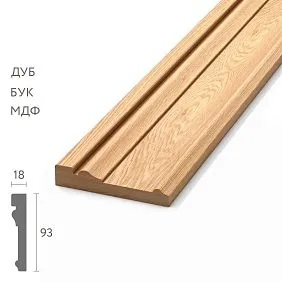
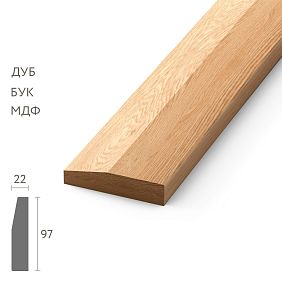
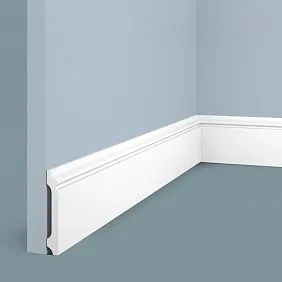
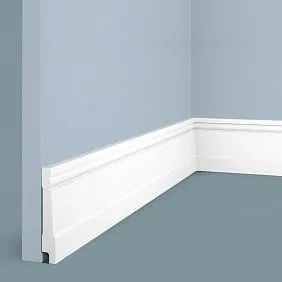
The answer is short: yes. But a different one.Flat wooden skirting boardWithout a figured profile, without curls and heels, 30–45 mm in height — or, conversely, wide and dark as a graphic accent — these are the languages a baseboard speaks in a modern interior.
Narrow wooden baseboardIn a loft — it's not a compromise between necessity and aesthetics. It's a conscious decision: a thin line that separates the floor and wall exactly as much as needed, and not a millimeter more. This is the essence of minimalism.





Loft and Minimalism: Why a Baseboard is Even Needed Here




The Philosophy of 'Removing Everything Superfluous' — and What Remains
Minimalism as an interior philosophy formed in the 1960s–70s from Japanese wabi-sabi aesthetics, Bauhaus industrial design, and Scandinavian cold functionalism. Loft as a style is a slightly different path: former industrial spaces in New York, Chicago, London, converted into housing and workshops, brought the aesthetic of exposed structure. Two different sources — but a shared value: material honesty.
Material honesty means — not hiding, not decorating, not covering with decor what can be left as is. Brick is brick. Concrete is concrete. Metal is metal. Wood is wood.
And here is where it gets most interesting. In the 'honest' interior of a loft or minimalism, a baseboard cannot be a decorative element in the classical sense. It cannot imitate palace profiles, it cannot carry architectural 'luxury'. But it cannot disappear entirely either: technically, the gap between floor and wall remains, dust collects in it, shifts from settling occur.
Thus, the concept of an 'honest baseboard' is born — thin, flat, made of real wood, without decorations. It is present — but does not attract attention. It solves a problem — but does not announce itself.
Our factory also produces:
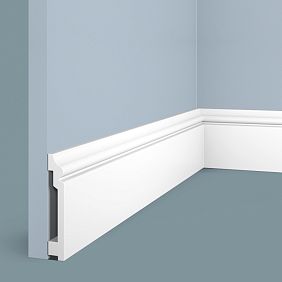
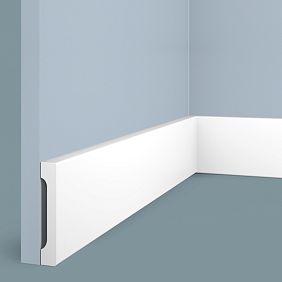
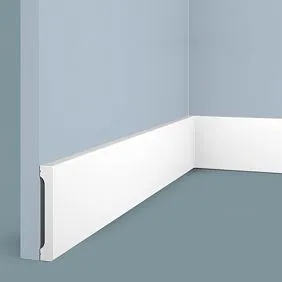
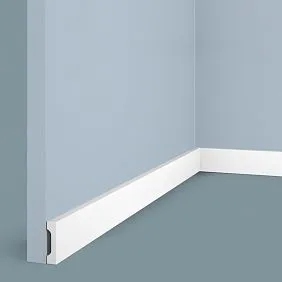
Three Roles of a Baseboard in Loft and Minimalism
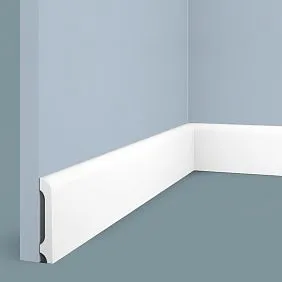
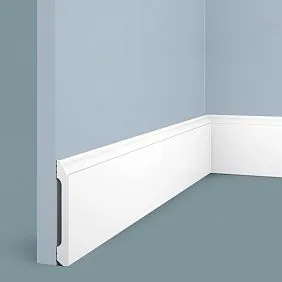
First role — technical. To close the gap. Hide cables and wires along the wall (in K-series baseboards with cable channels). Protect the lower zone of the wall from mops and vacuum cleaners. This role hasn't changed — only how 'visible' it is in the interior has changed.
Second role — graphic. In minimalism, every line carries meaning.Thin wooden baseboardIt creates one horizontal line at the base of the walls — clear, consistent, rhythmically repeating in every room. This is a line that 'structures' space inconspicuously, like a basic rhythm in music — not heard separately, but without it, everything falls apart.
Third role — material. In a loft with concrete, metal, and glass, wood performs the function of 'warmth'. It is the only organic material in a space of industrial textures.Gray wooden baseboardtreated with wax or oil — is wood that has 'aged', almost become metal, but remained alive. This very balance is the essence of loft.
Get Consultation
Why a Classic Baseboard Doesn't Work in a Loft
Wooden High Skirting BoardWith a figured profile like K-066 or K-018 — it's magnificent in a classic hall. In a loft, it looks like a joke. Not because it's poorly made — but because it speaks the wrong language. As if you brought a rococo armchair with gilding into an industrial space with exposed pipes under the ceiling.
Loft is honesty. A figured profile is theater. Conflict is inevitable.
In minimalism, it's a different story: there is a place for a tall baseboard — but only a flat, smooth one, without relief. A widemodern wooden skirting board100–120 mm, perfectly smooth, in matte black paint — this is no longer classic, it's graphics. A contrasting horizontal stripe that holds the lower zone of the space.
Narrow Wooden Baseboard 30–45 mm: Modern Sizes
Why Exactly 30–45 mm is the Optimal Size for a Minimalist Interior
The question of size is a question of proportion. In a classic interior, baseboard = 5–7% of wall height. With a 3.0 m ceiling — 150–210 mm. In minimalism, this logic doesn't work: there, the baseboard doesn't participate in the order system. Its task is to mark a boundary, nothing more.
30–45 mm — is the threshold at which a baseboard 'exists, but isn't noticed'. With a ceiling of 2.7–3.0 m, a 35–40 mm baseboard is 1.2–1.5% of the wall height. Almost nothing. A light shadow at the base.
This is exactly what minimalism needs: presence without dominance.
At a height of 30 mm — the baseboard is on the verge of disappearance. Suitable for interiors where the 'no baseboard' concept is almost realized, but technically the gap needs to be closed. K-034 (from 230 rub./lm, 30 mm) — the narrowest in the STAVROS K-series.
At a height of 40–45 mm, the skirting board is noticeable yet discreet. It reads as a line, not a decorative element. K-125 (from 270 rub./lm), K-105 (from 300 rub./lm) — rectangular profiles with minimal relief, ideal for minimalism and loft.
At a height of 60 mm, the skirting board already 'presences' in the interior. For strict minimalism — the upper limit. For 'soft' loft with wooden details — acceptable. K-006 (from 440 rub./lm) — with a slight rounding of the top edge, a neutral profile.
Flat skirting board profile: what 'without relief' means
Flat wooden skirting board— it is a rectangular or nearly rectangular cross-section without pronounced decorative relief. What does this give visually?
Firstly, the absence of shadow in the relief. A shaped profile creates a play of light and shadow — this is its virtue in classic styles and its defect in minimalism. A flat profile is a clean surface without 'noise'.
Secondly, color readability. On a flat surface, the color is uniform. This is fundamental for loft, wherea black wooden skirting boardor a grey one must be precisely black or grey — without halftones in the recesses.
Thirdly, ease of painting. A flat profile is painted in one even coat. No filling of recesses, no missed ridges.
Permissible deviations from 'absolute flatness'
Even in a minimalist skirting board, slight relief is acceptable — if it is functional, not decorative:
-
Rounding of the top edge R2–R5: a smooth transition instead of a sharp angle. Dust doesn't accumulate, harder to bump into. Example: K-105.
-
A small 45° chamfer on the top edge: 1–2 mm. A geometrically precise element, an 'industrial' accent. Very fitting in loft.
-
A groove for cable ducting on the back side: technical, not visible from the outside.
What is unacceptable in a skirting board for loft and minimalism: scotias, toruses, ovolos, coves, complex shaped profiles, ornaments, carvings.
Flat and thin skirting board: straight profile without extra elements
Rectangular profile — the most honest
A rectangle is the geometrically simplest form. Four right angles, four flat faces. Nothing extra. In industrial design, the rectangle is a basic module. In loft — a natural choice.
A skirting board with a rectangular profile, 40 mm high and 15 mm thick, made of solid oak with grey oil — this is a detail you'll only notice if you want to. It's simply there. It does its job.
K-034 and K-125 — these are examples from the K-series STAVROS with a profile close to rectangular. Without pronounced decorative elements. Minimal rounding of the top edge — that's all. This is exactly the kind of skirting board architects working in minimalism install.
Thin skirting board: thickness 10–12 mm — Scandinavian approach
In Scandinavian minimalism, a 'thin skirting board' is popular — not only narrow in height (30–50 mm) but also thin in projection from the wall (10–12 mm instead of the standard 15–18 mm). This creates a 'glued-on' effect — it barely protrudes, almost flush with the wall.
Visually: such a skirting board creates a very thin shadow at the base of the wall — visible with side lighting, almost invisible with direct light. It is the most 'unnoticeable' among visible skirting boards.
Installation: a thin skirting board requires a perfectly flat wall — any gap is visible.
Tall smooth skirting board in minimalism: when 'a lot' is also minimalism
The paradox of minimalism: sometimes one large, clean element is more 'minimalistic' than several small ones. A wide, flat skirting board 100–120 mm, perfectly smooth, in white matte paint on white walls — this is a monolithic white plane with a slight relief of shadow at the top.
Wide wooden skirting boardfrom the K-series — K-070 (from 950 rub./lm, ~110 mm), K-009 (~130 mm) — with smooth painting, works precisely as a 'large clean detail'. This is not classic — it's a modern interpretation of a wide skirting board. The boundary is not in height, but in the absence of relief.
Grey and black wooden skirting board: color solutions for loft
Grey skirting board: wood that remembers metal
Grey wooden skirting board— is one of the most sought-after elements in contemporary interior design. Gray is the color of loft style: concrete, metal, smoked glass. When wood is painted gray, it fits into this palette without losing its organic nature.
How does a gray wooden baseboard differ from a gray plastic one? In texture. Under gray oil or glaze on oak, dark annual rings show through—the pattern lives beneath the gray tone. This is 'living gray,' not the 'dead gray' of painted polymer.
Gray shades for baseboards in a loft:
| Shade | Description | Suitable finish | Combination |
|---|---|---|---|
| Light gray (smoky) | Gray with warmth | Osmo gray oil | White concrete, light flooring |
| Mouse gray | Neutral medium gray | Gray glaze | Graphite walls, natural oak |
| Dark gray (anthracite) | Almost black | Dark enamel, matte | Light walls, black metal |
| Gray with a bluish tint | Cold industrial | Bluish-gray glaze | Concrete walls, steel hardware |
| Silver-gray | With a metallic sheen | Wax coating + gray pigment | Metallic decorative elements |
Under oil, oak with gray tinting—these are K-034, K-125, K-105 in 'gray' finish. Under matte enamel—the same profile, but without texture. For loft style, oil is preferable: it preserves the 'honesty' of the wood.
Black baseboard: the boldest choice
a black wooden skirting board— is the maximum graphic accent. A black strip along the base of the walls creates the strongest possible 'lower belt'—a clear horizontal line that holds the space like a frame holds a canvas.
When a black baseboard is the right choice:
-
White or light gray walls + black skirting board: a classic loft contrast. The white wall plane is 'cut off' by a black line at the floor. The floor — any.
-
Dark walls + black skirting board: a monochrome concept. The skirting board merges with the wall, but under side lighting casts a shadow — creating volume without color contrast.
-
Light floor (natural oak, light concrete) + black skirting board: strong contrast between floor and skirting. The floor 'floats' in space, the skirting board defines the perimeter.
-
Black metal and industrial accents (pipes, beams, hardware) + black skirting board: unity of 'black metal' throughout the space.
When a black skirting board is a mistake:
-
Small dark rooms: black skirting board + dark walls + low ceiling = claustrophobia.
-
In children's rooms and bedrooms with soft, cozy design: black creates tension, uncomfortable for rest.
-
With wooden parquet in a reddish-brown tone: conflict between warm wood and cold black.
Technically: a black skirting board is a solid oak or beech skirting board painted with matte black enamel (RAL 9005 — pure black, RAL 9011 — graphite black, RAL 7021 — black-gray). Matte texture is mandatory: black gloss in a loft looks tacky, matte looks industrial and precise.
White skirting board in a loft: contrast through absence
A white wooden skirting board in a loft is a non-standard but workable solution. Especially in a 'light loft' — with white or light gray concrete, light wood, large windows. There, the white skirting board continues the walls downward, creating an 'infinite wall' effect. The floor begins abruptly, the boundary is sharp.
For a white skirting board in a loft — flat profile K-034 or K-125 in white matte enamel (RAL 9010 — warm white, RAL 9003 — cool white). Matte — without exceptions.
Wood in a loft: untreated surface, brushed, oil
Why wood texture in a loft is more important than color
In a loft, texture is key. Brick is texture. Concrete is texture. Metal is texture. Wood in this context should also come with its own texture — alive, natural, 'uncombed'.
This is precisely why for a loftWooden baseboardwood under glossy varnish is inappropriate. Gloss 'covers' the texture with a glassy film, turning a living surface into an imitation. In a loft — only oil, wax, or an open untreated surface.
The 'brushed' technique: a brushed skirting board for a loft
Brushing — mechanical surface treatment with a metal brush that removes soft early wood fibers, leaving a relief of hard late wood. Result: a pronounced texture with 'grooves' and 'ridges' of annual rings — like very old wood that has spent half a century outdoors.
On an oak skirting board K-034 or K-125 after brushing:
-
Relief depth: 0.5–1.5 mm
-
Texture: pronounced, 'alive', industrial
-
Under gray oil: the relief is emphasized — light ridges, dark grooves
-
Under black oil: an almost metallic surface with a living texture visible through it
A brushed skirting board is wood that has 'lived a life'. In a loft, this is a value, not a defect.
Oil as the only correct finish for a loft
Oil for wood is a finish that does not create a film on the surface but soaks into the fibers. Result: the surface remains matte, silky, 'alive'. The wood texture is completely open. To the touch — the wood remains wood, it does not become glass.
For a loft, this is fundamental. Loft is a tactile style. It should be pleasant to touch surfaces with your hand.
Choosing oil for a skirting board in a loft:
-
Osmo Polyx-Oil (Germany): oil-wax, matte or silk-matte. Universal, durable. Color 'natural' — preserves the natural tone of oak. Color 'dark walnut' — for a dark loft skirting board.
-
Osmo gray oil: gray pigment + oil base. Gives an 'aged' gray tone with a translucent texture. Perfect for loft.
-
Biofa (Germany): eco-friendly linseed oil, for interiors with a 'natural' concept. No chemical solvents.
-
Treatex black oil or equivalent: rich black tone with preserved texture. For black skirting in a loft — better than enamel: wood grain is preserved.
Unfinished surface: the most radical option
In extremely 'honest' loft interiors, wooden skirting is sometimes left completely uncoated — just sanded oak or pine to P180. Over time, the wood develops a patina — darkens in contact areas, lightens where untouched.
This solution is for those who understand: the skirting will 'live' in the interior — change over time, record the history of the space. In a loft — it's authentic. In an apartment with children — no.
Hidden skirting vs. exposed: arguments from both sides
Hidden skirting (shadow gap): an architectural solution
Hidden skirting is a concept where traditional skirting is replaced by a shadow gap: the wall ends 10–15 mm short of the floor, and in this gap — an aluminum or steel profile (or just empty space). With special side lighting, the floor appears 'floating' — the wall ends in mid-air.
Pros of hidden skirting:
-
Maximum minimalism — no element at the wall
-
Effect of a 'floating' wall with proper lighting
-
Clean lines without any horizontal accents
-
Perfect for interiors where 'nothing extra' is a programmatic stance
Cons of hidden skirting:
-
Technically complex: requires perfectly level floors and walls — any deviation is visible
-
Expensive to install: special aluminum profile + precise work
-
Dust in the gap — harder to clean than from a flat skirting
-
When laying cables along the wall — where to hide them? Aluminum profiles with cable channels — expensive
-
With the slightest building settlement — the gap becomes uneven
Exposed wooden skirting: honesty without compromise
Exposed wooden skirting in a loft is a choice that requires no justification.modern wooden skirting board— flat, narrow, dark — it is present honestly. Doesn't hide, but doesn't shout either.
Pros of exposed wooden skirting:
-
Practicality: covers the gap, hides cables, easy to dust
-
Easy installation: nailed — done
-
Flexibility: can be repainted when changing design
-
Warmth of wood in an industrial space
-
Price range — from 230 rub./lm (K-034)
Disadvantages:
-
There is a horizontal element at the wall — for 'absolute minimalism' this violates purity
-
Requires periodic coating renewal
When hidden, when exposed?
Hidden skirting board is appropriate:
-
In expensive architectural projects where the concept of 'absolute minimalism' is fundamental
-
With perfectly even substrates (new monolithic house with high-quality finishing)
-
In rooms without cables along the walls
Exposed wooden skirting board is appropriate:
-
In most loft and minimalist interiors — a balance of aesthetics and practicality
-
With any quality of walls and floor (narrow skirting board hides minor unevenness)
-
In interiors with exposed wood (floor, furniture, ceiling): skirting board from the same wood — material unity
Application in Different Rooms
Loft-style living room: black skirting board and concrete
Living room 40 m², ceilings 3.2 m, exposed floor beams. Walls — plaster 'concrete-like', light gray. Floor — natural oak engineered wood. Metal heating pipes painted black.
Solution: K-034 (30 mm) or K-125 (30–40 mm) oak, black matte enamel RAL 9005. Black skirting board 'rhymes' with black pipes — creates a system of black accents: pipes at the top, skirting board at the bottom, metal furniture legs in the middle. Wood floor and warm furniture tones — contrast within this system.
Loft-style kitchen: gray skirting board and brick backsplash
Kitchen 25 m², exposed brickwork on one wall. Floor — concrete microcement. Cabinetry — matte white.wooden itemsin the interior: solid oak countertop, wooden open shelves.
Solution: K-105 (40 mm) oak, gray Osmo oil (shade 'smoky gray'). Gray skirting board takes tone from the floor microcement. Oak texture through gray oil 'echoes' the wooden countertop — a unified wooden 'language' in different kitchen locations. Doesn't stand out — works within the system.
Minimalist bedroom: white thin skirting board
Bedroom 20 m², white walls, white ceiling, floor — bleached oak parquet. Minimal furniture, no decor. Bed on metal legs.
Solution: K-034 (30 mm) beech, white matte enamel RAL 9010. Skirting board practically invisible — white on white. Light shadow at the base with side lighting. Space — maximally 'quiet' and clean. Skirting board performs its function without disturbing the silence.
Hallway in a loft apartment: practicality plus style
Hallway is a 'transitional' space where skirting board suffers the most: mop, shoes, bags. Forwooden baseboardin a loft apartment hallway, a hard wood species is necessary — oak (K-034, K-125, K-006) and durable coating: varnish or oil-wax (oil-wax is more practical than pure oil — more resistant to mechanical wear).
Color — dark (anthracite gray or black): in hallways, dirt is visible on light colors. Dark skirting board hides mop marks.
FAQ: popular questions about skirting boards in loft and minimalism
Which skirting board to choose in loft style: narrow or wide?
Depends on the concept. Strict loft with industrial textures — narrow 30–45 mm, flat, black or gray. 'Warm loft' with exposed wood and natural materials — wide flat 100–120 mm possible, dark, without relief. Key — absence of decorative profile.
Does skirting board need to match the floor in loft style?
Not necessarily. Contrast is acceptable and organic in loft. Black skirting board on light oak floor — classic genre. Gray skirting board on concrete floor — tonal unity. White skirting board on dark parquet — Scandinavian technique. Rule 'skirting board = floor' — that's classic, not minimalism.
How to properly paint oak skirting board black?
Two options: matte enamel (Tikkurila OJSC, RAL 9005) — covers the texture, pure black; black oil (Osmo "black", Saicos "Ebony") — preserves the wood grain, black with a lively pattern. For loft style, oil is preferable: an "honest" surface.
How to install a narrow skirting board 30–40 mm?
Adhesive (liquid nails, polyurethane) — optimal for a narrow skirting board. Screws + putty over screw heads — more reliable, but takes longer to install. For a narrow skirting board, adhesive is preferable: fastening doesn't require multiple points.
Is it possible to completely avoid skirting boards in a loft?
Technically — yes, when using a shadow gap (concealed skirting). But only with perfectly even substrates and a separate solution for hiding cables. In most real situations — exposed wooden skirting is more practical and cheaper.
Wooden skirting or aluminum skirting in a loft — which is better?
Aluminum skirting — maximally "industrial", perfectly straight, durable. But cold: neither warmth nor texture. Wooden skirting — introduces the only organic material into the industrial space. This very balance — is the essence of loft. If there is anything wooden in the interior (floor, furniture, ceiling beams) — wooden skirting is more organic.
What wall color goes with a black skirting board?
White (RAL 9010, 9003), light gray (RAL 7044, 7047), warm white with texture ("concrete-look" plaster). Dark walls + black skirting — monochrome, works only with good lighting. Bright wall colors + black skirting — a dangerous contrast, requires a professional approach.
About the company STAVROS
A minimalist interior does not forgive second-rate details. Where classic style can hide imperfections behind an abundance of decor, minimalism exposes every imperfection. A 35 mm skirting board is a small element with high visibility. If it warps — it's visible. If the profile is imprecise — it's visible. If the coating is uneven — it's immediately visible.
K-series millworkSTAVROS — K-034 (from 230 rub./lm), K-125 (from 270 rub./lm), K-105 (from 300 rub./lm) and K-006 (from 440 rub./lm) — made from kiln-dried solid oak and beech with 8–10% moisture content. Milling precision — tolerance 0.2 mm. Hand sanding P180 — surface ready for oil or enamel coating without additional processing. Plank geometry — straight with a tolerance of 1 mm over 2.5 m length: a narrow skirting on an uneven plane creates gaps that can no longer be eliminated.
Wide wooden baseboardFor minimalist interiors — K-070 (~110 mm), K-009 (~130 mm) in smooth finish. Painting in any RAL color, tinting with gray oil, black oil, brushed surface — all performed under STAVROS production conditions before shipment. Ordering pre-painted skirting is more convenient: no need to paint on-site, no risk of uneven coating during installation.
Samples — from 180 rub. Stock program. Custom manufacturing if non-standard sizes or profiles are needed. Delivery throughout Russia and CIS countries.
STAVROS — where minimalism means precision, and wood remains wood.