Article Contents:
- Empire and Baroque — what these styles demand from a skirting board
- Carved wooden skirting board 100–120 mm — proportions for high ceilings
- Patterns and ornaments on skirting boards — acanthus, laurel branch, meander
- Gilding a skirting board: imitation gold leaf, gold paint, genuine gilding
- How to coordinate a carved skirting board with ceiling moldings and capitals
- Additional solutions: tall wooden skirting board in interiors of different scales
- Carving techniques for a classic skirting board
- Color solutions for wooden skirting boards in Baroque and Empire interiors
- Where to order a carved skirting board with a custom ornament
- Installation of carved wooden skirting boards: nuances and mistakes
- Restoration of a historical skirting board in Baroque and Empire style
- FAQ: answers to the most common questions
- About the Company STAVROS

There are spaces where every detail is a statement. Not just a finishing element, not just a functional transition from floor to wall, but a manifesto of taste, education, and an understanding of beauty. The Empire and Baroque styles are precisely such spaces. Here, it is impossible to install a cheap plastic skirting board and pretend everything is fine. Here, even the lowest element of the interior — the skirting board — must maintain the standard. And that standard is —carved wooden baseboard— a height of 100 to 120 millimeters, with gilding, historically accurate ornaments, and the authentic character of the era.
Why specifically the skirting board? Because it is the lower frame of the entire interior. The cornice molding finishes the ceiling from above, the skirting board finishes the wall from below. And if there is an architectural vacuum between them, if the skirting board does not match the scale and pathos of the space, the entire interior falls apart into disconnected fragments. A tall wooden skirting board in a classic interior is not an option; it is a necessity.


Empire and Baroque — what these styles demand from a skirting board
Before discussing technical parameters and decorative solutions, one must understand the philosophy of the two most monumental styles in the history of European interiors. Baroque and Empire are not simply 'beautiful' and 'rich.' They are systems built on the strictest principles of proportions, hierarchy of forms, and the symbolic language of ornaments.
Baroque — the style of the 17th–18th centuries, born from a desire to impress, captivate, and overwhelm the imagination. It is theater in architecture: every detail works towards the overall impression of grandeur. Curvilinear forms, luxurious gilding, swirling plant ornaments, mascaron, cartouches, volutes — all combine into a symphony that cannot be half-heard. A skirting board in a Baroque interior is part of this symphony. It must be tall, richly profiled, with carved ornamentation that echoes the decor of the walls, pilasters, and ceiling cornice.
Empire — the style of the Napoleonic era, early 19th century. It is stricter than Baroque, more monumental, more severe. Here, there are fewer curls and plant abundance, but more military symbolism, strict geometric lines, eagles, laurel wreaths, fasces, and meanders. The colors of Empire are red, dark green, black with gold. A tall wooden skirting board in the Empire style is a powerful horizontal accent at the base of the wall, supporting the entire space like a plinth supports a column.
What unites both styles in their demands for a skirting board? Three things: height, profile, and decor. No skirting board 40–60 mm high. No smooth, unprofiled surface. No white, matte, 'Scandinavian' solution. A carved wooden skirting board in an Empire or Baroque interior is always a minimum of 100 mm, always a complex profile with several steps, always decor — carved, gilded, historically accurate.
This is precisely where the main mistake made in decorating classic interiors begins: spending a colossal budget on furniture, moldings, lighting — and economizing on the skirting board. As a result, a magnificent Baroque hall with luxurious pilaster capitals and a coffered ceiling 'stands' on an MDF skirting board with a printed wood texture. It's like wearing a tailcoat with sneakers.




Carved wooden skirting board 100–120 mm — proportions for high ceilings
The question of proportions in a classic interior is mathematics. Not intuition, not 'by eye,' but a strict ratio of heights. A tall wooden skirting board must correspond to the ceiling height, the scale of the cornice molding, and the overall architectural concept of the space.
Classic rule: the height of the skirting board is 1/30 – 1/40 of the ceiling height. For a 3.6-meter ceiling — that's 90–120 mm. For a 4.5-meter ceiling (typical height of a classic mansion) — 110–150 mm. For ceilings of 5 meters or more, typical of grand halls, the skirting board can reach 200–250 mm, turning into a full-fledged plinth with a developed profile.
A 120 mm wooden skirting board — the gold standard for classic interiors with ceilings of 3.5–4.5 meters. This height allows for a full profile consisting of several elements: a base skirting board, an intermediate band, and an upper cornice-fillet. Each of these elements carries its own function — both architectural and decorative.
Structurally, a 120 mm wooden skirting board for a Baroque or Empire interior typically consists of three to four components installed sequentially. The lower part — a massive base skirting board with a simple or moderately decorated profile. The middle part — the field of the skirting board, where the main decorative ornament is placed — carved wooden patterns, acanthus leaves, meander, or laurel branches. The upper part — a cornice band with a cavetto and ogee, ensuring a smooth transition from the skirting board to the wall.
Such a composite construction has a fundamental advantage over a solid skirting board: each element can be manufactured separately, with the required level of decor, and replaced if damaged. A solid 120 mm skirting board made of solid wood is a very heavy, expensive, and inconvenient product to install. A composite one is a technically sound and economically justified solution.
The type of wood for a carved skirting board of this height is a fundamental question. For a tall wooden skirting board in a classic interior, traditionally used are: linden — soft, with even grain, ideal for fine carving; oak — hard, durable, with an expressive texture, taking gilding perfectly; pine — affordable, easy to work with, holding paint and varnish well. For top-class formal interiors — mahogany and walnut: they provide an exquisite dark base for gilding, characteristic specifically of the Empire style.
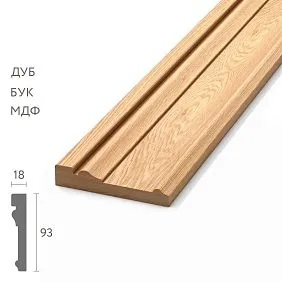
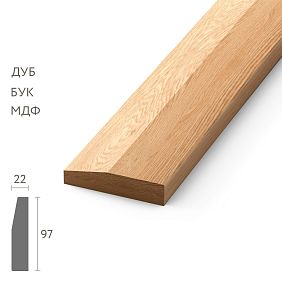
Our factory also produces:




Patterns and ornaments on skirting boards — acanthus, laurel branch, meander
Wooden patterns on skirting boards are not just decoration. It is the language spoken by the interior. And for the interior to speak correctly, each ornament must correspond to the style and era. Arbitrary mixing of ornaments from different historical systems is a mistake that immediately reveals amateurism.
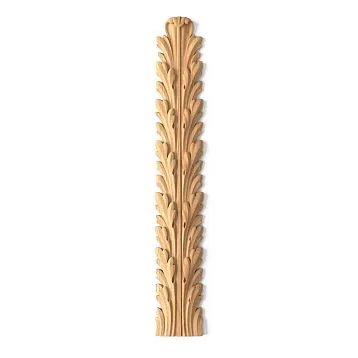
Acanthus — the most important ornamental motif of Western classicism. The leaves of the acanthus — a spiny-leaved Mediterranean plant — became the basis of the Corinthian order and have since remained a staple of European decor. In a Baroque interior, acanthus is powerful, lush, with deep cuts and scrolls. In an Empire interior — more strict, geometric, almost architectural. A wooden ornament of acanthus leaves on a skirting board creates a direct visual connection with the capitals of pilasters, the ceiling cornice, and furniture decor — this is precisely how a unified architectural space is formed.
Laurel branch — an attribute of victory, glory, and immortality. In an Empire interior, it is found everywhere: in cornices, in furniture decor, in wall paintings. On a skirting board, the laurel branch most often runs as a horizontal band along the upper edge — forming a kind of 'crown' at the base of the wall. Wooden laurel patterns pair well with the meander and can be executed either in carving or in applied decor technique.
Meander — a geometric ornament of ancient Greek origin, representing a continuous broken line. One of the most ancient and enduring ornamental motifs. In an Empire skirting board, the meander is often used as a horizontal dividing band between the main height of the skirting board and its upper cornice. A wooden ornament in the form of a meander is executed either in flat carving technique or as an applied milled strip.
Egg-and-dart ornament (ovolo) — alternating eggs and darts, one of the most recognizable classical profile decorations. Traditionally placed on the cyma reversa — a small convex profile element in the upper part of the skirting board. In Baroque interiors, the egg-and-dart is present everywhere: on cornices, architraves, frames.
Volutes and cartouches — decorative scrolls and shield-frames with ornamentation. Purely Baroque motifs, almost uncharacteristic of the Empire style. On a skirting board, cartouches may appear in corners — where the skirting board turns, forming an external corner. This is both a constructive solution for a problematic spot and a decorative accent simultaneously.
How are wooden patterns arranged on a skirting board? Ornamental decor always has a clear hierarchy. The most saturated, richest decor is in the upper third of the skirting board, closer to its cornice finish. The lower part of the skirting board is more austere, often completely without ornament: where the skirting board meets the floor, the decor is not visible anyway. This solution is both rational and architecturally correct: weight at the bottom, lightness at the top — this is precisely how the classical order system works.
It is important to remember: a carved wooden skirting board should echo other wooden elements of the interior — door architraves, window cornices, furniture decor. This does not mean that all ornaments must be identical. But they should belong to the same ornamental vocabulary, be executed in the same technique and on the same scale. Only then is the interior perceived as a unified architectural whole.
Get Consultation
Gilding a skirting board: imitation gold leaf, gold paint, real gilding
Gold in Baroque and Empire interiors is not an excess. It is a structural element, without which the style ceases to exist. Gold works as an amplifier: it 'turns on' the relief of the carving, makes visible what would be unnoticeable in a monotone paint job. A beautiful wooden skirting board in the Baroque style without gilding is unrealized potential.
But not all gilding is the same. There are several fundamentally different technologies, and the choice between them determines the final visual result, as well as the cost and durability.
Real gilding with gold leaf — the pinnacle of craftsmanship and the pinnacle of cost. Gold leaf is the thinnest sheets of metallic gold, 0.1–0.15 microns thick, applied to the surface using a special adhesive (mordant). There are two methods: oil gilding (simpler, matte) and water gilding (complex, with preliminary preparation using gesso and bole, allowing for a mirror-like, 'living' shine). Water-gilded gold leaf in a Baroque interior is that very glow visible under any lighting. It cannot be imitated by any paint.
Real gilding requires a professional. It is a long, meticulous process: applying gesso (a special ground of chalk and glue), sanding to absolute smoothness, applying bole (a tinted red or yellow ground), burnishing with an agate tool, and finally — applying sheets of gold leaf. Each stage requires experience and patience. But the result is unique.
Imitation gold leaf (composition leaf) — this is an imitation of gold leaf: thin sheets of a copper and zinc alloy, coated with varnish. Visually almost indistinguishable from real gold. Costs 15–20 times less. The main drawback — it darkens and turns green over time if not coated with a protective varnish. For skirting boards not subject to mechanical impact, imitation gold leaf under a high-quality protective varnish is a perfectly worthy solution.
Gold acrylic paint — the most accessible and most compromise option. Modern high-quality gold acrylic paints (Liquitex, Golden, Caparol) provide a good metallic shine and last a long time. But they are fundamentally different from real gold: they lack that 'living' iridescence, that variety of shades on different facets of the relief, which gold leaf creates. For mid-price range interiors — quite acceptable. For 'luxury' class interiors — no.
Partial gilding technique — one of the most effective and yet most economical techniques. The essence: the main surface of the skirting board is painted a dark color (black, dark green, burgundy, ochre), and only the protruding elements of the relief are gilded — the tips of acanthus leaves, profile edges, ornamental bands. This technique creates maximum decorative effect with minimal material consumption. This is precisely how most historically authentic Baroque and Empire interiors look: a dark base and shimmering gold on the relief.
How to choose a gilding technology? Here is a simple rule: for formal rooms — real gold leaf or imitation gold leaf with varnish. For private interiors in the mid-price range — high-quality gold acrylic paint with partial gilding technique. Never — cheap bronze powders: they give a 'cheap' shine, appropriate perhaps only on a carnival costume.
How to coordinate a carved skirting board with ceiling stucco and capitals
The architectural unity of a classical interior is built on a system of echoes and repetitions. The ornament of the skirting board should be 'recognizable' in the ceiling cornice. The profile of the skirting board should rhyme with the profile of the architraves. The scale of the wooden ornament on the skirting board should correspond to the scale of the stucco on the walls. This is not a random coincidence — it is a principle.
How to practically coordinate these elements? Always start with the largest, tallest element — the ceiling cornice. It is this that sets the scale of ornament for the entire interior. If the ceiling cornice is 15 centimeters high with an acanthus frieze and egg-and-dart ornament on the cyma reversa — the skirting board should repeat these same ornamental motifs on the same scale or slightly smaller. A carved wooden skirting board in such an interior is a 'mirror' of the cornice at the bottom.
The capitals of pilasters or columns — another node with which the skirting board should echo. If a Corinthian order with lush acanthus capitals is used in the interior — an acanthus ornament on the skirting board creates a direct architectural connection. Ionic order with volutes — volutes on skirting board cartouches and corner elements. Doric order with minimalist capitals — a more strict, geometric skirting board ornament.
The question of the skirting board's height relative to other horizontal divisions of the wall is very important. In a classical interior, the wall is often divided into three horizontal zones: the dado (from the floor to a height of approximately 80–100 cm), the wall field (the main part), and the frieze (the upper strip under the cornice). The skirting board should complete the dado zone — meaning its upper edge coincides with the upper boundary of the dado. If the wall is wallpapered or painted only in the field, and the dado is painted or finished differently — the skirting board fits organically into this horizontal system.
What to do if there is stucco in the interior — rosettes, medallions, frieze — but no capitals? In this case, focus on the ornaments of the stucco frieze. If a meander is used there — introduce a meander into the skirting board. If a laurel band — repeat it. If the stucco is abstract, 'general classical' — choose neutral, universal motifs: acanthus or egg-and-dart ornament.
Another important point — joining the skirting board with door architraves. In a classical interior, the architrave and skirting board are not two independent elements, they are an architectural system. The lower edge of the architrave should 'rest' on the skirting board, and the skirting board — should as if 'embrace' the architrave from below. For this, a special element is often used — a 'plinth block' or 'architrave base': a small square block installed at the bottom of the doorway, connecting the architrave with the skirting board. This architectural technique is one of the most beautiful and correct in classicism.
For those who want to delve deeper into the principles of classical decor, I recommend studyingclassical furniture and the principles of its decoration— there, the system of orders, decorative motifs, and proportions that underlies all this architectural logic is described in detail.
Additional solutions: tall wooden skirting board in interiors of different scales
One of the most frequent questions: can a tall carved wooden skirting board be used in an apartment with 3-meter ceilings? Or is this solution only for mansions and palaces?
The answer is yes, but wisely. With a 3-meter ceiling, a 120 mm high skirting board is already at the upper limit of what's recommended. But if you choose the right profile, color, and decor, this scale won't feel oppressive. The key condition: the skirting board should be painted the same color as the wall or slightly darker—not a contrasting color. A contrasting tall skirting board in a small room creates an effect of 'cut-off legs' at the walls. When the wall color continues onto the skirting board, its height is perceived as an elegant architectural detail, not a heavy horizontal accent.
For rooms with ceilings of 2.7–3 meters, the optimal beautiful wooden skirting board in a classical spirit is 80–100 mm. This is already a full-fledged architectural element capable of accommodating an ornamental band, but not so massive as to 'weigh down' the space.
Pay attention to the double skirting board solution—an architectural technique often used in interiors of medium height. The main skirting board is installed at a height of 60–70 mm. Above it, with a small gap, a thin profiled strip—a 'second row'—is mounted. The total visual height ends up being 120–130 mm, while the installation complexity and weight are significantly less than that of a solid tall skirting board.
One cannot fail to mention the skirting board box—a construction where the space between the skirting board and the wall is used for running electrical cables and pipes. For a classical interior, this is technically convenient and visually unnoticeable: all utilities are hidden behind the tall skirting board, eliminating the need to chase walls.
Carving techniques for classical skirting boards
Wooden ornament on a skirting board can be executed using several fundamentally different techniques. Understanding these techniques helps correctly assess the quality of the product and form a justified budget.
Hand carving is the highest form of craftsmanship. The carver works with chisels and gouges directly on the solid wood, creating the ornament 'by hand'. Each element is unique, with microscopic differences from its neighbor—this is precisely what gives the surface that 'liveliness' impossible to reproduce by machine. Hand wood carving for complex Baroque ornamentation is a slow, expensive, but incomparable result.
CNC machine carving is a modern technology that allows for reproducing complex wooden patterns with high precision and speed. The quality of CNC carving today is very high: modern routers create clear, detailed relief, practically indistinguishable from hand-carved work when viewed from a distance of 1–2 meters. However, upon close inspection, CNC carving always feels slightly 'dry', lacking that living irregularity created by a master's hand.
Combined technique—CNC carving with hand finishing. The machine does the bulk of the work, and the master refines the relief by hand: sharpening leaf edges, deepening grooves, adding softness to transitions. This is the optimal balance of price, speed, and quality for most classical interiors.
Polyurethane overlay decor is a fundamentally different solution. Polyurethane ornamental overlays are produced in molds and attached to the wooden skirting board with glue. They precisely imitate carved wooden ornament, looking practically identical visually when painted. Their advantage is low price and ease of installation. Their drawback is that they are not wood, and upon close inspection, especially under raking light, the material is noticeable. Acceptable for budget solutions. Not for high-class interiors.
Color solutions for wooden skirting boards in Baroque and Empire interiors
If Provence lives in mint and milk, then Baroque and Empire live in dark gold, bloody carmine, and night black. The color of a wooden skirting board is not just paint; it's participation in the coloristic system of the style.
For Baroque, the following are characteristic:
-
Dark burgundy (carmine) with golden relief—the most 'Baroque' combination. The main surface of the skirting board is painted a rich burgundy-red, and the protruding carved ornament is gilded.
-
Dark green with gold—interiors in the spirit of Italian palazzos. An emerald-green base and shimmering golden relief create the effect of brocade fabric transferred to wood.
-
Black with gold—the most dramatic and modern interpretation of Baroque. An absolutely black matte base and gilded relief—maximum contrast, maximum effect.
-
Ivory—for lighter Baroque interiors with many white surfaces. A skirting board in ivory color with a golden accent on the profile looks aristocratic.
For Empire, the following are traditional: -
Red (purple) with gold is the classic combination of the Napoleonic era.
-
Dark green with gold—the military color of the era, the color of uniforms and banners.
-
White with gold—a lighter, more 'neutral' interpretation of Empire, suitable for modern apartments.
-
Black with bronze is a strict, formal, masculine Empire style variant for a study or library.
Important note on painting technology: glossy paint on a dark base is categorically unsuitable for a wooden carved skirting board. Gloss on a dark surface creates inappropriate highlights and 'smudges' the relief. Use only matte or satin paint for the base. The shine should belong only to the gilding—then it will be the gilding that 'glows' against the dark background, creating the desired theatrical effect.
Where to order a carved skirting board with a custom ornament
This is perhaps the most practical question. A standard building supply store won't help here: at best, they'll have a pine skirting board with a simple milled profile. Baroque and Empire carved wooden skirting boards with historical ornaments are a custom order.
Where to turn? There are several categories of manufacturers.
Joinery workshops with an in-house carver. This is the optimal option for complex ornaments requiring hand finishing. The workshop can do everything: select the wood species, perform profiling, apply the carved ornament, prime, and prepare for painting or gilding. Production time—from 2 to 8 weeks depending on complexity.
Productions with CNC routers specializing in classical decor. Such productions can reproduce almost any historical ornament with high precision. To work, they need either a technical specification detailing the ornaments and dimensions, or a sample of an existing skirting board for scanning and copying.
Companies dealing with polyurethane decor. As mentioned, polyurethane is a more accessible alternative to wood. But some manufacturers' polyurethane decor ranges include very detailed Baroque ornaments that, under proper painting and gilding, look quite convincing.
What do you need to prepare to order a custom carved skirting board?
-
Room dimensions and ceiling height.
-
Baseboard height (usually 100 or 120 mm).
-
Description of the ornamental motif — specifying the style (Baroque, Empire), main ornament (acanthus, meander, laurel) and desired technology (hand carving, CNC, applied decor).
-
Finish — for painting, for gilding, for tinting.
-
Wood species.
-
Desired timeline and budget.
The more detailed the technical specifications — the more accurate the result and the fewer unpleasant surprises at the end.
Installation of carved wooden baseboards: nuances and mistakes
Even a perfectly crafted wooden carved baseboard can be ruined by improper installation. This is especially true for tall baseboards — a 120 mm wooden baseboard requires special care during installation.
Walls must be perfectly level. This is critical for a tall baseboard. A 40 mm high baseboard 'forgives' minor wall irregularities — it's easy to press against. A 120 mm baseboard forgives nothing: even a slight wall curvature creates a noticeable gap. Before installing a tall baseboard, walls must be checked with a straightedge and leveled if necessary.
Fastening. For tall wooden baseboards, only finishing nails or liquid nails in combination with additional clips are used. Regular screws are not suitable: they create visible heads that are very noticeable on a tall baseboard. Nails are driven at an angle into the wall, the heads are countersunk with a nail set and filled.
Corners. Internal corners when installing a carved baseboard are made at 45 degrees — using a miter saw with a rotating table. For a carved baseboard with a three-dimensional ornament, miter cuts require special precision: any misalignment of the ornament at the joint is immediately noticeable. A good solution is to use corner blocks: specially made elements installed in corners, to which the baseboard is butted with a straight cut. This both simplifies installation and adds an additional decorative accent.
Vertical level. The top edge of the baseboard must run strictly horizontally — check with a level every 50–70 centimeters. Even a slight slope of the baseboard on a tall wall is very noticeable.
Pause before installation. The wooden baseboard must be brought into the room at least 48–72 hours before installation — it must 'acclimatize,' adopt the room's temperature and humidity. A baseboard installed immediately after delivery from a cold warehouse may deform over time.
Restoration of a historical baseboard in Baroque and Empire style
In old houses — mansions, pre-revolutionary apartments, historical buildings — original wooden baseboards with profile carving are often preserved. This is an invaluable heritage that must be preserved. Restoring such a baseboard is a delicate task, requiring knowledge of the material and respect for the original.
First stage — diagnostics. Assess the condition of the wood: check for rot, woodworm, critical cracks. Check the fastening: perhaps part of the baseboard has already come away from the wall. Remove a small fragment of paint in an inconspicuous place — determine how many layers, what color the original finish was.
Removing paint from a historical baseboard is a responsible process. Chemical strippers are safer for the relief than mechanical stripping. The thermal method (heat gun) is also possible, but requires caution: overheating can cause cracks in old, dry wood.
Restoring lost fragments of ornament is the most difficult part. A cast is made from the preserved elements, a mold is made from it, into which restoration filler or special restoration plaster is poured. Lost wooden patterns can also be recreated from wood — a carver works from the original, precisely reproducing the lost elements.
The final finish of a historical baseboard should correspond as closely as possible to the original technology. If the original was coated with shellac — restore with shellac. If with oil paint — with oil paint. If gilded with gold leaf — use gold leaf. Replacing authentic finishes with modern materials devalues the entire restoration.
FAQ: answers to the most common questions
What baseboard height to choose for 3.5-meter ceilings?
Optimal height — 100–120 mm. A 120 mm wooden baseboard with such ceilings looks architecturally convincing and not overwhelming. With the right color and profile, it creates exactly that classic accent that is needed.
Can a carved baseboard be made from MDF?
Carving on MDF is possible, but limited: the material does not hold fine, detailed relief. For large, generalized ornamentation — acceptable. For fine Baroque acanthus leaf — only natural wood.
What wood is best for fine carving?
Linden (lime) — the recognized leader. It is soft, with even grain, cuts easily and cleanly. For a baseboard that will be painted later — an ideal choice. Oak is significantly more difficult to carve, but gives a more expressive texture under transparent coatings.
How long will gilding on a baseboard last?
Gold leaf under protective varnish — several decades. Imitation gold leaf without varnish — 3–5 years before darkening. Acrylic gold paint — 5–10 years with careful use.
Does a carved baseboard require special care?
Basic care — regularly wipe with a soft brush to remove dust from the recesses of the ornament. Wet cleaning — only with a slightly damp cloth, without aggressive detergents. Every few years — renew the protective varnish on gilded areas.
How much does a carved wooden baseboard cost?
The range is very wide. Standard milled pine baseboard — from 200 rub./m. Mid-level CNC wood carving — from 800 to 2500 rub./m. Hand carving with gilding — from 5000 rub./m and up. Antique baseboard with restoration — price is determined individually.
Can a carved wooden baseboard be combined with a polyurethane baseboard in the same room?
Technically — yes, if they are painted the same color and have a similar profile. But on large straight wall sections, it's better to use one material: the difference in texture and relief is noticeable under oblique lighting.
About the company STAVROS
When it comes to high-class wooden decor — classic profiles, carved ornaments, gilded products — the name STAVROS speaks for itself. The company specializes in the production and supply of decorative elements made from natural wood for classical, Empire, and Baroque interiors. The range includes wooden baseboards, profiles, applied ornaments, and cornice belts for interiors of any complexity and scale.
STAVROS works with both private clients and architects, designers, and construction companies. Custom orders based on technical specifications are possible — with ornament development, wood species selection, and finishing tailored to a specific interior. For detailed information on the assortment,classical furniture and decorvisit the company's website. A specialist consultation will help you choose the right solution for your project — without compromising between historical style and modern quality requirements.