Article Contents:
- Living room — the main space of the house, where the wooden baseboard sets the tone
- What the baseboard 'says' about the living room
- Living room as a space with history
- Wide baseboard 80–100 mm — for living rooms with ceilings from 2.8 m
- Proportion rule: 2.5–3.5% of ceiling height
- 100 mm baseboard for a living room with high ceiling: practice
- Thickness of wide baseboard — a not forgotten parameter
- Shaped classic profile for oak parquet
- Anatomy of a classic profile
- Oak as a wood species for a classic living room
- Toning oak baseboard to match parquet
- Baseboard + wall moldings in the living room — English paneling
- What is English paneling and why it works
- Baseboard as the foundation of a paneling system
- Panel height and proportions
- Three color scheme options for a paneling system
- Baseboard + ceiling molding in the living room — matching decor set
- The 'top-bottom' logic: baseboard and cornice as a paired frame
- Living room baseboard: molding as a set
- The role of living room baseboard decor in lighting
- TV wall and baseboard — cable routing nuances
- Why the cable issue needs to be resolved before baseboard installation
- Three methods of cable routing with wooden baseboard
- Baseboard under the TV — specifics of the zone
- Five living room styles with wooden baseboard
- First style: classic living room
- Second style: modern neoclassical
- Third style: Scandinavian living room
- Style four: English club style
- Style five: Art Deco living room
- Living room wall decor: skirting board and molding as a unified system
- Hierarchy of architectural decor in the living room
- Wooden decor as an alternative to stucco
- FAQ - answers to popular questions
- About the Company STAVROS

The living room is the face of the house. Not figuratively, but in the most literal sense: this is where guests are received, family life unfolds, and every detail works to create an impression. And if in the bedroom the skirting board is an intimate, almost personal detail, then in the living roomWooden baseboard— it's a public statement. It's visible to everyone, assessed immediately, and sets the tone for the entire space.
A wooden living room skirting board is not a 'finishing element' or 'what's left over from the renovation.' It's an architectural detail that, when chosen correctly, elevates the interior to the level of thoughtful design, and when chosen incorrectly, devalues expensive parquet, quality furniture, and any budget invested in finishing.
This article provides a systematic breakdown: from proportions and profiles to the 'skirting board + molding + stucco' system and the nuances of the TV wall. With examples for five styles, practical tables, and answers to questions that are usually asked too late—after the skirting board has already been purchased and installed.


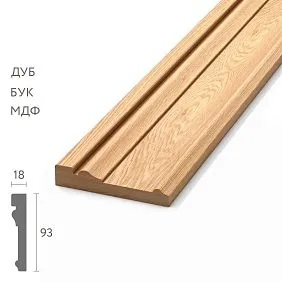

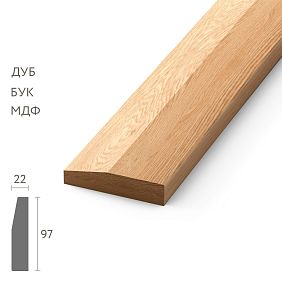


The living room is the main room of the house, where the wooden skirting board sets the tone
Architects say: a room is read from the bottom up. The gaze of a person entering first captures the floor and the lower zone of the walls—and only then rises to the furniture, decor, and ceiling. This is not a metaphor; it's the physiology of perception: peripheral vision fixes the 'floor-wall' horizon before anything else.
That's whyWide wooden skirting boardin the living room—it's not a decorative detail in the background. It's the first thing that reads the space, even before the gaze reaches the sofa or the painting on the wall.




What the skirting board 'says' about the living room
The skirting board carries three architectural messages simultaneously.
First—scale. A wide 100 mm skirting board in a living room with a 3,000 mm ceiling communicates: this is a large space with a claim to significance. A narrow 30 mm skirting board in the same living room—breaks the proportion, 'reduces' the room in the eyes of the observer.
Second—style. A flat rectangular skirting board—minimalism or Scandinavian style. A shaped profile with curves and 'shelves'—classic or neoclassical. A cavetto profile with a soft arc—transitional style, modern classic. The skirting board profile is the language in which the interior speaks.
Third—quality. A wooden living room skirting board made of solid oak with an oil finish—is a signal: no expense was spared on details here. A PVC skirting board next to oak parquet—a cognitive dissonance that is felt, even if not articulated in words.
Our factory also produces:
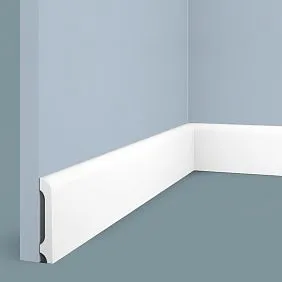
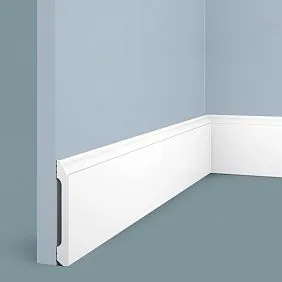
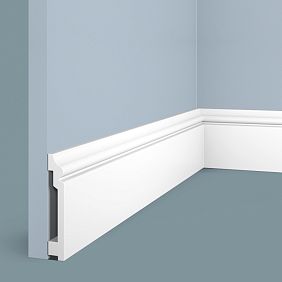
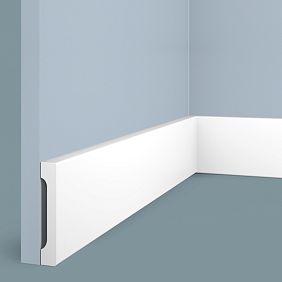
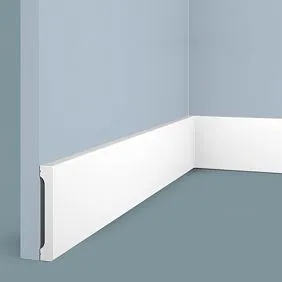
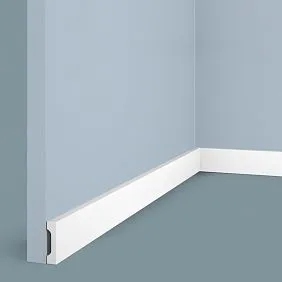
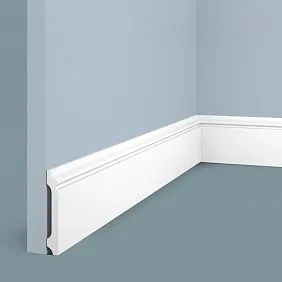
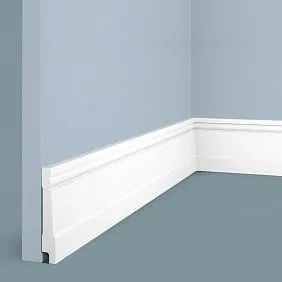
The living room as a space with history
Unlike the bedroom or kitchen, the living room is a room with architectural history. It was in the living rooms of palaces and mansions that the language of classical decor developed: skirting board—molding—cornice—stucco. This system has lasted for several centuries and still works—because it is based not on fashion, but on proportion.
A modern living room, even in a standard apartment, inherits this tradition. And a wooden skirting board with a shaped profile is not 'antique-style'; it's an honest choice of a proven architectural solution.
Get Consultation
Wide skirting board 80–100 mm—for living rooms with ceilings from 2.8 m
The question of skirting board width for the living room is often decided intuitively—'wide, because it's beautiful.' This is not the best approach. Behind each size lies geometric logic.
Proportion rule: 2.5–3.5% of ceiling height
The optimal skirting board height is 2.5–3.5% of the ceiling height. This rule, which comes from classical architecture, works in any modern interior.
| Ceiling Height | Minimum skirting board | Optimal skirting board | Maximum skirting board |
|---|---|---|---|
| 2,400 mm | 50 мм | 60 мм | 70 мм |
| 2,700 mm | 60 мм | 70–80 mm | 90 мм |
| 3,000 mm | 70 мм | 80–100 mm | 110 мм |
| 3,300 mm | 80 мм | 100–120 mm | 130 мм |
| 3,600 mm and above | 90 мм | 120–150 mm | 160 мм |
A 100 mm baseboard in a living room with a 2,700 mm ceiling is already the 'maximum', on the verge of being overloaded. In such a room, a 100 mm baseboard will start to 'press down' on the lower zone, reducing the visual height of the wall. With a 3,000 mm ceiling, 100 mm becomes an organic optimum.
100 mm baseboard for a living room with a high ceiling: practice
Living rooms with ceilings of 3,000 mm and above are classic for pre-revolutionary 'Stalin-era' buildings, elite new constructions, and townhouses. In such spaces, a narrow baseboard looks random—it 'gets lost' in the scale of the room. A wide 100–120 mm baseboard:
-
Creates a pronounced architectural accent at the base of the walls
-
'Holds' the scale of the room—balances the ceiling height
-
Creates a visual 'foundation' for heavy furniture (sofa, bookcase, sideboard)
-
Organically combines with developed ceiling moldings—the scale of the bottom corresponds to the scale of the top
The thickness of a wide baseboard—a not-forgotten parameter
A wide 100 mm baseboard must have sufficient thickness to not 'sag' between mounting points. Minimum thickness for an 80–100 mm baseboard: 16–18 mm. For 120 mm and wider: 18–20 mm. A thin baseboard (12 mm) with a width of 100 mm will 'flap' between cleats and may sag upon impact.
Solid wood baseboards by STAVROSare produced with correct width-to-thickness proportions—structural rigidity is built into the production standard.
Figurative profile of classic for oak parquet
A figurative profile is what distinguishes a 'baseboard for a classic living room' from a baseboard 'in general'. Let's analyze the language of profiles.
Anatomy of a classic profile
A classic figurative baseboard consists of several architectural elements derived from the order system:
Cyma reversa (or reverse ogee)—an S-shaped profile in the upper part of the baseboard. Creates a smooth transition to the wall. It is the 'signature' of classic order decoration.
Cyma recta—a concave arc transitioning into a horizontal shelf. Creates a shadow—a line marking the level of the 'shelf'.
Shelf—a horizontal straight band in the middle part of the profile. Establishes horizontality, emphasizes the architectural character of the baseboard.
Cove—a small concavity at the lower edge, ensuring a smooth transition to the floor. Reduces the 'harshness' of the baseboard/floor transition.
The combination of these elements in one profile—cyma reversa + cyma recta + shelf + cove—creates a developed classic baseboard that, with correct proportions, looks architecturally significant but not overloaded.
Oak as a wood species for a classic living room
Oak is the undisputed leader among wood species for a classic living room. It is chosen not because 'it's customary', but because oak's characteristics best meet the requirements:
-
Hardness (7 on the Brinell scale): an oak baseboard in a high-traffic living room is not afraid of impacts, scratches, accidental contact with furniture
-
Texture: the large open grain of oak is clearly visible on a wide baseboard—it is a 'speaking' material, unlike fine-grained species
-
Toning versatility: oak accepts toning from 'bleached' to 'black'—the entire spectrum of classic living rooms
-
Durability: under normal conditions, an oak baseboard with an oil finish retains its appearance for 20–30 years without replacement
An oak baseboard for a living room interior is an investment that pays off over time. Oak does not yellow, does not crack with humidity fluctuations within 40–60%, and does not deform under normal use.
Toning an oak baseboard to match parquet
Parquet in a living room is often toned—'honey', 'tobacco', 'wenge', 'white oil', 'grey oak'. The baseboard should 'read' within the same color system. But an oak baseboard in the tone of the parquet does not mean purchasing from the same batch—matching the tonal 'temperature' is sufficient.
Skirting board tinting before installation: apply the same composition used on the parquet (oil, stain + oil, hard oil-wax). If the parquet was factory-tinted with a water-soluble composition — apply the closest possible analogue to the skirting board. A difference in tone between vertical and horizontal planes is inevitable (due to different lighting angles) — make the skirting board 1 tone lighter than the parquet, and they will visually match.
Skirting board + wall moldings in the living room — English paneling
One of the most striking solutions for a classic living room is the 'English paneling' system, where walls are structured with rectangular frames made of moldings. The skirting board is the lower element of this system and its architectural foundation.
What is English paneling and why it works
'English paneling' is an architectural technique of wall cladding with rectangular frames made of profile moldings, creating an imitation of wooden panels. In classic English interiors of the 18th–19th centuries, walls were indeed paneled with wood from the floor to a height of 1,200–1,500 mm. Today, the same effect is achieved with moldings.
Why it works: dividing the wall into rectangular frames creates a visual rhythm — the wall ceases to be a uniform plane and gains scale, depth, and character. This works even in modern interiors not 'tailored' for classicism — a molding panel with correct proportions is organic in neoclassicism, art deco, and contemporary classic styles.
Skirting board as the foundation of the paneling system
In the 'English paneling' system, the skirting board is not just the lower edge of the wall. It serves as the architectural base from which the entire molding system 'grows'. The lower horizontal molding of the frame starts directly above the skirting board — or the skirting board itself is the lower horizontal element of the frame.
Therefore, the profile of the skirting board and the profile of the molding must be coordinated: if the skirting board has an elaborate profile with 'shelves' and curves — the frame moldings should carry the same architectural motifs. A lack of profile coordination destroys the system.
Panel height and proportions
The classic height of a molding panel is 1/3 of the wall height. With a ceiling height of 3,000 mm: panel up to 900–1,000 mm. Above the panel — the wall field (smooth or with simpler decor). An 80–100 mm skirting board with a panel height of 1,000 mm occupies 10% of the panel height — the proportion is maintained.
With a ceiling height of 2,700 mm: panel 800–900 mm, skirting board 60–70 mm.
STAVROS wooden moldingsare produced in profiles coordinated with skirting boards from the same catalog — this is a key advantage: the profile system is designed as a single whole, not a set of random elements.
Three color scheme options for the paneling system
Monochromatic panel. Skirting board, moldings, and wall in the same tone (most often — white). The frames create a play of shadows with side lighting — the system is read through relief, not color. A delicate, refined solution.
Panel with contrasting infill. Moldings and skirting board — white, the inner field of the frame — a different color (dark green, blue, burgundy, gray). The frames become pronounced 'paintings' on the wall. Striking and bold.
Wooden panel. Moldings and skirting board — in a natural oak tone or tinted. The frame field — a textured coating or contrasting paint. This is a 'warm' option emphasizing the naturalness of wood.
Skirting board + ceiling molding in the living room — coordinated decor set
A living room that simultaneously features ceiling molding and a wide, shaped skirting board at the floor — is a space with a complete architectural statement. The top and bottom 'respond' to each other, and the interior is perceived as an integral system.
The 'top — bottom' logic: skirting board and cornice as a paired frame
In classical architecture, the order system is built on the principle of symmetry between top and bottom: the base (skirting board) is symmetrical to the capital (cornice), the scale of the lower decor corresponds to the scale of the upper. In a modern living room, this principle works as follows:
-
Ceiling cornice with molding — the 'upper frame'
-
Wide, shaped skirting board — the 'lower frame'
-
The space between them — the wall as a 'canvas'
Визуальный эффект: стена «упакована» в раму сверху и снизу. Пространство обретает законченность, архитектурную весомость.
Key rule: the scale of the molded cornice and skirting board must be proportionate. A heavy 200 mm molded cornice with a 50 mm skirting board — creates imbalance: a 'heavy top' and a 'light bottom'. A 150 mm cornice with a 100–120 mm skirting board — achieves harmony.
Living room skirting board: molding as a set
A coordinated approach means: skirting board,Moldings, Ceiling cornice, door casings— a unified system from one manufacturer, one wood species, one profile language. It is precisely the coordinated solution that creates the impression of 'professional design', not just 'well-matched individual pieces'.
Non-coordinated approach: plaster molding cornice + wooden skirting board of unknown origin + plastic architraves. Each element might be good on its own — but the system does not work.
The role of living room skirting board decor in lighting
A wide, shaped skirting board creates a complex play of shadows when properly illuminated. In the evening, with side lighting from floor lamps and wall sconces, each protrusion of the profile casts a shadow—the skirting board 'comes to life,' gaining plasticity. This is something impossible to achieve with a flat skirting board, let alone a PVC skirting board with an imitation profile: only genuine relief, created by milling from solid wood, produces such a play of light.
TV wall and skirting board—nuances of cable routing
The TV wall in the living room is where architectural ambitions meet practical reality. The TV, soundbar, receiver, gaming console, router—all require cables. And the skirting board is the traditional place for routing them.
Why the cable issue must be resolved before skirting board installation
The most common mistake: the skirting board is installed, the TV is mounted, and cables are thrown over the skirting board or hidden in a plastic conduit over the wooden skirting board. The result—a wooden skirting board with a plastic conduit on the side, ruining the entire concept. The cable issue is resolved before installation—strictly.
Three methods for routing cables with wooden skirting boards
Method one: in the wall. Before skirting board installation, channels for cables are chased into the wall—from the TV location to the outlet locations. Cables are laid in the chases, which are then filled with plaster. After complete drying, the skirting board is installed. No visible cables. Labor-intensive, but the only method yielding a perfect result.
Method two: behind the skirting board. Cables are routed in the space between the wall and the skirting board. This requires:
-
A gap of at least 5–8 mm between the wall and the back surface of the skirting board (ensured by the skirting board profile or spacer strips)
-
Cable cross-section no more than 5–6 mm
-
Cable exit points—behind outlets built into the skirting board, or in specially milled cutouts
The method is suitable for 2–3 small cross-section cables. For a branched 'home theater' system—insufficient.
Method three: cable conduit under the skirting board. A metal or plastic cable conduit is mounted directly at floor level, after which the wooden skirting board is installed over it. The wooden skirting board completely conceals the cable conduit. This is a compromise option: the skirting board is 'raised' above the floor by the height of the cable conduit (10–15 mm), creating a small gap hidden by the lower part of the skirting board profile.
Skirting board under the TV—specifics of the zone
In the zone directly under the TV, the skirting board is often 'overloaded' with cables: HDMI, optical, power, antenna. Recommendations:
-
Route cables strictly vertically from the TV to the floor (in a chase or cable conduit)
-
Minimize the horizontal cable run along the skirting board
-
Place outlets and connectors directly behind the TV, not in the skirting board zone
-
If the skirting board is on clips—plan cable exit points through special slots in the lower part of the skirting board before installation
Five living room styles with wooden skirting boards
Instead of a photo selection (difficult to convey in text)—descriptive accounts of five solutions with specific parameters. Each solution is a complete image.
Style one: classic living room
Interior. Ceiling 3,200 mm, plaster cornice 180 mm, 'herringbone' parquet in oak with a 'honey' tone, walls in 'ivory' color, furniture in dark walnut.
Skirting board. Oak, width 120 mm, shaped profile with a cap, curve, and shelf, stained 'dark honey' (one tone darker than the parquet).
Decorative system.MoldingsOn the walls—English paneling up to a height of 1,100 mm.door casingsOf the same profile as the skirting board.
Effect. A room with a distinct aristocratic character, historical depth, and a sense of 'this was built to last.'
Style two: modern neoclassicism
Interior. Ceiling height 2,800 mm, smooth walls in RAL 7044 (grey-beige), oak parquet in a 'grey' tone (oil with grey pigment), furniture in grey and cream.
Baseboard. Oak, width 80 mm, white RAL 9010, profile with a soft bead along the top edge.
Decorative system.Ceiling cornice80 mm, white — matching the lower baseboard. Wall without moldings — a clean plane between two white horizontals.
Effect. Calm sophistication without pomp. Baseboard and cornice — a delicate 'frame' for the neutral wall.
Third style: Scandinavian living room
Interior. Ceiling height 2,600 mm, white walls (RAL 9016), light ash parquet in a natural oil tone, furniture in light grey and white with wooden details.
Baseboard. Ash or birch, width 60 mm, white acrylic paint (RAL 9016 — matching the wall). Profile — flat rectangle.
Decorative system. No moldings. Curtain cornice — wooden, natural ash tone — the only 'wooden' accent in the system.
Effect. Airiness, lightness, 'space without boundaries'. The baseboard dissolves into the wall — the floor 'extends' onto the wall without a visible transition.
Fourth style: English club style
Interior. Ceiling height 3,000 mm, walls painted dark green (dark Hunter Green), dark oak parquet in a 'tobacco' tone, leather and dark wood furniture, brass hardware.
Baseboard. Oak, width 100 mm, 'tobacco' stain — matching the parquet tone, profile with a pronounced shelf and lower bead.
Decorative system. Wall moldings form vertical panels. Inside the panels — dark green paint, the field above the panels — olive-beige tone.Wooden casingsin the tone of the baseboard.
Effect. A dark, 'masculine', serious living room with the feel of a London club library.
Fifth style: Art Deco living room
Interior. Ceiling height 3,200 mm, geometric 'checkerboard' parquet in oak in two tones (natural and dark), pearl-grey walls, golden metal accents in lighting fixtures and handles.
Baseboard. Oak, width 90 mm, 'golden oak' stain, profile with a straight shelf at the top edge — geometric, without 'soft' curves (Art Deco geometry versus classical roundness).
Decorative system.Moldingsin a geometric style — horizontal straight stripes on the walls instead of frames. Cornice with a rectilinear profile.
Effect. A living room with character, shine, and precise geometric accents. Wood warms the strict geometry.
Living room wall decor: baseboard and molding as a unified system
A discussion about living room wall decor is impossible without understanding the hierarchy of elements. In professional interior design, there is a strict system where each element has its place.
Hierarchy of architectural decor in the living room
First level (lowest): floor baseboard — the base of the wall.
Second level: wall panel (up to a height of 900–1,100 mm) — wooden cladding, molding frames, or panel imitation with paint.
Third level: frieze or dividing molding at a height of 900–1,100 mm — a horizontal line separating the panel and the wall field.
Fourth level: wall field (from 1,100 mm to the ceiling) — the main plane.
Fifth level (top): ceiling cornice — the transition from wall to ceiling, completing the system.
When all five levels are thought out and coordinated — the living room functions as a complete architectural space. Omitting any level (e.g., no baseboard or no cornice) — the system 'loses' an element and reads as unfinished.
Wooden decor as an alternative to stucco
Plaster molding is fragile, heavy, and requires special installation skills.Wooden trimSolid oak in the same role is stronger, easier to install, and amenable to local repair. A wooden ceiling cornice instead of plaster is an equally elegant solution, yet more durable and repairable.
The fundamental advantage of wood over plaster: if damaged, a wooden element can be locally restored (sanding + painting) or a single fragment replaced. Plaster molding with similar damage requires either specialized restoration or replacement of the entire section.
FAQ — answers to popular questions
Can a wide 100 mm baseboard be installed in a living room with a 2,600 mm ceiling?
Technically — yes. Visually — a 100 mm baseboard with a 2,600 mm ceiling will create a feeling of a 'low' room where the lower wall zone feels 'heavy'. The optimum for 2,600 mm is 70–80 mm. If you really want 100 mm — compensate with a light ceiling and walls: let the baseboard be the 'lower tier', and everything else be light and airy.
Is it necessary to coordinate the baseboard tone with the sofa color?
No, that's unnecessary. The baseboard is coordinated with the floor, walls, and architectural elements (trims, cornice). Furniture is the textile and furniture layer of the interior, which follows its own rules. The only exception: if the sofa is wooden (with exposed wooden frames) — it's better to coordinate the wood tone of the sofa and the baseboard.
How to properly join wooden baseboard in living room corners?
For internal corners — a 45° miter cut ('scarf joint') or a 'butt joint' (one baseboard butts against the wall, the other meets it end-to-end, carefully filled with putty). In professional execution — a 45° cut on a miter saw. For external corners (e.g., near a column or bay window) — a 45° miter cut with mandatory verification of the actual angle (it's rarely exactly 90°).
Oak baseboard for living room — matte or glossy?
Both options are suitable for a living room, but with different 'functions'. A glossy baseboard (varnish) reflects light, visually 'enlarges' the space — good for dark living rooms with insufficient natural light. A matte one (oil, wax, matte paint) — is more 'lively', doesn't create glare, looks more 'natural'. For a classic living room with multiple light sources — a matte baseboard is preferable: it doesn't 'overpower' the light from floor lamps and sconces.
How long does an oak wooden baseboard last in a living room?
Under normal operating conditions and with an oil-wax or acrylic paint finish — 20–30 years without replacement. An oil finish is renewed every 3–5 years (light sanding + new coat of oil). Acrylic paint under intensive use — repainting every 5–7 years. This is significantly longer than the lifespan of a PVC baseboard (PVC yellows, cracks, deforms after 7–10 years).
Is sealant needed between the baseboard and the wall in a living room?
A thin strip of acrylic sealant along the top edge is recommended. This closes the inevitable technological gap (especially on uneven walls), prevents dust accumulation in the crack, and improves sound insulation in the lower zone. The sealant is applied after installation, smoothed with a damp finger, and excess is removed with a damp cloth.
About the company STAVROS
The living room is the main interior manifesto of the house. Here, details do not forgive carelessness, and the correct choice of each element contributes to the overall impression for years.Wide wooden baseboardSolid oak — a detail that everyone sees. And which, when chosen correctly, says more about the homeowner than any decorative accessory.
STAVROS — a Russian manufacturer of wooden architectural elements from natural solid oak and beech. The STAVROS range includes a complete decorative system for classic and modern living rooms:wide baseboards and solid wood moldings, moldings, cornices, and ceiling decor, wooden door casings, Furniture legsandwooden furniture handles.
STAVROS production features stable material moisture content of 8–10%, precise geometric parameters, surface sanding to P320 for any finish. A unified system of profiles and tones throughout the catalog guarantees: by ordering baseboard, molding, and cornice from STAVROS, you will receive a coordinated set, not a collection of random parts.
A living room with the STAVROS decorative system is not an interior 'with expensive details'. It is an interior with character.