












































































Article Contents:
- Why an eco-friendly solid wood baseboard is important in a child's room
- Chemical emission: the invisible threat
- Tactile contact and the ecology of touch
- Physical comfort: warmth and softness
- Wood species for a child's room: pine, linden, birch — soft and safe
- Pine in a child's room: advantages and one caveat
- Linden: the ideal wood species for a child's room
- Birch: a balance of hardness and safety
- Oak and beech in a child's room: with caveats
- Comparison of wood species for a child's room
- Finish: only water-based paint or oil-wax — no varnishes
- What is prohibited in a child's room — and why
- Water-based paint — the optimal choice
- Oil-wax: a natural finish without compromises
- Wax without oil — for the most cautious parents
- What absolutely cannot be used as safe paint for a child's room baseboard
- Baseboard height in a child's room — 40–50 mm, rounded profile
- Why 40–50 mm, not 80–100 mm
- Rounded profile: a critical parameter
- Baseboard thickness and "projection" from the wall
- Cushion the corner with a soft pad — protection from impacts
- Soft corner under the baseboard: how it works
- Structural alternative: 45° miter cut without an external corner
- Protecting the lower zone: base shoe at the floor
- Caring for the baseboard in a child's room — safe cleaning agents
- How to clean a wooden baseboard in a child's room
- Eco-friendly cleaning agents for a child's room
- Periodic Coating Renewal
- Replacing the baseboard during a child's room renovation — sequence
- Step one: removal of the old baseboard
- Step two: selecting a new baseboard considering the child's age
- Step three: preparation of the new baseboard
- Step four: installation
- Step five: sealing and final inspection
- Eco-friendly children's room finishing as a system: baseboard in context
- Hypoallergenic baseboard: what this means in practice
- Additional wooden decor elements for the children's room
- FAQ - answers to popular questions
- About the Company STAVROS

A child's room is not just a space with a bed and a desk. It is an environment where the child spends most of their life in the early years. Here, they crawl on the floor, chew on everything they can reach, fall and get up, and touch every surface with their hands. This is why the finishing of a child's room is subject to requirements that are not relevant for any other room in the house. Andan eco-friendly wooden baseboardis no exception: it is not a decorative detail chosen 'as an afterthought,' but a full-fledged element of a safe environment, deserving of thoughtful selection.
The question 'which baseboard to install in a child's room' is not solved by the principle of 'what's cheapest' or 'what's left over from the living room.' It is solved by criteria: material, coating, profile geometry, height, installation method. Each of these criteria is directly related to the child's safety—both physical and environmental.
This article is a comprehensive guide. We will cover everything: from choosing the wood species to caring for the baseboard when the child outgrows diapers but hasn't yet outgrown the habit of hitting walls with toys.


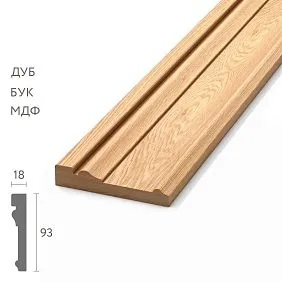

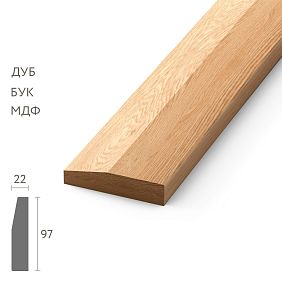


Why an eco-friendly solid wood baseboard is important in a child's room
Before discussing specific parameters—we need to address the main question: why does the baseboard material even matter in a child's room?




Chemical emission: the invisible threat
Most baseboards on the market are made of PVC or MDF. PVC baseboards contain polyvinyl chloride, plasticizers (phthalates), stabilizers, and dyes. MDF baseboards are made from wood fibers bonded with formaldehyde resins. Both materials, at normal temperatures, are within permissible emission limits—but in a child's room, the 'permissible limit' is not the same as in an adult's space.
A child in the first three years of life spends significantly more time near the floor than an adult. The concentration of volatile compounds near the floor is always higher than at adult height. A child crawling along the baseboard literally breathes air in immediate proximity to the PVC or MDF surface. This is not a theoretical threat—it is a real increase in the dose of inhalation exposure.
A solid wood baseboard in a child's roomcontains neither PVC nor formaldehyde glues. It is not 'almost natural,' not 'with the addition of natural components'—it is pure wood. With proper coating (without synthetic varnishes)—it is an absolutely neutral material in terms of chemical emission.
Our factory also produces:
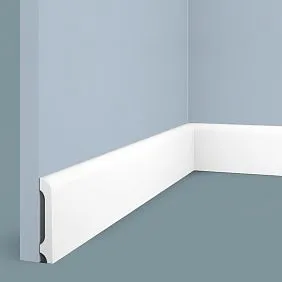
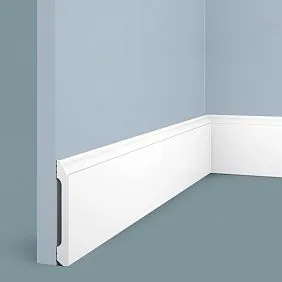
Tactile contact and the ecology of touch
Small children touch everything with their hands—and often put their hands in their mouths. The baseboard is an object of regular tactile contact: the child leans on it while walking along the wall, grabs it when falling. The surface of a solid wood baseboard with a water-based coating is safe if accidentally put in the mouth. The surface of PVC with migrating plasticizers is not.
Get Consultation
Physical comfort: warmth and softness
Wood is a material with low thermal conductivity. A wooden baseboard does not feel 'cold' to the touch. A child leaning against a wooden baseboard does not experience cold stress—unlike with a metal or plastic one.
In a fall (and children fall constantly—this is normal physical development) the corner of a wooden baseboard with a soft, rounded profile causes significantly less injury than a sharp plastic one. More on this—in the section on geometry.
Wood species for a child's room: pine, linden, birch—soft and safe
Wood species for a child's room is a separate topic that is often ignored when purchasing. Meanwhile, the species determines density, smell, and the ability to release resins.
Pine in a child's room: advantages and one caveat
A natural solid wood pine baseboard is the most affordable option made from solid wood. Pine has a characteristic coniferous aroma—a result of natural resin release (terpenes, pinenes). For adults, this aroma is pleasant and even considered beneficial (anti-inflammatory properties of phytoncides). For children under one year old with heightened respiratory sensitivity—intensive resin release is undesirable.
Caveat: pine actively releases resins in the first 1–2 years after baseboard production. Dried, seasoned, and coated with oil or wax pine is significantly less active. When ordering a pine baseboard, clarify the moisture content and time since production: a baseboard made from dry pine (moisture content 8–10%) with an oil coating is safe for a child's room.
Pine density: 450–550 kg/m³ — softwood. When struck, the edge of a pine baseboard 'gives' more softly than oak — causes less injury.
Linden: the ideal wood for a child's room
Linden is the best choice for a child's room. Softwood (density 400–480 kg/m³), resin-free, no characteristic odor, neutral white color. Linden wood does not contain tannic acids (like oak) and does not release resins (like pine). It is literally chemically neutral.
A linden baseboard for water-based paint is an absolutely clean surface without chemical nuances. A white linden baseboard in a white child's room is the perfect system: minimal chemistry, minimal visual noise, maximum ease of care.
One nuance: linden is soft and dents easily. If a child hits the baseboard with toys or a scooter — marks are inevitable. For active children over 3 years old — birch is more reliable.
Birch: a balance of hardness and safety
Birch is a semi-hard wood (density 600–650 kg/m³). It contains no resins, has no pronounced odor, and features a light, neutral color. It is more resistant to mechanical damage than linden but softer than oak. For a child's room for a child aged 3 and up, it is an optimal choice: the baseboard will withstand active use and maintain its appearance.
Oak and beech in a child's room: with caveats
Oak and beech are popular species forsolid wood baseboards. They are hard, durable, beautiful. But for a child's room — with caveats.
Oak contains tannic acids (tannins), which upon contact with white coating can cause yellowing. Under oil or tinted paint, oak works perfectly. Under white enamel — requires an isolating primer (shellac), otherwise within 6–12 months the white baseboard will yellow.
Beech is stable, dense (650–700 kg/m³), with no pronounced odor. For a child's room — a good choice provided proper coating. Hardness is an advantage for durability and somewhat a drawback in terms of injury risk: the sharp corner of a beech baseboard is harder than that of a pine one.
Comparison of wood species for a child's room
| Species | Density | Odor | Resins | Suitable for child's room |
|---|---|---|---|---|
| Linden | 400–480 kg/m³ | No | No | Ideally |
| Spruce | 450–550 kg/m³ | Present | Present | Yes (seasoned) |
| Birch | 600–650 kg/m³ | No | No | Excellent |
| Beech | 650–700 kg/m³ | No | No | Good |
| Oak | 680–750 kg/m³ | No | Tannic acids | With primer under white paint |
Coating: only water-based paint or oil-wax — no varnishes
Baseboard coating in a child's room — perhaps the most important choice after material selection. Here, a mistake costs the most.
What is prohibited in a child's room — and why
Nitro-varnishes and solvent-based varnishes. Contain toluene, xylene, acetone and other volatile organic compounds (VOCs). After drying, emission decreases but does not stop — upon heating (in summer in a room with closed windows) it reactivates. Absolutely unsuitable for children's rooms.
Alkyd enamels. Solvent emission during the drying period is high. After full curing (21 days) — emission is low, but still higher than with water-based coatings. For a child's room — undesirable.
Two-component polyurethane varnishes. Before polymerization — highly toxic (isocyanates). After full curing — inert, non-emitting. However, the two components achieve 'full curing' after 7–14 days at +20°C. Moving a child into a room with recently applied polyurethane coating is a risk.
Water-based emulsion paint — the optimal choice.
Wooden skirting board for water-based emulsion paint (acrylic dispersion on a water basis) — a safe and practical option for a child's room. Acrylic paint:
-
Does not contain organic solvents (base — water).
-
After drying (4–6 hours) — emission is practically zero.
-
Available in any RAL color (matching the color of walls, ceiling, furniture).
-
Easy to repaint when changing the child's room design.
-
Washes well: children's drawings on the skirting board are removed with a damp cloth.
Important: acrylic paint for the skirting board should contain a minimal amount of plasticizers. Choose paints marked 'for children's rooms' or 'VOC-free'.
Application technology for wooden skirting board:
-
Primer-sealer (to prevent tannin bleed — if oak).
-
First coat of diluted acrylic paint (ratio 90:10 with water) — priming coat.
-
Sanding raised grain with P320 after drying.
-
Final coat of undiluted paint — 1–2 coats.
Oil-wax: natural coating without compromises.
Oil-wax — a coating based on vegetable oils (linseed, tung, carnauba wood) and wax (carnauba, beeswax). Penetrates the wood structure, does not create a film. Absolutely safe for children — components of natural origin, without synthetic solvents.
Wooden skirting board without varnish for a child's room with oil-wax coating — looks like living wood: warm color, visible texture, matte surface. This is the most 'natural' appearance of a wooden skirting board, maximally emphasizing the material's naturalness.
Disadvantage of oil-wax: lower resistance to soiling compared to acrylic paint. Pencil drawings and juice stains — harder to remove. Requires coating renewal every 1–2 years.
Advantage of oil-wax: damaged area is easily repaired locally — just apply oil to the cleaned area. Acrylic paint leaves a noticeable 'patch' during spot repair.
Wax without oil — for the most cautious parents.
Pure furniture wax (beeswax or carnauba) — the most 'quiet' coating. No odor, no solvents, absolute naturalness. Matte velvety surface. Limitation: wax does not protect from moisture and wears off easily under intensive use — renewal needed once a year (or more often in actively used areas).
What absolutely cannot be used as safe paint for a child's room skirting board
-
Paints containing lead pigments (old stock, paints from unknown manufacturers).
-
Paints with antiseptic additives based on organic mercury compounds.
-
Tinted paints with unspecified pigment composition.
For a child's room — only paints with safety certification, 'VOC-free' marking, with composition indicated on the label.
Skirting board height in a child's room — 40–50 mm, rounded profile.
Skirting board size and shape in a child's room — not an aesthetic issue. It's a matter of injury risk.
Why 40–50 mm, not 80–100 mm
In a bedroom or living room, a wide skirting board 80–120 mm — an elegant architectural accent, adding visual weight and completeness to the room. In a child's room, a wide skirting board — is a blow with greater leverage when a child falls onto it. The wider the skirting board — the higher the top edge point, and the more painful the contact upon falling.
Baseboard height of 40–50 mm in a child's room:
-
Top edge at a height of 40–50 mm from the floor — below the level of a child's knees while walking (the knee is on average 25–35% of body height)
-
When falling, the child 'rolls' over the baseboard without hitting it with their knee or shin
-
Visually does not dominate — the child's room is decorated with other accents (wall color, furniture, decor)
Baseboard higher than 60–70 mm in a child's room — undesirable for children under 5 years old. Starting from 7–8 years, when the child is steady on their feet — the restriction is lifted.
Rounded profile: a critical parameter
A sharp baseboard angle upon impact concentrates pressure on a very small area — this causes maximum injury. A rounded profile distributes the load along an arc — significantly reducing the risk of cuts and bruising.
What is a 'rounded wooden baseboard for children' in terms of parameters:
-
Radius of the top corner rounding: at least 3–5 mm
-
Chamfer or fillet on the top edge: 2–3 mm ×45° or radius R3
-
Absence of sharp protruding edges on the profile
In the catalogsolid wood moldingsPay attention to the cross-section profile: a flat baseboard with sharp edges is not for a child's room. A baseboard with a semicircular or soft rounded profile of the top edge is needed.
Baseboard thickness and 'projection' from the wall
Another parameter directly related to safety: the baseboard's projection from the wall. The thicker the baseboard — the farther its top edge is from the wall. A baseboard with a thickness of 20–22 mm protrudes noticeably from the wall and creates a 'step' that a child can trip over.
Recommended baseboard thickness in a child's room: 12–14 mm. This is sufficient for rigidity, but the projection from the wall is insignificant — the risk of tripping is minimal.
Cushion the corner with a soft pad — protection from impacts
Corner joints of baseboards are the most injury-prone area. The external corner of the baseboard (where it turns 90° to the next wall) protrudes into the room space and upon impact 'receives' the maximum load.
Soft corner for baseboard: operating principle
A soft corner is a silicone or foamed PVC pad for the baseboard corner. It is installed on top of the wooden baseboard in the area of external corners. Upon impact, the soft material deforms, absorbing the impact energy.
This is not a replacement for a rounded profile — it is a supplement. The rounded profile reduces injury along the entire length of the baseboard. The soft corner pad — in the most dangerous points (room corners, corners near the doorway).
Important nuance: the soft corner pad should be made of material without migrating plasticizers. For a child's room — silicone pads (silicone is chemically neutral) are preferable to PVC pads.
Structural alternative: 45° miter cut without an external corner
If, when planning the room, it is possible to avoid external baseboard corners (furniture is arranged so that all room corners are internal) — the risk of impact contact is minimized structurally. This is an ideal scenario that does not require additional pads.
In most cases, it is impossible to completely avoid external corners. But reducing their number is possible with proper furniture arrangement.
Protection of the lower zone: fillet at the floor
The lower zone of the baseboard — contact with the floor. For small children crawling on the floor, fingers often go under the baseboard if it does not fit tightly. For a child's room — the baseboard should fit against the floor without a gap or with a minimal gap (up to 1 mm). If a gap is inevitable due to an uneven floor — placing a decorative cord or applying sealant closes it.
Caring for the baseboard in a child's room — safe cleaning agents
The child's room is the dirtiest room in the house. That's a fact. The baseboard in the child's room gets stains from juice, traces of crayons and pencils, impacts from toys, and wet handprints. Care must be regular and — safe.
How to clean a wooden baseboard in a child's room
For a baseboard with acrylic coating:
Acrylic coating is a film resistant to most household stains. Care:
-
Daily: dry or slightly damp cloth
-
Weekly: warm water with a drop of neutral soap (unscented baby soap is ideal)
-
Stubborn stains (crayons, markers): eraser or alcohol on a cotton pad (test in an inconspicuous area)
What not to use: abrasive cleaners (scratch the coating), chlorine-based liquids (discolor), concentrated acidic cleaners.
For baseboards with oil or wax coating:
Oil and wax are not a film, but an impregnation. The surface breathes but is less water-resistant.
-
Daily: dry cloth
-
Stains: slightly damp cloth with neutral soap, immediate drying
-
Spots: special cleaner for oiled surfaces (safe composition)
-
Annually: renewing the oil or wax layer
Absolutely avoid: soaking wooden baseboards with oil coating in water, using a steam cleaner (steam destroys the oil layer and raises wood fibers).
Eco-friendly cleaning products for children's rooms
In children's rooms, only eco-friendly cleaning is recommended:
-
Neutral soap solutions (baby soap, plain laundry soap without additives)
-
Baking soda solution (1 tsp per 1 liter of water) — for stubborn stains
-
Vinegar solution (1 tbsp per 1 liter of water) — only for acrylic coatings, not for oiled ones
What not to use: chlorine-based products, surfactants based on nonylphenol, synthetic fragrances — all of these enter the air of the children's room during use.
Periodic coating renewal
With intensive use in a children's room, the baseboard will require coating renewal after 2–4 years. This is not a flaw — it's a characteristic of natural wood. Renewing acrylic paint: light sanding with P320, reapplying paint. Takes 1–2 hours per room. Result — the baseboard looks like new. PVC baseboard in the same situation — only complete replacement.
Replacing baseboards during children's room renovation — sequence
When a child grows up and the nursery turns into a teenager's room — the baseboard is often changed as well. Or updated during planned renovation. The correct sequence ensures a neat result without rework.
Step one: removing the old baseboard
Baseboard on clips — removed in 5–10 minutes with a thin spatula (details in the previous article about hidden fastening). Baseboard on nails — removed with a flexible spatula by gradually prying. Baseboard on adhesive — most difficult removal: cut the seam with a knife along the top edge, then 'open' from below with a spatula. The wall after adhesive mounting requires putty in the baseboard area.
After removal — clean the baseboard area of old adhesive and putty, sand down unevenness.
Step two: choosing a new baseboard considering the child's age
Nursery 0–5 years: baseboard 40–50 mm, softwood, rounded profile, acrylic coating or oil.
Children's room 5–10 years: baseboard 50–70 mm, wood species of choice, profile with a slight bevel, acrylic or oil coating.
Teenager's room 10+ years: requirements similar to adult spaces. You can choosewide oak baseboard80–100 mm with decorative profile, acrylic or oil coating. At this age, the architectural character of the room is more important than soft profile requirements.
Step three: preparing the new baseboard
If the baseboard is supplied sanded (unfinished) — apply the finish before installation. This is significantly more convenient than painting an already installed baseboard: the ends, the back side, complex profile sections — everything is accessible.
After applying and drying the finish — let the baseboard acclimate in the room for 48–72 hours before installation. During this time, any possible residual solvent emission (from the paint) will complete.
Step four: installation
Choosing the installation method for a child's room — taking into account the specifics:
Clips — the best choice for a child's room. Allows for periodic removal, no adhesive chemicals, neat result without nails.
Liquid nails — acrylic adhesive, if clips are not possible. No nails, no odor (water-based acrylic adhesive).
Finish nails — classic, but requires filling the nail holes. Not recommended in a child's room with a child under 3 years old, because the child may pick at the filler in the nail holes.
Step five: sealing and final inspection
After installation — a thin strip of acrylic sealant along the top edge (where the baseboard meets the wall) and, if necessary, along the bottom edge. Sealant — only without antiseptic additives. White water-based acrylic sealant — safe.
Final inspection: ensure the baseboard has no sharp protrusions, that all corners are rounded or covered with soft pads, that there are no gaps at the floor where a child's finger could get caught.
Eco-friendly children's room finishing as a system: baseboard in context
Wooden baseboard in a child's room— part of an eco-friendly finishing system. Considering it in isolation is incorrect: if a natural wood baseboard with an oil finish stands against a wall covered with vinyl wallpaper with solvent-based adhesive — the overall environmental background is not determined by the baseboard.
System logic:
-
Baseboard made of natural wood →wooden door casingsmade from the same material → unity of eco-friendly finishing
-
Walls — water-based paint or paper wallpaper without synthetic adhesive
-
Floor — natural wood, cork, or safe laminate with E1 certification
-
Ceiling — water-based paint or fabric stretch ceiling
When all elements work as a system — the child's room truly becomes a safe environment. The baseboard is the finishing element of this system, but no less important than the walls or floor.
Hypoallergenic baseboard: what this means in practice
The term 'hypoallergenic baseboard for children' in marketing materials often simply means 'without PVC and without MDF'. In reality, the hypoallergenicity of a baseboard is determined by a combination of factors:
-
Wood species without allergenic resins and pollen (linden, birch — safer than coniferous)
-
Finish without synthetic solvents
-
Surface treatment that prevents dust accumulation in the profile relief
For children with dust allergies — a baseboard with minimal relief is preferable to a profiled one: in complex relief, dust accumulates faster and is harder to clean.
Additional wooden decor elements for a child's room
When building a safe wooden finish for a child's room, it's worth thinking about the space holistically.solid wood millwork— it's not just baseboards, but also door casings, ceiling moldings, and wall paneling.
For a child's room, decorativeMoldingsin the middle part of the wall — they create vertical zoning and become the basis for decorating the 'child's tier' of the wall (below the molding — bright color, above — neutral), which is convenient when updating the decor as the child grows.
wooden handles on furniturein a child's room — the same requirements: rounded profile, safe finish, no sharp corners. Unity of material (wood) and finish (acrylic paint or oil) creates visual and environmental integrity in the room.
FAQ — answers to popular questions
Can oak baseboards be installed in a newborn's room?
Yes, provided proper finishing. Oak contains tannic acids, which can cause yellowing under white paint without an isolating primer. For a child's room — apply a shellac primer before white paint. Under oil or tinted paint, oak is suitable without restrictions.
What's better — pine or linden baseboards for a 2–3 year old's room?
For this age — linden. It's softer, resin-free, odorless, and ideal for white acrylic paint. Pine releases resins more actively — for a child under 3, this is an additional burden on the respiratory system. After 5–6 years, the difference is negligible provided the pine is well-dried and oil-finished.
Is ventilation needed when painting baseboards with acrylic paint in a child's room?
When applying finish before installation — always in a well-ventilated area. If painting already installed baseboards — ventilate during work and for 24 hours after. After acrylic paint fully dries — ventilation is not mandatory, but advisable for another 12–24 hours to completely remove any water traces from the finish.
How often should oil finish on baseboards in a child's room be refreshed?
In a child's room with active use — every 1–2 years. Signs it needs refreshing: matte finish becomes dull, during wet cleaning water starts soaking into the wood instead of beading off. Refreshing — light sanding with P320, applying fresh oil, drying.
What radius for rounding the top corner of a baseboard is considered safe for a child?
A radius of 3 mm is the minimum. A radius of 5–8 mm is optimal. At R5 and above, the corner goes from potentially injurious to practically safe. Check the baseboard profile before purchase — feel the top edge with your hand: if you feel a sharp edge — the profile is unsuitable for a child's room without additional rounding with P80 sandpaper.
About the company STAVROS
Choosing baseboards for a child's room is a choice with long-term consequences. The material will be near your child every day, for years. And here there's no room for the compromise 'it'll do.'
STAVROS — a Russian manufacturer of wooden architectural elements from solid oak and beech.solid wood millworkin the STAVROS catalog is made from certified wood with 8–10% moisture content, without formaldehyde glues, without synthetic impregnations. The surface is sanded to P320 — ready for any safe finish application.
In the STAVROS range — a complete system of wooden decor for creating an eco-friendly interior:Wooden casings, Moldings and cornices, Furniture legsandwooden furniture handles. Every element — from one manufacturer, from the same wood species, with the same level of quality control.
A child's room finished with STAVROS wood — it's not just beautiful. It's right.


