Article Contents:
- What is Boot Skirting: Shape, Profile, Geometry
- Profile Anatomy: Why 'Boot'
- Three Types of Boot by Niche Geometry
- Sizes: Standard and Options
- Wood Species for Boot Skirting
- Where Boot Skirting is Used: Wooden Houses, Cladding, Baths
- Wooden House and Cladding: The Perfect Tandem
- Frame House: Boot as the Ideal Choice
- Bath and Sauna: Boot as a Functional Element
- Combined Bathrooms and Wet Areas of the Apartment
- Wooden Half-Round Skirting: Difference from Boot and Corner
- Half-Round Profile: A Different Idea
- Comparison of Boot, Half-Round and Cove
- Where Wooden Half-Round Skirting Looks Best
- Wooden Corner Skirting: Where Wall and Floor Meet at 90°
- Wooden Corner: The Simplest Geometry
- Three Types of Wooden Skirting Corners
- Wooden Corner Skirting: Key Differences from Boot
- Where Corner is More Appropriate than Boot
- Boot Installation: Fastening Without Nails and Classic Methods
- Three Methods for Installing Wooden Boot Skirting
- Corner Installation: Internal and External
- Recommendations for Fastening Spacing
- Plank Joints: Long Straight Walls
- Coating and Painting Boot Skirting: Features of Rounded and L-Shaped Profiles
- Why Applying Coating to Boot Skirting Requires Attention
- Oil vs Enamel for Boot Skirting: What to Choose
- Painting Boot Skirting in a Bath: Only Specialized Compounds
- FAQ: Answers to Common Questions About Boot Skirting
- About the Company STAVROS

Some words instantly evoke an image. 'Boot' is one of them. Mention it in a conversation with a carpenter or finisher, and both understand what's being discussed: that special profile with a distinctive 'heel' that fits snugly into corners and under cladding without creating gaps or cracks. A profile that has long been a working classic in wooden construction.
Wooden boot skirting— is not just 'another profile' in a long catalog. It's a specific geometric idea born from practical tasks: to cover the lower end of cladding, ensure a tight fit to the floor, compensate for gaps during the shrinkage of a wooden house, and not interfere with the movement of the cladding. Tasks unavoidable in wooden construction — and precisely for them, the 'boot' profile was invented and refined.
In this article — everything about wooden boot skirting: shape, geometry, differences from coving and corner profiles, application in wooden houses, saunas, with cladding, installation rules, and finishing features. Plus — a complete comparative analysis of related profiles: semicircular and corner.





What is boot skirting: shape, profile, geometry




Anatomy of the profile: why 'boot'
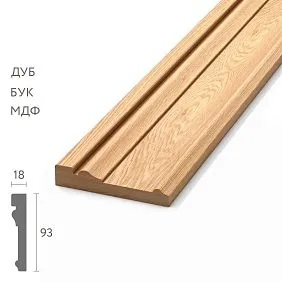
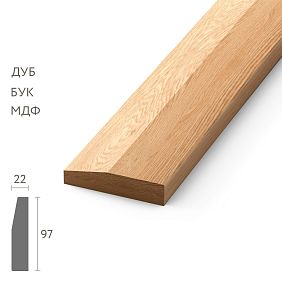
Imagine a cross-section: the vertical part is the 'shaft', the horizontal part is the 'sole'. The vertical plane adjoins the wall or cladding, the horizontal 'shelf' covers the floor. The bend between them is smooth or with a small radius. The silhouette indeed resembles a boot in cross-section.
The key geometric feature of the boot is the asymmetry of the two planes: the vertical part is always taller than the horizontal part is wide. It's not a right angle: the vertical shoulder is 30–60 mm, the horizontal is 15–25 mm. The asymmetry creates a specific niche above the horizontal shelf — where the lower end of the cladding or paneling 'fits'.
This niche is the functional DNAof wooden boot skirting. The cladding does not 'rest' on the floor — it 'stands' in the niche above the shelf with a 5–10 mm gap necessary for movement compensation. The skirting simultaneously covers both the lower end of the cladding from above and the gap to the floor from below.
Our factory also produces:
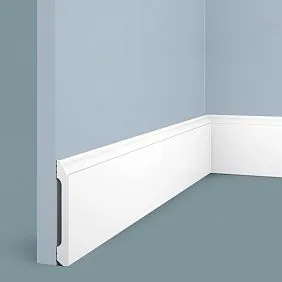
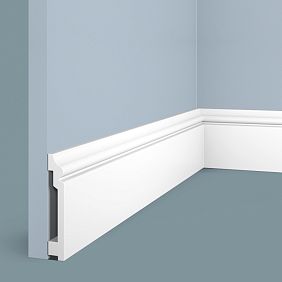
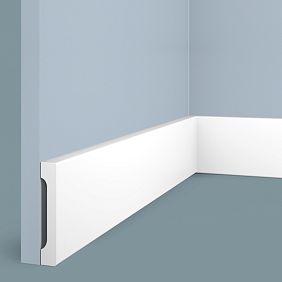
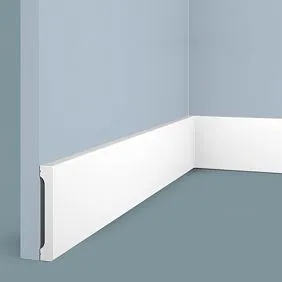
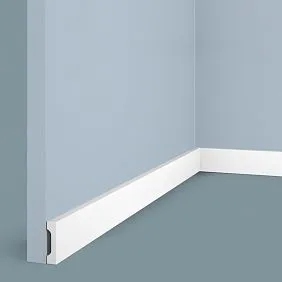
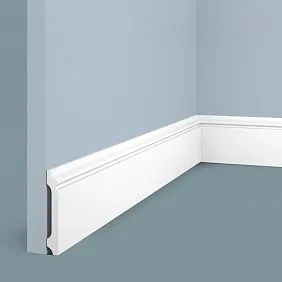
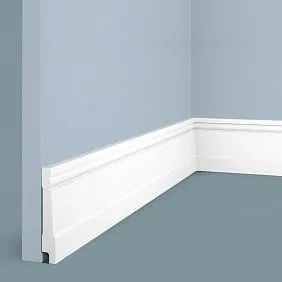
Three types of boot by niche geometry
L-shaped profiles of the 'boot' type are divided into three variants depending on the depth and size of the upper niche:
Classic boot with a narrow niche — niche depth 5–8 mm, suitable for standard thickness cladding (12–16 mm). The most common option for residential wooden houses.
Boot with a wide niche — depth 10–15 mm, for cladding thickness 20–22 mm or with significant shrinkage gaps. Used in new timber houses in the first years.
Reinforced boot with a support flange — the upper edge of the niche has a profiled cut for a specific cladding angle, holding the bottom row of cladding in plane. Used in production and industrial facilities with wooden walls.
Get Consultation
Sizes: standard and options
Standard sizes of the 'boot' profile on the Russian market:
| Vertical height | Horizontal shelf | Thickness | Application |
|---|---|---|---|
| 30 мм | 15 мм | 8 мм | Thin cladding, economy |
| 40 мм | 18 мм | 10 мм | Standard cladding |
| 50 мм | 20 мм | 12 мм | Thickened cladding, timber |
| 60 мм | 22 мм | 14 мм | Wooden house with a gap |
| 70 мм | 25 мм | 16 мм | Sauna, frame house |
Standard length of a piece — 2.5 m (STAVROS production). Some manufacturers offer 3 m — more convenient for rooms with wall lengths over 3 m (fewer joints).
Wood species for boot skirting
Wooden boot skirtingmade from different wood species — different results:
Pine — lightweight, inexpensive, easy to work with. But soft (200–300 HB): dents under mechanical impact. In log houses with coniferous paneling — a logical choice 'to match'. For saunas — only suitable in the anteroom.
Larch — the most correct choice for a skirting board in a log house and sauna. Hardness 490–580 HB, high moisture resistance, natural rot resistance. Slightly resinous at first high temperatures in the sauna — this is normal and passes.
Beech — smooth surface, beautiful uniform texture, good hardness (1200–1300 HB). For residential houses — an excellent option. For saunas and regularly damp rooms — no: beech is unstable under humidity-temperature cycles.
Oak — where maximum durability and characteristic texture are needed. An oak skirting board in a log house — a solution for 20–30 years without reinstallation. Price — corresponding.
Aspen — for saunas and steam rooms: practically resin-free, rot resistance, low thermal conductivity. A traditional choice for sauna rooms for centuries.
Abachi — exotic for professional saunas. Doesn't burn, doesn't release resin, exceptional thermal stability.
Where skirting board is used: log houses, paneling, saunas
Log house and paneling: the perfect tandem
The purpose of a skirting board — to close the lower end of the paneling and the gap to the floor simultaneously. This makes it indispensable in log houses, where paneling is the main wall finishing material.
In a timber or log house, paneling is mounted on battens with a bottom gap of 10–20 mm from the floor — this gap is necessary for ventilation behind the cladding and to compensate for wood movement. Without skirting — an ugly black gap at the base of the wall. With a cove — the gap is closed, but the lower end of the paneling is open (the end surface actively absorbs moisture). With a skirting board — the gap is closed and the end is hidden in a niche: the paneling is protected from capillary moisture rise.
This — the key functional advantage of a skirting board over a cove in relation to paneling: protection of the cladding end. A cove closes the corner, but the paneling end still 'faces' downward and is accessible for wetting. A skirting board shelters the end in a niche — the end is isolated.
Frame house: skirting board as the ideal choice
In a frame house with paneling or OSB wall cladding, the skirting board works on the same logic. A feature of frame construction — possible wall unevenness: drywall or paneling on the frame is not always perfectly vertical. The vertical plane of the skirting board adheres to the cladding along its entire height — minor deviations do not create visible gaps.
In a frame house with laminate flooring (a common combination) — the skirting board additionally closes the 10–15 mm expansion gap between the laminate and the wall, required by installation technology. Precisely for this function, the horizontal shelf of the skirting board must be wide enough: 18–22 mm — optimum.
Sauna and steam room: skirting board as a functional element
In a saunaWooden boot skirtingsolves a specific task not present in living spaces: organizing water drainage at the base of the wall.
In the washing area and steam room, water reaches the floor in significant amounts. A traditional skirting board, tightly pressed to the floor along its entire length — a water trap: it accumulates behind the skirting board against the wall and creates a constantly damp zone, a breeding ground for rot.
A skirting board in sauna execution is installed with a small gap between the horizontal shelf and the floor — 3–5 mm. Through this gap, water freely drains into the space behind the skirting board and further to the drain. No water 'pockets', no stagnation.
Wood species for sauna skirting board — larch, aspen, or abachi. Fastening — only stainless steel hardware (black screws rust in the very first season of sauna use). Coating — sauna oil or uncoated.
Combined bathrooms and wet areas in apartments
The same water drainage logic works in bathrooms: when laying wall tiles, a 'skirting board' made of moisture-resistant wood or a polyurethane equivalentKPU-series STAVROScloses the 'tile — floor' transition with a small technological gap at the base. This is a compromise between aesthetics (no open gap) and function (there is a path for water outflow).
In living spaces with underfloor water heating — wooden skirting board is not used: wood dries out under prolonged heating from below. Here — either a polyurethane equivalent or a PVC profile.
Wooden semicircular skirting board: difference from skirting board and cove
Semicircular profile: a different idea
Wooden semicircular skirting board— is a profile with a rounded front surface, the back side of which has flat surfaces for adhering to the floor and wall. Essentially — a cove with a 'convex' hypotenuse instead of concave or flat.
Cross-section of a semicircular skirting board: triangular base (like a cove) with an arc-shaped front face — semicircle or quarter circle (quadrant). Arc radius — from 10 to 40 mm depending on the standard size.
Visual character: soft, "airy", without sharp edges. Recommended where sharp corners are undesirable — children's rooms (safety), rooms in Art Nouveau or Provencal style (softness of lines), bedrooms in eco-style.
Functional character: the semi-circular profile is less functional than the 'sapozhok' — it does not form a niche for paneling, does not provide water drainage. It covers the corner and creates a soft transition — its role is limited to this.
Comparison of 'sapozhok', semi-circular, and 'galtel'
| Parameter | 'Sapozhok' | Semi-circular | 'Galtel' |
|---|---|---|---|
| Shape | L-shaped | Arc over the corner | Triangle |
| Niche for paneling | Yes | No | No |
| Covering the end of paneling | Yes | No | No |
| Water drainage (with a gap) | Yes (when installed with a gap) | No | Partially |
| Wooden house / paneling | Ideally | Not suitable | Good |
| Sauna / wet area | Yes | No | Partially |
| Visual character | Functional | Soft, decorative | Neutral |
| Installation | Slightly more difficult (corner of niche) | Simple | Simple |
The conclusion is simple: semi-circular skirting is a decorative choice for living spaces without specific requirements for paneling and humidity. 'Sapozhok' is a functional choice for wooden houses, saunas, and paneling.
Where semi-circular wooden skirting looks best
-
Children's rooms — no sharp edges, no risk of bumping
-
Bedrooms in Scandinavian and Provencal style — soft lines in the same tone as the wall
-
Studies and libraries with rounded furniture elements — visual consistency of forms
-
Verandas and summer rooms with white paint — airy, light visual weight
Wooden corner skirting: where the wall and floor junction forms a 90° angle
Wooden corner: the simplest geometry
Wooden corner skirting— is a profile with a rectangular cross-section of the 'isosceles right triangle' type or simply a rectangular batten mounted in a corner. Unlike the shoe and cove molding — both faces of the corner are straight, the front face is flat, diagonal.
The corner is the most 'honest' and geometrically clear profile for the junction of wall and floor. Its aesthetic is industrial, laconic. In a modern minimalist interior with white walls, gray concrete floors, or industrial laminate — a wooden corner creates an accent wooden line without decorative excess.
Three types of wooden corner skirting
Isosceles corner (45°×45°): legs are equal — symmetrical, adheres to wall and floor equally. Standard for rooms with a perfectly right angle (90°) between floor and wall.
Non-isosceles corner: one leg is longer than the other (e.g., 40×20 mm). Used when a larger gap near the wall needs to be covered with a small protrusion above the floor or vice versa.
Corner-cove molding (combo): externally — a corner with a flat front face, internally — small bevels for better adhesion to uneven surfaces. A compromise between the geometric precision of a corner and the practicality of cove molding.
Wooden corner skirting: key differences from shoe molding
| Parameter | Wooden corner | Wooden shoe molding |
|---|---|---|
| Cross-section | Isosceles / right triangle | L-shaped (asymmetry) |
| Niche for paneling | No | Yes |
| Application with cladding | Not optimal | Optimal |
| Visual character | Industrial, laconic | Functional, neutral |
| Wooden house | Possible (old house, even walls) | Recommended |
| Installation | Maximally simple | Slightly more complex |
| Style | Loft, minimalism | Wooden house, eco, natural |
Where a corner is more appropriate than shoe molding
-
Workshops, workrooms, garages — where function is needed without decoration
-
Commercial loft-style objects — wooden corner as an accent detail
-
Old apartments with well-established right angles — simple installation without gaps
-
Gyms and studios — simple contour without dust accumulation spots
Solid oak and beech wooden corner baseboardsSTAVROS are available in the K-series in several standard sizes — from narrow K-034 to wide functional profile.
Shoe molding installation: nail-free fastening and classic methods
Three methods for installing wooden shoe molding
Method 1: Finish nails into the floor (classic)
The most common method. Finish nails with a diameter of 1.6–1.8 mm, length 40–55 mm. They are driven through the horizontal shelf of the shoe molding into the floor at a 45° angle — this hides the nail head behind the baseboard. The heads are countersunk with a nail set and filled with wood putty to match the color.
Pros: fast, reliable, traditional. Cons: in a wooden floor — the nail may 'rise' over time due to shrinkage (solution: drive the nail deeper at an angle). In a concrete base — nails don't work, a dowel is needed.
Method 2: Liquid nails / construction adhesive (no visible fasteners)
Construction adhesive is applied in a zigzag pattern to the back surface of the shoe molding. The baseboard is pressed against the floor and wall, secured with painter's tape for 1–2 hours until cured.
Applicability condition: the wall and floor must be even — unevenness cannot be compensated by adhesive pressure. Wooden house with shrinkage — liquid nails should not be used under any circumstances.
Pros: no holes, clean surface after installation. Cons: if removal is necessary — partial damage to the floor and wall finish.
Method 3: Clips and sliding fasteners (wooden house)
In a new wooden house with active shrinkage — a sliding clip with a longitudinal slot. Principle: the clip is attached to the wall through the slot, the shoe molding snaps into the clip. During shrinkage, the wall pulls the clip down — the clip slides in the slot — the shoe molding remains in place.
The only correct method for installing shoe molding in a new log or timber house during the first 2–4 years.
Corner installation: internal and external
Internal corner (90°) for shoe molding — each plank is cut at a 45° angle. They are joined in a corner rosette. If the cut is inaccurate — a small gap is filled with color-matched acrylic sealant.
External corner — more complex: two planks are cut at 45° with the front surfaces aligned, the horizontal shelves are joined in a 'wedge'. Alternatively, a factory-made corner element is used.
Cutting tool: miter saw (miter box with a circular saw) — 45° with an accuracy of 0.5° is essential. An error of 1–2° on shoe molding due to its L-shaped cross-section creates a noticeable gap on the front face — undesirable.
Recommendations for spacing between fasteners
| Method | Fastener spacing | Distance from the end of the plank |
|---|---|---|
| Finish nails | 400–500 mm | 30–50 mm |
| Adhesive (zigzag) | Continuous | — |
| Clips | 600–800 mm | 50–80 mm |
| Dowels (concrete) | 500–600 mm | 40–60 mm |
On concrete base (screed): pre-drill ∅5–6 mm, plastic dowel, countersunk head screw through the horizontal shelf of the shoe molding. Hole — fill with putty.
Plank joints: long straight walls
For walls longer than 2.5 m (standard length of molding) — plank joints are inevitable. Rules for joining shoe molding:
-
Joint — only above a fastening point (above a nail or cleat)
-
Plank ends must be cut precisely at 90° — mandatory
-
Ends are not 'glued' with liquid nails — they are simply butted together tightly
-
When painting — the joint is puttied and painted over, disappears completely
Coating and painting of shoe molding: features of rounded and L-shaped profiles
Why applying coating to shoe molding requires attention
Wooden boot skirting— not a flat profile. It has an internal niche corner, a transition from the horizontal shelf to the vertical, possible roundings on the front face. Each of these elements is a potential zone of uneven coating application.
Risk zone 1: Internal niche corner. Paint or oil in the corner — either doesn't reach (dry spot), or accumulates (drip). Solution: a soft brush with short bristles 'works' the corner with a separate pass before applying the main coat.
Risk zone 2: Transition of planes. On the front edge, where the vertical plane transitions to the horizontal shelf — coating runs down due to gravity. Solution: apply in a thin layer, move the brush away from the edge, not towards it.
Risk zone 3: Back surface. With factory application — the back side is coated. When installing without factory coating, the back side remains uncoated. For wet rooms — this is unacceptable (pre-treatment of the back side with antiseptic or oil before installation is recommended).
Oil vs enamel for shoe molding: what to choose
Oil on wooden shoe molding — ideal for a wooden house with clapboard: the entire coating is uniform, 'alive', matte. Osmo Polyx-Oil is applied with a roller on the horizontal shelf and a brush on the vertical and niche. No risk of 'drips' in the corner — oil is absorbed, does not accumulate.
White matte enamel on shoe molding — in modern city apartments. Application rules:
-
Primer (isolating for coniferous species, acrylic for oak/beech)
-
Intermediate sanding P320
-
Enamel 1st coat (50–60% of final coverage)
-
Drying
-
Light sanding P400 (removing raised fibers)
-
Enamel 2nd coat — final
Result: uniform dense white surface without gaps or drips.
Painting shoe molding in a sauna: only specialized compounds
In the sauna roomwooden shoe moldingis coated with sauna oil (Sauna Oil) or left uncoated. Ordinary varnishes and enamels are not used in the steam room — at temperatures of 80–100°C, solvent-based coatings soften and can stick to the skin, water-based ones peel off with sudden humidity changes.
For the anteroom and washing area with temperatures up to 50–60°C — oil-wax (Osmo, BioFa) without tinting is acceptable.
FAQ: answers to popular questions about shoe molding
What is the difference between shoe molding and cove molding?
Cove molding — a triangular profile that covers the internal corner between the floor and wall. Shoe molding — an L-shaped profile with a recess that covers the corner AND the bottom edge of the paneling. Functionally, shoe molding expands the tasks of cove molding by adding protection for the paneling edge.
Can wooden shoe molding be used with laminate flooring?
Yes. The horizontal shelf of the shoe molding covers the laminate's expansion gap of 10–15 mm. Fastening — only into the wall or into the laminate gap, not through the laminate.
What size shoe molding should be chosen for standard 16 mm paneling?
The recess should be 3–5 mm deeper than the thickness of the paneling. For 16 mm paneling — recess 8–10 mm, standard shoe molding with a vertical height of 40–50 mm.
Does the back side of the shoe molding need to be treated?
Under normal living conditions — advisable, but not critical. In a sauna, kitchen, or bathroom — mandatory. Applying antiseptic or oil to the back side before installation — 15 minutes of work that prevents rotting at the point of contact with the floor.
Can shoe molding be installed without mitering corners, using end caps?
Yes. Factory-made corner end caps (internal and external corner) — plastic or wooden — are installed without mitering. This is faster and suitable for non-professional installation. However, end caps are always slightly noticeable: the joint with the strip is never perfectly invisible.
Can wooden shoe molding be installed on a heated floor?
Wooden — no. With constant heating from below, wood dries out, cracks, and deforms. For heated floors — polyurethaneKPU-molding STAVROSor PVC profile.
About the company STAVROS
STAVROS K-series wooden moldings— this is over 30 profiles made from chamber-dried solid beech and oak (moisture content 8–10%), manufactured using 3D milling and hand-sanded to P180. Among them are profiles for various tasks: from the minimalist K-034 (from 230 rub./lm) to the grand K-104 (from 6,060 rub./lm). For wet rooms, saunas, and heated floors —KPU-series polyurethane moldingwith the same classic shapes, absolute moisture resistance, and the ability to be painted in any RAL color.
To baseboards — coordinatedCarved Mouldings, KZ-series cornices, Furniture legsandstaircase components— everything in a single catalog, from one material, under one finish.
Warehouse in Moscow and St. Petersburg. Stock program — shipment from 1 piece on the day of order. Delivery throughout Russia and CIS. Samples of wooden molding — 180 rub. per set. Loyalty program for designers and architects. Specialist consultation — 8 (800) 555-46-75.
STAVROS — because even a modest shoe molding deserves a worthy wood species.