












































































Article Contents:
- GOST for Wooden Skirting Board: Standards for Dimensions, Moisture, and Processing
- Regulatory Framework: Which Standards Govern Wooden Skirting Boards
- Permissible Deviations in Cross-Section Dimensions
- Moisture requirements according to GOST
- Surface Treatment Requirements
- Wooden Skirting Board Quality Certificate: What is Checked
- Why a Certificate is Needed for a Wooden Skirting Board
- What is Checked During Certification
- What Must Be in the Certificate: Mandatory Details
- Voluntary vs. Mandatory Certification
- Solid vs. Finger-Jointed Wooden Skirting Board: Differences and Which is Better
- What is Solid and Finger-Jointed Skirting Board
- Detailed Comparison: Eight Parameters
- Why the Choice Depends on the Coating
- Finger Joint: Technology and Quality
- Wood Moisture Content: Permissible Percentage and How to Check
- Why Moisture is the Key Quality Parameter of a Skirting Board
- How to Check the Moisture Content of a Skirting Board
- Permissible Moisture Levels: Practical Scale
- First and Second Grade Defects According to GOST
- Wood Grade: What It Is
- Defects and Their Standardization
- What Grades Mean in Practice
- How to Check Skirting Board Quality When Purchasing
- Checklist: 8 Points
- Checking Upon Receiving a Large Order
- Storing Skirting Board After Purchase: Affects Quality
- FAQ: Answers to Popular Questions About GOST and Quality
- About the Company STAVROS

A buyer picking up a wooden skirting board in a hardware store typically evaluates three things: how it looks, how straight it is, and how much it costs. A professional—a builder, designer, or technical client—looks differently. They are interested in the wood's moisture content, grade class, the presence of a certificate, and the type of production: solid or finger-jointed solid wood. Because these parameters determine not 'pretty or not pretty,' but 'whether the skirting board will stand after a year or develop cracks and gaps.'
solid wood baseboard— a regulated product. It is subject to state standards, technical specifications, and mandatory safety requirements. Understanding these requirements, learning to read certificates, and checking quality when purchasing is the goal of this article. Not academic, but purely practical: knowledge of regulations protects against substandard goods and helps choose a baseboard that will last for decades.


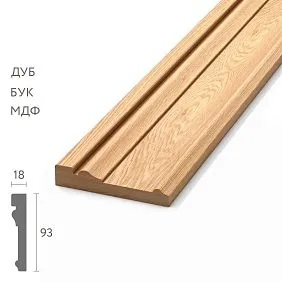

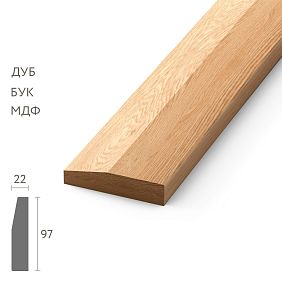


GOST for wooden baseboard: standards for dimensions, moisture content, and processing




Regulatory framework: which standards regulate wooden baseboard
Wooden baseboard is a product from the moldings group, i.e., a long-length element with a constant cross-section. Several regulatory documents apply to it, which collectively define requirements for material, geometry, surface quality, and moisture content.
GOST 8242–88 "Profile parts made of wood and wood-based materials" — the basic document for wooden moldings, including baseboards, casings, cornices, and coves. Establishes:
-
Permissible deviations in cross-sectional dimensions
-
Requirements for profile accuracy
-
Permissible defects by grades
-
Requirements for moisture content
-
Requirements for surface
GOST 2140–81 "Visible defects of wood" — a classifier of wood defects referenced by GOST 8242. This document provides definitions for knots, cracks, blue stain, resin pockets, and other defects, establishes methods for their measurement, and permissible limits.
GOST 6782.1–75 and GOST 6782.2–75 — standards for wood shrinkage and swelling. Critical when designing gaps in baseboard joints.
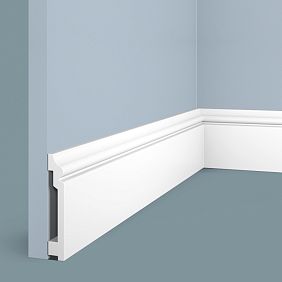
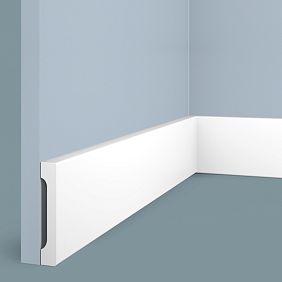
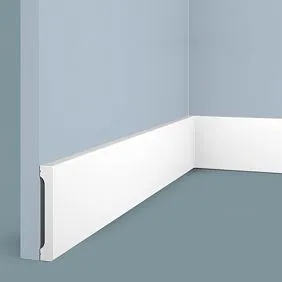
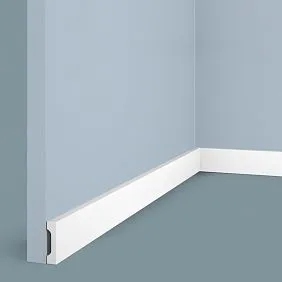
Manufacturer's Technical Specifications (TU) — supplement GOST when producing baseboard for specific profiles not covered in the basic GOST 8242. K-series profiles by STAVROS are manufactured according to the enterprise's TU, which are harmonized with GOST 8242 in all basic parameters.
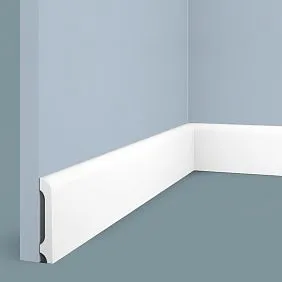
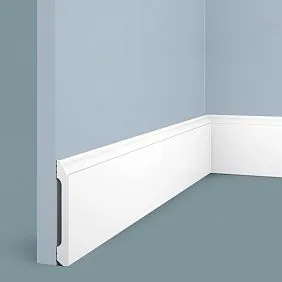
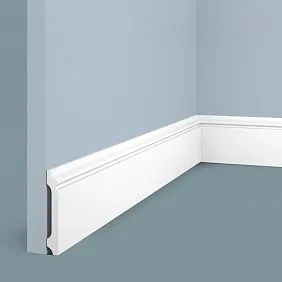
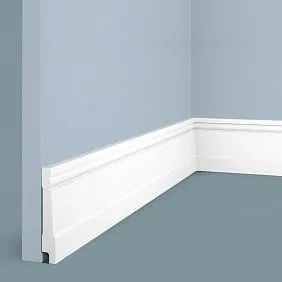
Our factory also produces:
Permissible deviations in cross-sectional dimensions
Wooden baseboard according to GOST8242–88 must meet the following geometric tolerances:
| Parameter | Permissible deviation |
|---|---|
| Section height (up to 30 mm) | ±0.5 mm |
| Section height (30–100 mm) | ±1.0 mm |
| Section height (over 100 mm) | ±1.5 mm |
| Section width (up to 50 mm) | ±0.5 mm |
| Section width (50–100 mm) | ±1.0 mm |
| Product length | +20 mm / −0 mm |
| Curvature along length | not more than 3 mm per 1,000 mm |
| Deviation of profile from template | ±0.5 mm |
The practical meaning of these numbers: if a baseboard is declared to have a height of 90 mm, the actual height should be in the range of 89–91 mm. If the measured height is 87 mm — this already exceeds the tolerance and formally constitutes a geometric defect.
Profile deviation from template ±0.5 mm is critical for batch uniformity. When assembling a long wall from multiple planks, a profile deviation of ±0.5 mm at joints will be barely noticeable. A deviation of ±1.5–2 mm is already a visible "step" at the joint.
Get Consultation
Moisture requirements according to GOST
GOST 8242-88 establishes normative moisture content for wooden profile parts depending on operating conditions:
| Operating conditions | Normative moisture content |
|---|---|
| Heated premises (apartments, offices) | 8 ± 2% (i.e., 6–10%) |
| Premises with variable heating | 10 ± 2% (8–12%) |
| Unheated premises | 15 ± 3% (12–18%) |
For residential premises — apartments, houses with constant heating — the normative moisture content of the baseboard upon shipment: 8 ± 2%, i.e., 6–10%.
Why exactly 6–10%? The average equilibrium moisture content of wood in a heated residential space under comfortable climate conditions (20°C, air humidity 45–55%) is 8–10%. A baseboard with 8–10% moisture content will neither dry out (crack, develop gaps) nor swell (warp, pull away from the wall) upon installation.
A baseboard with 15–18% moisture content (air-dried) in an apartment will dry out over a year with a 1–2% volume loss — which for a product with a cross-section of 90×20 mm means a height reduction of 0.9–1.8 mm and the appearance of cracks along the grain.
Surface finish requirements
GOST 8242-88 standardizes the surface roughness of millwork products. The Rm parameter (mean profile height) for parts:
-
For transparent coating (varnish, oil): Rm not exceeding 200 µm (corresponds to P180 sanding)
-
For opaque coating (paint): Rm not exceeding 320 µm (corresponds to P120 sanding)
In practice: a baseboard for varnish or oil should be sanded to P180 — this ensures smooth coating application without "raising the grain." A baseboard for paint — P120 is sufficient.
Wooden baseboard quality certificate: what is checked
Why a certificate is needed for a wooden baseboard
Wooden baseboard quality certificate— a document confirming product compliance with established standards. For the consumer, the certificate is a guarantee that the baseboard is made from verified raw materials, with technology compliance, and contains no harmful substances.
Why is this specifically important for a wooden baseboard? Wood is a natural material and inherently eco-friendly. But coatings, adhesives (in finger-jointed baseboards), preservatives, and treatments can be sources of volatile organic compounds (VOCs). Their content is precisely what is standardized and checked during certification.
What is checked during certification
Certification of wooden millwork products includes:
1. Physical and mechanical characteristics:
-
Moisture content (conductometric or gravimetric method)
-
Geometric dimensions and profile deviations
-
Bending strength (for load-bearing elements)
2. Environmental indicators:
-
Formaldehyde content (if adhesive was used in finger-jointing): according to emission class E1 — not exceeding 0.1 mg/m³ of room air under normal conditions
-
VOC content in the coating (if factory-applied coating is present)
-
Radiation background (for wood from regions with elevated natural radiation background)
3. Compliance with regulatory document:
-
GOST 8242-88 or enterprise technical specifications
-
Declaration of conformity or voluntary certificate
What should be in the certificate: mandatory details
A properly issued certificate for Wooden baseboard contains:
| Detail | Content |
|---|---|
| Document name | "Declaration of Conformity" or "Certificate of Conformity" |
| Product name | "Profile parts made of wood", "Wooden skirting board" |
| Regulatory document | GOST 8242-88 or technical specifications with number |
| Manufacturer | Name, address, tax identification number |
| Testing laboratory | Name, accreditation number |
| Validity period | Start and end date |
| Registration number | In the unified register of Rosakkreditatsiya |
The validity of the certificate can be checked by the registration number in the Rosakkreditatsiya register — a publicly available resource.
Voluntary vs. mandatory certification
Wooden skirting board is not included in the list of products subject to mandatory certification. This means: no mandatory certificate is required for skirting boards. However, conscientious manufacturers undergo voluntary certification — and provide a certificate or declaration upon request.
Red flag: the supplier cannot provide a certificate or declaration of conformity — meaning the product either has not undergone testing, or the results do not meet standards.
Green flag: voluntary certificate indicating the testing laboratory and tested parameters (moisture content, geometry, formaldehyde emission class E1).
Solid vs. finger-jointed wooden skirting board: difference and which is better
What is solid and finger-jointed skirting board
Solid wood skirting board— a product turned from a single piece of wood along its entire length. One skirting board strip (2.2 m) — one wooden blank without adhesive joints.
Finger-jointed wood skirting board— a product glued together from several short wooden segments ('lamellas') along the length using a finger or end-grain adhesive joint (finger joint). Visible adhesive joint seams are a characteristic feature of finger-jointed skirting.
Detailed comparison: eight parameters
| Parameter | Solid | Finger-jointed |
|---|---|---|
| Geometry stability | High (single blank) | Very high (adhesive compensates for stresses) |
| Texture aesthetics | Natural, continuous | Visible seams, texture disruption |
| Under transparent coating | Ideally | Not recommended (seams visible) |
| Under opaque paint | Good | Good |
| Cracking resistance | Medium (possible cracks along the grain) | High (adhesive holds lamellas) |
| Price | 20–40% higher | Below |
| Ecological | No adhesive | Contains adhesive (E1 class) |
| Application | Under varnish, oil, open grain | Under paint |
Why the choice depends on the finish
This is the key rule that resolves most doubts when choosing:
If the skirting board will have a transparent finish (varnish, oil, tinting) — only solid. A finger-jointed skirting board under a transparent finish reveals adhesive seams — dark transverse lines crossing the wood grain every 10–20 cm. This is aesthetically unacceptable for open grain.
If the skirting board will have an opaque paint finish (white, colored enamel) — solid or finger-jointed: not critical. Under paint, adhesive seams are not visible. A finger-jointed skirting board for painting is a rational choice: lower price for the same functional result.
Finger joint: technology and quality
Finger joint technology (finger jointing) is the joining of wooden lamellas through interlocking 'fingers' with the application of PVA or polyurethane adhesive. When properly executed:
-
The joint strength exceeds the strength of the wood itself in the transverse direction
-
Visually, with an opaque finish — indistinguishable from solid wood
-
E1 class adhesive — formaldehyde content within norm, safe for residential spaces
Poor-quality finger joint connection:
-
Adhesive applied unevenly — 'gaps' in seams
-
Lamels with defects (knots, cracks) in the joint area
-
Tooth geometry compromised — seam 'protrudes' above the plank surface
How to check: run a finger across the seam. Good connection — seam feels like a faint line, without protrusion. Poor — finger 'stumbles' over a micro-step in the seam.
Wood moisture content: permissible percentage and how to check
Why moisture content is the main quality parameter of a baseboard
Moisture content of a wooden baseboard at purchase — more important than profile, more important than wood species, more important than price. Buying a beautiful baseboard made from wet wood means guaranteed problems in 3–6 months: drying cracks along the grain, separation of joints between planks, pulling away from the wall at the bottom.
Wood is a hygroscopic material. It absorbs and releases moisture, striving for equilibrium moisture content with the environment. In a heated apartment in winter (central heating, air humidity 30–40%), the equilibrium moisture content of wood is 6–8%. A baseboard with 14% moisture content under such conditions will lose 6–8% moisture, leading to linear shrinkage across the grain.
For an oak baseboard with a cross-section of 90×20 mm and 6% shrinkage:
-
Change in height (across the grain): 90 mm × 0.3% per 1% moisture content × 6% = 1.6 mm
-
Change in width: 20 mm × 0.3% × 6% = 0.4 mm
Result: the baseboard will 'shrink' by 1.6 mm in height — and gaps in the joints will become visible.
How to check baseboard moisture content
Method 1: Electronic moisture meter. A contact moisture meter (pin-type or non-contact) is a precise tool that gives results in 3–5 seconds. Cost of a household moisture meter: from 800 to 3,000 rubles. For a professional builder or designer regularly working with wood — an essential tool.
How to use: two probe pins are inserted into the wood to a depth of 5–7 mm (not on the surface — the surface layer is always drier than the core). The reading is the actual moisture content of the solid wood.
Method 2: Gravimetric (laboratory). Accurate but time-consuming. A sample is weighed (mass M1), dried in an oven at 103°C to constant mass (M0), then weighed again.
W = \frac{M_1 - M_0}{M_0} \times 100\%
This method is used in official tests for GOST compliance.
Method 3: Tactile (estimative). Not precise but works with obvious discrepancies. Signs of a wet baseboard:
-
Noticeable 'coolness' to the touch (moisture cools the surface)
-
Ends of the plank slightly darker (wet wood is darker than dry)
-
On a fresh cut — a feeling of 'dampness'
-
Plank feels slightly heavier than expected for its volume
Permissible moisture content levels: practical scale
| Moisture Content | Assessment | Recommendation |
|---|---|---|
| 6–10% | Norm per GOST, kiln-dried | Buy, install |
| 10–12% | Acceptable | Acclimate indoors for 2–3 weeks before installation |
| 12–15% | Enhanced | Acclimate indoors for 4–6 weeks, risk of small cracks |
| 15–18% | Air drying | Not recommended for living spaces |
| Over 18% | Green wood | Cannot be installed |
Baseboard acclimatization before installation: even baseboard with normal moisture content (8–10%) should 'rest' indoors for 3–5 days before installation. This equalizes the temperature and humidity of the baseboard with the specific room conditions and prevents deformation immediately after installation.
First and second grade defects per GOST
Wood grading: what it is
GOST 2140–81 classifies wood defects and establishes their permissible limits for products of various purposes. For millwork products (baseboards), GOST 8242–88 establishes two grades: first and second. The difference between them lies in the permissible sizes and quantity of defects.
Defects and their standardization
Knots:
| Knot type | First grade | Second grade |
|---|---|---|
| Healthy light intergrown | Permitted up to 1/3 of the part width | Permitted up to 1/2 of the width |
| Healthy dark intergrown | Permitted up to 1/4 of the width | Permitted up to 1/3 of the width |
| Non-intergrown | Not permitted | Individual ones up to 10 mm are permitted |
| Rotten | Not permitted | Not permitted |
Cracks:
| Crack type | First grade | Second grade |
|---|---|---|
| Lateral surface | Permitted up to 1/4 of the part length | Up to 1/2 of the length |
| Through (across entire cross-section) | Not permitted | Not permitted |
| End | Allowed up to 2% of length | Up to 5% of length |
Blue stain and fungal discolorations:
| Defect | First grade | Second grade |
|---|---|---|
| Blue stain (surface) | Not allowed | Allowed in limited volume |
| Deep fungal discolorations | Not permitted | Not permitted |
Resin pockets (for coniferous species):
-
First grade: length up to 50 mm, no more than 2 pieces per 1 lm
-
Second grade: length up to 100 mm, no more than 3 pieces per 1 lm
For oak and beech (STAVROS) resin pockets are uncharacteristic — these species do not contain resin canals.
What grades mean in practice
First grade — skirting board without visible defects, ideal for open grain (varnish, oil). Second grade — skirting board with permissible defects, optimal under opaque paint: defects are hidden.
Important: both grades comply with GOST, neither is "reject". The difference is only in the area of application.
When purchasing from a manufacturer, clarify the grade. "First grade for oil" and "second grade for paint" — no more and no less. Paying extra for first grade when painting is money down the drain.
How to check skirting board quality when purchasing
Checklist: 8 points
When you holdsolid wood baseboardin your hands before purchase — these eight actions will take three minutes, but can save days of work and thousands of rubles.
1. Straightness. Place the plank on a flat surface or press it against a wall. Visually assess curvature along the length. GOST norm: no more than 3 mm per 1,000 mm. For a 2.2 m plank — maximum deviation from straight line 6.6 mm. Anything more is reject due to curvature.
2. Cross-section geometry. Use calipers or a square — check at two–three points along the length. Height deviation over 1.5 mm from the declared cross-section — violation of GOST.
3. Profile (for shaped profiles). Press the plank against a sample or an already purchased plank of the same article. The profile should match without a "step". Discrepancy over 0.5 mm — reject due to profile.
4. Surface. Run your palm over the face side. The surface should be smooth, without fuzz, without tool marks (crosswise wave from the tool). Face side — P180. Back side — P80–P120 (not finely sanded, this is normal).
5. Moisture content. If you have a moisture meter — measure at two–three points. Without it — tactile assessment (coldness, "dampness" of the end).
6. Defects on the face side. When purchasing for transparent coating — carefully inspect the face side: knots, cracks, blue stain. All this is permissible according to second grade norms, but unacceptable under varnish or oil if clean grain is important.
7. Ends. Inspect the ends of the plank: cracks on ends are allowed up to 2% of length (i.e., up to 44 mm for a 2.2 m plank). Longer end cracks — potential source of chipping when cutting.
8. Marking. On the bundle or a separate sticker should be indicated: species, grade, article (profile), moisture content, length, GOST or TU. Absence of marking — reason to request product documentation.
Inspection upon receiving a large order
When receiving a wholesale batch, check 5–10% of planks from each bundle as a sample:
-
Moisture: using a moisture meter, take 3 measurements per plank
-
Geometry: measure 2–3 planks from each bundle
-
Defects: quick inspection of the front side
If systematic violations are detected (more than 10% of planks with defects) — file a claim for the entire batch.
Storage of skirting boards after purchase: affects quality
A properly purchased skirting board with 8–10% moisture content can be 'ruined' by improper storage. Before installation:
-
Store in a closed room with normal air humidity (40–65%)
-
Do not store in a basement, bathroom, or near heat sources (radiator)
-
Do not store in a horizontal stack without spacers — the bottom planks will warp under pressure
-
Lay horizontally on spacers with a spacing of 50–60 cm: wooden slats 25–30 mm between layers
FAQ: answers to popular questions about GOST and quality
Should I require GOST when purchasing wooden skirting boards?
Yes, but not in the sense that 'the skirting board must have GOST marking.' What's more important is that the manufacturer can provide a declaration of conformity (voluntary), which specifies the verified standard. If the manufacturer operates according to its own technical specifications (TU) — that's fine, as long as the TU are harmonized with GOST 8242 in key parameters (moisture, geometry, surface quality).
What is the difference between 'Standard class' and 'Prestige class' skirting boards?
This is an internal classification by manufacturers, not a GOST standard. Typically, 'Standard' corresponds to the second grade of GOST (defects are allowed), while 'Prestige' corresponds to the first grade (no visible defects). Confirm the specific correspondence with the manufacturer.
Can I use spliced skirting boards in a children's room?
Yes, provided that the glue used in splicing is certified for emission class E1 (no more than 0.1 mg/m³ of formaldehyde). Most modern PVA and polyurethane wood glues comply with E1. Requesting confirmation from the manufacturer is a reasonable requirement.
How to visually distinguish oak from beech in a finished skirting board?
Oak: large radial pattern (wide medullary rays visible on the radial cut as silvery 'mirrors'), yellowish-brown hue. Beech: fine, uniform pattern, more homogeneous tone, pinkish or beige hue. Under opaque paint — it is practically impossible to determine the wood species from a finished skirting board.
What to do if the purchased skirting board develops cracks two weeks after installation?
Photograph the defect, keep the purchase documents. Cracks within the first weeks are almost always due to excessive moisture in the skirting board during installation. This is a manufacturing defect, giving grounds for a claim. Contact the seller with a demand for replacement or refund.
About the company STAVROS
When it comes to certificates and compliance with standards — it's not bureaucracy, but the foundation of trust.Wooden skirting board K-series STAVROSis made from solid oak and beech kiln-dried to 8–10% moisture content in accordance with the enterprise's technical specifications, harmonized with GOST 8242–88. Controlled production microclimate (temperature 20–24°C, air humidity not less than 40%) ensures consistent geometry and surface quality from batch to batch.
All products undergo quality control before shipment. A declaration of conformity is provided upon request. Two quality levels — Standard and Prestige — allow selecting skirting boards for any type of finish: for painting or to showcase the natural wood texture.
In the unified STAVROS wooden decor system:carved wooden casingsmade from the same solid wood,KZ-series cornices, decorative rose outlets, Wooden furniture handles— unified quality standard, unified wood species, unified tone.
Samples: 180 rub./set (credited towards order). Consultation, documentation, order placement: 8 (800) 555-46-75.
STAVROS — quality confirmed not by words, but by parameters.


