Article Contents:
- Oak — Premium Material for Wooden Skirting Boards: Hardness and Durability
- Oak Hardness on the Janka Scale: What It Means in Practice
- Oak Density and Its Implications
- Durability: How Long Does an Oak Skirting Board Last
- Oak Texture: Radial and Tangential Cuts — Differences
- Anatomy of Oak Texture
- Radial Cut Oak Skirting Board
- Tangential Cut Oak Skirting Board
- How to Identify the Cutting Method When Purchasing
- Bog Oak and Whitewashed Oak — Modern Color Solutions
- Dark Bog Oak: History and Technology
- Whitewashed Oak: Modern Neutral Tone
- Tinted Oak: Gray, Tobacco, Coffee
- Oil-Wax Finish: How to Enhance the Texture
- Chemistry of Oil-Wax: Components and Purpose
- What Oil-Wax Does to the Oak Surface
- Matte vs Semi-Matte Finish: Visual Effect
- Application Technology of Oil-Wax on Oak Skirting Board
- Oak Skirting Board with Oak Parquet Board — Perfect Match
- Why Oak to Oak Works Best
- Tonal Coordination of Skirting Board with Parquet Board
- Technical Nuance: Expansion Gap
- Oak Skirting Board with Chamfer — Modern Euro Profile
- What Is a Chamfer and Why It's Relevant
- Euro Profile: Parameters of Modern Skirting Board
- Skirting Board with Chamfer and Parquet Board with Chamfer: Visual Harmony
- Oak Skirting Board Price — What Determines the Cost
- Cost of Oak Raw Material
- Cost of drying and aging
- Processing Cost
- Final price-to-value ratio
- European and Russian oak: is there a difference
- Oak wooden decor system: skirting board as part of the whole
- FAQ - answers to popular questions
- About the Company STAVROS

There are materials that need no advertising. Oak is one of them. Millennia of presence in architecture, furniture, shipbuilding, and winemaking have forged a reputation that needs no explanation—it only needs to be understood. And when it comes tooak wooden skirting board, this reputation works at full strength: it's not just a finishing element, it's a choice in favor of durability, beauty, and the material's integrity.
Oak wooden skirting board—a category sought by people who have made a principled decision. Not 'which skirting board to buy,' but 'I want oak—tell me about it in detail.' This article is for them. We'll cover everything: from the physics of hardness to the metaphysics of texture, from the chemistry of oil-wax to the geometry of profiles, from the difference between European and Russian oak to an honest conversation about price.





Oak—a premium material for wooden skirting board: hardness and durability
Why oak? Not because 'expensive means good.' But because the physical properties of this species match the tasks of a skirting board as an architectural element at the base of a wall with the precision of an engineering calculation.




Oak hardness on the Janka scale: what it means in practice
The Janka scale—a standard for measuring wood hardness, widely used in flooring and architectural element production. Measurement is done by the force required to press a steel ball 11.28 mm in diameter halfway into the wood surface. Result—in pound-force (lbf) or newtons (N).
Pedunculate oak (Quercus robur)—European oak, standard for the Russian market: Janka hardness 1290 lbf (5740 N). Sessile oak (Quercus petraea)—a close species, slightly denser: about 1350 lbf.
For comparison:
| Species | Janka Hardness (lbf) | Application |
|---|---|---|
| Scots pine | 380–420 | Budget skirting board, construction wood |
| Birch | 1260 | Skirting board, mid-range parquet |
| European oak | 1290 | Premium skirting board, parquet |
| Ash | 1320 | Skirting board, sports parquet |
| Black locust | 1700 | Highly competitive species for extreme loads |
| Teak | 1155 | Exotic wood, decking wood |
Hardness of 1290 lbf has a specific consequence for a skirting board: an accidental kick, sliding contact from a chair leg, a vacuum cleaner bump—none of these will leave a dent on an oak skirting board. Where a pine skirting board would show a characteristic dent after the first interaction with furniture, an oak one will maintain the profile geometry unchanged.
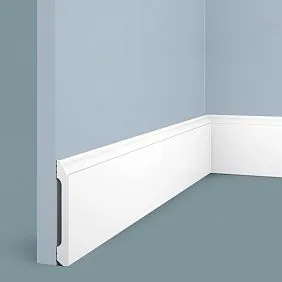
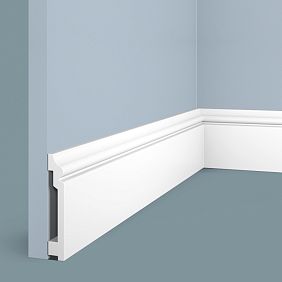
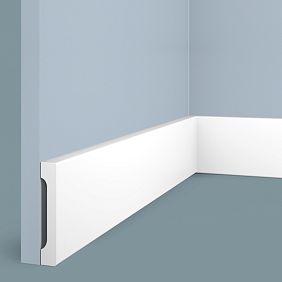
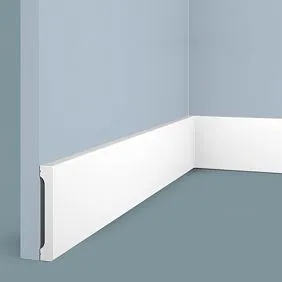
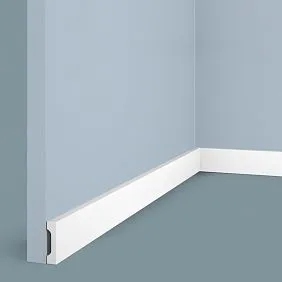
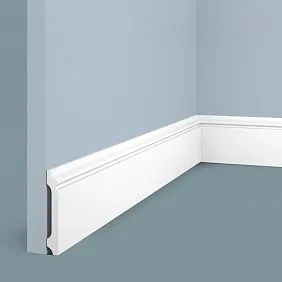
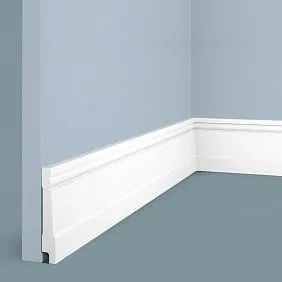
Our factory also produces:
Oak density and what follows from it
Oak density at 12% moisture content: 680–750 kg/m³. This is about 40–50% denser than pine. What this gives the skirting board:
-
Profile rigidity: a wide oak skirting board 100 mm with a 16 mm thickness does not 'sag' between fastening points even with a 500 mm cleat spacing
-
Stability: dense wood reacts slower to humidity changes—risk of warping and cracking is significantly lower than with softwoods
-
Acoustics: dense wood dampens vibration—an oak skirting board doesn't 'clap' when accidentally hit, the sound is dull, 'solid'
One nuance from installation practice: oak density means that a finishing nail without pre-drilling will deform the skirting board end. For an oak skirting board, a thin pilot hole 1.5–1.8 mm is always drilled before hammering a nail. Or cleat fastening is used—which is even more convenient.
Get Consultation
Durability: How Long Does an Oak Skirting Board Last
Under normal operating conditions (residential premises, humidity 40–60%, temperature +18–25°C) and with oil or acrylic paint coating —oak wooden skirting boardlasts 25–40 years without replacement. This is comparable to the service life of the apartment itself between major renovations. PVC skirting board service life: 8–12 years (after which — yellowing, cracking, deformation at corners). MDF skirting board: 10–15 years (provided no mechanical damage and normal humidity).
An oak skirting board is an investment that, with proper care, outlasts any flooring in the same room.
Oak Texture: Radial and Tangential Cut — Differences
Oak is a species with a characteristic and recognizable texture. But 'oak texture' is not a single picture. Depending on the method of sawing the log, the same oak produces fundamentally different visual effects.
Anatomy of Oak Texture
Oak has three distinctive visual elements that make it recognizable:
Large vessel pores. Oak is a ring-porous species. Early (spring) wood has large vessels, clearly visible to the naked eye. On the surface of the skirting board, they create a characteristic pattern of 'open pores' — small grooves along the annual rings.
Medullary rays. Oak has wide medullary rays — cells that transport nutrients radially from the center to the bark. On the cut surface, these rays appear as light 'mirrors' or 'marble veins' — a characteristic element of oak texture.
Annual rings. The alternation of early and late wood creates a striped pattern, the intensity of which depends on the cutting method.
Radial Cut of Oak Skirting Board
Radial cut (quarter-sawn) — lumber obtained by sawing the log so that the annual rings are perpendicular to the wide plane of the board (angle 60–90°).
Appearance: fine, uniform grain pattern. Medullary rays are maximally exposed — light 'silky' veins are clearly visible on the surface, giving the oak a special 'moire' sheen.
Practical properties:
-
Minimal shrinkage and swelling (2–3% across the grain vs. 4–5% for tangential)
-
Maximum stability with changes in humidity
-
Minimal risk of warping and cracking
For skirting board: radial cut is the optimal choice in terms of stability. A skirting board made of radial-cut oak is less responsive to seasonal humidity fluctuations. Visually — uniform, calm, 'silky' texture.
Tangential Cut of Oak Skirting Board
Tangential cut (flat-sawn) — lumber obtained so that the annual rings are parallel to the wide plane (angle 0–30°).
Appearance: large, 'lively' pattern — loops, arcs, and waves of annual rings. This is that 'classic' oak texture that most people imagine when thinking of oak: large wavy stripes, dynamic pattern.
Practical properties:
-
Greater shrinkage across the grain
-
More pronounced reaction to humidity changes
-
More 'lively' behavior — the skirting board reacts slightly more actively to seasonal changes
For skirting board: tangential cut provides a more decorative result — expressive texture looks good on a wide skirting board 80–120 mm. For a wooden skirting board, oak with a tangential cut is suitable provided proper drying (moisture content 8–10%) and a coating that stabilizes wood movement.
How to Determine the Cutting Method When Purchasing
Look at the end of the skirting board: if the annual rings are perpendicular to the face surface (or close to it) — radial cut. If the annual rings are parallel to the face surface or run in an 'arch' — tangential.
On the face surface: fine uniform pattern + 'silky' veins = radial. Large arcs and waves = tangential.
Bog oak and whitewashed oak — modern color solutions
Natural oak is a warm golden-honey tone with a slight yellowish tint. It's a classic. But modern interiors demand greater variety, and oak responds to this demand with a wide palette of treatments.
Dark bog oak: history and technology
Bog processing (mordanting) is one of the oldest methods of treating oak. A natural process: oak that has lain in the water of lakes or swamps for hundreds of years acquires a dark, almost black color — it is called bog oak. The reason: water rich in iron ions reacts with the tannic acids in the oak and forms a black chemical compound — iron tannate.
Modern technology for bog processing of oak skirting boards reproduces this reaction: the surface is treated with a solution of iron sulfate (ferrous sulfate) or iron acetate. The reaction with the wood's tannic acids occurs over several hours — the wood darkens from within, without applying paint.
What bog processing gives to an oak skirting board:
-
Deep dark gray, dark brown, or almost black tone
-
Preservation of the natural grain (this is not painting — the pigment is inside the wood)
-
Increased material value: bog oak looks 'aged', with history
-
Color durability: it does not 'sit' on the surface and does not peel off
After bog processing, the skirting board is coated with oil or wax — the tone is fixed and revealed.
Whitewashed oak: a modern neutral tone
Whitewashed oak is an oak skirting board with a coating based on white oil or white pigmented oil-wax. Technology: oil with white pigment (titanium dioxide) penetrates the open pores of the oak, filling them — the wood acquires an ashy-white, milky, or grayish-white tone while preserving the visible grain.
This fundamentally differs from white paint: paint creates a film on top of the wood, hiding the grain. White oil 'lives' in the wood — the grain is visible, the wood breathes, the tone is delicate, not 'shouting'.
Application of whitewashed oak skirting board:
-
Scandinavian style (white + wood + light floor)
-
Modern neoclassicism (grayish-white tone that 'works' with gray walls)
-
Provence and country (milky tone with visible wood grain)
Tinted oak: gray, tobacco, coffee
In addition to bog and whitewashed — a wide palette of tints:
-
'Gray oak': oil with gray pigment. A cool, modern tone — ideal for interiors in minimalist, loft, Scandinavian styles.
-
'Tobacco': a warm, rich brown — between honey and dark. A classic 'library' tone for English and classic interiors.
-
'Coffee': medium-dark brown with a reddish tint. A cozy, 'warm' tone for living rooms and bedrooms.
-
'Wenge': dark brown, almost black without bog processing — achieved with dark oil.
All these tones are a coating of oil-wax with pigment on a natural oak skirting board. The oak grain always remains readable — the oil does not hide the wood but reveals it.
Oil-wax coating: how to emphasize the grain
Oil-wax coating is not just a protective layer. It is the final 'dialogue' with the material: it is the oil that decides how the oak will appear to the observer.
Chemistry of oil-wax: what's in it and why
Oil-wax for wood is a mixture of several components:
Oils: linseed (polymerizes in the wood, creating a flexible elastic film), tung (fast-drying, provides strong protection), Carnauba oil (a hard natural wax-like oil from the Brazilian palm).
Waxes: carnauba wax (hardness, gloss, water repellency), beeswax (matte finish, plasticity), montan wax (synthetic, for hardness and wear resistance in some formulations).
Solvent (drier): in traditional formulations — white spirit or naphtha; in modern eco-friendly ones — isobutanol or organic acids. For children's rooms and living spaces — formulations without aromatic solvents.
Pigments (in tinted oils): inorganic pigments (iron oxides for brown, yellow, red tones; titanium dioxide for white; lamp black for black).
What oil-wax does to an oak surface
The oil penetrates the wood structure — into cells, pores, intercellular spaces — to a depth of 1–3 mm. Polymerizing inside, it creates a 'reinforced' structure: the wood remains wood, but with improved physical characteristics.
What the oil provides:
-
Water repellency: water beads up and rolls off the surface without being absorbed
-
Protection from dirt: pores are sealed — dirt cannot penetrate the structure
-
Stabilization: the oil reduces wood's hygroscopicity — the skirting board reacts more slowly to humidity changes
-
Texture enhancement: the oil accentuates the contrast between earlywood and latewood, makes oak's 'silky' medullary rays more expressive
What the wax does:
-
Creates a 'slippery' protective surface — dirt doesn't 'stick'
-
Regulates the degree of gloss (the wax-to-oil ratio affects matte finish)
-
Increases the hardness of the surface layer
Matte vs semi-matte finish: visual effect
Matte (2–5% gloss): surface is 'velvety', without glare, with maximally 'lively' texture. Under lighting — no mirror reflections, only wood texture. Preferred for classic and Scandinavian interiors, for rooms with multiple light sources.
Semi-matte (15–25% gloss): slight surface glow. Texture is well-defined, but at certain lighting angles — a delicate 'pearly' highlight. Works well in dark classic interiors where you need to 'enliven' dark skirting.
Satin (30–40% gloss): pronounced shine, textural pattern is clearly visible. For modern interiors with active lighting.
Application technology for oil-wax on oak skirting
Step-by-step process for application before installation (optimal option):
-
Surface sanding P150, then P220 — along the grain. Cross-grain scratches will create 'highlighting' in the transverse direction after oil application.
-
Degreasing: wipe the surface with a cloth slightly dampened with white spirit or isopropanol. Let dry for 15 minutes.
-
Applying the first coat of oil: thin, even layer with a brush or fabric applicator — along the grain. Let absorb for 15–30 minutes.
-
Removing excess: with a microfiber cloth, rub the oil along the grain, removing all unabsorbed residue. This is a key step: unabsorbed residue will dry and create a 'sticky' surface.
-
Drying the first coat: 12–24 hours at +20°C.
-
Sanding raised grain: P320 along the grain. This removes the 'fuzziness' that the first coat of oil causes on oak.
-
Applying the second coat: same process. The second coat goes onto the prepared structure and gives the final result.
-
Drying: 24–48 hours until fully cured.
After this, the skirting is ready for installation.
Oak skirting for oak parquet flooring — the perfect match
The most organic combination in a wooden interior isOak wooden skirting boardpaired with flooring boards made from the same wood species. This isn't just an aesthetic choice—it's a material unity.
Why oak with oak works best
When the baseboard and flooring are made from the same species, they react similarly to changes in humidity and temperature. Oak 'expands' by the same amount in both the baseboard and the flooring—the thermal gap between them remains stable. If you use a baseboard made from a different species (for example, a pine baseboard with oak flooring), species with different expansion coefficients can create stress at the joint.
Additionally: visual unity of the wood species creates 'honesty' in the interior. When the floor, baseboard,door casingsare made from the same oak, it reads as a deliberate design decision, not a random assortment of details.
Tonal coordination of the baseboard with the flooring board
Flooring boards today come in a huge range of tones. The task is to coordinate the tone of the baseboard and the floor. The principle:
Baseboard matching the floor tone: an oak baseboard under oak flooring with a similar tone. The floor 'continues' onto the baseboard, the boundary is minimal. A monolithic solution, good for large rooms.
Baseboard 1–2 tones darker than the floor: a classic ratio. The baseboard 'holds' the lower zone, creating a 'frame' for the floor. Suitable for classic and neoclassical interiors.
Baseboard lighter than the floor: a more modern approach. Dark flooring + light baseboard—a contrast where the baseboard acts as a divider between the dark floor and the wall.
White baseboard with any oak flooring: a universal neutral solution. Works in most styles, from Scandinavian to contemporary.
Technical nuance: expansion gap
Flooring boards are installed with a technological gap of 8–12 mm from the wall. The baseboard is installed over this gap, covering it. The oak baseboard is attached only to the wall (not to the flooring board!)—this allows the flooring to move freely during expansion. Clip mounting is the ideal option: the baseboard is held on the wall and does not rigidly contact the flooring.
Oak baseboard with a chamfer—a modern Euro-profile
Alongside classic shaped profiles, there is a modern minimalist format gaining popularity in European interiors: oak baseboard with a chamfer.
What is a chamfer and why is it relevant
A chamfer is a flat cut at a specific angle (usually 45°) on the top edge of the baseboard. As a result, instead of a right angle (90°), there is a beveled plane 5–15 mm wide.
Visual effect of the chamfer: it creates a delicate play of shadows along the top edge of the baseboard—a thin dark line that 'separates' the baseboard from the wall. This line is so subtle it doesn't shout for attention, but adds visual completeness to the profile—the baseboard doesn't 'cut into' the wall at a blunt angle, but 'recedes' into it with a soft slope.
Euro-profile: parameters of a modern baseboard
The modern 'Euro-profile' for oak baseboards includes:
-
Rectangular cross-section (without classic curves and fillets)
-
Chamfer on the top edge at 45°, width 8–12 mm
-
Lower fillet R3 for a smooth transition to the floor (optional)
-
Thickness: 16–18 mm
-
Width: 60–80 mm (rarely 100 mm)
Such a baseboard is organic in contemporary interiors, lofts, Scandinavian style, and apartments with minimalist furniture. It 'goes unnoticed'—creates a clean horizontal line at the base of the wall without unnecessary decoration.
Baseboard with a chamfer and flooring board with a chamfer: a visual rhyme
Many modern-format flooring boards are produced with a chamfer along the perimeter of each board—it creates thin shadows between the boards, visually 'outlining' the laying pattern. A baseboard with a similar chamfer on its top edge is a direct visual rhyme with the flooring: both elements use the same technique.
This is an example of systemic design: when details aren't just 'coordinated by tone,' but also echo each other through a constructive solution.
Oak skirting board price — what determines the cost
An honest conversation about price. Oak skirting board costs more than PVC and MDF strips — and more than softwood skirting boards. Let's break down what makes up this cost.
Cost of oak raw materials
Oak is a slow-growing species. Oak suitable for processing into quality lumber grows for 80–150 years. This fundamentally distinguishes it from pine (40–60 years) and spruce (50–70 years). Slow growth forms a dense, uniform structure — and makes the raw material significantly more expensive.
Yield of quality lumber from oak logs: 30–45% of volume. The rest is bark, slabs, trimmings, sawdust. Particularly low yield for radial cut (15–25%) — this explains the higher price of radial oak skirting board compared to tangential.
Cost of drying and aging
Oak requires long drying. Kiln drying of oak lumber to 8–10% moisture — is a process lasting 4–8 weeks (depending on cross-section thickness) with strict temperature and humidity control. Forced drying of oak causes internal stresses and cracks — quality oak skirting board requires slow, careful drying.
Drying cost (electricity, equipment, time) — a significant part of the final product price.
Processing cost
Milling the profile of oak skirting board — working with hard material. Cutters wear out faster than when working with softwood. Feed rate is lower. Sanding to P320 on hard oak requires longer processing and more abrasive consumption.
All this increases production cost compared to a similar product made of pine by 40–70%.
Final price-to-value ratio
Wooden skirting board made of oak costs 2–4 times more than a PVC counterpart of the same width. But service life — 3–4 times longer. And this doesn't account for the difference in environmental quality (chemical purity of natural wood), aesthetics (live texture vs imitation) and repairability (oak can be restored, PVC — only replaced).
At the same time,solid wood millwork — not the most expensive item in renovation. Skirting board around a 15 m² room — about 50–55 linear meters (including margin). Cost difference between oak and PVC skirting board for the entire room — several thousand rubles. With a service life of 25–30 years — this is an insignificant difference in annual cost of ownership.
European and Russian oak: is there a difference
A question that regularly arises when buying: European pedunculate oak and pedunculate oak from Russian forests — are they the same? Practically yes. Quercus robur — a species widespread throughout Europe from the British Isles to the Urals. Physical characteristics — hardness, density, texture — of European and Russian oak are practically identical.
Difference — in growing conditions. Oak from Voronezh or Bryansk region, where soils are fertile, climate mild — may have a looser structure than oak from Transcarpathia or Poland, growing in harsher conditions. But this difference is insignificant for skirting board — it's critical only for cooperage production, where specific permeability requirements are placed on oak.
For skirting board, choose not 'region of origin', but parameters: moisture 8–10%, grade A or AB (without large knots and blue stain), uniform structure without obvious defects.
Wooden decor system made of oak: skirting board as part of a whole
Oak wooden skirting board — the most noticeable, but not the only element of the wooden decor system made of this species. A conscious approach to interior design implies a comprehensive solution.
Wooden moldings made of oak on walls — complete the theme started by the skirting board. Same species, same tone, same processing — a monolithic architectural image.Door architraves made of oak — vertical continuation of the skirting board: same fibers, same oil tone, same material story.Wooden furniture legs made of oak under a sofa or bed — a rhyme between the skirting board at the wall and the furniture support in the center of the room.
wooden furniture handles made of oak — the final point of the system. You open a cabinet drawer — and your hand feels the same warm, dense, 'live' material as the skirting board along the wall. The interior becomes holistic not only visually, but also tactilely.
FAQ — answers to popular questions
How does oak skirting board from radial cut differ from tangential — is it worth paying extra?
Radial cut — more stable material (less shrinkage) and rarer visual pattern (uniform with 'silky' veins). Tangential — more expressive pattern (large waves), more affordable in price. For rooms with stable climate (central heating, no sharp humidity fluctuations) — tangential skirting board works perfectly. For rooms with humidity fluctuations (country house, irregularly heated) — radial is preferable.
Can you paint oak skirting board with white acrylic paint?
Yes, but with mandatory priming with shellac sealer. Oak contains tannic acids (tannins), which through white acrylic paint without primer will cause yellowing in 6–18 months. Shellac primer blocks tannin release — white coating will remain white. Nitrocellulose or alkyd primer doesn't provide reliable isolation — only shellac.
Should the oil finish on an oak baseboard be refreshed and how often?
In residential areas with normal use — every 3–5 years. Signs it's needed: the surface has become dry-matte (water doesn't bead up but soaks in), worn spots appear. Procedure: sanding with P320, dust removal, applying oil with rubbing and drying. Takes 1–2 hours per room.
Oak baseboard in the bathroom — is it possible?
With caveats. Oak slowly deteriorates with constant water contact. Suitable for bathrooms only under these conditions: oil finish with high wax content (water-repellent), good room ventilation, no direct water splashing on the baseboard. Refresh the finish every 1–2 years. For bathrooms with poor ventilation or direct water contact with the baseboard — it's better to choose thermally modified wood or PVC.
How to remove a scratch from an oak baseboard with an oil finish?
Minor scratch: apply a drop of the same oil, rub in, let dry. Deep scratch: local sanding P150 → P220 → P320 on the damaged area, then apply oil. When spot-repairing an oil finish, the 'patch' border is almost invisible — the oil 'integrates' into the existing finish. This is a key advantage of oil over paint.
About the company STAVROS
Oak lives a long time. The tree your baseboard is made from today grew, perhaps, a hundred years ago. That's reason enough to approach the choice with respect — and choose a manufacturer who understands the material just as seriously.
STAVROS — a Russian manufacturer of architectural decor from solid natural oak and beech.Oak wooden baseboard in the STAVROS range is made from certified wood with 8–10% moisture content, kiln-dried, with P320 surface sanding — ready for application of any finish without additional preparation.
The STAVROS catalog features a complete system of oak wooden decor:baseboards and moldings, Moldings and cornices, door casings, Furniture legsandfurniture handles. One wood species, one production standard, one tonal system — for an interior where all details speak the same language.
STAVROS: wood that outlives the renovation.