












































































Article Contents:
- Minimalism Trend: Why Thin and Narrow Wooden Skirting Became the Standard of the Time
- Where Minimalism in Skirting Came From
- Thin Skirting: Parameters That Define 'Thinness'
- Narrow Skirting as an Architectural Technique
- Narrow Skirting Color: Three Strategies
- Concealed Skirting: When the Boundary Disappears
- What is Concealed Skirting and Why It Became an Icon of Modern Design
- How Concealed Skirting Works: Three Technical Options
- Pros of Concealed Skirting
- Cons and Complexities of Concealed Skirting
- Concealed Skirting and Wooden Skirting: Can They Be Combined
- Rectangular Skirting 20×40 mm: Honesty of Form as Style
- Why Rectangle is Not Simplification, But a Position
- Technical Parameters of Rectangular Skirting
- Rectangular Skirting and Parquet: Working Combinations
- Decorative Wooden Skirting: When It Becomes a Work of Art
- Decorative Skirting — A Separate Story
- Ways to Make Skirting a Decorative Element
- Decorative Skirting in the Wooden Decor System
- Loft-Style Skirting: Dark Wood, Texture, and Character
- Loft is Not 'Without Skirting'
- Processing Technologies for Loft Skirting
- Loft Skirting: Specific Combinations with Interior
- Concealed Skirting with Accent Wall and Lighting: Synergy
- Accent Wall — A Popular Technique Requiring Proper Framing
- Lighting in the Groove: How It's Done Correctly
- Wooden Skirting and Lighting: A Different Format
- Combination of Concealed Skirting with Accent Wooden Slat
- How to choose between hidden and wooden baseboards: a practical matrix
- Decision matrix by interior type
- FAQ: answers to popular questions about modern baseboard trends
- About the Company STAVROS

There are details by which an experienced designer instantly reads the level of an interior. The baseboard is one of them. Not because it's the main element of the space, but because it's precisely in the baseboard that the approach is revealed: whether the designer thought of the space as a whole — or simply 'covered the wall gap with whatever was found.'
Trends of the last decade in baseboard treatment — this is a story about how design learns to be silent. Less is more.Thin wooden baseboardinstead of the Soviet rounded one. Hidden baseboard in a groove instead of surface-mounted. Rectangle instead of shaped profile. Dark wood instead of white paint. Lighting instead of a visible baseboard altogether.
But this doesn't mean classic is dead. It means that today the choice has become conscious: each style has its own baseboard, and choosing correctly means accurately capturing the character of the space.


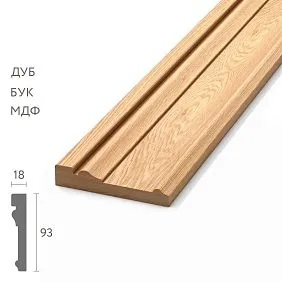

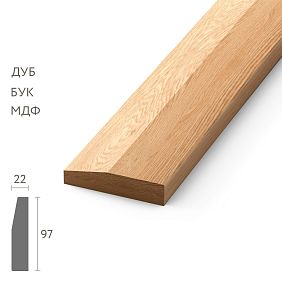


Minimalism trend: why thin and narrow wooden baseboard has become the standard of the time




Where minimalism in baseboards came from
Minimalism in interior design is not a recent fashion. It's a movement with deep roots in Japanese aesthetics of 'ma' (emptiness as value), in Scandinavian tradition of functional beauty, in German Bauhaus with its cult of honest form. When this wave swept over Russia — which happened around 2010–2015, when IKEA, Pinterest, and Instagram came to the country en masse — the concept of a 'beautiful baseboard' began to change.
The Soviet rounded baseboard at 60 mm — is loud. It's visible at the wall. It 'speaks.' In an interior built on silence and clean planes — it's unnecessary noise.
Narrow wooden baseboardat 20–40 mm — whispers. Or remains silent altogether, painted the color of the wall. That's exactly what a minimalist space needs.
Our factory also produces:
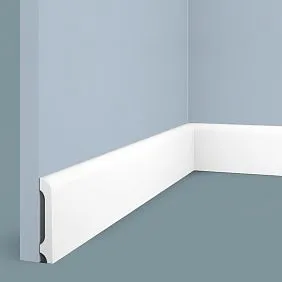
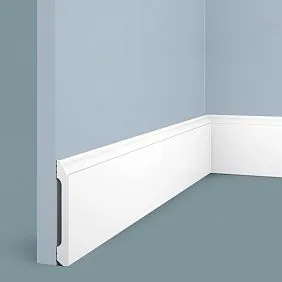
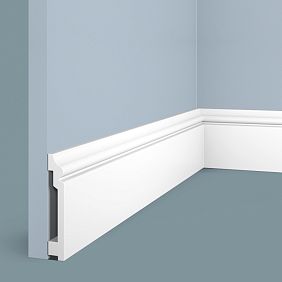
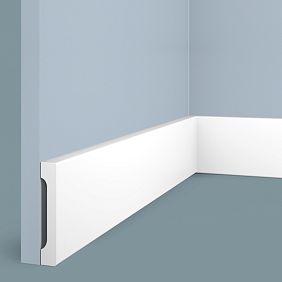
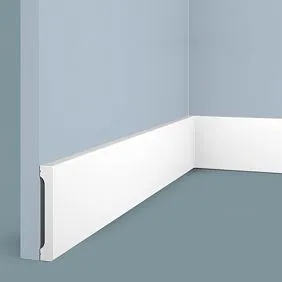
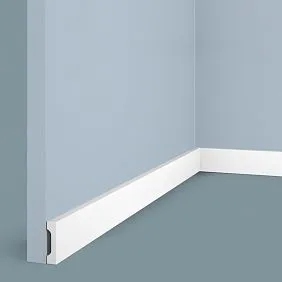
Thin baseboard: parameters that define 'thinness'
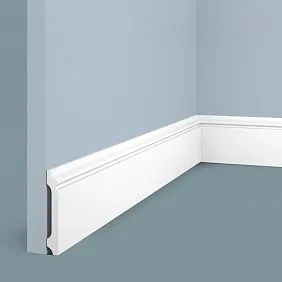
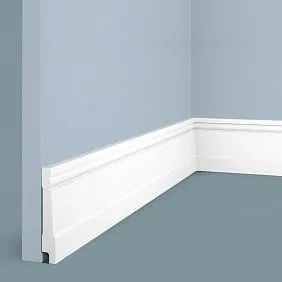
'Thin' in relation to a baseboard — is not only height, but also thickness. Classic has a thickness of 18–25 mm. ModernThin wooden baseboard— 10–15 mm, sometimes 8 mm. With a height of 40 mm and thickness of 12 mm — the baseboard presses against the wall as an almost imperceptible strip.
Why such thinness? It's about proportion. A thin baseboard doesn't 'detach' the floor from the wall, but gently marks the transition. The space is perceived as a single volume — without horizontal breaks at the base of the wall.
Technical parameters of thin baseboard:
| Parameter | Classic | Thin minimalist |
|---|---|---|
| Height | 55–100+ mm | 20–45 mm |
| Thickness | 18–25 mm | 8–15 mm |
| Weight (per meter) | 0.8–1.2 kg | 0.2–0.4 kg |
| Profile | Rounded, multi-step | Rectangular, bevel 1–2 mm |
| Fastening | Dowels, liquid nails | Liquid nails, finishing nails |
| Finish | Any | Usually matching the wall color or contrasting |
Get Consultation
Narrow skirting as an architectural technique
Paradox: sometimes designers use a tall narrow skirting — for example, 80×12 mm — precisely to visually 'raise' the ceiling. The thin tall strip along the wall creates a vertical rhythm. The gaze slides upward, rather than stopping at the base of the wall.
This is the opposite of Soviet logic: there, a wide skirting 'grounded' the interior, gave it stability. The modern thin tall version — 'stretches' the space.
Color of narrow skirting: three strategies
Matching the wall color. The most popular strategy in Scandinavian and minimalist interiors. White skirting on a white wall — it's almost invisible. No horizontal break, the wall 'flows' to the floor. Effect — the space appears larger.
Matching the floor color. The skirting is painted to match the parquet (oak, ash, walnut). Creates the feeling that the floor 'extends' onto the wall. A warm and cozy effect.
Contrasting. Dark skirting on a light wall — a graphic line at the base. An architectural accent without additional elements. Works in loft, modern classic, Japanese style.
Hidden skirting: when the boundary disappears
What is hidden skirting and why it became an icon of modern design
Hidden (recessed) skirting is a fundamentally different concept. Instead of an overlay element on the wall — a groove, a milled slot in the lower part of the wall, recessed to a depth of 10–15 mm. The floor meets the wall, and at the base of the wall — a shadow, a dark gap, a visual break. No physical skirting — only the shadow from the groove.
The effect is magical: the wall 'floats' above the floor. The heaviness of the structure disappears. The space becomes light — even if it's a small apartment.
This technique comes straight from premium architecture of the 2000s. Scandinavian and Dutch architectural firms actively used it in residences and museum spaces. By 2015–2020, it became available in Russian renovations of 'comfort+' level.
How hidden skirting works: three technical options
Option 1: Groove in plaster or drywall.
In the lower part of the wall, at a height of 10–15 mm from the finished floor level, a horizontal groove is formed with a depth of 10–15 mm and a height of 10–20 mm. The groove is painted black or dark gray — creating a shadow. The floor fits tightly to the wall. On top — no skirting.
This is the most budget-friendly option for hidden skirting: only a properly executed plaster groove + painting. The difficulty — precision in making the groove: if the groove is not straight or done after laying the floor, the result will be sloppy.
Option 2: Metal profile for hidden skirting.
A special aluminum or steel profile, embedded in the plaster during rough finishing. After the final wall covering — only the gap and a thin metal strip are visible. Clean, precise execution. Requires planning at the rough finishing stage.
Option 3: Hidden skirting with lighting.
A groove in the lower part of the wall, into which an LED strip is placed. Bottom lighting: the floor glows with a strip at the base of the wall. Effect — weightlessness, the interior 'floats'. Used in bedrooms, living rooms with zoning, in hallways.
Pros of hidden skirting
-
Visual lightness. The space is perceived as larger and lighter — especially critical for small apartments.
-
No problem of 'skirting vs. floor joint'. Any irregularities in laying parquet or tiles are hidden in the groove.
-
No dust collector. Traditional skirting is a trap for dust at the base. The hidden groove is easy to vacuum.
-
Endless clean line. No corner joints of skirting, no places where 'they didn't align' — only a smooth horizontal groove along the entire perimeter.
Cons and difficulties of hidden skirting
-
Only at the rough finishing stage. Installing a recessed skirting board into a finished finish is practically impossible without redoing it. It's an element of planning, not a finishing solution.
-
Requires perfectly flat walls. Any deviation from the wall's verticality results in an uneven groove or visible gap. Recessed skirting boards are merciless to plaster quality.
-
Cost. The metal profile for a recessed skirting board + the labor for its installation is more expensive than a standard surface-mounted one.
-
Incompatible with a wooden house experiencing shrinkage. A recessed skirting board in a log or timber house with active shrinkage does not work: the wall moves, and the groove changes size.
Recessed skirting board and wooden skirting board: can they be combined
Yes — and it's one of the most sophisticated design techniques of recent years. A recessed groove in the main part of the room +decorative wooden skirting boardin niches, by the fireplace, by a built-in bookshelf. Where the wall 'meets' a functional object — a wooden skirting board emphasizes the transition. Where the wall is plain — the groove creates invisibility.
Rectangular skirting board 20×40 mm: honesty of form as style
Why a rectangle is not simplification, but a position
When an architect chooses arectangular wooden skirting board20×40 mm without a single bevel or radius — it's not because 'there's no money for a profiled one.' It's a principled position: the material should speak for itself, without decorative additions.
A rectangle is the most honest form in architecture. Oak 20×40 mm, oiled, with visible wood grain texture — this is not modest. It's quietly confident. Like a man in a good linen jacket without flashy details — style is conveyed through material quality, not through ornament.
Technical parameters of a rectangular skirting board
Rectangular profile is available in a wide range of sizes:
| Section | Height | Width | Application |
|---|---|---|---|
| 10×30 mm | Minimal skirting board | The thinnest option | Scandinavian minimalism |
| 15×40 mm | Minimalist standard | Light and elegant | Modern classic, loft |
| 20×40 mm | Optimal balance | Stable, noticeable | Most modern styles |
| 20×60 mm | Tall rectangle | Architectural line | Rooms with ceilings 2.9–3.2 m |
| 25×80 mm | Wide rectangle | Monumental | Loft with high ceilings, neoclassical without ornament |
Rectangular baseboard and parquet: working combinations
Rectangular baseboard — a universal partner for parquet. Several specific combinations:
Natural oak (oil) + dark stained oak baseboard. Light floor, dark baseboard — contrast emphasizes the boundary. Works in Scandinavian and Japanese style.
Bleached ash parquet + white enamel baseboard. Almost monochrome solution. Space is maximally open and clean.
Dark walnut parquet + walnut baseboard (or dark oil). Baseboard continues the floor color — the wall 'grows' from the wooden base. Cozy, warm, organic.
Concrete microcement screed + dark 20×40 oak baseboard. Industrial floor with a living wooden baseboard — texture contrast. One of the best techniques of modern loft.
Decorative wooden baseboard: when it becomes a work of art
Decorative baseboard — a separate story
decorative wooden skirting board— it's no longer just covering the gap at the wall. It's an architectural element that shapes the character of the room. In classic interiors — a wide baseboard with a shaped profile gives 'weight' to the space. In modern ones — a decorative wooden strip at the floor creates a warm accent in an otherwise cold space.
What makes a baseboard decorative is not the profile itself, but its role in the interior. When the baseboard is the first horizontal line from which the entire space is counted, when furniture height is chosen with reference to it, when its color is taken as an accent in pillows and details — it is decorative.
Ways to make a baseboard a decorative element
Contrasting tone. Dark green or deep blue baseboard on a white wall — a technique that came from British design (Farrow & Ball, the rule of 'dados' and 'skirtings'). The baseboard acquires independent visual weight.
Carved profile as ornament. In a classic interiorcarved wooden baseboardwith a multi-step profile — full-fledged architectural decor. Combines withcarved casings STAVROSandKZ-series cornices— an architectural ensemble is created from a single solid wood of one species.
Visible texture under oil. Oak or walnut under clear oil without pigment — the fiber texture, alive, unique. Two pieces of oak from different trees — always different. This is the decorativeness of natural material.
Toning in a non-standard color. Oak baseboard, toned in gray-blue or taupe — not white and not 'wood-like'. An author's solution that makes the interior unique.
Decorative baseboard in the wooden decor system
A decorative baseboard truly works only in a system. Baseboard + door casing + ceiling cornice from one species, one batch, one finish — that's an ensemble. Baseboard by itself, MDF casing 'wood-like', polyurethane cornice 'like stucco' — that's chaos, which reads as a lack of concept.
That's why it's important thatwooden moldings STAVROSis produced in a complete system: baseboard, casing, cornice, rosette, furniture handle — one manufacturer, one species, one batch. The tone matches not 'approximately', but literally — from the same forest, same drying.
Baseboard in loft style: dark wood, texture and character
Loft is not 'without baseboards'
A common misconception about loft style: 'lofts don't have baseboards.' This is not true. Lofts don't have curved radius baseboards with white enamel. But baseboards do exist in lofts — and they are an important element of the style.
Wooden loft baseboard— is a rectangle. Wood with a pronounced texture. Dark finish. Sometimes — with a metallic texture (brushed along the grain, metallized oil). Sometimes — with an 'aged' effect (burning, brushing).
Processing technologies for loft baseboards
Brushing. A special metal brush removes the soft wood fibers, leaving the hard fibers untouched. The surface gains relief — light, hard fibers on a dark background. The visual effect is wood that has 'lived': years are visible, the structure is visible. It is both honest and beautiful.
Burning (yakisugi). Japanese technique: the surface is briefly burned with a gas torch, the charred layer is washed off and protects the underlying wood layers. Color: dark gray to black with visible fiber structure. Smell: slightly charcoal-like (disappears after 2–3 weeks). This baseboard in an apartment is a conversation piece: every guest asks what it is.
Oil with dark pigment. Osmo, Rubio Monocoat, or LOBA oil in colors like 'espresso,' 'black walnut,' 'bog oak' — tones the wood to a deep shade while preserving a living matte surface without a film. Unlike varnish — it's tactilely soft, with no light glare.
Metallized oil. Oil with metallic pigment (silver, copper, anthracite) — the wood surface acquires a metallic sheen while retaining the wood structure. A rare and effective solution for objects with designer lighting.
Loft baseboard: specific combinations with interior
Concrete wall + dark brushed oak baseboard 20×60 mm. Two brutal materials meet at the floor. Joint — anthracite acrylic sealant. Effect: industrial aesthetics with the warmth of living wood.
Brick wall (exposed brick) + burnt baseboard 20×40 mm. Red brick and dark burnt baseboard — a historical loft. Brick with history, baseboard with Japanese technique — an unexpected and precise dialogue.
White wall + cement tile floor + dark rectangular baseboard. Mediterranean loft. The whiteness of the wall and the dark 'frame' of the floor create a sense of architectural strength.
Light parquet + black baseboard 15×40 mm. Scandinavian-loft hybrid — the most popular combination in European design of the 2020s.
Recessed baseboard with accent wall and lighting: synergy
Accent wall — a popular technique requiring proper framing
Accent wall (feature wall, focal wall) — one wall in a room, highlighted by color, texture, or material. A dark green wall in the living room, a marble panel in the bedroom, wooden slats in the study. This technique works excellently — but requires precise finishing at the base.
A recessed baseboard at an accent wall is the perfect solution. The groove makes the wall appear 'floating': the dark green paint doesn't 'sit' heavily on the floor but seems to hover above it. This enhances the drama of the accent wall.
Lighting in the groove: how to do it correctly
LED strip in the groove of a recessed baseboard — one of the most effective lighting techniques in residential interiors. Technically, it's not complicated but requires precise execution at each stage:
Step 1: Preparing the groove. The groove is formed in the plaster at a height of 15–20 mm from the finished floor level. Groove depth — at least 20 mm (to accommodate the LED strip and ensure light dispersion angle). Groove height — 20–25 mm.
Step 2: Electrical work. The wire for the LED strip is routed into the groove before finishing. It is hidden in the plaster or in a chase at the base of the wall. It exits to the power supply at one point (typically behind the baseboard in a corner or in a wardrobe).
Step 3: Color inside the groove. The inner surface of the groove is painted matte black — this hides the visibility of the LED strip and enhances the shadow.
Step 4: LED strip. Monochrome warm white (2700–3000K) — for living spaces. Cool white (4000K) or RGB — for corridors, kitchens, work areas. Pixel density of the strip: at least 60 diodes/m for uniform glow without visible dots.
Step 5: Dimmer. Baseboard lighting without a dimmer is a missed opportunity. A dimmable LED strip with a smart switch (Tuya, Yandex Alice) allows changing brightness by scenario: 'night light,' 'evening,' 'workday.'
Wooden baseboard and lighting: a different format
An alternative to a recessed groove with lighting is a widesolid wood baseboard STAVROSwith a milled channel on the back side, into which an LED strip is placed. The baseboard is attached to the wall, leaving a gap at the floor — light exits from below, illuminating the floor.
This solution is easier to install (no groove in the plaster needed), works on finished finishes, and creates the same 'floating' baseboard effect. Solid wood with bottom lighting — the warmth of wood plus the magic of diffused light.
Combination of a hidden skirting board with an accent wooden batten
A modern design technique: a hidden skirting board at the base + vertical wooden battens on an accent wall. The battens run from the hidden skirting board to the ceiling (or to a hidden cornice). All wood is of the same species, with the same finish. The wall becomes a panel of battens 'growing' from an invisible base.
This is exactly what is called a 'wooden accent' in modern interiors: not just one skirting board or one batten, but a system of elements united by a single material.STAVROS wooden battens and moldingsare produced as a unified system — specifically for such design solutions.
How to choose between a hidden skirting board and a wooden one: a practical matrix
Decision matrix by interior type
| Interior type | Recommended skirting board | Finish | Notes |
|---|---|---|---|
| Scandinavian minimalism | Thin rectangular 15×40 or hidden | White enamel or wall color | The main thing is invisibility |
| Japanese wabi-sabi | Hidden groove or thin rectangular oak | Natural oil without pigment | Maximum naturalness |
| Modern Classic | Shaped 80–100 mm or wide rectangular | White enamel | Proportion relative to the ceiling |
| Loft | Rectangular 20×40–60 mm, dark | Dark oil, brushed, charred | Texture and tone |
| Neoclassical | Multi-radius K-009, K-018, K-066 | White enamel or varnish | Ensemble with architrave and cornice |
| Mediterranean | Rectangular or classic, painted | White, blue, sand enamel | Warm tones |
| Children's room | Thin rectangular or classic 60 mm | Eco-friendly oil or water-based enamel | Ecology is a priority |
FAQ: answers to popular questions about modern skirting board trends
Is hidden skirting suitable for an apartment in a new building?
Perfect — if planned at the rough finishing stage. In a new building with bare walls, the hidden groove is easily formed during plastering. If the apartment already has finished decoration — embedding is significantly more difficult and expensive.
Is thin wooden skirting board durable?
With a thickness of 12–15 mm made of hardwood (oak, beech) — durable enough for normal use. A heel strike or sharp object will leave a mark (as on any wood). For high-traffic areas (hallway, corridor) — it is recommended to choose a thicker skirting board (15–18 mm) or protect external corners with a metal corner.
Can loft-style wooden skirting be combined with white walls?
Not just possible — it's one of the most effective design techniques. A dark rectangular skirting board on a white wall creates a clear graphic line at the base, giving the space structure without additional elements.
Is skirting lighting needed if the apartment is small?
Especially needed. In a small apartment, skirting lighting (or hidden groove lighting) visually raises the ceiling, 'lifts' the walls from the floor, and creates a sense of more space. The effect is especially noticeable in the hallway — usually the darkest place in the apartment.
Wooden rectangular skirting in Scandinavian style — paint white or leave oiled?
Depends on the floor. White parquet or light laminate — skirting white, matching the floor and walls. Light oak under oil — skirting oak under oil, matching the floor. Contrast works when the floor is dark and the wall is light: then the skirting is either matching the floor (dark) or white (matching the wall).
About the company STAVROS
Modern trends in skirting board treatment — from hidden grooves to thin loft-style rectangles — create new material requirements.STAVROS wooden skirting K-seriesmeets these requirements: milling accuracy ±0.2 mm, P180 sanding for any modern coating (oil, varnish, enamel, brushing, tinting), moisture content 8–10% — stability with any heating system.
Over 30 profiles: from minimalist K-034 (40 mm) and laconic K-125 to monumental K-104 (170+ mm). For Scandinavian interiors, for lofts with dark tinting, for neoclassicism with figured ensembles —STAVROS skirtingalways from the same source asplinth, cornicesandrosettes— a unified decorative system.
Samples: 180 rub./set. Consultation on profile selection for a specific style: 8 (800) 555-46-75.
STAVROS — wooden skirting for those who think of interior as architecture, not as renovation.


